 by Tom Gurney
Tom Gurney BSc (Hons) is an art history expert with over 20 years experience
Published on June 19, 2020 / Updated on October 2, 2026
Email: tomgurney1@gmail.com / Phone: +44 7429 011000
Paradiso XXX
Two figures rise through a broad field of pale lines. Dante raises one arm; Beatrice turns towards him as they enter a stream of light. On the left, delicate plant forms crowd the bank, while the marks to the right grow harder to distinguish. This is Botticelli's drawing for Paradiso XXX, the canto in which Dante's vision begins to change as he reaches the Empyrean. The Berlin museum calls the scene “Dante and Beatrice in the river of light,” a precise guide to a sheet that first looks almost weightless.[1][2]
The drawing belongs to Berlin's Kupferstichkabinett, inventory Botticelli, Paradiso 30. The current museum record credits Botticelli, dates it to about 1492–95 and describes metalpoint and brown pen on parchment. The old, generic label “Canto XXX” needs that fuller identity: Dante's poem has a thirtieth canto in more than one part, and this image belongs to Paradiso. Its figures and flowered light differ from Botticelli's drawings for the earthly Purgatory.[1]
At a glance
- Current titleLa Divina Commedia, Paradiso XXX: Dante and Beatrice in the River of Light
- ArtistSandro Botticelli in the current Berlin record
- Dateabout 1492–95
- Mediummetalpoint and brown pen on parchment
- Dimensions32.2 × 47.0 cm, sheet size
- Current collectionKupferstichkabinett, Staatliche Museen zu Berlin
- Inventory numberBotticelli, Paradiso 30
- SubjectDante and Beatrice on the way to the Empyrean in Paradiso XXX
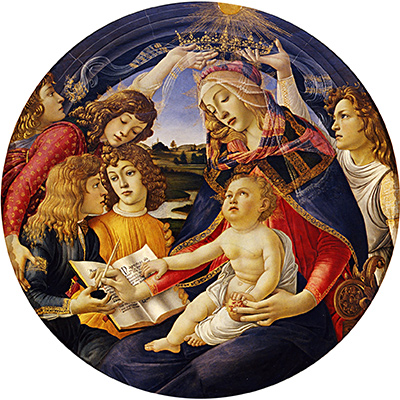
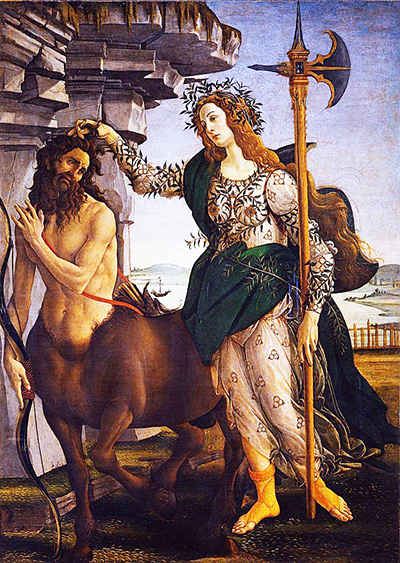
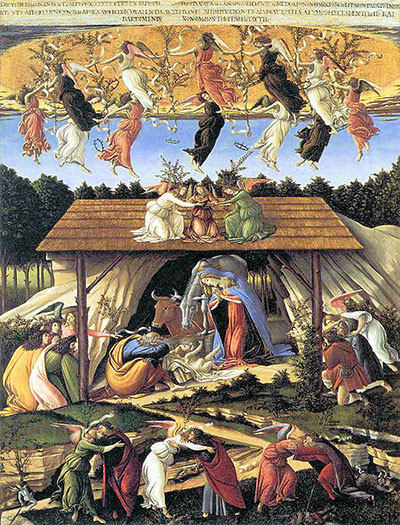
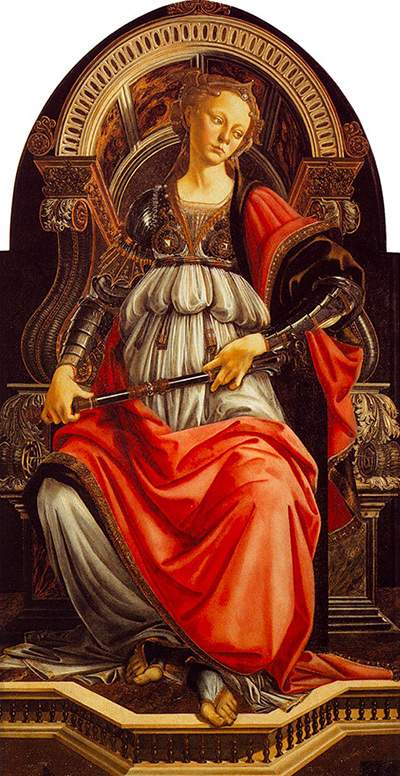
Where this work sits in Botticelli’s career
Fortitude
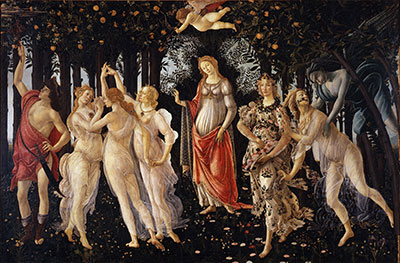
1470Primavera
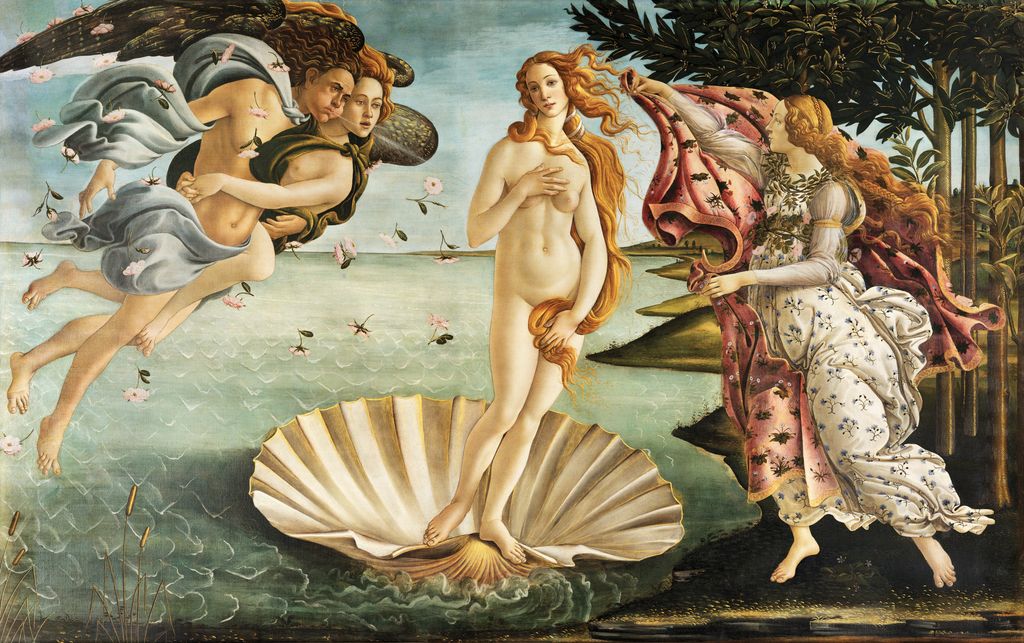
c. 1480The Birth of Venus
c. 1485Paradiso XXX
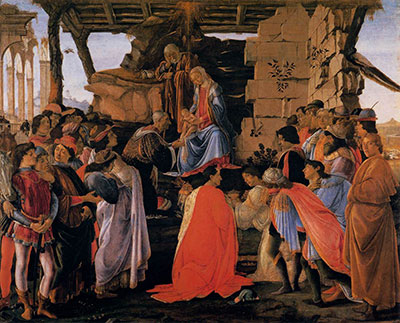
c. 1492–95The Mystical Nativity
c. 1500Contents
- Two Travelers in a Sea of Light
- The River and the Rose in Dante's Poem
- Reading the Different Kinds of Line
- One Canto within a Larger Project
The museum title, date, technique and measurements describe this particular sheet. In the poem the river later gives way to a vision of the heavenly rose. That later transformation is important context, but it should not be mistaken for an unmistakably finished rose in every mark of this drawing.[1][2]
Two Travelers in a Sea of Light
Dante and Beatrice are the largest legible forms. The figure at left extends his arm up and outward. Beatrice, at right, turns towards him, her robe opening into long, flowing contours. Their bodies are near the lower middle of the sheet rather than placed on solid ground. The viewer's eye follows the gestures and then the diagonal lines that carry both figures through the broad space.[1]
The space is not a conventional landscape with a distant horizon. Its diagonals and swirls suggest a current, while the light ground keeps the figures almost suspended. On the left, plants are rendered with curling stems, leaves and clustered blossoms. They supply a firm edge against which the central figures can be read. On the right, floral or cloud-like forms are faint and diffuse. The difference makes the two sides feel unequal without closing the space into a single perspective view.[1]
Small lively forms appear around the raised arm and the left-hand bank. Some are little winged bodies. Berlin's institutional account identifies them as cherubs representing the blessed, a pictorial answer to the living sparks that Dante describes moving between the luminous river and its flowered banks. The pale photograph still does not allow every tiny trace to be identified with certainty. This difference between poetic sparks and drawn figures makes the comparison between text and image more revealing.[1][2][4]
The figures' raised hands matter because they give scale and direction. Dante seems to reach or respond; Beatrice remains his companion and guide. There is no need to invent a conversation from their exact finger positions. The broad relationship between them is visible enough: two travelers confronting a scene whose forms are less stable than the places through which Dante has passed earlier.[1][2]
The River and the Rose in Dante's Poem
At the opening of the Empyrean, Dante's sight is strengthened for a new kind of vision. He sees a river of light between banks of flowers; sparks move out into the blossoms and return. After he looks into the river, its appearance changes, and he sees the blessed and angels in their fuller order. The University of Texas's Danteworlds account explains that the vision develops into the white rose of the blessed later in the same canto.[2]
Botticelli's drawing concentrates on the moment of passage. The river-like diagonals and flowered bank are readily apparent, especially when the image is enlarged. The later rose is part of the canto's unfolding language, but Berlin's current title points to the two figures in the light stream. This is an important distinction between an entire poem and the particular episode a drawing chooses to emphasize.[1][2]
Dante's own wording explains why that episode is difficult to freeze in an image. Beatrice tells him that the river, the jewels moving in and out of it, and the smiling plants are preliminary appearances of a reality his sight cannot yet bear. He must drink from the light stream before its forms become intelligible. A few lines later, Dante likens the change to people taking off masks: flowers and sparks give way to the revealed courts of heaven. Botticelli's pale field can be read as a response to this temporary, unstable first sight. The drawing is not an illustration of a fixed heavenly river existing independently of Dante's vision; it pictures a stage in the pilgrim's adjustment. That reading follows the sequence of Paradiso XXX, not a surviving statement of the artist's intention.[2][5]
The transformation also explains why a literal topographical reading is inadequate. The poem's light first looks like water and flowers, then changes as Dante becomes able to see more. The drawing holds that unstable first appearance. Its thin lines can suggest a place made of radiance while still giving the eye recognizable forms: people, vegetation and a route forward.[1][2]
Beatrice's role is essential to this stage of the journey. She has guided Dante through Paradise, and here she remains beside him as the scene passes beyond ordinary bodily scale. Danteworlds places the arrival in the Empyrean beyond time and space, with the river and rose as successive forms of vision. Botticelli keeps Beatrice visible at the centre of that transition rather than replacing the scene with an abstract diagram.[1][2]
Reading the Different Kinds of Line
Berlin lists metalpoint and brown pen as the media. In the museum photograph, some brown contours—particularly on the figures and left bank—are much stronger than the near-invisible structure above and to the right. A viewer who glances only at the most emphatic lines will see two figures among plants. A closer view reveals the larger, paler field around them.[1]
The visual imbalance is productive. The well-defined left bank offers a starting point; the lighter right-hand forms let the eye travel into an area that resists instant naming. The sheet does not have to be described as a finished monochrome picture to be compelling. Its material traces make the act of looking gradual, which suits a passage in which sight itself changes.[1][2]
The full parchment measures 47 centimetres wide and 32.2 high. Its landscape format gives room for the two figures to be held inside an environment rather than simply set before a backdrop. The museum's image includes the sheet border; a small reproduction may crop or compress the faint areas. Opening the institution's full-size image makes the marks along the river and at the right much easier to examine.[1]
One should still separate what a digital image shows from what a material examination would settle. A photograph can reveal line and composition, but it cannot establish every sequence of mark-making or prove why one passage was retraced and another left pale. Berlin's stated medium and date provide the dependable object facts; the shifting visual effect is available to any close viewer.[1]
One Canto within a Larger Project
Botticelli made this sheet for an extensive cycle of Dante drawings. Berlin's institutional account describes the series as a late fifteenth-century effort to translate the poem's world into parchment images. Other sheets represent Inferno's crowded and sharply bounded spaces or Purgatory's terraces. This Paradiso page works with a different problem: how to give form to a place Dante describes through light, flowers and changing sight.[1][3]
Berlin's account records the 1882 acquisition of 85 Dante drawings from the Hamilton collection. That later history explains their presence together in the Kupferstichkabinett. It does not establish the original arrangement of every sheet or the precise working order in Botticelli's studio. This drawing is securely identified by its present inventory and its relation to Paradiso XXX.[1][3]
The next canto moves further into the rose and brings a change in Dante's guidance. Those later developments should not swallow this particular drawing. Here the two travelers remain side by side, and the river of light is still the central visual event. The figure with the extended arm and the flowered bank offer an entry point into an image whose pale surroundings take longer to appear.[1][2]
Berlin's account adds that Botticelli did not depict the divine light of the poem's final canto: a blank sheet once stood at the end of the sequence and was lost around 1900. That is evidence about the cycle's later survival, not proof that this Paradiso XXX page was meant to carry the entire ending. Its delicate river scene still belongs to an earlier threshold in Dante's account.[2][4]
Look again at the span between Dante's raised hand and the upper field of the sheet. A few faint lines turn that open parchment into a current and a space to move through. Botticelli asks the viewer to do some of the same work as the pilgrim: follow a guide, let the eye adjust, and discover that the scene contains more than its first visible outline.[1][2]
Botticelli and related artworks
Discussion
Look again at the details and evidence discussed above. Which part of the drawing changes most when you know its history?
These prompts invite close looking and source-led questions rather than a single settled interpretation.
Reader Insights
Which lines first make the light stream visible around the two figures?
How does the drawing differ from the later rose vision in the same canto?
What does enlargement reveal in the pale right-hand part of the sheet?
Join the Conversation
Share an observation or question about the drawing below.
References
- Staatliche Museen zu Berlin, Kupferstichkabinett, “La Divina Commedia, Paradiso XXX: Dante und Beatrice im Lichtstrom,” inv. Botticelli, Paradiso 30, current collection record updated 12 August 2026, accessed 29 September 2026 View source.
- University of Texas at Austin, Danteworlds, “Empyrean,” commentary on Paradiso XXX–XXXIII, accessed 29 September 2026 View source.
- Kupferstichkabinett, Staatliche Museen zu Berlin, “La Divina Commedia, Purgatorio X,” institutional Dante-cycle account on Google Arts & Culture, accessed 29 September 2026 View source.
- Staatliche Museen zu Berlin, “Botticelli Featuring Dante,” institution-authored exhibition story on Google Arts & Culture, accessed 29 September 2026 View source.
- Dante Alighieri, Paradiso XXX, original Italian text, especially lines 61–93, and Henry Wadsworth Longfellow's translation, both directly consulted 1 October 2026; the image sequence supplies a primary comparison with the Berlin drawing, not evidence of Botticelli's precise intention View source View source.
- Image credit. Sandro Botticelli, Paradiso XXX, about 1492–95, Staatliche Museen zu Berlin, Kupferstichkabinett, inv. Botticelli, Paradiso 30. Photo: Philipp Allard. Public Domain Mark 1.0. View the full-size museum image View source · View source · View source.