

 Buy Art Prints Now
from Amazon
* As an Amazon Associate I earn from qualifying purchases.
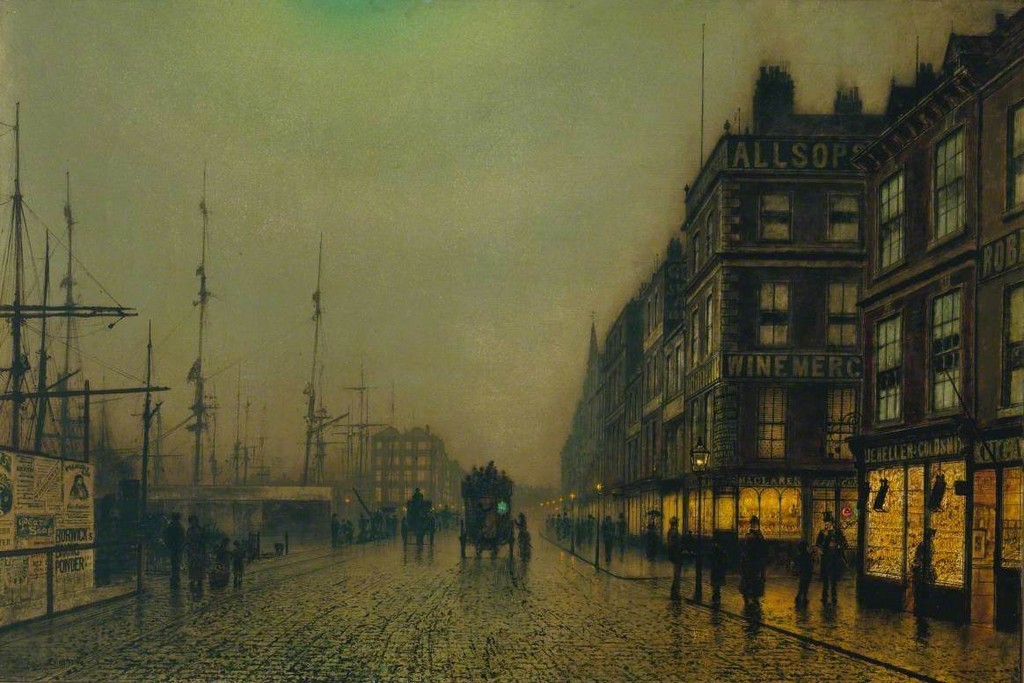
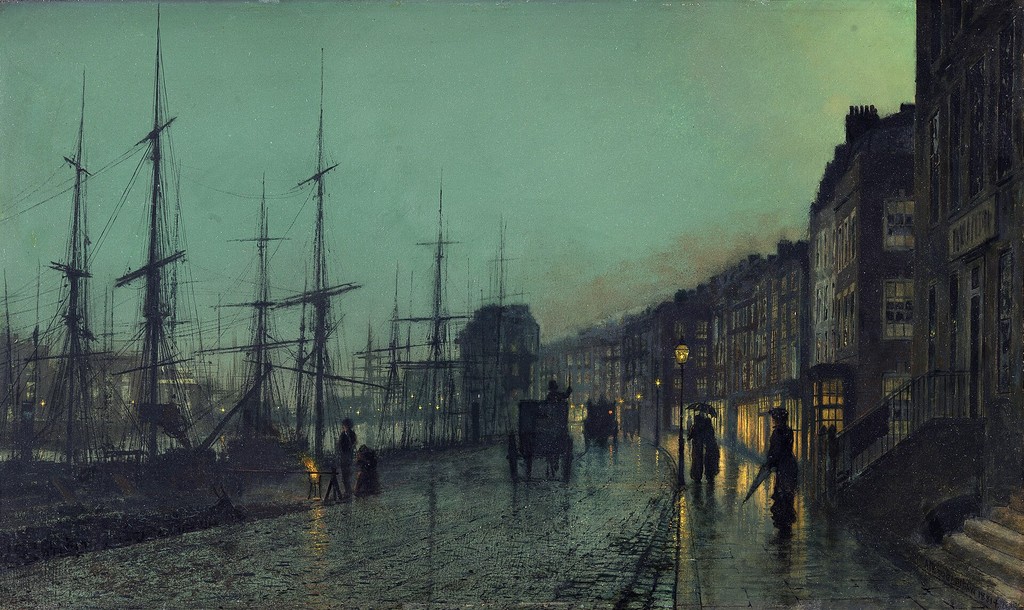
Shipping on the Clyde, 1881 — Carmen Thyssen Collection, public domain.
 by Tom Gurney
Tom Gurney BSc (Hons) is an art history expert with over 20 years experience
Page Created: August 31, 2026 / Page Updated: September 16, 2026
Email: tomgurney1@gmail.com / Phone: +44 7429 011000
John Atkinson Grimshaw: Ports and Docklands: Introduction
John Atkinson Grimshaw’s ports are places of trade seen through unstable light. Ships, warehouses, streets and vehicles identify working environments, while fog, rain and reflection soften their practical edges. Liverpool, Glasgow and Hull do not form one generic “harbour” in his art. Liverpool often joins the quay to a straight commercial street; Glasgow brings the Clyde’s maritime economy into view; Hull survives in a thinner record of named dock scenes. Together they show how Grimshaw could make industrial Britain both recognisably modern and deliberately poetic.[1][2]
At a Glance
- Principal portsLiverpool, Glasgow and Hull
- Related Yorkshire harboursScarborough and Whitby
- Recurring infrastructureQuays, docks, warehouses, ships, roads and lamps
- Human activityDock workers, pedestrians, drivers and fishing communities
- Characteristic conditionsMoonlight, fog, rain, wet paving and reflected artificial light
- Key objectShipping on the Clyde (1881), Carmen Thyssen-Bornemisza Collection
Contents
- Introduction
- Ports as Modern Landscapes
- Liverpool: The Quay as Street
- Glasgow: Commerce on the Clyde
- Hull: A More Cautious Record
- Labour, Transport and Scale
- Fog, Gaslight and Reflections
- Fishing Harbours and Commercial Docks
- Repetition without Sameness
Ports as Modern Landscapes
Grimshaw expanded his subjects in the later 1870s and early 1880s to include city streets, rivers and docksides. Scarborough Museums and Galleries connects that development to commercial pressure and to his ability to adapt subjects for buyers. Its guide names Glasgow and Hull among the modern cities he treated, while the Museo Thyssen-Bornemisza biography identifies Glasgow, Liverpool, Scarborough and Whitby among his frequent urban or port locations.[1][2]
These pictures are landscapes, but their geography is built by commerce. A quay establishes an edge between road and water; masts and rigging indicate shipping; warehouses and shopfronts place exchange close to the route of arrival. Grimshaw did not have to show cargo being unloaded in detail for trade to shape the scene. A roadway leading beside vessels, a cluster of lamps or a worker waiting near the dock can make movement and labour present.
That approach also separates this theme from the metropolitan focus of London and the Thames. Both groups use water and reflection, but the port paintings repeatedly emphasise the junction of shipping, warehouses and streets. The dock is not merely a distant view. It is the structure around which the picture’s movements are organised.
Liverpool: The Quay as Street
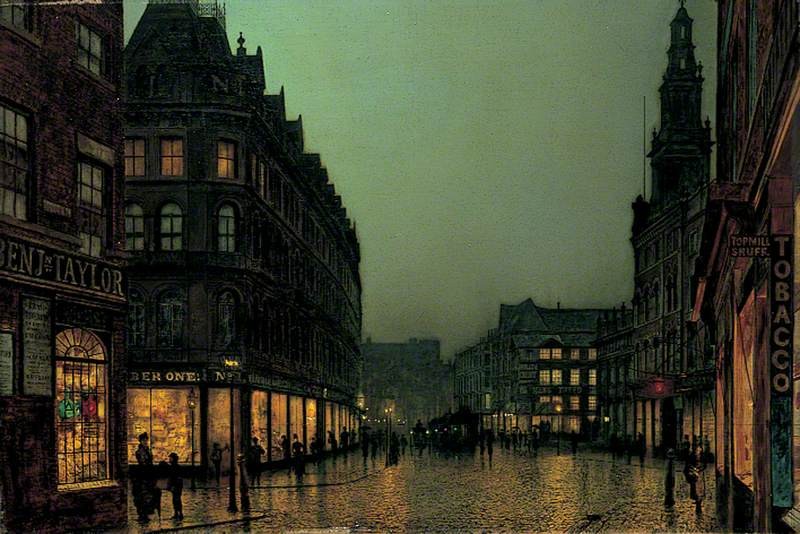
Tate dates Liverpool Quay by Moonlight to 1887. Its account calls attention to the golden glow from shopfronts, fog, wet cobbles and an omnibus receding along a straight street.[4] The painting therefore treats Liverpool’s quay as an urban corridor as well as a waterfront. Buildings make one side of the route; vessels and dock structures press upon the other; transport travels between them.
In a close-looking observation, the straight recession matters because it pulls the eye past pedestrians and vehicles rather than letting it rest on a single ship. The quay reads as a channel through which people, goods and light may pass. Warm shop windows offer points of orientation, yet reflected illumination breaks apart on the road. The modern city is visible without becoming fully stable.
Grimshaw returned to Liverpool in multiple titles recorded by the researched census: Liverpool Docks, Liverpool Docks by Night, Salthouse Dock, Liverpool and views of the Custom House appear alongside Liverpool Quay by Moonlight.[5] Those records vary in date and specificity. They establish recurrence, not a complete sequence or proof that every similarly titled object has been correctly identified.
Glasgow: Commerce on the Clyde
Shipping on the Clyde provides the strongest exact-object anchor for Glasgow. The Museo Nacional Thyssen-Bornemisza records the work as an 1881 oil on cardboard, measuring 30.5 by 51 centimetres, in the Carmen Thyssen-Bornemisza Collection, inventory CTB.1989.28.[3] The collection record interprets Victorian port scenes as lyrical responses to the industrial age, but it also identifies concrete labour: two dock workers warm themselves beside a small fire at the edge of the road.
The museum places that moment within the Clyde’s history as a route for imports, re-export and shipbuilding. Its interpretation notes the expansion of Glasgow’s population with opportunities created by docks and railways.[3] Grimshaw’s picture does not inventory that system. Instead, it compresses large-scale commerce into a damp street where a few human figures, ships and scattered sources of light imply the wider network.
Close looking distinguishes the material effects from the historical account. Pinpoint lights puncture the grey atmosphere, and the workers’ fire makes warmth local rather than general. The road, river air and vessels remain cool and misted. This contrast turns an economic setting into an immediate bodily one: industry is encountered as wetness, cold, waiting and brief heat. The dedicated object guide examines those relationships at full length.
Hull: A More Cautious Record
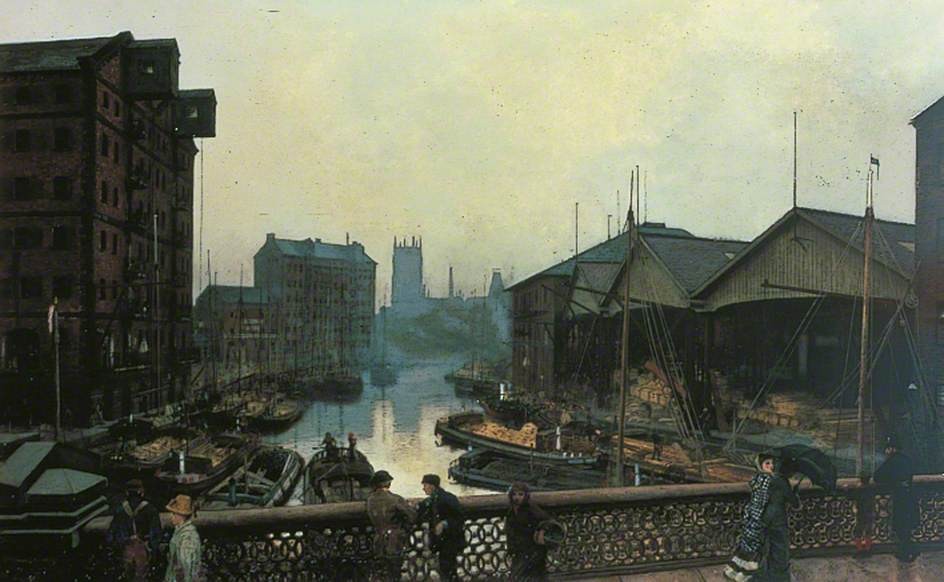
Hull must be treated differently because the locked evidence is less object-specific. Scarborough Museums includes Hull among the modern urban subjects Grimshaw adopted and also groups it with the fishing ports that allowed him to study light on water.[1] The online works census supplies two relevant titles, Evening Scene by the Docks, Hull and Princes Dock, Hull, but neither record provides a secure date in the current snapshot.[5]
Those limits are meaningful. It is safe to say that Hull formed a distinct subject within Grimshaw’s port practice; it is not safe to manufacture a chronology, collection history or visual reading that the locked records do not support. Liverpool has a Tate object record and Glasgow has a detailed Thyssen interpretation. Hull, by contrast, remains a documented strand awaiting stronger exact-object research.
The difference prevents the three cities from being flattened into one narrative. Liverpool can be examined through the relation between quay and shopping street. Glasgow can be tied to the Clyde and a documented scene of dock labour. Hull demonstrates how a broad artist survey should disclose gaps as carefully as it presents well-supported works.
Labour, Transport and Scale
Grimshaw’s dockside figures are usually small relative to the streets, ships and buildings around them. Small scale does not make labour absent. In Shipping on the Clyde, the museum specifically identifies two workers beside a fire.[3] In Tate’s description of Liverpool Quay by Moonlight, the receding omnibus makes public transport part of the quay’s spatial order.[4] Scarborough’s institutional guide also describes fishing-port paintings as views of modern, everyday working landscapes and their people.[1]
A close-looking approach asks what those figures do within the composition before assigning them symbolic roles. A person may establish the width of a road, interrupt a reflection or mark the distance between foreground and ship. Workers and travellers are not individualised portraits, but neither are they dispensable decoration. Their bodies measure environments built for goods and vehicles on a much larger scale.
For comparison, Leeds and Yorkshire follows inland industry, homes and coastal residence, while the paintings and artworks hub places docks beside landscapes, interiors and figure subjects. These contexts show that Grimshaw’s industrial imagery developed within a broader practice rather than as a separate documentary project.
Fog, Gaslight and Reflections
Light gives the port scenes their coherence. The Thyssen curator identifies moonlight, shop lighting, street lamps, vehicle lamps and a small fire as separate sources capable of producing different reflections on wet surfaces.[3] Tate’s Liverpool account similarly emphasises shopfront glow passing through fog and returning from wet cobbles.[4] These are not interchangeable effects: a lamp fixes a point, fog enlarges or muffles it, and water or rain carries it across another plane.
The moonlight and nocturnes guide examines darkness as a broader pictorial system. At a dock, however, light also locates activity. A shop remains open, a vehicle moves along a route, a signal or fire answers an immediate need. Atmosphere can make the place feel remote from ordinary time while the scattered lights insist that work and movement continue.
This double character helps explain the pictures’ appeal. Scarborough Museums describes Grimshaw’s urban scenes as modern subjects given a poetic, seemingly timeless appearance, and connects his repeated nocturnes to a market among Victorian middle-class buyers.[1] The paintings aestheticise industrial settings, but their lamps, streets and vessels keep the modern city embedded in the view.
Fishing Harbours and Commercial Docks
Scarborough and Whitby broaden the port theme beyond Liverpool, Glasgow and Hull. Grimshaw moved his family to Scarborough in 1876, and the museum guide states that he developed his moonlight technique there by studying light on water. It dates his first known moonlight picture of Whitby Harbour to 1867, before that residence.[1] Coastal experience therefore connects an early nocturne experiment with a later period of concentrated harbour painting.
The guide’s discussion of ‘Burning Off’, a Fishing Boat at Scarborough identifies a harbour flare used to warn fishing boats in dangerous conditions. That functional light differs from a shop window or decorative street lamp even when all contribute to nocturnal atmosphere.[1] Fishing harbours involve local practices, weather and coastal risk; the larger commercial docks foreground urban transport and trade. Grimshaw could poeticise both without erasing their different purposes.
Repetition without Sameness
Institutional accounts note that the success of Grimshaw’s nocturnes encouraged him to repeat related scenes.[1] In dock subjects, recurrence may involve a long road, silhouetted masts, a low luminous sky and points of reflected light. These elements create family resemblance, but location and infrastructure alter their meaning. An omnibus on a Liverpool quay, workers beside a Clyde fire and an undated Hull dock title belong to different evidential and geographic contexts.
The technique, light and photography essay considers how repeated structures might have been planned, while keeping any photographic aid evidence-qualified. On this page, the safer conclusion is visual and documentary: Grimshaw developed adaptable arrangements for port subjects, and current museum records let us compare some instances more closely than others. Repetition should prompt exact-object checking, not automatic assumptions that two related titles describe the same painting.
Researched works directory
This searchable evidence census contains 88 distinct records assembled from public collection data and a reproducible Wikidata snapshot. It is not a catalogue raisonné, not a claim of complete oeuvre coverage, and it keeps works with repeated titles as separate objects.
| Name | Date | Medium |
|---|---|---|
| A Dead Linnet | 1862 | Painting |
| A House in a Clearing | 1870 | Painting |
| A Moonlit Evening | 1880 | Painting |
| A Moonlit Lane | 1874 | Painting |
| A Mossy Glen | 1864 | Painting |
| A View of Hampstead, London | 1882 | Painting |
| A Wooded Valley | Date unknown | Painting |
| A Yorkshire Home | 1878 | Painting |
| An Autumn Idyll | 1885 | Painting |
| Autumn Glory: The Old Mill | 1869 | Painting |
| Autumn Regrets | 1882 | Painting |
| Baiting the Lines, Whitby | 1884 | Painting |
| Boar Lane, Leeds | 1881 | Painting |
| Bowder Stone, Borrowdale | 1865 | Painting |
| Briggate, Leeds | 1891 | Painting |
| 'Burning Off', a Fishing Boat at Scarborough | 1877 | Painting |
| Canny Glasgow | 1887 | Painting |
| Evening Glow | 1884 | Painting |
| Evening Scene by the Docks, Hull | Date unknown | Painting |
| Fiamella | 1883 | Painting |
| Glasgow Docks | 1886 | Painting |
| Gloucester Docks | 1885 | Painting |
| Golden Visions | 1870 | Painting |
| Greenwich, Half Tide | 1884 | Painting |
| In Peril (The Harbour Flare) | 1879 | Painting |
| In the golden gloaming | Date unknown | Painting |
| In the Golden Mists of Autumn | 1884 | Painting |
| In the Golden Olden Times | 1870 | Painting |
| Ingleborough from under White Scar, Yorkshire Limestone Strata | 1868 | Painting |
| Iris | 1886 | Painting |
| Knostrop Old Hall at Dusk | 1870 | Painting |
| Leeds Bridge | 1880 | Painting |
| Lights in the Harbour, Scarborough | 1879 | Painting |
| Liverpool Docks | 1892 | Painting |
| Liverpool Docks by Night | 1892 | Painting |
| Liverpool Docks (panel 1 of 5) | Date unknown | Painting |
| Liverpool Docks (panel 2 of 5) | Date unknown | Painting |
| Liverpool Docks (panel 3 of 5) | Date unknown | Painting |
| Liverpool Docks (panel 4 of 5) | Date unknown | Painting |
| Liverpool Docks (panel 5 of 5) | Date unknown | Painting |
| Liverpool Quay by Moonlight | 1887 | Painting |
| Moonlight Scene near Leeds | 1881 | Painting |
| Night Scene, Rouen | 1893 | Painting |
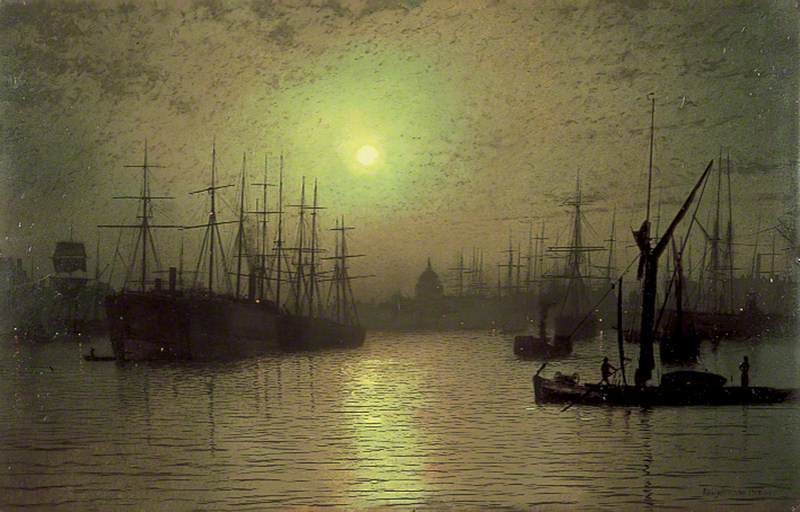
| Nightfall down the Thames | 1880 | Painting |
| Nightfall in Scarborough Harbour, North Yorkshire | 1884 | Painting |
| November Morning, Knostrop Hall, Leeds | 1883 | Painting |
| Old English House by Moonlight | Date unknown | Painting |
| Park Row, Leeds | 1882 | Painting |
| Princes Dock, Hull | Date unknown | Painting |
| Quai de Paris, Rouen | 1893 | Painting |
| Reflections on the Thames, Westminster | 1880 | Painting |
| Reflections on the Thames, Westminster, London | 1880 | Painting |
| Roundhay Park Lake | Date unknown | Painting |
| Salthouse Dock, Liverpool | Date unknown | Painting |
| Salthouse Dock, Liverpool, 1884 | Date unknown | Painting |
| Scarborough Lights | 1877 | Painting |
| Shipping on the Clyde | 1881 | Painting |
| Sic transit gloria mundi (The Burning of the Spa Saloon) | 1876 | Painting |
| Silver Moonlight | 1880 | Painting |
| Silver Moonlight | 1886 | Painting |
| Snow and Mist (Caprice in Yellow Minor) | 1892 | Painting |
| Stapleton Park, near Pontefract | Date unknown | Painting |
| Sunday Night, Knostrop Cut, Leeds | 1893 | Painting |
| Thames Moonlight | 1880 | Painting |
| The Custom House, Liverpool, Looking North | Date unknown | Painting |
| The Custom House, Liverpool, Looking South | Date unknown | Painting |
| The Harbour at Whitby by Moonlight | 1879 | Painting |
| The Head of Gertrude Grimshaw | 1874 | Painting |
| 'The Ironbound Shore' | 1869 | Painting |
| The Lady of Shalott | 1875 | Painting |
| The Parable of the Lost Sheep | Date unknown | Painting |
| The Rector's Garden, Queen of the Lilies | 1877 | Painting |
| The Seal of the Covenant | 1868 | Painting |
| The Sun's Farewell | Date unknown | Painting |
| The Thames by Moonlight with Southwark Bridge, London | 1884 | Painting |
| Thro' the Wood | Date unknown | Painting |
| Tree Shadows on the Park Wall, Roundhay, Leeds | 1872 | Painting |
| Under the Beeches | 1892 | Painting |
| Under the Silvery Moonbeams | Date unknown | Painting |
| View of Heath Street by Night | 1882 | Painting |
| View of Scarborough | 1876 | Painting |
| View of Southwark Bridge at Night | 1882 | Painting |
| Whitby | 1878 | Painting |
| Whitby Docks | 1876 | Painting |
| Whitby Harbor | 1874 | Painting |
| Windermere | 1863 | Painting |
| Woodland near Leeds | Date unknown | Painting |
| Yew Court, Scalby, near Scarborough | 1875 | Painting |
Frequently Asked Questions
Institutional sources identify Liverpool, Glasgow, Hull, Scarborough and Whitby among his port subjects. The current online census also includes docks at Gloucester and harbour or river scenes elsewhere, but it does not claim complete coverage.[1][2][5]
Shipping on the Clyde (1881) has a detailed museum record with medium, dimensions, collection and inventory number. The Thyssen curator also discusses its dock workers, multiple light sources and industrial setting.[3]
It is productively both. Tate’s account emphasises a quay, shopfronts, wet cobbles and an omnibus on a straight road, so commercial waterfront and city street share the composition.[4]
The locked sources confirm Hull as a Grimshaw subject and preserve two named dock records, but those records are undated and lack the detailed institutional interpretation available for Liverpool and Glasgow. The page therefore does not infer unsupported object histories.[1][5]
Discussion
Use this evidence-led guide as a starting point for close looking rather than a final verdict.
Share an observation about John Atkinson Grimshaw: Ports and Docklands or a source that adds useful context.
Reader Insights
Which work most clearly complicates the familiar label of painter of moonlight?
Where do place, market, family or literary culture most productively alter your reading?
Which source or surviving object would you investigate next?
Join the Conversation
Add your reading below, keeping observations specific and evidence clear.
References
- Scarborough Museums and Galleries, Atkinson Grimshaw: At Home in Yorkshire, accessed 31 August 2026.
- Museo Nacional Thyssen-Bornemisza, John Atkinson Grimshaw, accessed 31 August 2026.
- Museo Nacional Thyssen-Bornemisza, Shipping on the Clyde, accessed 31 August 2026.
- Tate, Liverpool Quay by Moonlight, accessed 31 August 2026.
- Wikidata, John Atkinson Grimshaw, accessed 31 August 2026.