

 Buy Art Prints Now
from Amazon
* As an Amazon Associate I earn from qualifying purchases.
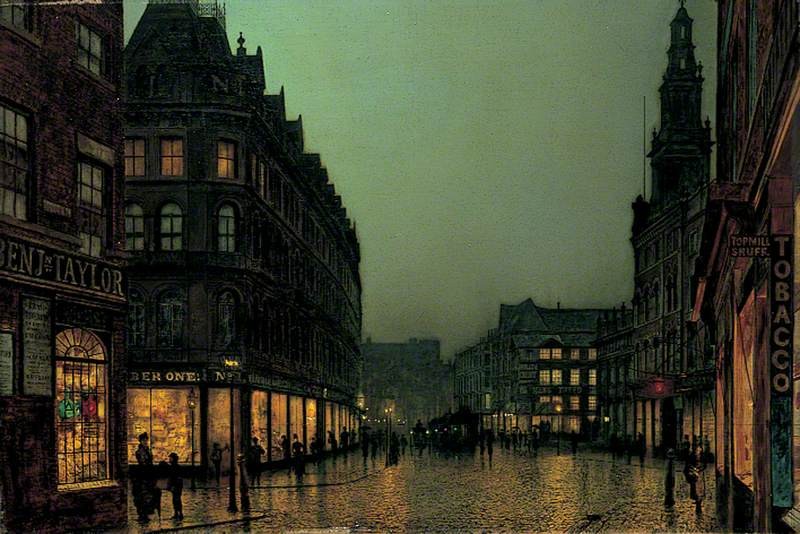
Boar Lane, Leeds, c.1879 — Leeds Art Gallery, public domain.
 by Tom Gurney
Tom Gurney BSc (Hons) is an art history expert with over 20 years experience
Page Created: August 31, 2026 / Page Updated: September 16, 2026
Email: tomgurney1@gmail.com / Phone: +44 7429 011000
Boar Lane, Leeds: Introduction
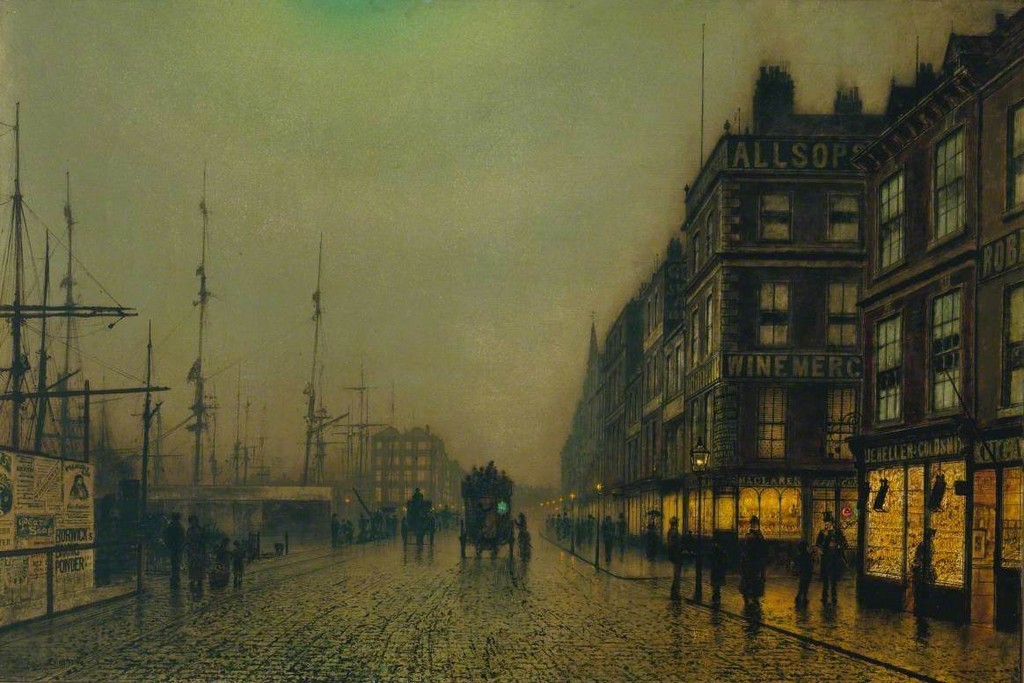
In Boar Lane, Leeds, c.1879, John Atkinson Grimshaw turns a central commercial street into an encounter between traffic, pedestrians, shop windows and damp evening air. The road is recognisable as part of the modern city, but light prevents it from behaving like a neutral record. Warm interiors shine into the street, figures become silhouettes, and the long perspective draws ordinary movement towards an uncertain distance. The painting is both local and constructed: a Leeds subject organised through the visual language that made Grimshaw’s urban nights distinctive.[1][3]
At a Glance
- ArtistJohn Atkinson Grimshaw (1836–1893)
- Public display title and dateBoar Lane, Leeds, c.1879
- MediumOil on canvas
- Dimensions61.2 × 91.6 cm
- CollectionLeeds Art Gallery, Leeds Museums and Galleries
- AccessionLEEAG.PA.2000.0017
John Atkinson Grimshaw in context
Contents
- Introduction
- Exact Object Record
- A Commercial Street after Dark
- Perspective and the Moving Crowd
- Moonlight and Shop Light
- Wet Ground as an Active Surface
- Modern Leeds and Selective Evidence
- Sharp Detail and Atmospheric Distance
- Why the Painting Matters
Exact Object Record
The work treated here is Boar Lane, Leeds, publicly dated about 1879, an oil on canvas measuring 61.2 centimetres high by 91.6 centimetres wide. Leeds Art Gallery catalogues the canvas under accession LEEAG.PA.2000.0017.[1][2]
One structured image record derived from the Art UK object assigns the year 1881.[2] The public date remains c.1879 because the available records differ; the qualification acknowledges that disagreement without pretending to resolve it. Title, medium, dimensions, collection and accession number are consistent, so the date variance does not undermine the object’s identity.[1][2]
This distinction matters because Grimshaw returned to related urban motifs. A shared place-name or similar street arrangement is not enough to merge records. Exact dimensions and collection data keep this Leeds Art Gallery canvas separate from other versions or treatments of Boar Lane.
A Commercial Street after Dark
Boar Lane was part of the city Grimshaw knew throughout his career. The Thoresby Society places his upbringing and working life within Leeds and identifies Boar Lane and Park Row among the familiar streets he transformed through night effects.[4] Leeds Museums’ recent exhibition likewise included depictions of both streets in its account of his “moonlights”.[3]
Close looking begins with the street’s mixed uses. Buildings present a repeated line of shopfronts and upper storeys, while pedestrians and wheeled traffic occupy the road. These elements identify a commercial thoroughfare rather than a deserted picturesque lane. Yet no single transaction or face becomes the narrative centre. The city is busy in aggregate: movement is distributed among small bodies, horses, vehicles and illuminated premises.
The Leeds and Yorkshire guide places Boar Lane beside Knostrop, suburban roads and river subjects. That range prevents one city-centre painting from standing for all of Grimshaw’s Yorkshire. Here, the distinctive subject is public circulation—people passing through a street shaped by retail and transport.
Perspective and the Moving Crowd
The broad canvas gives Grimshaw room to make the road a principal form. In a close-looking observation, the street narrows steadily towards the distance as building fronts reinforce its direction. Figures shrink along that route, while nearer vehicles interrupt the open surface. Scale therefore does more than create convincing depth; it arranges different speeds and degrees of visibility.
No pedestrian is large enough to become a portrait. Clothing and posture help distinguish bodies, but fading detail keeps them part of the street’s rhythm. The same is true of traffic. A carriage or cart can establish width, direction and activity without requiring a particular anecdote. Grimshaw makes a shared urban space legible through the relation among many minor presences.
This differs from the compressed solitude of some suburban lane scenes. The paintings and artworks overview sets those works beside streets, harbours and interiors. Boar Lane belongs to the denser end of that spectrum, where architecture and population compete for attention.
Moonlight and Shop Light
Leeds Museums interprets Grimshaw’s nocturnes through the meeting of moonlight with newer forms of artificial illumination. It argues that this conjunction reveals an artist engaged with the modern city rather than merely repeating Victorian nostalgia.[3] Boar Lane, Leeds makes that meeting especially clear because windows and lamps belong to the street’s commercial function.
In close-looking terms, the brightest areas do not illuminate everything evenly. A window produces a compact field of warmth; a lamp makes a point; the sky provides a broader, cooler radiance. Their effects spread across wet ground in broken passages rather than mirror-like copies. Darkness remains between the sources, so the viewer advances from one visible zone to another.
The moonlight and nocturnes essay follows this system across cities and ports. Boar Lane adds a particular emphasis: artificial light advertises occupied interiors while the street remains exposed to weather. The contrast separates private brightness from public movement even as reflections connect them.
Wet Ground as an Active Surface
Rain-darkened paving changes the lower half of the composition. Instead of serving as an empty base beneath buildings and figures, the street receives and disperses light. Near a bright shopfront, colour extends beyond the window; farther away, scattered accents help mark depth. The road becomes a second field of illumination, less stable than the architecture above it.
This is a close-looking description, not a claim that the picture reports one precisely documented shower. Moisture is inferred from the visible sheen and reflections. Grimshaw’s choice to emphasise it allows a relatively low-lit scene to remain readable while retaining the sensation of evening.
The effect also links Boar Lane to his river and harbour painting. Water, wet cobbles and mist all redistribute brightness, though each does so differently. Technique, Light and Photography examines those visual methods while keeping any proposed optical assistance evidence-qualified.
Modern Leeds and Selective Evidence
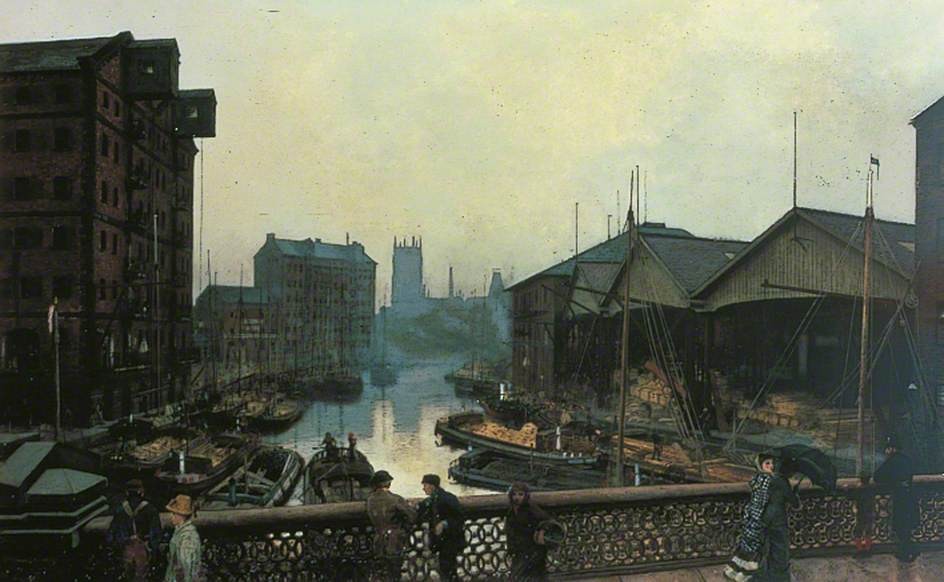
Another Grimshaw painting, Leeds Bridge (1880), helps establish the city’s industrial context. A Leeds Museums learning resource identifies warehouses, factory buildings, river transport and lifting equipment around that scene and asks viewers to consider both the activity shown and the harsher urban realities left outside the image.[5] That interpretive method is useful for Boar Lane too.
Shopfronts, traffic and pedestrians are evidence of city life, but the painting does not inventory wages, working conditions, crowd identities or every business on the road. Atmosphere regulates what remains visible. The scene can evoke commerce without explaining its social structures, and it can make wet streets beautiful without claiming that Victorian Leeds was comfortable or clean.
The Museo Thyssen-Bornemisza biography notes that Grimshaw’s urban moonlights brought him fame and that he worked primarily for private clients.[6] Boar Lane’s combination of recognisable place and controlled radiance helps explain that appeal. Buyers could encounter the modern city as a specific environment and as a poetic image at the same time.
Sharp Detail and Atmospheric Distance
Art UK characterises Grimshaw’s nocturnal townscapes by gaslight, wet streets, sharp focus and striking atmosphere.[1] In Boar Lane, Leeds, precision is not distributed equally. Nearby façades and vehicles can carry firmer edges, while recession, weather and low light simplify the farther street. The alternation lets accuracy and uncertainty coexist.
Close looking should therefore ask where detail is withheld as well as where it appears. A dark figure may be spatially exact but socially anonymous. A shop window may locate an interior without revealing its occupants. A building may be recognisable through its outline while its surface falls into shade. These choices keep the scene coherent without turning it into an architectural survey.
Claims about tools need more evidence than visual resemblance. A convincing vanishing route or seemingly photographic crop cannot by itself prove the use of a camera or lens. The painting securely demonstrates compositional control; the exact means by which every stage was prepared remain less certain.[3][6]
Why the Painting Matters
Boar Lane, Leeds condenses several of Grimshaw’s central concerns into one object: a named northern city, nocturnal movement, natural and artificial illumination, damp surfaces and a modern street made emotionally resonant. Its power does not depend on choosing between topography and atmosphere. Recognition gives the lights and figures civic weight, while pictorial organisation makes the location more than a document.
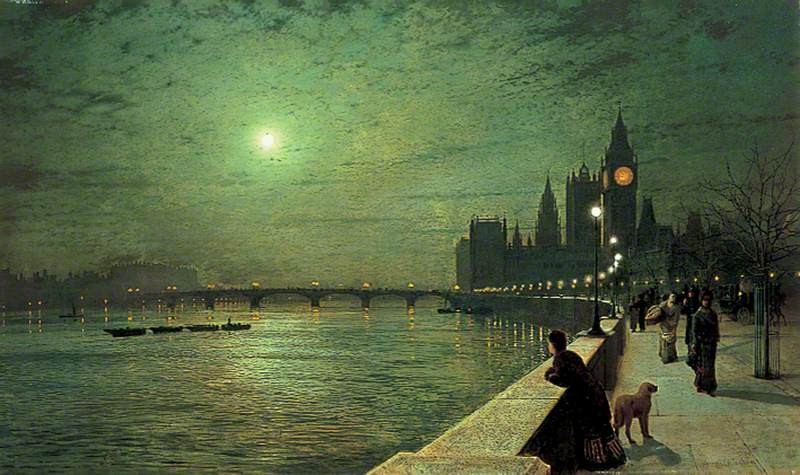
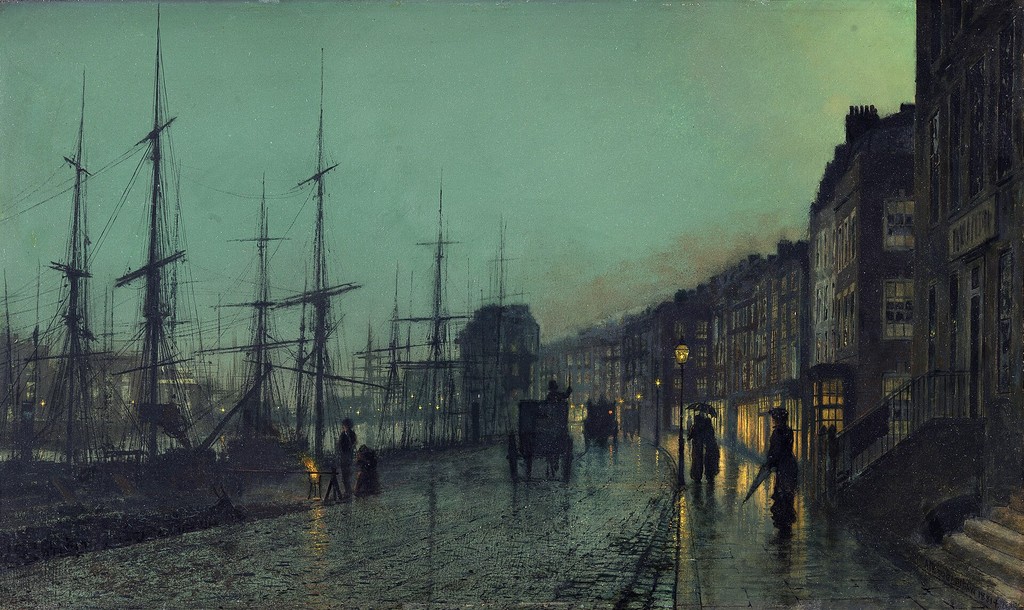
The canvas also provides a counterpoint to the cluster’s two other exact-object studies. Reflections on the Thames moves illumination onto a metropolitan river, while Shipping on the Clyde places workers and vessels within a Glasgow port. Boar Lane remains land-bound and densely commercial. Together, the works show how Grimshaw adapted night effects to different structures of urban life.
Its present place in Leeds Art Gallery completes that local relationship. The artist painted his home city; the city’s public collection now preserves the canvas under a distinct accession. The brief uncertainty around its year should remain visible, but it does not diminish the painting’s value as a securely identified Leeds object.
Researched works directory
This searchable evidence census contains 88 distinct records assembled from public collection data and a reproducible Wikidata snapshot. It is not a catalogue raisonné, not a claim of complete oeuvre coverage, and it keeps works with repeated titles as separate objects.
| Name | Date | Medium |
|---|---|---|
| A Dead Linnet | 1862 | Painting |
| A House in a Clearing | 1870 | Painting |
| A Moonlit Evening | 1880 | Painting |
| A Moonlit Lane | 1874 | Painting |
| A Mossy Glen | 1864 | Painting |
| A View of Hampstead, London | 1882 | Painting |
| A Wooded Valley | Date unknown | Painting |
| A Yorkshire Home | 1878 | Painting |
| An Autumn Idyll | 1885 | Painting |
| Autumn Glory: The Old Mill | 1869 | Painting |
| Autumn Regrets | 1882 | Painting |
| Baiting the Lines, Whitby | 1884 | Painting |
| Boar Lane, Leeds | 1881 | Painting |
| Bowder Stone, Borrowdale | 1865 | Painting |
| Briggate, Leeds | 1891 | Painting |
| 'Burning Off', a Fishing Boat at Scarborough | 1877 | Painting |
| Canny Glasgow | 1887 | Painting |
| Evening Glow | 1884 | Painting |
| Evening Scene by the Docks, Hull | Date unknown | Painting |
| Fiamella | 1883 | Painting |
| Glasgow Docks | 1886 | Painting |
| Gloucester Docks | 1885 | Painting |
| Golden Visions | 1870 | Painting |
| Greenwich, Half Tide | 1884 | Painting |
| In Peril (The Harbour Flare) | 1879 | Painting |
| In the golden gloaming | Date unknown | Painting |
| In the Golden Mists of Autumn | 1884 | Painting |
| In the Golden Olden Times | 1870 | Painting |
| Ingleborough from under White Scar, Yorkshire Limestone Strata | 1868 | Painting |
| Iris | 1886 | Painting |
| Knostrop Old Hall at Dusk | 1870 | Painting |
| Leeds Bridge | 1880 | Painting |
| Lights in the Harbour, Scarborough | 1879 | Painting |
| Liverpool Docks | 1892 | Painting |
| Liverpool Docks by Night | 1892 | Painting |
| Liverpool Docks (panel 1 of 5) | Date unknown | Painting |
| Liverpool Docks (panel 2 of 5) | Date unknown | Painting |
| Liverpool Docks (panel 3 of 5) | Date unknown | Painting |
| Liverpool Docks (panel 4 of 5) | Date unknown | Painting |
| Liverpool Docks (panel 5 of 5) | Date unknown | Painting |
| Liverpool Quay by Moonlight | 1887 | Painting |
| Moonlight Scene near Leeds | 1881 | Painting |
| Night Scene, Rouen | 1893 | Painting |
| Nightfall down the Thames | 1880 | Painting |
| Nightfall in Scarborough Harbour, North Yorkshire | 1884 | Painting |
| November Morning, Knostrop Hall, Leeds | 1883 | Painting |
| Old English House by Moonlight | Date unknown | Painting |
| Park Row, Leeds | 1882 | Painting |
| Princes Dock, Hull | Date unknown | Painting |
| Quai de Paris, Rouen | 1893 | Painting |
| Reflections on the Thames, Westminster | 1880 | Painting |
| Reflections on the Thames, Westminster, London | 1880 | Painting |
| Roundhay Park Lake | Date unknown | Painting |
| Salthouse Dock, Liverpool | Date unknown | Painting |
| Salthouse Dock, Liverpool, 1884 | Date unknown | Painting |
| Scarborough Lights | 1877 | Painting |
| Shipping on the Clyde | 1881 | Painting |
| Sic transit gloria mundi (The Burning of the Spa Saloon) | 1876 | Painting |
| Silver Moonlight | 1880 | Painting |
| Silver Moonlight | 1886 | Painting |
| Snow and Mist (Caprice in Yellow Minor) | 1892 | Painting |
| Stapleton Park, near Pontefract | Date unknown | Painting |
| Sunday Night, Knostrop Cut, Leeds | 1893 | Painting |
| Thames Moonlight | 1880 | Painting |
| The Custom House, Liverpool, Looking North | Date unknown | Painting |
| The Custom House, Liverpool, Looking South | Date unknown | Painting |
| The Harbour at Whitby by Moonlight | 1879 | Painting |
| The Head of Gertrude Grimshaw | 1874 | Painting |
| 'The Ironbound Shore' | 1869 | Painting |
| The Lady of Shalott | 1875 | Painting |
| The Parable of the Lost Sheep | Date unknown | Painting |
| The Rector's Garden, Queen of the Lilies | 1877 | Painting |
| The Seal of the Covenant | 1868 | Painting |
| The Sun's Farewell | Date unknown | Painting |
| The Thames by Moonlight with Southwark Bridge, London | 1884 | Painting |
| Thro' the Wood | Date unknown | Painting |
| Tree Shadows on the Park Wall, Roundhay, Leeds | 1872 | Painting |
| Under the Beeches | 1892 | Painting |
| Under the Silvery Moonbeams | Date unknown | Painting |
| View of Heath Street by Night | 1882 | Painting |
| View of Scarborough | 1876 | Painting |
| View of Southwark Bridge at Night | 1882 | Painting |
| Whitby | 1878 | Painting |
| Whitby Docks | 1876 | Painting |
| Whitby Harbor | 1874 | Painting |
| Windermere | 1863 | Painting |
| Woodland near Leeds | Date unknown | Painting |
| Yew Court, Scalby, near Scarborough | 1875 | Painting |
Frequently Asked Questions
The public display date used here is c.1879. A linked structured image record gives 1881, so the qualified date preserves the catalogue variance rather than forcing a false certainty.[1][2]
It is in Leeds Art Gallery, part of Leeds Museums and Galleries, with accession number LEEAG.PA.2000.0017.[1][2]
No. Close looking reveals several kinds of illumination, including windows and street lighting as well as the broader night sky. Leeds Museums treats that meeting of natural and artificial light as central to Grimshaw’s modernity.[3]
Discussion
Use this evidence-led guide as a starting point for close looking rather than a final verdict.
Share an observation about Boar Lane, Leeds or a source that adds useful context.
Reader Insights
Which visible detail most changes your reading of Boar Lane, Leeds?
How do medium, scale, setting and current museum evidence shape the encounter?
What remains uncertain once documented fact is separated from visual inference?
Join the Conversation
Add your reading below, keeping observations specific and evidence clear.
References
- Art UK, Boar Lane, Leeds, accessed 31 August 2026.
- Wikimedia Commons, exact file for Boar Lane, Leeds, Leeds Art Gallery, accessed 31 August 2026.
- Leeds Museums and Galleries, “Exhibition sheds new light on renowned Leeds artist John Atkinson Grimshaw”, accessed 31 August 2026.
- The Thoresby Society, “John Atkinson Grimshaw (1836–1893)”, accessed 31 August 2026.
- Leeds Museums and Galleries via MyLearning, “Leeds Bridge by John Atkinson Grimshaw”, accessed 31 August 2026.
- Museo Nacional Thyssen-Bornemisza, John Atkinson Grimshaw, accessed 31 August 2026.