

 Buy Art Prints Now
from Amazon
* As an Amazon Associate I earn from qualifying purchases.
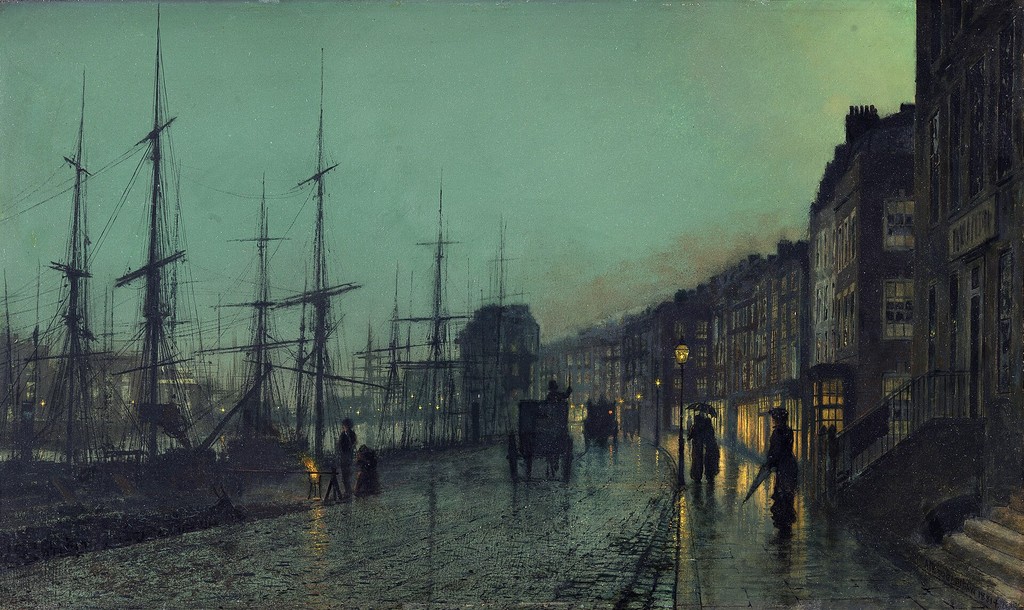
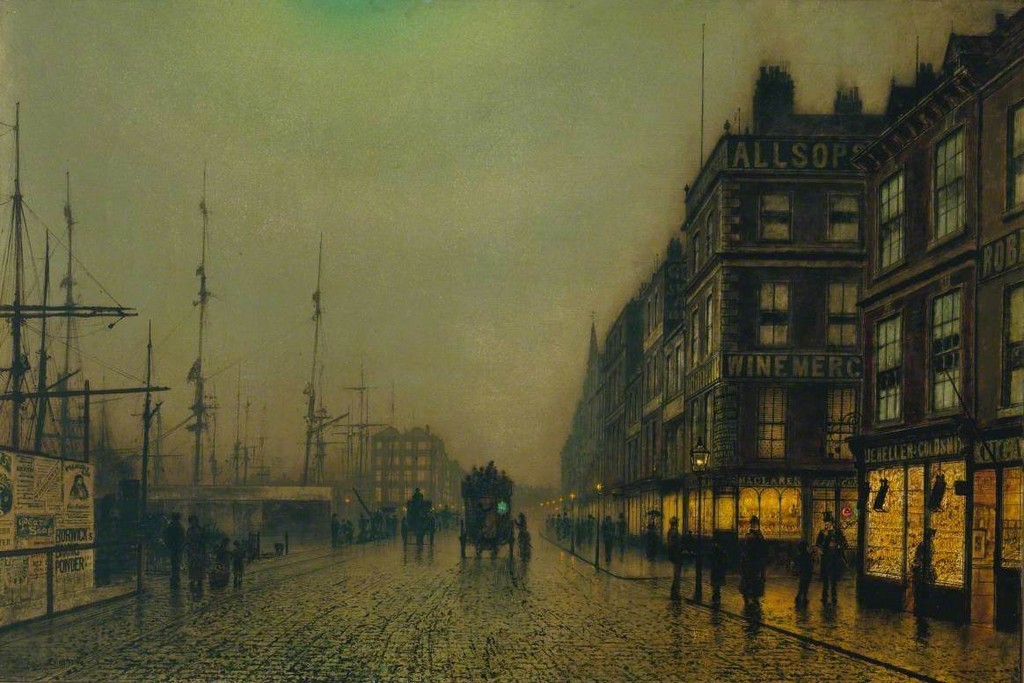
Liverpool Quay by Moonlight, 1887 — Tate, public domain.
 by Tom Gurney
Tom Gurney BSc (Hons) is an art history expert with over 20 years experience
Page Created: August 31, 2026 / Page Updated: September 16, 2026
Email: tomgurney1@gmail.com / Phone: +44 7429 011000
John Atkinson Grimshaw Moonlight and Nocturnes: Introduction
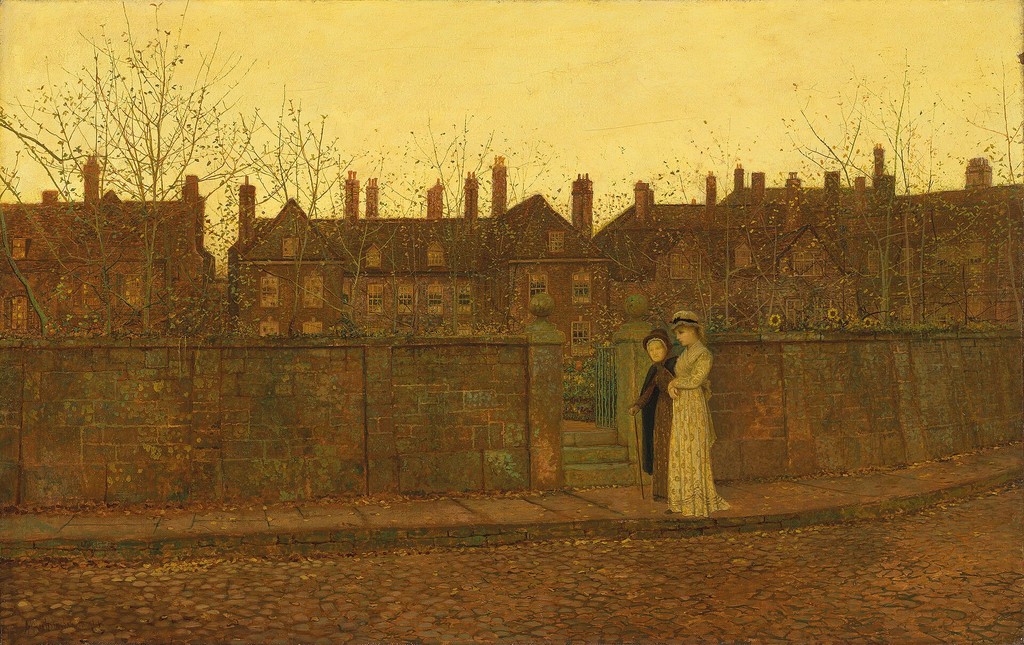
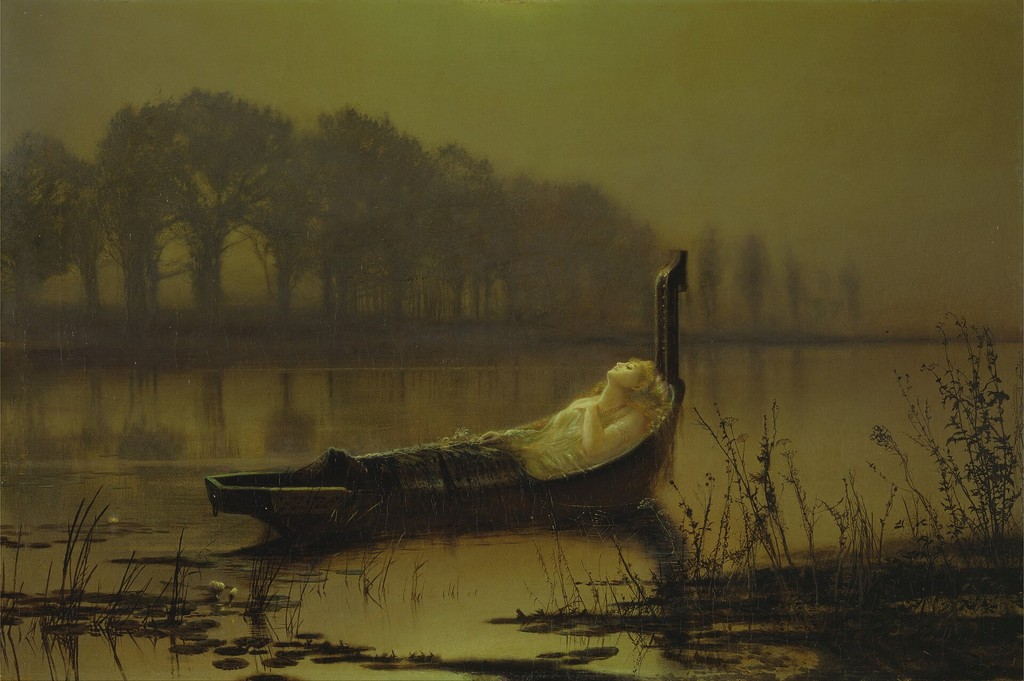
John Atkinson Grimshaw made night recognisable without making it ordinary. A pale moon, an illuminated window or the glow of a shopfront can be the brightest note in his paintings, yet the surrounding darkness remains full of information: branches cross the sky, façades recede, figures pass, and water or wet paving returns light in broken reflections. Grimshaw called such works his “moonlights”. They became his defining subject and established his reputation as one of Victorian Britain’s most distinctive painters of the hours after sunset.[1]
These scenes are not simply fantasies of old streets under a full moon. Their lamps, quays, warehouses, bridges and traffic belong to an industrialising society. Grimshaw repeatedly brought natural and artificial light into the same image, finding poetry in places shaped by commerce and new urban infrastructure. His nocturnes can therefore feel suspended between stillness and activity, memory and modernity. They are best understood through the places he knew, the effects he observed and the pictorial choices with which he transformed them.
At a Glance
- First known moonlightA view of Whitby Harbour painted in 1867[2]
- Principal settingsLeeds, Scarborough, Whitby, Liverpool, Glasgow, Hull and London[3]
- Recurring lightMoonlight set against lamps, windows, shopfronts, flames and reflections
- Visual hallmarksBare branches, still skies, receding roads, dark silhouettes and luminous surfaces
- Typical human presenceSmall walkers, workers, vehicles and solitary figures rather than large crowds
- Central tensionCarefully shaped atmosphere drawn from the modern Victorian city and port
Contents
- Introduction
- Making moonlight a subject
- Moonlight meets artificial light
- How darkness stays legible
- The modern city after sunset
- Fog, wet stone and reflected light
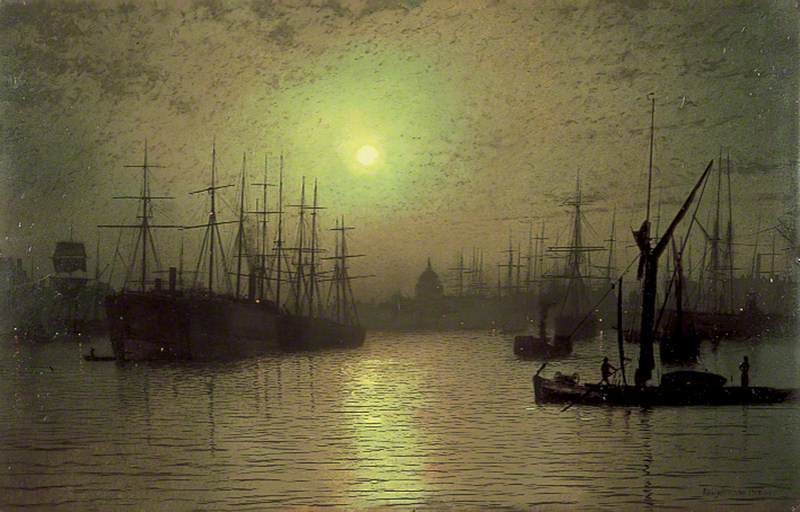
- Harbours, rivers and working water
- London and the Thames
- Figures at the edge of the light
- Repetition, demand and invention
Making moonlight a subject
Grimshaw did not begin his career as a specialist in nocturnes. His early work drew on close natural observation and the detailed methods associated with Pre-Raphaelite painting. The institutional chronology published by Scarborough Museums identifies 1867 as the year of his first known moonlight scene, set at Whitby Harbour.[2] That coastal beginning matters. Moonlight was not initially detached from place: it was an effect encountered above water, vessels and the built edge of a working town.
During the 1870s, moonlight became increasingly central to his practice. Scarborough offered sustained opportunities to study light across sea and harbour, while Leeds provided river, street and industrial subjects. The Scarborough guide notes that the popularity of these scenes led him to revisit related arrangements.[2] A harbour flare, a distant lamp or a bright moon could each reorganise the relationship between darkness, distance and movement.
For the geographic foundations of this development, see Leeds and Yorkshire. The broader career sequence is set out in the biography.
Moonlight meets artificial light
The word “moonlight” can disguise how many kinds of illumination Grimshaw placed in a single scene. The moon may establish the painting’s cool overall radiance, while windows and street lamps punctuate it with warmer points. Shopfronts spread light horizontally across a pavement; harbour flames and signals interrupt the dark near water; reflections make a source appear again in altered form.
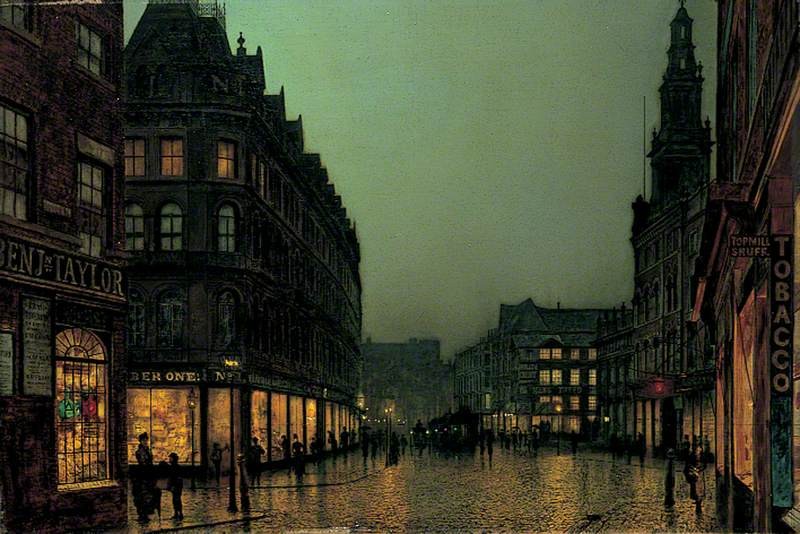
Leeds Museums and Galleries stresses this conjunction of moonlight with new forms of artificial lighting when interpreting Grimshaw as a painter of modern urban experience.[1] The result is more complex than a contest between nature and technology. In his nocturnes, the two can seem to collaborate. Moonlight gives the street a broad tonal unity, while human-made light identifies doors, businesses, vehicles and routes. The city is quiet, but it is not switched off.
How darkness stays legible
Grimshaw’s darkness is rarely an empty field. Close looking shows a sequence of tonal steps rather than a single black mass. A façade may be darker than the sky but lighter than a doorway; a tree trunk may first merge with a building and then separate where it crosses the moon. Small changes in value allow the viewer to read deep space without the clarity of daylight.
His characteristic bare branches serve more than a decorative purpose. Their fine silhouettes measure the brightness of the sky and create a foreground screen through which the scene is viewed. Roads, riverbanks and rows of buildings often establish a strong recession. Tate’s account of Liverpool Quay by Moonlight draws attention to the omnibus travelling away along a straight street, a device Grimshaw used repeatedly.[4] The moving vehicle gives the eye a route into depth even while fog softens distant detail.
These observations concern visible pictorial effects, not a claim about a single hidden method. Questions about lenses, photography and possible transfer procedures require evidence-qualified treatment; they are examined separately in Technique, Light and Photography.
The modern city after sunset
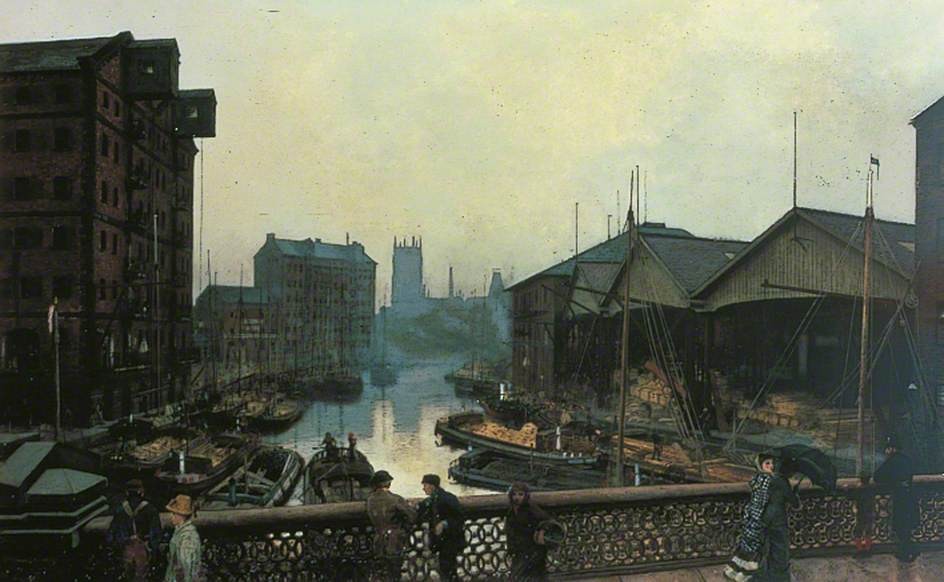
Grimshaw’s nocturnes can appear timeless at first glance, but their subject matter is historically specific. Leeds Museums’ learning resource describes Leeds Bridge as an image of a district dense with warehouses, boats, factory buildings and heavy-lifting equipment.[6] A church and industrial structures share the skyline. The painting invites viewers to notice ordinary movement around a crossing point, while the still water and controlled light make that activity feel unusually hushed.
This is an important correction to an exclusively nostalgic reading. Grimshaw selected and ordered what he saw; he did not offer a complete social survey of Victorian Leeds. The MyLearning resource asks what the image reveals and what it leaves out, particularly in relation to industrial labour and difficult living conditions.[6] Atmosphere can focus attention, but it can also conceal. The nocturnes are valuable records of how modern places were imagined, not transparent documents of everything that happened within them.
The same tension animates Boar Lane, Leeds: architecture, traffic and shop lighting become a measured evening spectacle. Its exact object history is discussed on Boar Lane, Leeds.
Fog, wet stone and reflected light
Fog and damp surfaces help light travel through Grimshaw’s pictures. They do not merely obscure. A crisp lamp can become a diffuse haze in the air, while wet paving converts a small bright source into a longer streak. The surface underfoot then participates in the lighting of the scene.
Tate’s interpretation of Liverpool Quay by Moonlight identifies a golden glow from shopfronts passing through fog and returning from wet cobbles.[4] In close-looking terms, these transitions connect foreground and distance. The brightest marks are not isolated ornaments: each has a dimmer echo nearby. Sharp and softened edges alternate, preventing the meticulously organised architecture from feeling diagrammatic.
Grimshaw’s limited nocturnal palette likewise contains purposeful variation. Cool sky and shadow can make amber light seem warmer; muted greens or blue-greys can make a pale moon feel intense without a large area of white. The effect depends on relationships between colours rather than brightness alone. This controlled contrast is why a modest point of light can seem to illuminate far more of the canvas than it physically occupies.
Harbours, rivers and working water
Water expanded the nocturne’s possibilities. Scarborough Museums records that the fishing ports of Scarborough, Whitby and Hull enabled Grimshaw to explore light on water while showing modern working landscapes.[2] In ‘Burning Off’, a Fishing Boat at Scarborough of 1877, the source identifies the harbour flare as a practical warning used in dangerous conditions.[2] Light here is functional before it is picturesque.
The port paintings also connect local observation to a larger commercial geography. Liverpool, Glasgow and Hull recur in Grimshaw’s work, and Museo Thyssen includes dock views among the subjects for which he became best known.[3] Liverpool Quay by Moonlight, dated 1887 by Tate, turns a straight commercial street into a deep corridor of glow, mist and movement.[4] Yet the vehicle, shopfronts and quay setting keep the image tied to circulation and trade.
That dual identity—working port and poetic nightscape—is explored across Ports and Docklands. It also distinguishes Grimshaw from painters who treated moonlight chiefly as an escape from contemporary urban life.
London and the Thames
Grimshaw’s London subjects translate the same concerns to another scale. Museo Thyssen records that, after financial difficulties in 1879, he rented a Chelsea studio while his family remained in Yorkshire.[3]
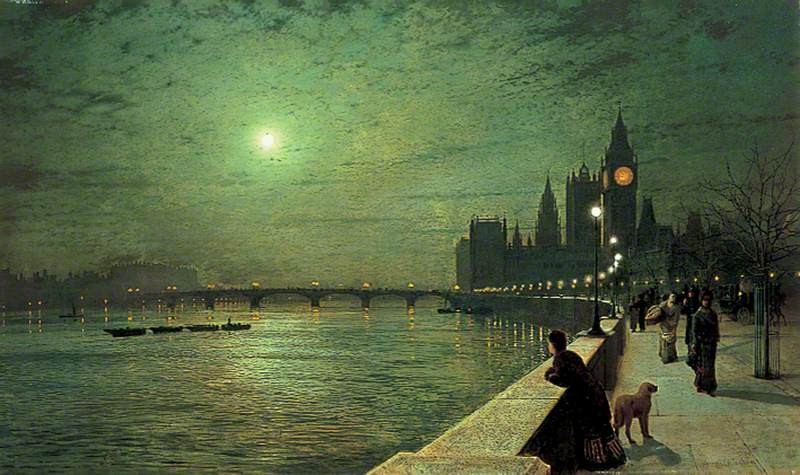
Works such as Nightfall down the Thames and Reflections on the Thames, Westminster, London place the river within an urban network of banks, bridges and distant illumination. Art UK records Reflections on the Thames as an 1880 painting in the Leeds Art Gallery collection.[7] Rather than treating water as an open seascape, such pictures use it as a dark reflective route through the capital. The river receives the city’s light, stretches it and carries the eye toward an indistinct distance.
Tate’s View of Heath Street by Night broadens this London night beyond the central river.[5] A receding path, framed sky and sparse illumination could serve a suburban street as readily as a quay. See London and the Thames and Reflections on the Thames for the capital’s distinct role.
Figures at the edge of the light
Human figures in Grimshaw’s moonlights are often small enough to be discovered after the setting. Their scale preserves the architecture and atmosphere as the dominant subjects, but it also turns a path or street into lived space. A walker confirms the depth of a road; workers connect a harbour to its daily purpose; a passing vehicle implies time continuing beyond the painted instant.
The solitary woman in many lane scenes is especially characteristic. Scarborough Museums notes both this repetition and the breadth of social classes represented by women in Grimshaw’s work.[2] It would be reductive to assign every figure the same story. Depending on the setting, she may mark scale, direct the gaze or intensify the quiet. Such restraint suggests an encounter without settling its narrative.
Repetition, demand and invention
The popularity of Grimshaw’s moonlights shaped their production. The Scarborough guide reports that financial pressure led him to produce approximately one painting a week in the early 1880s and connects repeated lane scenes to a dependable market.[2] Yet each arrangement could vary through the balance of sky and ground, a shifted figure, a stronger reflection or a changed architectural fragment. Commercial discipline and visual invention sustained one another.
The full range of subjects, including daylight landscapes, interiors and literary scenes, can be compared in Paintings and Artworks. That wider view makes clear how decisively the nocturnes shaped his public identity without exhausting his career.
Why the nocturnes still look modern
Grimshaw recognised that the modern city had a distinctive night-time appearance. Leeds Museums’ 2025–26 exhibition set his work alongside contemporary painting, neon and photography to challenge simple Victorian nostalgia.[1] Its framing identifies a continuing concern: artificial illumination changes how a city is seen and imagined.
James McNeill Whistler’s admiration, reported by both Leeds Museums and Museo Thyssen, has long helped establish the importance of Grimshaw’s moonlights.[1][3] The comparison is useful when it draws attention to the nocturne as an artistic problem rather than merely a time of day. Grimshaw’s own answer remained unusually concrete. His night scenes retain walls, vehicles, rigging, branches and wet roads even as fog and reflection loosen their edges.
Their power lies in that coexistence. The paintings make room for beauty without erasing infrastructure, and for stillness without pretending that the city has ceased to work. Moonlight becomes both illumination and organising idea.
Researched works directory
This searchable evidence census contains 88 distinct records assembled from public collection data and a reproducible Wikidata snapshot. It is not a catalogue raisonné, not a claim of complete oeuvre coverage, and it keeps works with repeated titles as separate objects.
| Name | Date | Medium |
|---|---|---|
| A Dead Linnet | 1862 | Painting |
| A House in a Clearing | 1870 | Painting |
| A Moonlit Evening | 1880 | Painting |
| A Moonlit Lane | 1874 | Painting |
| A Mossy Glen | 1864 | Painting |
| A View of Hampstead, London | 1882 | Painting |
| A Wooded Valley | Date unknown | Painting |
| A Yorkshire Home | 1878 | Painting |
| An Autumn Idyll | 1885 | Painting |
| Autumn Glory: The Old Mill | 1869 | Painting |
| Autumn Regrets | 1882 | Painting |
| Baiting the Lines, Whitby | 1884 | Painting |
| Boar Lane, Leeds | 1881 | Painting |
| Bowder Stone, Borrowdale | 1865 | Painting |
| Briggate, Leeds | 1891 | Painting |
| 'Burning Off', a Fishing Boat at Scarborough | 1877 | Painting |
| Canny Glasgow | 1887 | Painting |
| Evening Glow | 1884 | Painting |
| Evening Scene by the Docks, Hull | Date unknown | Painting |
| Fiamella | 1883 | Painting |
| Glasgow Docks | 1886 | Painting |
| Gloucester Docks | 1885 | Painting |
| Golden Visions | 1870 | Painting |
| Greenwich, Half Tide | 1884 | Painting |
| In Peril (The Harbour Flare) | 1879 | Painting |
| In the golden gloaming | Date unknown | Painting |
| In the Golden Mists of Autumn | 1884 | Painting |
| In the Golden Olden Times | 1870 | Painting |
| Ingleborough from under White Scar, Yorkshire Limestone Strata | 1868 | Painting |
| Iris | 1886 | Painting |
| Knostrop Old Hall at Dusk | 1870 | Painting |
| Leeds Bridge | 1880 | Painting |
| Lights in the Harbour, Scarborough | 1879 | Painting |
| Liverpool Docks | 1892 | Painting |
| Liverpool Docks by Night | 1892 | Painting |
| Liverpool Docks (panel 1 of 5) | Date unknown | Painting |
| Liverpool Docks (panel 2 of 5) | Date unknown | Painting |
| Liverpool Docks (panel 3 of 5) | Date unknown | Painting |
| Liverpool Docks (panel 4 of 5) | Date unknown | Painting |
| Liverpool Docks (panel 5 of 5) | Date unknown | Painting |
| Liverpool Quay by Moonlight | 1887 | Painting |
| Moonlight Scene near Leeds | 1881 | Painting |
| Night Scene, Rouen | 1893 | Painting |
| Nightfall down the Thames | 1880 | Painting |
| Nightfall in Scarborough Harbour, North Yorkshire | 1884 | Painting |
| November Morning, Knostrop Hall, Leeds | 1883 | Painting |
| Old English House by Moonlight | Date unknown | Painting |
| Park Row, Leeds | 1882 | Painting |
| Princes Dock, Hull | Date unknown | Painting |
| Quai de Paris, Rouen | 1893 | Painting |
| Reflections on the Thames, Westminster | 1880 | Painting |
| Reflections on the Thames, Westminster, London | 1880 | Painting |
| Roundhay Park Lake | Date unknown | Painting |
| Salthouse Dock, Liverpool | Date unknown | Painting |
| Salthouse Dock, Liverpool, 1884 | Date unknown | Painting |
| Scarborough Lights | 1877 | Painting |
| Shipping on the Clyde | 1881 | Painting |
| Sic transit gloria mundi (The Burning of the Spa Saloon) | 1876 | Painting |
| Silver Moonlight | 1880 | Painting |
| Silver Moonlight | 1886 | Painting |
| Snow and Mist (Caprice in Yellow Minor) | 1892 | Painting |
| Stapleton Park, near Pontefract | Date unknown | Painting |
| Sunday Night, Knostrop Cut, Leeds | 1893 | Painting |
| Thames Moonlight | 1880 | Painting |
| The Custom House, Liverpool, Looking North | Date unknown | Painting |
| The Custom House, Liverpool, Looking South | Date unknown | Painting |
| The Harbour at Whitby by Moonlight | 1879 | Painting |
| The Head of Gertrude Grimshaw | 1874 | Painting |
| 'The Ironbound Shore' | 1869 | Painting |
| The Lady of Shalott | 1875 | Painting |
| The Parable of the Lost Sheep | Date unknown | Painting |
| The Rector's Garden, Queen of the Lilies | 1877 | Painting |
| The Seal of the Covenant | 1868 | Painting |
| The Sun's Farewell | Date unknown | Painting |
| The Thames by Moonlight with Southwark Bridge, London | 1884 | Painting |
| Thro' the Wood | Date unknown | Painting |
| Tree Shadows on the Park Wall, Roundhay, Leeds | 1872 | Painting |
| Under the Beeches | 1892 | Painting |
| Under the Silvery Moonbeams | Date unknown | Painting |
| View of Heath Street by Night | 1882 | Painting |
| View of Scarborough | 1876 | Painting |
| View of Southwark Bridge at Night | 1882 | Painting |
| Whitby | 1878 | Painting |
| Whitby Docks | 1876 | Painting |
| Whitby Harbor | 1874 | Painting |
| Windermere | 1863 | Painting |
| Woodland near Leeds | Date unknown | Painting |
| Yew Court, Scalby, near Scarborough | 1875 | Painting |
Frequently Asked Questions
Moonlit streets, harbours, rivers and lanes became his most recognisable subjects. He called them his “moonlights”, and institutions treat them as a defining strand of his career.[1][2]
Scarborough Museums dates his first known moonlight scene to 1867 and identifies Whitby Harbour as its subject.[2] “First known” acknowledges that the surviving record cannot document every attempt.
No. His practice included daylight landscapes, autumn scenes, portraits, interiors, literary and classical subjects. The nocturnes brought him particular fame, but they form one major strand within a varied career.[3]
They contain identifiable places and historical details, but they are composed paintings, not neutral records. Grimshaw selected visual information to create atmosphere, so they need comparison with other urban evidence.[6]
Follow how light moves: from moon or lamp into fog, water or wet paving. Then notice the recession of roads and buildings, the silhouettes of branches, and the scale of small figures. These relationships reveal how he made darkness spatially legible and emotionally charged.
Discussion
Use this evidence-led guide as a starting point for close looking rather than a final verdict.
Share an observation about John Atkinson Grimshaw Moonlight and Nocturnes or a source that adds useful context.
Reader Insights
Which work most clearly complicates the familiar label of painter of moonlight?
Where do place, market, family or literary culture most productively alter your reading?
Which source or surviving object would you investigate next?
Join the Conversation
Add your reading below, keeping observations specific and evidence clear.
References
- Leeds Museums and Galleries, “Exhibition sheds new light on renowned Leeds artist John Atkinson Grimshaw”:, accessed 31 August 2026.
- Scarborough Museums and Galleries, Atkinson Grimshaw: At Home in Yorkshire (large-print guide):, accessed 31 August 2026.
- Museo Nacional Thyssen-Bornemisza, “John Atkinson Grimshaw”:, accessed 31 August 2026.
- Tate, “Liverpool Quay by Moonlight”:, accessed 31 August 2026.
- Tate, “View of Heath Street by Night”:, accessed 31 August 2026.
- Leeds Museums and Galleries via MyLearning, “Leeds Bridge by John Atkinson Grimshaw”:, accessed 31 August 2026.
- Art UK, “Reflections on the Thames, Westminster, London”:, accessed 31 August 2026.