

 Buy Art Prints Now
from Amazon
* As an Amazon Associate I earn from qualifying purchases.
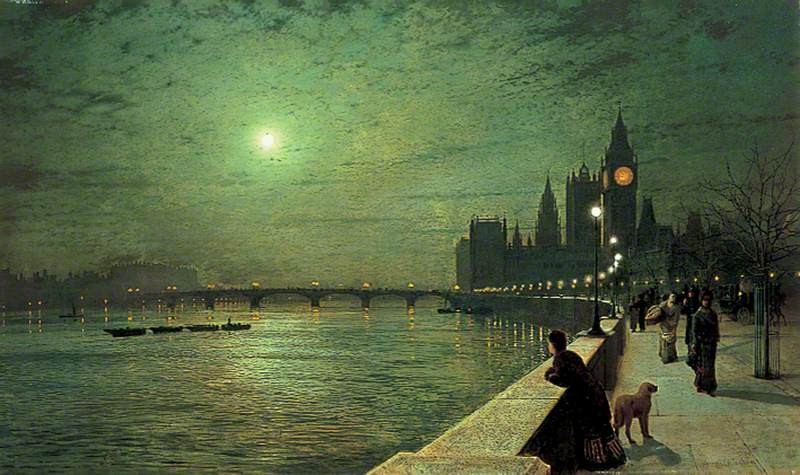
Reflections on the Thames, Westminster, London, 1880 — Leeds Art Gallery, public domain.
 by Tom Gurney
Tom Gurney BSc (Hons) is an art history expert with over 20 years experience
Page Created: August 31, 2026 / Page Updated: September 16, 2026
Email: tomgurney1@gmail.com / Phone: +44 7429 011000
John Atkinson Grimshaw: London and the Thames: Introduction
London gave John Atkinson Grimshaw a new version of the urban night. In Yorkshire and the northern ports he had already learned to organise streets, industry and water through low light. The capital added the breadth of the Thames, the ceremonial profile of Westminster, bridge structures and neighbourhood roads. These were not neutral views of landmarks. Grimshaw adjusted their visibility through haze, reflected illumination and carefully placed figures, turning metropolitan geography into an atmosphere.
His London chronology needs cautious wording. One current institutional guide says that he took a London studio for two years in 1880; Museo Nacional Thyssen-Bornemisza places the move after his financial setback of 1879 and identifies Chelsea, without giving the same narrow span.[1][2] The records agree on a London working base around the opening years of the 1880s, but their different levels of precision should not be forced into a false single date.
At a Glance
- London phaseA working presence began around 1880, though institutional chronologies differ in precision[1][2]
- Studio districtChelsea, while Grimshaw’s family remained at Knostrop in Leeds[2]
- Principal settingThe Thames around Westminster, seen through evening or nocturnal light
- Secure objectReflections on the Thames, Westminster, London, dated 1880[5]
- Beyond the riverView of Heath Street by Night, an 1882 Hampstead subject in Tate’s collection[4]
- Recurring structureWater, embankments, bridges and receding streets joined by reflected light
Contents
- Introduction
- A London phase, not a permanent departure
- What Chelsea changed
- The Thames as an urban space
- Reflections at Westminster
- Westminster, bridges and distance
- Nightfall on the river
- Heath Street beyond the river
- London within Grimshaw’s career
A London phase, not a permanent departure
Grimshaw’s work in London followed a period of financial strain. Scarborough Museums records that debt forced him to leave his coastal house in 1879 and places a two-year London studio from 1880.[1] Museo Thyssen likewise connects the capital to that setback, adding that he rented in Chelsea while his family stayed at Knostrop Old Hall.[2] Neither account describes an uncomplicated relocation of the entire household.
It is therefore more accurate to speak of a London phase or working base than a clean break with Leeds. Grimshaw continued to belong to a network of places. The capital enlarged his range of subjects while Yorkshire remained the family centre to which he returned. The biography sets this movement within his full career; Leeds and Yorkshire explains the home ground that London did not replace.
The timing also helps explain why metropolitan scenes sit beside continued northern work. Grimshaw did not finish one regional chapter before beginning another. Around 1880, he could use related visual ideas—distant lamps, reflective surfaces, slender silhouettes—in pictures associated with several cities.
What Chelsea changed
Chelsea mattered first as a place from which Grimshaw could work in the capital. Museo Thyssen securely identifies the district, but the locked institutional sources do not establish a precise street address or an exact opening and closing day.[2] Claims beyond that evidence should remain qualified. A studio is not proof that every nearby view was painted directly from its window, nor that he lived there continuously.
What the base did provide was access. The Thames, central London and roads leading into outer districts could now be studied within the rhythm of a London stay. That proximity expanded the range of sites he could translate into the nocturnal mode for which he was already known. Chelsea should consequently be understood as an enabling location rather than a stylistic cause.
This distinction protects the paintings from an overly simple biography. Their atmosphere did not appear because Grimshaw crossed a city boundary. It developed from long practice, then met a new set of embankments, traffic patterns and monumental silhouettes.
The Thames as an urban space
In Grimshaw’s London pictures, the Thames is both a body of water and a route through the built city. It opens a broad horizontal interval between the viewer and distant architecture. At the same time, embankments, bridges and lights prevent it from reading as untouched nature. The river belongs to metropolitan movement even when boats and crowds are subdued.
That combination differs from the enclosed recession of a street. A road often leads the eye between façades; the Thames spreads laterally and receives light across its surface. The painter could place a bridge or skyline against the luminous distance, then use darker foreground forms to give the view depth. These are close-looking observations about pictorial organisation, not claims that every feature occupied an exact surveyed position.
The comparison with Ports and Docklands is useful. Both groups involve water, commerce and illumination, but the London river scenes tend to make civic architecture and the extended waterway more prominent. Dock paintings more often compress the viewer into streets, quays and working edges.
Reflections at Westminster
Reflections on the Thames, Westminster, London is the cluster’s securely locked London object. Art UK dates it to 1880 and records Leeds Art Gallery as its collection.[5] The exact image record identifies oil on canvas, dimensions of 76.2 by 127 centimetres and accession number LEEAG.PA.1900.0181.[6] Those facts distinguish the work from similarly titled Thames scenes.
Close looking at the exact reproduction shows how strongly the horizontal format belongs to the subject.[6] The expanse of river occupies much of the view, while the built bank and Westminster forms establish a distant metropolitan edge. Points and bands of illumination are returned unevenly by the water. They do not behave like objects laid on a mirror; broken tonal changes make the surface appear mobile.
Grimshaw also preserves areas in which details are withheld. Architecture can be identifiable without every façade being equally sharp, and figures can register as human presence without becoming individual portraits. The composition asks the viewer to move between recognition and uncertainty. For a closer account of title, date, size and collection history, see Reflections on the Thames.
Westminster, bridges and distance
Westminster offered more than a famous silhouette. Its vertical towers, long river frontage and bridge connections created a system of contrasts that could be read in weak light. Upright architectural accents interrupt the river’s breadth; bridge lines draw the eye across it; small foreground figures measure the scale of public space.
Grimshaw’s treatment does not turn the capital into a crisp daylight prospect. A monument may anchor the location while haze reduces surrounding information. This selective legibility is central to the experience of the paintings: the viewer knows where the scene is, yet must work through dusk or night to understand its spatial order.
It is tempting to treat every luminous point as evidence for a named technology. The pictures can certainly bring natural and manufactured illumination together, a relationship emphasised in Leeds Museums’ recent interpretation of Grimshaw’s nocturnes.[3] But identification of a particular lamp type should depend on a specific object record. The broader visual fact is secure: London light arrives from more than one source and is altered by air and water.
Nightfall on the river
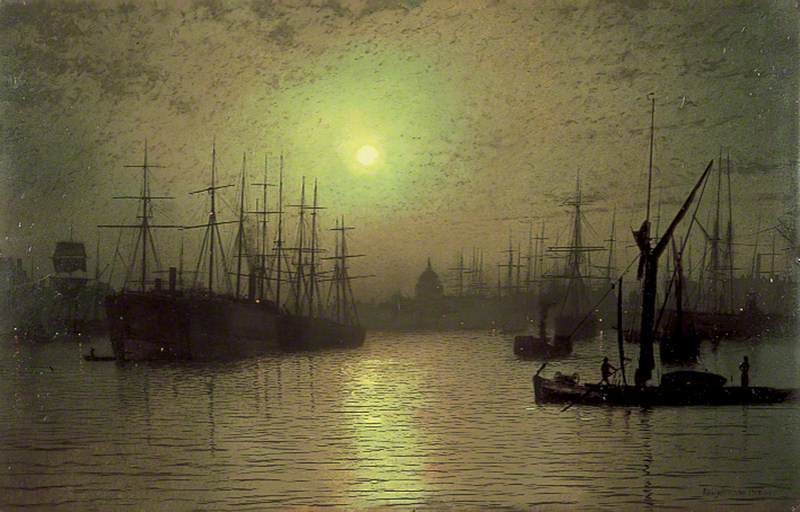
Leeds Museums names Nightfall down the Thames of 1880 among the nocturnes through which Grimshaw addressed the modern city.[3] It belongs here as a contextual work rather than a separate exact-object page. Its title itself shifts emphasis away from a single monument and toward a changing condition—the fall of evening across the river.
The Thames allowed that transition to be pictured over a wide field. Sky, water and the darkening city could hold different stages of visibility at once. A remaining brightness above the horizon might coexist with already illuminated buildings and nearly unreadable foreground forms. In close-looking terms, “nightfall” is not simply a dark palette; it is a sequence in which some parts of the city become less visible as others begin to shine.
Grimshaw’s wider handling of these effects is examined in Moonlight and Nocturnes. The London works add a particular scale and civic setting to that theme without defining it alone.
Heath Street beyond the river
London did not mean only the Thames. Tate’s collection record identifies View of Heath Street by Night as an 1882 work.[4] The Hampstead setting redirects attention from a ceremonial river frontage to a road, buildings and movement through a neighbourhood. Its inclusion is important because it prevents Grimshaw’s capital from collapsing into Westminster views.
The change of setting also tests the portability of his methods. A street supplies its own recession, while façades and trees frame a narrower section of sky. Figures and vehicles can indicate distance through scale. Light still orders the scene, but there is no broad river to carry reflections across the composition.
Calling the picture “suburban” describes its position within Grimshaw’s London subjects, not an absence of urban life. Heath Street connects people and traffic; it is not a secluded country lane. The scene shows how his established night vocabulary could respond to another metropolitan environment.
London within Grimshaw’s career
The London works should neither be isolated as an experiment nor allowed to absorb Grimshaw’s whole reputation. Museo Thyssen lists London alongside Glasgow, Liverpool, Leeds, Scarborough and Whitby among the cities and ports he often represented.[2] His ability to carry a recognisable approach between them was part of his commercial and artistic reach.
London nevertheless sharpened certain possibilities. The Thames joined vast reflective space to nationally recognisable architecture. Westminster offered a legible location that could survive partial concealment. Heath Street showed that neighbourhood traffic and narrower roads could be treated with comparable seriousness. Together they expanded the kinds of modern setting that his night painting could hold.
The Paintings and Artworks guide restores the balance by placing these scenes beside landscapes, interiors and literary subjects. London was a consequential strand within a varied practice: a place where an already mature painter encountered fresh distances, surfaces and patterns of light.
Researched works directory
This searchable evidence census contains 88 distinct records assembled from public collection data and a reproducible Wikidata snapshot. It is not a catalogue raisonné, not a claim of complete oeuvre coverage, and it keeps works with repeated titles as separate objects.
| Name | Date | Medium |
|---|---|---|
| A Dead Linnet | 1862 | Painting |
| A House in a Clearing | 1870 | Painting |
| A Moonlit Evening | 1880 | Painting |
| A Moonlit Lane | 1874 | Painting |
| A Mossy Glen | 1864 | Painting |
| A View of Hampstead, London | 1882 | Painting |
| A Wooded Valley | Date unknown | Painting |
| A Yorkshire Home | 1878 | Painting |
| An Autumn Idyll | 1885 | Painting |
| Autumn Glory: The Old Mill | 1869 | Painting |
| Autumn Regrets | 1882 | Painting |
| Baiting the Lines, Whitby | 1884 | Painting |
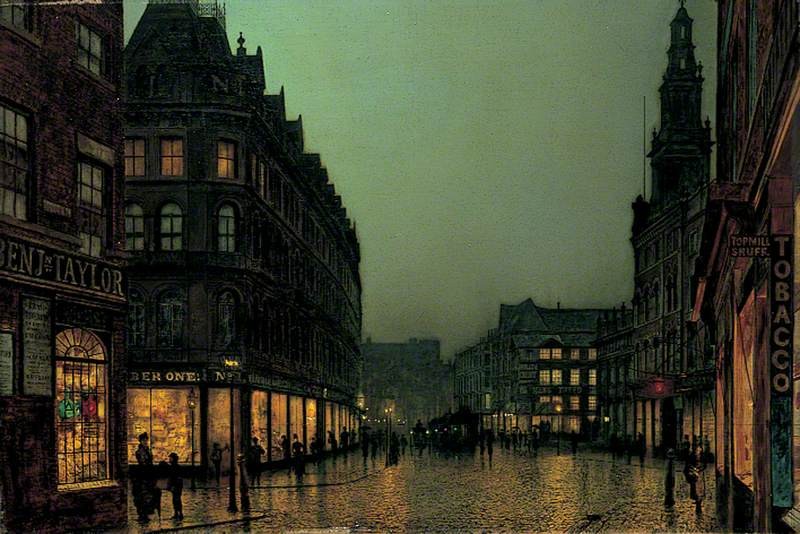
| Boar Lane, Leeds | 1881 | Painting |
| Bowder Stone, Borrowdale | 1865 | Painting |
| Briggate, Leeds | 1891 | Painting |
| 'Burning Off', a Fishing Boat at Scarborough | 1877 | Painting |
| Canny Glasgow | 1887 | Painting |
| Evening Glow | 1884 | Painting |
| Evening Scene by the Docks, Hull | Date unknown | Painting |
| Fiamella | 1883 | Painting |
| Glasgow Docks | 1886 | Painting |
| Gloucester Docks | 1885 | Painting |
| Golden Visions | 1870 | Painting |
| Greenwich, Half Tide | 1884 | Painting |
| In Peril (The Harbour Flare) | 1879 | Painting |
| In the golden gloaming | Date unknown | Painting |
| In the Golden Mists of Autumn | 1884 | Painting |
| In the Golden Olden Times | 1870 | Painting |
| Ingleborough from under White Scar, Yorkshire Limestone Strata | 1868 | Painting |
| Iris | 1886 | Painting |
| Knostrop Old Hall at Dusk | 1870 | Painting |
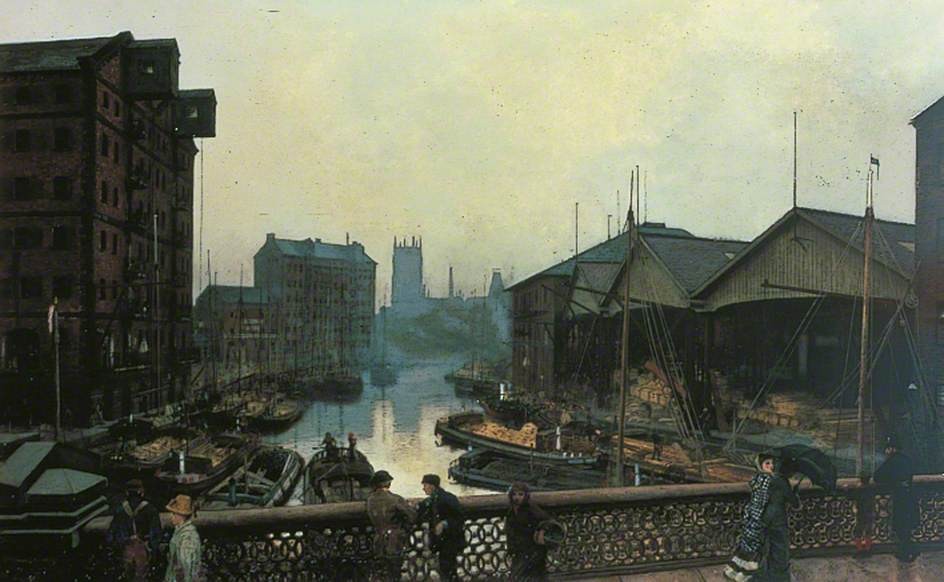
| Leeds Bridge | 1880 | Painting |
| Lights in the Harbour, Scarborough | 1879 | Painting |
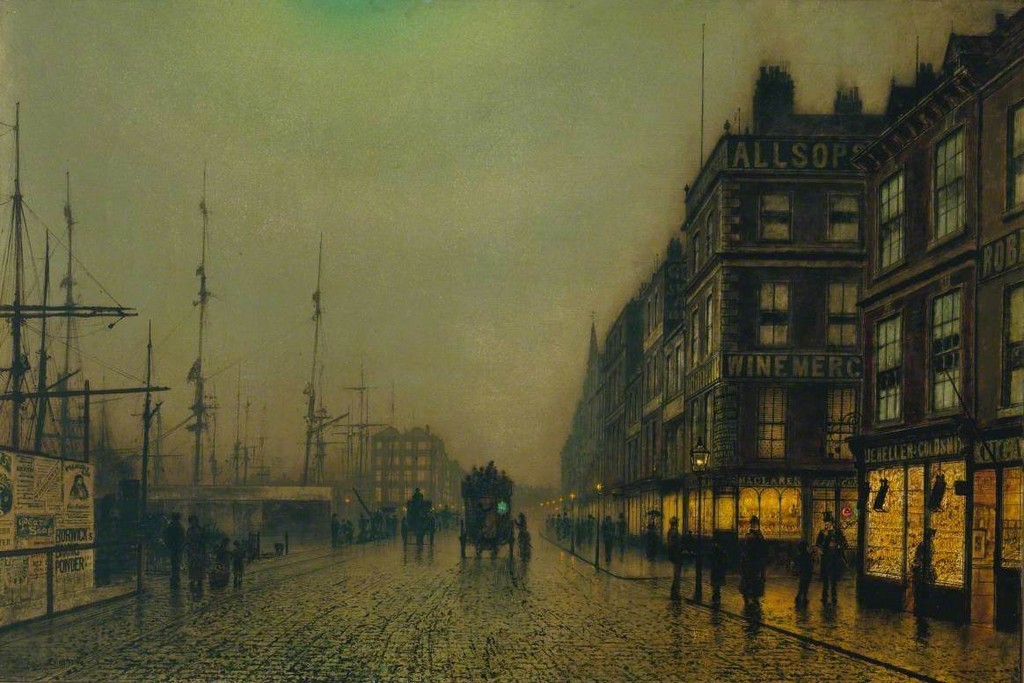
| Liverpool Docks | 1892 | Painting |
| Liverpool Docks by Night | 1892 | Painting |
| Liverpool Docks (panel 1 of 5) | Date unknown | Painting |
| Liverpool Docks (panel 2 of 5) | Date unknown | Painting |
| Liverpool Docks (panel 3 of 5) | Date unknown | Painting |
| Liverpool Docks (panel 4 of 5) | Date unknown | Painting |
| Liverpool Docks (panel 5 of 5) | Date unknown | Painting |
| Liverpool Quay by Moonlight | 1887 | Painting |
| Moonlight Scene near Leeds | 1881 | Painting |
| Night Scene, Rouen | 1893 | Painting |
| Nightfall down the Thames | 1880 | Painting |
| Nightfall in Scarborough Harbour, North Yorkshire | 1884 | Painting |
| November Morning, Knostrop Hall, Leeds | 1883 | Painting |
| Old English House by Moonlight | Date unknown | Painting |
| Park Row, Leeds | 1882 | Painting |
| Princes Dock, Hull | Date unknown | Painting |
| Quai de Paris, Rouen | 1893 | Painting |
| Reflections on the Thames, Westminster | 1880 | Painting |
| Reflections on the Thames, Westminster, London | 1880 | Painting |
| Roundhay Park Lake | Date unknown | Painting |
| Salthouse Dock, Liverpool | Date unknown | Painting |
| Salthouse Dock, Liverpool, 1884 | Date unknown | Painting |
| Scarborough Lights | 1877 | Painting |
| Shipping on the Clyde | 1881 | Painting |
| Sic transit gloria mundi (The Burning of the Spa Saloon) | 1876 | Painting |
| Silver Moonlight | 1880 | Painting |
| Silver Moonlight | 1886 | Painting |
| Snow and Mist (Caprice in Yellow Minor) | 1892 | Painting |
| Stapleton Park, near Pontefract | Date unknown | Painting |
| Sunday Night, Knostrop Cut, Leeds | 1893 | Painting |
| Thames Moonlight | 1880 | Painting |
| The Custom House, Liverpool, Looking North | Date unknown | Painting |
| The Custom House, Liverpool, Looking South | Date unknown | Painting |
| The Harbour at Whitby by Moonlight | 1879 | Painting |
| The Head of Gertrude Grimshaw | 1874 | Painting |
| 'The Ironbound Shore' | 1869 | Painting |
| The Lady of Shalott | 1875 | Painting |
| The Parable of the Lost Sheep | Date unknown | Painting |
| The Rector's Garden, Queen of the Lilies | 1877 | Painting |
| The Seal of the Covenant | 1868 | Painting |
| The Sun's Farewell | Date unknown | Painting |
| The Thames by Moonlight with Southwark Bridge, London | 1884 | Painting |
| Thro' the Wood | Date unknown | Painting |
| Tree Shadows on the Park Wall, Roundhay, Leeds | 1872 | Painting |
| Under the Beeches | 1892 | Painting |
| Under the Silvery Moonbeams | Date unknown | Painting |
| View of Heath Street by Night | 1882 | Painting |
| View of Scarborough | 1876 | Painting |
| View of Southwark Bridge at Night | 1882 | Painting |
| Whitby | 1878 | Painting |
| Whitby Docks | 1876 | Painting |
| Whitby Harbor | 1874 | Painting |
| Windermere | 1863 | Painting |
| Woodland near Leeds | Date unknown | Painting |
| Yew Court, Scalby, near Scarborough | 1875 | Painting |
Frequently Asked Questions
The safest summary is around 1880. Scarborough Museums dates a two-year London studio from 1880, while Museo Thyssen places his move after the financial difficulties of 1879 without fixing the same duration.[1][2]
Museo Thyssen identifies Chelsea.[2] The locked institutional evidence does not support a more precise address here, so the district is preferable to an unsupported street-level claim.
His subjects included evening and nocturnal river views around Westminster. Secure examples include Reflections on the Thames, Westminster, London and the contextually documented Nightfall down the Thames, both dated 1880.[3][5]
No. Art UK records the painting in Leeds Art Gallery.[5] Its London subject and Leeds ownership are distinct parts of the object’s history.
Yes. Tate’s View of Heath Street by Night of 1882 is a Hampstead street subject.[4] It demonstrates that his London work extended beyond bridges, embankments and Westminster.
Discussion
Use this evidence-led guide as a starting point for close looking rather than a final verdict.
Share an observation about John Atkinson Grimshaw: London and the Thames or a source that adds useful context.
Reader Insights
Which work most clearly complicates the familiar label of painter of moonlight?
Where do place, market, family or literary culture most productively alter your reading?
Which source or surviving object would you investigate next?
Join the Conversation
Add your reading below, keeping observations specific and evidence clear.
References
- Scarborough Museums and Galleries, Atkinson Grimshaw: At Home in Yorkshire large-print guide, accessed 31 August 2026.
- Museo Nacional Thyssen-Bornemisza, “John Atkinson Grimshaw”, accessed 31 August 2026.
- Leeds Museums and Galleries, “Exhibition sheds new light on renowned Leeds artist John Atkinson Grimshaw”, accessed 31 August 2026.
- Tate, View of Heath Street by Night, accessed 31 August 2026.
- Art UK, Reflections on the Thames, Westminster, London, accessed 31 August 2026.
- Wikimedia Commons, exact file record for Reflections on the Thames, Westminster, London, accessed 31 August 2026.