



 by Tom Gurney
Tom Gurney BSc (Hons) is an art history expert with over 20 years experience
Published on June 19, 2020 / Updated on November 3, 2026
Email: tomgurney1@gmail.com / Phone: +44 7429 011000
Women Walking on the Beach: Introduction
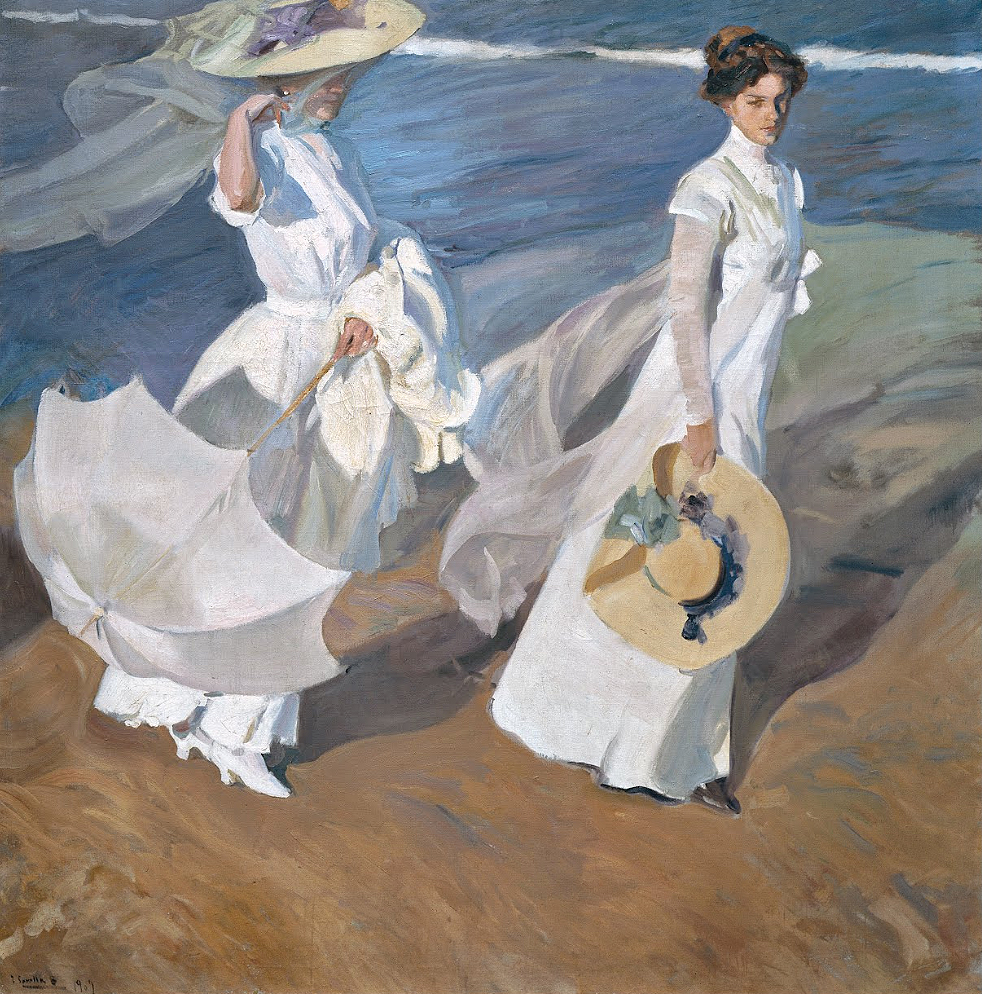
Two women move along the water’s edge, their white clothes filling much of the canvas. The woman on the left steadies her broad hat while an open parasol hangs low in front of her. Her companion carries her hat by her side, leaving her dark hair exposed. Between and behind them, thin fabric lifts into the air. The beach gives them somewhere to walk, but the breeze supplies another movement altogether: it stretches, folds and briefly separates the cloth from the bodies beneath it.
Joaquín Sorolla painted Women Walking on the Beach in Valencia in the summer of 1909. Also known in English as Strolling along the Seashore, its Spanish title is Paseo a la orilla del mar. The women are his wife, Clotilde García del Castillo, and their elder daughter, María. The oil painting measures 205 × 200 cm and belongs to the Museo Sorolla in Madrid, where it is inventory number 834.[1] Those dimensions matter. This is a nearly square canvas, a little over two metres high, in which a familiar family outing becomes a large and physically commanding encounter.
The picture’s appeal begins with the apparent ease of the walk. Stay with it, however, and that ease becomes more complicated. The figures appear to move towards the lower right, while veils and loose fabric stream back towards the left. A light object can swell into a large shape; a nearly hidden foot can determine the direction of a whole body. Sorolla gives the walkers weight and the air a visible force, holding both within a tightly measured frame.
At a Glance
- ArtistJoaquín Sorolla
- SubjectWomen Walking on the Beach
- Date1909
- CollectionMuseo Sorolla
- Inventory834
This work across Joaquín Sorolla’s career
Contents
- A square filled with movement
- The wind takes shape
- What white can contain
- A family portrait in public space
- Valencia after America
- Clotilde on the beach, five years earlier
- The feeling of a passing moment
A square filled with movement
There is no strip of sky above the sea. Water reaches the upper boundary, and a broken line of foam passes behind the women’s heads. Below them, sand occupies a substantial stretch of the foreground. We look slightly down at their route rather than out towards a distant horizon. The setting consequently feels close: the sea becomes a field of colour behind the figures, while the beach brings their steps towards us.
The format has room for the two upright bodies but little room above them. Clotilde’s hat meets the top edge and is cut by it. At the bottom, by contrast, an expanse of sand remains between the women and the frame. This unequal allocation of space is one of the picture’s strongest decisions. The figures seem caught as they pass through a larger world, yet their placement is far from arbitrary. The open foreground gives their movement somewhere to continue.
At first glance the white dresses can seem to form a single broad shape. Looking again separates two contrasting outlines. María, on the right, makes a relatively narrow, continuous column, running from her high collar to the hem near her shoes. Clotilde spreads across the left half through her hat, raised arm, gathered clothing and parasol. One figure is elongated; the other opens out. The difference keeps a pair of similarly dressed walkers from becoming two repeated verticals.
Their spacing is equally active. A wedge of blue water appears between their upper bodies. Lower down, drifting fabric crosses this interval and draws them together again. Sorolla does not need joined hands to make them read as companions. Their shared direction, proximity and overlapping white shapes establish a connection, while their distinct gestures preserve their individuality.
The parasol answers the broad brim of María’s carried hat. Both are circular objects seen obliquely, but they occupy different levels and face us differently. The parasol spreads across the lower left; the hat hangs lower on María’s body, towards the right. These rounded shapes interrupt the long lines of the dresses. They also give the eye a route across the pair without relying solely on the faces.
The shore contributes a further set of diagonals. Its changing zones of blue, greenish grey and brown run behind the figures, suggesting the shallow slope between water and drier ground. The women’s shadows extend across the sand at another angle. Rather than placing two portraits against a neutral seaside backdrop, Sorolla sets bodies, accessories, shoreline and shadows into a network of directions. The scene feels mobile because these directions do not all agree.
Women Walking on the Beach — larger view
The wind takes shape
Clotilde’s raised hand gives the breeze a practical consequence. Her fingers come up beside the hat brim, a small gesture made necessary by the much larger spread of material above and behind her. The veil pulls away towards the left, its thinness visible where darker water shows through it. The hat itself remains a more solid, pale plane. Against the force of the air, the hand supplies a point of control.
Below, the parasol creates a different kind of resistance. Its stretched covering bows out across the foreground, with slender ribs and a handle clarifying its construction. The large curve looks light enough to be affected by the wind, yet it retains a definite structure. Near it, the gathered folds at Clotilde’s other hand are softer and more irregular. The picture places several kinds of white material close together and lets their different behaviours distinguish them.
María’s hat is no longer on her head. Its warm straw colour stands out against the pale dress, and dark blue decoration curves around the crown. Her lowered arm gives this accessory a different role from Clotilde’s hat: it hangs with the body rather than requiring an upward gesture. The comparison is immediately legible, even before we know who the two women are. One protects a hat in place; the other carries hers as she walks.
The loose fabric behind María makes a long, wavering passage towards the centre and left. It alternately broadens into illuminated surfaces and narrows into folds. A dark opening within it helps us read its volume. Here the breeze is more than an atmosphere suggested by the sea: it has acquired an outline, a rhythm and a changing translucency. The cloth records its action without becoming a diagram of it.
The more firmly fitted portions of the dresses provide the necessary counterweight. Collars, sleeves and waists give the bodies a stable organisation, while hems and trailing lengths respond more freely. If everything billowed equally, the figures would lose their solidity. Instead, Sorolla lets us distinguish the pressure of clothing against a body from material lifting away from it. The women remain believable walkers inside the sweeping forms.
We cannot measure a gust or reconstruct the exact succession of steps from the painting. What we can see is a carefully sustained difference between the slow action of walking and the quicker action of fabric. This double pace makes the scene unusually vivid. The bodies seem capable of continuing steadily along the beach, while each arrangement of veil and hem could disappear almost at once.
What white can contain
The dresses are white, but very little of the painted surface is a uniform white. Cool blue marks define folds on Clotilde’s bodice and skirt. Pale grey and lilac enter the cloth that drifts behind María. Creamier passages gather around the hat and the fabric at Clotilde’s hand. These changes allow the clothing to remain luminous while giving it depth, weight and texture.
A useful place to look is María’s skirt. Its broad front receives a relatively clear illumination, while a cool crease and darker lower edge turn the material around her legs. The painted changes are economical. We do not need every seam or fold to understand how the dress falls. A few substantial shifts in tone give the skirt a surface, and the darker glimpses of footwear attach that surface to the ground.
Clotilde’s dress is more interrupted. The parasol overlaps it, gathered material complicates its middle, and moving edges break its lower outline. Her figure consequently asks the eye to assemble several connected pieces. In María, the long silhouette is available almost at once. Sorolla makes the same general colour serve two different kinds of visual construction.
The sea helps keep the whites bright. Behind the women, blue passages range from relatively pale streaks to deeper, greyer areas. The brushwork often stretches sideways, so that the water seems to pass across the picture even as the walkers move diagonally through it. Small patches of foam offer another white, more broken and distant than the cloth. The comparison gives the dresses scale: their white is substantial enough to clothe bodies, while the foam disperses along a thin moving edge.
The sand supplies warmth beneath this cool field. Ochre and brown strokes are crossed by greyer marks and irregular suggestions of moisture. It is not an evenly coloured stage. Its broken surface keeps the foreground alive, although it contains fewer sharply described objects than the figures above. The eye can travel down into it and then return to the white hems.
The shadows are particularly important. They are dark enough to anchor the walkers, but their colour remains part of the surrounding sand and reflected light. Their elongated shapes broaden the figures’ presence on the beach. We see the women twice in different terms: upright as clothed bodies, and stretched across the ground as connected masses of darkness. Those shadows help a scene full of airborne material remain physically convincing.
The effect depends on relationships between marks. Blue intensifies a neighbouring pale passage; a dark edge turns a skirt. A stroke that looks loose at close range becomes an edge, a fold or a patch of wet sand when seen in relation to the whole. Sorolla gives those marks enough independence to remain visible as paint, while making their colour and direction carry the scene.
A family portrait in public space
Knowing the sitters changes the encounter. Clotilde and María are members of the painter’s household, represented in a public seaside setting. Their identity gives the picture the specificity of a portrait, while their movement and surroundings bring it into the world of an outdoor scene. The museum describes its subject as an elegant promenade, a recognised kind of image centred on well-dressed people taking the air by the shore.[1]
The distinction is visible in what the women are doing. They remain fully dressed and carry the accessories of an outing. Their activity is walking beside the sea. We do not need an invented conversation, destination or occasion to understand that action. The familiar details of keeping a hat in place and carrying another make the scene particular without turning it into an anecdote.
There is also a difference in how the two faces are presented. Clotilde’s broad brim shades and partly conceals her features, making her raised hand and tilted head especially significant. María’s uncovered head is more exposed against the blue. Her face turns slightly towards our side of the picture, although her body keeps its forward direction. Neither woman provides a simple, frontal address that would stop the walk and turn the encounter into a formal sitting.
It is tempting to supply emotions for these expressions. The painting offers something more durable than a guessed mood: a contrast in bearing. Clotilde’s upper outline is busy with hat, arm and veil; María’s is quieter and more contained. Their relationship emerges through this difference as well as their likeness of dress and purpose. The scene lets two people share an outing without making them identical participants.
The family subject also helps explain the picture’s place within Sorolla’s broader work. The National Gallery’s account of his career places family portraits alongside social subjects, coastal scenes, gardens and landscapes, and highlights his large outdoor paintings of relatives.[2] Here those interests meet within one canvas. The clothes and faces give it the intimacy of familiar models; the large scale, open air and demanding arrangement make it an ambitious public painting.
Valencia after America
The summer of 1909 followed Sorolla’s successful visit to the United States. The Museo Sorolla places Paseo a la orilla del mar in the Valencia campaign after that American triumph; its educational guide gives the same setting and identifies the two family sitters.[1][3] The sequence gives the picture a professional context without requiring it to illustrate a private feeling about success. We can recognise the moment in his career while allowing the painting to remain an encounter with bodies, weather and light.
The return to Valencia also brought a range of beach subjects. The women’s promenade belongs beside bathing scenes and other activities at the shore, but its particular action should remain clear. In Time for a Bathe, the 1909 Museo Sorolla painting numbered 835, a woman with a parasol stands beside a pink-clad girl. After Bathing, Valencia, inventory 836, concerns girls dressing under white fabric.[3] Neither is another title for this portrait of Clotilde and María.
That distinction makes comparison useful. In the bathing pictures, cloth relates to changing, covering and the transition between water and land. Here clothing accompanies an already composed public appearance. The broader contrast with coastal labour is equally telling. Sorolla’s Return from Fishing belongs to the substantial strand of work and hardship in his painting discussed by the National Gallery.[2] The beach could accommodate labour, play and leisure; this canvas concentrates on the last of those, allowing the effort of an occupation to give way to the small adjustments required by the wind. Fabric can provide a brilliant field for light in both situations, yet the human activity gives that field a different meaning. We read a dress in motion differently from a cloth being used to dry or cover a body.
The 1909 group also includes The Horse’s Bath and The Little Yacht.[3][4] The recurrence of water and beach across distinct works reveals how many actions Sorolla could organise within a coastal setting. A shared year does not make them successive episodes of one afternoon. The promenade’s concentration on two adult figures remains its own solution, and the broad beach theme becomes more interesting when those differences are kept in view.

Comparison: The Little Yacht by Joaquín Sorolla
Clotilde on the beach, five years earlier
A particularly revealing comparison is Clotilde at the Beach, painted in Valencia in the summer of 1904. The earlier oil, also in the Museo Sorolla, measures 129 × 150 cm. Its museum record identifies it as an outdoor portrait and documents its appearance in several international exhibitions.[5] It already joins a recognisable family sitter to sea, sand, white clothing and a parasol, but the resulting experience is quite different.
In that picture Clotilde sits on the beach. Her body turns towards us beneath a pale parasol, and her broad skirt spreads across the lower part of the image. Sea and shore recede beside her. The seated pose makes a compact centre, and the parasol creates a luminous enclosure around the head and shoulders. The viewer has time to settle into the relationship between the face, the shade and the surrounding water.
In the 1909 painting the parasol has moved away from its familiar sheltering position. It hangs low, opening a large pale shape across the foreground, while Clotilde’s hand attends to her hat. The accessory has become part of a mobile arrangement. María’s presence introduces a second centre, so that attention passes between two bodies and the interval connecting them. The scene is no longer held around a single seated figure.
The difference in format reinforces the change. The 1904 canvas is wider than it is high, accommodating the seated body and the shore beside it. The later painting is almost square and taller than either woman’s depicted figure needs to be if treated as a small seaside study. Its scale enlarges the walk, while its close upper boundary compresses the heads and hats against the frame. Shared motifs produce distinct pictorial structures.
The comparison also reveals how versatile white fabric can be. In the seated portrait, the skirt spreads and rests; in the promenade, white lengths lift, overlap and fall around advancing legs. Sorolla does not simply repeat a successful combination of woman, parasol and beach. He changes the distribution of weight and the experience of time.
The feeling of a passing moment
The cropped hat and apparently casual spacing have often invited comparison with photography. The Museo Sorolla explicitly draws attention to the framing, while the National Gallery discusses photography as a broader context for Sorolla’s unexpected angles and cropped compositions.[1][6] That is a useful way to describe the picture’s immediacy. It does not establish a particular photograph as its source.
The painting’s sense of a moment depends on more than the edge cutting through a hat. María’s carried hat is held at an angle that exposes its decorated surface; Clotilde’s parasol balances an open expanse against the skirts; the trailing cloth makes a pale bridge across the centre. These relationships remain available to prolonged looking. The impression of something passing is supported by a composition that rewards staying still.
Near the lower edge, the relatively empty sand becomes especially effective. It gives our eye a pause after the crowded folds and accessories above. Yet the strokes remain directional and the shadows continue into this space, so the pause does not become a dead area. The beach belongs to the picture’s movement even where nobody occupies it.
Returning from that foreground to the figures, the walk feels newly measured. The women have a common destination beyond the frame, but their attention and gestures differ. Their clothes unite them in colour and separate them in shape. The sea stretches behind them as a continuous setting, while the breeze makes each loose edge temporarily unique. Sorolla holds these variations together without making the outing feel ceremonious. A familiar walk acquires the scale of a major portrait, and the ordinary work of moving through wind becomes the picture’s absorbing subject.
Watch: Sorolla, light and painting
Three National Gallery films offer an introduction, a closer look at technique and a longer curator’s talk.
An introduction to 'Sorolla: Spanish Master of Light'
Start with a short exhibition introduction to Sorolla’s subjects and career.
Watch on YouTubeArtworks and exhibition records
Browse 103 artwork articles, 350 numbered entries from the Hispanic Society’s 1909 New York catalogue, and two selected Meadows Museum drawings. These are records, not a count of unique artworks: repeated historical titles remain separate entries and may overlap with the articles. A catalogue’s exhibition year does not establish an execution date. This researched selection is not a complete catalogue raisonné.
| Name | Date | Medium |
|---|---|---|
| Women Walking on the Beach | 1909 | Painting |
| Sewing the Sail | 1896 | Painting |
| Running Along the Beach | 1908 | Painting |
| Sad Inheritance | 1899 | Painting |
| Mother | 1895–1900 | Painting |
| The Horse's Bath | 1909 | Painting |
| The Pink Robe | 1916 | Painting |
| And They Still Say Fish are Expensive! | 1894 | Painting |
| The Return from Fishing | 1894 | Painting |
| Children on the Beach | 1909 | Painting |
| Castilla, the Feast of Bread | 1913 | Painting |
| Sevilla, Holy Week Penitents | 1914 | Painting |
| Aragon, Jota | 1914 | Painting |
| Navarre, the Town Council of Roncal | 1914 | Painting |
| Guipúzcoa, Bowling | 1914 | Painting |
| Andalucía, El Encierro | 1914 | Painting |
| Seville, the Dance | 1915 | Painting |
| Sevilla, The Bullfighters | 1915 | Painting |
| Galicia, The Pilgrimage | 1915 | Painting |
| The Fish | 1915 | Painting |
| Valencia, Couples on Horseback | 1916 | Painting |
| Extremadura, The Market | 1917 | Painting |
| Elche, The Palm Grove | 1918–1919 | Painting |
| The Tunny Catch | 1919 | Painting |
| Louis Comfort Tiffany | 1911 | Painting |
| Adobe Houses | 1890–1895 | Painting |
| After Bathing | 1915 | Painting |
| After Bathing, Valencia | 1909 | Painting |
| After Bathing, Valencian Beach | 1908 | Painting |
| Afternoon Sun, Playa de Valencia | 1910 (Album catalogue) | Painting |
| Aim of Ibiza | 1919 | Painting |
| Almond Trees in Asis | Spring,1887–1889 | Painting |
| Another Margarita | 1892 | Painting |
| Antonio García at the Beach | 1909 | Painting |
| Around Segovia | 9–15 October 1906 | Painting |
| Artist's Patio, Cafe Novedades, Seville | 1915 | Painting |
| Asturian Landscape | circa 1904 | Painting |
| Aureliano de Beruete | 1902 | Painting |
| Aureliano de Beruete y Moret, Son | 1902 | Painting |
| The Bath, Jávea | 1905 | Painting |
| The Bathing Hour | 1915 execution, signed and dated1917 (Sothebys catalogue account) | Painting |
| Bathing Time | 1904 | Painting |
| Beach at Valencia | 1908 in ARC catalogue | Painting |
| Beach at Zarauz | 1910 | Painting |
| Beach of Biarritz | 1906 | Painting |
| Beach of Biarritz, France | Summer1906 | Painting |
| Beached Boats | 1915 | Painting |
| Beaching the Boat | 1908 in ARC catalogue | Painting |
| Blessing the Boat | 1895 | Painting |
| Blind Man of Toledo | 1906 | Painting |
| Boat Builders | 1894 | Painting |
| Boat in Albufera | 1895 | Painting |
| Boy on the Sand | Undated | Painting |
| Boys in the Sea | 1908 | Painting |
| Boys on the Beach | BeforeNewYork1909exhibition; exactyearunresolved | Painting |
| Breakwater, San Sebastian | 1917–1918 | Painting |
| Bulls in the Sea | 1903 | Painting |
| Capturing the Moment | 1906 | Painting |
| Castle of La Mota, Medina del Campo | 29 May 1912 | Painting |
| Children in the Sea | Painting | |
| Children on the Beach, Valencia | 1916 | Painting |
| Children on the Seashore | 1903 | Painting |
| Child's Siesta | circa 1918 (ARC catalogue) | Painting |
| Church Roncal Stairs | 22–28August1912 | Painting |
| Clothilde at the Beach | Summer1904 | Painting |
| Clotilde and Elena on the Rocks at Javea | 1905 | Painting |
| Clotilde García del Castillo | April1890 | Painting |
| Clotilde in a Grey Dress | 1900 | Painting |
| Clotilde with Hat | 1910 | Painting |
| Coast at Santa Cristina | 29 September 1915 (current CERES1122) | Painting |
| Court of the Dances, Alcázar, Sevilla | 1910 | Painting |
| Covachuelas, Toledo | 21–30 October 1906 | Painting |
| Dragging the Trawler | circa 1903–1904 in educational catalogue | Painting |
| El Retiro, Madrid | 1898 | Painting |
| Female Nude | 1902 | Painting |
| Fisherman in Valencia | 1904 | Painting |
| Fisherwomen from Valencia | June–July 1915 | Painting |
| Fishing Boats | by February 1909 | Painting |
| Fishing Nets | 1893 | Painting |
| The Gardens at the Sorolla Family House | spring 1920 | Painting |
| Hall of the Ambassadors, Alhambra, Granada | 1909 | Painting |
| Harbour | 1880 | Painting |
| Joaquín Sorolla García in a White Dress | 1896 | Painting |
| Lighthouse Walk at Biarritz | 1906 | Painting |
| The Little Yacht | 1909 | Painting |
| Maria at La Granja | 1907 | Painting |
| My Children | 1904 | Painting |
| My Wife and Daughters in the Garden | 1910 | Painting |
| Portrait of Benito Pérez Galdós | 1894 | Painting |
| A Rooftop with Flowers | 1902 | Painting |
| Self Portrait | 1904 | Painting |
| Self Portrait | 1909 | Painting |
| Señora de Sorolla in Black | 1906 | Painting |
| La Siesta | 1911 | Painting |
| The Skipping Rope | 1907 | Painting |
| Swimmers, Jávea | 1905 | Painting |
| Time for a Bathe | 1909 | Painting |
| Under the Awning, Zarauz | 1910 | Painting |
| Valencia Beach in the Morning Light | summer 1908 | Painting |
| Valencian Fishermen | 1895 | Painting |
| The White Boat, Jávea | 1905 | Painting |
| White Slave Trade | 1894 | Painting |
| The Wounded Foot | 1909 | Painting |
| Seven Peaks, Guadarrama — 1909 catalogue, no. 1 | Painting | |
| Covachuelas, Toledo — 1909 catalogue, no. 2 | Painting | |
| Las Pedrizas, El Pardo — 1909 catalogue, no. 3 | Painting | |
| Señor Gomar — 1909 catalogue, no. 4 | Painting | |
| El Torneo, El Pardo — 1909 catalogue, no. 5 | Painting | |
| A Toledo Street — 1909 catalogue, no. 6 | Painting | |
| View from El Torneo — 1909 catalogue, no. 7 | Painting | |
| Walls of Segovia — 1909 catalogue, no. 8 | Painting | |
| Convent of El Parral, Segovia — 1909 catalogue, no. 9 | Painting | |
| Environs of Segovia — 1909 catalogue, no. 10 | Painting | |
| Reflections from the Cape, Jávea — 1909 catalogue, no. 11 | Painting | |
| The Clamores, Segovia — 1909 catalogue, no. 12 | Painting | |
| Rocks of the Cape, Jávea — 1909 catalogue, no. 13 | Painting | |
| Farmhouse, Alcira — 1909 catalogue, no. 14 | Painting | |
| María at Biarritz — 1909 catalogue, no. 15 | Painting | |
| Shadow of the Alcántara Bridge, Toledo — 1909 catalogue, no. 16 | Painting | |
| Castle of San Servando, Toledo — 1909 catalogue, no. 17 | Painting | |
| Dr Decret — 1909 catalogue, no. 18 | Painting | |
| Alcántara Bridge, Toledo — 1909 catalogue, no. 19 | Painting | |
| The Forest, La Granja — 1909 catalogue, no. 20 | Painting | |
| Trout Stream, La Granja — 1909 catalogue, no. 21 | Painting | |
| Court of the Dances, Alcázar, Seville — 1909 catalogue, no. 22 | Painting | |
| Oleanders — 1909 catalogue, no. 23 | Painting | |
| Glen, Asturias — 1909 catalogue, no. 24 | Painting | |
| Pavilion of Charles V, Seville — 1909 catalogue, no. 25 | Painting | |
| St Martin's Bridge, Toledo — 1909 catalogue, no. 26 | Painting | |
| Orange Trees — 1909 catalogue, no. 27 | Painting | |
| Rope Makers — 1909 catalogue, no. 28 | Painting | |
| Señor Franzen — 1909 catalogue, no. 29 | Painting | |
| Rocks at the Lighthouse, Biarritz — 1909 catalogue, no. 30 | Painting | |
| St Martin's Bridge, Toledo — 1909 catalogue, no. 31 | Painting | |
| Valencian Fisherwoman — 1909 catalogue, no. 32 | Painting | |
| Road of San Esteban, Asturias — 1909 catalogue, no. 33 | Painting | |
| Basin in the Alcázar, Seville — 1909 catalogue, no. 34 | Painting | |
| Harbour of Valencia — 1909 catalogue, no. 35 | Painting | |
| Haymaking, Asturias — 1909 catalogue, no. 36 | Painting | |
| House of El Greco, Toledo — 1909 catalogue, no. 37 | Painting | |
| María with a Black Hat — 1909 catalogue, no. 38 | Painting | |
| Entrance Tower, Toledo — 1909 catalogue, no. 39 | Painting | |
| Las Covachuelas, Toledo — 1909 catalogue, no. 40 | Painting | |
| Rocks, Jávea — 1909 catalogue, no. 41 | Painting | |
| Road of the Alijares, Toledo — 1909 catalogue, no. 42 | Painting | |
| Segovian Family — 1909 catalogue, no. 43 | Painting | |
| Scalding Grapes, Jávea — 1909 catalogue, no. 44 | Painting | |
| Joaquín — 1909 catalogue, no. 45 | Painting | |
| Elena — 1909 catalogue, no. 46 | Painting | |
| El Grutesco, Alcázar, Seville — 1909 catalogue, no. 47 | Painting | |
| Beach of Valencia — 1909 catalogue, no. 48 | Painting | |
| Sails Drying, Valencia — 1909 catalogue, no. 49 | Painting | |
| Orange Tree — 1909 catalogue, no. 50 | Painting | |
| Little Boy with a Toy Boat — 1909 catalogue, no. 51 | Painting | |
| Old Valencian Fisherman — 1909 catalogue, no. 52 | Painting | |
| Fishing Boats — 1909 catalogue, no. 53 | Painting | |
| Harbour of Valencia — 1909 catalogue, no. 54 | Painting | |
| The Kiss — 1909 catalogue, no. 55 | Painting | |
| Little Boy on a Rock, Jávea — 1909 catalogue, no. 56 | Painting | |
| The Queen's Beam, Valsaín — 1909 catalogue, no. 57 | Painting | |
| Staircase of the Palace, La Granja — 1909 catalogue, no. 58 | Painting | |
| Elena at El Pardo — 1909 catalogue, no. 59 | Painting | |
| Fountain of the Horses, La Granja — 1909 catalogue, no. 60 | Painting | |
| Autumn, La Granja — 1909 catalogue, no. 61 | Painting | |
| María Painting, El Pardo — 1909 catalogue, no. 62 | Painting | |
| Fountain of the Forest, La Granja — 1909 catalogue, no. 63 | Painting | |
| Fountain of Neptune, La Granja — 1909 catalogue, no. 64 | Painting | |
| Orange Grove, Valencia — 1909 catalogue, no. 65 | Painting | |
| Francisqueta, Valencia — 1909 catalogue, no. 66 | Painting | |
| Waiting for the Fish, Valencia — 1909 catalogue, no. 67 | Painting | |
| Taking in the Sail, Valencia — 1909 catalogue, no. 68 | Painting | |
| Return from Fishing, Valencia — 1909 catalogue, no. 69 | Painting | |
| Crayfishers, Valencia — 1909 catalogue, no. 70 | Painting | |
| Swimmer, Jávea — 1909 catalogue, no. 71 | Painting | |
| Elena among Roses — 1909 catalogue, no. 72 | Painting | |
| Idyll — 1909 catalogue, no. 73 | Painting | |
| Vicente Blasco Ibáñez — 1909 catalogue, no. 74 | Painting | |
| Yellow Tree, La Granja — 1909 catalogue, no. 75 | Painting | |
| Blind Man of Toledo — 1909 catalogue, no. 76 | Painting | |
| Fisherwoman with Her Son, Valencia — 1909 catalogue, no. 77 | Painting | |
| The Bath, La Granja — 1909 catalogue, no. 78 | Painting | |
| Sewing the Sail, Valencia — 1909 catalogue, no. 79 | Painting | |
| Looking for Crabs, Jávea — 1909 catalogue, no. 80 | Painting | |
| María, La Granja — 1909 catalogue, no. 81 | Painting | |
| Joaquín and His Dog — 1909 catalogue, no. 82 | Painting | |
| Upon the Sand — 1909 catalogue, no. 83 | Painting | |
| Valencian Fisherwomen — 1909 catalogue, no. 84 | Painting | |
| Señora de Sorolla in White — 1909 catalogue, no. 85 | Painting | |
| At the Seashore, Valencia — 1909 catalogue, no. 86 | Painting | |
| Valencian Woman — 1909 catalogue, no. 87 | Painting | |
| In the Gardens of La Granja — 1909 catalogue, no. 88 | Painting | |
| Old Castilian — 1909 catalogue, no. 89 | Painting | |
| Marqués de Urquijo — 1909 catalogue, no. 90 | Painting | |
| Fisherman's Daughter, Valencia — 1909 catalogue, no. 91 | Painting | |
| Elena and Her Dolls — 1909 catalogue, no. 92 | Painting | |
| My Children — 1909 catalogue, no. 93 | Painting | |
| Swimmers — 1909 catalogue, no. 94 | Painting | |
| Low Tide: Elena at Biarritz — 1909 catalogue, no. 95 | Painting | |
| Mending Nets — 1909 catalogue, no. 96 | Painting | |
| The Bath, Jávea — 1909 catalogue, no. 97 | Painting | |
| The Bath, Jávea — 1909 catalogue, no. 98 | Painting | |
| Boxing Raisins — 1909 catalogue, no. 99 | Painting | |
| Forest Bridge, La Granja — 1909 catalogue, no. 100 | Painting | |
| View of the Palace, La Granja — 1909 catalogue, no. 101 | Painting | |
| Return from Fishing, Valencia — 1909 catalogue, no. 102 | Painting | |
| At the Bath, Valencia — 1909 catalogue, no. 103 | Painting | |
| Little Girl with a Blue Ribbon, Valencia — 1909 catalogue, no. 104 | Painting | |
| María at the Harbour of Jávea — 1909 catalogue, no. 105 | Painting | |
| Instantaneous, Biarritz — 1909 catalogue, no. 106 | Painting | |
| Boy among Breakers, Jávea — 1909 catalogue, no. 107 | Painting | |
| Garden of the Alcázar, Seville — 1909 catalogue, no. 108 | Painting | |
| Oleander Road, Valencia — 1909 catalogue, no. 109 | Painting | |
| María and Her Grandmother — 1909 catalogue, no. 110 | Painting | |
| Malvarrosa Beach, Valencia — 1909 catalogue, no. 111 | Painting | |
| The Huerta of Valencia — 1909 catalogue, no. 112 | Painting | |
| Garden of the Alcázar, Seville — 1909 catalogue, no. 113 | Painting | |
| Garden of the Alcázar, Seville — 1909 catalogue, no. 114 | Painting | |
| The Giralda, Seville — 1909 catalogue, no. 115 | Painting | |
| Palace of Charles V, Seville — 1909 catalogue, no. 116 | Painting | |
| Harbour of Valencia — 1909 catalogue, no. 117 | Painting | |
| Marqués de la Vega-Inclán — 1909 catalogue, no. 118 | Painting | |
| Harbour of Valencia — 1909 catalogue, no. 119 | Painting | |
| At the Water, Valencia — 1909 catalogue, no. 120 | Painting | |
| House in the Huerta, Valencia — 1909 catalogue, no. 121 | Painting | |
| Beach Garden, Valencia — 1909 catalogue, no. 122 | Painting | |
| Huerta of Valencia — 1909 catalogue, no. 123 | Painting | |
| Garden of the Alcázar, Seville — 1909 catalogue, no. 124 | Painting | |
| Asturias — 1909 catalogue, no. 125 | Painting | |
| San Sebastián — 1909 catalogue, no. 126 | Painting | |
| Old Harbour, Biarritz — 1909 catalogue, no. 127 | Painting | |
| Beach of Biarritz — 1909 catalogue, no. 128 | Painting | |
| Beach of Biarritz — 1909 catalogue, no. 129 | Painting | |
| Beach of Biarritz — 1909 catalogue, no. 130 | Painting | |
| Beach of Biarritz — 1909 catalogue, no. 131 | Painting | |
| Beach of Biarritz — 1909 catalogue, no. 132 | Painting | |
| Beach of Biarritz — 1909 catalogue, no. 133 | Painting | |
| Beach of Biarritz — 1909 catalogue, no. 134 | Painting | |
| Beach of Biarritz — 1909 catalogue, no. 135 | Painting | |
| Beach of Biarritz — 1909 catalogue, no. 136 | Painting | |
| Beach of Biarritz — 1909 catalogue, no. 137 | Painting | |
| Beach of Biarritz — 1909 catalogue, no. 138 | Painting | |
| Beach of Biarritz — 1909 catalogue, no. 139 | Painting | |
| Beach of Biarritz — 1909 catalogue, no. 140 | Painting | |
| Beach of Biarritz — 1909 catalogue, no. 141 | Painting | |
| Beach of Biarritz — 1909 catalogue, no. 142 | Painting | |
| Beach of Biarritz — 1909 catalogue, no. 143 | Painting | |
| La Concha, San Sebastián — 1909 catalogue, no. 144 | Painting | |
| Beach of Biarritz — 1909 catalogue, no. 145 | Painting | |
| Beach of Biarritz — 1909 catalogue, no. 146 | Painting | |
| Beach of Biarritz — 1909 catalogue, no. 147 | Painting | |
| Beach of Biarritz — 1909 catalogue, no. 148 | Painting | |
| Beach of Biarritz — 1909 catalogue, no. 149 | Painting | |
| Beach of Biarritz — 1909 catalogue, no. 150 | Painting | |
| Beach of Biarritz — 1909 catalogue, no. 151 | Painting | |
| Beach of Biarritz — 1909 catalogue, no. 152 | Painting | |
| Beach of Biarritz — 1909 catalogue, no. 153 | Painting | |
| Beach of Biarritz — 1909 catalogue, no. 154 | Painting | |
| Beach of Valencia — 1909 catalogue, no. 155 | Painting | |
| Beach of Valencia — 1909 catalogue, no. 156 | Painting | |
| Beach of Valencia — 1909 catalogue, no. 157 | Painting | |
| Harbour of San Sebastián — 1909 catalogue, no. 158 | Painting | |
| Harbour of San Sebastián — 1909 catalogue, no. 159 | Painting | |
| Beach of Valencia — 1909 catalogue, no. 160 | Painting | |
| Pasajes — 1909 catalogue, no. 161 | Painting | |
| Harbour of San Sebastián — 1909 catalogue, no. 162 | Painting | |
| La Concha, San Sebastián — 1909 catalogue, no. 163 | Painting | |
| La Concha, San Sebastián — 1909 catalogue, no. 164 | Painting | |
| Harbour of Pasajes — 1909 catalogue, no. 165 | Painting | |
| Beach of Valencia — 1909 catalogue, no. 166 | Painting | |
| Beach of Valencia — 1909 catalogue, no. 167 | Painting | |
| Beach of Valencia — 1909 catalogue, no. 168 | Painting | |
| Beach of Valencia — 1909 catalogue, no. 169 | Painting | |
| Beach of Valencia — 1909 catalogue, no. 170 | Painting | |
| Beach of Valencia — 1909 catalogue, no. 171 | Painting | |
| Beach of Valencia — 1909 catalogue, no. 172 | Painting | |
| Beach of Valencia — 1909 catalogue, no. 173 | Painting | |
| Beach of Valencia — 1909 catalogue, no. 174 | Painting | |
| Beach of Valencia — 1909 catalogue, no. 175 | Painting | |
| Beach of Valencia — 1909 catalogue, no. 176 | Painting | |
| Beach of Valencia — 1909 catalogue, no. 177 | Painting | |
| Cape San Antonio, Jávea — 1909 catalogue, no. 178 | Painting | |
| Galicia — 1909 catalogue, no. 179 | Painting | |
| Sewing the Sail — 1909 catalogue, no. 180 | Painting | |
| Poppies — 1909 catalogue, no. 181 | Painting | |
| Beach of Valencia — 1909 catalogue, no. 182 | Painting | |
| Malvarrosa — 1909 catalogue, no. 183 | Painting | |
| Harbour of San Sebastián — 1909 catalogue, no. 184 | Painting | |
| Beach of Valencia — 1909 catalogue, no. 185 | Painting | |
| Locutory — 1909 catalogue, no. 186 | Painting | |
| Beach of Valencia — 1909 catalogue, no. 187 | Painting | |
| Beach of Valencia — 1909 catalogue, no. 188 | Painting | |
| Cape San Antonio, Jávea — 1909 catalogue, no. 189 | Painting | |
| Beach of Valencia — 1909 catalogue, no. 190 | Painting | |
| Oleanders — 1909 catalogue, no. 191 | Painting | |
| Beach of Valencia — 1909 catalogue, no. 192 | Painting | |
| La Concha, San Sebastián — 1909 catalogue, no. 193 | Painting | |
| Beach of Valencia — 1909 catalogue, no. 194 | Painting | |
| Beach of Valencia — 1909 catalogue, no. 195 | Painting | |
| Beach of Valencia — 1909 catalogue, no. 196 | Painting | |
| Biarritz — 1909 catalogue, no. 197 | Painting | |
| Biarritz — 1909 catalogue, no. 198 | Painting | |
| Segovia — 1909 catalogue, no. 199 | Painting | |
| Asturias — 1909 catalogue, no. 200 | Painting | |
| Versailles — 1909 catalogue, no. 201 | Painting | |
| Beach of Valencia — 1909 catalogue, no. 202 | Painting | |
| Beach of Valencia — 1909 catalogue, no. 203 | Painting | |
| Beach of Valencia — 1909 catalogue, no. 204 | Painting | |
| Beach of Valencia — 1909 catalogue, no. 205 | Painting | |
| Court of El Cabañal — 1909 catalogue, no. 206 | Painting | |
| In the River — 1909 catalogue, no. 207 | Painting | |
| Harbour of Valencia — 1909 catalogue, no. 208 | Painting | |
| Beach of Valencia — 1909 catalogue, no. 209 | Painting | |
| Harbour of Valencia — 1909 catalogue, no. 210 | Painting | |
| Beach of Valencia — 1909 catalogue, no. 211 | Painting | |
| Beach of Valencia — 1909 catalogue, no. 212 | Painting | |
| Beach of Valencia — 1909 catalogue, no. 213 | Painting | |
| Royal Mallows — 1909 catalogue, no. 214 | Painting | |
| Geraniums — 1909 catalogue, no. 215 | Painting | |
| Altar of St Vincent, Valencia — 1909 catalogue, no. 216 | Painting | |
| Beach of Valencia — 1909 catalogue, no. 217 | Painting | |
| Harbour of Avilés — 1909 catalogue, no. 218 | Painting | |
| Beach of Valencia — 1909 catalogue, no. 219 | Painting | |
| Beach of Valencia — 1909 catalogue, no. 220 | Painting | |
| Beach of Valencia — 1909 catalogue, no. 221 | Painting | |
| Market of León — 1909 catalogue, no. 222 | Painting | |
| Beach of Valencia — 1909 catalogue, no. 223 | Painting | |
| Beach of Valencia — 1909 catalogue, no. 224 | Painting | |
| Beach of Valencia — 1909 catalogue, no. 225 | Painting | |
| Beach of Valencia — 1909 catalogue, no. 226 | Painting | |
| Beach of Valencia — 1909 catalogue, no. 227 | Painting | |
| Huerta of Valencia — 1909 catalogue, no. 228 | Painting | |
| Beach of Valencia — 1909 catalogue, no. 229 | Painting | |
| Beach of Valencia — 1909 catalogue, no. 230 | Painting | |
| Beach of Valencia — 1909 catalogue, no. 231 | Painting | |
| Beach of Valencia — 1909 catalogue, no. 232 | Painting | |
| Beach of Valencia — 1909 catalogue, no. 233 | Painting | |
| Beach of Valencia — 1909 catalogue, no. 234 | Painting | |
| Asturias — 1909 catalogue, no. 235 | Painting | |
| Beach of Valencia — 1909 catalogue, no. 236 | Painting | |
| Women Playing — 1909 catalogue, no. 237 | Painting | |
| Beach of Valencia — 1909 catalogue, no. 238 | Painting | |
| Beach of Valencia — 1909 catalogue, no. 239 | Painting | |
| Beach of Valencia — 1909 catalogue, no. 240 | Painting | |
| Beach of Valencia — 1909 catalogue, no. 241 | Painting | |
| Market of León — 1909 catalogue, no. 242 | Painting | |
| Beach of Valencia — 1909 catalogue, no. 243 | Painting | |
| Beach of Valencia — 1909 catalogue, no. 244 | Painting | |
| Beach of Valencia — 1909 catalogue, no. 245 | Painting | |
| Beach of Valencia — 1909 catalogue, no. 246 | Painting | |
| Asturias — 1909 catalogue, no. 247 | Painting | |
| León — 1909 catalogue, no. 248 | Painting | |
| Asturias — 1909 catalogue, no. 249 | Painting | |
| Jávea — 1909 catalogue, no. 250 | Painting | |
| Asturias — 1909 catalogue, no. 251 | Painting | |
| León — 1909 catalogue, no. 252 | Painting | |
| Asturias — 1909 catalogue, no. 253 | Painting | |
| Asturias — 1909 catalogue, no. 254 | Painting | |
| Beach of Valencia — 1909 catalogue, no. 255 | Painting | |
| Beach of Valencia — 1909 catalogue, no. 256 | Painting | |
| Asturias — 1909 catalogue, no. 257 | Painting | |
| León — 1909 catalogue, no. 258 | Painting | |
| Beach of Valencia — 1909 catalogue, no. 259 | Painting | |
| Beach of Valencia — 1909 catalogue, no. 260 | Painting | |
| Beach of Valencia — 1909 catalogue, no. 261 | Painting | |
| León — 1909 catalogue, no. 262 | Painting | |
| Beach of Valencia — 1909 catalogue, no. 263 | Painting | |
| Asturias — 1909 catalogue, no. 264 | Painting | |
| Galicia — 1909 catalogue, no. 265 | Painting | |
| Malvarrosa — 1909 catalogue, no. 266 | Painting | |
| Jávea — 1909 catalogue, no. 267 | Painting | |
| Biarritz — 1909 catalogue, no. 268 | Painting | |
| Harbour of Jávea — 1909 catalogue, no. 269 | Painting | |
| La Concha, San Sebastián — 1909 catalogue, no. 270 | Painting | |
| San Sebastián — 1909 catalogue, no. 271 | Painting | |
| San Sebastián — 1909 catalogue, no. 272 | Painting | |
| Beach of Valencia — 1909 catalogue, no. 273 | Painting | |
| Beach of Valencia — 1909 catalogue, no. 274 | Painting | |
| Beach of Valencia — 1909 catalogue, no. 275 | Painting | |
| Beach of Valencia — 1909 catalogue, no. 276 | Painting | |
| Beach of Valencia — 1909 catalogue, no. 277 | Painting | |
| Washerwomen — 1909 catalogue, no. 278 | Painting | |
| San Sebastián — 1909 catalogue, no. 279 | Painting | |
| Beach of Valencia — 1909 catalogue, no. 280 | Painting | |
| San Sebastián — 1909 catalogue, no. 281 | Painting | |
| San Sebastián — 1909 catalogue, no. 282 | Painting | |
| Beach of Valencia — 1909 catalogue, no. 283 | Painting | |
| Beach of Valencia — 1909 catalogue, no. 284 | Painting | |
| Uncle Pancha — 1909 catalogue, no. 285 | Painting | |
| Señor García — 1909 catalogue, no. 286 | Painting | |
| Boy Nude, La Granja — 1909 catalogue, no. 287 | Painting | |
| Señora de Sorolla in Black — 1909 catalogue, no. 288 | Painting | |
| Duke of Alba — 1909 catalogue, no. 289 | Painting | |
| Mother: Señora de Sorolla — 1909 catalogue, no. 290 | Painting | |
| Running along the Beach — 1909 catalogue, no. 291 | Painting | |
| After the Bath — 1909 catalogue, no. 292 | Painting | |
| Lighthouse Walk, Biarritz — 1909 catalogue, no. 293 | Painting | |
| Little Boy on the Beach — 1909 catalogue, no. 294 | Painting | |
| Cape San Antonio, Jávea — 1909 catalogue, no. 295 | Painting | |
| Count of Villagonzalo — 1909 catalogue, no. 296 | Painting | |
| Boy in the Sea — 1909 catalogue, no. 297 | Painting | |
| Children on the Beach — 1909 catalogue, no. 298 | Painting | |
| Valencian Boats — 1909 catalogue, no. 299 | Painting | |
| The Little Brother — 1909 catalogue, no. 300 | Painting | |
| Children in the Sea — 1909 catalogue, no. 301 | Painting | |
| Orange Grove, Alcira — 1909 catalogue, no. 302 | Painting | |
| At the Water — 1909 catalogue, no. 303 | Painting | |
| Little Boy on the Beach — 1909 catalogue, no. 304 | Painting | |
| Street of Orange Trees — 1909 catalogue, no. 305 | Painting | |
| Playing in the Water — 1909 catalogue, no. 306 | Painting | |
| Beach of Valencia by Morning Light — 1909 catalogue, no. 307 | Painting | |
| Coming out of the Bath — 1909 catalogue, no. 308 | Painting | |
| The Grandson — 1909 catalogue, no. 309 | Painting | |
| Water Joy — 1909 catalogue, no. 310 | Painting | |
| On the Sand — 1909 catalogue, no. 311 | Painting | |
| Francisco Acebal — 1909 catalogue, no. 312 | Painting | |
| Marcelino Menéndez y Pelayo — 1909 catalogue, no. 313 | Painting | |
| Aureliano de Beruete — 1909 catalogue, no. 314 | Painting | |
| Marqués de Viana — 1909 catalogue, no. 315 | Painting | |
| Beach of Valencia — 1909 catalogue, no. 316 | Painting | |
| Señor Granzón — 1909 catalogue, no. 317 | Painting | |
| Oxen Ready to Beach Fishing Boats, Valencia — 1909 catalogue, no. 318 | Painting | |
| Children in the Sea — 1909 catalogue, no. 319 | Painting | |
| Sea: Morning Effect — 1909 catalogue, no. 320 | Painting | |
| Fishing Boat — 1909 catalogue, no. 321 | Painting | |
| Sails at Sea — 1909 catalogue, no. 322 | Painting | |
| Return from Fishing — 1909 catalogue, no. 323 | Painting | |
| Boats on the Sand — 1909 catalogue, no. 324 | Painting | |
| Study of Boats — 1909 catalogue, no. 325 | Painting | |
| Fishing Boats — 1909 catalogue, no. 326 | Painting | |
| Boats — 1909 catalogue, no. 327 | Painting | |
| Children on the Shore — 1909 catalogue, no. 328 | Painting | |
| Beach of Valencia — 1909 catalogue, no. 329 | Painting | |
| Beach of Valencia — 1909 catalogue, no. 330 | Painting | |
| Beach of Valencia — 1909 catalogue, no. 331 | Painting | |
| Beach of Valencia — 1909 catalogue, no. 332 | Painting | |
| Nets Drying — 1909 catalogue, no. 333 | Painting | |
| Shoving off the Boat — 1909 catalogue, no. 334 | Painting | |
| Beach of Valencia — 1909 catalogue, no. 335 | Painting | |
| Oleanders — 1909 catalogue, no. 336 | Painting | |
| Beach of Valencia — 1909 catalogue, no. 337 | Painting | |
| Beach of Valencia — 1909 catalogue, no. 338 | Painting | |
| Beach of Valencia — 1909 catalogue, no. 339 | Painting | |
| Leonese Peasants — 1909 catalogue, no. 340 | Painting | |
| At the Bath — 1909 catalogue, no. 341 | Painting | |
| Sea Idyll — 1909 catalogue, no. 342 | Painting | |
| The Little Granddaughter — 1909 catalogue, no. 343 | Painting | |
| Manuel B. Cossío — 1909 catalogue, no. 344 | Painting | |
| The Peppers — 1909 catalogue, no. 345 | Painting | |
| Raimundo de Madrazo — 1909 catalogue, no. 346 | Painting | |
| Alejandro Pidal y Mon — 1909 catalogue, no. 347 | Painting | |
| Señora de Sorolla in Spanish Mantilla — 1909 catalogue, no. 348 | Painting | |
| My Daughters, Elena and María, on Horseback in Valencian Costumes of 1808 — 1909 catalogue, no. 349 | Painting | |
| Sad Inheritance — 1909 catalogue, no. 350 | Painting | |
| Study of Hands | c. 1889 | Drawing |
| Clotilde Reading (recto) | c. 1902 | Drawing |
Discussion
Look again at the images and ideas explored in Women Walking on the Beach. These editorial prompts invite your observations.
Reader Insights
Which detail in Women Walking on the Beach first caught your attention, and where did your eye travel next?
The section “A square filled with movement” offers one way into the subject. Which detail or comparison most helps you assess that reading?
After reading “The feeling of a passing moment”, what would you return to for a closer look?
Join the Conversation
Share a detail, comparison or question about Women Walking on the Beach below.
References
- Museo Sorolla, “Paseo a la orilla del mar,” collection record, inventory 834; object data and accompanying interpretation. Ministerio de Cultura. View source.
- National Gallery, “Sorolla: Spanish Master of Light,” exhibition press release, issued January 2019; career account and discussion of outdoor family paintings. National Gallery. View source.
- Museo Sorolla, Sorolla entre nosotros, educational guide for secondary and upper-secondary students, PDF pp. 9, 19–25; especially the reproduction and account of Paseo a orillas del mar, pp. 24–25, and the distinct bathing scenes, pp. 20–21. Ministerio de Cultura. View source.
- Museo Sorolla and Fundación Museo Sorolla, Sorolla, el color del mar, exhibition catalogue, 2013, PDF p. 51, catalogue entry 26, “El balandrito,” inventory 838. Ministerio de Cultura. View source.
- Museo Sorolla, “Clotilde en la playa,” CER.es full collection record, inventory 00670; dating, dimensions, description and reasoned classification. CER.es, Ministerio de Cultura. View source.
- National Gallery, “Bright colours, bold brushstrokes, and unexpected angles,” Sorolla: Spanish Master of Light, section “A new approach to composition.” National Gallery. View source.
- Hispanic Society of America, Catalogue of Paintings by Joaquín Sorolla y Bastida, 1909, entries 1–350. View source.
- Amanda W. Dotseth, Study of Hands, Sketch for The Regency, and Six Other Drawings by Joaquín Sorolla y Bastida, At the Meadows, Fall 2018, pp. 24–29. View source.


