



 by Tom Gurney
Tom Gurney BSc (Hons) is an art history expert with over 20 years experience
Published on June 19, 2020 / Updated on November 3, 2026
Email: tomgurney1@gmail.com / Phone: +44 7429 011000
Sad Inheritance by Joaquín Sorolla: Introduction
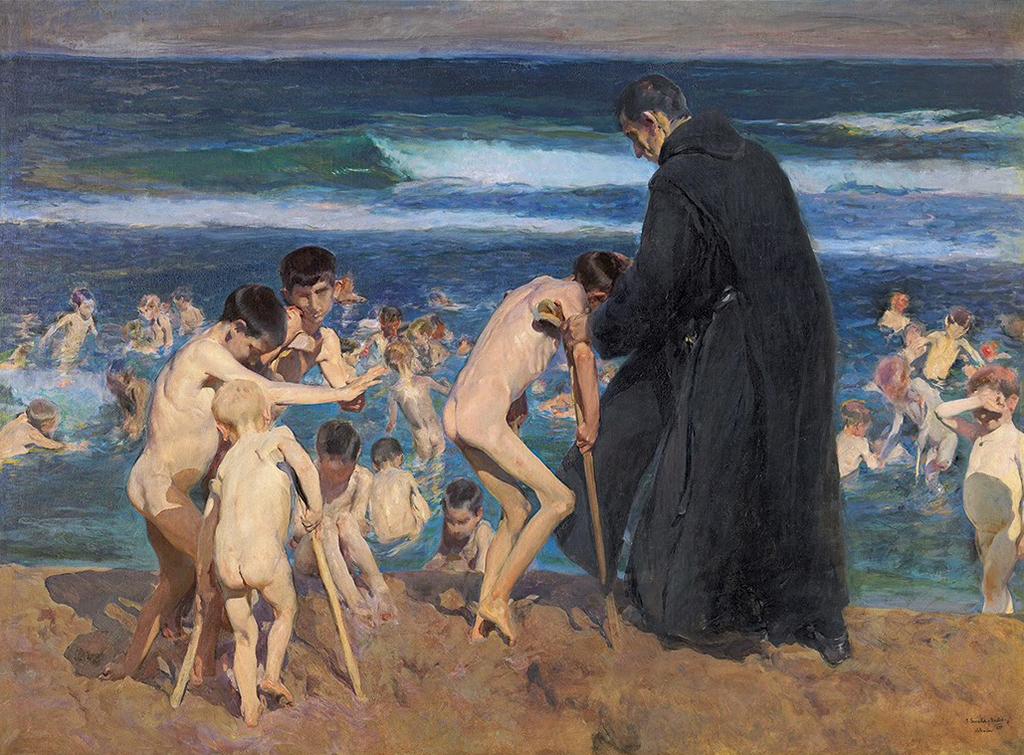
The children in Joaquín Sorolla’s Sad Inheritance occupy the threshold between land and sea. Some stand on the sand, some are partly immersed, and others appear farther out among the waves. Their bodies turn in different directions. At the right of the foreground, a religious brother bends towards a boy using a crutch; at the left, children gather around another pair of crutches. These close exchanges unfold against an enormous spread of water. Assistance and bathing belong to the same scene.
Painted in 1899, ¡Triste herencia! is an oil on canvas measuring 212 × 288 centimetres, now in the collection of Fundación Bancaja.[1] Its scale gives the encounter a public presence. The shore fills almost the whole picture, leaving only a narrow strip of sky. Sorolla brings the nearest children close enough for us to follow the relationships between hands, shoulders, feet and supports, while the sea continues far beyond them. The image holds together a specific moment of human contact and a space that no single figure controls.
The title places a heavy interpretation on what we see. It belongs to a period in which disability could be discussed through assumptions about inherited misfortune and moral fault. The children’s appearance does not establish those explanations. Looking closely at the painting, and at the language of its early admirers, reveals a more complicated relationship between its subject, its formidable pictorial construction and the meanings audiences brought to it.
At a Glance
- ArtistJoaquín Sorolla
- SubjectSad Inheritance by Joaquín Sorolla
- Date1899
- CollectionFundación Bancaja
This work across Joaquín Sorolla’s career
Contents
- The shore as a meeting place
- A dark habit against a coloured sea
- What the title asks us to believe
- Encounter and preparation
- Paris: a social picture among other shores
- Recognition, movement and later recollection
The shore as a meeting place
The foreground is divided into two principal groups, with an opening between them. On the right, the brother’s dark habit makes a large, nearly continuous shape. His head inclines, one arm reaches towards the boy, and the broad fall of the garment leads down to the sand. Beside him, the boy’s exposed back and bent legs create an angular counterform. The crutch provides a slender upright between the two bodies. Where the garment appears weighty and settled, the boy’s stance is more visibly dependent on a sequence of separate points of support.
This relationship is conveyed through posture rather than an elaborate exchange of expressions. The brother’s face is turned down; the boy’s face is largely hidden. We follow the direction of the adult’s attention through his bowed head and extended arm. The painting gives us enough to recognise an act of assistance, without supplying the words exchanged or the feelings of either person. The physical connection is precise; their private experience remains their own.
The left-hand group is more interwoven. One child faces away from us, with the long diagonals of crutches descending beside his body. Other children stand close behind and to the side. An arm extends across the group, interrupting the vertical pattern of bodies and supports. Heads appear at different heights, and the overlapping shoulders make it difficult to separate every contour immediately. The group asks for slower looking than the strong silhouette of the brother. Its structure emerges through successive contacts and partial views.
Between the groups, the sand remains visible. This interval is small, but important: it allows the central boy’s feet and the angle of his crutch to be read clearly. It also prevents the foreground from becoming an unbroken line of figures. The eye can move through the opening towards children at the water’s edge, where a head or a back catches the light. Nearness and distance are connected through bodies rather than through a road, a building or a sequence of landscape landmarks.
The waterline provides a further diagonal, cutting across the lower part of the painting. Its irregular edge makes standing on the beach and entering the sea appear as adjacent conditions. Sand, shallow water and deeper water do not occupy sealed compartments. Children sit, stand and bathe at different points along their meeting. The composition thus gives assistance a particular setting: it happens on an unstable border, beside water that is visibly moving.
At the outer edges, figures are cut by the frame. On the right a child raises an arm towards his face, while another body continues beyond the boundary. At the left, a smaller figure is partly lost at the edge. These interruptions suggest a gathering extending beyond the portion shown. The foreground is carefully organised, yet the whole activity does not appear arranged exclusively for the spectator. We have been given a close view within a larger occasion.
Sad Inheritance by Joaquín Sorolla — larger view
A dark habit against a coloured sea
The brother’s garment anchors the picture through its size and darkness. It reaches from near the top of the canvas almost to the bottom, linking the distant sea to the nearest sand. Its outline is especially clear against the pale surf and the illuminated skin of the boy beside it. The body beneath the habit is mostly concealed, so that weight, movement and attention must be read through the garment’s fall and the exposed head and hand.
Within this dark mass there are still distinctions. Folds change direction around the arm and through the lower skirt. Some passages appear warmer, others cooler; small touches along the edges allow the cloth to remain separate from the water and sand. The garment does not become a flat hole in the colour. Its relative stillness makes the broken movement around it more apparent.
The children’s bodies are painted through a different rhythm. Light spreads over a shoulder, a curved back or a thigh, then breaks into shadow at a joint or beneath an arm. Their flesh is not one uniform pale colour. Warm ochres and pinks sit beside cooler shadows and the reflected colours of the shore. Close to the water, a body can appear partly continuous with the green and blue surrounding it. The contrast between clothed adult and unclothed children is therefore also a contrast between a large enclosed form and many small, changing surfaces.
Across the upper half, the sea is built from horizontal bands. Deep blue water gives way to a green swell, white foam and a nearer expanse crossed by smaller disturbances. The waves stretch sideways, while the foreground bodies turn, bend and overlap. This meeting of long horizontal movement with short, irregular human gestures helps hold the canvas together. The sea offers breadth; the groups on the sand concentrate attention.
The brightest surf does not coincide with the foreground act of assistance. It runs behind the brother’s shoulders, drawing the eye up and across the composition. Below it, the crowded bathing area is more fragmented: heads, limbs, reflections and foam compete for recognition. Sorolla varies the degree of definition with distance. A hand in the foreground needs a different pictorial emphasis from a head appearing above the water farther back.
These differences also complicate the idea that this is simply a dark painting. Its subject and title encouraged sombre interpretations, but the surface contains considerable colour and brightness. Even the shadowed water is active with blue and green. The sand carries violet shadows, and sunlit bodies punctuate the middle distance. The painting’s gravity depends on the relationships between these elements, rather than on the exclusion of light.
What the title asks us to believe
Sad Inheritance is often discussed as one of Sorolla’s major social paintings. The term is useful when it draws attention to the public significance given to contemporary lives. Here, a group of children in institutional care becomes the subject of a large exhibition canvas. The picture asks its audience to spend time with people whose circumstances were frequently interpreted through charity, dependence and social judgment.
The title goes further than identifying the scene. “Inheritance” invites a causal explanation: it suggests that the children have received a burden from an earlier generation. Yet the painted bodies cannot tell us why a particular child uses a crutch, who the children’s parents were, or what their family histories might have been. The distinction between the visible subject and the title’s implied explanation matters because early critics often treated that explanation as self-evident.
Writing in an essay first published in January 1901, Aureliano de Beruete identified the adult as a brother of San Juan de Dios and described children being taken to bathe. His account also used stigmatising categories and connected the scene to supposed social vice.[2] Those claims tell us about the framework through which an influential admirer read the work. They cannot serve as diagnoses of the children. The institution’s identity and the critic’s judgments about its charges are different kinds of evidence.
Beruete’s visual attention could be acute even when his language about disability was prejudiced. He noticed the foreground groups, the severe outline of the habit and a sunlit child in the water. He compared the brother to the monks and ascetics of seventeenth-century Spanish painting.[2] That comparison helps explain why the adult could appear familiar to an exhibition audience: a figure of religious care was also legible through an established tradition of Spanish art. It does not prove that Sorolla copied a particular earlier painting.
The comparison places considerable interpretive weight on the adult. His scale and clothing give him a commanding presence, and early criticism made him the principal bearer of protection and dignity. The image also directs attention towards the children’s relationships with one another. The left-hand group has its own network of gestures; the background contains many separate actions. No single adult can account for all the human activity in the canvas.
Leonard Williams, writing in 1909, made the title’s assumptions more explicit. He contrasted the children with working fishing communities and attached unsupported moral judgments to their parentage. He also described their attitudes as universally joyless and the sea as responding to the scene’s emotional character.[3] His prose gives the reader a strongly directed experience before there is much opportunity to look independently. The visible variety of gestures in the water is absorbed into one overarching judgment.
Returning to the picture makes that uniformity difficult to sustain. Some figures are bent or seated, others are upright; arms reach, bodies turn, and heads look in different directions. These gestures do not disclose a reliable catalogue of emotions. They do show that the gathering is more varied than the critic’s summary allows. The children occupy a shared setting, but they do not become interchangeable expressions of the title.
Recent scholarship has examined precisely this openness to different public meanings. Rachel Vorsanger’s study of Sorolla’s social realism argues that Sad Inheritance could carry different emotional and political force in France and Spain.[4] Her approach is a useful reminder that a painting’s reception depends on the circumstances of viewing. The title, the exhibition setting and the language surrounding the work all helped shape what audiences believed they were seeing.

Comparison: Aureliano de Beruete by Joaquín Sorolla
Encounter and preparation
Fundación Bancaja reports Sorolla’s recollection of encountering the group while studying Valencian fishing subjects in 1899 and obtaining permission to paint beside the water.[1] The impression of a suddenly encountered scene should be considered alongside the painting’s sustained organisation.
The foundation records colour notes, ink compositions and figure drawings, with preparatory works given to Chase, Laparra, Sargent and Bonnat.[1]
In the finished canvas, the broad relation of foreground to sea must work at a distance, while each overlap in the nearest groups needs to remain intelligible. Looking at the whole and following the contacts within it are complementary ways of understanding its construction.
The large format makes this coordination especially consequential. A slight change to the brother’s position would alter the balance of the whole right side. Moving a crutch would change how a child’s stance is understood. Shifting a head in the left-hand group could open or close the view towards the water. The completed picture presents a moment, but its legibility depends on relationships that can be tested and revised.
These gifts gave the preparatory works a place in professional exchanges. The smaller objects could command attention beyond their service to the large canvas.
Paris: a social picture among other shores
Beruete’s account of the Paris Universal Exhibition of 1900 is particularly valuable because he served on its international painting jury. He recalled an enthusiastic response to Sorolla’s display and the award of a Grand Prix.[2] His description places Sad Inheritance within a group of paintings, rather than leaving it alone as the sole explanation of Sorolla’s success.
He described a nearby bathing picture in which women prepare to wrap a small child in a white sheet. The sea and fishing boats form its background. For Beruete, this made a strong contrast with Sad Inheritance: the same coast could prompt quite different emotional readings. He associated the first with morning brightness and the second with the fading day.[2] His distinction belongs to his interpretation of the pictures, but it shows that the contrast between them was already central to an early response.
Beruete also placed a painting of fishermen eating in their boat beside Sad Inheritance, with Sewing the Sail nearby. The latter drew his admiration for making a piece of canvas and the work around it compelling.[2] Visitors could therefore encounter several relationships between bodies and the coastal environment: bathing, assistance, rest and labour. Sorolla’s range was present within the display itself.
That proximity is useful when comparing Sad Inheritance with Sewing the Sail. Both give a large area of the picture to something that can dominate individual figures: an expanse of water in one, a spread of sailcloth in the other. People are understood through their positions around these fields and through the directions of their arms. The human significance emerges from the arrangement of an activity, rather than from a single face presented in isolation.
A comparison with Return from Fishing makes another distinction clear. Coastal work can gather people, animals and equipment into a shared effort, with movement organised around a task. In Sad Inheritance, the nearest gestures concern balance and assistance. The beach remains a place of bodily effort, but its effort has a different purpose. Reducing Sorolla’s shore to an emblem of uncomplicated vitality would obscure this difference.
The distinction need not become a story in which one kind of painting cancels another. His social subjects and coastal scenes share an interest in how bodies occupy space, how people act together and how light reveals their surroundings. The demands placed on those interests change from canvas to canvas. Here, expansive outdoor painting gives particular weight to a small number of close contacts.
Beruete also recalled visiting the exhibition with Sorolla after the award. He presented the painter as still critical of his own work, conscious of its imperfections when seen under different lighting and beside other artists’ pictures.[2] This recollection shifts the emphasis from the finished canvas as a triumphant, self-contained achievement to the experience of seeing it in a new environment. A painting made around outdoor light becomes an object viewed indoors, alongside other canvases, under conditions its subject cannot determine.
The observation has particular relevance to Sad Inheritance. Its balance depends on the dark habit remaining articulated, the nearest bodies standing clearly against water and sand, and the background retaining its many small movements. A reproduction can show those relationships, but the painting’s large physical scale adds another dimension: the groups occupy an area comparable to the viewer’s own bodily space. Its exhibition history concerns this substantial object as well as the recognisable image it carries.
Recognition, movement and later recollection
The painting received Madrid’s Medal of Honour in 1901. Bancaja records that a hoped-for state purchase failed; Sorolla withdrew it in December 1902 and sold it to Jesús Vidal. It later passed to John E. Berwind and the Church of the Ascension in New York. Bancaja acquired it at auction in 1981.[1]
Williams provides a contemporary glimpse of that American history. A footnote to his 1909 essay identifies the Church of the Ascension’s Sunday-school room as the painting’s location and credits Berwind and the rector, Percy Stickney Grant, with its loan to the Hispanic Society exhibition.[3] This specific acknowledgment shows how a canvas associated with European exhibition honours could become available to a new public through local relationships in New York.
The church setting also placed its scene of religious care in a different environment from an international exhibition hall. That circumstance does not tell us how every visitor responded. It does, however, change the picture’s immediate surroundings and the associations an audience might bring to the brother’s presence. The history of the painting includes these successive settings as well as its date of execution and its prizes.
Sorolla’s own later distance from the subject is another part of its reception. Duncan C. Phillips, Jr., writing after a visit to the painter in Madrid in 1912, reported his reluctance to make another picture of this kind. Phillips placed the exchange within an account of Sorolla’s preference for joyful subjects and his enthusiasm for light.[5] It is a critic’s report of a conversation, shaped by the argument of his essay, rather than an unrestricted statement of intention for every later canvas.
That recollection should not make the painting seem an accidental interruption in an otherwise coherent career. Its colour, scale and attention to bodily movement belong closely to Sorolla’s larger practice. What differs is the public burden carried by the subject and its title. The encounter required him to make a large outdoor picture in which assistance, exposure and the presence of other people remain central.
Seen closely, the painting repeatedly returns attention to the distance between a broad interpretation and a particular gesture. The title proposes an inherited fate; a hand reaches towards a shoulder. A critic describes universal gloom; a child farther back stands bright against the water. The brother’s dark silhouette gathers the composition, but the sea and the scattered bathers continue on either side. The canvas sustains these different scales of attention, allowing the human encounter to remain more particular than the explanations once imposed upon it.
Watch: Sorolla, light and painting
Three National Gallery films offer an introduction, a closer look at technique and a longer curator’s talk.
An introduction to 'Sorolla: Spanish Master of Light'
Start with a short exhibition introduction to Sorolla’s subjects and career.
Watch on YouTubeArtworks and exhibition records
Browse 103 artwork articles, 350 numbered entries from the Hispanic Society’s 1909 New York catalogue, and two selected Meadows Museum drawings. These are records, not a count of unique artworks: repeated historical titles remain separate entries and may overlap with the articles. A catalogue’s exhibition year does not establish an execution date. This researched selection is not a complete catalogue raisonné.
| Name | Date | Medium |
|---|---|---|
| Women Walking on the Beach | 1909 | Painting |
| Sewing the Sail | 1896 | Painting |
| Running Along the Beach | 1908 | Painting |
| Sad Inheritance | 1899 | Painting |
| Mother | 1895–1900 | Painting |
| The Horse's Bath | 1909 | Painting |
| The Pink Robe | 1916 | Painting |
| And They Still Say Fish are Expensive! | 1894 | Painting |
| The Return from Fishing | 1894 | Painting |
| Children on the Beach | 1909 | Painting |
| Castilla, the Feast of Bread | 1913 | Painting |
| Sevilla, Holy Week Penitents | 1914 | Painting |
| Aragon, Jota | 1914 | Painting |
| Navarre, the Town Council of Roncal | 1914 | Painting |
| Guipúzcoa, Bowling | 1914 | Painting |
| Andalucía, El Encierro | 1914 | Painting |
| Seville, the Dance | 1915 | Painting |
| Sevilla, The Bullfighters | 1915 | Painting |
| Galicia, The Pilgrimage | 1915 | Painting |
| The Fish | 1915 | Painting |
| Valencia, Couples on Horseback | 1916 | Painting |
| Extremadura, The Market | 1917 | Painting |
| Elche, The Palm Grove | 1918–1919 | Painting |
| The Tunny Catch | 1919 | Painting |
| Louis Comfort Tiffany | 1911 | Painting |
| Adobe Houses | 1890–1895 | Painting |
| After Bathing | 1915 | Painting |
| After Bathing, Valencia | 1909 | Painting |
| After Bathing, Valencian Beach | 1908 | Painting |
| Afternoon Sun, Playa de Valencia | 1910 (Album catalogue) | Painting |
| Aim of Ibiza | 1919 | Painting |
| Almond Trees in Asis | Spring,1887–1889 | Painting |
| Another Margarita | 1892 | Painting |
| Antonio García at the Beach | 1909 | Painting |
| Around Segovia | 9–15 October 1906 | Painting |
| Artist's Patio, Cafe Novedades, Seville | 1915 | Painting |
| Asturian Landscape | circa 1904 | Painting |
| Aureliano de Beruete | 1902 | Painting |
| Aureliano de Beruete y Moret, Son | 1902 | Painting |
| The Bath, Jávea | 1905 | Painting |
| The Bathing Hour | 1915 execution, signed and dated1917 (Sothebys catalogue account) | Painting |
| Bathing Time | 1904 | Painting |
| Beach at Valencia | 1908 in ARC catalogue | Painting |
| Beach at Zarauz | 1910 | Painting |
| Beach of Biarritz | 1906 | Painting |
| Beach of Biarritz, France | Summer1906 | Painting |
| Beached Boats | 1915 | Painting |
| Beaching the Boat | 1908 in ARC catalogue | Painting |
| Blessing the Boat | 1895 | Painting |
| Blind Man of Toledo | 1906 | Painting |
| Boat Builders | 1894 | Painting |
| Boat in Albufera | 1895 | Painting |
| Boy on the Sand | Undated | Painting |
| Boys in the Sea | 1908 | Painting |
| Boys on the Beach | BeforeNewYork1909exhibition; exactyearunresolved | Painting |
| Breakwater, San Sebastian | 1917–1918 | Painting |
| Bulls in the Sea | 1903 | Painting |
| Capturing the Moment | 1906 | Painting |
| Castle of La Mota, Medina del Campo | 29 May 1912 | Painting |
| Children in the Sea | Painting | |
| Children on the Beach, Valencia | 1916 | Painting |
| Children on the Seashore | 1903 | Painting |
| Child's Siesta | circa 1918 (ARC catalogue) | Painting |
| Church Roncal Stairs | 22–28August1912 | Painting |
| Clothilde at the Beach | Summer1904 | Painting |
| Clotilde and Elena on the Rocks at Javea | 1905 | Painting |
| Clotilde García del Castillo | April1890 | Painting |
| Clotilde in a Grey Dress | 1900 | Painting |
| Clotilde with Hat | 1910 | Painting |
| Coast at Santa Cristina | 29 September 1915 (current CERES1122) | Painting |
| Court of the Dances, Alcázar, Sevilla | 1910 | Painting |
| Covachuelas, Toledo | 21–30 October 1906 | Painting |
| Dragging the Trawler | circa 1903–1904 in educational catalogue | Painting |
| El Retiro, Madrid | 1898 | Painting |
| Female Nude | 1902 | Painting |
| Fisherman in Valencia | 1904 | Painting |
| Fisherwomen from Valencia | June–July 1915 | Painting |
| Fishing Boats | by February 1909 | Painting |
| Fishing Nets | 1893 | Painting |
| The Gardens at the Sorolla Family House | spring 1920 | Painting |
| Hall of the Ambassadors, Alhambra, Granada | 1909 | Painting |
| Harbour | 1880 | Painting |
| Joaquín Sorolla García in a White Dress | 1896 | Painting |
| Lighthouse Walk at Biarritz | 1906 | Painting |
| The Little Yacht | 1909 | Painting |
| Maria at La Granja | 1907 | Painting |
| My Children | 1904 | Painting |
| My Wife and Daughters in the Garden | 1910 | Painting |
| Portrait of Benito Pérez Galdós | 1894 | Painting |
| A Rooftop with Flowers | 1902 | Painting |
| Self Portrait | 1904 | Painting |
| Self Portrait | 1909 | Painting |
| Señora de Sorolla in Black | 1906 | Painting |
| La Siesta | 1911 | Painting |
| The Skipping Rope | 1907 | Painting |
| Swimmers, Jávea | 1905 | Painting |
| Time for a Bathe | 1909 | Painting |
| Under the Awning, Zarauz | 1910 | Painting |
| Valencia Beach in the Morning Light | summer 1908 | Painting |
| Valencian Fishermen | 1895 | Painting |
| The White Boat, Jávea | 1905 | Painting |
| White Slave Trade | 1894 | Painting |
| The Wounded Foot | 1909 | Painting |
| Seven Peaks, Guadarrama — 1909 catalogue, no. 1 | Painting | |
| Covachuelas, Toledo — 1909 catalogue, no. 2 | Painting | |
| Las Pedrizas, El Pardo — 1909 catalogue, no. 3 | Painting | |
| Señor Gomar — 1909 catalogue, no. 4 | Painting | |
| El Torneo, El Pardo — 1909 catalogue, no. 5 | Painting | |
| A Toledo Street — 1909 catalogue, no. 6 | Painting | |
| View from El Torneo — 1909 catalogue, no. 7 | Painting | |
| Walls of Segovia — 1909 catalogue, no. 8 | Painting | |
| Convent of El Parral, Segovia — 1909 catalogue, no. 9 | Painting | |
| Environs of Segovia — 1909 catalogue, no. 10 | Painting | |
| Reflections from the Cape, Jávea — 1909 catalogue, no. 11 | Painting | |
| The Clamores, Segovia — 1909 catalogue, no. 12 | Painting | |
| Rocks of the Cape, Jávea — 1909 catalogue, no. 13 | Painting | |
| Farmhouse, Alcira — 1909 catalogue, no. 14 | Painting | |
| María at Biarritz — 1909 catalogue, no. 15 | Painting | |
| Shadow of the Alcántara Bridge, Toledo — 1909 catalogue, no. 16 | Painting | |
| Castle of San Servando, Toledo — 1909 catalogue, no. 17 | Painting | |
| Dr Decret — 1909 catalogue, no. 18 | Painting | |
| Alcántara Bridge, Toledo — 1909 catalogue, no. 19 | Painting | |
| The Forest, La Granja — 1909 catalogue, no. 20 | Painting | |
| Trout Stream, La Granja — 1909 catalogue, no. 21 | Painting | |
| Court of the Dances, Alcázar, Seville — 1909 catalogue, no. 22 | Painting | |
| Oleanders — 1909 catalogue, no. 23 | Painting | |
| Glen, Asturias — 1909 catalogue, no. 24 | Painting | |
| Pavilion of Charles V, Seville — 1909 catalogue, no. 25 | Painting | |
| St Martin's Bridge, Toledo — 1909 catalogue, no. 26 | Painting | |
| Orange Trees — 1909 catalogue, no. 27 | Painting | |
| Rope Makers — 1909 catalogue, no. 28 | Painting | |
| Señor Franzen — 1909 catalogue, no. 29 | Painting | |
| Rocks at the Lighthouse, Biarritz — 1909 catalogue, no. 30 | Painting | |
| St Martin's Bridge, Toledo — 1909 catalogue, no. 31 | Painting | |
| Valencian Fisherwoman — 1909 catalogue, no. 32 | Painting | |
| Road of San Esteban, Asturias — 1909 catalogue, no. 33 | Painting | |
| Basin in the Alcázar, Seville — 1909 catalogue, no. 34 | Painting | |
| Harbour of Valencia — 1909 catalogue, no. 35 | Painting | |
| Haymaking, Asturias — 1909 catalogue, no. 36 | Painting | |
| House of El Greco, Toledo — 1909 catalogue, no. 37 | Painting | |
| María with a Black Hat — 1909 catalogue, no. 38 | Painting | |
| Entrance Tower, Toledo — 1909 catalogue, no. 39 | Painting | |
| Las Covachuelas, Toledo — 1909 catalogue, no. 40 | Painting | |
| Rocks, Jávea — 1909 catalogue, no. 41 | Painting | |
| Road of the Alijares, Toledo — 1909 catalogue, no. 42 | Painting | |
| Segovian Family — 1909 catalogue, no. 43 | Painting | |
| Scalding Grapes, Jávea — 1909 catalogue, no. 44 | Painting | |
| Joaquín — 1909 catalogue, no. 45 | Painting | |
| Elena — 1909 catalogue, no. 46 | Painting | |
| El Grutesco, Alcázar, Seville — 1909 catalogue, no. 47 | Painting | |
| Beach of Valencia — 1909 catalogue, no. 48 | Painting | |
| Sails Drying, Valencia — 1909 catalogue, no. 49 | Painting | |
| Orange Tree — 1909 catalogue, no. 50 | Painting | |
| Little Boy with a Toy Boat — 1909 catalogue, no. 51 | Painting | |
| Old Valencian Fisherman — 1909 catalogue, no. 52 | Painting | |
| Fishing Boats — 1909 catalogue, no. 53 | Painting | |
| Harbour of Valencia — 1909 catalogue, no. 54 | Painting | |
| The Kiss — 1909 catalogue, no. 55 | Painting | |
| Little Boy on a Rock, Jávea — 1909 catalogue, no. 56 | Painting | |
| The Queen's Beam, Valsaín — 1909 catalogue, no. 57 | Painting | |
| Staircase of the Palace, La Granja — 1909 catalogue, no. 58 | Painting | |
| Elena at El Pardo — 1909 catalogue, no. 59 | Painting | |
| Fountain of the Horses, La Granja — 1909 catalogue, no. 60 | Painting | |
| Autumn, La Granja — 1909 catalogue, no. 61 | Painting | |
| María Painting, El Pardo — 1909 catalogue, no. 62 | Painting | |
| Fountain of the Forest, La Granja — 1909 catalogue, no. 63 | Painting | |
| Fountain of Neptune, La Granja — 1909 catalogue, no. 64 | Painting | |
| Orange Grove, Valencia — 1909 catalogue, no. 65 | Painting | |
| Francisqueta, Valencia — 1909 catalogue, no. 66 | Painting | |
| Waiting for the Fish, Valencia — 1909 catalogue, no. 67 | Painting | |
| Taking in the Sail, Valencia — 1909 catalogue, no. 68 | Painting | |
| Return from Fishing, Valencia — 1909 catalogue, no. 69 | Painting | |
| Crayfishers, Valencia — 1909 catalogue, no. 70 | Painting | |
| Swimmer, Jávea — 1909 catalogue, no. 71 | Painting | |
| Elena among Roses — 1909 catalogue, no. 72 | Painting | |
| Idyll — 1909 catalogue, no. 73 | Painting | |
| Vicente Blasco Ibáñez — 1909 catalogue, no. 74 | Painting | |
| Yellow Tree, La Granja — 1909 catalogue, no. 75 | Painting | |
| Blind Man of Toledo — 1909 catalogue, no. 76 | Painting | |
| Fisherwoman with Her Son, Valencia — 1909 catalogue, no. 77 | Painting | |
| The Bath, La Granja — 1909 catalogue, no. 78 | Painting | |
| Sewing the Sail, Valencia — 1909 catalogue, no. 79 | Painting | |
| Looking for Crabs, Jávea — 1909 catalogue, no. 80 | Painting | |
| María, La Granja — 1909 catalogue, no. 81 | Painting | |
| Joaquín and His Dog — 1909 catalogue, no. 82 | Painting | |
| Upon the Sand — 1909 catalogue, no. 83 | Painting | |
| Valencian Fisherwomen — 1909 catalogue, no. 84 | Painting | |
| Señora de Sorolla in White — 1909 catalogue, no. 85 | Painting | |
| At the Seashore, Valencia — 1909 catalogue, no. 86 | Painting | |
| Valencian Woman — 1909 catalogue, no. 87 | Painting | |
| In the Gardens of La Granja — 1909 catalogue, no. 88 | Painting | |
| Old Castilian — 1909 catalogue, no. 89 | Painting | |
| Marqués de Urquijo — 1909 catalogue, no. 90 | Painting | |
| Fisherman's Daughter, Valencia — 1909 catalogue, no. 91 | Painting | |
| Elena and Her Dolls — 1909 catalogue, no. 92 | Painting | |
| My Children — 1909 catalogue, no. 93 | Painting | |
| Swimmers — 1909 catalogue, no. 94 | Painting | |
| Low Tide: Elena at Biarritz — 1909 catalogue, no. 95 | Painting | |
| Mending Nets — 1909 catalogue, no. 96 | Painting | |
| The Bath, Jávea — 1909 catalogue, no. 97 | Painting | |
| The Bath, Jávea — 1909 catalogue, no. 98 | Painting | |
| Boxing Raisins — 1909 catalogue, no. 99 | Painting | |
| Forest Bridge, La Granja — 1909 catalogue, no. 100 | Painting | |
| View of the Palace, La Granja — 1909 catalogue, no. 101 | Painting | |
| Return from Fishing, Valencia — 1909 catalogue, no. 102 | Painting | |
| At the Bath, Valencia — 1909 catalogue, no. 103 | Painting | |
| Little Girl with a Blue Ribbon, Valencia — 1909 catalogue, no. 104 | Painting | |
| María at the Harbour of Jávea — 1909 catalogue, no. 105 | Painting | |
| Instantaneous, Biarritz — 1909 catalogue, no. 106 | Painting | |
| Boy among Breakers, Jávea — 1909 catalogue, no. 107 | Painting | |
| Garden of the Alcázar, Seville — 1909 catalogue, no. 108 | Painting | |
| Oleander Road, Valencia — 1909 catalogue, no. 109 | Painting | |
| María and Her Grandmother — 1909 catalogue, no. 110 | Painting | |
| Malvarrosa Beach, Valencia — 1909 catalogue, no. 111 | Painting | |
| The Huerta of Valencia — 1909 catalogue, no. 112 | Painting | |
| Garden of the Alcázar, Seville — 1909 catalogue, no. 113 | Painting | |
| Garden of the Alcázar, Seville — 1909 catalogue, no. 114 | Painting | |
| The Giralda, Seville — 1909 catalogue, no. 115 | Painting | |
| Palace of Charles V, Seville — 1909 catalogue, no. 116 | Painting | |
| Harbour of Valencia — 1909 catalogue, no. 117 | Painting | |
| Marqués de la Vega-Inclán — 1909 catalogue, no. 118 | Painting | |
| Harbour of Valencia — 1909 catalogue, no. 119 | Painting | |
| At the Water, Valencia — 1909 catalogue, no. 120 | Painting | |
| House in the Huerta, Valencia — 1909 catalogue, no. 121 | Painting | |
| Beach Garden, Valencia — 1909 catalogue, no. 122 | Painting | |
| Huerta of Valencia — 1909 catalogue, no. 123 | Painting | |
| Garden of the Alcázar, Seville — 1909 catalogue, no. 124 | Painting | |
| Asturias — 1909 catalogue, no. 125 | Painting | |
| San Sebastián — 1909 catalogue, no. 126 | Painting | |
| Old Harbour, Biarritz — 1909 catalogue, no. 127 | Painting | |
| Beach of Biarritz — 1909 catalogue, no. 128 | Painting | |
| Beach of Biarritz — 1909 catalogue, no. 129 | Painting | |
| Beach of Biarritz — 1909 catalogue, no. 130 | Painting | |
| Beach of Biarritz — 1909 catalogue, no. 131 | Painting | |
| Beach of Biarritz — 1909 catalogue, no. 132 | Painting | |
| Beach of Biarritz — 1909 catalogue, no. 133 | Painting | |
| Beach of Biarritz — 1909 catalogue, no. 134 | Painting | |
| Beach of Biarritz — 1909 catalogue, no. 135 | Painting | |
| Beach of Biarritz — 1909 catalogue, no. 136 | Painting | |
| Beach of Biarritz — 1909 catalogue, no. 137 | Painting | |
| Beach of Biarritz — 1909 catalogue, no. 138 | Painting | |
| Beach of Biarritz — 1909 catalogue, no. 139 | Painting | |
| Beach of Biarritz — 1909 catalogue, no. 140 | Painting | |
| Beach of Biarritz — 1909 catalogue, no. 141 | Painting | |
| Beach of Biarritz — 1909 catalogue, no. 142 | Painting | |
| Beach of Biarritz — 1909 catalogue, no. 143 | Painting | |
| La Concha, San Sebastián — 1909 catalogue, no. 144 | Painting | |
| Beach of Biarritz — 1909 catalogue, no. 145 | Painting | |
| Beach of Biarritz — 1909 catalogue, no. 146 | Painting | |
| Beach of Biarritz — 1909 catalogue, no. 147 | Painting | |
| Beach of Biarritz — 1909 catalogue, no. 148 | Painting | |
| Beach of Biarritz — 1909 catalogue, no. 149 | Painting | |
| Beach of Biarritz — 1909 catalogue, no. 150 | Painting | |
| Beach of Biarritz — 1909 catalogue, no. 151 | Painting | |
| Beach of Biarritz — 1909 catalogue, no. 152 | Painting | |
| Beach of Biarritz — 1909 catalogue, no. 153 | Painting | |
| Beach of Biarritz — 1909 catalogue, no. 154 | Painting | |
| Beach of Valencia — 1909 catalogue, no. 155 | Painting | |
| Beach of Valencia — 1909 catalogue, no. 156 | Painting | |
| Beach of Valencia — 1909 catalogue, no. 157 | Painting | |
| Harbour of San Sebastián — 1909 catalogue, no. 158 | Painting | |
| Harbour of San Sebastián — 1909 catalogue, no. 159 | Painting | |
| Beach of Valencia — 1909 catalogue, no. 160 | Painting | |
| Pasajes — 1909 catalogue, no. 161 | Painting | |
| Harbour of San Sebastián — 1909 catalogue, no. 162 | Painting | |
| La Concha, San Sebastián — 1909 catalogue, no. 163 | Painting | |
| La Concha, San Sebastián — 1909 catalogue, no. 164 | Painting | |
| Harbour of Pasajes — 1909 catalogue, no. 165 | Painting | |
| Beach of Valencia — 1909 catalogue, no. 166 | Painting | |
| Beach of Valencia — 1909 catalogue, no. 167 | Painting | |
| Beach of Valencia — 1909 catalogue, no. 168 | Painting | |
| Beach of Valencia — 1909 catalogue, no. 169 | Painting | |
| Beach of Valencia — 1909 catalogue, no. 170 | Painting | |
| Beach of Valencia — 1909 catalogue, no. 171 | Painting | |
| Beach of Valencia — 1909 catalogue, no. 172 | Painting | |
| Beach of Valencia — 1909 catalogue, no. 173 | Painting | |
| Beach of Valencia — 1909 catalogue, no. 174 | Painting | |
| Beach of Valencia — 1909 catalogue, no. 175 | Painting | |
| Beach of Valencia — 1909 catalogue, no. 176 | Painting | |
| Beach of Valencia — 1909 catalogue, no. 177 | Painting | |
| Cape San Antonio, Jávea — 1909 catalogue, no. 178 | Painting | |
| Galicia — 1909 catalogue, no. 179 | Painting | |
| Sewing the Sail — 1909 catalogue, no. 180 | Painting | |
| Poppies — 1909 catalogue, no. 181 | Painting | |
| Beach of Valencia — 1909 catalogue, no. 182 | Painting | |
| Malvarrosa — 1909 catalogue, no. 183 | Painting | |
| Harbour of San Sebastián — 1909 catalogue, no. 184 | Painting | |
| Beach of Valencia — 1909 catalogue, no. 185 | Painting | |
| Locutory — 1909 catalogue, no. 186 | Painting | |
| Beach of Valencia — 1909 catalogue, no. 187 | Painting | |
| Beach of Valencia — 1909 catalogue, no. 188 | Painting | |
| Cape San Antonio, Jávea — 1909 catalogue, no. 189 | Painting | |
| Beach of Valencia — 1909 catalogue, no. 190 | Painting | |
| Oleanders — 1909 catalogue, no. 191 | Painting | |
| Beach of Valencia — 1909 catalogue, no. 192 | Painting | |
| La Concha, San Sebastián — 1909 catalogue, no. 193 | Painting | |
| Beach of Valencia — 1909 catalogue, no. 194 | Painting | |
| Beach of Valencia — 1909 catalogue, no. 195 | Painting | |
| Beach of Valencia — 1909 catalogue, no. 196 | Painting | |
| Biarritz — 1909 catalogue, no. 197 | Painting | |
| Biarritz — 1909 catalogue, no. 198 | Painting | |
| Segovia — 1909 catalogue, no. 199 | Painting | |
| Asturias — 1909 catalogue, no. 200 | Painting | |
| Versailles — 1909 catalogue, no. 201 | Painting | |
| Beach of Valencia — 1909 catalogue, no. 202 | Painting | |
| Beach of Valencia — 1909 catalogue, no. 203 | Painting | |
| Beach of Valencia — 1909 catalogue, no. 204 | Painting | |
| Beach of Valencia — 1909 catalogue, no. 205 | Painting | |
| Court of El Cabañal — 1909 catalogue, no. 206 | Painting | |
| In the River — 1909 catalogue, no. 207 | Painting | |
| Harbour of Valencia — 1909 catalogue, no. 208 | Painting | |
| Beach of Valencia — 1909 catalogue, no. 209 | Painting | |
| Harbour of Valencia — 1909 catalogue, no. 210 | Painting | |
| Beach of Valencia — 1909 catalogue, no. 211 | Painting | |
| Beach of Valencia — 1909 catalogue, no. 212 | Painting | |
| Beach of Valencia — 1909 catalogue, no. 213 | Painting | |
| Royal Mallows — 1909 catalogue, no. 214 | Painting | |
| Geraniums — 1909 catalogue, no. 215 | Painting | |
| Altar of St Vincent, Valencia — 1909 catalogue, no. 216 | Painting | |
| Beach of Valencia — 1909 catalogue, no. 217 | Painting | |
| Harbour of Avilés — 1909 catalogue, no. 218 | Painting | |
| Beach of Valencia — 1909 catalogue, no. 219 | Painting | |
| Beach of Valencia — 1909 catalogue, no. 220 | Painting | |
| Beach of Valencia — 1909 catalogue, no. 221 | Painting | |
| Market of León — 1909 catalogue, no. 222 | Painting | |
| Beach of Valencia — 1909 catalogue, no. 223 | Painting | |
| Beach of Valencia — 1909 catalogue, no. 224 | Painting | |
| Beach of Valencia — 1909 catalogue, no. 225 | Painting | |
| Beach of Valencia — 1909 catalogue, no. 226 | Painting | |
| Beach of Valencia — 1909 catalogue, no. 227 | Painting | |
| Huerta of Valencia — 1909 catalogue, no. 228 | Painting | |
| Beach of Valencia — 1909 catalogue, no. 229 | Painting | |
| Beach of Valencia — 1909 catalogue, no. 230 | Painting | |
| Beach of Valencia — 1909 catalogue, no. 231 | Painting | |
| Beach of Valencia — 1909 catalogue, no. 232 | Painting | |
| Beach of Valencia — 1909 catalogue, no. 233 | Painting | |
| Beach of Valencia — 1909 catalogue, no. 234 | Painting | |
| Asturias — 1909 catalogue, no. 235 | Painting | |
| Beach of Valencia — 1909 catalogue, no. 236 | Painting | |
| Women Playing — 1909 catalogue, no. 237 | Painting | |
| Beach of Valencia — 1909 catalogue, no. 238 | Painting | |
| Beach of Valencia — 1909 catalogue, no. 239 | Painting | |
| Beach of Valencia — 1909 catalogue, no. 240 | Painting | |
| Beach of Valencia — 1909 catalogue, no. 241 | Painting | |
| Market of León — 1909 catalogue, no. 242 | Painting | |
| Beach of Valencia — 1909 catalogue, no. 243 | Painting | |
| Beach of Valencia — 1909 catalogue, no. 244 | Painting | |
| Beach of Valencia — 1909 catalogue, no. 245 | Painting | |
| Beach of Valencia — 1909 catalogue, no. 246 | Painting | |
| Asturias — 1909 catalogue, no. 247 | Painting | |
| León — 1909 catalogue, no. 248 | Painting | |
| Asturias — 1909 catalogue, no. 249 | Painting | |
| Jávea — 1909 catalogue, no. 250 | Painting | |
| Asturias — 1909 catalogue, no. 251 | Painting | |
| León — 1909 catalogue, no. 252 | Painting | |
| Asturias — 1909 catalogue, no. 253 | Painting | |
| Asturias — 1909 catalogue, no. 254 | Painting | |
| Beach of Valencia — 1909 catalogue, no. 255 | Painting | |
| Beach of Valencia — 1909 catalogue, no. 256 | Painting | |
| Asturias — 1909 catalogue, no. 257 | Painting | |
| León — 1909 catalogue, no. 258 | Painting | |
| Beach of Valencia — 1909 catalogue, no. 259 | Painting | |
| Beach of Valencia — 1909 catalogue, no. 260 | Painting | |
| Beach of Valencia — 1909 catalogue, no. 261 | Painting | |
| León — 1909 catalogue, no. 262 | Painting | |
| Beach of Valencia — 1909 catalogue, no. 263 | Painting | |
| Asturias — 1909 catalogue, no. 264 | Painting | |
| Galicia — 1909 catalogue, no. 265 | Painting | |
| Malvarrosa — 1909 catalogue, no. 266 | Painting | |
| Jávea — 1909 catalogue, no. 267 | Painting | |
| Biarritz — 1909 catalogue, no. 268 | Painting | |
| Harbour of Jávea — 1909 catalogue, no. 269 | Painting | |
| La Concha, San Sebastián — 1909 catalogue, no. 270 | Painting | |
| San Sebastián — 1909 catalogue, no. 271 | Painting | |
| San Sebastián — 1909 catalogue, no. 272 | Painting | |
| Beach of Valencia — 1909 catalogue, no. 273 | Painting | |
| Beach of Valencia — 1909 catalogue, no. 274 | Painting | |
| Beach of Valencia — 1909 catalogue, no. 275 | Painting | |
| Beach of Valencia — 1909 catalogue, no. 276 | Painting | |
| Beach of Valencia — 1909 catalogue, no. 277 | Painting | |
| Washerwomen — 1909 catalogue, no. 278 | Painting | |
| San Sebastián — 1909 catalogue, no. 279 | Painting | |
| Beach of Valencia — 1909 catalogue, no. 280 | Painting | |
| San Sebastián — 1909 catalogue, no. 281 | Painting | |
| San Sebastián — 1909 catalogue, no. 282 | Painting | |
| Beach of Valencia — 1909 catalogue, no. 283 | Painting | |
| Beach of Valencia — 1909 catalogue, no. 284 | Painting | |
| Uncle Pancha — 1909 catalogue, no. 285 | Painting | |
| Señor García — 1909 catalogue, no. 286 | Painting | |
| Boy Nude, La Granja — 1909 catalogue, no. 287 | Painting | |
| Señora de Sorolla in Black — 1909 catalogue, no. 288 | Painting | |
| Duke of Alba — 1909 catalogue, no. 289 | Painting | |
| Mother: Señora de Sorolla — 1909 catalogue, no. 290 | Painting | |
| Running along the Beach — 1909 catalogue, no. 291 | Painting | |
| After the Bath — 1909 catalogue, no. 292 | Painting | |
| Lighthouse Walk, Biarritz — 1909 catalogue, no. 293 | Painting | |
| Little Boy on the Beach — 1909 catalogue, no. 294 | Painting | |
| Cape San Antonio, Jávea — 1909 catalogue, no. 295 | Painting | |
| Count of Villagonzalo — 1909 catalogue, no. 296 | Painting | |
| Boy in the Sea — 1909 catalogue, no. 297 | Painting | |
| Children on the Beach — 1909 catalogue, no. 298 | Painting | |
| Valencian Boats — 1909 catalogue, no. 299 | Painting | |
| The Little Brother — 1909 catalogue, no. 300 | Painting | |
| Children in the Sea — 1909 catalogue, no. 301 | Painting | |
| Orange Grove, Alcira — 1909 catalogue, no. 302 | Painting | |
| At the Water — 1909 catalogue, no. 303 | Painting | |
| Little Boy on the Beach — 1909 catalogue, no. 304 | Painting | |
| Street of Orange Trees — 1909 catalogue, no. 305 | Painting | |
| Playing in the Water — 1909 catalogue, no. 306 | Painting | |
| Beach of Valencia by Morning Light — 1909 catalogue, no. 307 | Painting | |
| Coming out of the Bath — 1909 catalogue, no. 308 | Painting | |
| The Grandson — 1909 catalogue, no. 309 | Painting | |
| Water Joy — 1909 catalogue, no. 310 | Painting | |
| On the Sand — 1909 catalogue, no. 311 | Painting | |
| Francisco Acebal — 1909 catalogue, no. 312 | Painting | |
| Marcelino Menéndez y Pelayo — 1909 catalogue, no. 313 | Painting | |
| Aureliano de Beruete — 1909 catalogue, no. 314 | Painting | |
| Marqués de Viana — 1909 catalogue, no. 315 | Painting | |
| Beach of Valencia — 1909 catalogue, no. 316 | Painting | |
| Señor Granzón — 1909 catalogue, no. 317 | Painting | |
| Oxen Ready to Beach Fishing Boats, Valencia — 1909 catalogue, no. 318 | Painting | |
| Children in the Sea — 1909 catalogue, no. 319 | Painting | |
| Sea: Morning Effect — 1909 catalogue, no. 320 | Painting | |
| Fishing Boat — 1909 catalogue, no. 321 | Painting | |
| Sails at Sea — 1909 catalogue, no. 322 | Painting | |
| Return from Fishing — 1909 catalogue, no. 323 | Painting | |
| Boats on the Sand — 1909 catalogue, no. 324 | Painting | |
| Study of Boats — 1909 catalogue, no. 325 | Painting | |
| Fishing Boats — 1909 catalogue, no. 326 | Painting | |
| Boats — 1909 catalogue, no. 327 | Painting | |
| Children on the Shore — 1909 catalogue, no. 328 | Painting | |
| Beach of Valencia — 1909 catalogue, no. 329 | Painting | |
| Beach of Valencia — 1909 catalogue, no. 330 | Painting | |
| Beach of Valencia — 1909 catalogue, no. 331 | Painting | |
| Beach of Valencia — 1909 catalogue, no. 332 | Painting | |
| Nets Drying — 1909 catalogue, no. 333 | Painting | |
| Shoving off the Boat — 1909 catalogue, no. 334 | Painting | |
| Beach of Valencia — 1909 catalogue, no. 335 | Painting | |
| Oleanders — 1909 catalogue, no. 336 | Painting | |
| Beach of Valencia — 1909 catalogue, no. 337 | Painting | |
| Beach of Valencia — 1909 catalogue, no. 338 | Painting | |
| Beach of Valencia — 1909 catalogue, no. 339 | Painting | |
| Leonese Peasants — 1909 catalogue, no. 340 | Painting | |
| At the Bath — 1909 catalogue, no. 341 | Painting | |
| Sea Idyll — 1909 catalogue, no. 342 | Painting | |
| The Little Granddaughter — 1909 catalogue, no. 343 | Painting | |
| Manuel B. Cossío — 1909 catalogue, no. 344 | Painting | |
| The Peppers — 1909 catalogue, no. 345 | Painting | |
| Raimundo de Madrazo — 1909 catalogue, no. 346 | Painting | |
| Alejandro Pidal y Mon — 1909 catalogue, no. 347 | Painting | |
| Señora de Sorolla in Spanish Mantilla — 1909 catalogue, no. 348 | Painting | |
| My Daughters, Elena and María, on Horseback in Valencian Costumes of 1808 — 1909 catalogue, no. 349 | Painting | |
| Sad Inheritance — 1909 catalogue, no. 350 | Painting | |
| Study of Hands | c. 1889 | Drawing |
| Clotilde Reading (recto) | c. 1902 | Drawing |
Discussion
Look again at the images and ideas explored in Sad Inheritance by Joaquín Sorolla. These editorial prompts invite your observations.
Reader Insights
Which detail in Sad Inheritance by Joaquín Sorolla first caught your attention, and where did your eye travel next?
The section “The shore as a meeting place” offers one way into the subject. Which detail or comparison most helps you assess that reading?
After reading “Recognition, movement and later recollection”, what would you return to for a closer look?
Join the Conversation
Share a detail, comparison or question about Sad Inheritance by Joaquín Sorolla below.
References
- Fundación Bancaja, “¡Triste herencia!,” collection record: object details and account of the painting’s origins, preparatory works, exhibitions and ownership. Owner’s record. View source.
- Aureliano de Beruete, “Joaquín Sorolla y Bastida,” originally published in La Lectura, January 1901; reprinted in Eight Essays on Joaquín Sorolla y Bastida, vol. I, New York: Hispanic Society of America, 1909, printed pp. 77–90, especially pp. 78–84 and 89–90. Digitised volume. View source.
- Leonard Williams, “The Art of Joaquín Sorolla,” in Eight Essays on Joaquín Sorolla y Bastida, vol. I, New York: Hispanic Society of America, 1909, printed pp. 211–221, especially p. 221 and its loan footnote. Digitised volume. View source.
- Rachel Vorsanger, “Reflection and Refraction: Multivalent Social Realism in the Work of Joaquín Sorolla,” Arts 13, no. 3 (2024), article 78, abstract and §1, “Introduction.” Article and abstract. View source.
- Duncan C. Phillips, Jr., “Sorolla: The Painter of Sunlight,” Art and Progress 4, no. 2 (December 1912), pp. 791–797, especially p. 794. Digitised article. View source.
- Hispanic Society of America, Catalogue of Paintings by Joaquín Sorolla y Bastida, 1909, entries 1–350. View source.
- Amanda W. Dotseth, Study of Hands, Sketch for The Regency, and Six Other Drawings by Joaquín Sorolla y Bastida, At the Meadows, Fall 2018, pp. 24–29. View source.


