 by Tom Gurney
Tom Gurney BSc (Hons) is an art history expert with over 20 years experience
Published on June 19, 2020 / Updated on November 3, 2026
Email: tomgurney1@gmail.com / Phone: +44 7429 011000
Sevilla, Holy Week Penitents: Introduction
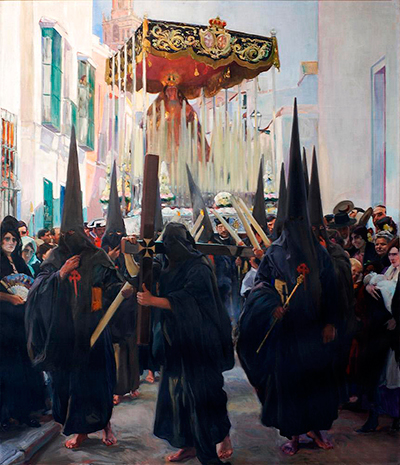
A narrow street, a crowded pavement and a few large figures bring a public ceremony almost within touching distance. In Joaquín Sorolla’s Sevilla, Holy Week Penitents, dark robes occupy the foreground while an embroidered canopy rises into the light above them. The procession advances towards us, yet its crowded arrangement makes the movement feel measured and interrupted. There is room for a foot to come forward, a body to turn and a spectator to look across the street; there is little room for anyone to move freely.
Painted in 1914, this oil on canvas belongs to the Hispanic Society Museum & Library in New York. Its Spanish title, Sevilla. Los nazarenos, names the penitents taking part in the city’s Holy Week observances. At 351 × 300.5 centimetres, it is taller than it is wide, with a format that accommodates both the figures close to the ground and the canopy high above their heads. The Prado’s retrospective account places its making in March and April 1914.[1] Its scale gives the street gathering a bodily presence that a small reproduction can only suggest.
At a Glance
- ArtistJoaquín Sorolla
- SubjectSevilla, Holy Week Penitents
- Date1914
- CollectionHispanic Society Museum & Library
- InventoryA1809
This work across Joaquín Sorolla’s career
Contents
- A procession approaching the viewer
- Faces, hoods and spectators
- A street shaped by light
- Black robes and brilliant ornament
- Making a ceremonial image
- One Seville within Vision of Spain
A procession approaching the viewer
The foreground is organised around three substantial masses of dark clothing. On the left, an upright figure stands beside the crowd. Near the centre, a softer, drooping hood and a bent posture interrupt the series of pointed silhouettes. On the right, a tall hood rises above a broad robe whose lower edge allows the feet to appear. Behind these principal figures, other dark points emerge among heads, poles and candles. Their repeated shapes give the group coherence without turning it into a perfectly regular line.
The clothing makes the bodies appear broad and heavy below, exceptionally narrow above. Each pointed hood carries the eye upward; each widening robe draws it back towards the pavement. This alternating motion is one of the picture’s strongest rhythms. It joins the human procession to the vertical lines of the architecture and the slender supports of the canopy. The same upward emphasis runs through very different materials: dark cloth, pale walls and glittering ceremonial furnishings.
The large cross near the centre adds another pattern. Its substantial upright stands out against the lighter setting, while a pale diagonal in the left half of the foreground crosses the downward fall of the robes. Hands emerge to grasp and steady what is being carried. These small areas of exposed flesh are especially noticeable because the surrounding garments conceal so much of the body. Sorolla makes carrying visible as an action, through the relationship between hand, object and posture.
Movement is clearest near the bottom of the painting. Feet project from the hems at different angles, and the patches of open paving between the figures suggest a route continuing towards the viewer. Higher up, the densely packed forms seem almost stationary. The scene therefore has two speeds: a slow bodily advance below and an elaborate, suspended structure above. The canopy appears to hover, although the surrounding poles and closely assembled procession keep it connected to the street.
Faces, hoods and spectators
A procession brings people into public view, but these robes also withdraw their wearers from ordinary recognition. Some faces are concealed; others appear only partly, within the shadow of a hood. The picture asks us to register people through stance, scale, hands and spacing before we can read individual features. That emphasis differs sharply from a portrait, where a face often commands the first and longest attention.
At either side, spectators supply a contrasting field of uncovered faces. On the left, dark clothing and pale patches of skin form a compact border. On the right, heads cluster at different heights above a mixture of pale and coloured garments. People look into the procession from beside it, and their proximity helps establish the width of the available passage. The ceremony occupies the middle of a street that remains visibly inhabited.
This arrangement also gives the viewer a particular position. We look along the procession’s route, close to the level of the approaching figures, while the spectators watch from the edges. Our view is more exposed than theirs. The central gap seems to lead directly out of the canvas, but the foreground bodies also obstruct it. The resulting sense of nearness depends on these large, partly unreadable figures and the compressed crowd behind them.
The pointed hoods belong to the Spanish penitential setting named by the work. Sorolla also studied variations in how this clothing appeared. A drawing in the Museo Sorolla, Nazarenos con el capirote a la espalda, records figures with hoods over their heads and the pointed element lowered behind one of them. The museum dates it to the Seville campaign of 1914.[2] That small sheet indicates how attentively he looked at the changing silhouettes of ceremonial dress. In the finished panel, differences between erect points, falling cloth and bent bodies prevent the shared costume from producing identical figures.
A street shaped by light
The architecture encloses the procession without making the painting feel like an interior. Pale buildings rise on both sides, and the bright upper part of the street remains open to daylight. Green shutters and window frames punctuate the left wall. On the right, the larger, quieter plane of masonry gives the foremost hood a clear background. The buildings perform different tasks within the composition: one side supplies a succession of small incidents, while the other allows a dominant silhouette to stand out.
The street recedes behind the canopy through fragments rather than through an uninterrupted view. Supports, heads, flowers and buildings overlap, making depth something the eye pieces together. A reddish tower appears in the distance above the left side of the canopy. It adds another upright accent and extends the setting beyond the immediate gathering, though the procession remains the centre of attention.
The strongest spatial effect comes from the relationship between the shaded people and the luminous walls. Dark figures seem close enough to block the view; light continues over and around them. The street is both an enclosure and a channel. It concentrates the crowd and directs the procession forward, while the visible architecture carries the eye back into the city.
Even the small areas of pavement matter. A pale strip near the central figure separates adjacent robes, and the open ground at the bottom makes the surrounding dark shapes easier to distinguish. Without those intervals, the lower half could become a single unbroken mass. Sorolla leaves enough light between bodies to suggest their separate positions and enough overlap to preserve the pressure of the gathering.
Black robes and brilliant ornament
The dark garments are the basis of the colour scheme, but they contain many visible changes. Blue and green notes describe folds; cooler highlights catch sleeves and shoulders; deeper passages allow one figure to merge temporarily with another. The effect depends on variation within darkness. A robe can read as a single powerful shape from a distance and still reveal the weight and direction of its cloth when examined closely.
Warm colour is distributed more sparingly. Hands and feet, small red and gold details on the garments, and faces within the crowd punctuate the foreground. These accents make the surrounding dark fabric seem more extensive. They also keep attention moving across it: a warm hand leads towards the central cross; a small bright emblem brings the eye back to a chest; exposed feet reconnect the ceremonial clothing with the physical act of walking.
Above, the canopy concentrates ornament. Its dark embroidered border, gold scrolls and red underside create a richly coloured horizontal form among the many verticals. Beneath it, the pale dress of the image of the Virgin, numerous candles and surrounding flowers make a dense, luminous area. The canopy gives that brilliance an upper boundary. Its slightly sloping edges also introduce a sense of angle and movement into an arrangement otherwise dominated by upright forms.
There are thus two very different ways of making cloth impressive. The robes gather into large areas whose folds are described with relatively broad changes of tone. The canopy presents a worked surface of curving decoration, strong colour and small bright accents. One absorbs attention through mass, the other through ornament. Both belong to the same ceremony, and the painting depends on their visual conversation.
Sorolla’s interest in clothing was supported by material research. The Museo Sorolla explains that much of its textile collection was acquired during his travels to prepare the Hispanic Society panels, and that traditional garments appear in the large compositions and related studies.[3] Here, clothing does more than identify a public custom. Its different structures determine the painting’s rhythm, distribute its colour and control how much of each person we can see.
Making a ceremonial image
The panel grew out of time spent in Seville, with a working place as well as observations made in the streets. The Museo Sorolla’s catalogue Clotilde de Sorolla records that he began the canvas at the Convent of San Clemente during his stay in spring 1914.[4] The building in which he worked and the street represented in the painting are different parts of its history. The finished scene presents an outdoor procession.
His preparation continued while the large canvas was underway. The museum’s record for the drawing Damas en el balcón discusses a group of Holy Week sketches, probably made between 4 and 11 April. These address the processional floats, the advance of penitents and people watching. The same record cites letters to Clotilde in which Sorolla describes seeing processions on successive days and searching the streets for details useful to his picture.[5] The surviving evidence gives a sense of looking undertaken for particular pictorial problems: how a float appears from an angle, how a procession advances and how spectators occupy its surroundings.
Related paintings show that preparation could include possibilities ultimately set aside. The Museo Sorolla identifies its Paso de la Virgen del Valle, inventory 01034, as a preparatory study for Los nazarenos that was not used. Its present catalogue dates it between 6 and 12 April 1914.[6] A study of a particular float therefore cannot by itself establish the identity of everything shown in the finished panel. It belongs to a larger process of observation, comparison and selection.
An earlier photographic image offers another connection with local visual culture. Seville’s municipal photographic archive identifies a photograph by Ramón Almela, dated about 1886, of the canopy float of the Virgen del Rosario of the Hermandad de Montesión, as an inspiration for Los nazarenos.[7] This is a specific archival attribution concerning a source image. Alongside the drawings and studies, it helps explain how the final painting could bring together close observation of living ceremony with an already existing representation of it.
What emerges on the monumental canvas is a carefully concentrated encounter. The hooded figures command the lower half, the canopy commands the upper half, and the spectators bind both to the street. Whatever the individual sources of its details, their final arrangement makes the procession legible as a whole. The gathering feels crowded, yet its principal shapes remain clear.
One Seville within Vision of Spain
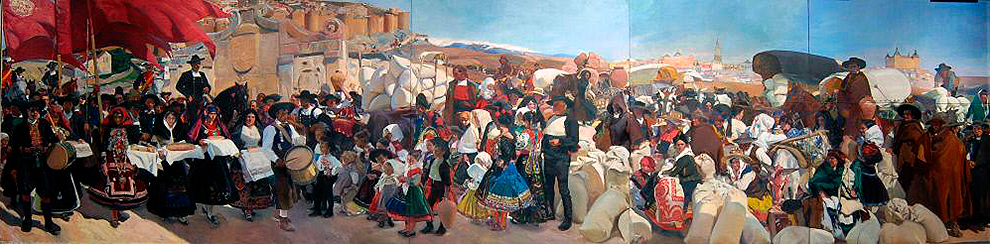
Holy Week Penitents followed Castilla, the Feast of Bread in the sequence of Sorolla’s great regional panels. Archer Milton Huntington had formally commissioned the ensemble on 26 November 1911. Blanca Pons-Sorolla’s account places the penitents in 1914 and the separate Seville subjects of dance and bullfighters in 1915.[8] Religious ceremony was therefore one of several ways Sorolla represented the city. Its presence within the cycle gains meaning from those differences of activity, setting and dress.
The contrast with the much wider Castilian panel is especially useful. There, the eye can travel laterally through an extensive gathering. Here, the narrower format places the viewer before an approaching group, with the crowd pressed into the margins. The proportions change the kind of attention each work invites: one encourages a survey across many figures, while the other makes a small number of monumental silhouettes immediately dominant.
The complete Vision of Spain surrounds its audience with fourteen canvases representing selected regional customs and activities. The Hispanic Society dates their making between 1912 and 1919 and the inauguration of the installation to 1926.[9] Within that larger room, this panel contributes a particular register of colour and bodily movement. Its dark, measured foreground and brilliant upper structure give public religious ceremony an unmistakable visual presence. Seen on its own, it draws attention to the same close relationships that organise the event: people and street, concealment and visibility, the burden carried at ground level and the splendid canopy rising above it.
Comparison: Castilla, the Feast of Bread
Watch: Sorolla, light and painting
Three National Gallery films offer an introduction, a closer look at technique and a longer curator’s talk.
An introduction to 'Sorolla: Spanish Master of Light'
Start with a short exhibition introduction to Sorolla’s subjects and career.
Watch on YouTubeArtworks and exhibition records
Browse 103 artwork articles, 350 numbered entries from the Hispanic Society’s 1909 New York catalogue, and two selected Meadows Museum drawings. These are records, not a count of unique artworks: repeated historical titles remain separate entries and may overlap with the articles. A catalogue’s exhibition year does not establish an execution date. This researched selection is not a complete catalogue raisonné.
| Name | Date | Medium |
|---|---|---|
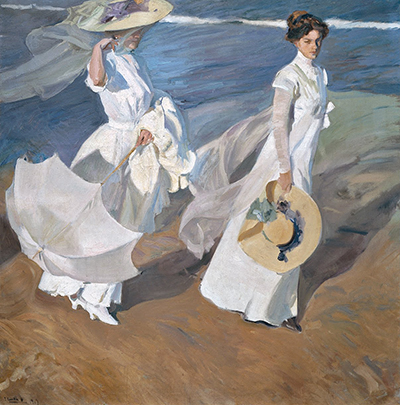
| Women Walking on the Beach | 1909 | Painting |
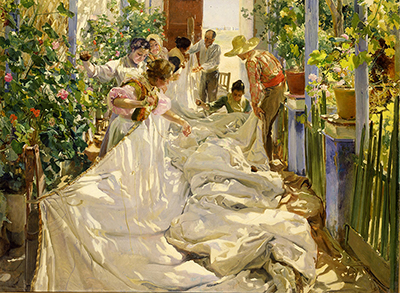
| Sewing the Sail | 1896 | Painting |
| Running Along the Beach | 1908 | Painting |
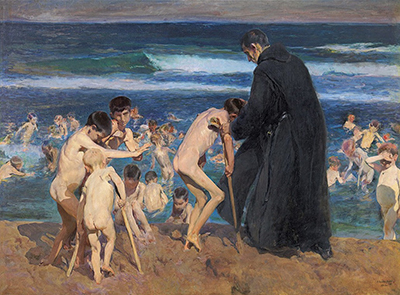
| Sad Inheritance | 1899 | Painting |
| Mother | 1895–1900 | Painting |
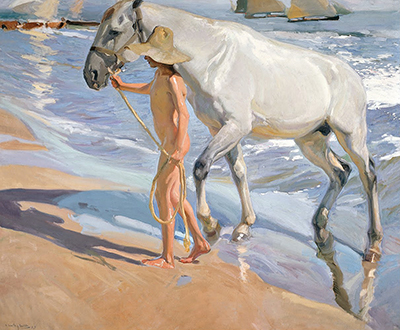
| The Horse's Bath | 1909 | Painting |
| The Pink Robe | 1916 | Painting |
| And They Still Say Fish are Expensive! | 1894 | Painting |
| The Return from Fishing | 1894 | Painting |
| Children on the Beach | 1909 | Painting |
| Castilla, the Feast of Bread | 1913 | Painting |
| Sevilla, Holy Week Penitents | 1914 | Painting |
| Aragon, Jota | 1914 | Painting |
| Navarre, the Town Council of Roncal | 1914 | Painting |
| Guipúzcoa, Bowling | 1914 | Painting |
| Andalucía, El Encierro | 1914 | Painting |
| Seville, the Dance | 1915 | Painting |
| Sevilla, The Bullfighters | 1915 | Painting |
| Galicia, The Pilgrimage | 1915 | Painting |
| The Fish | 1915 | Painting |
| Valencia, Couples on Horseback | 1916 | Painting |
| Extremadura, The Market | 1917 | Painting |
| Elche, The Palm Grove | 1918–1919 | Painting |
| The Tunny Catch | 1919 | Painting |
| Louis Comfort Tiffany | 1911 | Painting |
| Adobe Houses | 1890–1895 | Painting |
| After Bathing | 1915 | Painting |
| After Bathing, Valencia | 1909 | Painting |
| After Bathing, Valencian Beach | 1908 | Painting |
| Afternoon Sun, Playa de Valencia | 1910 (Album catalogue) | Painting |
| Aim of Ibiza | 1919 | Painting |
| Almond Trees in Asis | Spring,1887–1889 | Painting |
| Another Margarita | 1892 | Painting |
| Antonio García at the Beach | 1909 | Painting |
| Around Segovia | 9–15 October 1906 | Painting |
| Artist's Patio, Cafe Novedades, Seville | 1915 | Painting |
| Asturian Landscape | circa 1904 | Painting |
| Aureliano de Beruete | 1902 | Painting |
| Aureliano de Beruete y Moret, Son | 1902 | Painting |
| The Bath, Jávea | 1905 | Painting |
| The Bathing Hour | 1915 execution, signed and dated1917 (Sothebys catalogue account) | Painting |
| Bathing Time | 1904 | Painting |
| Beach at Valencia | 1908 in ARC catalogue | Painting |
| Beach at Zarauz | 1910 | Painting |
| Beach of Biarritz | 1906 | Painting |
| Beach of Biarritz, France | Summer1906 | Painting |
| Beached Boats | 1915 | Painting |
| Beaching the Boat | 1908 in ARC catalogue | Painting |
| Blessing the Boat | 1895 | Painting |
| Blind Man of Toledo | 1906 | Painting |
| Boat Builders | 1894 | Painting |
| Boat in Albufera | 1895 | Painting |
| Boy on the Sand | Undated | Painting |
| Boys in the Sea | 1908 | Painting |
| Boys on the Beach | BeforeNewYork1909exhibition; exactyearunresolved | Painting |
| Breakwater, San Sebastian | 1917–1918 | Painting |
| Bulls in the Sea | 1903 | Painting |
| Capturing the Moment | 1906 | Painting |
| Castle of La Mota, Medina del Campo | 29 May 1912 | Painting |
| Children in the Sea | Painting | |
| Children on the Beach, Valencia | 1916 | Painting |
| Children on the Seashore | 1903 | Painting |
| Child's Siesta | circa 1918 (ARC catalogue) | Painting |
| Church Roncal Stairs | 22–28August1912 | Painting |
| Clothilde at the Beach | Summer1904 | Painting |
| Clotilde and Elena on the Rocks at Javea | 1905 | Painting |
| Clotilde García del Castillo | April1890 | Painting |
| Clotilde in a Grey Dress | 1900 | Painting |
| Clotilde with Hat | 1910 | Painting |
| Coast at Santa Cristina | 29 September 1915 (current CERES1122) | Painting |
| Court of the Dances, Alcázar, Sevilla | 1910 | Painting |
| Covachuelas, Toledo | 21–30 October 1906 | Painting |
| Dragging the Trawler | circa 1903–1904 in educational catalogue | Painting |
| El Retiro, Madrid | 1898 | Painting |
| Female Nude | 1902 | Painting |
| Fisherman in Valencia | 1904 | Painting |
| Fisherwomen from Valencia | June–July 1915 | Painting |
| Fishing Boats | by February 1909 | Painting |
| Fishing Nets | 1893 | Painting |
| The Gardens at the Sorolla Family House | spring 1920 | Painting |
| Hall of the Ambassadors, Alhambra, Granada | 1909 | Painting |
| Harbour | 1880 | Painting |
| Joaquín Sorolla García in a White Dress | 1896 | Painting |
| Lighthouse Walk at Biarritz | 1906 | Painting |
| The Little Yacht | 1909 | Painting |
| Maria at La Granja | 1907 | Painting |
| My Children | 1904 | Painting |
| My Wife and Daughters in the Garden | 1910 | Painting |
| Portrait of Benito Pérez Galdós | 1894 | Painting |
| A Rooftop with Flowers | 1902 | Painting |
| Self Portrait | 1904 | Painting |
| Self Portrait | 1909 | Painting |
| Señora de Sorolla in Black | 1906 | Painting |
| La Siesta | 1911 | Painting |
| The Skipping Rope | 1907 | Painting |
| Swimmers, Jávea | 1905 | Painting |
| Time for a Bathe | 1909 | Painting |
| Under the Awning, Zarauz | 1910 | Painting |
| Valencia Beach in the Morning Light | summer 1908 | Painting |
| Valencian Fishermen | 1895 | Painting |
| The White Boat, Jávea | 1905 | Painting |
| White Slave Trade | 1894 | Painting |
| The Wounded Foot | 1909 | Painting |
| Seven Peaks, Guadarrama — 1909 catalogue, no. 1 | Painting | |
| Covachuelas, Toledo — 1909 catalogue, no. 2 | Painting | |
| Las Pedrizas, El Pardo — 1909 catalogue, no. 3 | Painting | |
| Señor Gomar — 1909 catalogue, no. 4 | Painting | |
| El Torneo, El Pardo — 1909 catalogue, no. 5 | Painting | |
| A Toledo Street — 1909 catalogue, no. 6 | Painting | |
| View from El Torneo — 1909 catalogue, no. 7 | Painting | |
| Walls of Segovia — 1909 catalogue, no. 8 | Painting | |
| Convent of El Parral, Segovia — 1909 catalogue, no. 9 | Painting | |
| Environs of Segovia — 1909 catalogue, no. 10 | Painting | |
| Reflections from the Cape, Jávea — 1909 catalogue, no. 11 | Painting | |
| The Clamores, Segovia — 1909 catalogue, no. 12 | Painting | |
| Rocks of the Cape, Jávea — 1909 catalogue, no. 13 | Painting | |
| Farmhouse, Alcira — 1909 catalogue, no. 14 | Painting | |
| María at Biarritz — 1909 catalogue, no. 15 | Painting | |
| Shadow of the Alcántara Bridge, Toledo — 1909 catalogue, no. 16 | Painting | |
| Castle of San Servando, Toledo — 1909 catalogue, no. 17 | Painting | |
| Dr Decret — 1909 catalogue, no. 18 | Painting | |
| Alcántara Bridge, Toledo — 1909 catalogue, no. 19 | Painting | |
| The Forest, La Granja — 1909 catalogue, no. 20 | Painting | |
| Trout Stream, La Granja — 1909 catalogue, no. 21 | Painting | |
| Court of the Dances, Alcázar, Seville — 1909 catalogue, no. 22 | Painting | |
| Oleanders — 1909 catalogue, no. 23 | Painting | |
| Glen, Asturias — 1909 catalogue, no. 24 | Painting | |
| Pavilion of Charles V, Seville — 1909 catalogue, no. 25 | Painting | |
| St Martin's Bridge, Toledo — 1909 catalogue, no. 26 | Painting | |
| Orange Trees — 1909 catalogue, no. 27 | Painting | |
| Rope Makers — 1909 catalogue, no. 28 | Painting | |
| Señor Franzen — 1909 catalogue, no. 29 | Painting | |
| Rocks at the Lighthouse, Biarritz — 1909 catalogue, no. 30 | Painting | |
| St Martin's Bridge, Toledo — 1909 catalogue, no. 31 | Painting | |
| Valencian Fisherwoman — 1909 catalogue, no. 32 | Painting | |
| Road of San Esteban, Asturias — 1909 catalogue, no. 33 | Painting | |
| Basin in the Alcázar, Seville — 1909 catalogue, no. 34 | Painting | |
| Harbour of Valencia — 1909 catalogue, no. 35 | Painting | |
| Haymaking, Asturias — 1909 catalogue, no. 36 | Painting | |
| House of El Greco, Toledo — 1909 catalogue, no. 37 | Painting | |
| María with a Black Hat — 1909 catalogue, no. 38 | Painting | |
| Entrance Tower, Toledo — 1909 catalogue, no. 39 | Painting | |
| Las Covachuelas, Toledo — 1909 catalogue, no. 40 | Painting | |
| Rocks, Jávea — 1909 catalogue, no. 41 | Painting | |
| Road of the Alijares, Toledo — 1909 catalogue, no. 42 | Painting | |
| Segovian Family — 1909 catalogue, no. 43 | Painting | |
| Scalding Grapes, Jávea — 1909 catalogue, no. 44 | Painting | |
| Joaquín — 1909 catalogue, no. 45 | Painting | |
| Elena — 1909 catalogue, no. 46 | Painting | |
| El Grutesco, Alcázar, Seville — 1909 catalogue, no. 47 | Painting | |
| Beach of Valencia — 1909 catalogue, no. 48 | Painting | |
| Sails Drying, Valencia — 1909 catalogue, no. 49 | Painting | |
| Orange Tree — 1909 catalogue, no. 50 | Painting | |
| Little Boy with a Toy Boat — 1909 catalogue, no. 51 | Painting | |
| Old Valencian Fisherman — 1909 catalogue, no. 52 | Painting | |
| Fishing Boats — 1909 catalogue, no. 53 | Painting | |
| Harbour of Valencia — 1909 catalogue, no. 54 | Painting | |
| The Kiss — 1909 catalogue, no. 55 | Painting | |
| Little Boy on a Rock, Jávea — 1909 catalogue, no. 56 | Painting | |
| The Queen's Beam, Valsaín — 1909 catalogue, no. 57 | Painting | |
| Staircase of the Palace, La Granja — 1909 catalogue, no. 58 | Painting | |
| Elena at El Pardo — 1909 catalogue, no. 59 | Painting | |
| Fountain of the Horses, La Granja — 1909 catalogue, no. 60 | Painting | |
| Autumn, La Granja — 1909 catalogue, no. 61 | Painting | |
| María Painting, El Pardo — 1909 catalogue, no. 62 | Painting | |
| Fountain of the Forest, La Granja — 1909 catalogue, no. 63 | Painting | |
| Fountain of Neptune, La Granja — 1909 catalogue, no. 64 | Painting | |
| Orange Grove, Valencia — 1909 catalogue, no. 65 | Painting | |
| Francisqueta, Valencia — 1909 catalogue, no. 66 | Painting | |
| Waiting for the Fish, Valencia — 1909 catalogue, no. 67 | Painting | |
| Taking in the Sail, Valencia — 1909 catalogue, no. 68 | Painting | |
| Return from Fishing, Valencia — 1909 catalogue, no. 69 | Painting | |
| Crayfishers, Valencia — 1909 catalogue, no. 70 | Painting | |
| Swimmer, Jávea — 1909 catalogue, no. 71 | Painting | |
| Elena among Roses — 1909 catalogue, no. 72 | Painting | |
| Idyll — 1909 catalogue, no. 73 | Painting | |
| Vicente Blasco Ibáñez — 1909 catalogue, no. 74 | Painting | |
| Yellow Tree, La Granja — 1909 catalogue, no. 75 | Painting | |
| Blind Man of Toledo — 1909 catalogue, no. 76 | Painting | |
| Fisherwoman with Her Son, Valencia — 1909 catalogue, no. 77 | Painting | |
| The Bath, La Granja — 1909 catalogue, no. 78 | Painting | |
| Sewing the Sail, Valencia — 1909 catalogue, no. 79 | Painting | |
| Looking for Crabs, Jávea — 1909 catalogue, no. 80 | Painting | |
| María, La Granja — 1909 catalogue, no. 81 | Painting | |
| Joaquín and His Dog — 1909 catalogue, no. 82 | Painting | |
| Upon the Sand — 1909 catalogue, no. 83 | Painting | |
| Valencian Fisherwomen — 1909 catalogue, no. 84 | Painting | |
| Señora de Sorolla in White — 1909 catalogue, no. 85 | Painting | |
| At the Seashore, Valencia — 1909 catalogue, no. 86 | Painting | |
| Valencian Woman — 1909 catalogue, no. 87 | Painting | |
| In the Gardens of La Granja — 1909 catalogue, no. 88 | Painting | |
| Old Castilian — 1909 catalogue, no. 89 | Painting | |
| Marqués de Urquijo — 1909 catalogue, no. 90 | Painting | |
| Fisherman's Daughter, Valencia — 1909 catalogue, no. 91 | Painting | |
| Elena and Her Dolls — 1909 catalogue, no. 92 | Painting | |
| My Children — 1909 catalogue, no. 93 | Painting | |
| Swimmers — 1909 catalogue, no. 94 | Painting | |
| Low Tide: Elena at Biarritz — 1909 catalogue, no. 95 | Painting | |
| Mending Nets — 1909 catalogue, no. 96 | Painting | |
| The Bath, Jávea — 1909 catalogue, no. 97 | Painting | |
| The Bath, Jávea — 1909 catalogue, no. 98 | Painting | |
| Boxing Raisins — 1909 catalogue, no. 99 | Painting | |
| Forest Bridge, La Granja — 1909 catalogue, no. 100 | Painting | |
| View of the Palace, La Granja — 1909 catalogue, no. 101 | Painting | |
| Return from Fishing, Valencia — 1909 catalogue, no. 102 | Painting | |
| At the Bath, Valencia — 1909 catalogue, no. 103 | Painting | |
| Little Girl with a Blue Ribbon, Valencia — 1909 catalogue, no. 104 | Painting | |
| María at the Harbour of Jávea — 1909 catalogue, no. 105 | Painting | |
| Instantaneous, Biarritz — 1909 catalogue, no. 106 | Painting | |
| Boy among Breakers, Jávea — 1909 catalogue, no. 107 | Painting | |
| Garden of the Alcázar, Seville — 1909 catalogue, no. 108 | Painting | |
| Oleander Road, Valencia — 1909 catalogue, no. 109 | Painting | |
| María and Her Grandmother — 1909 catalogue, no. 110 | Painting | |
| Malvarrosa Beach, Valencia — 1909 catalogue, no. 111 | Painting | |
| The Huerta of Valencia — 1909 catalogue, no. 112 | Painting | |
| Garden of the Alcázar, Seville — 1909 catalogue, no. 113 | Painting | |
| Garden of the Alcázar, Seville — 1909 catalogue, no. 114 | Painting | |
| The Giralda, Seville — 1909 catalogue, no. 115 | Painting | |
| Palace of Charles V, Seville — 1909 catalogue, no. 116 | Painting | |
| Harbour of Valencia — 1909 catalogue, no. 117 | Painting | |
| Marqués de la Vega-Inclán — 1909 catalogue, no. 118 | Painting | |
| Harbour of Valencia — 1909 catalogue, no. 119 | Painting | |
| At the Water, Valencia — 1909 catalogue, no. 120 | Painting | |
| House in the Huerta, Valencia — 1909 catalogue, no. 121 | Painting | |
| Beach Garden, Valencia — 1909 catalogue, no. 122 | Painting | |
| Huerta of Valencia — 1909 catalogue, no. 123 | Painting | |
| Garden of the Alcázar, Seville — 1909 catalogue, no. 124 | Painting | |
| Asturias — 1909 catalogue, no. 125 | Painting | |
| San Sebastián — 1909 catalogue, no. 126 | Painting | |
| Old Harbour, Biarritz — 1909 catalogue, no. 127 | Painting | |
| Beach of Biarritz — 1909 catalogue, no. 128 | Painting | |
| Beach of Biarritz — 1909 catalogue, no. 129 | Painting | |
| Beach of Biarritz — 1909 catalogue, no. 130 | Painting | |
| Beach of Biarritz — 1909 catalogue, no. 131 | Painting | |
| Beach of Biarritz — 1909 catalogue, no. 132 | Painting | |
| Beach of Biarritz — 1909 catalogue, no. 133 | Painting | |
| Beach of Biarritz — 1909 catalogue, no. 134 | Painting | |
| Beach of Biarritz — 1909 catalogue, no. 135 | Painting | |
| Beach of Biarritz — 1909 catalogue, no. 136 | Painting | |
| Beach of Biarritz — 1909 catalogue, no. 137 | Painting | |
| Beach of Biarritz — 1909 catalogue, no. 138 | Painting | |
| Beach of Biarritz — 1909 catalogue, no. 139 | Painting | |
| Beach of Biarritz — 1909 catalogue, no. 140 | Painting | |
| Beach of Biarritz — 1909 catalogue, no. 141 | Painting | |
| Beach of Biarritz — 1909 catalogue, no. 142 | Painting | |
| Beach of Biarritz — 1909 catalogue, no. 143 | Painting | |
| La Concha, San Sebastián — 1909 catalogue, no. 144 | Painting | |
| Beach of Biarritz — 1909 catalogue, no. 145 | Painting | |
| Beach of Biarritz — 1909 catalogue, no. 146 | Painting | |
| Beach of Biarritz — 1909 catalogue, no. 147 | Painting | |
| Beach of Biarritz — 1909 catalogue, no. 148 | Painting | |
| Beach of Biarritz — 1909 catalogue, no. 149 | Painting | |
| Beach of Biarritz — 1909 catalogue, no. 150 | Painting | |
| Beach of Biarritz — 1909 catalogue, no. 151 | Painting | |
| Beach of Biarritz — 1909 catalogue, no. 152 | Painting | |
| Beach of Biarritz — 1909 catalogue, no. 153 | Painting | |
| Beach of Biarritz — 1909 catalogue, no. 154 | Painting | |
| Beach of Valencia — 1909 catalogue, no. 155 | Painting | |
| Beach of Valencia — 1909 catalogue, no. 156 | Painting | |
| Beach of Valencia — 1909 catalogue, no. 157 | Painting | |
| Harbour of San Sebastián — 1909 catalogue, no. 158 | Painting | |
| Harbour of San Sebastián — 1909 catalogue, no. 159 | Painting | |
| Beach of Valencia — 1909 catalogue, no. 160 | Painting | |
| Pasajes — 1909 catalogue, no. 161 | Painting | |
| Harbour of San Sebastián — 1909 catalogue, no. 162 | Painting | |
| La Concha, San Sebastián — 1909 catalogue, no. 163 | Painting | |
| La Concha, San Sebastián — 1909 catalogue, no. 164 | Painting | |
| Harbour of Pasajes — 1909 catalogue, no. 165 | Painting | |
| Beach of Valencia — 1909 catalogue, no. 166 | Painting | |
| Beach of Valencia — 1909 catalogue, no. 167 | Painting | |
| Beach of Valencia — 1909 catalogue, no. 168 | Painting | |
| Beach of Valencia — 1909 catalogue, no. 169 | Painting | |
| Beach of Valencia — 1909 catalogue, no. 170 | Painting | |
| Beach of Valencia — 1909 catalogue, no. 171 | Painting | |
| Beach of Valencia — 1909 catalogue, no. 172 | Painting | |
| Beach of Valencia — 1909 catalogue, no. 173 | Painting | |
| Beach of Valencia — 1909 catalogue, no. 174 | Painting | |
| Beach of Valencia — 1909 catalogue, no. 175 | Painting | |
| Beach of Valencia — 1909 catalogue, no. 176 | Painting | |
| Beach of Valencia — 1909 catalogue, no. 177 | Painting | |
| Cape San Antonio, Jávea — 1909 catalogue, no. 178 | Painting | |
| Galicia — 1909 catalogue, no. 179 | Painting | |
| Sewing the Sail — 1909 catalogue, no. 180 | Painting | |
| Poppies — 1909 catalogue, no. 181 | Painting | |
| Beach of Valencia — 1909 catalogue, no. 182 | Painting | |
| Malvarrosa — 1909 catalogue, no. 183 | Painting | |
| Harbour of San Sebastián — 1909 catalogue, no. 184 | Painting | |
| Beach of Valencia — 1909 catalogue, no. 185 | Painting | |
| Locutory — 1909 catalogue, no. 186 | Painting | |
| Beach of Valencia — 1909 catalogue, no. 187 | Painting | |
| Beach of Valencia — 1909 catalogue, no. 188 | Painting | |
| Cape San Antonio, Jávea — 1909 catalogue, no. 189 | Painting | |
| Beach of Valencia — 1909 catalogue, no. 190 | Painting | |
| Oleanders — 1909 catalogue, no. 191 | Painting | |
| Beach of Valencia — 1909 catalogue, no. 192 | Painting | |
| La Concha, San Sebastián — 1909 catalogue, no. 193 | Painting | |
| Beach of Valencia — 1909 catalogue, no. 194 | Painting | |
| Beach of Valencia — 1909 catalogue, no. 195 | Painting | |
| Beach of Valencia — 1909 catalogue, no. 196 | Painting | |
| Biarritz — 1909 catalogue, no. 197 | Painting | |
| Biarritz — 1909 catalogue, no. 198 | Painting | |
| Segovia — 1909 catalogue, no. 199 | Painting | |
| Asturias — 1909 catalogue, no. 200 | Painting | |
| Versailles — 1909 catalogue, no. 201 | Painting | |
| Beach of Valencia — 1909 catalogue, no. 202 | Painting | |
| Beach of Valencia — 1909 catalogue, no. 203 | Painting | |
| Beach of Valencia — 1909 catalogue, no. 204 | Painting | |
| Beach of Valencia — 1909 catalogue, no. 205 | Painting | |
| Court of El Cabañal — 1909 catalogue, no. 206 | Painting | |
| In the River — 1909 catalogue, no. 207 | Painting | |
| Harbour of Valencia — 1909 catalogue, no. 208 | Painting | |
| Beach of Valencia — 1909 catalogue, no. 209 | Painting | |
| Harbour of Valencia — 1909 catalogue, no. 210 | Painting | |
| Beach of Valencia — 1909 catalogue, no. 211 | Painting | |
| Beach of Valencia — 1909 catalogue, no. 212 | Painting | |
| Beach of Valencia — 1909 catalogue, no. 213 | Painting | |
| Royal Mallows — 1909 catalogue, no. 214 | Painting | |
| Geraniums — 1909 catalogue, no. 215 | Painting | |
| Altar of St Vincent, Valencia — 1909 catalogue, no. 216 | Painting | |
| Beach of Valencia — 1909 catalogue, no. 217 | Painting | |
| Harbour of Avilés — 1909 catalogue, no. 218 | Painting | |
| Beach of Valencia — 1909 catalogue, no. 219 | Painting | |
| Beach of Valencia — 1909 catalogue, no. 220 | Painting | |
| Beach of Valencia — 1909 catalogue, no. 221 | Painting | |
| Market of León — 1909 catalogue, no. 222 | Painting | |
| Beach of Valencia — 1909 catalogue, no. 223 | Painting | |
| Beach of Valencia — 1909 catalogue, no. 224 | Painting | |
| Beach of Valencia — 1909 catalogue, no. 225 | Painting | |
| Beach of Valencia — 1909 catalogue, no. 226 | Painting | |
| Beach of Valencia — 1909 catalogue, no. 227 | Painting | |
| Huerta of Valencia — 1909 catalogue, no. 228 | Painting | |
| Beach of Valencia — 1909 catalogue, no. 229 | Painting | |
| Beach of Valencia — 1909 catalogue, no. 230 | Painting | |
| Beach of Valencia — 1909 catalogue, no. 231 | Painting | |
| Beach of Valencia — 1909 catalogue, no. 232 | Painting | |
| Beach of Valencia — 1909 catalogue, no. 233 | Painting | |
| Beach of Valencia — 1909 catalogue, no. 234 | Painting | |
| Asturias — 1909 catalogue, no. 235 | Painting | |
| Beach of Valencia — 1909 catalogue, no. 236 | Painting | |
| Women Playing — 1909 catalogue, no. 237 | Painting | |
| Beach of Valencia — 1909 catalogue, no. 238 | Painting | |
| Beach of Valencia — 1909 catalogue, no. 239 | Painting | |
| Beach of Valencia — 1909 catalogue, no. 240 | Painting | |
| Beach of Valencia — 1909 catalogue, no. 241 | Painting | |
| Market of León — 1909 catalogue, no. 242 | Painting | |
| Beach of Valencia — 1909 catalogue, no. 243 | Painting | |
| Beach of Valencia — 1909 catalogue, no. 244 | Painting | |
| Beach of Valencia — 1909 catalogue, no. 245 | Painting | |
| Beach of Valencia — 1909 catalogue, no. 246 | Painting | |
| Asturias — 1909 catalogue, no. 247 | Painting | |
| León — 1909 catalogue, no. 248 | Painting | |
| Asturias — 1909 catalogue, no. 249 | Painting | |
| Jávea — 1909 catalogue, no. 250 | Painting | |
| Asturias — 1909 catalogue, no. 251 | Painting | |
| León — 1909 catalogue, no. 252 | Painting | |
| Asturias — 1909 catalogue, no. 253 | Painting | |
| Asturias — 1909 catalogue, no. 254 | Painting | |
| Beach of Valencia — 1909 catalogue, no. 255 | Painting | |
| Beach of Valencia — 1909 catalogue, no. 256 | Painting | |
| Asturias — 1909 catalogue, no. 257 | Painting | |
| León — 1909 catalogue, no. 258 | Painting | |
| Beach of Valencia — 1909 catalogue, no. 259 | Painting | |
| Beach of Valencia — 1909 catalogue, no. 260 | Painting | |
| Beach of Valencia — 1909 catalogue, no. 261 | Painting | |
| León — 1909 catalogue, no. 262 | Painting | |
| Beach of Valencia — 1909 catalogue, no. 263 | Painting | |
| Asturias — 1909 catalogue, no. 264 | Painting | |
| Galicia — 1909 catalogue, no. 265 | Painting | |
| Malvarrosa — 1909 catalogue, no. 266 | Painting | |
| Jávea — 1909 catalogue, no. 267 | Painting | |
| Biarritz — 1909 catalogue, no. 268 | Painting | |
| Harbour of Jávea — 1909 catalogue, no. 269 | Painting | |
| La Concha, San Sebastián — 1909 catalogue, no. 270 | Painting | |
| San Sebastián — 1909 catalogue, no. 271 | Painting | |
| San Sebastián — 1909 catalogue, no. 272 | Painting | |
| Beach of Valencia — 1909 catalogue, no. 273 | Painting | |
| Beach of Valencia — 1909 catalogue, no. 274 | Painting | |
| Beach of Valencia — 1909 catalogue, no. 275 | Painting | |
| Beach of Valencia — 1909 catalogue, no. 276 | Painting | |
| Beach of Valencia — 1909 catalogue, no. 277 | Painting | |
| Washerwomen — 1909 catalogue, no. 278 | Painting | |
| San Sebastián — 1909 catalogue, no. 279 | Painting | |
| Beach of Valencia — 1909 catalogue, no. 280 | Painting | |
| San Sebastián — 1909 catalogue, no. 281 | Painting | |
| San Sebastián — 1909 catalogue, no. 282 | Painting | |
| Beach of Valencia — 1909 catalogue, no. 283 | Painting | |
| Beach of Valencia — 1909 catalogue, no. 284 | Painting | |
| Uncle Pancha — 1909 catalogue, no. 285 | Painting | |
| Señor García — 1909 catalogue, no. 286 | Painting | |
| Boy Nude, La Granja — 1909 catalogue, no. 287 | Painting | |
| Señora de Sorolla in Black — 1909 catalogue, no. 288 | Painting | |
| Duke of Alba — 1909 catalogue, no. 289 | Painting | |
| Mother: Señora de Sorolla — 1909 catalogue, no. 290 | Painting | |
| Running along the Beach — 1909 catalogue, no. 291 | Painting | |
| After the Bath — 1909 catalogue, no. 292 | Painting | |
| Lighthouse Walk, Biarritz — 1909 catalogue, no. 293 | Painting | |
| Little Boy on the Beach — 1909 catalogue, no. 294 | Painting | |
| Cape San Antonio, Jávea — 1909 catalogue, no. 295 | Painting | |
| Count of Villagonzalo — 1909 catalogue, no. 296 | Painting | |
| Boy in the Sea — 1909 catalogue, no. 297 | Painting | |
| Children on the Beach — 1909 catalogue, no. 298 | Painting | |
| Valencian Boats — 1909 catalogue, no. 299 | Painting | |
| The Little Brother — 1909 catalogue, no. 300 | Painting | |
| Children in the Sea — 1909 catalogue, no. 301 | Painting | |
| Orange Grove, Alcira — 1909 catalogue, no. 302 | Painting | |
| At the Water — 1909 catalogue, no. 303 | Painting | |
| Little Boy on the Beach — 1909 catalogue, no. 304 | Painting | |
| Street of Orange Trees — 1909 catalogue, no. 305 | Painting | |
| Playing in the Water — 1909 catalogue, no. 306 | Painting | |
| Beach of Valencia by Morning Light — 1909 catalogue, no. 307 | Painting | |
| Coming out of the Bath — 1909 catalogue, no. 308 | Painting | |
| The Grandson — 1909 catalogue, no. 309 | Painting | |
| Water Joy — 1909 catalogue, no. 310 | Painting | |
| On the Sand — 1909 catalogue, no. 311 | Painting | |
| Francisco Acebal — 1909 catalogue, no. 312 | Painting | |
| Marcelino Menéndez y Pelayo — 1909 catalogue, no. 313 | Painting | |
| Aureliano de Beruete — 1909 catalogue, no. 314 | Painting | |
| Marqués de Viana — 1909 catalogue, no. 315 | Painting | |
| Beach of Valencia — 1909 catalogue, no. 316 | Painting | |
| Señor Granzón — 1909 catalogue, no. 317 | Painting | |
| Oxen Ready to Beach Fishing Boats, Valencia — 1909 catalogue, no. 318 | Painting | |
| Children in the Sea — 1909 catalogue, no. 319 | Painting | |
| Sea: Morning Effect — 1909 catalogue, no. 320 | Painting | |
| Fishing Boat — 1909 catalogue, no. 321 | Painting | |
| Sails at Sea — 1909 catalogue, no. 322 | Painting | |
| Return from Fishing — 1909 catalogue, no. 323 | Painting | |
| Boats on the Sand — 1909 catalogue, no. 324 | Painting | |
| Study of Boats — 1909 catalogue, no. 325 | Painting | |
| Fishing Boats — 1909 catalogue, no. 326 | Painting | |
| Boats — 1909 catalogue, no. 327 | Painting | |
| Children on the Shore — 1909 catalogue, no. 328 | Painting | |
| Beach of Valencia — 1909 catalogue, no. 329 | Painting | |
| Beach of Valencia — 1909 catalogue, no. 330 | Painting | |
| Beach of Valencia — 1909 catalogue, no. 331 | Painting | |
| Beach of Valencia — 1909 catalogue, no. 332 | Painting | |
| Nets Drying — 1909 catalogue, no. 333 | Painting | |
| Shoving off the Boat — 1909 catalogue, no. 334 | Painting | |
| Beach of Valencia — 1909 catalogue, no. 335 | Painting | |
| Oleanders — 1909 catalogue, no. 336 | Painting | |
| Beach of Valencia — 1909 catalogue, no. 337 | Painting | |
| Beach of Valencia — 1909 catalogue, no. 338 | Painting | |
| Beach of Valencia — 1909 catalogue, no. 339 | Painting | |
| Leonese Peasants — 1909 catalogue, no. 340 | Painting | |
| At the Bath — 1909 catalogue, no. 341 | Painting | |
| Sea Idyll — 1909 catalogue, no. 342 | Painting | |
| The Little Granddaughter — 1909 catalogue, no. 343 | Painting | |
| Manuel B. Cossío — 1909 catalogue, no. 344 | Painting | |
| The Peppers — 1909 catalogue, no. 345 | Painting | |
| Raimundo de Madrazo — 1909 catalogue, no. 346 | Painting | |
| Alejandro Pidal y Mon — 1909 catalogue, no. 347 | Painting | |
| Señora de Sorolla in Spanish Mantilla — 1909 catalogue, no. 348 | Painting | |
| My Daughters, Elena and María, on Horseback in Valencian Costumes of 1808 — 1909 catalogue, no. 349 | Painting | |
| Sad Inheritance — 1909 catalogue, no. 350 | Painting | |
| Study of Hands | c. 1889 | Drawing |
| Clotilde Reading (recto) | c. 1902 | Drawing |
Discussion
Look again at the images and ideas explored in Sevilla, Holy Week Penitents. These editorial prompts invite your observations.
Reader Insights
Which detail in Sevilla, Holy Week Penitents first caught your attention, and where did your eye travel next?
The section “A procession approaching the viewer” offers one way into the subject. Which detail or comparison most helps you assess that reading?
After reading “One Seville within Vision of Spain”, what would you return to for a closer look?
Join the Conversation
Share a detail, comparison or question about Sevilla, Holy Week Penitents below.
References
- Museo Nacional del Prado, Joaquín Sorolla (1863–1923), exhibition, 2009, “Visión de España” section and checklist no. 83, Sevilla. Los nazarenos, 1914, oil on canvas, 351 × 300.5 cm. Exhibition and checklist. View source.
- Museo Sorolla, Nazarenos con el capirote a la espalda, 1914, inventory 10961, description and interpretive catalogue entry, CER.es, Ministerio de Cultura. Collection record. View source.
- Museo Sorolla, “Textiles,” collection overview, paragraphs on acquisitions made during preparation of the Hispanic Society panels. Museum collection account. View source.
- Museo Sorolla, Clotilde de Sorolla, exhibition catalogue, 2012, p. 51, “1914. Medio siglo.” Catalogue. View source.
- Museo Sorolla, Damas en el balcón, 1914, inventory 11198, “Clasificación Razonada,” including reported correspondence of 7–9 April 1914 and references to Epistolarios de Joaquín Sorolla II (2008), p. 128 onward, CER.es, Ministerio de Cultura. Collection record. View source.
- Museo Sorolla, Paso de la Virgen del Valle, inventory 01034, dating and “Clasificación Razonada,” including the revised title and dating from the 2019 catalogue, CER.es, Ministerio de Cultura. Collection record. View source.
- Ayuntamiento de Sevilla, ICAS–SAHP, Fototeca Municipal, Semana Santa en Sevilla. 100 fotografías que deberías conocer, caption 001, photograph 001_jjs29_013, Ramón Almela, Paso de palio de la Virgen del Rosario de la Hermandad de Montesión, c. 1886, Colección J. J. Serrano. Municipal archive captions. View source.
- Blanca Pons-Sorolla, “Sorolla in the Huntingtons’ Collections,” in José Luis Colomer, Blanca Pons-Sorolla and Mark A. Roglán, eds., Sorolla in America: Friends and Patrons, 2015, p. 66, publisher’s excerpt PDF p. 14, commission and panel sequence. Publisher’s excerpt. View source.
- Hispanic Society Museum & Library, “Joaquín Sorolla’s Vision of Spain,” paragraphs on the commission, execution and inauguration. Owner’s ensemble account. View source.
- Hispanic Society of America, Catalogue of Paintings by Joaquín Sorolla y Bastida, 1909, entries 1–350. View source.
- Amanda W. Dotseth, Study of Hands, Sketch for The Regency, and Six Other Drawings by Joaquín Sorolla y Bastida, At the Meadows, Fall 2018, pp. 24–29. View source.