



 by Tom Gurney
Tom Gurney BSc (Hons) is an art history expert with over 20 years experience
Published on June 19, 2020 / Updated on November 3, 2026
Email: tomgurney1@gmail.com / Phone: +44 7429 011000
Joaquín Sorolla: a biography: Introduction
Joaquín Sorolla’s life followed a widening circuit: from art classes in Valencia to study in Italy and France, from the competitive exhibitions of Madrid and Paris to commissions in the United States. Yet his paintings repeatedly returned to people and places he knew well. His wife Clotilde and their three children appear across decades of work. The Valencian shore remained a place of fishing, labour and play; a family holiday could become a concentrated campaign of painting. International success enlarged the scale of his commitments without giving his career a simple, uninterrupted direction towards brighter pictures.
Sorolla was born in 1863 and died in 1923. During those sixty years he became a painter of social subjects, a portraitist, an observer of landscape and a designer of an enormous regional ensemble for New York. His work moved between small colour studies and canvases large enough to organise a room around them. The relationship between these different activities gives his biography its particular interest. The young artist who copied Spanish masters at the Prado did not disappear when the celebrated painter began placing white dresses against the sea. The discipline, ambition and curiosity of his training continued to operate beneath the apparent ease of his mature work.[1][2]
At a Glance
- ArtistJoaquín Sorolla
- SubjectJoaquín Sorolla: a biography
Joaquín Sorolla in context
Joaquín Sorolla
1863–1923 [3]Jules Bastien-Lepage
1848–1884 [6]John Singer Sargent
1856–1925 [7]Anders Zorn
1860–1920 [8]Contents
- Valencia: family, training and the García household
- Rome, Paris and Assisi, 1885–1889
- Madrid, a growing family and the social pictures
- Sewing the sail and painting the household
- Paris in 1900 and the work of becoming established
- The family portrait and the international painter
- Germany, London and the opening towards America
- The Valencian summer of 1909
- A house for living and working
- Vision of Spain and the final working decade
Valencia: family, training and the García household
Joaquín Sorolla y Bastida was born in Valencia on 27 February 1863. Both parents died in the cholera epidemic of 1865, and he and his younger sister were taken into the household of their maternal aunt Isabel Bastida and her husband José Piqueres. Piqueres was a locksmith. Leonard Williams’s early biography, published while Sorolla was alive, describes the boy working in his uncle’s trade while attending drawing classes for artisans.[1]
Williams tells the early life as a story of talent overcoming obstacles: a pupil distracted from lessons by drawing, a sympathetic teacher and a workshop apprentice eventually allowed to pursue art. Such an account belongs to the contemporary construction of an artist’s reputation as well as to his biography. Sorolla’s art developed through instruction, access to materials and the practical help of other people. Childhood bereavement does not, by itself, explain the subjects or emotional character of paintings made many years afterwards.
In 1878 he entered Valencia’s School of Fine Arts. There he became friends with Juan Antonio García del Castillo, whose father, Antonio García Peris, was a photographer. Antonio García became an important early supporter of the young painter; through this household Sorolla also knew Juan Antonio’s sister Clotilde, his future wife.[9] The connection brought patronage and family life into the same circle. It also placed photography within the world of his training, long before unusual viewpoints and abrupt cropping became prominent features of his painting.
This was a professional education with several components. Drawing from the figure, perspective and the study of colour supplied the means to construct convincing people and spaces. Williams records Sorolla’s success in those branches of his schooling, then describes his visits to Madrid and his copying of Velázquez and Ribera at the Prado.[1] The museum offered more than a collection of subjects to imitate. It allowed a young painter to examine how a head emerges from darkness, how a few clear accents animate a restrained costume, and how a group can occupy a room without appearing to have been arranged as a diagram.
Sorolla first encountered Velázquez’s paintings in Madrid in 1881.[10] His later family portraits make the importance of that encounter easier to understand, but the lesson was not limited to portraiture. A painter attentive to the relationship between a figure and the air around it could carry that concern from the museum into an outdoor setting. The surroundings changed; the problem of making a person belong convincingly to a place remained.
His early ambitions also required participation in public exhibitions. The large historical canvas The Second of May, shown in 1884, belongs to that competitive world. Williams describes its subject as Madrid’s resistance to the French during the War of Independence and reports that Sorolla arranged models in Valencia’s bullring, using smoke to recreate the appearance of fighting.[1] It shows that observation from life could serve an ambitious historical reconstruction. Outdoor work and the established exhibition system were already intertwined.

My Children — larger view
Four stages of Joaquín Sorolla’s career
These periods group related developments; painting, travel and local work overlap across their boundaries.
Learning through looking
Valencian training, study in Italy and encounters with painting in Paris helped form Sorolla’s practice. Copying and observation joined formal study. [5]

Work and international audiences
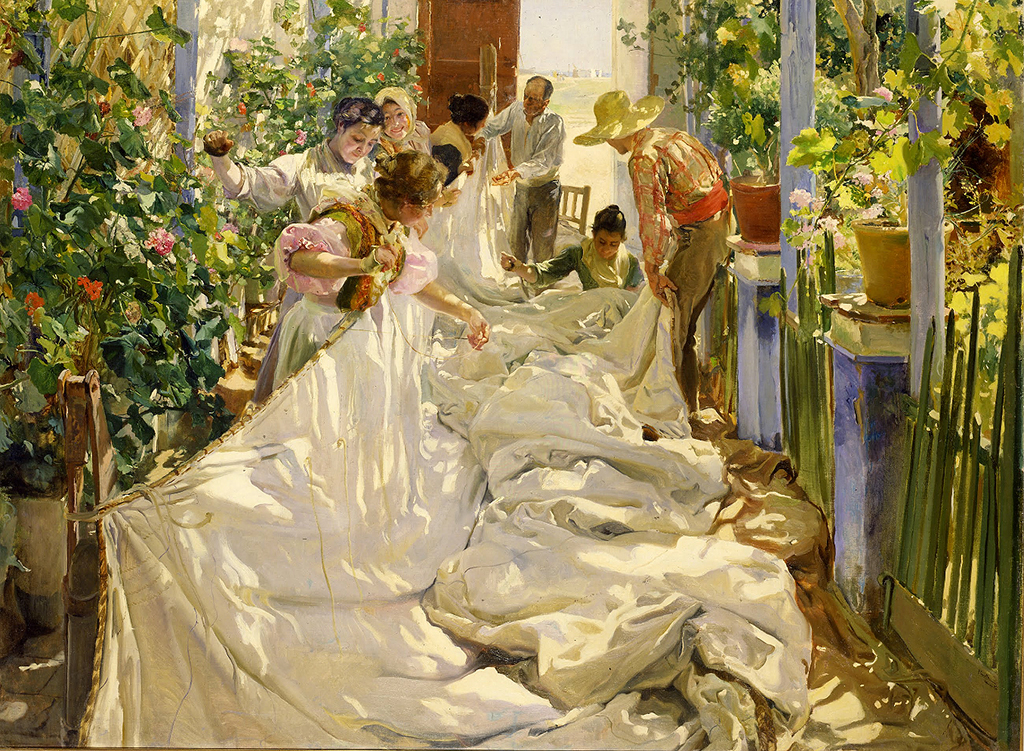
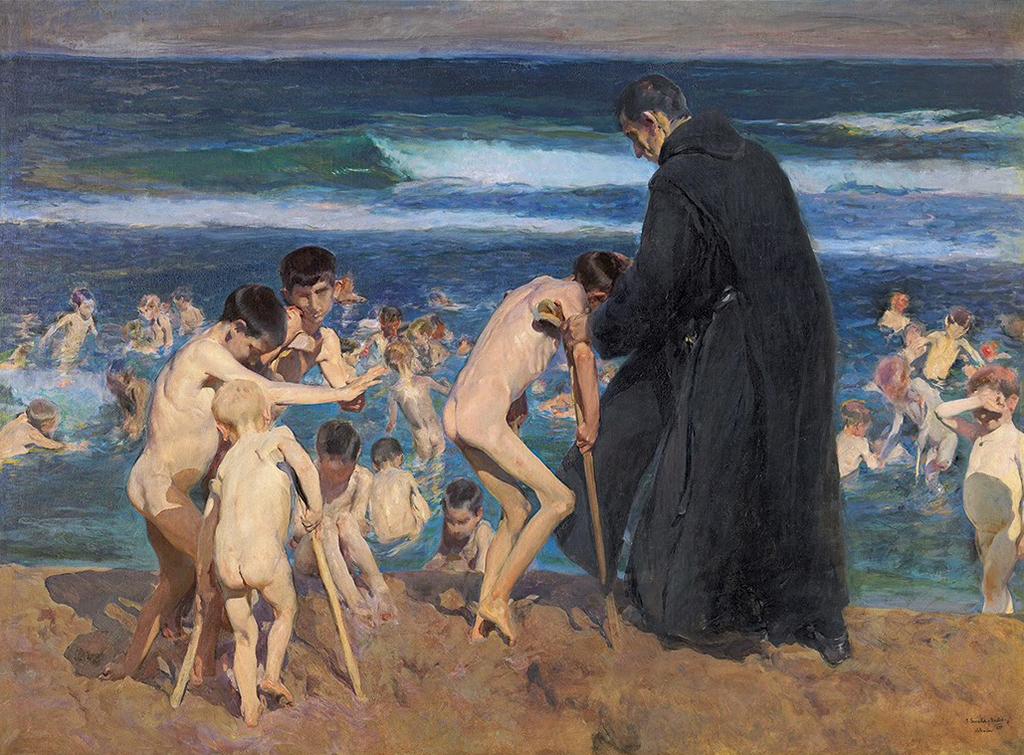
Large canvases brought coastal labour and social subjects before exhibition audiences. Sewing the Sail and Sad Inheritance make different uses of the figure group. [5]
Family, coast and portraiture
Portraits, outdoor figure groups and quieter interiors belong together in his mature range. Moving cloth and water can be compared with the stillness of a seated sitter. [5]
Regional panels and the later years
The fourteen regional canvases of Vision of Spain were painted between 1912 and 1919. Their eventual gallery presents peoples, costumes and traditions through a selected sequence of monumental scenes. [11]

Rome, Paris and Assisi, 1885–1889
Sorolla won a scholarship from the Diputación de Valencia in 1884, which made possible his journey to Rome in 1885. Italy provided a setting for further study and a network of working artists. Rafael Gil Salinas identifies his contact with Spanish painters in Rome, his friendship with Pedro Gil Moreno de Mora and their journey to Paris in 1885. There Sorolla encountered the work of Jules Bastien-Lepage and Adolph von Menzel. Gil Salinas also documents his subsequent Italian travels, study of older art and move to Assisi following illness in 1887.[12]
Rome and Paris offered different kinds of authority. The Italian capital carried the prestige of the classical and Renaissance traditions; Paris put Sorolla in contact with recent naturalist painting. Williams’s account makes the second encounter a decisive stimulus, especially through Bastien-Lepage and Menzel. Its language presents modern naturalism as a liberation from academic routine.[1] That opposition is revealing as a critical position, but the paintings need not be understood as the product of a clean break. Sorolla could learn from contemporary scenes and continue copying earlier masters. Both activities depended upon close attention to visible form.
The Italian years contained substantial differences of scale and purpose. A major religious picture, The Burial of Christ, belonged to the world of scholarship obligations and public recognition. Williams records its exhibition in Madrid in 1887 without a medal. Alongside such projects came small studies of streets, buildings and landscape. In these, a wall, doorway or patch of vegetation could provide a complete problem in colour and space. A modest support still required concentrated decisions about what mattered.[1][13]
The catalogue Sorolla: Arte de la luz records small Italian works including Outskirts of Rome, dated 1885–1886, and Assisi studies of olive trees and a house dated 1887–1889.[13] These works give the scholarship years a substance beyond preparation for the famous beach paintings. Sorolla was already testing how much a small painting could contain. Architecture, landscape and everyday surroundings belonged to his developing practice alongside figures and exhibition pictures.
He married Clotilde García del Castillo in Valencia on 8 September 1888.[9] The couple spent part of their early married life in Assisi. Gil Salinas places their departure from Italy in June 1889, followed by a visit to the Paris Universal Exhibition and a return to Spain; Madrid became their eventual home around 1889–1890.[12][13]
Pedro Gil remained an important connection beyond the journey to Paris. Sorolla’s correspondence with him, like his correspondence with Clotilde, is preserved as part of the documentary record described by the Museo Sorolla.[14] These relationships supplied a continuing framework for a career that increasingly depended on travel. The biography is not simply a succession of cities. Friends, relatives and patrons connected the places and helped give professional movement a durable personal structure.
Madrid, a growing family and the social pictures
In Madrid, Sorolla began building the professional standing that would make larger international opportunities possible. The city provided exhibitions, potential patrons and access to the Prado. Valencia continued to provide family connections and subjects. His career consequently developed through movement between a metropolitan base and places where he could work for extended periods. Establishing himself in the capital did not close the coastal part of his life.
María Clotilde, the couple’s first child, was born on 13 April 1890. The museum’s reasoned record for the seated portrait Clotilde places that painting in April 1890, after the birth, and explains its revised dating through comparison with a dated profile and a photograph of mother and daughter.[15] Their son Joaquín was born in 1892, and Elena followed in 1895.[9] Family life thus developed alongside the demanding work of establishing Sorolla’s reputation. The children would become repeated subjects, but their presence in paintings took different forms as they grew: informal studies, ambitious group portraits and outdoor scenes.
The early 1890s brought a group of pictures that could address a public directly through recognisable social situations. Another Marguerite!, painted in 1892, presents a woman under guard in a railway carriage. Williams describes the bare compartment, the confined group and the restrained arrangement through which Sorolla conveyed the subject.[1] Rather than surround the figure with an elaborate explanation, the picture makes enclosure itself part of its meaning. The social subject and the construction of space work together: a carriage carrying people forward also confines them.
The painting’s recognition in Madrid and its award at the 1893 World’s Columbian Exposition in Chicago established an American connection well before Sorolla’s own visits to the United States.[2][16] Exhibition success could carry a painting farther than its maker. It also placed Sorolla within a broad international culture of naturalist pictures, in which contemporary life provided subjects for large, carefully organised canvases. His reputation abroad began with difficult human circumstances as well as with the luminous coastal scenes that later became especially popular.
White Slave Trade and The Return from Fishing offered markedly different settings. Williams contrasted the subdued railway interior of the first with the activity of people and cattle bringing a fishing boat to shore in the second.[1] The coast entered his work as a place of human activity. It was a place where bodies, animals, equipment and weather had to be understood together. A fishing boat was both an object in light and something that required physical work to move.
The 1894 Return from Fishing was acquired by the French state after its appearance at the Paris Salon in 1895. In the same period And They Still Say Fish Are Expensive! brought official recognition in Spain.[2][9] These successes made the maritime subjects part of Sorolla’s public identity. The ambition lay partly in giving ordinary working situations the scale and visibility associated with major exhibition painting. The practical tasks of the shore could support a picture with the weight of an established public genre.
The relationship between social subject and luminous setting remained flexible. Darkness was not the only possible vehicle for seriousness, and brightness did not automatically turn a scene into leisure. Work might be shown through the coordination of several figures, the handling of heavy equipment or the organisation of a shared space. Sorolla’s later beach pictures would become more varied, but these earlier canvases established the shore as somewhere that people inhabited and used, rather than a coloured backdrop placed behind them.

Comparison: And They Still Say Fish Are Expensive!
Sewing the sail and painting the household
Sewing the Sail, painted in 1896, gave this relationship between ordinary work and ambitious painting an especially clear form. Aureliano de Beruete’s contemporary discussion treats the sail itself as the picture’s central presence and describes the people sewing, the vegetation and the sunlight filtering through leaves. He found significance in Sorolla’s ability to make an apparently modest task compelling on a large canvas.[17] The critic’s emphasis is valuable: the textile was not incidental furniture around a more elevated subject. Its folds and illumination could hold attention in their own right.
The change was also a matter of working scale. The 2015 museum catalogue describes a picture begun from direct observation in a Valencian courtyard and apparently completed in Madrid. It cites a letter to Pedro Gil of 26 December 1896 in which Sorolla associated the work with a new direction.[13] That account suggests a painter reflecting on his practice, not merely producing an effortless succession of outdoor impressions. The large canvas could combine observation on site with decisions made elsewhere. Its vitality does not require the fiction that every passage was completed at once.
Beruete’s response also shows how Sorolla’s work could cross an existing hierarchy of subjects. A sail being repaired had a direct practical purpose. The picture made viewers spend time with that work through an organisation of light, figures and material. Its achievement could be discussed in the language of major art without disguising what the people were doing. The success of such paintings helped expand Sorolla’s reputation, while leaving him room to develop less public subjects alongside them.[17]
At home, the birth of Elena prompted the work that became Mother. The museum dates the canvas approximately 1895–1900 and identifies preparatory material connected with Clotilde and the newborn child.[18] It therefore belongs to a span of work rather than to a single recoverable instant immediately after the birth. The extended date is a reminder that an intimate subject could be reconsidered and developed with the same seriousness as a large exhibition picture.
Mother also complicates the association between Sorolla and brilliant outdoor light. Its subject is an interior and its colour is restrained. Clotilde and Elena are surrounded by bedding, with the heads carrying a concentration of attention that a busier setting would disperse.[18] The painting depends on the relationship between a small amount of visible human form and a much larger area of pale fabric. The scale of the canvas allows a quiet domestic situation to become absorbing without adding incident. Sorolla’s interest in light included its capacity to reduce and soften, as well as to dazzle.
Family painting was not a separate, lesser activity kept outside the professional career. Some portraits could remain closely bound to household life; others travelled to exhibitions and demonstrated what Sorolla could do for prospective clients. His recurring access to familiar sitters allowed him to try different arrangements, but familiarity did not determine a single style. A family member might appear in formal dress in one picture and in an outdoor scene in another. The continuity was the relationship with the sitter, while the pictorial purpose could change.[16][19]
Paris in 1900 and the work of becoming established
The Paris Universal Exhibition of 1900 brought Sorolla a Grand Prix. Beruete, who served on the international jury, described the favourable response to his paintings and the award. His account places Sad Inheritance!, a bathing subject and Sewing the Sail within the display, making clear that recognition attached to a range of work rather than to an isolated formula.[17] A professional breakthrough could confirm several possibilities at once.
Sad Inheritance!, painted in 1899, was especially important in the establishment of his international standing. It shows children, including children with disabilities, bathing under the supervision of a religious brother. Early responses frequently interpreted the subject through assumptions about illness and social status that should not be repeated as medical facts. The painting’s owner, Fundación Bancaja, documents both its extensive preparation and the recognition it brought Sorolla in Paris and Madrid.[20] Its place in the career is clear without accepting the prejudices through which some contemporary viewers described the children.
The evidence of preparation is particularly useful. Bancaja records studies of the composition and individual figures, and notes that Sorolla gave preparatory works to other painters.[20] Such gifts placed the making of a large picture within a network of professional exchange. A study could have value as an object of painting and drawing, as well as serving a later canvas. The apparent immediacy of Sorolla’s art should not erase this material work of examination and revision.
Beruete’s recollection of walking through the Paris exhibition with Sorolla gives another view of the established painter. He reported that Sorolla remained critical of his own work and attentive to the qualities of other artists. The account names painters whose different strengths interested him, including Krøyer, Zorn, Bonnat and Jean-Paul Laurens.[17] This is evidence reported by a friend, with the favourable perspective that friendship can bring. Even so, it offers something more specific than the idea of a naturally gifted painter untouched by other art: success could be followed by comparison and renewed work.
The return to painting after the exhibition mattered as much as the prize. Beruete describes Sorolla resuming work on the coast at Jávea and discusses stronger colour and distinctions between foreground figures and surrounding space in subsequent pictures.[17] Recognition and experimentation were connected rather than consecutive phases. The prize placed him among internationally recognised painters; it did not remove the practical questions that confronted him in front of another subject.
The family portrait and the international painter
By 1904 Sorolla could use a portrait of his children to make a substantial statement about his own art. My Children shows Joaquín standing, with María and Elena seated. The museum identifies the setting as his Madrid studio and records the painting’s participation in the 1909 exhibitions in New York, Buffalo and Boston.[19] It was a family image that could take its place in a public account of his achievement.
The arrangement in the painting is unusually clear. Joaquín stands near the left, his grey suit interrupted by a large white bow. Behind him, María’s red dress extends towards Elena, who reclines at the right. The two seated figures create a broad passage of red across the darker room. A vertical edge close to the right of the composition helps contain the group, while the standing boy provides an upright counterweight. The three children occupy different depths and different kinds of pose, but the arrangement connects them through colour and spacing.
The white bow carries far more visual force than its small size would suggest. Against the grey suit and dim surroundings it gives the eye an immediate point of entry. Red then leads attention across the picture, where faces and hands emerge with different degrees of emphasis. The background is not empty, yet it does not compete evenly with the children. Sorolla makes the family visible through selective attention. The room holds more than the viewer is asked to inspect.
Velázquez remained relevant to this kind of painting. The museum and the National Gallery relate My Children to the Spanish master’s treatment of figures and interior space.[10][19] The comparison helps explain how Sorolla’s earlier museum study continued within his mature practice. Its value lies in the pictorial relationship, rather than in turning the children into substitutes for figures in a famous predecessor. The portrait has its own balance of upright form, relaxed posture and colour.
In 1906 Sorolla presented a major individual exhibition at the Galerie Georges Petit in Paris. Camille Mauclair’s review, published that October, describes the event as a transformation in the painter’s public standing. An artist already respected through Salon appearances became visible to a much larger audience through the collected force of his work.[21] The important change was the opportunity to see a career together. An individual exhibition could reveal differences of subject and handling that a few entries in a large international show might conceal.
Mauclair admired Sorolla’s ability but also made distinctions. He considered some portraits less individual than the marine pictures and small studies; he wondered whether a tighter selection might have produced a more consistently impressive exhibition. At the same time, he recognised that a broad display allowed viewers to follow the artist’s development.[21] This mixture of enthusiasm and reservation makes his review useful historical evidence. Sorolla’s success did not mean that critics saw every part of his work in the same way.
The review also counters a later tendency to remember him through a narrow selection of sunlit canvases. Mauclair discussed dark portrait backgrounds, delicate quieter harmonies, large pictures and numerous small studies. His account presents variety as part of the experience of the exhibition.[21] The career was already being interpreted as a body of work, with internal differences to assess. That was a different kind of visibility from winning a medal for a single contribution.
The years around the Paris exhibition also widened the places represented in his work. Biarritz entered his painting in 1906, and northern resorts such as Zarauz offered a coastal world different from the Valencian fishing beaches. The American exhibition dossier distinguishes these resort subjects from the Mediterranean scenes and also places his views of Toledo, Segovia, the Alcázar and the Alhambra within his developing landscape practice.[16] His range of places mattered because light was encountered through particular surroundings: a promenade, an enclosed garden and an open working shore offered different relationships between people and space.
The traveller’s practice and the portraitist’s practice could therefore overlap without becoming identical. A resort offered familiar family sitters and unfamiliar arrangements; an architectural setting supplied fixed forms against which changes of illumination could register. Sorolla’s increasing public success gave these different pictures a shared audience. It did not require him to make their places look alike.
Germany, London and the opening towards America
Exhibitions followed in Berlin, Düsseldorf and Cologne in 1907, then at London’s Grafton Galleries in 1908. The London display brought Sorolla’s work to Archer M. Huntington, founder of the Hispanic Society of America. Blanca Pons-Sorolla’s study reproduces the relevant evidence from Huntington’s diary and traces the invitation for an exhibition in New York the following year.[22] A connection formed in London would become central to the remaining years of Sorolla’s career.
This international sequence overlapped with family demands. In 1907 María’s illness kept Sorolla from accompanying his work to Germany. The family later spent time at La Granja, where he painted portraits and garden subjects.[9] The point is not to turn illness into an explanation for style. It is to recognise that exhibitions abroad, work at home and the needs of the household did not proceed in separate compartments. The painter’s presence and the circulation of his pictures were sometimes on different timetables.
The 1909 New York catalogue announced the Hispanic Society exhibition from 8 February to 8 March. Its introduction presented Sorolla through both biography and criticism, and the exhibition itself offered a varied account of his work.[23] American viewers were encountering an artist with an established European history. The display did not introduce an unknown painter suddenly detached from his earlier career; it gathered work whose reputation had already been built through prizes, exhibitions and collecting.
The catalogue is also evidence of how that reputation was framed. Williams gave prominence to Sorolla’s origins, training and progression towards contemporary subjects. The life story helped organise the pictures for viewers who might know relatively little about the painter. Yet his account’s contrasts between sombre social scenes and the energy of the coast also show the interpretive choices involved. Biography could make a wide body of work appear to move towards a coherent destination, even when the paintings themselves retained a broader range.[23]
The exhibition travelled on to Buffalo and Boston. Sorolla returned to the United States in 1911 for exhibitions in Chicago and Saint Louis; the Chicago catalogue identifies the Hispanic Society’s management and gives the dates 14 February to 12 March.[16][24] These were sustained professional connections. American interest generated further exhibitions, collecting and portraits, rather than ending with a single season’s acclaim.
Portrait commissions connected Sorolla with sitters whose worlds differed from the Valencian shore. He painted President William Howard Taft in Washington in 1909 and Louis Comfort Tiffany in 1911.[22][25] Their portraits belong to the same expanding practice that included family pictures and outdoor studies. Different clients required different circumstances, but the artist still faced the task of placing a person convincingly within the chosen setting.
The Tiffany connection also reached into the household. Sorolla painted the designer in the garden of his Long Island home and ordered lamps for the new Madrid house.[25] This small connection between a portrait commission and domestic furnishing makes the international career tangible. Patronage was not only a list of transactions or names. It could shape the objects and spaces among which the family lived and the painter worked.
The Valencian summer of 1909
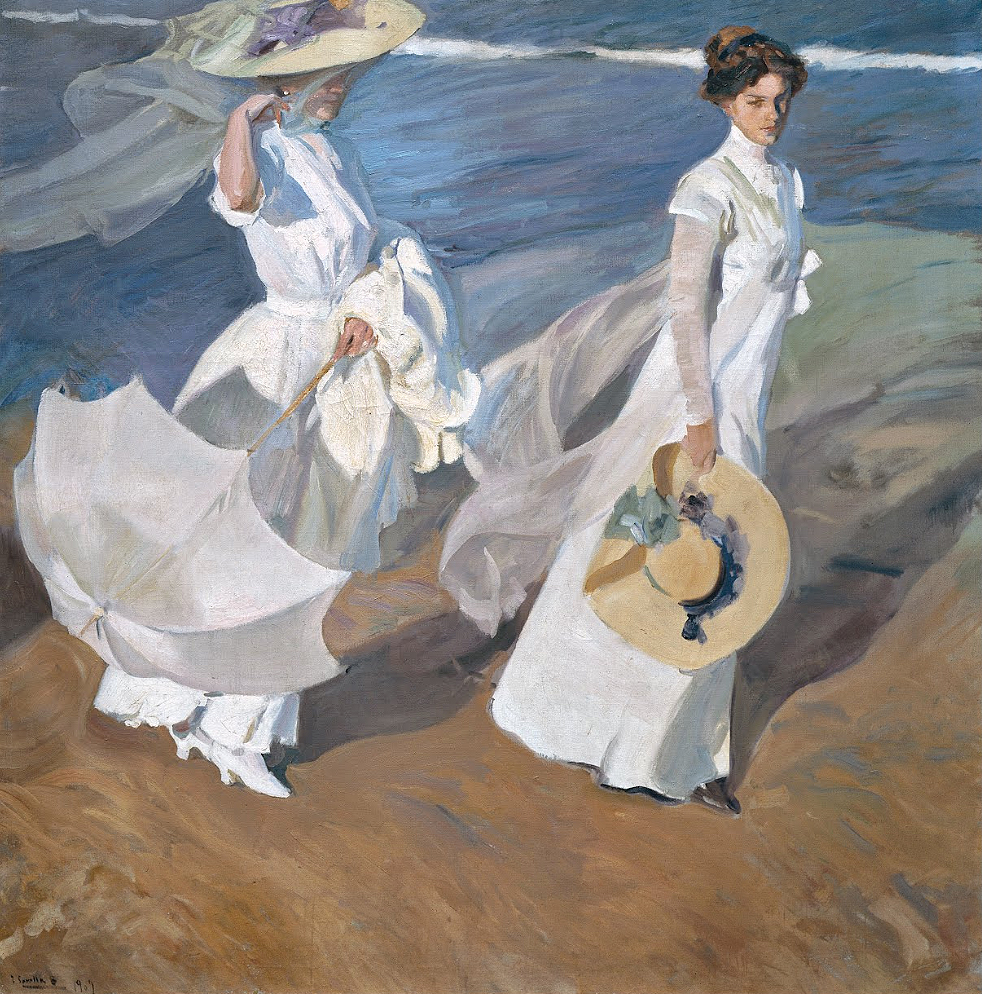
After the American journey, Sorolla worked again on the Valencian coast in 1909. Women Walking on the Beach, also known as Strolling along the Seashore, brings Clotilde and María into this setting. The museum identifies both women and dates the picture to that summer.[26] The familiar coast had become a place where an elegant family portrait and a beach scene could meet.
The sitters’ identity changes the biographical significance of the picture. Clotilde was not a passing model introduced late in his career. She belonged to its earliest supporting household, had shared the Italian years and appeared repeatedly in his work. María, born as the couple established themselves in Spain, was now a young woman. The painting brings two generations into a subject that the internationally successful Sorolla could still find close to home.
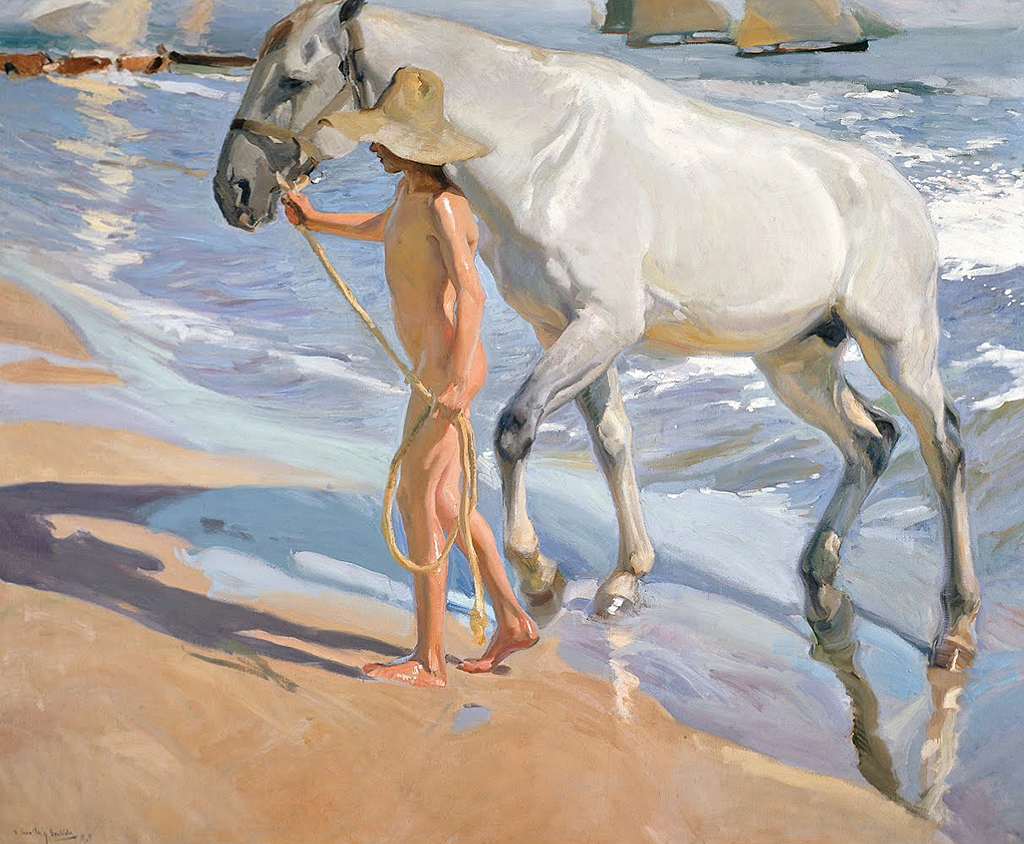
This does not mean that all the people in his beach pictures were relatives. The coast supplied many kinds of subject, and named sitters should be distinguished from unnamed figures. Nor should the pictures of 1909 be treated as interchangeable records of one afternoon. Their formats, actions and arrangements differ. Strolling, bathing, drying after a swim and working with a boat require different patterns of attention, even when they share water and sand.[26][27]
By this stage, the shore could support an unusually broad range of pictorial decisions. A figure might be seen against open water or from a viewpoint that reduced the sky; fabric could become a large field of light; movement could carry the eye laterally rather than towards a distant horizon. These choices explain why returning to a familiar place did not necessarily produce repetitive paintings. Sorolla’s subject was both the visible activity and the problem of making a particular arrangement hold together.
The distinction between a family member and a pictorial role is useful here. Knowing a sitter’s name places the scene within the life; the painting also depends on form and movement. A daughter is also a moving figure; a dress is also a shape in light. Sorolla’s experience of familiar people could enter a composition without requiring a story about what they were thinking or saying. The biography becomes richer when it preserves that space between documented identity and visible form.
A house for living and working
Work began on Sorolla’s new Madrid house in 1910, and the family moved in at the end of 1911.[9] He collaborated with the architect Enrique María de Repullés on a building that combined domestic rooms, substantial studio space and a garden. The museum guide describes three connected garden areas drawing on Andalusian and Italian examples.[25] The house gave an established painter a place in which the practical requirements of work and the arrangement of everyday surroundings could be considered together.
It is easy to view such a house only as a reward for success. It was also working equipment on a large scale. A portraitist needed room for canvases, sitters and changing arrangements. Paintings needed storage, and a painter who worked outdoors still required spaces in which to prepare and reconsider them. The new house made these activities physically adjacent to family life. Its garden, meanwhile, offered subjects that could be encountered repeatedly as planting, weather and light changed.
Duncan C. Phillips Jr visited Sorolla there in the spring of 1912 and published his account in Art and Progress that December. His article records a hospitable painter speaking enthusiastically about America and the new Hispanic Society commission.[28] It is an observer’s account, shaped by the writer’s tastes and by the conventions of a studio visit. Its value is in the encounter it describes, not in treating every reported exchange as a complete statement of Sorolla’s beliefs.
Phillips connected Sorolla’s painting with the pleasures of light, but his response was not uniformly admiring. He worried that some daring viewpoints and luminous effects might become too demonstrative. That reservation gives the visit a productive tension: the qualities which attracted him also prompted questions about the boundary between convincing observation and display.[28] The mature painter was not simply repeating an established formula for an uncritical public. At least one sympathetic visitor found the newer work adventurous enough to dispute.
The article also records Sorolla’s admiration for Las Meninas and describes a Vermeer reproduction in his library.[28] Those details place the new house within a longer artistic education. International prosperity did not make older painting irrelevant. The artist who had copied in the Prado continued to be understood through his interest in the relation of light, people and interior space, even when his own most celebrated subjects stood outdoors.
Vision of Spain and the final working decade
Huntington’s largest commission was formalised on 26 November 1911. Sorolla would paint fourteen panels known as Vision of Spain for the Hispanic Society. The project occupied much of his subsequent working life, with the great Castilian panel completed in 1913 and the sequence continuing through the later 1910s to Ayamonte: The Tuna Catch in 1919.[22] The relationship with America now reached beyond exhibitions and individual purchases to an ensemble that required years of travel and work.
The commission changed the scale of the relationship between a picture and its destination. A portrait or beach scene could be considered separately, then hung with other works. The regional panels were conceived as parts of a larger interior experience. Their people, actions and places had to function both within each canvas and in relation to the ensemble. Sorolla was painting subjects encountered through travel while organising a sustained representation for viewers elsewhere.
The series selected ceremonies, work, dress and recreation as means of representing Spain’s regions. It should be understood as a constructed vision shaped by a commission, rather than a neutral inventory of a whole country. The National Gallery’s account describes Sorolla’s travels, his attention to regional clothing and traditions, and his use of local models, sometimes supplied with costume and props.[2] Observation and arrangement remained connected. A scene could draw upon actual people and material culture while also being composed to carry a larger representative role.
This was a considerable extension of problems already present in the earlier career. Sorolla had long worked with groups and the tasks that linked them. Now those figures also contributed to a regional identity within an architectural scheme. The demand was not simply to make everything larger. He had to sustain differences of place and activity while giving each scene enough force to belong to the whole. The regional commission gathered several of his existing strengths into an unusually prolonged undertaking.
Other painting continued during these years. The Pink Robe dates from 1916, while The Siesta, painted in 1911, belongs to the period in which the American relationship and the new household were taking shape.[9][10] Their presence alongside the commission prevents the later career from becoming a single project with occasional interruptions. Sorolla continued to find pictorial possibilities in the beach and the family circle while developing his most extensive public ensemble.
The garden likewise joined earlier interests with a new practical setting. In the house he could arrange a place and then paint it, becoming both the maker of the surroundings and their observer. That relationship differed from travelling to an established monument or working on a public shore. Familiarity could make small changes more apparent. A wall, pool or area of planting might remain recognisable while the distribution of illumination altered the balance of the view.
Illness, death and the family’s legacy
A stroke in June 1920 brought Sorolla’s active painting career to an end. He died at Cercedilla on 10 August 1923.[2][9][15] The house and garden remained, together with the paintings that had occupied so much of his time. The professional life of journeys, sittings and seasonal campaigns was over; the family now faced the question of how to preserve what it had left behind.
Clotilde and the family helped transform the Madrid house and its collections into the Museo Sorolla, which opened in 1932. Their son Joaquín supported his mother in creating the museum and became its first director.[9][25] A home that had been organised around living and painting consequently became a setting in which later viewers could encounter the work together with the spaces and objects of its making. That continuity gives the museum a particular place in his legacy. Pictures of relatives, garden views and studio interiors can be considered alongside the environment in which part of the career unfolded.
The documentary archive adds another form of continuity. It preserves family and professional correspondence, including letters involving Clotilde, Pedro Gil, Aureliano de Beruete, Vicente Blasco Ibáñez and Huntington, together with records concerning the house and domestic matters.[14] These materials do not reduce the paintings to illustrations of private events. They make it possible to understand the practical connections behind a career whose public image can otherwise seem almost effortless.
Sorolla’s life brought painting into sustained contact with instruction, friendship, family, travel and patronage. The route from Valencia to international recognition involved public competitions and the ordinary requirements of making a living, as well as remarkable facility with a brush. His continuing interest in people at home, people at work and people outdoors gave that route its subjects. The mature paintings retain the breadth of those experiences: the museum student’s concern with space, the portraitist’s attention to a sitter, the traveller’s scrutiny of a place and the working painter’s repeated effort to make a fleeting appearance endure.
Further reading
Museum publications, a historical exhibition catalogue and the early-work catalogue raisonné offer different ways to continue.
Sorolla: Catalogue Raisonné of Paintings, Volume I. Blanca Pons-Sorolla and collaborators. Ediciones El Viso, 2026. Covers 1876–1894.
Use this volume for the early paintings, from juvenilia to the major works of the 1890s. Publisher information.
Catalogue of Paintings by Joaquín Sorolla y Bastida. Hispanic Society of America, New York, 1909.
The historical exhibition catalogue supplies the numbered records in the directory. Its titles and ownership statements describe that exhibition period. Read the historical catalogue.
Eight Essays on Joaquín Sorolla y Bastida. Hispanic Society of America, 1909. Essays in several languages.
Compare contemporary judgments by Beruete, Mauclair, Williams and Huneker with the paintings discussed in the articles. Read the period essays.
Watch: Sorolla, light and painting
Three National Gallery films offer an introduction, a closer look at technique and a longer curator’s talk.
An introduction to 'Sorolla: Spanish Master of Light'
Start with a short exhibition introduction to Sorolla’s subjects and career.
Watch on YouTubeArtworks and exhibition records
Browse 103 artwork articles, 350 numbered entries from the Hispanic Society’s 1909 New York catalogue, and two selected Meadows Museum drawings. These are records, not a count of unique artworks: repeated historical titles remain separate entries and may overlap with the articles. A catalogue’s exhibition year does not establish an execution date. This researched selection is not a complete catalogue raisonné.
| Name | Date | Medium |
|---|---|---|
| Women Walking on the Beach | 1909 | Painting |
| Sewing the Sail | 1896 | Painting |
| Running Along the Beach | 1908 | Painting |
| Sad Inheritance | 1899 | Painting |
| Mother | 1895–1900 | Painting |
| The Horse's Bath | 1909 | Painting |
| The Pink Robe | 1916 | Painting |
| And They Still Say Fish are Expensive! | 1894 | Painting |
| The Return from Fishing | 1894 | Painting |
| Children on the Beach | 1909 | Painting |
| Castilla, the Feast of Bread | 1913 | Painting |
| Sevilla, Holy Week Penitents | 1914 | Painting |
| Aragon, Jota | 1914 | Painting |
| Navarre, the Town Council of Roncal | 1914 | Painting |
| Guipúzcoa, Bowling | 1914 | Painting |
| Andalucía, El Encierro | 1914 | Painting |
| Seville, the Dance | 1915 | Painting |
| Sevilla, The Bullfighters | 1915 | Painting |
| Galicia, The Pilgrimage | 1915 | Painting |
| The Fish | 1915 | Painting |
| Valencia, Couples on Horseback | 1916 | Painting |
| Extremadura, The Market | 1917 | Painting |
| Elche, The Palm Grove | 1918–1919 | Painting |
| The Tunny Catch | 1919 | Painting |
| Louis Comfort Tiffany | 1911 | Painting |
| Adobe Houses | 1890–1895 | Painting |
| After Bathing | 1915 | Painting |
| After Bathing, Valencia | 1909 | Painting |
| After Bathing, Valencian Beach | 1908 | Painting |
| Afternoon Sun, Playa de Valencia | 1910 (Album catalogue) | Painting |
| Aim of Ibiza | 1919 | Painting |
| Almond Trees in Asis | Spring,1887–1889 | Painting |
| Another Margarita | 1892 | Painting |
| Antonio García at the Beach | 1909 | Painting |
| Around Segovia | 9–15 October 1906 | Painting |
| Artist's Patio, Cafe Novedades, Seville | 1915 | Painting |
| Asturian Landscape | circa 1904 | Painting |
| Aureliano de Beruete | 1902 | Painting |
| Aureliano de Beruete y Moret, Son | 1902 | Painting |
| The Bath, Jávea | 1905 | Painting |
| The Bathing Hour | 1915 execution, signed and dated1917 (Sothebys catalogue account) | Painting |
| Bathing Time | 1904 | Painting |
| Beach at Valencia | 1908 in ARC catalogue | Painting |
| Beach at Zarauz | 1910 | Painting |
| Beach of Biarritz | 1906 | Painting |
| Beach of Biarritz, France | Summer1906 | Painting |
| Beached Boats | 1915 | Painting |
| Beaching the Boat | 1908 in ARC catalogue | Painting |
| Blessing the Boat | 1895 | Painting |
| Blind Man of Toledo | 1906 | Painting |
| Boat Builders | 1894 | Painting |
| Boat in Albufera | 1895 | Painting |
| Boy on the Sand | Undated | Painting |
| Boys in the Sea | 1908 | Painting |
| Boys on the Beach | BeforeNewYork1909exhibition; exactyearunresolved | Painting |
| Breakwater, San Sebastian | 1917–1918 | Painting |
| Bulls in the Sea | 1903 | Painting |
| Capturing the Moment | 1906 | Painting |
| Castle of La Mota, Medina del Campo | 29 May 1912 | Painting |
| Children in the Sea | Painting | |
| Children on the Beach, Valencia | 1916 | Painting |
| Children on the Seashore | 1903 | Painting |
| Child's Siesta | circa 1918 (ARC catalogue) | Painting |
| Church Roncal Stairs | 22–28August1912 | Painting |
| Clothilde at the Beach | Summer1904 | Painting |
| Clotilde and Elena on the Rocks at Javea | 1905 | Painting |
| Clotilde García del Castillo | April1890 | Painting |
| Clotilde in a Grey Dress | 1900 | Painting |
| Clotilde with Hat | 1910 | Painting |
| Coast at Santa Cristina | 29 September 1915 (current CERES1122) | Painting |
| Court of the Dances, Alcázar, Sevilla | 1910 | Painting |
| Covachuelas, Toledo | 21–30 October 1906 | Painting |
| Dragging the Trawler | circa 1903–1904 in educational catalogue | Painting |
| El Retiro, Madrid | 1898 | Painting |
| Female Nude | 1902 | Painting |
| Fisherman in Valencia | 1904 | Painting |
| Fisherwomen from Valencia | June–July 1915 | Painting |
| Fishing Boats | by February 1909 | Painting |
| Fishing Nets | 1893 | Painting |
| The Gardens at the Sorolla Family House | spring 1920 | Painting |
| Hall of the Ambassadors, Alhambra, Granada | 1909 | Painting |
| Harbour | 1880 | Painting |
| Joaquín Sorolla García in a White Dress | 1896 | Painting |
| Lighthouse Walk at Biarritz | 1906 | Painting |
| The Little Yacht | 1909 | Painting |
| Maria at La Granja | 1907 | Painting |
| My Children | 1904 | Painting |
| My Wife and Daughters in the Garden | 1910 | Painting |
| Portrait of Benito Pérez Galdós | 1894 | Painting |
| A Rooftop with Flowers | 1902 | Painting |
| Self Portrait | 1904 | Painting |
| Self Portrait | 1909 | Painting |
| Señora de Sorolla in Black | 1906 | Painting |
| La Siesta | 1911 | Painting |
| The Skipping Rope | 1907 | Painting |
| Swimmers, Jávea | 1905 | Painting |
| Time for a Bathe | 1909 | Painting |
| Under the Awning, Zarauz | 1910 | Painting |
| Valencia Beach in the Morning Light | summer 1908 | Painting |
| Valencian Fishermen | 1895 | Painting |
| The White Boat, Jávea | 1905 | Painting |
| White Slave Trade | 1894 | Painting |
| The Wounded Foot | 1909 | Painting |
| Seven Peaks, Guadarrama — 1909 catalogue, no. 1 | Painting | |
| Covachuelas, Toledo — 1909 catalogue, no. 2 | Painting | |
| Las Pedrizas, El Pardo — 1909 catalogue, no. 3 | Painting | |
| Señor Gomar — 1909 catalogue, no. 4 | Painting | |
| El Torneo, El Pardo — 1909 catalogue, no. 5 | Painting | |
| A Toledo Street — 1909 catalogue, no. 6 | Painting | |
| View from El Torneo — 1909 catalogue, no. 7 | Painting | |
| Walls of Segovia — 1909 catalogue, no. 8 | Painting | |
| Convent of El Parral, Segovia — 1909 catalogue, no. 9 | Painting | |
| Environs of Segovia — 1909 catalogue, no. 10 | Painting | |
| Reflections from the Cape, Jávea — 1909 catalogue, no. 11 | Painting | |
| The Clamores, Segovia — 1909 catalogue, no. 12 | Painting | |
| Rocks of the Cape, Jávea — 1909 catalogue, no. 13 | Painting | |
| Farmhouse, Alcira — 1909 catalogue, no. 14 | Painting | |
| María at Biarritz — 1909 catalogue, no. 15 | Painting | |
| Shadow of the Alcántara Bridge, Toledo — 1909 catalogue, no. 16 | Painting | |
| Castle of San Servando, Toledo — 1909 catalogue, no. 17 | Painting | |
| Dr Decret — 1909 catalogue, no. 18 | Painting | |
| Alcántara Bridge, Toledo — 1909 catalogue, no. 19 | Painting | |
| The Forest, La Granja — 1909 catalogue, no. 20 | Painting | |
| Trout Stream, La Granja — 1909 catalogue, no. 21 | Painting | |
| Court of the Dances, Alcázar, Seville — 1909 catalogue, no. 22 | Painting | |
| Oleanders — 1909 catalogue, no. 23 | Painting | |
| Glen, Asturias — 1909 catalogue, no. 24 | Painting | |
| Pavilion of Charles V, Seville — 1909 catalogue, no. 25 | Painting | |
| St Martin's Bridge, Toledo — 1909 catalogue, no. 26 | Painting | |
| Orange Trees — 1909 catalogue, no. 27 | Painting | |
| Rope Makers — 1909 catalogue, no. 28 | Painting | |
| Señor Franzen — 1909 catalogue, no. 29 | Painting | |
| Rocks at the Lighthouse, Biarritz — 1909 catalogue, no. 30 | Painting | |
| St Martin's Bridge, Toledo — 1909 catalogue, no. 31 | Painting | |
| Valencian Fisherwoman — 1909 catalogue, no. 32 | Painting | |
| Road of San Esteban, Asturias — 1909 catalogue, no. 33 | Painting | |
| Basin in the Alcázar, Seville — 1909 catalogue, no. 34 | Painting | |
| Harbour of Valencia — 1909 catalogue, no. 35 | Painting | |
| Haymaking, Asturias — 1909 catalogue, no. 36 | Painting | |
| House of El Greco, Toledo — 1909 catalogue, no. 37 | Painting | |
| María with a Black Hat — 1909 catalogue, no. 38 | Painting | |
| Entrance Tower, Toledo — 1909 catalogue, no. 39 | Painting | |
| Las Covachuelas, Toledo — 1909 catalogue, no. 40 | Painting | |
| Rocks, Jávea — 1909 catalogue, no. 41 | Painting | |
| Road of the Alijares, Toledo — 1909 catalogue, no. 42 | Painting | |
| Segovian Family — 1909 catalogue, no. 43 | Painting | |
| Scalding Grapes, Jávea — 1909 catalogue, no. 44 | Painting | |
| Joaquín — 1909 catalogue, no. 45 | Painting | |
| Elena — 1909 catalogue, no. 46 | Painting | |
| El Grutesco, Alcázar, Seville — 1909 catalogue, no. 47 | Painting | |
| Beach of Valencia — 1909 catalogue, no. 48 | Painting | |
| Sails Drying, Valencia — 1909 catalogue, no. 49 | Painting | |
| Orange Tree — 1909 catalogue, no. 50 | Painting | |
| Little Boy with a Toy Boat — 1909 catalogue, no. 51 | Painting | |
| Old Valencian Fisherman — 1909 catalogue, no. 52 | Painting | |
| Fishing Boats — 1909 catalogue, no. 53 | Painting | |
| Harbour of Valencia — 1909 catalogue, no. 54 | Painting | |
| The Kiss — 1909 catalogue, no. 55 | Painting | |
| Little Boy on a Rock, Jávea — 1909 catalogue, no. 56 | Painting | |
| The Queen's Beam, Valsaín — 1909 catalogue, no. 57 | Painting | |
| Staircase of the Palace, La Granja — 1909 catalogue, no. 58 | Painting | |
| Elena at El Pardo — 1909 catalogue, no. 59 | Painting | |
| Fountain of the Horses, La Granja — 1909 catalogue, no. 60 | Painting | |
| Autumn, La Granja — 1909 catalogue, no. 61 | Painting | |
| María Painting, El Pardo — 1909 catalogue, no. 62 | Painting | |
| Fountain of the Forest, La Granja — 1909 catalogue, no. 63 | Painting | |
| Fountain of Neptune, La Granja — 1909 catalogue, no. 64 | Painting | |
| Orange Grove, Valencia — 1909 catalogue, no. 65 | Painting | |
| Francisqueta, Valencia — 1909 catalogue, no. 66 | Painting | |
| Waiting for the Fish, Valencia — 1909 catalogue, no. 67 | Painting | |
| Taking in the Sail, Valencia — 1909 catalogue, no. 68 | Painting | |
| Return from Fishing, Valencia — 1909 catalogue, no. 69 | Painting | |
| Crayfishers, Valencia — 1909 catalogue, no. 70 | Painting | |
| Swimmer, Jávea — 1909 catalogue, no. 71 | Painting | |
| Elena among Roses — 1909 catalogue, no. 72 | Painting | |
| Idyll — 1909 catalogue, no. 73 | Painting | |
| Vicente Blasco Ibáñez — 1909 catalogue, no. 74 | Painting | |
| Yellow Tree, La Granja — 1909 catalogue, no. 75 | Painting | |
| Blind Man of Toledo — 1909 catalogue, no. 76 | Painting | |
| Fisherwoman with Her Son, Valencia — 1909 catalogue, no. 77 | Painting | |
| The Bath, La Granja — 1909 catalogue, no. 78 | Painting | |
| Sewing the Sail, Valencia — 1909 catalogue, no. 79 | Painting | |
| Looking for Crabs, Jávea — 1909 catalogue, no. 80 | Painting | |
| María, La Granja — 1909 catalogue, no. 81 | Painting | |
| Joaquín and His Dog — 1909 catalogue, no. 82 | Painting | |
| Upon the Sand — 1909 catalogue, no. 83 | Painting | |
| Valencian Fisherwomen — 1909 catalogue, no. 84 | Painting | |
| Señora de Sorolla in White — 1909 catalogue, no. 85 | Painting | |
| At the Seashore, Valencia — 1909 catalogue, no. 86 | Painting | |
| Valencian Woman — 1909 catalogue, no. 87 | Painting | |
| In the Gardens of La Granja — 1909 catalogue, no. 88 | Painting | |
| Old Castilian — 1909 catalogue, no. 89 | Painting | |
| Marqués de Urquijo — 1909 catalogue, no. 90 | Painting | |
| Fisherman's Daughter, Valencia — 1909 catalogue, no. 91 | Painting | |
| Elena and Her Dolls — 1909 catalogue, no. 92 | Painting | |
| My Children — 1909 catalogue, no. 93 | Painting | |
| Swimmers — 1909 catalogue, no. 94 | Painting | |
| Low Tide: Elena at Biarritz — 1909 catalogue, no. 95 | Painting | |
| Mending Nets — 1909 catalogue, no. 96 | Painting | |
| The Bath, Jávea — 1909 catalogue, no. 97 | Painting | |
| The Bath, Jávea — 1909 catalogue, no. 98 | Painting | |
| Boxing Raisins — 1909 catalogue, no. 99 | Painting | |
| Forest Bridge, La Granja — 1909 catalogue, no. 100 | Painting | |
| View of the Palace, La Granja — 1909 catalogue, no. 101 | Painting | |
| Return from Fishing, Valencia — 1909 catalogue, no. 102 | Painting | |
| At the Bath, Valencia — 1909 catalogue, no. 103 | Painting | |
| Little Girl with a Blue Ribbon, Valencia — 1909 catalogue, no. 104 | Painting | |
| María at the Harbour of Jávea — 1909 catalogue, no. 105 | Painting | |
| Instantaneous, Biarritz — 1909 catalogue, no. 106 | Painting | |
| Boy among Breakers, Jávea — 1909 catalogue, no. 107 | Painting | |
| Garden of the Alcázar, Seville — 1909 catalogue, no. 108 | Painting | |
| Oleander Road, Valencia — 1909 catalogue, no. 109 | Painting | |
| María and Her Grandmother — 1909 catalogue, no. 110 | Painting | |
| Malvarrosa Beach, Valencia — 1909 catalogue, no. 111 | Painting | |
| The Huerta of Valencia — 1909 catalogue, no. 112 | Painting | |
| Garden of the Alcázar, Seville — 1909 catalogue, no. 113 | Painting | |
| Garden of the Alcázar, Seville — 1909 catalogue, no. 114 | Painting | |
| The Giralda, Seville — 1909 catalogue, no. 115 | Painting | |
| Palace of Charles V, Seville — 1909 catalogue, no. 116 | Painting | |
| Harbour of Valencia — 1909 catalogue, no. 117 | Painting | |
| Marqués de la Vega-Inclán — 1909 catalogue, no. 118 | Painting | |
| Harbour of Valencia — 1909 catalogue, no. 119 | Painting | |
| At the Water, Valencia — 1909 catalogue, no. 120 | Painting | |
| House in the Huerta, Valencia — 1909 catalogue, no. 121 | Painting | |
| Beach Garden, Valencia — 1909 catalogue, no. 122 | Painting | |
| Huerta of Valencia — 1909 catalogue, no. 123 | Painting | |
| Garden of the Alcázar, Seville — 1909 catalogue, no. 124 | Painting | |
| Asturias — 1909 catalogue, no. 125 | Painting | |
| San Sebastián — 1909 catalogue, no. 126 | Painting | |
| Old Harbour, Biarritz — 1909 catalogue, no. 127 | Painting | |
| Beach of Biarritz — 1909 catalogue, no. 128 | Painting | |
| Beach of Biarritz — 1909 catalogue, no. 129 | Painting | |
| Beach of Biarritz — 1909 catalogue, no. 130 | Painting | |
| Beach of Biarritz — 1909 catalogue, no. 131 | Painting | |
| Beach of Biarritz — 1909 catalogue, no. 132 | Painting | |
| Beach of Biarritz — 1909 catalogue, no. 133 | Painting | |
| Beach of Biarritz — 1909 catalogue, no. 134 | Painting | |
| Beach of Biarritz — 1909 catalogue, no. 135 | Painting | |
| Beach of Biarritz — 1909 catalogue, no. 136 | Painting | |
| Beach of Biarritz — 1909 catalogue, no. 137 | Painting | |
| Beach of Biarritz — 1909 catalogue, no. 138 | Painting | |
| Beach of Biarritz — 1909 catalogue, no. 139 | Painting | |
| Beach of Biarritz — 1909 catalogue, no. 140 | Painting | |
| Beach of Biarritz — 1909 catalogue, no. 141 | Painting | |
| Beach of Biarritz — 1909 catalogue, no. 142 | Painting | |
| Beach of Biarritz — 1909 catalogue, no. 143 | Painting | |
| La Concha, San Sebastián — 1909 catalogue, no. 144 | Painting | |
| Beach of Biarritz — 1909 catalogue, no. 145 | Painting | |
| Beach of Biarritz — 1909 catalogue, no. 146 | Painting | |
| Beach of Biarritz — 1909 catalogue, no. 147 | Painting | |
| Beach of Biarritz — 1909 catalogue, no. 148 | Painting | |
| Beach of Biarritz — 1909 catalogue, no. 149 | Painting | |
| Beach of Biarritz — 1909 catalogue, no. 150 | Painting | |
| Beach of Biarritz — 1909 catalogue, no. 151 | Painting | |
| Beach of Biarritz — 1909 catalogue, no. 152 | Painting | |
| Beach of Biarritz — 1909 catalogue, no. 153 | Painting | |
| Beach of Biarritz — 1909 catalogue, no. 154 | Painting | |
| Beach of Valencia — 1909 catalogue, no. 155 | Painting | |
| Beach of Valencia — 1909 catalogue, no. 156 | Painting | |
| Beach of Valencia — 1909 catalogue, no. 157 | Painting | |
| Harbour of San Sebastián — 1909 catalogue, no. 158 | Painting | |
| Harbour of San Sebastián — 1909 catalogue, no. 159 | Painting | |
| Beach of Valencia — 1909 catalogue, no. 160 | Painting | |
| Pasajes — 1909 catalogue, no. 161 | Painting | |
| Harbour of San Sebastián — 1909 catalogue, no. 162 | Painting | |
| La Concha, San Sebastián — 1909 catalogue, no. 163 | Painting | |
| La Concha, San Sebastián — 1909 catalogue, no. 164 | Painting | |
| Harbour of Pasajes — 1909 catalogue, no. 165 | Painting | |
| Beach of Valencia — 1909 catalogue, no. 166 | Painting | |
| Beach of Valencia — 1909 catalogue, no. 167 | Painting | |
| Beach of Valencia — 1909 catalogue, no. 168 | Painting | |
| Beach of Valencia — 1909 catalogue, no. 169 | Painting | |
| Beach of Valencia — 1909 catalogue, no. 170 | Painting | |
| Beach of Valencia — 1909 catalogue, no. 171 | Painting | |
| Beach of Valencia — 1909 catalogue, no. 172 | Painting | |
| Beach of Valencia — 1909 catalogue, no. 173 | Painting | |
| Beach of Valencia — 1909 catalogue, no. 174 | Painting | |
| Beach of Valencia — 1909 catalogue, no. 175 | Painting | |
| Beach of Valencia — 1909 catalogue, no. 176 | Painting | |
| Beach of Valencia — 1909 catalogue, no. 177 | Painting | |
| Cape San Antonio, Jávea — 1909 catalogue, no. 178 | Painting | |
| Galicia — 1909 catalogue, no. 179 | Painting | |
| Sewing the Sail — 1909 catalogue, no. 180 | Painting | |
| Poppies — 1909 catalogue, no. 181 | Painting | |
| Beach of Valencia — 1909 catalogue, no. 182 | Painting | |
| Malvarrosa — 1909 catalogue, no. 183 | Painting | |
| Harbour of San Sebastián — 1909 catalogue, no. 184 | Painting | |
| Beach of Valencia — 1909 catalogue, no. 185 | Painting | |
| Locutory — 1909 catalogue, no. 186 | Painting | |
| Beach of Valencia — 1909 catalogue, no. 187 | Painting | |
| Beach of Valencia — 1909 catalogue, no. 188 | Painting | |
| Cape San Antonio, Jávea — 1909 catalogue, no. 189 | Painting | |
| Beach of Valencia — 1909 catalogue, no. 190 | Painting | |
| Oleanders — 1909 catalogue, no. 191 | Painting | |
| Beach of Valencia — 1909 catalogue, no. 192 | Painting | |
| La Concha, San Sebastián — 1909 catalogue, no. 193 | Painting | |
| Beach of Valencia — 1909 catalogue, no. 194 | Painting | |
| Beach of Valencia — 1909 catalogue, no. 195 | Painting | |
| Beach of Valencia — 1909 catalogue, no. 196 | Painting | |
| Biarritz — 1909 catalogue, no. 197 | Painting | |
| Biarritz — 1909 catalogue, no. 198 | Painting | |
| Segovia — 1909 catalogue, no. 199 | Painting | |
| Asturias — 1909 catalogue, no. 200 | Painting | |
| Versailles — 1909 catalogue, no. 201 | Painting | |
| Beach of Valencia — 1909 catalogue, no. 202 | Painting | |
| Beach of Valencia — 1909 catalogue, no. 203 | Painting | |
| Beach of Valencia — 1909 catalogue, no. 204 | Painting | |
| Beach of Valencia — 1909 catalogue, no. 205 | Painting | |
| Court of El Cabañal — 1909 catalogue, no. 206 | Painting | |
| In the River — 1909 catalogue, no. 207 | Painting | |
| Harbour of Valencia — 1909 catalogue, no. 208 | Painting | |
| Beach of Valencia — 1909 catalogue, no. 209 | Painting | |
| Harbour of Valencia — 1909 catalogue, no. 210 | Painting | |
| Beach of Valencia — 1909 catalogue, no. 211 | Painting | |
| Beach of Valencia — 1909 catalogue, no. 212 | Painting | |
| Beach of Valencia — 1909 catalogue, no. 213 | Painting | |
| Royal Mallows — 1909 catalogue, no. 214 | Painting | |
| Geraniums — 1909 catalogue, no. 215 | Painting | |
| Altar of St Vincent, Valencia — 1909 catalogue, no. 216 | Painting | |
| Beach of Valencia — 1909 catalogue, no. 217 | Painting | |
| Harbour of Avilés — 1909 catalogue, no. 218 | Painting | |
| Beach of Valencia — 1909 catalogue, no. 219 | Painting | |
| Beach of Valencia — 1909 catalogue, no. 220 | Painting | |
| Beach of Valencia — 1909 catalogue, no. 221 | Painting | |
| Market of León — 1909 catalogue, no. 222 | Painting | |
| Beach of Valencia — 1909 catalogue, no. 223 | Painting | |
| Beach of Valencia — 1909 catalogue, no. 224 | Painting | |
| Beach of Valencia — 1909 catalogue, no. 225 | Painting | |
| Beach of Valencia — 1909 catalogue, no. 226 | Painting | |
| Beach of Valencia — 1909 catalogue, no. 227 | Painting | |
| Huerta of Valencia — 1909 catalogue, no. 228 | Painting | |
| Beach of Valencia — 1909 catalogue, no. 229 | Painting | |
| Beach of Valencia — 1909 catalogue, no. 230 | Painting | |
| Beach of Valencia — 1909 catalogue, no. 231 | Painting | |
| Beach of Valencia — 1909 catalogue, no. 232 | Painting | |
| Beach of Valencia — 1909 catalogue, no. 233 | Painting | |
| Beach of Valencia — 1909 catalogue, no. 234 | Painting | |
| Asturias — 1909 catalogue, no. 235 | Painting | |
| Beach of Valencia — 1909 catalogue, no. 236 | Painting | |
| Women Playing — 1909 catalogue, no. 237 | Painting | |
| Beach of Valencia — 1909 catalogue, no. 238 | Painting | |
| Beach of Valencia — 1909 catalogue, no. 239 | Painting | |
| Beach of Valencia — 1909 catalogue, no. 240 | Painting | |
| Beach of Valencia — 1909 catalogue, no. 241 | Painting | |
| Market of León — 1909 catalogue, no. 242 | Painting | |
| Beach of Valencia — 1909 catalogue, no. 243 | Painting | |
| Beach of Valencia — 1909 catalogue, no. 244 | Painting | |
| Beach of Valencia — 1909 catalogue, no. 245 | Painting | |
| Beach of Valencia — 1909 catalogue, no. 246 | Painting | |
| Asturias — 1909 catalogue, no. 247 | Painting | |
| León — 1909 catalogue, no. 248 | Painting | |
| Asturias — 1909 catalogue, no. 249 | Painting | |
| Jávea — 1909 catalogue, no. 250 | Painting | |
| Asturias — 1909 catalogue, no. 251 | Painting | |
| León — 1909 catalogue, no. 252 | Painting | |
| Asturias — 1909 catalogue, no. 253 | Painting | |
| Asturias — 1909 catalogue, no. 254 | Painting | |
| Beach of Valencia — 1909 catalogue, no. 255 | Painting | |
| Beach of Valencia — 1909 catalogue, no. 256 | Painting | |
| Asturias — 1909 catalogue, no. 257 | Painting | |
| León — 1909 catalogue, no. 258 | Painting | |
| Beach of Valencia — 1909 catalogue, no. 259 | Painting | |
| Beach of Valencia — 1909 catalogue, no. 260 | Painting | |
| Beach of Valencia — 1909 catalogue, no. 261 | Painting | |
| León — 1909 catalogue, no. 262 | Painting | |
| Beach of Valencia — 1909 catalogue, no. 263 | Painting | |
| Asturias — 1909 catalogue, no. 264 | Painting | |
| Galicia — 1909 catalogue, no. 265 | Painting | |
| Malvarrosa — 1909 catalogue, no. 266 | Painting | |
| Jávea — 1909 catalogue, no. 267 | Painting | |
| Biarritz — 1909 catalogue, no. 268 | Painting | |
| Harbour of Jávea — 1909 catalogue, no. 269 | Painting | |
| La Concha, San Sebastián — 1909 catalogue, no. 270 | Painting | |
| San Sebastián — 1909 catalogue, no. 271 | Painting | |
| San Sebastián — 1909 catalogue, no. 272 | Painting | |
| Beach of Valencia — 1909 catalogue, no. 273 | Painting | |
| Beach of Valencia — 1909 catalogue, no. 274 | Painting | |
| Beach of Valencia — 1909 catalogue, no. 275 | Painting | |
| Beach of Valencia — 1909 catalogue, no. 276 | Painting | |
| Beach of Valencia — 1909 catalogue, no. 277 | Painting | |
| Washerwomen — 1909 catalogue, no. 278 | Painting | |
| San Sebastián — 1909 catalogue, no. 279 | Painting | |
| Beach of Valencia — 1909 catalogue, no. 280 | Painting | |
| San Sebastián — 1909 catalogue, no. 281 | Painting | |
| San Sebastián — 1909 catalogue, no. 282 | Painting | |
| Beach of Valencia — 1909 catalogue, no. 283 | Painting | |
| Beach of Valencia — 1909 catalogue, no. 284 | Painting | |
| Uncle Pancha — 1909 catalogue, no. 285 | Painting | |
| Señor García — 1909 catalogue, no. 286 | Painting | |
| Boy Nude, La Granja — 1909 catalogue, no. 287 | Painting | |
| Señora de Sorolla in Black — 1909 catalogue, no. 288 | Painting | |
| Duke of Alba — 1909 catalogue, no. 289 | Painting | |
| Mother: Señora de Sorolla — 1909 catalogue, no. 290 | Painting | |
| Running along the Beach — 1909 catalogue, no. 291 | Painting | |
| After the Bath — 1909 catalogue, no. 292 | Painting | |
| Lighthouse Walk, Biarritz — 1909 catalogue, no. 293 | Painting | |
| Little Boy on the Beach — 1909 catalogue, no. 294 | Painting | |
| Cape San Antonio, Jávea — 1909 catalogue, no. 295 | Painting | |
| Count of Villagonzalo — 1909 catalogue, no. 296 | Painting | |
| Boy in the Sea — 1909 catalogue, no. 297 | Painting | |
| Children on the Beach — 1909 catalogue, no. 298 | Painting | |
| Valencian Boats — 1909 catalogue, no. 299 | Painting | |
| The Little Brother — 1909 catalogue, no. 300 | Painting | |
| Children in the Sea — 1909 catalogue, no. 301 | Painting | |
| Orange Grove, Alcira — 1909 catalogue, no. 302 | Painting | |
| At the Water — 1909 catalogue, no. 303 | Painting | |
| Little Boy on the Beach — 1909 catalogue, no. 304 | Painting | |
| Street of Orange Trees — 1909 catalogue, no. 305 | Painting | |
| Playing in the Water — 1909 catalogue, no. 306 | Painting | |
| Beach of Valencia by Morning Light — 1909 catalogue, no. 307 | Painting | |
| Coming out of the Bath — 1909 catalogue, no. 308 | Painting | |
| The Grandson — 1909 catalogue, no. 309 | Painting | |
| Water Joy — 1909 catalogue, no. 310 | Painting | |
| On the Sand — 1909 catalogue, no. 311 | Painting | |
| Francisco Acebal — 1909 catalogue, no. 312 | Painting | |
| Marcelino Menéndez y Pelayo — 1909 catalogue, no. 313 | Painting | |
| Aureliano de Beruete — 1909 catalogue, no. 314 | Painting | |
| Marqués de Viana — 1909 catalogue, no. 315 | Painting | |
| Beach of Valencia — 1909 catalogue, no. 316 | Painting | |
| Señor Granzón — 1909 catalogue, no. 317 | Painting | |
| Oxen Ready to Beach Fishing Boats, Valencia — 1909 catalogue, no. 318 | Painting | |
| Children in the Sea — 1909 catalogue, no. 319 | Painting | |
| Sea: Morning Effect — 1909 catalogue, no. 320 | Painting | |
| Fishing Boat — 1909 catalogue, no. 321 | Painting | |
| Sails at Sea — 1909 catalogue, no. 322 | Painting | |
| Return from Fishing — 1909 catalogue, no. 323 | Painting | |
| Boats on the Sand — 1909 catalogue, no. 324 | Painting | |
| Study of Boats — 1909 catalogue, no. 325 | Painting | |
| Fishing Boats — 1909 catalogue, no. 326 | Painting | |
| Boats — 1909 catalogue, no. 327 | Painting | |
| Children on the Shore — 1909 catalogue, no. 328 | Painting | |
| Beach of Valencia — 1909 catalogue, no. 329 | Painting | |
| Beach of Valencia — 1909 catalogue, no. 330 | Painting | |
| Beach of Valencia — 1909 catalogue, no. 331 | Painting | |
| Beach of Valencia — 1909 catalogue, no. 332 | Painting | |
| Nets Drying — 1909 catalogue, no. 333 | Painting | |
| Shoving off the Boat — 1909 catalogue, no. 334 | Painting | |
| Beach of Valencia — 1909 catalogue, no. 335 | Painting | |
| Oleanders — 1909 catalogue, no. 336 | Painting | |
| Beach of Valencia — 1909 catalogue, no. 337 | Painting | |
| Beach of Valencia — 1909 catalogue, no. 338 | Painting | |
| Beach of Valencia — 1909 catalogue, no. 339 | Painting | |
| Leonese Peasants — 1909 catalogue, no. 340 | Painting | |
| At the Bath — 1909 catalogue, no. 341 | Painting | |
| Sea Idyll — 1909 catalogue, no. 342 | Painting | |
| The Little Granddaughter — 1909 catalogue, no. 343 | Painting | |
| Manuel B. Cossío — 1909 catalogue, no. 344 | Painting | |
| The Peppers — 1909 catalogue, no. 345 | Painting | |
| Raimundo de Madrazo — 1909 catalogue, no. 346 | Painting | |
| Alejandro Pidal y Mon — 1909 catalogue, no. 347 | Painting | |
| Señora de Sorolla in Spanish Mantilla — 1909 catalogue, no. 348 | Painting | |
| My Daughters, Elena and María, on Horseback in Valencian Costumes of 1808 — 1909 catalogue, no. 349 | Painting | |
| Sad Inheritance — 1909 catalogue, no. 350 | Painting | |
| Study of Hands | c. 1889 | Drawing |
| Clotilde Reading (recto) | c. 1902 | Drawing |
Discussion
Look again at the images and ideas explored in Joaquín Sorolla: a biography. These editorial prompts invite your observations.
Reader Insights
Which detail in Joaquín Sorolla: a biography first caught your attention, and where did your eye travel next?
The section “Valencia: family, training and the García household” offers one way into the subject. Which detail or comparison most helps you assess that reading?
After reading “Illness, death and the family’s legacy”, what would you return to for a closer look?
Join the Conversation
Share a detail, comparison or question about Joaquín Sorolla: a biography below.
References
- Leonard Williams, “The Art of Joaquín Sorolla,” biographical section, in Eight Essays on Joaquín Sorolla y Bastida, vol. I, Hispanic Society of America, New York, 1909, printed pp. 197–216; especially pp. 197–205 on childhood, training and Italy, and pp. 205–216 on social and coastal subjects. Digitised volume. View source.
- National Gallery, “Sorolla: Spanish Master of Light,” press release, January 2019, career and exhibition-room summaries, including social paintings, portraits, the regional commission and final years. National Gallery. View source.
- Museo Sorolla, Sala I: Biografía, museum handout, both pages. View source.
- Museum of Modern Art, Impressionism, movement overview. View source.
- Hispanic Society of America, Eight Essays on Joaquín Sorolla y Bastida, 1909, Beruete, Mauclair and Williams essays. View source.
- Musée d’Orsay, Jules Bastien-Lepage (1848–1884). View source.
- National Gallery, John Singer Sargent, life dates. View source.
- Zorn Museum, Anders Zorn, life dates. View source.
- Museo Sorolla, Sala I · Biografía, two-page museum handout, pp. 1–2, chronology entries 1878, 1888, 1890, 1895, 1907, 1910–1911, 1920 and 1923; opening text on the museum’s inauguration in 1932. Museum handout. View source.
- National Gallery, “Bright colours, bold brushstrokes, and unexpected angles,” sections “In the tradition of the Spanish Old Masters,” “A new approach to composition” and “Painting technique.” Sorolla’s technique. View source.
- Hispanic Society Museum & Library, Joaquín Sorolla’s Vision of Spain. View source.
- Rafael Gil Salinas, “Sorolla en Italia: inicio de su proyección internacional,” MAKMA, published in Sorolla Poliédrico, November 2023, online 2 January 2024, paragraphs on the scholarship, Rome and Paris, Assisi, and return to Spain. MAKMA. View source.
- Consuelo Luca de Tena, curator, and José Manuel Pascual, deputy curator, Sorolla: Arte de la luz, Museo Sorolla / Fundación Museo Sorolla, 2015, printed pp. 29–48, PDF pp. 21–40; especially catalogue entries 3–5, printed pp. 29–31, Madrid discussion p. 32, Sewing the Sail discussion p. 41 and note 21, and Mother pp. 46–47. Museum catalogue. View source.
- Museo Sorolla, “Archivo documental,” description of the correspondence and domestic records, with bibliographic entries for the published correspondence with Clotilde García del Castillo and Pedro Gil Moreno de Mora. Documentary archive. View source.
- Museo Sorolla / CER.es, Clotilde; Clotilde García del Castillo, inventory 00273, “Clasificación razonada,” dating discussion identifying María Clotilde’s birth as 13 April 1890; author identity fields give Sorolla’s birth and death dates and places. Collection record. View source.
- Fundación MAPFRE, Sorolla y Estados Unidos / Sorolla and EEUU, exhibition press dossier, 2014, PDF pp. 1–4 and 6, sections on early American collecting, Huntington, Ryan, portraits exhibited in America, landscapes, gardens and coastal subjects. Exhibition dossier. View source.
- Aureliano de Beruete, essay on Sorolla, originally La Lectura, January 1901, reprinted in Eight Essays on Joaquín Sorolla y Bastida, vol. I, 1909, printed pp. 77–96; especially pp. 78–90 on the Paris display, Sewing the Sail and the Grand Prix, and pp. 95–96 on subsequent work. Digitised volume. View source.
- Museo Sorolla, “Mother,” inventory 324, date, birth context and preparatory works. Museum object page. View source.
- Museo Sorolla / CER.es, Mis hijos, inventory 00651, description, date, exhibition history and “Clasificación razonada,” particularly the confirmed 1909 American exhibitions and the Madrid studio setting. Collection catalogue. View source.
- Fundación Bancaja, “¡Triste herencia!,” 1899, collection record and account of studies, artist gifts, awards and acquisition history. Owner’s record. View source.
- Camille Mauclair, “M. Sorolla y Bastida,” Art et Décoration, October 1906, reprinted in Eight Essays on Joaquín Sorolla y Bastida, vol. I, 1909, printed pp. 107–127, opening review of the Georges Petit exhibition and distinctions between portraits, marine pictures and studies. Digitised volume. View source.
- Blanca Pons-Sorolla, “Sorolla in the Huntingtons’ Collections,” in José Luis Colomer, Blanca Pons-Sorolla and Mark A. Roglán, eds., Sorolla in America: Friends and Patrons, selected publisher excerpt, printed pp. 45, 47–54 and 66–67, PDF pp. 5–11 and 14–15; Huntington’s 13 May 1908 diary entry at printed p. 48, exhibition documents p. 51, and commission and panel sequence p. 66. Photograph caption, PDF p. 2, for Taft portrait context. Publisher excerpt. View source.
- Leonard Williams, introduction, Catalogue of Paintings by Joaquín Sorolla y Bastida Exhibited by the Hispanic Society of America, February 8 to March 8, 1909, New York, 1909, title page and opening “The Art of Joaquín Sorolla,” “Biographical” section. Exhibition catalogue. View source.
- Art Institute of Chicago / Hispanic Society of America, Catalogue of Paintings by Joaquín Sorolla y Bastida, Chicago, 1911, title page giving management and exhibition dates, 14 February–12 March 1911. Exhibition catalogue. View source.
- Museo Sorolla, Sorolla entre nosotros, secondary-school museum guide, PDF pp. 3–7, 15, 19, 31 and 34–39, on the house, family legacy, studios, Tiffany lamps and gardens. Museum guide. View source.
- Museo Sorolla, “Paseo a la orilla del mar,” inventory 834, date and identification of Clotilde and María. Museum object page. View source.
- Museo Sorolla / CER.es, La hora del baño, inventory 00835, and Después del baño, inventory 00836, distinct 1909 collection records. La hora del baño and Después del baño. View source 1. View source 2.
- Duncan C. Phillips Jr, “Sorolla: The Painter of Sunlight,” Art and Progress 4, no. 2, December 1912, pp. 791–797; visit and reported conversation p. 794, discussion of viewpoints pp. 792–793, Velázquez p. 792, and library/Vermeer p. 797. Digitised article. View source.
- Hispanic Society of America, Catalogue of Paintings by Joaquín Sorolla y Bastida, 1909, entries 1–350. View source.
- Amanda W. Dotseth, Study of Hands, Sketch for The Regency, and Six Other Drawings by Joaquín Sorolla y Bastida, At the Meadows, Fall 2018, pp. 24–29. View source.


