


 by Tom Gurney
Tom Gurney BSc (Hons) is an art history expert with over 20 years experience
Published on June 19, 2020 / Updated on November 6, 2026
Email: tomgurney1@gmail.com / Phone: +44 7429 011000
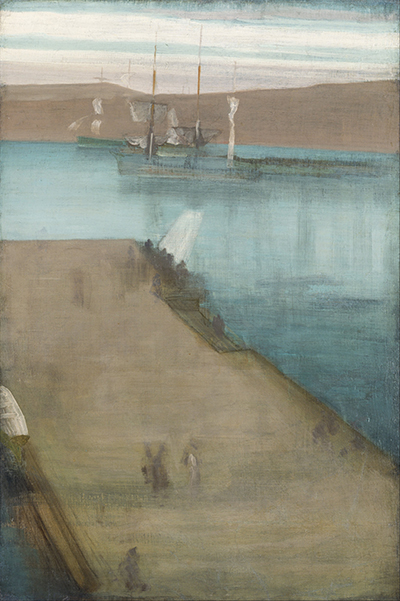
James McNeill Whistler's Valparaiso Harbor is a vertical oil painting of 1866, now in the Smithsonian American Art Museum. It looks down across a diagonal pier towards sailing ships and the hills around the Chilean port. The Smithsonian records it as Valparaiso Harbor, while the catalogue raisonné prefers Sketch for “Nocturne in Blue and Gold: Valparaiso Bay”.[1][4]
Those titles preserve different parts of the work's history. “Valparaiso Harbor” is the current museum and local route title; Valparaiso Harbour was used at a British exhibition in 1927. The longer catalogue title identifies a proposed relation to Whistler's later Freer nocturne, but that relationship has been disputed. A responsible account must explain all three usages without allowing any one of them to erase the object in front of us.[1][2][4][14]
At a Glance
- CatalogueYMSM 074
- Date1866
- MediumOil on canvas
- Dimensions76.6 × 51.1 cm; 30 1/8 × 20 1/8 in.
- SignatureNone
- Museum titleValparaiso Harbor
- CollectionSmithsonian American Art Museum, 1929.6.159
- CreditGift of John Gellatly
- FrameAmerican-made Grau-style, c. 1920s; not Whistler-selected
- DisplayNot on view on 25 August 2026; check the current museum listing
Contents
- At a glance
- What does Valparaiso Harbor show?
- Why does the painting have two main titles?
- Which Valparaiso painting is this?
- Four nearby catalogue identities
- Was it painted from a club window?
- The journey to Chile
- The bombardment of Valparaiso
- Why did Whistler go to Valparaiso?
- How the pier builds the view
At a glance
- Artist: James McNeill Whistler (1834–1903).[1][4] - Date: 1866.[1][4] - Medium: oil on canvas.[1][4] - Dimensions: 76.6 × 51.1 centimetres; 30 1/8 × 20 1/8 inches.[1][4] - Catalogue number: YMSM 074.[1] - Museum number: Smithsonian American Art Museum 1929.6.159.[4] - Credit: Gift of John Gellatly.[4][15] - Signature and inscription: none.[1] - Current museum title: Valparaiso Harbor.[4] - Current display status: not on view when checked on 25 August 2026.[4]
What does Valparaiso Harbor show?
The composition begins above its subject. A pier or jetty runs diagonally across the foreground below the viewer, carrying a few very small figures. Boats gather beside it, and a small white sail catches the eye near its far-right end. Several taller sailing ships stand farther into the bay, with the coastal hills forming a distant boundary.[1][4]
This is a harbour arranged through large directional contrasts. The pier makes the strongest diagonal, ships and masts provide upright intervals, and water and hills extend laterally. The human figures are scale markers within that structure. Nothing in the locked evidence identifies them as named sailors, soldiers, officials or merchants.[1][11]
The light is daylight or bright overcast rather than nocturnal. Water, pier, vessels and shore remain spatially separable, although not consistently detailed. That visible daytime condition matters because the scholarly title names a nocturne that this painting is not.[1][2][8]
Why does the painting have two main titles?
The Smithsonian's Valparaiso Harbor is not an obsolete mistake. It is the current title attached to accession 1929.6.159, and it keeps the physical subject immediately legible. The spelling “Harbor” follows present American museum usage.[4]
When the Royal Society of British Artists displayed the picture in 1927, its catalogue used Valparaiso Harbour. The changed final letters reflect British spelling, not a second canvas. That exhibition title is an important public checkpoint before John Gellatly acquired the work.[3][14][15]
The catalogue raisonné published in 1980 and subsequently revised online prefers Sketch for “Nocturne in Blue and Gold: Valparaiso Bay.” Its title carries a hypothesis: the daylight upright is closely related to the Freer Gallery's YMSM 076, which Whistler transformed into a nocturne.[1][2][8]
The most useful solution is therefore additive. Valparaiso Harbor names the Smithsonian object and route; the longer title records the scholarly proposal. “Sketch” should not be used as a verdict that the painting is merely minor, preparatory or aesthetically incomplete.[1][4]
Which Valparaiso painting is this?
This is YMSM 074, Smithsonian 1929.6.159. It is an upright canvas measuring a little over three-quarters of a metre high. It has no signature or inscription, so catalogue identity and collection history are especially important controls.[1][3][4]
It is not YMSM 073, Crepuscule in Flesh Colour and Green: Valparaiso, the horizontal Tate marine. That painting distributes ships across a broad twilight sea and carries the written place and year “Valparaiso. 66.” Its technical evidence, flesh-coloured preparation and proposed 30 March subject must not be transferred here.[6]
It is not YMSM 075, The Morning after the Revolution, Valparaiso, the related daylight upright in the Hunterian. Nor is it YMSM 076, Nocturne in Blue and Gold: Valparaiso Bay, the Freer canvas that continued to change after the Chilean journey.[7][8]
Four nearby catalogue identities
The sequence from YMSM 073 to 076 encourages comparison because all four works concern Valparaiso. Yet the sequence is not a storyboard. One canvas is horizontal; three are upright. They have different object histories, surface histories and present collections.[1][6][7][8]
YMSM 073 renders shipping at twilight. YMSM 074 preserves the descending pier and harbour in daylight. YMSM 075 develops a comparable upright view with extra background ships and small boats to the right of the pier. YMSM 076 now submerges an associated view in nocturnal blue and gold.[1][2][6][7][8]
These distinctions protect each object from becoming evidence for every other one. A title, pigment, inscription, cleaning record or historical interpretation secured for one Valparaiso painting does not automatically belong to its neighbour.[1][2]
Was it painted from a club window?
W. McQueen told Joseph and Elizabeth Pennell in 1921 that his father had hosted Whistler at a Club in Valparaiso. According to the account, the “beautiful upright Valparaiso” was painted from the Club's windows.[1][9]
The elevated viewpoint makes that tradition plausible. Viewers look down on the pier, boats and small figures rather than meeting them at water level. Both YMSM 074 and the related Freer composition could derive from a high position overlooking the same part of the port.[1][8][9]
The story is not an identified studio address. McQueen reported his father's memory more than fifty years after the visit, and the Club has not been securely located in the relevant records. The safest conclusion is that the painting preserves a probable elevated harbour view associated with a later local tradition, not a demonstrably recoverable window.[1][9]
The journey to Chile
Whistler reached Valparaiso on 12 March 1866 after leaving Southampton in February. He remained in Chile until early September, with travel to Santiago and nearby country. His surviving South America notebook provides contemporary chronology, contacts and financial evidence, although it does not name YMSM 074.[1][10]
The port was not a neutral picturesque destination. Spain and Chile were at war, Spanish warships had imposed a blockade, and British and United States vessels were present in the bay. Whistler saw a maritime environment in which commercial traffic, diplomacy and military power overlapped.[10][11]
That setting belongs to the painting's circumstances. It does not turn every mast into a named warship or every figure on the pier into a participant in a documented action. The canvas contains no inscription tying it to one day, and no known letter fixes its execution to a precise hour.[1][10][11]
The bombardment of Valparaiso
Spanish forces bombarded the largely undefended port on 31 March 1866 after giving several days' warning. Foreign squadrons withdrew rather than confronting Spain, and the attack destroyed substantial commercial property. Diplomatic documents and Chilean naval history establish the event independently of Whistler's pictures.[11]
YMSM 074 does not show the bombardment. There are no identifiable gun flashes, shells, burning buildings or urban ruins. Its small figures cannot securely be narrated as civilians fleeing, troops assembling or officials observing the attack.[1][11]
Political history remains necessary because it explains the charged harbour Whistler entered and the unusual concentration of shipping. It should function as documented context, not as an illustrated script laid over ambiguous marks.[10][11]
Why did Whistler go to Valparaiso?
Whistler's motive has often been romanticised as support for Chile. His notebook and later research instead connect him with Captain Horace Doty, payments, weapons and an experimental torpedo or arms venture. He may have hoped to act as intermediary and profit from the conflict.[10][11]
The exact role is unresolved. “Arms dealer,” “mercenary” and patriotic volunteer each compress uncertain evidence into a single identity. Financial need, political sympathies, personal escape and artistic curiosity could have operated together.[5][10][11]
None of these possible motives is the visible subject of Valparaiso Harbor. The route page should neither conceal the wartime setting nor make the upright harbour a covert diagram of a weapons scheme.[1][10]
How the pier builds the view
The pier is the composition's principal spatial instrument. It enters the lower field obliquely and carries the gaze towards the right, where the light sail supplies a small terminal accent. Its direction converts a broad bay into a descending view from a particular height.[1][2]
Small figures break the pier into intervals. Their scale strengthens the sense of distance between spectator and waterfront, but their abbreviated forms resist portrait-like reading. They belong simultaneously to lived port activity and to the painting's measured arrangement.[1][4]
The pier also establishes a boundary that Whistler did not leave wholly untouched. Catalogue examination notes thinned paint and a reinforced outline on its right side. What looks like spontaneous economy is therefore partly the result of adjustment.[2]
Ships, boats and the white sail
Several tall ships rise beyond the foreground. Their masts counter the pier's diagonal while their hulls settle into the horizontal water. Whistler supplied enough information to evoke a working harbour without offering a reliable vessel-by-vessel register.[1][2]
Smaller boats cluster nearer the jetty. At the far right, a pale sail catches more light than many surrounding forms and gives the eye a point of concentration. Its visual role is more secure than any proposed identity for the craft.[1]
The sailing ship next to the jetty is partly overpainted. In places it is difficult to decide where ship ends and sea begins. That ambiguity is material evidence of revision, not a licence to complete the vessel imaginatively.[2]
Daylight without complete clarity
Unlike the Freer nocturne, this canvas allows pier, boats, ships and land to occupy more distinct zones. Daylight clarifies the harbour's depth and supports the little figures as scale indicators.[1][8]
Yet the image is not topographically exhaustive. Some boundaries dissolve, while others have been sharpened later with outlines. Thin paint passes over portions of the sea, hills, sky and jetty, producing a surface that seems both open and corrected.[2]
This tension helps explain why “sketch” has persisted. The painting contains unresolved passages, but it also contains deliberate structural reinforcement. Provisional handling and sustained revision can coexist.[1][2]
Why the upright format matters
The canvas is roughly one and a half times as high as it is wide. That upright shape gives the descent from hills and ships to jetty and boats more force than it would have in a conventional horizontal marine. The viewer does not scan an open sea from side to side; the eye drops through stacked bands and then follows the pier away.[1][4]
The format also makes individual masts feel tall within a comparatively narrow bay. They mediate between the distant hills and the nearer diagonal, preventing the harbour from separating into unrelated upper and lower halves. Small figures occupy the lowest active band and measure the scale of everything beyond them.[1]
Comparison with the broad Tate Crepuscule clarifies the choice. YMSM 073 spreads its ships across a horizontal twilight field, whereas the Smithsonian canvas compresses port activity into a downward corridor. Shared place and year therefore produced different visual problems, not interchangeable variants of one marine.[1][6]
Observation and arrangement
Recognisable harbour elements do not make the image a neutral survey. Whistler selected a high point, let some vessels remain abbreviated and organised the pier as a visual armature. The result retains observed traffic while directing attention through proportion, spacing and tone.[1][2]
The distinction matters in both directions. Calling the work purely abstract would ignore pier, figures, shipping and Chilean topography. Calling it a documentary panorama would overlook omissions, uncertain boundaries and later reinforcement. The painting depends upon a friction between a particular port and a designed surface.[1][4]
Its small people are a good example. They establish that the pier was occupied and give a human measure to the bay, yet their reduction prevents the viewer from recovering individual action. Whistler makes activity perceptible without turning it into anecdote.[1][11]
Open passages are not empty passages
An unresolved contour can record choice as surely as a sharply finished one. Beside the jetty, the partly overpainted ship remains present through fragments even where its form merges with the water. The ambiguity makes the surface history visible.[2]
Elsewhere, outlining restored legibility. These corrections demonstrate that Whistler did not simply stop at one uniform degree of finish. Some areas were suppressed, some passed over thinly and some brought forward again.[2]
For that reason, the term “sketch” is most informative when it names a mode of searching and a catalogue relationship. It becomes misleading if it asks readers to regard every open area as negligence or every stronger boundary as evidence of a separate finisher.[1][2]
Is it a sketch for the Freer nocturne?
Thomas Way and Harry Dennis, followed by the Pennells, treated YMSM 074 as an unfinished study for the painting now catalogued as YMSM 076. The two works share an upright harbour view, prominent pier, shipping and hills.[1][2][9]
The connection is visually persuasive at a broad level. A daylight sketch could precede a nocturnal transformation, especially because the Freer canvas was extensively reworked after 1866. Its present darkness need not reproduce its earliest state.[2][8]
Nevertheless, Elizabeth Getscher disputed the sketch designation because the two canvases organise space differently. Similar subject and viewpoint do not prove that one was a direct preparatory design for the other.[2]
Catalogue scholarship offers a careful middle course: the works may have looked more alike before Whistler's later changes to YMSM 076. This is a plausible reconstruction, not a documented physical sequence. There is no surviving statement by Whistler that labels YMSM 074 a preparatory study for the Freer work.[1][2][8]
How the Freer painting changed
YMSM 076 began in Valparaiso in 1866 but was worked upon later, probably through the 1870s. Its present nocturnal unity is therefore not a transparent record of what stood on the canvas during the Chilean visit.[8]
Later revision could have suppressed daylight divisions, redistributed accents and deepened the atmosphere. Such changes would increase the visible distance between it and YMSM 074 even if both began from closely related observation.[2][8]
The word “for” in the catalogue title should consequently remain a scholarly proposition. It usefully directs comparison, but it cannot settle which motifs were first, which were altered independently, or whether Whistler conceived a simple study-to-finished-work progression.[1][2]
Relation to The Morning after the Revolution
YMSM 075, now at the Hunterian, is another daylight upright of the harbour. Its shipping, pier and figures make it particularly close to YMSM 074 before the Freer nocturne enters the comparison.[2][7]
The Hunterian picture includes two additional ships in the background and small boats to the right of the pier. Those differences indicate repeated exploration of a shared prospect rather than mechanical duplication.[2][7]
Its title, The Morning after the Revolution, Valparaiso, must not migrate to the Smithsonian canvas. Whatever historical questions that title raises belong first to YMSM 075. YMSM 074 has neither “morning” nor “revolution” in its secured historical titles.[1][7]
Three upright states of a harbour
Together YMSM 074, 075 and 076 show how Whistler could revisit a single port through altered selection, light and surface. The first two retain daylight separation; the third is known through a later nocturnal state.[1][7][8]
It is tempting to arrange them as sketch, variant and final. The object histories resist that simplicity. No continuous studio record establishes the exact order of every campaign, and the Freer canvas's later work changes the evidence available to modern eyes.[2][8]
A stronger reading treats the group as three related solutions. Pier, ships and hills are stable enough to sustain comparison, while format alone cannot tell us the precise direction of dependence.[1][2][7][8]
What does the surface reveal?
The YMSM technical account describes the picture as apparently “tidied up.” Thinned paint passes over the jetty, sea, hills and sky, and selected forms were outlined so that the subject reads more clearly.[2]
The bow of the sailing ship near the pier received a clarifying contour. The right side of the pier was also reinforced. Elsewhere the same ship remains difficult to distinguish from the water because it is partly overpainted.[2]
These observations identify changes but not their author, dates or number of campaigns. “Tidied” cannot safely be translated into “completed by Whistler,” “restored by a dealer” or “altered after bankruptcy” without further evidence.[2][3]
What cannot be claimed from technique
No page-specific scientific analysis in the locked sources supplies a pigment list for YMSM 074. Colours and mixtures documented in Tate's YMSM 073 or the Freer's YMSM 076 cannot be copied across simply because all were painted around Valparaiso.[2][6][8]
The surface also supplies no signature, inscription or written date. The 1866 date rests on catalogue evidence, subject and Whistler's documented presence, not on a mark deciphered from the paint.[1][10]
Visual examination supports statements about thin application, overpainting and outlines. It does not establish the precise studio, hour, weather, recipe or identity of every later hand.[1][2]
The 1966 conservation treatment
In 1966 Ben E. Johnson in Virginia relined the canvas. The same recorded campaign removed varnish, cleaned the picture, retouched losses or disturbed areas and applied new varnish.[2][16]
That documented conservation should be kept separate from the earlier-looking tidying described in the catalogue. A lining and varnish treatment in 1966 does not explain every thin passage or reinforced contour already embedded in the paint structure.[2][16]
Conversely, uncertainty about the earlier outlines should not obscure the known modern intervention. The object viewed today includes both Whistler's nineteenth-century work and a twentieth-century conservation history.[2][16]
Is the frame original?
No frame is securely documented for the painting between 1866 and 1878. It may at some stage have occupied a Flat Whistler frame with painted frieze decoration, but the catalogue treats that as a possibility rather than an identified surviving surround.[2][17]
Frames used during the work's 1907–27 passage through dealers and collections are also unrecorded. The absence matters because a frame can strongly affect the apparent boundary and tonal field of such an open harbour design.[2]
The present surround is an American-made Grau-style frame dating from about the 1920s, with a width of 14.9 centimetres. “Grau-style” describes a design lineage. It does not mean Frederick Henry Grau made the frame, nor that Whistler selected it for this canvas.[2][17]
Bankruptcy and Thomas Way
The painting was among Whistler's assets during his bankruptcy in 1879. Thomas Way acquired it as part of a group of about thirty paintings. Way was an important creditor and later Whistler's lithographic printer and collaborator.[3][12]
Thomas Robert Way later recalled that loose or damaged canvases rejected as unsaleable were bought for his father. The account helps explain how unfinished or little-known material moved out of Whistler's control, but it is retrospective family testimony.[3][12]
It cannot prove that YMSM 074 itself was torn, stripped, mutilated or abandoned. Nor did every bankruptcy acquisition return to Whistler. This painting remained in the Way family's ownership into the twentieth century.[3][12]
From Way to the British art market
Agnew bought YMSM 074 from Thomas Robert Way in May 1907. In November the firm sold it to the dealer W. B. Paterson. William Allan Coats subsequently acquired it, probably through Paterson.[3][13]
After Coats died in 1926, Paterson handled the collection sale. The picture re-entered a public exhibition record at the Royal Society of British Artists in 1927 under the straightforward title Valparaiso Harbour.[3][14]
This chain explains why the public title and catalogue title diverged. The 1927 label preceded the catalogue raisonné's later decision to build a proposed relationship with the Freer nocturne into the work's preferred name.[1][3][14]
Gellatly and the Smithsonian
David Croal Thomson sold the painting to the New York dealers E. & A. Milch in 1927. Milch sold it to the collector John Gellatly in 1928. The catalogue history gives the price as $32,000.[3][15]
Gellatly gave his collection to the Smithsonian Institution in 1929. The museum credit for this work is therefore “Gift of John Gellatly,” and its accession number is 1929.6.159.[4][15]
The transfer placed a once little-publicised bankruptcy canvas in a permanent United States collection. It also stabilised Valparaiso Harbor as a museum-facing title even as later scholarship reframed it as a sketch connected with YMSM 076.[1][4]
Exhibition and reception history
The locked history does not make YMSM 074 one of Whistler's familiar lifetime exhibition pictures. Its first securely named public exhibition in these sources is the Royal Society of British Artists display in 1927, nearly a quarter-century after his death.[3][14]
That limited early visibility helps explain the importance of owner and catalogue testimony. Unlike the Tate Valparaiso marine, it did not accumulate a comparable sequence of contemporary reviews through which to follow an 1860s reception.[3][6]
Later Whistler exhibitions and Smithsonian interpretation brought it into broader contexts. Those later appearances should not be projected backwards as evidence that nineteenth-century audiences already knew it under today's preferred scholarly title.[1][3][4]
What the Smithsonian record adds
The Smithsonian American Art Museum identifies the canvas as a Chilean harbour waterscape containing boats, a group of figures and a cityscape. Its compact subject terms corroborate what is visibly present without forcing a military narrative.[4]
The museum marks its digital image “Free to use.” Reuse should still preserve the artist, title, date, museum, gift credit and accession number so that an open image does not become an anonymous illustration.[4]
The object record stated “Not on view” when checked on 25 August 2026. Display status can change independently of ownership, so visitors should confirm the current museum listing before travelling.[4]
Why the painting matters
YMSM 074 makes Whistler's Valparaiso group more complex than a progression from observed sea to finished nocturne. Its high viewpoint, daylight spacing and diagonal pier preserve an organisation not fully recoverable from the later state of YMSM 076.[1][2][8]
Its surface also complicates the romance of an untouched sketch. Partly suppressed shipping, thin revisions and clarifying outlines show that openness could be revised and managed. The work is provisional in places without being merely accidental.[2]
Finally, its ownership history shows how bankruptcy, collaboration, dealerships and collecting shaped what later became canonical. Thomas Way's acquisition, the 1907 market chain, the 1927 exhibition and Gellatly's gift all helped recover a painting that had not been a lifetime exhibition mainstay.[3][12][13][14][15]
Route and image status
The retained route is `/james-whistler/valparaiso-harbor/`. The public address currently redirects to the Whistler paintings hub, while the local source shell retains its title, canonical address and image but contains no body prose.[18]
The resolved local reproduction is `Valparaiso Harbor James Abbott McNeill Whistler.jpg`. It remains a candidate for later restoration of a standalone page, subject to final reproduction, credit and quality review.[18]
This account is editorial content only. No live HTML, redirect, canonical, sitemap, hub or image file has been changed, and there was no inherited route prose to reuse.[18]
Frequently Asked Questions
Discussion
How does this daylight harbour complicate the idea of a simple sketch for a nocturne?
Follow the diagonal pier, tiny figures, boats, white sail, ships and hills, then compare open passages with the later clarifying outlines and the related Freer canvas.
Reader Insights
How does looking down the pier organise your movement through the bay?
Where do overpainting and reinforced contours make the image feel both open and revised?
What supports the sketch-for-nocturne proposal, and what keeps it uncertain?
Join the Conversation
Share a close observation or an object-history question.
References
- Margaret F. MacDonald and Grischka Petri, “Sketch for ‘Nocturne in Blue and Gold: Valparaiso Bay,’” YMSM 074, subject and date record, The Paintings of James McNeill Whistler: A Catalogue Raisonné, University of Glasgow, 2021. https://www.whistlerpaintings.gla.ac.uk/catalogue/display/?mid=y074&xml=sub
- Margaret F. MacDonald and Grischka Petri, “Sketch for ‘Nocturne in Blue and Gold: Valparaiso Bay’: Technical Description,” YMSM 074, University of Glasgow, 2021. https://www.whistlerpaintings.gla.ac.uk/catalogue/display/?mid=y074&xml=tec
- Margaret F. MacDonald and Grischka Petri, “Sketch for ‘Nocturne in Blue and Gold: Valparaiso Bay’: History and Bibliography,” YMSM 074, University of Glasgow, 2021. https://www.whistlerpaintings.gla.ac.uk/catalogue/display/?mid=y074&xml=his
- Smithsonian American Art Museum, “Valparaiso Harbor,” 1929.6.159, collection, credit, image-use and display record. https://americanart.si.edu/artwork/valparaiso-harbor-27716
- Smithsonian American Art Museum, “James McNeill Whistler,” artist and collection record. https://americanart.si.edu/artist/james-mcneill-whistler-5348
- MacDonald and Petri, “Crepuscule in Flesh Colour and Green: Valparaiso,” YMSM 073; Tate N05065. https://www.whistlerpaintings.gla.ac.uk/catalogue/display/?mid=y073
- MacDonald and Petri, “The Morning after the Revolution, Valparaiso,” YMSM 075; Hunterian GLAHA 46325. https://www.whistlerpaintings.gla.ac.uk/catalogue/display/?mid=y075
- MacDonald and Petri, “Nocturne in Blue and Gold: Valparaiso Bay,” YMSM 076; Freer Gallery of Art F1909.127a-b. https://www.whistlerpaintings.gla.ac.uk/catalogue/display/?mid=y076
- Elizabeth Robins Pennell and Joseph Pennell, The Whistler Journal, Philadelphia, 1921, p. 48, recording W. McQueen's Club-window account.
- James McNeill Whistler, South America notebook, February 1866–January 1867, GUW 04335, The Correspondence of James McNeill Whistler, University of Glasgow. https://www.whistler.arts.gla.ac.uk/correspondence/recno/display/?cid=04335
- U.S. Department of State, diplomatic correspondence from Valparaiso, March 1866, Foreign Relations of the United States, 1866, part 2; Armada de Chile, “Bombardeo de Valparaíso—31 de marzo de 1866.” https://history.state.gov/historicaldocuments/frus1866p2/d317
- Thomas Way and Thomas Robert Way, records and memoir accounts concerning Whistler's 1879 bankruptcy acquisitions, cited in the YMSM 074 history record.
- Thomas Agnew & Sons stock records for May and November 1907, and YMSM 074 provenance.
- Royal Society of British Artists, 1927 annual exhibition catalogue, Valparaiso Harbour.
- John Gellatly collection and Smithsonian Institution gift records, 1928–29, cited in the YMSM 074 history and Smithsonian object records.
- Smithsonian conservation record, treatment by Ben E. Johnson, Virginia, 1966, cited in the YMSM 074 technical record.
- Sarah L. Parkerson Day, Whistler frame research report, 2017; University of Glasgow, “Picture Frames.” https://www.whistlerpaintings.gla.ac.uk/catalogue/essaydisplay/?eid=frames
- James McNeill Whistler Waterhouse+ route, redirect, image, carryover, inherited-prose and protected-live inventories, frozen 25 August 2026.


