


 by Tom Gurney
Tom Gurney BSc (Hons) is an art history expert with over 20 years experience
Published on June 19, 2020 / Updated on November 6, 2026
Email: tomgurney1@gmail.com / Phone: +44 7429 011000
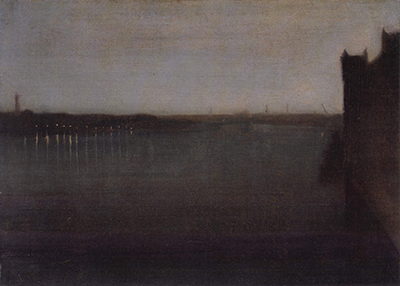
James McNeill Whistler's Nocturne: Grey and Gold—Westminster Bridge turns one of London's most politically charged riverfronts into a study of unequal weights. The Houses of Parliament rise as a compressed dark mass at the extreme right. Across the river, Lambeth's lamps form a slender, broken sequence above their reflections. Between them lies a broad reach of water whose apparent simplicity was made through rubbing, revision and fluid lateral paint. The picture is neither an empty exercise in colour nor a conventional topographical panorama. It is an industrial and governmental London view pared to the signs that can survive dusk.[1][4][5]
The painting is YMSM 145 and belongs to Glasgow Museums as Burrell Collection accession 35.642. It is dated 1872–74, painted in oil on canvas, and measures 47.5 by 63 centimetres unframed. Glasgow Museums records no signature or inscription. The work is currently associated with the Burrell Collection's Central Galleries, where it was listed as a gallery highlight when checked on 26 August 2026; display arrangements should always be confirmed before a visit.[1][2][3]
At a Glance
- CatalogueYMSM 145
- Date1872–74
- SupportOil on coarse-weave canvas
- Dimensions47.5 × 63 cm unframed
- SignatureNo signature or inscription recorded
- ViewpointFrom Westminster Bridge, looking upriver
- Preferred titleNocturne: Grey and Gold—Westminster Bridge
- CollectionBurrell Collection, Glasgow, 35.642
- DisplayCentral Galleries highlight on 26 August 2026; verify current status
- CreditGift of Sir William and Lady Burrell, 1944
Contents
- The object behind the changing names
- Looking upriver from Westminster Bridge
- Lambeth as a line of working light
- A river made from intervals
- Distance without anecdote
- Dating a painting without a written date
- The drawing that preserves another stage
- Coarse canvas and a reddish foundation
- Rubbing down the city
- Simplicity manufactured in stages
The object behind the changing names
The modern title is essential because Whistler's own labels were remarkably unstable. At the Dudley Gallery in 1875 the painting appeared as Nocturne in Blue and Gold, No. 3. A card on its reverse abbreviates a similar blue-and-gold Westminster title. The Grosvenor Gallery exhibited it in 1877 without the number, still as blue and gold. For the 1892 Goupil retrospective, however, it became Nocturne. Grey and Gold—Westminster Bridge, the form from which the catalogue raisonné derived today's preferred name.[4][6][15]
Colour words cannot identify the canvas by themselves. Another painting, YMSM 119, also carries a `No. 3` label, while the 1905 Whistler memorial exhibition called the Westminster work blue and silver. Such slippage was not just clerical untidiness. Whistler used titles to adjust how pictures met new rooms, owners and arguments. The secure identification instead comes from the image, the Westminster site, the Wyndham provenance and the chain from the Dudley and Grosvenor exhibitions to the Burrell Collection.[4][6][17]
Looking upriver from Westminster Bridge
The viewpoint faces southwest or upriver towards Chelsea from Westminster Bridge. It places the north bank and the Houses of Parliament at the right, with industrial Lambeth stretched across the left. This orientation matters. The painting does not depict Westminster Bridge from a distant bank; the bridge is the viewing platform. Nor does it show Parliament as a complete architectural prospect. Its near terrace and two square towers press into the image from the edge, so close and dark that they operate almost as a single vertical obstruction.[1][4]
The placement produces a striking asymmetry. Parliament occupies relatively little width but carries enormous tonal force. Its black-brown shape blocks part of the sky and descends nearly to the bottom of the canvas. The river opens away from it towards a long, low horizon. Instead of centring London's most famous government building, Whistler makes the monument a boundary from which the eye travels. The city is recognised through a cropped silhouette rather than an inventory of Gothic detail.[1][5]
Lambeth as a line of working light
Across the water, the opposite bank has an entirely different scale. A factory chimney stands at the far left. Low buildings then extend horizontally, joined by a regular chain of small yellow-orange lights. Their reflections fall into the river as thin, wavering vertical strokes. More chimneys emerge faintly in the distance, and a crane can be detected towards the right of the horizon. Whistler retained enough industrial information to establish Lambeth without describing individual premises.[1][4]
This bank is not merely a decorative string of gold against blue. Its lamps register work, transport and settlement after daylight detail has receded. The painting therefore holds two forms of modern London together: the monumental state architecture nearest the viewer and the manufacturing shore across the Thames. Neither becomes a narrative setting. There are no legible crowds, parliamentary incidents or named labourers. Yet the surviving chimney, crane and lamps prevent the nocturne from floating free of urban history.[1][4][6]
A river made from intervals
Water occupies most of the lower half, but its dark expanse is continually adjusted. The line of reflections is strongest at left, while faint changes of blue, green and brown carry the eye towards Parliament. The sky is lighter and cooler, though it is not a uniform blank. The low horizon gives both fields unusual breadth. Small verticals—chimneys, towers, crane and reflected lamps—interrupt the prevailing horizontal movement at carefully unequal intervals.[4][5]
The familiar grey-and-gold description names a relationship rather than the whole palette. Grey-blue and deep greenish blue dominate; warm underlayers and yellow-orange lights complicate them. The right-hand tower reads almost black, yet its edges merge into adjacent darkness rather than behaving like a cut silhouette. Gold is scarce. Because it is scarce, each lamp acquires disproportionate visual force. The title helps a viewer notice these relations, but it should not replace looking at the river, architecture and industrial bank that generate them.[1][5]
Distance without anecdote
Whistler's omissions reorganise scale. A conventional London prospect might use boats and figures to measure the river or convert the Houses of Parliament into a picturesque destination. Here the nearest recognisable architecture is also the least accommodating: it is too dark and too abruptly cropped to invite a tour of its façade. The far bank carries more individual marks, yet those marks are minute. The viewer has firm geographical bearings without a narrative route into the scene.[1][4]
The result depends on differences among kinds of visibility. Parliament is unmistakable as a mass but difficult to inspect. Lambeth is readable as an industrial bank but not as a list of buildings. The water is extensive but gives little account of its traffic. Lights are precise in rhythm but unstable as reflections. Whistler did not abolish information uniformly; he decided what each part of the city could disclose at night. That uneven disclosure is more exact than the loose description `misty` suggests.[4][5]
The unframed canvas is modest, roughly the span of an adult arm rather than the scale of a municipal panorama. Its present frame measures 71 by 86.4 centimetres and is 7.5 centimetres deep. Within that object, the large zones of water and sky make the view feel more extensive than its support. Scale is produced internally by the distance between the left lights and right tower, not by physical size alone.[1][5]
Dating a painting without a written date
Neither signature nor date appears on the canvas, and the accepted 1872–74 range is an evidence-based interval. Percy Wyndham later thought the picture had been painted and perhaps bought earlier, but his recollection of the purchase was demonstrably wrong: he acquired it in 1875. A letter in which Whistler offered the work to Alfred Chapman can be placed between June 1874 and the autumn of 1875. The related drawing bears a butterfly associated with about 1874–75. Together these records support a painting begun or substantially formed before the Dudley exhibition, without forcing it into one undocumented day.[3][8][9]
Whistler's sales letter gives a sensory memory rather than a studio calendar. He described a warm summer night and a view from the Houses of Parliament, adding that others found its colour lovely. The pitch establishes the intended object and its climate, but it is also market language addressed to a prospective buyer. It cannot prove that the whole surface was painted outdoors on one evening, nor that the appearance visible now is identical to its first unvarnished state.[3][9]
The drawing that preserves another stage
The pen drawing Souvenir of Nocturne in Blue and Gold / From Westminster Bridge, M.0569, is especially revealing because it resembles the oil while preserving differences. Its Parliament towers stand more prominently on the horizon. Two barges appear in the river. Technical examination shows that corresponding vessels once existed in the painting and were covered, although raking light can still make them barely perceptible. Other ghostly changes may include a boat at left and more distant craft, but those readings remain tentative.[5][8]
The word `Souvenir` does not settle whether the drawing came before or after every phase of the painting. It may record an earlier arrangement, or it may be a near-contemporary recollection of one. What it proves is that the oil's sparseness was selected. Whistler did not simply fail to observe the barges; he reduced visible incidents after admitting them to the design. The open water is thus the outcome of editing, not the absence of work.[5][8]
Coarse canvas and a reddish foundation
The support is conspicuously coarse, roughly comparable to a French toile de 12. It may have been obtained in Paris, although that origin is not certain. Cusping along the upper and lower edges records tension from the stretched fabric. Such a support could never disappear completely beneath Whistler's very thin paint. Its threads break up smooth passages and make the physical weave part of the atmospheric effect.[5]
Beneath the surface lies a dark reddish-brown undercoat. It is exposed in places where buildings and reflections were painted and then rubbed down. That warm foundation complicates the cool surface colours: grey-blue does not sit on neutral white but over a darker, redder field. The result is a muted luminosity rather than opaque blue coverage. The undercoat also helps soft forms remain connected to the surrounding night when top layers become extremely thin.[5]
Rubbing down the city
Whistler's method combined placement with subtraction. Parts of the buildings and their reflections were reduced by rubbing, allowing the undercoat to reappear and softening their contours. The sky was then worked around the towers, chimneys and heaps along the skyline with considerable care. Across wider areas of sky and water, fluid brushstrokes travel from left to right and merge. The surface looks calm because different operations have been brought into alignment, not because the artist performed one uninterrupted sweep.[5]
This evidence challenges two opposite myths. The picture is not an accidental stain that escaped revision, but neither is it a densely modelled academic view concealed beneath fog. Whistler removed some boats, reduced buildings and controlled the intervals of light while retaining a remarkably thin skin of paint. The tension between a coarse textile and smoothed fluid passages gives the work much of its vibration. Atmosphere here is a material construction.[5][13]
Simplicity manufactured in stages
The composition can be read as a sequence of decisions. First, the reddish-brown preparation established a low-value field whose warmth would remain active. Dark riverside structures and reflections were set down, then partly abraded. The skyline required paint to turn around small interruptions rather than pass indiscriminately over them. Fluid blue-green strokes joined sky and water laterally. Finally, reduction of the barges allowed the river to carry fewer local accents. Technical evidence does not supply a complete hour-by-hour chronology, but it establishes more than one kind of action.[5]
This staged account changes how the lights are understood. They are not random sparks added to an otherwise finished landscape. Their spacing becomes legible because neighbouring incidents were quietened. The near-black right mass also gains force from the low, rubbed horizon that precedes it. A viewer may experience the balance immediately, yet immediacy of perception should not be confused with immediacy of manufacture.[5][8]
Whistler's broad statements about nocturnes and rapid execution were made in argumentative settings: sales letters, aesthetic self-definition and a hostile courtroom. They remain indispensable evidence of intention and public strategy. The canvas supplies a different order of testimony. Undercoat, weave, rubbing and pentimenti cannot explain what the artist thought, but they can show what happened to the object. Responsible interpretation lets those two records correct one another.[9][13]
Was it originally more blue?
One scholarly proposal suggests that cleaning and varnishing may have altered the colour balance, helping a picture once called blue and gold come to look grey and gold. The related drawing's inscription supports the historical blue title, but titles alone are not scientific colour measurements. Whistler continued to move between colour terms for the same works, and later surface treatments changed how light passes through varnish and paint. A blue-to-grey shift is therefore possible, not demonstrated.[4][5]
That distinction matters because the present painting contains both families of colour. Its upper field can register as blue-grey, while warmer brown material and yellow lights prevent a purely silver effect. The safest interpretation treats the title history, material history and current appearance as related but separate evidence. None grants access to an untouched original moment.[5][6]
What “nocturne” changes—and what it does not
Frederick Leyland suggested the word `nocturne` for Whistler's moonlights, and Whistler quickly valued its ability to imply mood and arrangement without prescribing a story. In court he later described the category through relations of line, form and colour. Those statements explain why the Westminster view resists the conventions of a detailed urban panorama. Musical language asks the viewer to attend to recurrence, interval, weight and tone.[13][16]
It does not make London irrelevant. The massive Parliament terrace, Lambeth lamps and industrial silhouettes are the actual terms being arranged. Likewise, a comparison with Japanese asymmetry or restricted colour can illuminate Whistler's broader visual culture, but no single print is established as the source for this composition. The painting's achievement lies in transforming a specific reach of the Thames without denying that it is specific.[1][4][16]
The Dudley Gallery exhibition of 1875
The first secure public appearance came at the Ninth Winter Exhibition of Cabinet Pictures in Oil at the Dudley Gallery, where it was catalogue number 160. William Michael Rossetti regarded it as one of the exhibition's memorable achievements. Tom Taylor, writing in The Times, objected to the musical titles and compared the muted tonal result with decorated wall covering. These responses confronted the same economy from opposite positions: one saw unprecedented concentration, the other insufficient pictorial substance.[6][7]
The Examiner offered a more materially alert account. Its critic praised the bank lights, misty blues and liquid sweeps, while arguing that the rough canvas interrupted the melting colour. That observation is valuable because technical study confirms the weave's prominence. Another critic complained that glazing made the dark work reflect spectators like a mirror. Reception therefore involved conditions of display as well as theories of finish. The nocturne asked viewers to distinguish subtle paint while glass, gallery light and their own reflections interfered.[5][6]
Grosvenor Gallery and a new kind of city atmosphere
At the Grosvenor Gallery in 1877 the canvas appeared again as Nocturne in Blue and Gold. Sidney Colvin praised its rendering of the river and the mixed darkness and glare above a living city. A Scotsman review likewise responded to the luminosity of Whistler's evening effects. By then the painting had not become uncontroversial, but critics possessed a more developed language for its limited palette and atmospheric urbanism.[6][7]
It would be misleading to turn this sequence into a fable in which everyone mocked Whistler in 1875 and understood him two years later. Praise and resistance existed together from the beginning. Some criticism concerned the title; some the scarcity of incident; some the coarse support; some the difficulty of seeing a glazed dark canvas. The work's history is richer when those distinct objections are preserved rather than collapsed into hostility towards modern art.[6]
Percy and Madeline Wyndham
Percy Wyndham bought the painting directly from Whistler in 1875. The catalogue raisonné records £210, the sterling equivalent of 200 guineas. A nocturne selling from an exhibition at the requested price was unusual. Ownership was shared with his wife, Madeline Wyndham, herself an artist. Her later correspondence shows that this was not merely a speculative acquisition: she wrote that the family cared deeply for the picture when reporting its damage.[6][10]
The sale became evidence in Whistler's legal struggle with John Ruskin. In sworn answers and trial testimony, Whistler cited the Wyndham purchase while arguing that the critic's attack had harmed his market. The legal records are not perfectly tidy: colour titles shift, and recollected dates vary. Provenance and exhibition records secure the object even where courtroom shorthand calls it blue and gold or blue and silver.[13][14]
The painting that did not reach the courtroom
This canvas is often pulled too close to the famous Ruskin dispute. Ruskin's published allegation about flinging paint concerned Nocturne in Black and Gold: The Falling Rocket, not Westminster Bridge. Whistler's own trial testimony reduced the Wyndham picture to a river scene while identifying its sale. There were plans to show it to the jury, but Madeline Wyndham was away and the work could not be obtained. Dealer Oswald Colnaghi prepared enthusiastic evidence about it yet never took the stand.[4][6][13]
The verdict also needs precision. Whistler succeeded on liability but received only one farthing in damages, without the financial vindication a simple claim that he “won” implies. Westminster Bridge mattered to the case as proof of sale and as a possible example of his atmospheric painting; it was not the libelled picture. Keeping those functions separate prevents the notoriety of The Falling Rocket from swallowing this canvas's independent history.[6][13][14]
A hole before the 1892 retrospective
In February 1892 Madeline Wyndham agreed to lend the nocturne to Whistler's Goupil Gallery retrospective but reported a grave problem: the canvas had been pierced. She wanted the damage repaired before exhibition and asked whether Whistler wished to inspect it. His response through the organiser David Croal Thomson was urgent. The painting was to go to restorer Stephen Richards, who had to mend it in time for the show.[10][11]
Whistler was unsure whether the surface had ever been varnished. He instructed Thomson that Richards should clean it very gently, then varnish it, and report whether the tear could be repaired without visible residue. These directions are evidence of the artist's concern, not proof that the intervention became undetectable. A Glasgow conservation report in 1960 still located a roughly repaired area along the middle-right skyline.[5][12]
Treatment and the surface seen today
The 1960 campaign relined the canvas, cleaned it lightly and selectively, retouched the damaged area and applied new varnish. Subsequent examination found slight discolouration in both retouching and coating. A later matt varnish may also be present. Despite these changes, the paint layer is described as structurally secure, including passages where it is exceptionally thin.[5]
These records make present colour a historical condition. Whistler's reddish ground and blue-green paint remain central, but varnishes alter saturation and transparency, while old cleaning can change local balance. The repaired tear belongs to the material biography just as surely as the concealed barges. Conservation does not invalidate visual analysis; it defines which surface is actually being analysed.[5][12]
The Goupil retrospective and a misplaced joke
At Goupil in 1892 the work appeared as catalogue number 19 under the grey-and-gold Westminster title. Whistler used the exhibition and its catalogue to stage his history of criticism, often turning hostile reviews into weapons against their authors. For this painting he recycled Taylor's 1875 complaint, though he misidentified the newspaper. Elsewhere in the catalogue, a sneer about a `Farce in Moonshine` that appears to concern the Westminster nocturne was attached to Old Battersea Bridge.[6][15]
That mistake has consequences. It shows why picturesque anecdotes cannot be moved between Whistler's similarly named nocturnes merely because they sound appropriate. Titles, reviews and labels repeatedly crossed object boundaries. The Westminster canvas must remain YMSM 145; Old Battersea Bridge is YMSM 140, and YMSM 119 is yet another work associated with a `No. 3` label. Catalogue discipline is not pedantry here—it is what keeps three different paintings from acquiring one synthetic biography.[4][15][17]
From the Wyndhams to William Burrell
After Percy Wyndham's death, Madeline retained her interest until her own death in 1920. The subsequent family path is plausible but not fully documented. The painting probably descended to their eldest daughter, Mary Constance Wyndham Charteris, and was likely sold after deaths in the Charteris family in 1937. It should not be given a fabricated 1928 auction history or treated as securely invisible for a fixed number of years.[6]
The next firm transfer occurred on 28 July 1938, when William Burrell bought the canvas from the London dealers Adams. Sir William and Lady Burrell signed the Deed of Gift transferring their collection to the City of Glasgow in 1944. The purpose-built Burrell Collection opened in Pollok Country Park in 1983. Glasgow Museums now records the painting under accession 35.642 and supplies the governing dimensions, credit and current location.[1][6]
Private attachment and public custody
The custody history changes the kinds of evidence surrounding the picture. In the Wyndham household, letters reveal affection, domestic location and anxiety after accidental damage. The Goupil loan brought the canvas temporarily back under Whistler's direction, exposing his concern with cleaning and presentation. Burrell's purchase converted an aristocratic family possession into part of a deliberately assembled collection; the 1944 gift eventually placed it within a civic museum structure.[1][6][10][12]
Those transitions should not be flattened into a continuous march towards fame. The incomplete years after 1920 resist a perfectly continuous provenance narrative, while the 1892 repair and 1960 treatment show that custody also means physical intervention. Public ownership has made catalogue data, conservation findings and an official image accessible. It has not restored an untouched nineteenth-century surface. The painting's authority comes partly from the unusually candid record of those changes.[1][5][6]
Seeing it at the Burrell Collection
The painting was listed among the Burrell's Central Galleries highlights on 26 August 2026. That is useful evidence of current presentation, not a permanent promise: rotations, loans and conservation can change what is on view. The museum's collection page should be checked near the date of a visit.[1][2]
Glasgow Museums' image is licensed for non-commercial reuse with attribution under CC BY-NC 4.0. The smaller image already associated with the existing web route matches the official object photograph, so its subject identity is secure. Publication on a commercial website nevertheless requires a separate rights and resolution decision. Object identification and permission to publish are different questions.[1]
Why Westminster Bridge matters
The painting demonstrates that reduction can intensify historical place. Parliament is more imposing because it is cropped into a dark barrier. Lambeth's industrial bank becomes more insistent because it survives as lamps, chimney and crane. The river gains scale because barges were suppressed. Grey, blue and gold remain attached to a particular geography even as their relations become the principal visual event.[1][4][5]
It also preserves the labour behind apparent effortlessness. Coarse canvas, reddish undercoat, rubbed buildings, painted-out boats, careful work around the skyline and long fluid strokes all contribute to its hush. Later damage, lining, cleaning, retouching and varnish complicate the surface without erasing that construction. The nocturne is therefore best understood not as a vague mood but as a repeatedly edited and historically altered object that makes dusk legible through very few marks.[5][8]
Frequently Asked Questions
It looks upriver from Westminster Bridge towards Chelsea. The Houses of Parliament form the dark mass at right; industrial Lambeth, including a chimney, low buildings and a row of lamps, runs along the left bank. The Thames fills most of the lower field, with reflected lights and distant industrial silhouettes.[1][4]
Discussion
How does Whistler hold Parliament, Lambeth industry and the Thames inside one muted sequence of grey, gold and reddish-brown?
Follow the cropped towers, low industrial bank, chain of lights, thin reflections and broad lateral strokes, then compare that economy with the suppressed barges and rubbed-down surface.
Reader Insights
How does the dark mass of Parliament offset the small repeated lights across Lambeth?
What changes when the related drawing and raking-light evidence restore the barges Whistler suppressed?
Where do thin paint, rubbing-down and the reddish undercoat make distance visible?
Join the Conversation
Share a close observation or an object-history question.
References
- Glasgow Museums, “Nocturne: Grey and Gold—Westminster Bridge,” Burrell Collection 35.642, current collection record, checked 26 August 2026. https://collections.glasgowmuseums.com/mwebcgi/mweb?request=record%3Bid%3D36461%3Btype%3D101
- The Burrell Collection, “Central Galleries,” current gallery highlights, checked 26 August 2026. https://burrellcollection.com/visit/central-galleries/
- Margaret F. MacDonald and Grischka Petri, “Nocturne: Grey and Gold—Westminster Bridge: Date,” YMSM 145, The Paintings of James McNeill Whistler: A Catalogue Raisonné, University of Glasgow, 2021. https://www.whistlerpaintings.gla.ac.uk/catalogue/display/?mid=y145
- MacDonald and Petri, “Nocturne: Grey and Gold—Westminster Bridge: Subject and Titles,” YMSM 145, University of Glasgow, 2021. https://www.whistlerpaintings.gla.ac.uk/catalogue/display/?mid=y145&xml=sub
- MacDonald and Petri, “Nocturne: Grey and Gold—Westminster Bridge: Technical Description,” YMSM 145, University of Glasgow, 2021. https://www.whistlerpaintings.gla.ac.uk/catalogue/display/?mid=y145&xml=tec
- MacDonald and Petri, “Nocturne: Grey and Gold—Westminster Bridge: History,” YMSM 145, University of Glasgow, 2021. https://www.whistlerpaintings.gla.ac.uk/catalogue/display/?mid=y145&xml=his
- MacDonald and Petri, “Nocturne: Grey and Gold—Westminster Bridge: Bibliography,” YMSM 145, University of Glasgow, 2021. https://www.whistlerpaintings.gla.ac.uk/catalogue/display/?mid=y145&xml=bib
- Margaret F. MacDonald, “Souvenir of Nocturne in Blue and Gold / From Westminster Bridge,” M.0569, James McNeill Whistler: Drawings, Pastels and Watercolours—A Catalogue Raisonné, University of Glasgow. https://www.whistlerpaintings.gla.ac.uk/catalogue/display/?mid=m0569
- James McNeill Whistler to Alfred Chapman, [June 1874/1875?], GUW 07901, The Correspondence of James McNeill Whistler, University of Glasgow. https://www.whistler.arts.gla.ac.uk/correspondence/recno/display/?cid=07901
- Madeline Wyndham to James McNeill Whistler, 23 February 1892, GUW 07342, University of Glasgow correspondence edition. https://www.whistler.arts.gla.ac.uk/correspondence/recno/display/?cid=07342
- James McNeill Whistler to David Croal Thomson, 28 February 1892, GUW 08213, University of Glasgow correspondence edition. https://www.whistler.arts.gla.ac.uk/correspondence/recno/display/?cid=08213
- James McNeill Whistler to David Croal Thomson, 4 March 1892, GUW 08351, University of Glasgow correspondence edition. https://www.whistler.arts.gla.ac.uk/correspondence/recno/display/?cid=08351
- High Court of Justice, Whistler v. Ruskin transcript and witness papers, 25 November 1878, GUW 11991, University of Glasgow correspondence edition. https://www.whistler.arts.gla.ac.uk/correspondence/recno/display/?cid=11991
- James McNeill Whistler, sworn answers to interrogatories in Whistler v. Ruskin, 6 and 16 November 1878, GUW 13279, University of Glasgow correspondence edition. https://www.whistler.arts.gla.ac.uk/correspondence/recno/display/?cid=13279
- James McNeill Whistler and Goupil Gallery, Nocturnes, Marines & Chevalet Pieces: Small Collection Kindly Lent by Their Owners, London, 1892, Smithsonian Libraries, DOI 10.5479/sla.880959.39088020308615. https://library.si.edu/digital-library/book/nocturnesmarine00whis
- James McNeill Whistler to Frederick Richards Leyland, 2–9 November 1872, GUW 08794, University of Glasgow correspondence edition. https://www.whistler.arts.gla.ac.uk/correspondence/recno/display/?cid=08794
- MacDonald and Petri, comparative records for The Last of Old Westminster (YMSM 039), Nocturne: Blue and Silver—Battersea Reach (YMSM 119) and Nocturne: Blue and Gold—Old Battersea Bridge (YMSM 140), University of Glasgow, 2021. https://www.whistlerpaintings.gla.ac.uk/catalogue/display/?mid=y039 https://www.whistlerpaintings.gla.ac.uk/catalogue/display/?mid=y119 https://www.whistlerpaintings.gla.ac.uk/catalogue/display/?mid=y140


