


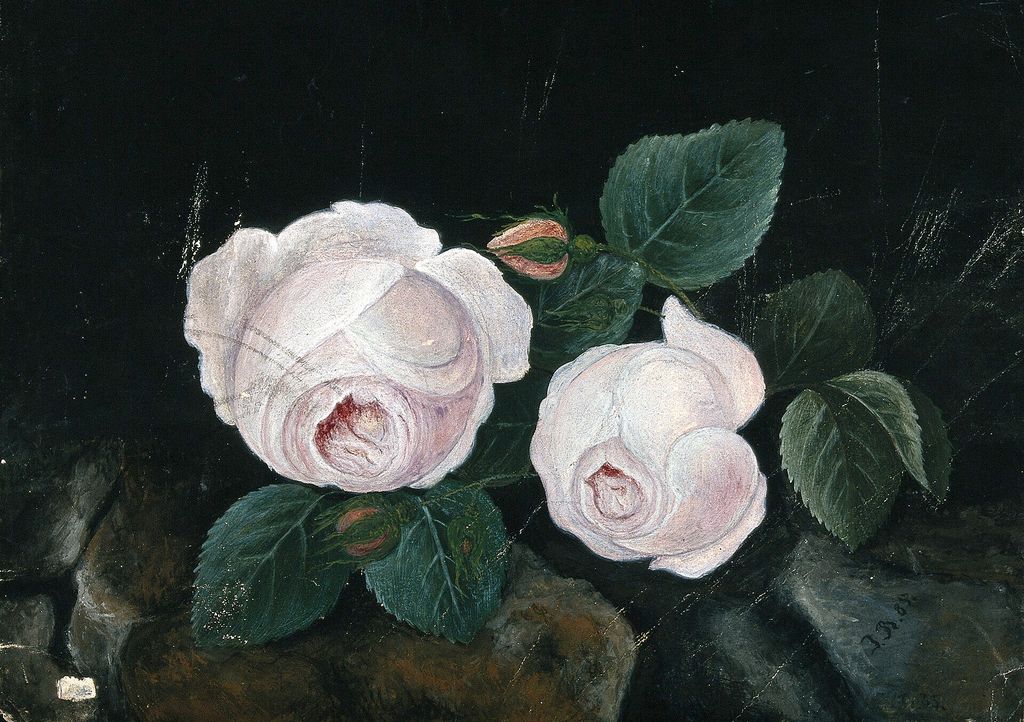
 by Tom Gurney
Tom Gurney BSc (Hons) is an art history expert with over 20 years experience
Page Created on September 22, 2026 / Page Updated on September 22, 2026
Email: tomgurney1@gmail.com / Phone: +44 7429 011000
Introduction
Georgia O’Keeffe’s White Rose with Larkspur No. II turns a familiar garden flower into an engulfing visual environment. A rose spreads beyond the lower and side edges of the vertical canvas, while small blue-violet blossoms rise into a field where petals and atmosphere nearly merge. The picture is descriptive enough to invite botanical recognition and abstract enough to frustrate it.[1]
That tension extends into the surviving evidence. The historic title names larkspur, yet the current catalogue description calls the upper cluster sweet peas. The painting belongs to a documented group of five white-rose pictures made in 1927, but its history differs sharply from the better-travelled abstractions beside it: O’Keeffe retained this canvas for more than fifty years before choosing it herself for Boston.[1][2][8]
At a Glance
- ArtistGeorgia O’Keeffe
- ArtworkWhite Rose with Larkspur
- Artistic contextAmerican modernism
Contents
- Object identity
- White made from colour
- Crop, scale and movement
- Rose, upper blossoms and ground
- Larkspur or sweet pea?
- Titles, inscriptions and the July date
- Five white roses in 1927
- From flower to abstraction
- 1927 and the Intimate Gallery exhibition
- Enlargement and the photographic close-up
- Sexualised readings and their limits
- Material practice and technical limits
- An artist-retained painting
- “The painting for Boston”
- O’Keeffe and Moore
- French-language reframing in Montréal
- A public afterlife in Boston
- How to look at the painting
Object identity
- Artist: Georgia O’Keeffe (1887–1986)
- Authoritative title: White Rose with Larkspur No. II
- Date: July 1927
- Medium: oil on canvas
- Catalogue raisonné: CR 597
- Dimensions: 40 × 30 inches (101.6 × 76.2 cm)
- Collection: Museum of Fine Arts, Boston
- Accession: 1980.207
- Credit: Henry H. and Zoe Oliver Sherman Fund[1][3]
The title, date, dimensions and catalogue number distinguish CR 597 from White Rose with Larkspur No. I, CR 596. The Boston canvas is four inches taller, although both are thirty inches wide. That extra height matters: the upper blossoms have more space in which to rise and dissolve, while the vast rose remains anchored below.[1][7] The distinction prevents the two closely related compositions from collapsing into one generic image.
The catalogue raisonné title uses the Roman numeral “II”; the MFA uses “No. 2”. Both designate the same object. The Smithsonian’s independent inventory confirms the museum accession number and records rose and larkspur as subjects, while Access O’Keeffe reports that the current owner verified the core data in October 2025.[1][3] These independent identifiers also make the record usable when titles vary across institutions.
White made from colour
The rose appears white only at first glance. Its broad petals carry pale blue-grey, cream, yellow-green and muted lavender, with darker folds defining the overlapping layers. O’Keeffe makes whiteness relational: each petal looks lighter or cooler because it meets a neighbouring tint, and the flower gains volume through shifts in temperature rather than strong outlines.[1][15] Subtle colour is therefore structural, carrying both light and the sensation of petal depth.
At the centre, a small greenish hollow is surrounded by curling petal edges. From there, the bloom expands in scalloped rings, but the rings are irregular and interrupted. Some folds turn inward, others lift towards the viewer, and still others flatten into broad colour zones. The structure suggests growth without becoming a botanical diagram. The result is ordered enough to read and varied enough to avoid decorative regularity.
Dark pointed leaves along the bottom edge sharpen the rose’s softness. Their green-black accents are few, yet they establish the deepest values in the composition and make the pale petals appear luminous. They also remind us that the flower is attached to a plant, even as enlargement and cropping remove stem, soil, vase and garden from view.[1] Their abrupt geometry also stops the lower edge from becoming entirely soft and weightless.
Crop, scale and movement
The canvas does not contain the rose so much as cut through it. Petals continue beyond the left, right and lower boundaries, encouraging the viewer to imagine a bloom larger than the visible field. The crop converts a small object into a space through which the eye moves, and it prevents the flower from settling into the conventional completeness of a still-life specimen.[1][12]
The movement begins low, near the rose’s recessed centre, then follows successive folds outward and upward. These arcs slow the eye because each boundary is softly graded rather than sharply drawn. Above them, the smaller blossoms create a contrary rhythm: detached, rising and scattered, they punctuate the smooth mass with irregular light shapes. This change of tempo keeps the composition from becoming a single repetitive spiral.
No ruler can reconcile the two floral scales. The rose seems monumental, while the upper blooms remain comparatively small, yet both occupy the same shallow field. O’Keeffe makes scale expressive rather than measurable. Enlargement gives the rose physical authority, and reduction lets the companion flowers behave like distant notes, fragments or events in colour.[12][14] The mismatch is one source of the picture’s quiet strangeness and imaginative reach.
Rose, upper blossoms and ground
The upper half is built from soft periwinkle, blue, violet, grey-white and green. Several small pale blossoms emerge within it, some more distinct than others. Their contours repeatedly disappear into adjacent colour, so the viewer alternates between seeing flowers against a ground and seeing a nearly continuous field in which figure and ground exchange roles.[1] The upper colour thus behaves simultaneously as setting, substance and partially absorbed blossom.
This dissolution differs from the rose’s firmer construction. The lower bloom retains an intelligible centre and layered anatomy even at its most abstract edges. Above it, the smaller forms are less stable: a petal may also read as cloud, reflected light or an opening in the colour. The two modes allow recognition and uncertainty to coexist in one picture. O’Keeffe sustains attention by making the degree of recognisability change as the eye ascends.
The transition is gradual. Bluish shadows inside the white rose prepare the cooler field, while faint green passages link the dark leaves to the upper background. O’Keeffe does not simply place white below blue. She passes colour through the entire canvas, using repeated hues to bind forms that remain unequal in scale, clarity and botanical identity.[1][15] Colour continuity achieves the unity that conventional perspectival space has been asked to surrender.
Larkspur or sweet pea?
The archival title names larkspur, and that language appears repeatedly on the painting’s backing. Access O’Keeffe nevertheless describes the upper cluster as “light purple sweet peas”. This is a genuine documentary discrepancy within the authoritative record, not a reason to modernise the historic title or pretend that the stylised image provides a secure species identification.[1] The conflict is especially significant because both statements appear in the same evolving catalogue.
Larkspur belongs to Delphinium in the buttercup family. Botanical and horticultural descriptions emphasise irregular flowers, a spurred sepal and, in many cultivated delphiniums, tall spikes carrying blue, purple, pink or white blooms. Sweet pea, Lathyrus odoratus, belongs to the pea family and is a scrambling annual with conspicuously pea-shaped flowers.[17][18][19][20] Those distinctions make comparison possible while also exposing what the painting omits.
The painted cluster’s rounded, wing-like forms can explain why a cataloguer saw sweet peas, while its blue-violet vertical grouping remains compatible with the title’s larkspur. Neither comparison settles the matter because O’Keeffe simplified individual structures and blurred several edges. The responsible conclusion is double: “larkspur” has archival authority, while “sweet pea” records a later act of visual identification.[1] The disagreement is evidence about cataloguing and perception as well as about the depicted plant.
Titles, inscriptions and the July date
The preferred title derives from the Downtown Gallery Archive and O’Keeffe’s Abiquiú Notebooks. The Whitney Archive supplies White Rose with Larkspur, No. 2, and other records shorten it to White Rose No. 2 or replace the Roman numeral with “#2”. The MFA’s No. 2 therefore belongs to a long documentary history rather than a recent error.[1] Each variant shifts emphasis slightly between pairing, sequence and the rose as dominant subject.
The reverse carries O’Keeffe’s painted inscription, “Georgia O’Keeffe / July 1927”. On the stretcher, Alfred Stieglitz wrote “#5” in graphite. Backing records repeat the title, artist and year in several forms, including an An American Place label on which a monetary value was scratched out, leaving evidence of gallery administration without preserving the original amount.[1] The erased value is a material reminder that pricing histories can survive only as traces.
These physical records fix the month more securely than a general stylistic date could. They also reveal that one canvas could accumulate several systems of naming: O’Keeffe’s signature and date, Stieglitz’s inventory number, gallery title, abbreviated title and later museum form. When the work was examined at An American Place in March 1946, those records helped maintain continuity across decades.[1] The reverse is therefore an archive of circulation as well as a support for the painted face.
Five white roses in 1927
Christie’s account of the companion White Rose with Larkspur No. I states that O’Keeffe made five white-rose paintings in 1927. The group was not five repetitions of one design. It moved between paired flowers, concentrated views and images in which the rose motif became so transformed that a different title could plausibly take over.[7][8][9][10][11] Seen together, the group records an investigation sustained across several distinct pictorial solutions.
CR 596 is the closest comparison. Its thirty-six-by-thirty-inch canvas also places a large white rose below periwinkle and lavender blooms, with dark leaves around them. Yet its catalogue history is less stable: O’Keeffe’s notebooks questioned whether it was the work listed in 1928, and the record preserves an earlier loan to Dr Constance Friess, one of her physicians.[7] Its documentary uncertainty also warns against reconstructing the series solely from numbered titles.
CR 597 is taller and gives the upper cluster a more extended field. Its rose feels less like an isolated object than a lower terrain from which the smaller blossoms rise. The comparison shows how modest changes in format, spacing and contour alter the relation between intimacy and monumentality. Numbering marks sequence, but it does not make one canvas a duplicate of another.[1][7]
From flower to abstraction
In Abstraction White Rose, CR 599, spiralling grey-white bands flow from a centre that is no longer readily identifiable as a flower. O’Keeffe preserved the rose in the title while loosening its descriptive anatomy. She valued the canvas enough to tell the dealer Edith Halpert in 1950 that she did not wish to sell it, evidence that abstraction and personal retention could coincide.[9]
White Rose, Abstraction with Pink, CR 600, turns the motif into a swirling field of pink and white. Its backing says 1928, but the Whitney, Downtown Gallery and Abiquiú records, together with inclusion in the 1928 exhibition, support 1927. The disagreement demonstrates why inscriptions are powerful evidence without always being the last word on date.[10] Archival comparison here corrects a physical label without dismissing the label as historical evidence.
CR 601 travels furthest through language. The catalogue calls it Ballet Skirt or Electric Light, while other records name White Rose – Abstraction and Ballet Skirt or Electric Light/White Rose III. A pale central light expands through layered haloes that can suggest petals, tulle or electric radiance. Across the group, O’Keeffe tested how far one organisation of curves could migrate between flower and analogy.[11]
1927 and the Intimate Gallery exhibition
The white roses were made during a decisive year. The Brooklyn Museum mounted O’Keeffe’s first museum retrospective in 1927, confirming an institutional standing that exceeded the annual commercial exhibitions through which Stieglitz had introduced her work. By then her large-format flowers, first shown as a major group in 1925, were already central to her public identity.[6][12][14] The group therefore appeared when O’Keeffe’s flowers had become both achievement and expectation.
Success created its own pressure. O’Keeffe had to produce enough new work for recurring exhibitions while resisting a critical language that treated her pictures as direct evidence of female body and psyche. The July inscription places CR 597 inside that productive cycle, several months before its documented appearance at the Intimate Gallery in January 1928.[1][13] Formal invention and the labour of maintaining an exhibition career were inseparable in this period.
The painting should not be reduced to biography. Its forms record sustained decisions about crop, colour, interval and edge, not an unmediated confession. Yet the career context matters because it explains both the ambitious scale and the interpretive contest around it: a garden subject could become modernist experiment, market event and gendered public symbol at the same time.[12][13] That combination helps explain why a seemingly modest subject generated unusually charged debate.
Stieglitz opened the Intimate Gallery in 1925 after the close of 291, and operated it until 1929. Its archive retains photocopied invitations, catalogues, reviews and other ephemera for O’Keeffe’s exhibitions. The modest name described a setting that nevertheless functioned as a powerful centre for American modernism and for the annual construction of O’Keeffe’s public career.[5][25] The surviving archive permits study of that machinery even when individual installation details are missing.
The 1928 O’Keeffe Exhibition ran from 9 January to 27 February. Access O’Keeffe assigns CR 597 to that show; the surviving public record does not establish its exact catalogue number, wall position or neighbouring works. Those gaps should remain gaps, because reconstructing an installation from a later series relationship would turn a plausible arrangement into false documentation.[1][4] Restraint is more informative than an attractive but undocumented reconstruction of the original room.
O’Keeffe was not passive within these displays. Metropolitan Museum scholarship notes that she supervised nearly all installations at the Intimate Gallery. The exhibition was consequently more than Stieglitz’s framing of her work: placement, spacing and sequence also belonged to her practice. CR 597’s engulfing crop would have met viewers within an environment she helped organise.[14] Her participation complicates any account that assigns all exhibition authorship to her dealer.
Enlargement and the photographic close-up
O’Keeffe’s magnified flowers were unprecedented in scale when she developed them in the early 1920s, but they did not emerge in isolation. National Gallery scholarship places them near close-up photography by Imogen Cunningham, Paul Strand and Edward Steichen, as well as flower paintings by Charles Demuth and Marsden Hartley. The affinity concerns ways of seeing, not proof that one photograph supplied this composition.[12]
Stieglitz made photography and advanced art mutually visible through 291, the Intimate Gallery and An American Place. The MFA’s own history of early modern photography recalls his role as artist, editor, collector and advocate. That institutional context helps explain why photographic cropping belongs in the conversation, while the painting’s slow tonal construction remains irreducibly different from a camera exposure.[12][25] Paint, however, allows colour transitions and spatial ambiguities that no literal crop can explain alone.
O’Keeffe later offered a practical account of enlargement: people in a fast city might ignore a small flower, but making it enormous would compel them to look. CR 597 fulfils that proposition without merely illustrating it. The rose exceeds easy possession, and the upper blossoms reward the attentive viewer precisely because they are less secure than the monumental form below.[12] Compulsion to look is produced here through patience, not through spectacle by itself.
Sexualised readings and their limits
Early critics repeatedly interpreted O’Keeffe’s flowers through sexual and psychoanalytic frameworks, encouraged in part by Stieglitz’s presentation of her as an instinctive female creator. That history cannot be erased, because it shaped how audiences encountered the paintings. It also cannot serve as a universal key that makes every fold, opening or colour passage evidence of one fixed meaning.[12][13] The interpretive habit became part of the work’s public history even where it distorted formal evidence.
O’Keeffe worked during the 1920s to separate her art from such readings and in 1939 openly objected to viewers placing their own associations onto her flowers. Her resistance does not forbid viewers from recognising bodily resonance. It changes the burden of interpretation: an association should be identified as the viewer’s, weighed against formal and historical evidence, and prevented from cancelling everything else the painting does.[12][13]
Kathleen Pyne offers a more historically specific account of this tension. She places the two white-rose-and-larkspur canvases near the end of a 1927 sequence of flowers whose delicate, repeating forms engaged contemporary conventions of femininity. In her reading, their appearance within the 1928 annual exhibition helped critics classify O’Keeffe’s display as distinctly “woman’s art”.[27] This is a history of reception and artistic strategy, rather than proof that the rose carries one concealed sexual meaning.
Pyne’s argument also complicates a simple opposition between O’Keeffe and gendered interpretation. The artist could employ intricacy, craft and delicacy while resisting critics who converted those qualities into a supposedly natural female essence. CR 597 consequently belongs to a contested visual language: femininity could be constructed, tested and marketed through form, yet the same language could confine its maker within a stereotype.[27] The painting’s soft transitions become historically charged without ceasing to be deliberate formal choices.
The white rose has its own cultural histories of love, purity, mourning and myth, but none is securely documented as O’Keeffe’s programme for CR 597. The MFA curator’s discussion ranges from Aphrodite to Gertrude Stein, presenting a broad history of the motif rather than a decoded iconography. Here the most defensible meanings arise through scale, attention, touch imagined through paint and the unstable boundary between flower and abstraction.[2]
Material practice and technical limits
The public object record identifies oil on canvas and preserves reverse inscriptions, but it provides no CR 597-specific pigment analysis, infrared image, cross-section, varnish history or current condition report. The visible colour therefore supports close description, not chemical identification. Pale green in a petal can be named as seen; it cannot responsibly be converted into a pigment recipe from reproduction alone.[1] This limit protects the difference between attentive looking and unsupported technical certainty.
Technical study of five other O’Keeffe paintings at the Museo Thyssen found fine preparatory drawing, carefully mixed tones, thin paint and wet-into-dry layering. Hundreds of colour cards surviving in her studio further document methodical colour preparation, while artist-made backing boards preserve titles, symbols and exhibition evidence. These findings illuminate broader practice but were not obtained from the Boston canvas.[15] They demonstrate a disciplined studio intelligence rather than a spontaneous pouring-out of colour.
Conservation research has linked some O’Keeffe paintings from the annual-exhibition era to commercial pre-primed canvas and lead-soap protrusions. The study sampled four named works, none of them CR 597. Its chronology makes questions about the 1927 support reasonable, but there is no analytical basis for claiming that this canvas has the same ground, protrusions or degradation mechanism.[16] Such restraint is essential because conservation mechanisms are material facts, not stylistic analogies.
An artist-retained painting
The documented provenance is unusually concise. CR 597 remained with O’Keeffe until 1980, when she sold it directly to the Museum of Fine Arts. The museum acquired it on 18 June with the Henry H. and Zoe Oliver Sherman Fund. There is no recorded intervening dealer or private owner to fill the long interval.[1][3] The apparent simplicity of the sequence is itself unusual within a long and mobile career.
Christie’s states that the painting hung in O’Keeffe’s bedroom at Abiquiú before the MFA acquisition. As an auction-house account written for the related CR 596, that detail is valuable but belongs to a different evidential tier from the owner-verified provenance. It suggests domestic importance while leaving the exact installation dates and duration unrecorded in the public catalogue.[8] Domestic display nevertheless places the work within daily life rather than public exhibition alone.
Retention can easily be romanticised as proof of a single private meaning. The safer conclusion is material: O’Keeffe controlled the picture for more than half a century, kept it through changes in galleries, homes and reputation, and eventually determined its institutional destination. That long custody gives the 1980 transaction a different character from an ordinary secondary-market purchase.[1][2] Her final act of placement is among the clearest documented choices in the object’s history.
“The painting for Boston”
MFA curator Erica Hirshler reports that O’Keeffe selected the work herself and declared it “the painting for Boston”. The phrase does not explain why she chose this canvas, but it records unusual agency at the point of acquisition. Artist, museum and city were joined by a decision made after decades of living with the painting.[2] Its force comes partly from what it withholds: Boston is named, but the reason remains private.
The accession also entered a museum with an established Stieglitz history. In 1924 the MFA had accepted a significant group of his photographs, an early institutional recognition of photography as art. Decades later, O’Keeffe made further Stieglitz gifts to museums. CR 597’s arrival therefore connected her independent late-life judgement with a longer Boston history of the modernist network in which her career began.[25]
That context should not be mistaken for a documented motive. No public source says that the 1924 gift caused her 1980 choice, or that “Boston” carried one private association. What can be said is more concrete: the artist selected a retained 1927 flower painting, the MFA purchased it directly, and the work became accession 1980.207 rather than entering through posthumous dispersal.[1][2][3]
O’Keeffe and Moore
In 2024–25 the canvas re-entered an international exhibition history through Georgia O’Keeffe and Henry Moore. Organised by the San Diego Museum of Art with the O’Keeffe Museum and Henry Moore Foundation, the project travelled through San Diego, Albuquerque, Montréal and Boston. The MFA presentation brought together about sixty works by O’Keeffe and ninety by Moore.[1][21][24] This was only the second documented exhibition phase currently attached to the catalogue record.
The comparison focused on transformations of natural form through unusual perspective, shifts in scale and layered composition. Recreated studios placed tools and collected objects beside the finished art, while works by Edward Weston, Barbara Hepworth, Arthur Dove and Jean Arp widened the Boston context. CR 597 appeared alongside Abstraction White Rose, making the 1927 motif’s representational range newly visible.[21] The comparison treated collecting, arranging and looking as shared practices across different media.
This pairing changed the question asked of O’Keeffe’s flowers. Rather than treating them principally as emblems of gender or biography, it set enlargement, interior structure and organic transformation beside Moore’s sculptural procedures. The result did not erase earlier reception; it supplied a comparative formal history in which a rose could be examined as a constructed natural form.[21][22] It also placed the Boston painting within a history of abstraction grounded in close observation.
French-language reframing in Montréal
The Montréal presentation, Georgia O’Keeffe et Henry Moore : géants de l’art moderne, ran from 10 February to 2 June 2024. Its French interpretation described more than 120 works and studio reconstructions, organising the exhibition through the real and surreal, studios, bones and stones, shells and flowers, and landscapes of forms.[22][23] The sectional structure made comparison legible without pretending that the artists shared one programme.
The section Des coquillages et des fleurs emphasised the connected structures of organic objects. Its text explicitly argued that dialogue with Moore offered a new view of O’Keeffe’s flower paintings, breaking with the habitual sexualised interpretation she repeatedly rejected. Translation thus did more than change language: it made a historiographic claim about how these works should now be studied.[22] That curatorial choice directly addresses a century of reception rather than avoiding its difficulty.
CR 597’s documentary problem becomes especially productive in this setting. Whether the small upper blossoms are called larkspur or sweet peas, their function depends on structure, scale and relation to the rose. The Montréal frame encourages comparison without requiring botanical certainty, while the bilingual French and English records make the exhibition’s interpretive priorities accessible across linguistic audiences.[22][23] In this sense, multilingual interpretation expands the object’s questions without supplying a false answer.
A public afterlife in Boston
Museum ownership gives the painting lives that provenance lists rarely capture. It has appeared in reproductions and public programmes, and the MFA now describes it as one of the most beloved rose images in its collection. Such language records affection rather than scholarly consensus, but affection is part of reception: visitors may know the image long before they know CR numbers or gallery archives.[2]
From 2019 to 2021, the MFA displayed CR 597 in Women Take the Floor, a seven-gallery reinstallation of more than 200 works, primarily from its own collection. The painting appeared in “Women on the Move”, devoted to professional artists and designers of the 1920s and 1930s.[28][29] This adds a substantial exhibition phase absent from the present Access O’Keeffe chronology and shows how an owning museum can reactivate a familiar object through a new institutional argument.
The exhibition explicitly addressed museums’ unequal support for women and linked its revision of twentieth-century art to the centenary of women’s suffrage, while acknowledging exclusions within earlier feminist movements. Press coverage named CR 597 among the O’Keeffe works on view and reported curator Nonie Gadsden’s claim that the artist’s success carried political force even when O’Keeffe denied being political.[28][29] That frame belongs to twenty-first-century curation; it should not be projected backwards as O’Keeffe’s declared intention in 1927.
A 2024 WBUR report documented a tour organised with Women’s Lunch Place for women experiencing homelessness. Before CR 597, one participant saw figures or angels emerging from the rose. Her response does not become the painting’s hidden meaning. It matters because it records interpretation as a social act within an effort to make a museum that had felt inaccessible become welcoming.[26] The report preserves her words as reception evidence rather than translating them into curatorial doctrine.
That encounter extends the work beyond the familiar story of elite modernism. A canvas once managed through Stieglitz’s small gallery, kept in O’Keeffe’s home and chosen for a major museum became a site where a contemporary visitor could test personal perception publicly. Reception history includes criticism and exhibitions, but it also includes who feels entitled to look, speak and return.[5][26] The right to interpret is part of the painting’s continuing public meaning in Boston.
How to look at the painting
Begin at the rose’s greenish centre and follow one petal until it leaves the canvas. Repeat the movement along a neighbouring fold and compare their temperatures: blue-grey against cream, pale green against muted lavender. The flower’s apparent whiteness will become an accumulation of coloured decisions rather than a blank or neutral surface.[1][15] Notice also how no single contour provides a complete boundary for the enlarged bloom.
Then move upward slowly. Count only the blossoms you can distinguish with confidence, noticing where one edge dissolves into the blue-violet field. Hold the two names—larkspur and sweet pea—without forcing a verdict. The uncertainty makes visible the difference between an archival title, a catalogue description and what a stylised painting can botanically prove.[1][17][19] Let the two identifications sharpen observation rather than turning looking into a forced taxonomy.
Finally, imagine the canvas among its 1927 companions: one closely related arrangement, two rose abstractions and a design that also became ballet skirt or electric light. CR 597 occupies neither a simple beginning nor an endpoint. Its achievement lies in keeping recognition active while colour, crop and scale loosen the flower from ordinary space, making sustained looking the subject as much as the rose itself.[7][9][10][11][12]
Discussion
Which piece of evidence most changes the way you read White Rose with Larkspur?
Reader Insights
Which visible detail most changes your reading of White Rose with Larkspur?
How do medium, setting and documented history shape the encounter?
What remains uncertain when documented fact is separated from interpretation?
Join the Conversation
Share your reading of White Rose with Larkspur below.
References
- Access O’Keeffe, “White Rose with Larkspur No. II, 1927,” CR 597, Georgia O’Keeffe Museum, accessed 20 September 2026, View Source.
- Museum of Fine Arts Boston, “Curators’ View: Roses in Bloom,” View Source.
- Smithsonian Institution, “White Rose with Larkspur No. 2, (painting),” Inventories of American Painting and Sculpture, View Source.
- Access O’Keeffe, “O’Keeffe Exhibition,” Intimate Gallery, 9 January–27 February 1928, View Source.
- Georgia O’Keeffe Museum Archives, “Intimate Gallery (1925–1929),” View Source.
- Georgia O’Keeffe Museum, “Timeline,” View Source.
- Access O’Keeffe, “White Rose with Larkspur No. I, 1927,” CR 596, View Source.
- Christie’s, “Georgia O’Keeffe, White Rose with Larkspur No. I,” 9 November 2022, View Source.
- Access O’Keeffe, “Abstraction White Rose, 1927,” CR 599, View Source.
- Access O’Keeffe, “White Rose, Abstraction with Pink, 1927,” CR 600, View Source.
- Access O’Keeffe, “Ballet Skirt or Electric Light, 1927,” CR 601, View Source.
- National Gallery of Art, scholarly object file for Georgia O’Keeffe, Jack-in-Pulpit No. 2, View Source.
- Georgia O’Keeffe Museum, Exhibiting O’Keeffe, View Source.
- Lisa M. Messinger, Georgia O’Keeffe, Metropolitan Museum of Art Bulletin 42, no. 2 (Autumn 1984), View Source.
- Museo Nacional Thyssen-Bornemisza, “Georgia O’Keeffe in the Thyssen-Bornemisza Collections,” View Source.
- Annette S. Ortiz Miranda, Dale Kronkright and Marc Walton, “The influence of commercial primed canvases in the manifestation of metal soaps protrusions in Georgia O’Keeffe’s oil paintings,” npj Heritage Science 8, 107 (2020), View Source.
- Kew Science, Plants of the World Online, “Delphinium L.,” View Source.
- Royal Horticultural Society, “Delphinium,” View Source.
- Kew Science, Plants of the World Online, “Lathyrus odoratus L.,” View Source.
- Royal Horticultural Society, “Lathyrus odoratus,” View Source.
- Museum of Fine Arts Boston, “Georgia O’Keeffe and Henry Moore,” View Source.
- Musée des beaux-arts de Montréal, “Georgia O’Keeffe et Henry Moore : géants de l’art moderne,” View Source.
- Musée des beaux-arts de Montréal, “O’Keeffe and Moore: Giants of Modern Art,” View Source.
- Museum of Fine Arts Boston, press release, “Georgia O’Keeffe and Henry Moore,” View Source.
- Museum of Fine Arts Boston, “Alfred Stieglitz and Early Modern Photography,” View Source.
- WBUR, “MFA offers free tours for homeless women from a day shelter,” 13 June 2024, View Source.
- Kathleen A. Pyne, Modernism and the Feminine Voice: O’Keeffe and the Women of the Stieglitz Circle (Berkeley: University of California Press, 2007), pp. 261–63, View Source.
- Museum of Fine Arts Boston, “Women Take the Floor” and exhibition press release, 27 August 2019, View Source and View Source.
- Nadja Sayej, “Women take the floor: an exhibition that shifts the male gaze of art history,” The Guardian, 14 April 2021, View Source.