


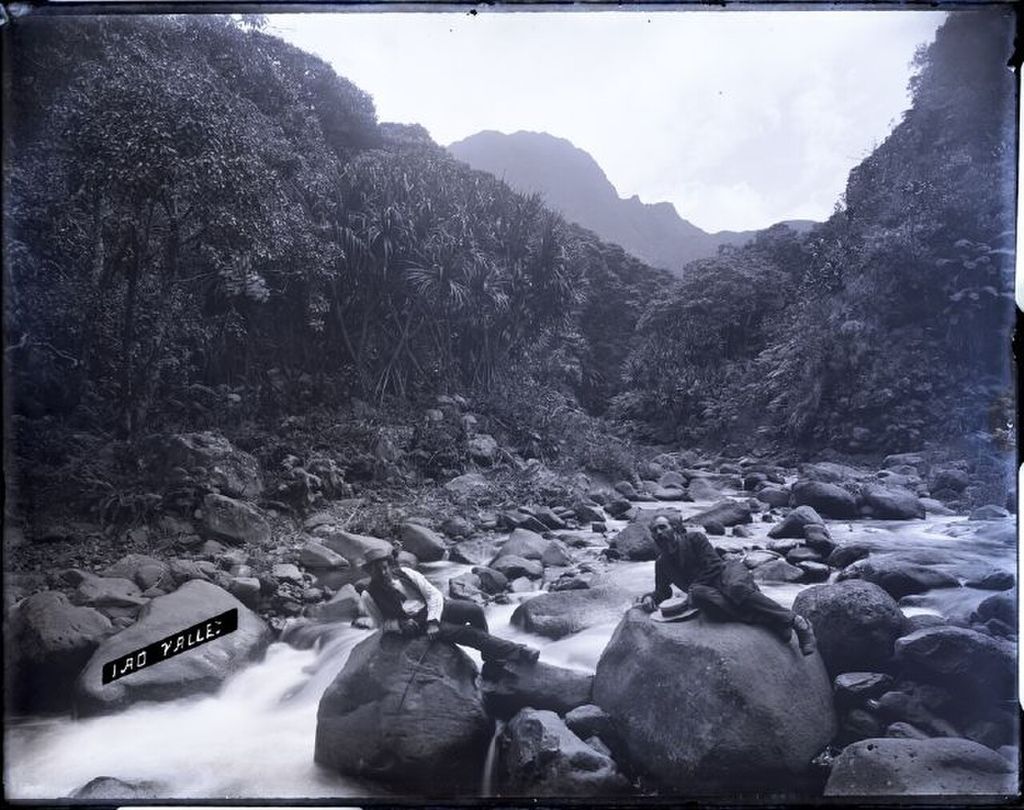
 by Tom Gurney
Tom Gurney BSc (Hons) is an art history expert with over 20 years experience
Page Created on September 22, 2026 / Page Updated on September 22, 2026
Email: tomgurney1@gmail.com / Phone: +44 7429 011000
At a Glance
- ArtistGeorgia O’Keeffe
- ArtworkWaterfall, No. 1, ‘Íao Valley, Maui
- Artistic contextAmerican modernism
Contents
- A white descent through green
- The Memphis painting
- Writing ʻĪao correctly
- Mountains that fill the frame
- Water seen in intervals
- Cloud, mist and withheld distance
- The pineapple commission
- Plantation access and its limits
- Nine weeks among four islands
- Entering ʻĪao
- A valley of ancestors and conflict
- Wai, stream and responsibility
- Four paintings, not one formula
- Colour and pictorial structure
- Keck’s 1948 surface coating
- The Hawaiian pictures in New York
- Reunions, ecology and Ansel Adams
- How to look now
A white descent through green
Georgia O’Keeffe’s Waterfall, No. 1, ʻĪao Valley, Maui compresses a deep, rain-fed valley into a canvas little more than nineteen inches high. Green ridges surge upwards and inward until only narrow openings remain for cloud and sky. Through their centre, a white waterfall drops in interrupted sections, disappearing behind folds before returning near the lower edge. The water is physically slight but compositionally decisive: a bright vertical pulse holding vast slopes in tension.[1][2]
Painted in 1939 during O’Keeffe’s nine-week journey through Hawaiʻi, the work belongs to a group made possible by a Hawaiian Pineapple Company commission but not confined to its advertising purpose.[4][5] She painted plants, lava formations, coastlines, mountains and several views of ʻĪao. The commission explains travel and access; it does not turn every canvas into commercial illustration. This waterfall emerged from an encounter that exceeded the client’s demand for fruit.
The valley also exceeds the picture. ʻĪao carries Native Hawaiian cultural, spiritual and political histories, including chiefly burials and the battle of Kepaniwai.[10][12] O’Keeffe’s unpeopled view neither records nor cancels those histories. Looking responsibly means holding two facts together: the painting is a concentrated modernist construction, and the place it selects cannot be reduced to luxuriant scenery available for an outsider’s discovery.
The Memphis painting
The Memphis Brooks Museum of Art owns the work as accession 76.7, a gift from Art Today. It is oil on canvas, measures 19 1/8 by 16 inches, or approximately 48.6 by 40.6 centimetres, and carries catalogue raisonné number 979.[1][2][3] Its modest vertical format intensifies the valley’s steepness. The viewer faces a wall of rising land rather than surveying a broad panorama from a secure distance.
The published provenance is concise. O’Keeffe retained the painting until 1976, when it was sold through the Doris Bry Gallery and entered the Brooks as Art Today’s gift.[1] Current records name no intervening private owner. That direct sequence gives the artist unusually long custody of a work first shown in 1940, while the later gallery transaction links its private history to public collection in a single year.
The object’s reverse is only partly available to researchers. Access O’Keeffe records O’Keeffe’s name written by Alfred Stieglitz, the year added by Doris Bry, two An American Place labels and a title strip cut from the 1940 exhibition checklist.[1] The stretcher and verso are inaccessible. Those limits matter because the surviving backing is already rich evidence; unavailable areas should not be made to supply imagined signatures, revisions or technical facts.
The gift credit also identifies a local mechanism of collecting. Art Today acquired the painting for Memphis rather than leaving it in the market after O’Keeffe’s sale.[1][2] Although the public record does not narrate the group’s selection process, the credit should remain visible because it distinguishes donor, dealer and artist. Museum ownership here arose from collective support, while the retained labels ensured that the work arrived with its earliest display history physically attached.
Writing ʻĪao correctly
The catalogue title uses ʻĪao: an ʻokina followed by a capital I with kahakō. Older labels and databases often print “Iao”, while the inherited page register contains “’Íao”, substituting an opening quotation mark and an acute accent. The manuscript follows current Hawaiian institutional orthography because diacritics distinguish language rather than decorate it. Historical title variants remain transcribed as their records preserve them.[1][10]
The Whitney Archive supplies Waterfall, No. 1, ʻĪao Valley, Maui. Downtown Gallery records vary punctuation and use “#1”; O’Keeffe’s Abiquiú Notebooks place the number at the end.[1] None changes the essential four-part identification: subject, sequence number, valley and island. The precision differentiates this canvas from related Hawaiian waterfalls and from later waterfall subjects that O’Keeffe painted elsewhere.
A small documentary correction demonstrates why object records remain provisional. Lynes’s catalogue transcribed the checklist fragment on the backing as number 14, but the Brooks reported in 2025 that the actual number is 16.[1] The change does not alter authorship or date. It improves the link between physical label and exhibition checklist, showing how renewed inspection can correct an authoritative publication without displacing its wider scholarship.
“Maui” remains in CR 979’s accepted title, while the catalogue titles for Nos. 2 and III stop at ʻĪao Valley.[8][9] That difference should not be treated as evidence of another island or subject; their institutional records securely identify the same valley group. It shows instead how place information can contract across a series, with numbering carrying some of the burden once viewers and cataloguers recognise the shared motif.
Mountains that fill the frame
No level foreground prepares entry into the painting. Pale green slopes rise directly from the lower corners, converge around the waterfall and continue beyond the top edge. The left ridge forms a broad triangular mass; a taller central-right peak bulges forward; the far right becomes a cropped green wall. Each form overlaps another, making depth through obstruction rather than through a road, riverbank or measured sequence of diminishing objects.
O’Keeffe varies green continuously. Acid yellow-green lights the nearest left and right slopes; emerald and blue-green define middle ridges; grey-green softens distant peaks. Purple-black seams expose rock, shadow or vegetative clefts without being anatomically mapped. Because colour changes with each fold, “lush” is insufficient description. The valley is organised through contrasts among illuminated growth, saturated mass, recessed darkness and atmospheric loss.
The brushwork remains visible without turning the mountains into loose notation. Long diagonal strokes reinforce the fall of slopes, while shorter grey and dark marks articulate broken surfaces. Some edges are firm enough to make adjacent ridges collide; others dissolve into mist. The picture depends on that alternation. If every edge were sharp, space would become a stack of cut-outs; if every edge softened, the waterfall would lose the enclosure that gives its descent force.
Cropping intensifies that enclosure. The nearest slopes continue beyond both side edges and below the lower boundary, while several summits nearly touch the cloud band. Nothing reveals the full mountain or the base of the fall. O’Keeffe gives the viewer a bounded aperture within a larger system, using what the canvas excludes to make the visible terrain feel extensive rather than miniature.
Water seen in intervals
The waterfall begins beneath a yellow-green saddle near the centre. A thin white line drops beside a dark seam, widens into a brighter flare and then disappears behind a projecting ridge. It returns as a small white mark lower down, vanishes again and finally emerges close to the bottom edge. These interruptions allow the viewer to infer continuous water while recognising that the painted surface supplies only fragments.
White is not uniform. Grey and pale blue cool the main fall, while warmer cream appears where water meets green. Its brightest passages are narrow and irregular rather than geometrically straight. Against surrounding darks, they seem luminous enough to move. O’Keeffe creates animation without repeating individual droplets: changes in width, value and visibility convey falling water more economically than detailed spray.
The descent also establishes the picture’s scale. Without it, the green forms could be leaves, folded fabric or abstract planes. A recognisable waterfall turns them into mountains, yet its extreme thinness makes those mountains appear enormous. This is not a neutral measurement of the valley. It is a compositional decision in which one small, legible event activates the magnitude of everything around it.
Its lower disappearance is especially important. The water does not arrive at a visible pool or stream, so the composition withholds the expected completion of a waterfall view. That truncation keeps attention on falling rather than arrival. It also separates pictorial structure from watershed description: the canvas follows a luminous path through folds, while the valley’s downstream hydrology remains beyond the frame.
Cloud, mist and withheld distance
Across the upper third, white cloud closes much of the sky. Small blue openings survive at the corners and above the central peaks, but none expands into a broad atmosphere. Cloud therefore behaves less like backdrop than a second enclosing mass. Its low edge cuts around the ridges and sends pale vapour into the basin, where a horizontal mist band softens the transition between near and distant land.
Several blue-grey peaks appear through that vapour. Their reduced saturation and blurred contours create atmospheric distance without conventional linear perspective. The farthest pair almost floats between cloud and valley, while nearer green summits remain dense and materially present. O’Keeffe uses loss of chromatic intensity as spatial evidence: what recedes becomes cooler, paler and less bounded.
Mist also interrupts the valley’s apparent solidity. The foreground slopes seem heavy enough to touch, yet the centre can dissolve into moisture. This contrast prevents the composition from becoming a fixed emblem of green abundance. ʻĪao’s rainfall and moving cloud are implied through shifting visibility, and the waterfall joins those atmospheric cycles even though no rain is shown striking the surface.
The pineapple commission
O’Keeffe travelled to Hawaiʻi after the Hawaiian Pineapple Company commissioned two paintings for a promotional campaign. She was fifty-one and already nationally prominent for flowers, New York buildings, bones and New Mexican landscapes.[5][14] Corporate sponsorship paid for travel, but the resulting group encompassed more than twenty works across several islands. The company’s narrow brief opened into an investigation of environments it did not control pictorially.
Smithsonian interpretation notes that none of the canvases completed in Hawaiʻi depicted a pineapple. Only after her return did the company send a plant to New York, where she produced the requested image.[5] The distinction matters for CR 979. It was painted within a commissioned journey but selected a waterfall outside the advertised product, preserving O’Keeffe’s authority over what she found worth painting.
The commission’s language of tropical abundance belonged to an industry selling Hawaiʻi to mainland consumers. O’Keeffe’s waterfall can resist the literal product image while still participating in an outsider’s visual economy of dramatic islands. Treating it as purely independent would erase the conditions of travel; treating it as an advertisement would erase its formal and subject freedom. Its history lies between patronage and refusal of prescribed content.
The arrangement began before the 1939 journey. In 1938 the advertising agency N. W. Ayer engaged O’Keeffe for the Hawaiian Pineapple Company campaign, giving the trip a defined commercial origin.[4] Yet neither the agency nor company selected ʻĪao as the final image. The distance between contract and canvas helps explain why the Hawaiian group reads as sustained personal work rather than a set of twenty product designs.
Art historian Sascha T. Scott challenges accounts that treat the commission chiefly as creative escape. She traces the company’s wealth to the Dole family’s participation in Indigenous dispossession and United States conquest, arguing that O’Keeffe’s experiences were structured by colonialism and that the finished advertisements helped naturalise occupation.[22] CR 979 did not appear in those advertisements and should not be called propaganda. Its travel was nevertheless financed by the same campaign, making pictorial freedom inseparable from the colonial infrastructure that enabled it.
Plantation access and its limits
Honolulu Museum scholarship places the trip inside plantation labour and gender hierarchy. When O’Keeffe asked to stay near pineapple fields so she could study their “sharp and silvery” appearance, company representatives refused, saying residence among labourers was improper for a woman. They offered a peeled and sliced pineapple, which removed precisely the growing form she wanted to observe.[6] Control of access shaped what the commissioned artist could see.
Plantation agriculture depended on immigrant workers from China, Japan, Korea, Portugal and the Philippines, and its promotional images often concealed labour conditions.[6] That social structure is not visible in Waterfall, No. 1, but it belongs to the institutional journey behind the canvas. The absent workers should not be turned into figures O’Keeffe intended to represent; their absence instead marks a boundary around the seemingly unrestricted mobility promised by sponsorship.
The Honolulu curator asks whether O’Keeffe’s pineapple-free submissions were oversight, refusal or private protest.[6] The question is useful because it exposes competing interpretations, but evidence does not settle motive. CR 979 demonstrates that she devoted sustained attention to a subject outside the product brief. It cannot by itself prove political resistance, and its unpeopled valley should not be recruited as uncomplicated evidence of solidarity with plantation workers.
Gender restriction and artistic privilege operated together. Company representatives could deny O’Keeffe the residence she wanted while still financing an itinerary unavailable to most people, and her fame gave her leverage to return images beyond their instructions.[5][6] That uneven position complicates heroic stories of independence. She negotiated corporate control successfully as an artist, but the journey remained embedded in a colonial economy whose workers had far less freedom over labour and movement.
Nine weeks among four islands
From late January into April 1939, O’Keeffe travelled through Oʻahu, Hawaiʻi Island, Maui and Kauaʻi.[4][14] The itinerary introduced volcanic coasts, tropical plants and wet mountain valleys unlike the northern New Mexico terrain with which critics increasingly associated her. A surviving 1939 photograph places her near the natural stone arch at Lehoʻula Beach in Hāna, anchoring at least part of the Maui journey in archival evidence.[19]
O’Keeffe’s correspondence narrows the ʻĪao episode. She told Stieglitz that she had been painting up the valley for three days and described sheer green mountains, multiple waterfalls and a winding shelf road frightening enough to slow traffic sharply.[20] The letter supports sustained work before the motif rather than an image invented entirely after departure. It does not identify which canvas occupied each day, so the statement establishes duration and conditions for the group without converting the numbered titles into a daily sequence.
Patricia Jennings Morriss, O’Keeffe’s twelve-year-old Maui guide, later recalled rain forcing them into the family station wagon while the artist continued to paint. O’Keeffe initially made her face away, then allowed her to watch on condition that she remain silent.[21] The memoir offers rare eyewitness evidence of a car used as field studio and of work continuing through unstable weather. Written decades later, it cannot by itself identify CR 979 as the precise canvas observed, but it materially strengthens the on-site history of the waterfall group.
The Hawaiian works include hibiscus, plumeria, white bird of paradise, papaya, lava bridges and fishhooks as well as waterfalls.[5][13] Such variety undermines the idea that O’Keeffe merely replaced red desert with green tropics. She moved between close botanical study, collected object, coast and deep landscape, testing how each subject altered scale, crop and colour.
After returning to New York in April, she completed the pineapple painting demanded by the company. The summer brought illness at Lake George, and the year also included recognition by the New York World’s Fair committee.[4] CR 979 thus belongs to an intense but bounded episode rather than a permanent relocation. The fact that O’Keeffe retained it until 1976 suggests the brief journey continued to matter within her own collection.
Entering ʻĪao
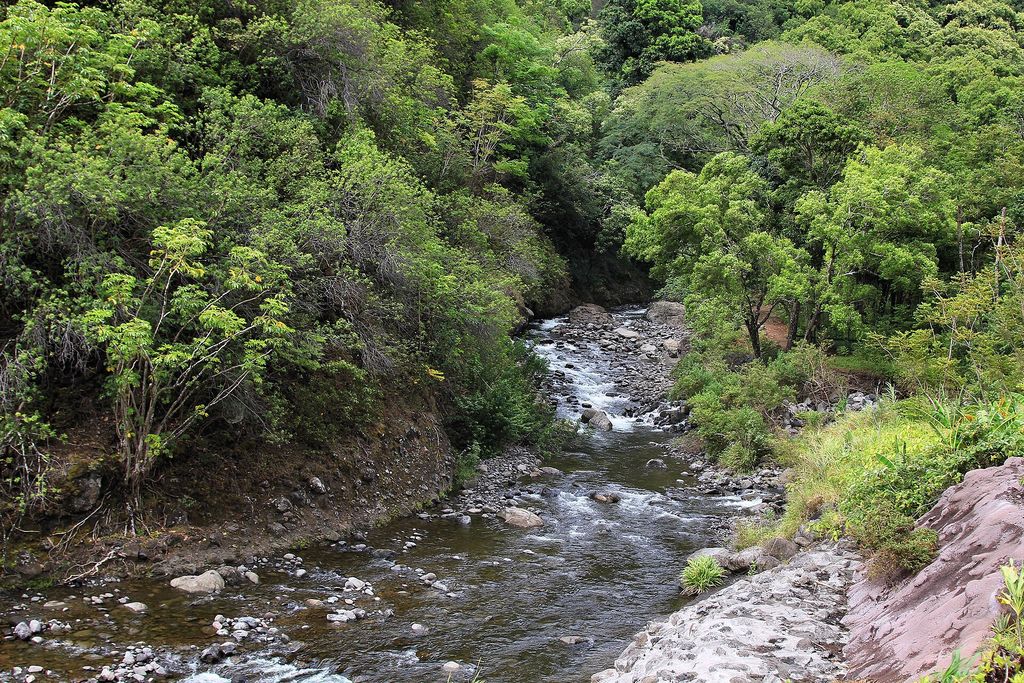
The painting gives no road, visitor or viewing platform, although one related title explicitly says “End of Road”.[7] CR 979 suppresses the means of arrival and begins where the valley already fills vision. That omission heightens immersion but can also make access appear effortless. In reality, O’Keeffe reached ʻĪao through hosts, transport and the networks surrounding a mainland commission.
Current state interpretation describes Kukaʻemoku, commonly marketed as the ʻĪao Needle, as an erosional feature rising roughly 1,200 feet from the valley floor.[10] CR 979 does not securely identify that feature, and its peaks should not be assigned names by resemblance. The painting selects a waterfall-centred basin rather than functioning as a complete topographical inventory.
The narrowing slopes create a bodily sense of entry. Their green masses press from both sides, while mist blocks the rear and cloud lowers the ceiling. Yet no single viewpoint could necessarily contain every relation in the canvas. O’Keeffe’s construction may condense successive observations, altering distance and overlap until the valley feels both immediate and unreachable.
Kukaʻemoku has become the valley’s most promoted landmark, but its fame can distort how other ʻĪao views are described.[10] CR 979’s subject is the waterfall and its enclosing ridges, not a verified portrait of the erosional feature. Resisting automatic identification protects both geographical accuracy and visual attention: the painting’s pointed forms deserve to be read on their own evidence rather than forced into a tourist checklist.
A valley of ancestors and conflict
ʻĪao is not historically empty terrain. Hawaiʻi State Parks identifies it as a place of cultural and spiritual value and the site of the 1790 battle of Kepaniwai, where Kamehameha I’s forces defeated the Maui army.[10] The battle helped extend his political power across the islands. Its violence gives the valley a historical register absent from scenic descriptions of cloud, waterfall and vegetation.
Research filed with Hawaiʻi’s Land Use Commission also describes ʻĪao as a burial place of Maui rulers and a geographic stronghold. During the invasion, members of Maui’s ruling family escaped through the pass towards Olowalu.[12] These accounts connect ridges and waterways to chiefly authority, ancestral remains, refuge and warfare. They make clear that the valley’s meaning long predates O’Keeffe’s nine-week visit.
The canvas does not depict Kepaniwai, and there is no evidence that O’Keeffe designed its dark ravines as historical symbols. Adding Hawaiian history therefore requires discipline. It corrects any modern tendency to call the scene untouched wilderness, while leaving the work’s documented subject intact. The painting records what one visiting artist made of a view; it does not encompass the place’s cultural memory.
The relation between burial ground and landscape also changes the ethics of scenic possession. A ridge may be formally powerful to an artist while holding ancestral significance not available for visual appropriation or casual summary.[12] Museums can acknowledge that limit without claiming knowledge O’Keeffe did not record. The result is a more exact account of encounter: she shaped a view of ʻĪao, but neither her canvas nor its later fame grants ownership over the valley’s meanings.
Wai, stream and responsibility
Hawaiian language holds the importance of fresh water in the word wai. The state Division of Aquatic Resources describes freshwater as sacred and central to traditional land organisation, agriculture and stream ecology.[11] Water supported loʻi cultivation and connected mountain, plain and sea through species that travelled upstream. A waterfall is consequently more than a picturesque white accent, even when a painting treats it formally.
O’Keeffe’s image emphasises water by making it the canvas’s brightest and most continuous directional element. Still, the stream’s lower course, ecological communities and human uses remain outside the frame. The white fall signifies water visually but does not document its social distribution. Cultural context enlarges what viewers know about the place without converting a modernist landscape into an ethnographic record.
Contemporary responsibility also shapes ʻĪao’s interpretation. State public discussions have addressed the sacredness of the valley, visitor facilities and risks of desecration.[10] Such debates show that cultural value is living, not an episode sealed in 1790. They invite museums and viewers to use precise place names, resist possession language and recognise that celebrated landscape imagery circulates beyond the communities whose histories it touches.
Four paintings, not one formula
CR 979 is part of a compact group of four ʻĪao waterfall compositions. CR 978, Waterfall End of Road—ʻĪao Valley, and CR 980, Waterfall, No. 2, share its roughly 19-by-16-inch vertical format. CR 981, Waterfall, No. III, is larger at about 24 1/4 by 20 inches.[7][8][9] Catalogue adjacency and titles establish a sequence of attention, though not a documented order of outdoor sessions.
In CR 978 a single green mountain dominates and two pale waterfalls cross its face.[7] CR 980 looks towards a distant fall inside a broad V, using white cloud to deepen the opening.[8] CR 981 creates a darker, more vertiginous cleft, its fall drawn into what Honolulu curators call a zipper-like tract.[6][9] CR 979 differs by multiplying mountain layers and breaking one central descent into several intervals.
Serial comparison reveals decisions that one painting conceals. O’Keeffe adjusted crop, fall count, distance, cloud, shadow and ridge alignment rather than copying a fixed vista. The vertical supports stay small enough to handle, but each gives the valley a different pressure. Repetition becomes analysis: the place changes as she shifts what the frame admits and how white water negotiates green mass.
Numbering should not imply simple improvement. “No. 1”, “No. 2” and “No. III” organise related works, while End of Road names a viewing circumstance instead. The surviving records do not prove that CR 979 was painted first or that the Roman and Arabic numerals came directly from a planned series. Catalogue order is evidence of relation, not a diary of execution.
The works dispersed along different routes. CR 979 remained with O’Keeffe until Memphis acquired it; No. 2 entered a New York private collection by 1947; No. III travelled through several private owners before its 1996 Honolulu gift; End of Road reached Honolulu through a 1989 purchase.[1][7][8][9] Their reunion in later exhibitions reconstructed a series that ownership had separated, allowing variations to be studied side by side again.
Colour and pictorial structure
O’Keeffe builds the valley from a relatively concentrated palette, yet the result is not monochrome. Yellow-green signals exposed or near slopes; cooler emerald marks middle distance; blue-grey carries peaks backwards; purple-black cuts ravines; white joins cloud, mist and falling water. Small blue sky openings prevent the upper field from closing completely. Each colour has spatial work as well as expressive force.
Dark seams function like drawing inside colour. They mark divisions among ridges and guide the eye downwards, sometimes running parallel to the waterfall and sometimes opposing it. O’Keeffe does not outline every mass. A contour may begin decisively and dissolve into adjacent green, allowing the viewer to complete the fold. This selective firmness keeps the small canvas from becoming diagrammatic.
General technical studies describe O’Keeffe’s careful colour mixing, thin application and preference for letting one layer dry before another.[17] Those findings explain productive questions for close looking but are not an examination of CR 979. Its visible weave and controlled bands may be described; pigment identity, underdrawing and layer sequence cannot be asserted without owner-approved analysis.
Keck’s 1948 surface coating
A typed label records that Caroline Keck sprayed the painting with butyl methacrylate polymer in March 1948.[1] This was a synthetic conservation coating applied nine years after the work’s date. The record does not state whether Keck first cleaned the surface, why coating was judged necessary or how much material was deposited. It should therefore be described precisely as a documented intervention rather than generically as restoration.
The same dated treatment appears on CR 978 and CR 981.[7][9] Repetition across three ʻĪao canvases suggests that they were cared for as a related group while still close to O’Keeffe, but the records do not identify a single coordinated treatment session or shared condition problem. The coating joined paintings that later followed different ownership paths, becoming an invisible material link within the dispersed series.
CR 979’s appearance in the 2006 touring exhibition Color and Conservation brought this history into public interpretation.[1][16] That exhibition examined O’Keeffe’s close collaboration with Keck and her concern that works retain their intended colour and surface. Present condition remains unreported in detail. A historic synthetic coating may alter gloss or colour over time, but no such change should be claimed here without current examination.
The spray treatment also affects how “original surface” should be discussed. The paint belongs to 1939, but every present view passes through or reflects a later coating whose exact condition is unpublished. This does not make visual analysis invalid. It means observations of saturation and sheen must remain phenomenological, while scientific claims about O’Keeffe’s first appearance await an examination capable of separating paint, coating and subsequent ageing.
The Hawaiian pictures in New York
Stieglitz opened Georgia O’Keeffe: Exhibition of Oils and Pastels at An American Place on 1 February 1940, and it continued through 27 March.[15] CR 979’s cut checklist title physically connects the canvas to that debut. New York audiences encountered the Hawaiian group together only months after O’Keeffe’s return, filtered through Stieglitz’s gallery and the numbering that organised twenty-one new pictures.
The exhibition transformed commissioned travel into an artist’s body of work. Pineapple imagery did not define the wall; waterfalls, flowers, lava and trees established a broader account of Hawaiʻi.[4][5] Yet mainland reception could admire tropical novelty without confronting plantation power or Native Hawaiian history. The images’ beauty and their framing within American modernism did not automatically explain the political conditions of the places represented.
In 1990 the Honolulu Museum of Art organised Georgia O’Keeffe Paintings of Hawaiʻi, returning the group to an island institution.[1] That shift in location matters. Works once introduced through a New York gallery could be reconsidered near the landscapes and communities they depict, although museum display still mediates the encounter. Reception changes when authority to interpret moves among mainland and Hawaiian institutions.
Reunions, ecology and Ansel Adams
In 2014, Georgia O’Keeffe and Ansel Adams: The Hawaiʻi Pictures paired O’Keeffe’s paintings with photographs Adams made during separate visits, first in Honolulu and then in Santa Fe.[18] He was not beside her in ʻĪao in 1939. The comparison concerns distinct practices and dates: painted compression and saturated colour on one side, photographic tone and lens-based framing on the other.
In 2018 the New York Botanical Garden reunited seventeen Hawaiian paintings in New York for the first time since 1940. Its Visions of Hawaiʻi project combined art with living plants, botanical research, correspondence and interpretation of the islands’ ecological and cultural complexity.[13][14] The exhibition then travelled to Memphis, where the Brooks presented its own waterfall within the larger group.[2]
That botanical framing added necessary friction to the word “exotic”. Plants that seemed novel to a mainland visitor could be native, introduced, cultivated through Polynesian settlement or bound to plantation exchange. O’Keeffe’s paintings preserve her intense response, not a complete environmental survey. Modern reception can admire their selection while examining what mid-century visions of Hawaiʻi highlighted, transformed or left outside the frame.
The exhibition’s combination of art gallery and living conservatory also changed the mode of comparison.[13] Viewers could move between painted forms and cultivated plants rather than encountering the canvases only within a career chronology. For the waterfall, the ecological context redirected attention towards rainfall, vegetation and island biodiversity, while historical interpretation questioned the fantasy that tropical beauty exists outside human migration, cultivation and environmental change.
How to look now
Begin with the waterfall rather than the mountains. Trace each white interval and notice where land interrupts it. The eye supplies continuity across gaps, turning separate marks into one descent. Then compare that vertical rhythm with the dark ravines around it. Some run almost parallel; others bend away, making the water appear to thread through a structure that is continually closing.
Next move from the nearest yellow-green slopes towards the blue-grey peaks. Watch edges soften and colours cool as distance increases. The white mist band is neither empty space nor solid cloud; it is a transition that conceals part of the terrain and suspends any easy route through it. Above it, tiny blue apertures show how little open sky the composition permits.
Finally, hold visual immersion beside historical knowledge. The painting offers no people, yet ʻĪao is a place of ancestors, water, political power, battle and continuing Hawaiian cultural responsibility.[10][11][12] O’Keeffe’s achievement lies in the exact pressure she creates among ridge, vapour and fall. Responsible reception lets that achievement remain powerful without allowing the framed view to stand for the whole valley.
The object itself also carries time. A 1940 checklist fragment, O’Keeffe’s decades of ownership, a 1948 synthetic coating, a 1976 museum gift and later exhibitions have accumulated around the 1939 surface.[1][2] Looking now involves more than reconstructing a moment outdoors. It means seeing a small painting as material object, serial experiment, product of sponsored travel and one partial encounter with a place whose meanings continue beyond it.
Discussion
Which piece of evidence most changes the way you read Waterfall, No. 1, ‘Íao Valley, Maui?
Reader Insights
Which visible detail most changes your reading of Waterfall, No. 1, ‘Íao Valley, Maui?
How do medium, setting and documented history shape the encounter?
What remains uncertain when documented fact is separated from interpretation?
Join the Conversation
Share your reading of Waterfall, No. 1, ‘Íao Valley, Maui below.
References
- Access O’Keeffe, “Waterfall, No. 1, ʻĪao Valley, Maui, 1939”, CR 979. View Source
- Memphis Brooks Museum of Art, “Georgia O’Keeffe: Visions of Hawaiʻi”. View Source
- Smithsonian Institution, “Waterfall, No. 1, Iao Valley, Maui”. View Source
- Access O’Keeffe, “Chronology”. View Source
- Smithsonian American Art Museum, “Hibiscus with Plumeria”. View Source
- Honolulu Museum of Art, “HoMA Selects: Waterfall—No. III—ʻĪao Valley”. View Source
- Access O’Keeffe, “Waterfall End of Road—ʻĪao Valley, 1939”, CR 978. View Source
- Access O’Keeffe, “Waterfall, No. 2, ʻĪao Valley, 1939”, CR 980. View Source
- Access O’Keeffe, “Waterfall, No. III, ʻĪao Valley, 1939”, CR 981. View Source
- Hawaiʻi Division of State Parks, “ʻĪao Valley State Monument”. View Source
- Hawaiʻi Division of Aquatic Resources, “Cultural Importance”. View Source
- Hawaiʻi Land Use Commission, Puʻuhonua: The Legacy of Olowalu, Appendix G. View Source
- New York Botanical Garden, “Georgia O’Keeffe: Visions of Hawaiʻi”. View Source
- New York Botanical Garden, “Georgia O’Keeffe: Visions of Hawaiʻi”, exhibition announcement. View Source
- Access O’Keeffe, “Georgia O’Keeffe: Exhibition of Oils and Pastels”, 1940. View Source
- Access O’Keeffe, “Georgia O’Keeffe: Color and Conservation”, touring exhibition. View Source
- Georgia O’Keeffe Museum, “Conservation and Technical Documentation”. View Source
- Access O’Keeffe, “Georgia O’Keeffe and Ansel Adams: The Hawaiʻi Pictures”, touring exhibition. View Source
- Georgia O’Keeffe Museum Archives, “Georgia O’Keeffe in Hawaii, 1939”. View Source
- National Endowment for the Humanities, “Georgia O’Keeffe Paints Hawaii”, Humanities, Spring 2018. View Source
- Patricia Jennings Morriss and Maria Ausherman, Georgia O’Keeffe’s Hawaiʻi (Kihei: Koa Books, 2011), pp. 64–65. View Source
- Sascha T. Scott, “Georgia O’Keeffe’s Hawai‘i? Decolonizing the History of American Modernism”, American Art 34, no. 2 (2020), 26–53. View Source