


 by Tom Gurney
Tom Gurney BSc (Hons) is an art history expert with over 20 years experience
/
Email: tomgurney1@gmail.com / Phone: +44 7429 011000
George Bellows: Introduction
George Bellows (1882–1925) painted modern life as a contest between bodies, buildings, weather and paint. His New York crowds surge through streets and around boxing rings; excavation pits open beneath the city; the Maine coast meets the sea with equal force. Yet the energy of his art is never merely impulsive. Beneath the loaded brushwork are purposeful designs, changing colour systems and a sustained interest in how figures occupy space.
Bellows moved easily between subjects and media during a career cut short at forty-two. He was celebrated early for urban realism, but he also made searching portraits, hundreds of coastal pictures and a major body of lithographs. The full range matters: the painter of a dark, illegal prizefight is also the painter of sunlit family groups and rocky Atlantic shores.[1][2][3]
At a Glance
- IdentityGeorge Wesley Bellows, American painter, draughtsman and printmaker.
- DatesBorn 12 August 1882 in Columbus, Ohio; died 8 January 1925 in New York.
- Movement relationA leading younger associate of the Ashcan circle, but not one of The Eight in their 1908 exhibition.
- MediaOil painting, drawing, illustration and lithography.
- Signature subjectsNew York streets, construction, boxing, portraits, family life and the Maine coast.
- Key collectionsNational Gallery of Art, The Met, Cleveland Museum of Art, Brooklyn Museum, LACMA and Smithsonian American Art Museum.
George Bellows in context
Realism
c. 1840–1900American Realism
c. 1870–1930Ashcan circle
c. 1898–1917Winslow Homer
1836–1910Thomas Eakins
1844–1916Robert Henri
1865–1929John Sloan
1871–1951George Bellows
1882–1925Edward Hopper
1882–1967Pennsylvania Station Excavation
c. 1907–08New York
1911Cliff Dwellers
1913My Family
1916A Stag at Sharkey's
1917Dempsey and Firpo
1924Contents
- Introduction
- Who Was George Bellows?
- New York as Work, Crowd and Change
- Inside the Boxing Ring
- Painterly Force and Deliberate Structure
- From Stone to Paper, and into War
- Portraits, Family and the Maine Coast
- Five Essential Works
- How to Look at Bellows
Who Was George Bellows?
Bellows left Ohio State University in 1904 and moved to New York, where he studied with Robert Henri at the New York School of Art. Recognition followed quickly. He became an associate of the National Academy of Design in 1909, taught at the Art Students League, helped organise the 1913 Armory Show and was elected a full academician that year. He married Emma Story in 1910; they had two daughters, Anne and Jean. Bellows later worked in Maine, California, Rhode Island and Woodstock as well as New York.[1]
Henri encouraged direct engagement with contemporary life. That links Bellows to the Ashcan artists, but the history needs precision: he sympathised with their subjects and approach without taking part in The Eight’s landmark 1908 exhibition. His independence was characteristic. He could win academic honours while supporting artist-led exhibitions that challenged juried institutions.[2] The biography follows that compressed, eventful career in detail.
New York as Work, Crowd and Change
Bellows arrived in a city of demolition, construction, transport and dense public spectacle. He painted boys swimming from rough East River piers, labourers, tenements, winter streets and the uneasy edges where park, river and industry met. His New York City pictures do not form a neutral survey. Viewpoints tip, figures collide and weather turns familiar places strange. Broad handling gives crowds momentum while carefully placed darks, diagonals and intervals hold them together.[3]
The 1911 painting New York is not a literal record of one intersection. Bellows combined elements from several commercial districts into an imaginary, impossibly congested city.[4] Pennsylvania Station Excavation, dated about 1907–1908, fixes attention on a different kind of modern transformation. The Brooklyn Museum canvas is one of four Bellows made around the project: workers appear small inside a cold, smoke-filled pit created by tearing down the old city to build the new.[5]
Inside the Boxing Ring
Bellows’s boxing pictures remain his most concentrated studies of bodily pressure and spectatorship. Public prizefighting was illegal in New York when he visited Sharkey’s Athletic Club. Private clubs evaded the ban by describing fighters as members; an outsider granted temporary membership was called a “stag.” In Stag at Sharkey’s, the exact 1909 Cleveland oil, the grappling fighters form a bright knot above a crowd whose reactions are part of the subject.[6]
Both Members of This Club, also painted in 1909, uses the legal fiction in its title. Its interracial bout carried particular force in the Jim Crow era, soon after Jack Johnson became world heavyweight champion. The Black boxer appears to be defeating his white opponent, while the ringside audience presses towards the violence.[7] Bellows revisited boxing in drawings and lithographs, changing scale, emphasis and circulation rather than simply copying paintings. The boxing pictures keep those media and objects distinct.[8]
Painterly Force and Deliberate Structure
Bellows is often remembered for slashing strokes, thick paint and compressed action. Those qualities are real, but they coexist with calculation. He varied palettes and techniques across subjects, studied colour theories, and later worked with Jay Hambidge’s system of dynamic symmetry.[1][3] A Bellows picture may feel instantaneous while depending on a strongly engineered armature.
The contrast is especially clear in Cliff Dwellers, painted in 1913. LACMA’s technical account records diagonal rows of pinholes related to compositional alignments and to Hardesty Maratta’s ideas, although the museum cautions that further study is needed to determine exactly how the geometry functioned.[9] The lesson is not to replace sensation with a diagram. It is to see broad handling and formal control as partners. The wider guide to Bellows’s paintings traces that relationship across city, ring, portrait and coast.
From Stone to Paper, and into War
Bellows began making lithographs in 1916 and became an important figure in the American revival of the medium.[2] Lithography let him return to earlier themes, develop new tonal effects and circulate images beyond a unique canvas. Exact identity remains essential: the National Gallery’s A Stag at Sharkey’s is a 1917 lithograph in black, not the Cleveland painting of 1909. Its impression has its own accession number and catalogue entry.[10] The prints and lithographs introduction explains stones, states and impressions without collapsing them into shared titles.
His 1918 war work requires another boundary. Bellows tried to enlist but did not see combat in Europe. Images such as the lithograph Sniped drew on newspaper reports, published accounts, photographs, illustrations and soldiers’ stories.[11] Their violence should therefore be understood as a constructed response to wartime information and propaganda, not eyewitness testimony. The war work guide examines how those sources, moral claims and print processes meet.
Portraits, Family and the Maine Coast
Bellows’s career did not progress in a simple line away from the city. Portraits accompany every phase, from early New York sitters to later depictions of Emma, their daughters, friends and patrons. He sought individual presence rather than a uniform type, and his family offered an arena for ambitious experiments in figure, colour and setting.[2]
During the summer of 1916 in Camden, Bellows made two closely related, unfinished paintings of Emma, Anne and Jean outdoors. The National Gallery’s My Family is one version; the relationship to the Boston painting Study of Emma and the Children remains uncertain, though the latter is generally regarded as preparatory.[12] Maine also transformed his landscape practice. Beginning in 1911, he repeatedly visited the coast and made an extensive group of shore and sea pictures. The 1913 Vine Clad Shore–Monhegan Island identifies one exact Smithsonian canvas within that much larger production.[13] Explore these shifts through portraits, family and Maine.
Five Essential Works
These five paintings offer a concise introduction to Bellows’s changing view of modern life. Each title refers to a particular museum object:
- Pennsylvania Station Excavation (c. 1907–1908). Brooklyn Museum, 67.205.1. Labourers are dwarfed by the pit where destruction and construction become inseparable.[5]
- Stag at Sharkey’s (1909). Cleveland Museum of Art, 1922.1133. Two fighters grind together above a ring of spectators; “stag” describes the outsider’s temporary club status.[6]
- Both Members of This Club (1909). National Gallery of Art, 1944.13.1. The struggle links boxing’s legal evasions to the racial politics surrounding an interracial bout.[7]
- New York (1911). National Gallery of Art, 1986.72.1. A composite city packs traffic, pedestrians, signs, smoke and buildings into sustained congestion.[4]
- Cliff Dwellers (1913). Los Angeles County Museum of Art, 16.4. Sunlit street activity and shadowed tenements resist a single reading, while underlying pinholes point to deliberate planning.[9]
Together they move from winter excavation and dim boxing clubs to a composite commercial centre and the crowded Lower East Side. They also show why “energy” is only a beginning: Bellows repeatedly changed the structure, palette and social pressure of a scene.
How to Look at Bellows
Begin with the relationship between action and organisation. Follow a major diagonal, then notice which face, glove, wheel or roofline interrupts it. Compare the speed suggested by a brushstroke with the stability of the entire design. Ask where Bellows places the viewer: above a crowd, below the ropes, at the edge of a pit or close to a sitter.
Context sharpens that looking without settling every meaning. Boxing law, urban redevelopment, race, class, wartime reporting and family identity all change what is visible. So do exact medium and object: a painting, drawing and lithographic impression may share a motif while making different claims.
Follow George Bellows's career through four stages
Columbus, sport and Robert Henri's classroom
Bellows grew up in Columbus, balanced drawing with baseball and basketball at Ohio State, and moved to New York in 1904. Study with Robert Henri redirected his energy toward the people, streets and immediate experience of the modern city.
Excavations, crowds and club fights
Rapidly handled paintings of the Penn Station excavation, East River swimmers and illicit boxing clubs established Bellows's reputation. Public recognition came early, but the apparent speed of his surfaces rested on controlled tonal and compositional decisions.
The Lower East Side, colour systems and lithography
Bellows broadened his subjects through tenement streets, family groups, Maine coasts and illustration. From 1916 lithography became a major practice, carrying boxing, satire, portrait and wartime imagery into a medium built around stones and multiple impressions.
Portraits, Woodstock and renewed sporting drama
Later years joined searching portraits and family images to landscapes made around Woodstock and the coast. Bellows also returned to public sport in ambitious boxing subjects before his sudden death after appendicitis in January 1925.
Essential works
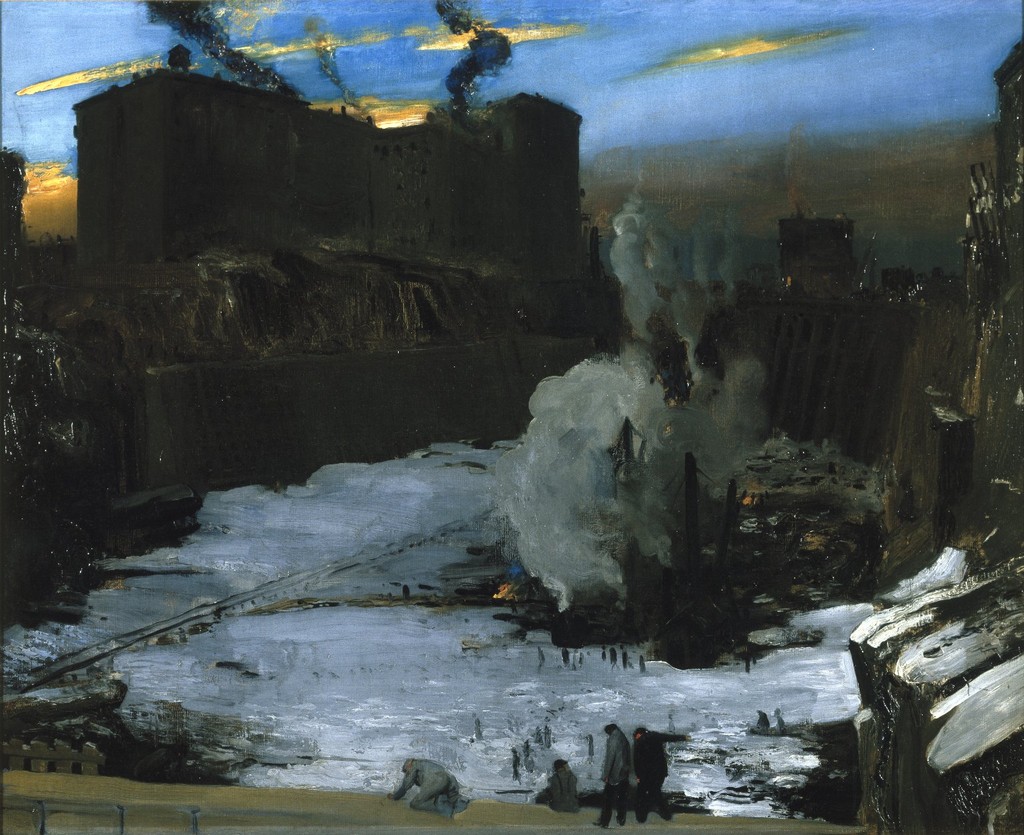
Pennsylvania Station Excavation
c. 1907–08 · Workers and steam are dwarfed by a winter construction pit that makes modern rebuilding feel both productive and destructive.
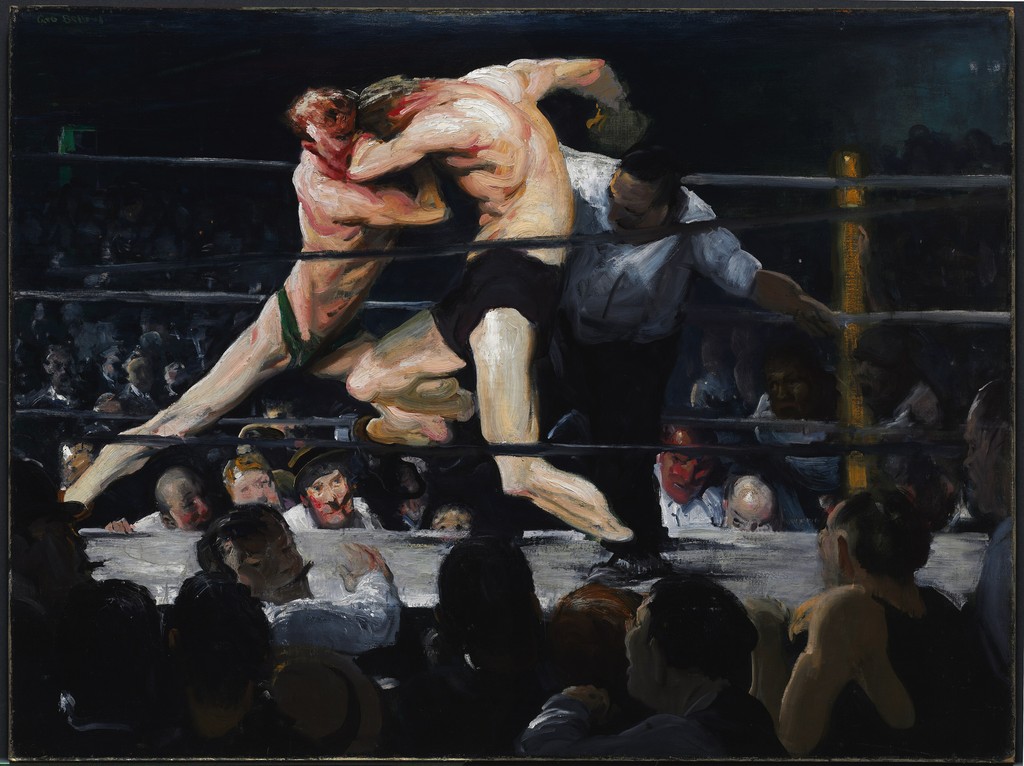
Stag at Sharkey's
1909 · Two fighters, a reaching referee and a compressed crowd turn an illicit club bout into a study of force and spectatorship.
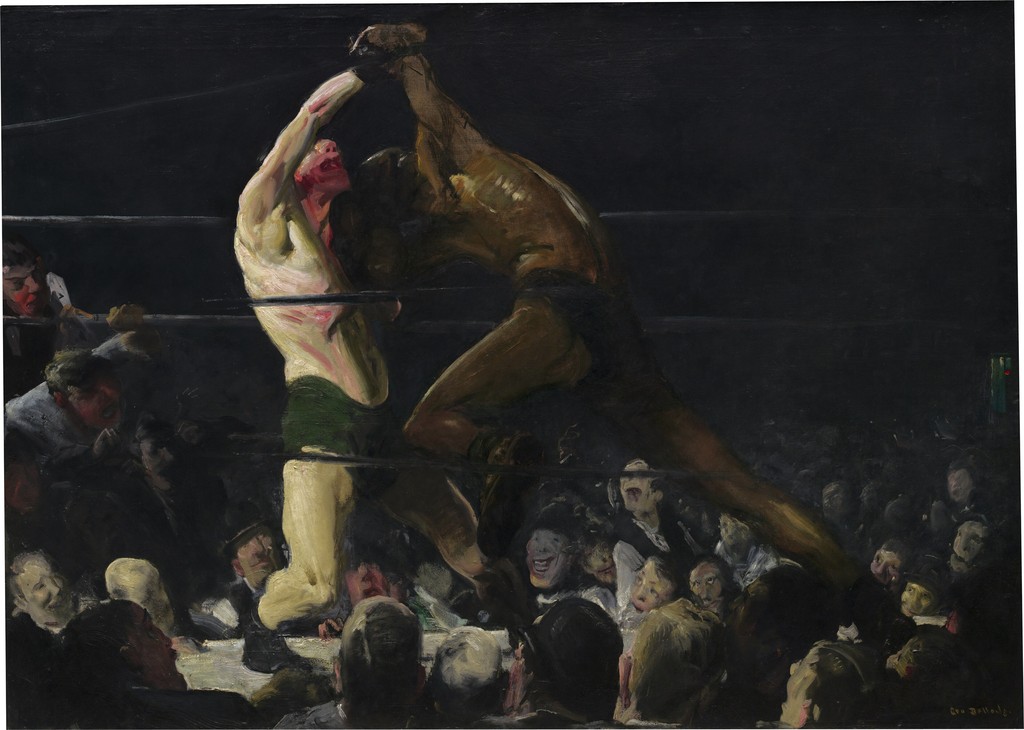
Both Members of This Club
1909 · An interracial fight gives Bellows's boxing formula a sharper charge of race, law and Jack Johnson-era anxiety.
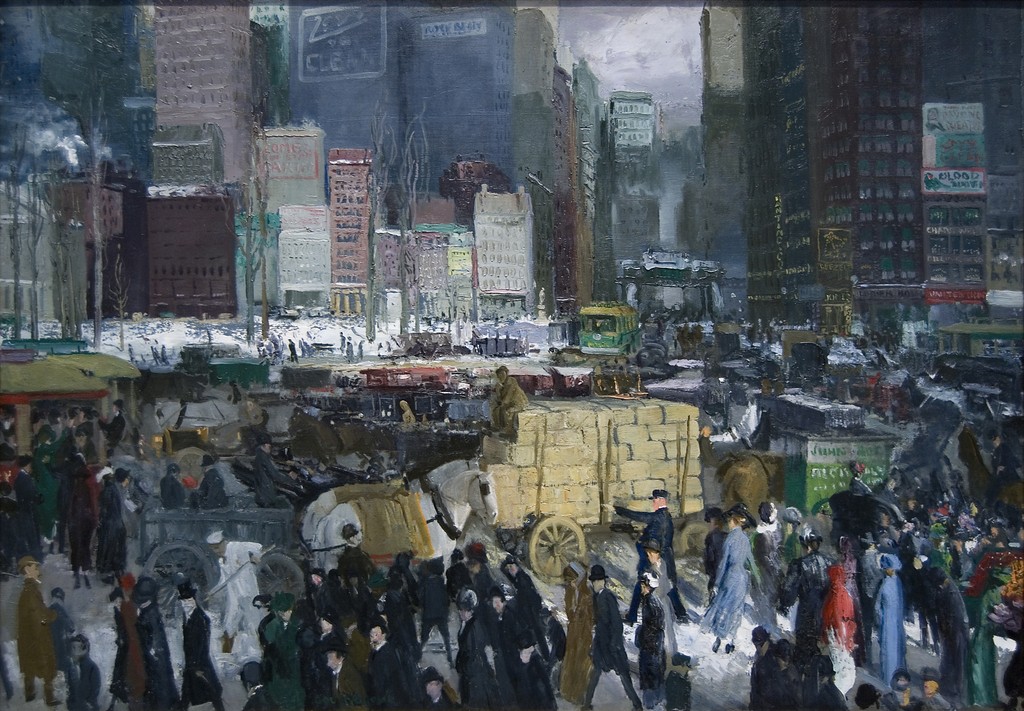
New York
1911 · Pedestrians, carts, streetcars and buildings crowd into an audacious composite image of the modern city.
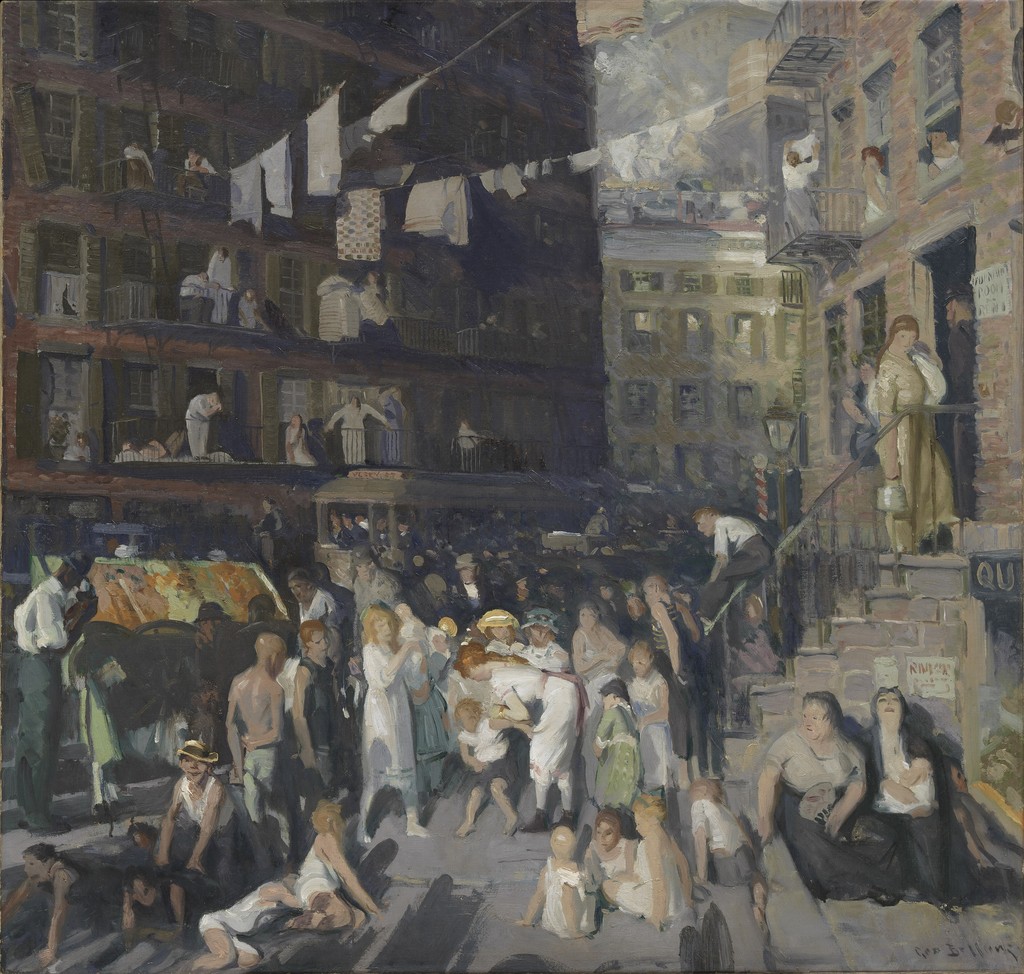
Cliff Dwellers
1913 · A Lower East Side street becomes a dense choreography of heat, traffic, work, play and social proximity.
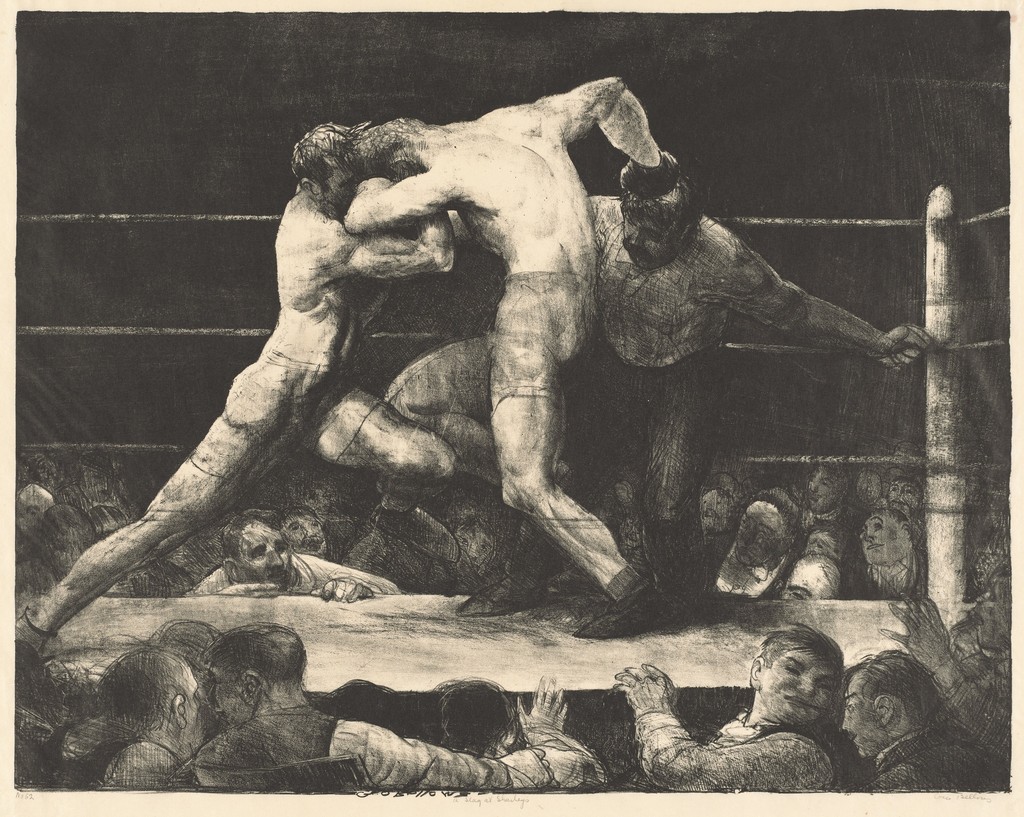
A Stag at Sharkey's
1917 · The famous boxing design is rebuilt in black and white for lithographic printing, not merely copied from the oil.
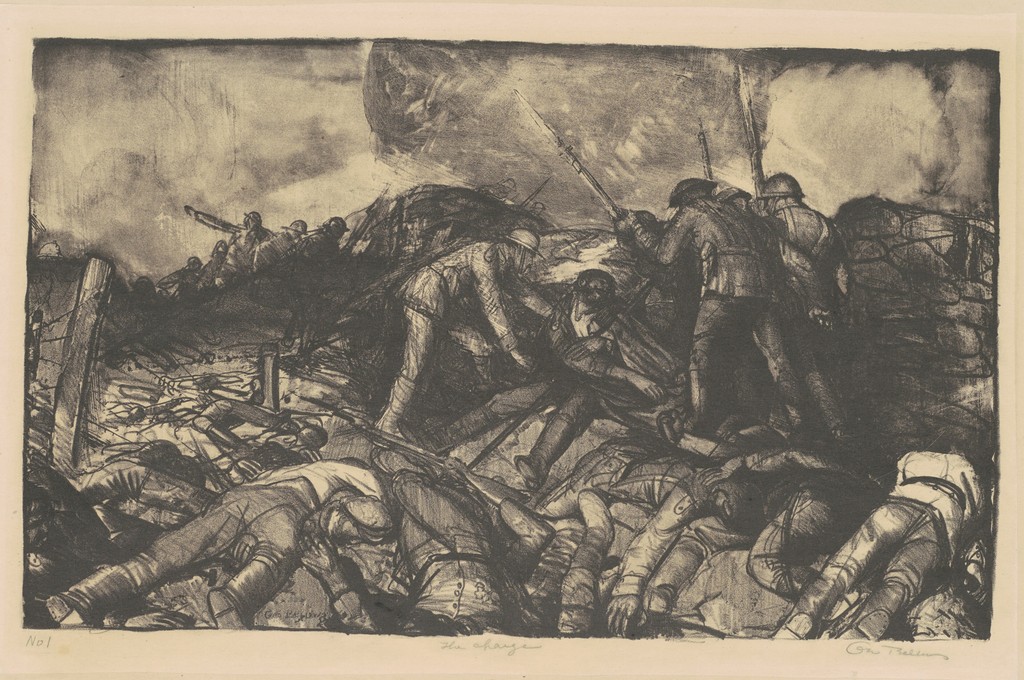
The Charge
1918 · A wartime print translates reported violence into compressed bodies and stark tonal drama while remaining non-eyewitness imagery.
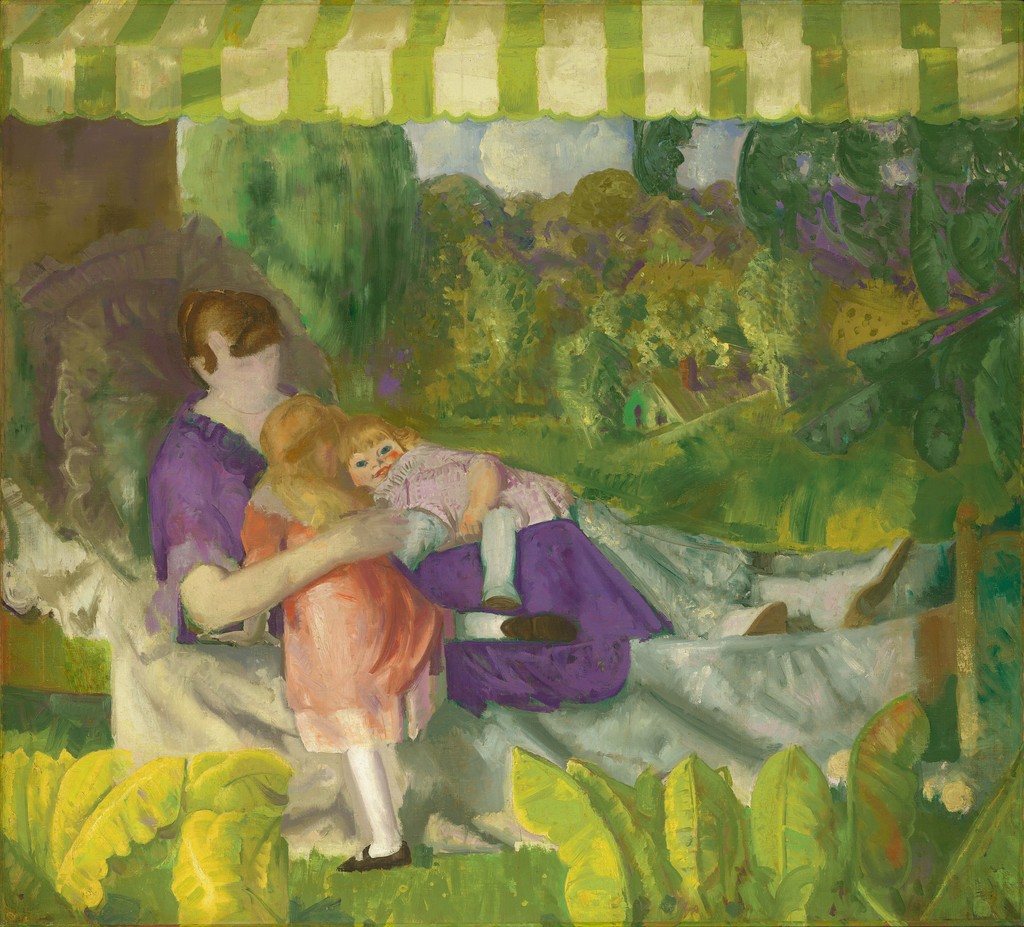
My Family
1916 · Emma and the Bellows daughters occupy an outdoor family portrait structured through colour, scale and the problem of figure in landscape.
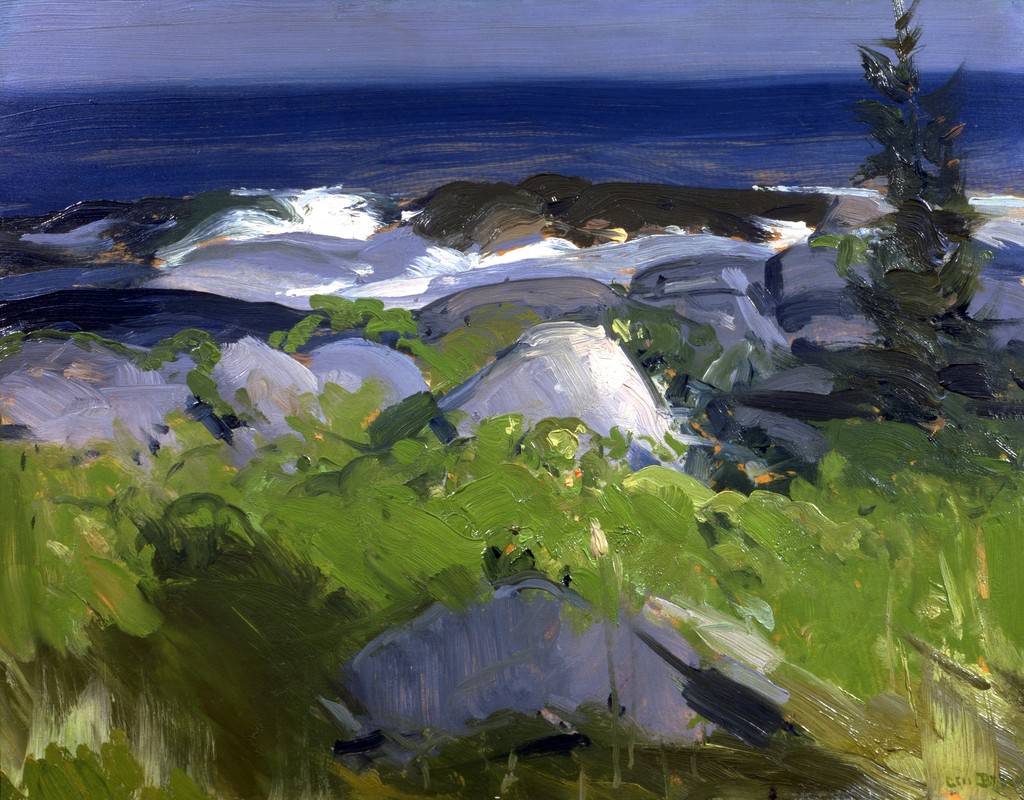
Vine Clad Shore–Monhegan Island
1913 · Bright vegetation, blue water and hard rock show how Bellows carried physical paint and structural rhythm to the Maine coast.
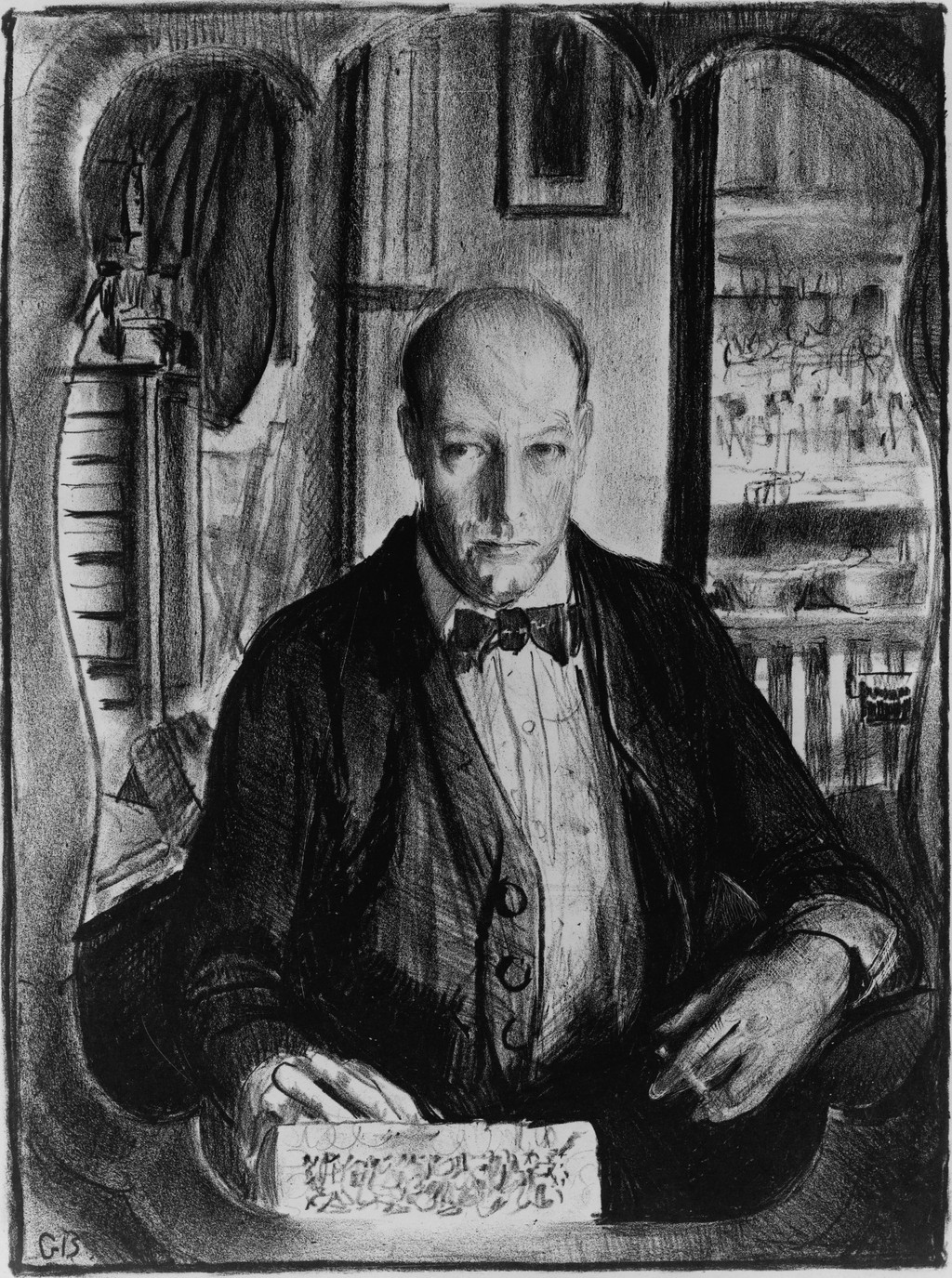
Self-Portrait
1921 · The artist presents himself through lithographic line, tonal pressure and an unsentimental frontal presence.
Researched works directory
This searchable evidence census was assembled from public museum records and a reproducible Wikidata snapshot. It is not a catalogue raisonné, not a claim to complete oeuvre coverage, and not a substitute for the published catalogue literature, which was not used to claim absolute completeness.
| Name | Date | Medium |
|---|---|---|
| A Cloudy Day / Hudson River: Coming Squall | 1908 | Painting |
| A Day in June | 1913 | Painting |
| A Fresh Breeze | 1913 | Painting |
| A Grandmother | 1914 | Painting |
| A Knockout | 1921 | |
| A Morning Snow--Hudson River | 1910 | Painting |
| A Stag at Sharkey's | 1917 | |
| A Winter Day - Under the Elevated near Brooklyn Bridge | 1907 | Painting |
| Allan Donn Puts to Sea | 1923 | |
| An Irish Girl | 1922 | Drawing |
| Anne | 1915 | Painting |
| Anne 1921 | 1923 | |
| Anne and Her Mother | 1917 | Drawing |
| Anne in Black Velvet | 1917 | Painting |
| Anne in White | 1920 | Painting |
| Anne with a Japanese Parasol | 1917 | Painting |
| Approach of Rain | 1913 | Painting |
| Approach to the Bridge at Night | 1913 | Painting |
| Arms of a Boxer | 1916 | Drawing |
| Artists' Evening | 1916 | |
| August Lundberg (No 2) | 1907 | Painting |
| Aunt Fanny | 1920 | Painting |
| Barnyard and Chickens | 1924 | Painting |
| Bethesda Fountain (Fountain in Central Park) | 1905 | Painting |
| Between Rounds, large, first stone | 1916 | |
| Between Rounds, small, second stone | 1923 | |
| Blue Morning | 1909 | Painting |
| Blue Snow, the Battery | 1910 | Painting |
| Both Members of This Club | 1909 | Painting |
| Boy in a Blue Coat | 1915 | Painting |
| Boy with Eton Collar (Portrait of Meredith Hare) | 1921 | Painting |
| Breaking Sky, Monhegan | 1916 | Painting |
| Bridge, Blackwell’s Island | 1909 | Painting |
| Builders of Ship | 1916 | Painting |
| California Headlands | 1917 | Painting |
| Caricature of Adam and Eve and Two Female Portrait Sketches | Date unknown | Drawing |
| Central Park | 1905 | Painting |
| Chester Dale | 1922 | Painting |
| Children Playing in a Park | 1905 | Drawing |
| Cleaning Fish | 1913 | Painting |
| Cliff Dwellers | 1913 | Painting |
| Cliffs | Date unknown | Painting |
| Club Night | 1907 | Painting |
| Coming Storm | 1914 | Painting |
| Coopers Lake, Woodstock | 1924 | Painting |
| Counted Out, first stone | 1921 | |
| Counted Out, second stone | 1921 | |
| Criehaven Wharf | 1916 | Painting |
| Cross-Eyed Boy | Date unknown | Painting |
| Dance in a Madhouse | 1917 | |
| Dancing Town (The Top of the World) | 1922 | Drawing |
| Dempsey and Firpo | 1923 | |
| Dempsey and Firpo | 1924 | Painting |
| Dempsey through the Ropes | 1923 | |
| Dempsey Through the Ropes | Date unknown | Painting |
| Deserted Factory | 1924 | Painting |
| Dock Builders | 1916 | Painting |
| Edge of the Pasture - Glow of the Sun | 1916 | Painting |
| Edith Cavell | 1918 | Painting |
| Elinor, Jean and Anna | 1920 | Painting |
| Elsie, Emma and Marjorie, First Stone | 1921 | |
| Elsie, Emma and Marjorie, second stone | 1921 | |
| Elsie Reading to Emma, First Stone | 1921 | |
| Elsie Reading to Emma, Second Stone | 1921 | |
| Elsie Speicher [verso] | 1920 | Drawing |
| Emma and Her Children | 1923 | Painting |
| Emma at the Piano | 1914 | Painting |
| Emma at the Window | 1920 | Painting |
| Emma, Elsie and Gene | 1921 | |
| Emma in a Purple Dress | 1920 | Painting |
| Emma in the Black Print | 1919 | Painting |
| Emma in the Purple Dress | 1919 | Painting |
| Evening Blue | 1916 | Painting |
| Evening Swell | 1911 | Painting |
| Excavation at Night | 1908 | Painting |
| Family in a Surrey | 1921 | Drawing |
| Fern Woods | Date unknown | Painting |
| Five Cows | 1919 | Painting |
| Floating Ice | 1910 | Painting |
| Florence Davey | 1914 | Painting |
| Fog Breakers | 1913 | Painting |
| Forty-two Kids | 1907 | Painting |
| Frankie, the Organ Boy | 1907 | Painting |
| Garaldine Lee, No. 2 | 1914 | Painting |
| Gardiner's Bay from Sag Harbor | 1899 | Painting |
| Ghost of Sergeant Pelly | 1918 | Drawing |
| Golf Course, California | 1917 | Painting |
| Gorge and Sea | 1911 | Painting |
| Grandma Bellows | 1919 | Painting |
| Gray Sea | 1913 | Painting |
| Harbor of Monhegan, Fish Boats | 1911 | Painting |
| Haystacks and Barn | 1909 | Painting |
| Head of Boy (aka Gray Boy) | 1905 | Painting |
| Hungry Dogs, second stone | 1916 | |
| Hunter and Mountains | 1920 | Painting |
| In a Rowboat | 1916 | Painting |
| In an Elevator | 1916 | |
| In the Park, Dark | 1916 | |
| Introducing Georges Carpentier | 1921 | |
| Introducing John L. Sullivan | 1916 | |
| Introducing John L. Sullivan | 1923 | Painting |
| Introducing the Champion | 1916 | |
| Introductions | 1921 | |
| Jackie (Jacqueline Hudson) | 1914 | Painting |
| Jean 1923 | 1923 | |
| Jean in a Black Hat | 1923 | |
| Jean with Blue Book and Apple | 1916 | Painting |
| Jim Twadell's Place | 1924 | Painting |
| Julie Hudson | 1914 | Painting |
| Katherine Rosen | 1921 | Painting |
| Kids | 1906 | Painting |
| Lady Jean | 1924 | Painting |
| Lady of 1860 - The Actress | 1922 | Drawing |
| Lady with a Fan | 1921 | |
| Launching | 1913 | Painting |
| Little Girl in White (Queenie Burnett) | 1907 | Painting |
| Love of Winter | 1914 | Painting |
| Lychnis and Her Sons | 1923 | |
| Madeline Davis | 1914 | Painting |
| Man and Dog | 1905 | Painting |
| Matinicus | 1916 | |
| Maud Dale | 1919 | Painting |
| May Day in Central Park | 1905 | Painting |
| Men of the Docks | 1912 | Painting |
| Mill Dam | 1924 | Painting |
| Miss Bentham | 1906 | Painting |
| Monhegan Island | 1913 | Painting |
| Mother and Children | 1916 | |
| Mother and Children, Second State | 1916 | |
| Mountain Farm | 1922 | Painting |
| Mr. and Mrs. Phillip Wase | 1924 | Painting |
| Mrs. Chester Dale | 1919 | Painting |
| Mrs. T. in Cream Silk, No.1 | 1919 | Painting |
| Mrs. T. in Cream Silk, No.2 | 1920 | Painting |
| Mrs. Walter H. Richter | 1922 | Painting |
| Murder of Edith Cavell | 1918 | |
| My Family | 1916 | Painting |
| My Mother | 1921 | Painting |
| New York | 1911 | Painting |
| North River | 1908 | Painting |
| Nude Girl, Miss Leslie Hall | 1909 | Painting |
| Nude Girl Reclining | 1919 | Drawing |
| Nude Study, Girl Standing on One Foot | 1923 | |
| Nude with Fan | 1920 | Painting |
| Nude with Hexagonal Quilt | 1924 | Painting |
| Nude with Parrot | 1915 | Painting |
| Nude with Red Hair | 1920 | Painting |
| Old Barn, Grey Day | 1920 | Painting |
| Old Fisherman | 1904 | Painting |
| Ox Team, Wharf at Matinicus | 1916 | Painting |
| Paddy Flannigan | 1908 | Painting |
| Padre | 1917 | Painting |
| Paradise Point | 1919 | Painting |
| Pennsylvania Station Excavation | c. 1907–1908 | Painting |
| Pigs and Donkey | 1920 | Painting |
| Polo at Lakewood | 1910 | Painting |
| Portrait of a Boy | 1921 | Painting |
| Portrait of a Laughing Boy | 1907 | Painting |
| Portrait of Florence Budd | 1914 | Painting |
| Portrait of Florence Pierce | 1914 | Painting |
| Portrait of Geraldine Lee, No. 1 | 1914 | Painting |
| Portrait of My Mother No. 1 | 1921 | Painting |
| Portrait of Prosper Invernizzi | 1907 | Painting |
| Portrait of Walter Littlefield | 1915 | Painting |
| Porträt der Anne | 1915 | Painting |
| Porträt der Laura | 1922 | Painting |
| Prayer Meeting, second stone | 1916 | |
| Preliminaries | 1916 | |
| Preliminaries | Date unknown | |
| Pueblo Tesuque, No. 2 | 1917 | Painting |
| Rain on the River | 1908 | Painting |
| Return of the Useless | 1918 | Painting |
| River Front No. 1 | 1914 | Painting |
| Rock Bound | 1913 | Painting |
| Rock Reef, Maine | 1913 | Painting |
| Rock Ridge Farm | Date unknown | Painting |
| Rocks and Coast | 1911 | Painting |
| Rolling Breakers | 1913 | Painting |
| Romance of Autumn | 1916 | Painting |
| Romance of Criehaven | 1916 | Painting |
| Roumanian Girl | 1921 | Painting |
| Samuel Knopf | 1922 | Painting |
| Santuario de Chimata | 1917 | Painting |
| Seated Female Nude (Emma Story Bellows) | Date unknown | Drawing |
| Seated Nude | 1910 | Painting |
| Self-Portrait | 1921 | |
| Shipyard Society | 1916 | Painting |
| Sixteen East Gay Street | 1923 | |
| Sketches of Heads, Including One of Chester Dale | Date unknown | Drawing |
| Sketches of Three Female Heads [recto] | Date unknown | Drawing |
| Snow-Capped River | 1911 | Painting |
| Snow Dumpers | 1911 | Painting |
| Society Ball [verso] | 1907 | Drawing |
| Splinter Beach | 1916 | |
| Stag at Sharkey's | 1909 | Painting |
| Steaming Streets | 1908 | Painting |
| Storm Sea | 1913 | Painting |
| Street Fight [recto] | 1907 | Drawing |
| Studies of Jean | 1920 | Drawing |
| Study for "Mr. and Mrs. Philip Wase | 1924 | Drawing |
| Study for Nude with Hexagonal Quilt | 1924 | Drawing |
| Study for "Riverfront No. 1 | 1915 | Drawing |
| Study of Emma and the Children | 1917 | Painting |
| Summer City | 1909 | Painting |
| Summer Fantasy | 1924 | Painting |
| Summer Night, Riverside Drive | 1909 | Painting |
| Sun Glow | 1913 | Painting |
| Sun Shadows (Rocks at Monhegan) | 1913 | Painting |
| Sunday 1897 | 1921 | |
| Sunlit surf | 1913 | Painting |
| Swans in Central Park | 1906 | Painting |
| Tennis | 1920 | |
| Tennis at Newport | 1919 | Painting |
| Tennis at Newport | 1920 | Painting |
| Tennis Tournament | 1920 | Painting |
| The Barricade | 1918 | Painting |
| The Beach, Newport (In the Sand) | 1919 | Painting |
| The Big Dory | 1913 | Painting |
| The Black Derby / Head of a man with a red nose | 1905 | Painting |
| The Brook | Date unknown | Painting |
| The Charge | 1918 | |
| The Cigarette | 1918 | |
| The Coming Storm | 1916 | Painting |
| The Dock | 1913 | Painting |
| The Donkey Cart | 1922 | Drawing |
| The Fish Wharf, Matinicus Island | 1916 | Painting |
| The Fisherman | 1917 | Painting |
| The Germans Arrive | 1918 | Painting |
| The Grove — Monhegan | 1911 | Painting |
| The Gulls, Monhegan | 1911 | Painting |
| The Harbor, Monhegan Coast, Maine | 1913 | Painting |
| The Kindliness Came Not from Her | 1922 | Drawing |
| The Launching | Date unknown | Painting |
| The Law Is Too Slow | 1923 | |
| The Lone Tenement | 1909 | Painting |
| The Newsboy | 1908 | Painting |
| The Novitiate | 1916 | |
| The Palisades | 1909 | Painting |
| The Red Vine, Matinicus Island, Maine | 1916 | Painting |
| The Sand Cart | 1917 | Painting |
| The Sea | 1911 | Painting |
| The Shower-Bath | 1917 | |
| The Studio | 1919 | Painting |
| The Teamster | 1916 | Painting |
| The Tournament | 1920 | |
| The Village Houses | 1920 | Painting |
| The Warships | 1909 | Painting |
| The White Hope | 1921 | |
| The White Horse | 1922 | Painting |
| The Widow | 1917 | Painting |
| Three Children | 1919 | Painting |
| Three Pigs and a Mountain | 1922 | Painting |
| Three Rollers | 1911 | Painting |
| Through the Trees, Monhegan Island, Maine | 1913 | Painting |
| Tumble of Waters | 1913 | Painting |
| Two Girls | 1917 | |
| Two Women | 1924 | Painting |
| Up the Gorge | 1913 | Painting |
| Up the Hudson | 1908 | Painting |
| Village on the Hill | 1916 | Painting |
| Vine Clad Shore--Monhegan Island | 1913 | Painting |
| Waldo Peirce | 1920 | Painting |
| War Series | 1918 | Painting |
| West Wind | 1913 | Painting |
| Willard in Training Quarters | 1916 | |
| Winter Afternoon, Riverside Park | 1909 | Painting |
| Winter Road | 1912 | Painting |
| Woodstock Road, Woodstock, New York | 1924 | Drawing |
Frequently Asked Questions
Bellows is especially famous for forceful New York and boxing scenes, including Stag at Sharkey’s. His reputation also rests on city crowds, portraits, lithographs and Maine seascapes, so the prizefight pictures are a powerful entrance rather than a summary.[1][6]
Yes, Bellows is widely associated with the Ashcan circle and studied with Robert Henri. However, he was not one of the artists who exhibited as The Eight in 1908. Calling him a leading younger associate preserves both the connection and the chronology.[2]
Stag at Sharkey’s is often treated as his signature painting. Other defining works include Both Members of This Club, New York, Cliff Dwellers and Pennsylvania Station Excavation, each of which reveals a different pressure within modern urban life.
Lithography offered Bellows a flexible black-and-white medium for portraits, satire, boxing, war and other subjects. From 1916 to his death, his work helped renew American interest in the process. A print derived from a familiar composition is still a separate object with its own stone, state and impression history.[2][10]
Major holdings are spread across the United States. In Washington, the National Gallery of Art and Smithsonian American Art Museum represent Bellows in several media; The Met has extensive holdings in New York. Cleveland, Brooklyn and LACMA hold three of the five paintings introduced above. Displays change, so consult each museum’s current object record before visiting.
Discussion
Use this evidence-led guide as a starting point for close looking rather than a final verdict.
Share an observation about George Bellows or a source that adds useful context.
Reader Insights
Which work most clearly complicates the familiar image of Bellows as a strictly literal realist?
Where do New York, exhibition culture, printmaking, family or place most productively alter your reading?
Which source or surviving object would you investigate next?
Join the Conversation
Add your reading below, keeping observations specific and evidence clear.
References
- National Gallery of Art, “George Bellows”, accessed 31 August 2026.
- Smithsonian American Art Museum, “George Bellows”, accessed 31 August 2026.
- The Metropolitan Museum of Art, “George Bellows” exhibition overview, accessed 31 August 2026.
- National Gallery of Art, “New York”, accessed 31 August 2026.
- Brooklyn Museum, “Pennsylvania Station Excavation”, accessed 31 August 2026.
- Cleveland Museum of Art, “Stag at Sharkey’s”, accessed 31 August 2026.
- National Gallery of Art, “Both Members of This Club”, accessed 31 August 2026.
- National Gallery of Art, Bellows: The Boxing Pictures, accessed 31 August 2026.
- Los Angeles County Museum of Art, “Cliff Dwellers”, accessed 31 August 2026.
- National Gallery of Art, “A Stag at Sharkey’s”, accessed 31 August 2026.
- The Metropolitan Museum of Art, “Sniped from War Series”, accessed 31 August 2026.
- National Gallery of Art, “My Family”, accessed 31 August 2026.
- Smithsonian American Art Museum, “Vine Clad Shore–Monhegan Island”, accessed 31 August 2026.