 by Tom Gurney
Tom Gurney BSc (Hons) is an art history expert with over 20 years experience
/
Email: tomgurney1@gmail.com / Phone: +44 7429 011000
Cliff Dwellers: Introduction
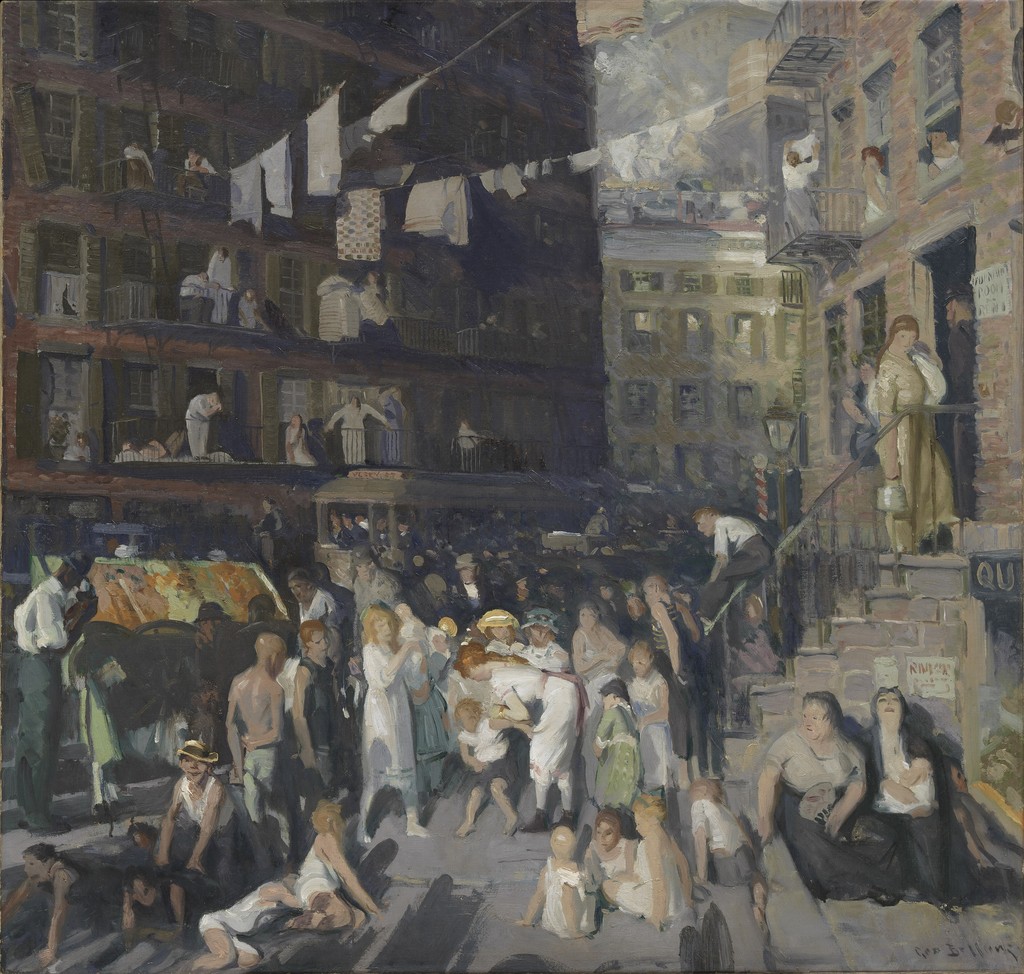
George Bellows’s Cliff Dwellers fills a Lower East Side street with children, adults, traffic, washing and summer light. Painted in 1913, it neither keeps the tenement neighbourhood at a safe distance nor compresses its residents into a single message. Crowded housing is unmistakable, but so are play, work, movement and sociability. The painting’s force comes from that tension: Bellows shows material pressure while making the street feel intensely alive.[1][6]
At a Glance
- ArtistGeorge Bellows (1882–1925)
- TitleCliff Dwellers — without a leading article
- Date1913; completed in May according to Bellows’s record book
- MediumOil on canvas
- CollectionLos Angeles County Museum of Art (LACMA)
- Accession16.4
George Bellows in context
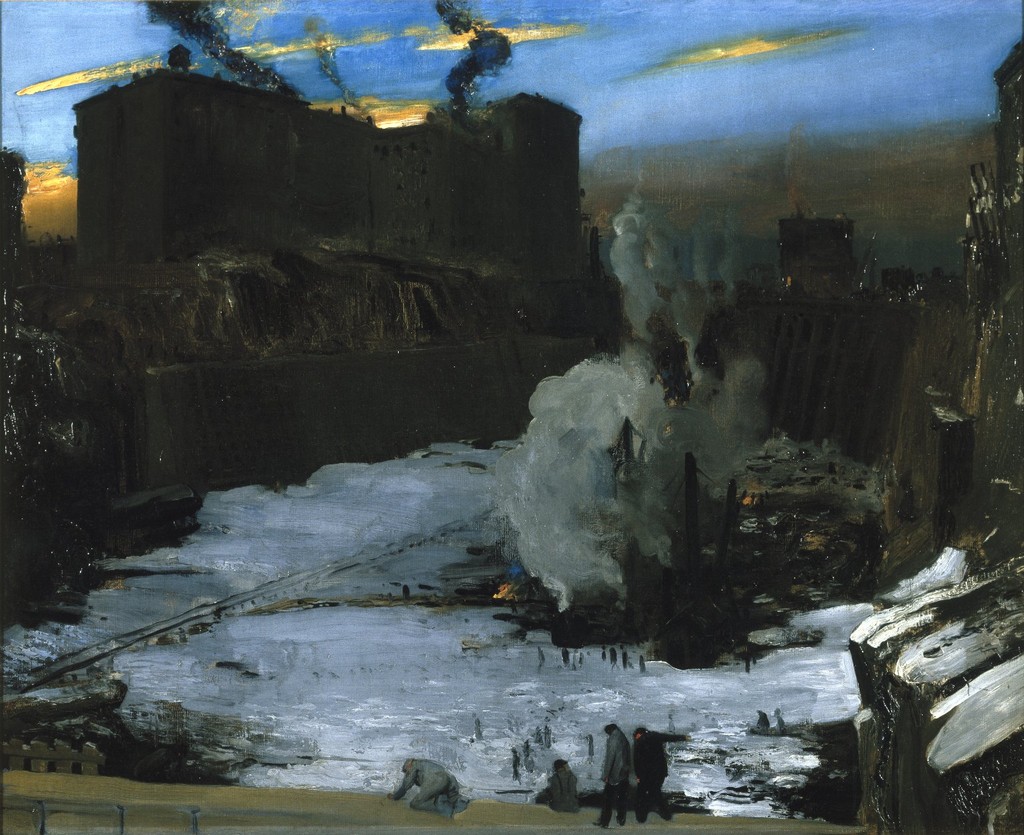
Pennsylvania Station Excavation
c. 1907–08New York
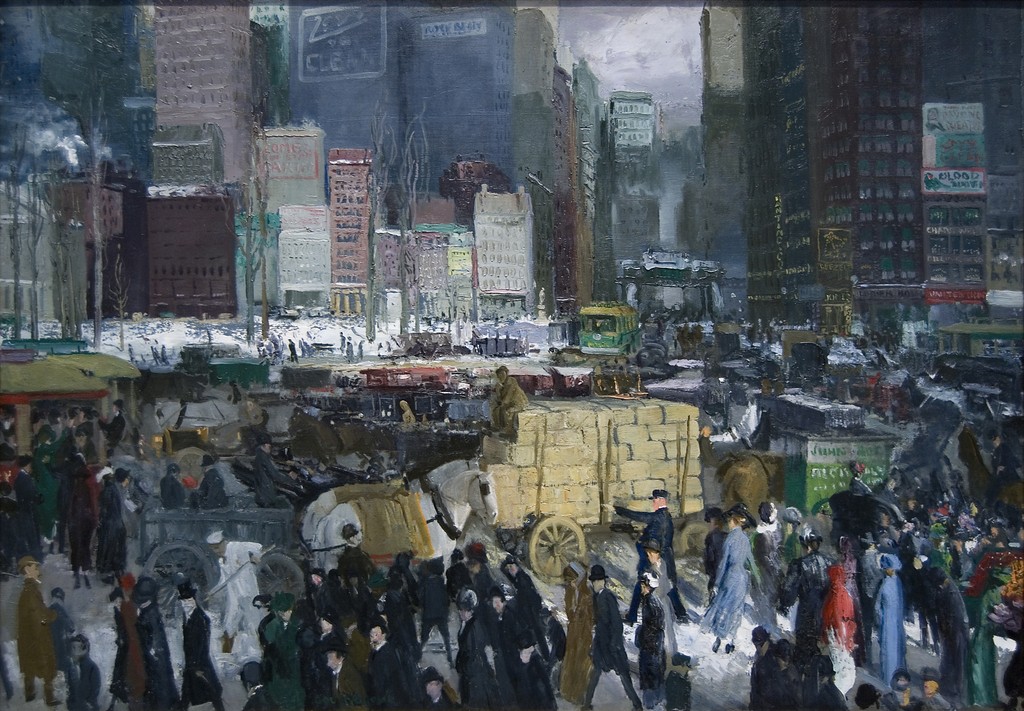
1911Cliff Dwellers
1913My Family
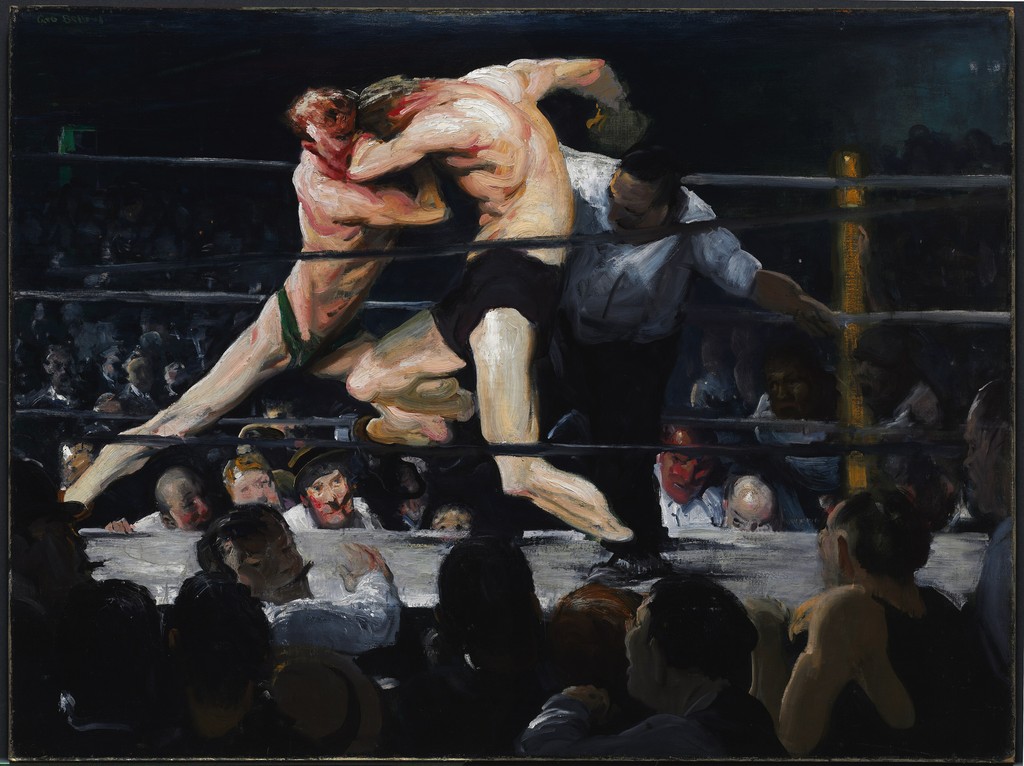
1916A Stag at Sharkey's
1917Dempsey and Firpo
1924Contents
- Introduction
- The Exact Painting and Its Title
- A Street Built from Many Speeds
- Heat, Air and the Tenement Walls
- Social Criticism or Urban Vitality?
- Three Colour Chords
- Pinhole Geometry and Its Limits
- The Armory Show Year and the 1916 Purchase
- How to Look at Cliff Dwellers
The Exact Painting and Its Title
LACMA records Cliff Dwellers as an oil on canvas measuring 40 3/16 by 42 1/16 inches (102.08 by 106.84 centimetres). It entered the collection through the Los Angeles County Fund and carries accession number 16.4.[1] These details identify the square-format painting, rather than any of the related drawings through which Bellows reconsidered parts of its design.
The absence of “The” is deliberate. Bellows’s record book indicates that he completed the canvas in May 1913 and crossed out the definite article in its written title, leaving Cliff Dwellers. LACMA’s current catalogue follows that evidence.[1] Some older captions and titles of related works on paper retain an article, but they do not override the painting’s present name. The Commons file record likewise identifies its digital reproduction as the 1913 LACMA painting, rather than one of those studies.[3]
The title is a metaphor as well as an identifier. The Met explains that the period phrase alluded to Indigenous cliff settlements in the American Southwest, then applied that image of layered dwelling to New York tenements.[6] It is not a description of the residents’ identity. In the canvas, stacked balconies, windows and fire escapes make the people above the pavement seem lodged in vertical strata, while the crowd below spreads across the street.
A Street Built from Many Speeds
The first impression is density, but the scene is not an undifferentiated mass. A market cart flares with orange and yellow at the left. Behind it, a streetcar pushes through the middle distance, its row of windows marking a slower horizontal movement. Figures lean from windows and gather along balconies; sheets and garments cross the upper half of the picture. At the right, a woman climbs the steps while seated adults and children occupy the pavement below.[1]
Bellows makes the lower centre especially active. Young women in pale clothes catch the sun, children tug, turn and collide, and darker figures pass behind them. No single incident governs the whole painting. Instead, small encounters overlap, much as traffic, trade, household labour and play would overlap in the street itself. The viewer must keep shifting attention between foreground bodies, the vehicle, the cart and the inhabited walls.
That restless structure belongs to Bellows’s larger engagement with New York City. He had moved from Columbus to New York in 1904 and studied with Robert Henri, whose teaching encouraged direct attention to ordinary urban life.[4][5] The Smithsonian notes Bellows’s particular ability to convey moving crowds.[5] Here, that ability is not simply a matter of rapid brushwork: it depends on distributing different actions across an unusually compressed field.
Heat, Air and the Tenement Walls
The buildings establish pressure before any social interpretation begins. A large block at the left lies in deep shadow, its facade broken into dark rectangles. The lighter building on the right rises close to the picture edge, while the street seems to narrow behind the streetcar. Bodies spill into the available open ground. The Met reads the residents at windows and in the street as seeking relief from overcrowded rooms in summer heat.[6]
Yet the atmosphere is not sealed. Sunlight strikes the foreground and the right-hand facade. A stiff breeze lifts washing above the street, introducing visible air into the canyon of masonry.[1] Bellows therefore makes enclosure and release coexist. The walls hem people in, but light, fabric and human motion keep the composition from becoming static.
The destination sign on the streetcar and the irregular meeting of streets led LACMA’s curator to suggest a Lower East Side area between the Bowery and Catherine Slip, below Chatham Square.[1] That is a reasoned location, not proof of one precisely observed corner. Like Bellows’s New York, the scene works as a concentrated urban construction even when individual signs make its geography plausible.
Social Criticism or Urban Vitality?
Cliff Dwellers has often been treated as a denunciation of tenement conditions. There is strong visual support for taking poverty and crowding seriously: neglected buildings dominate the scene, domestic activity has moved into public space, and adults and children compete with commerce and transport. The Met stresses the way residents appear constrained by brick walls and by circumstances they cannot readily escape.[6]
LACMA’s longer curatorial note complicates a purely condemnatory reading. It argues that much of the painting’s reputation for explicit social criticism derives from its relation to Bellows’s drawing Why Don’t They Go to the Country for a Vacation?, published as an August 1913 frontispiece in the socialist journal The Masses. Bellows’s record book calls that work a study for Cliff Dwellers, but the museum also observes that its transfer-and-reworking method resembles other illustrations made specifically for the magazine. The drawing may have prepared the painting and then acquired an editorial use, or it may have been conceived for publication from the outset; the available evidence does not settle the sequence.[1]
This matters because a satirical title attached to a magazine drawing does not automatically become the painting’s statement. Bellows held left-wing views and contributed illustrations to The Masses from 1912 to 1917.[4] Even so, LACMA distinguishes the direct address of editorial imagery from the tone of Ashcan painting. Its account finds bustling activity, pleasure and resilience here, especially in the bright group of women and children, the lively boys, the working mother on the steps and the produce cart.[1]
The two interpretations need not cancel one another. Vitality does not make overcrowding harmless, and social awareness does not require every figure to appear defeated. A stronger reading holds the visible constraints together with the residents’ agency. Bellows presents people making use of the street, not merely serving as evidence in an argument about it.
Three Colour Chords
The apparent spontaneity rests on a recorded colour plan. Bellows noted that the painting used three “chords,” a concept associated with the colour theorist and paint supplier Hardesty G. Maratta. Like harmonies in music, these triads were meant to establish relationships across a composition. LACMA identifies one combination of orange, red-purple and green-blue around the produce wagon and through the lower crowd; a second helps organise the blue-purple shadow, green shutters and brick at the left; a third contributes to the yellow-green light on the right-hand building.[1]
These are not three sealed zones. Related hues recur, and white alters their apparent temperature and brightness. Bellows also mixed colours wet into wet on the canvas, producing intermediate tones that soften the limits of the scheme.[1] The result explains why the market cart, pale clothing, shadowed facade and sunlit wall can each command attention without breaking the painting apart.
Colour also shapes the social encounter. Light gathers around the central children and women, while faces and bodies in the middle distance emerge more intermittently from dark paint. The eye moves because the palette gives it successive places to land. Bellows’s paintings often translate collective energy into contrasts of value and hue; here the method is both controlled and sensuous.
Pinhole Geometry and Its Limits
Close technical examination reveals a second kind of order. LACMA reports at least ninety tiny pinholes arranged in horizontal, vertical and diagonal rows. Some surviving red diagonal marks coincide with them, and the spacing can form equilateral triangles, a key element in compositional systems associated with Maratta. Certain alignments are striking: pinholes touch the head and elbows of the woman holding a fan at lower right, while a strong building edge follows another row.[1]
The evidence does not provide a complete diagram of Bellows’s intentions. Pins may have helped locate figures, establish proportional intervals or transfer elements from a related design. Numerous geometric patterns could be drawn through such a network, and LACMA explicitly calls for further study before identifying which forms Bellows actually used.[1] The responsible conclusion is modest: the marks prove careful construction, but not one fully decoded formula.
That caution changes how the surface looks. Broad strokes and crowded incidents can suggest a scene seized all at once. The pinholes and colour notes reveal extended planning beneath that impression. Bellows did not have to choose between immediacy and design; he engineered a structure capable of carrying apparent disorder.
The Armory Show Year and the 1916 Purchase
The year 1913 placed Bellows at the centre of changing American art. He helped organise the Armory Show, exhibited works there and became a full member of the National Academy of Design.[4] The Met dates the New York exhibition to February and March and discusses the expanded colour and technique of Bellows’s work that year.[6]
Whether the finished Cliff Dwellers itself hung in the New York Armory Show requires qualification. A short LACMA feature says that it was featured in the 1913 show.[2] The museum’s detailed object note, however, says Bellows’s record book places completion in May, after the New York dates given by The Met.[1][6] On those records, it is secure to connect the painting with Bellows’s Armory Show year and participation; an exact New York display claim remains difficult to reconcile without fuller exhibition documentation.
The later history is clearer. The painting won a $500 third prize at the Carnegie Institute’s 1914 annual exhibition, travelled to other venues and was shown in Los Angeles. LACMA records that the museum bought it directly from Bellows on 16 September 1916.[1] The institution describes it as among its earliest paintings, while its 2015 feature calls it the first artwork to enter the collection that became LACMA.[1][2] Its accession, 16.4, still carries that early place in the museum’s history.
How to Look at Cliff Dwellers
Begin at the bright produce cart, then follow the streetcar into the narrowing middle distance. Let the diagonal steps pull you back towards the woman climbing at the right. Only then look upward, where washing, balconies and figures extend the crowd into the architecture.
Next compare the central pool of light with the shadowed building. The painting does not assign virtue to one side and hardship to the other; both belong to the same street. Finally, return to the children. Their physical intensity gives the work much of its vitality, but the walls, traffic and adult labour around them prevent play from becoming an escape from social circumstance. That double attention—to pleasure and pressure—is the most useful way into Bellows’s picture.
Researched works directory
This searchable evidence census was assembled from public museum records and a reproducible Wikidata snapshot. It is not a catalogue raisonné, not a claim to complete oeuvre coverage, and not a substitute for the published catalogue literature, which was not used to claim absolute completeness.
| Name | Date | Medium |
|---|---|---|
| A Cloudy Day / Hudson River: Coming Squall | 1908 | Painting |
| A Day in June | 1913 | Painting |
| A Fresh Breeze | 1913 | Painting |
| A Grandmother | 1914 | Painting |
| A Knockout | 1921 | |
| A Morning Snow--Hudson River | 1910 | Painting |
| A Stag at Sharkey's | 1917 | |
| A Winter Day - Under the Elevated near Brooklyn Bridge | 1907 | Painting |
| Allan Donn Puts to Sea | 1923 | |
| An Irish Girl | 1922 | Drawing |
| Anne | 1915 | Painting |
| Anne 1921 | 1923 | |
| Anne and Her Mother | 1917 | Drawing |
| Anne in Black Velvet | 1917 | Painting |
| Anne in White | 1920 | Painting |
| Anne with a Japanese Parasol | 1917 | Painting |
| Approach of Rain | 1913 | Painting |
| Approach to the Bridge at Night | 1913 | Painting |
| Arms of a Boxer | 1916 | Drawing |
| Artists' Evening | 1916 | |
| August Lundberg (No 2) | 1907 | Painting |
| Aunt Fanny | 1920 | Painting |
| Barnyard and Chickens | 1924 | Painting |
| Bethesda Fountain (Fountain in Central Park) | 1905 | Painting |
| Between Rounds, large, first stone | 1916 | |
| Between Rounds, small, second stone | 1923 | |
| Blue Morning | 1909 | Painting |
| Blue Snow, the Battery | 1910 | Painting |
| Both Members of This Club | 1909 | Painting |
| Boy in a Blue Coat | 1915 | Painting |
| Boy with Eton Collar (Portrait of Meredith Hare) | 1921 | Painting |
| Breaking Sky, Monhegan | 1916 | Painting |
| Bridge, Blackwell’s Island | 1909 | Painting |
| Builders of Ship | 1916 | Painting |
| California Headlands | 1917 | Painting |
| Caricature of Adam and Eve and Two Female Portrait Sketches | Date unknown | Drawing |
| Central Park | 1905 | Painting |
| Chester Dale | 1922 | Painting |
| Children Playing in a Park | 1905 | Drawing |
| Cleaning Fish | 1913 | Painting |
| Cliff Dwellers | 1913 | Painting |
| Cliffs | Date unknown | Painting |
| Club Night | 1907 | Painting |
| Coming Storm | 1914 | Painting |
| Coopers Lake, Woodstock | 1924 | Painting |
| Counted Out, first stone | 1921 | |
| Counted Out, second stone | 1921 | |
| Criehaven Wharf | 1916 | Painting |
| Cross-Eyed Boy | Date unknown | Painting |
| Dance in a Madhouse | 1917 | |
| Dancing Town (The Top of the World) | 1922 | Drawing |
| Dempsey and Firpo | 1923 | |
| Dempsey and Firpo | 1924 | Painting |
| Dempsey through the Ropes | 1923 | |
| Dempsey Through the Ropes | Date unknown | Painting |
| Deserted Factory | 1924 | Painting |
| Dock Builders | 1916 | Painting |
| Edge of the Pasture - Glow of the Sun | 1916 | Painting |
| Edith Cavell | 1918 | Painting |
| Elinor, Jean and Anna | 1920 | Painting |
| Elsie, Emma and Marjorie, First Stone | 1921 | |
| Elsie, Emma and Marjorie, second stone | 1921 | |
| Elsie Reading to Emma, First Stone | 1921 | |
| Elsie Reading to Emma, Second Stone | 1921 | |
| Elsie Speicher [verso] | 1920 | Drawing |
| Emma and Her Children | 1923 | Painting |
| Emma at the Piano | 1914 | Painting |
| Emma at the Window | 1920 | Painting |
| Emma, Elsie and Gene | 1921 | |
| Emma in a Purple Dress | 1920 | Painting |
| Emma in the Black Print | 1919 | Painting |
| Emma in the Purple Dress | 1919 | Painting |
| Evening Blue | 1916 | Painting |
| Evening Swell | 1911 | Painting |
| Excavation at Night | 1908 | Painting |
| Family in a Surrey | 1921 | Drawing |
| Fern Woods | Date unknown | Painting |
| Five Cows | 1919 | Painting |
| Floating Ice | 1910 | Painting |
| Florence Davey | 1914 | Painting |
| Fog Breakers | 1913 | Painting |
| Forty-two Kids | 1907 | Painting |
| Frankie, the Organ Boy | 1907 | Painting |
| Garaldine Lee, No. 2 | 1914 | Painting |
| Gardiner's Bay from Sag Harbor | 1899 | Painting |
| Ghost of Sergeant Pelly | 1918 | Drawing |
| Golf Course, California | 1917 | Painting |
| Gorge and Sea | 1911 | Painting |
| Grandma Bellows | 1919 | Painting |
| Gray Sea | 1913 | Painting |
| Harbor of Monhegan, Fish Boats | 1911 | Painting |
| Haystacks and Barn | 1909 | Painting |
| Head of Boy (aka Gray Boy) | 1905 | Painting |
| Hungry Dogs, second stone | 1916 | |
| Hunter and Mountains | 1920 | Painting |
| In a Rowboat | 1916 | Painting |
| In an Elevator | 1916 | |
| In the Park, Dark | 1916 | |
| Introducing Georges Carpentier | 1921 | |
| Introducing John L. Sullivan | 1916 | |
| Introducing John L. Sullivan | 1923 | Painting |
| Introducing the Champion | 1916 | |
| Introductions | 1921 | |
| Jackie (Jacqueline Hudson) | 1914 | Painting |
| Jean 1923 | 1923 | |
| Jean in a Black Hat | 1923 | |
| Jean with Blue Book and Apple | 1916 | Painting |
| Jim Twadell's Place | 1924 | Painting |
| Julie Hudson | 1914 | Painting |
| Katherine Rosen | 1921 | Painting |
| Kids | 1906 | Painting |
| Lady Jean | 1924 | Painting |
| Lady of 1860 - The Actress | 1922 | Drawing |
| Lady with a Fan | 1921 | |
| Launching | 1913 | Painting |
| Little Girl in White (Queenie Burnett) | 1907 | Painting |
| Love of Winter | 1914 | Painting |
| Lychnis and Her Sons | 1923 | |
| Madeline Davis | 1914 | Painting |
| Man and Dog | 1905 | Painting |
| Matinicus | 1916 | |
| Maud Dale | 1919 | Painting |
| May Day in Central Park | 1905 | Painting |
| Men of the Docks | 1912 | Painting |
| Mill Dam | 1924 | Painting |
| Miss Bentham | 1906 | Painting |
| Monhegan Island | 1913 | Painting |
| Mother and Children | 1916 | |
| Mother and Children, Second State | 1916 | |
| Mountain Farm | 1922 | Painting |
| Mr. and Mrs. Phillip Wase | 1924 | Painting |
| Mrs. Chester Dale | 1919 | Painting |
| Mrs. T. in Cream Silk, No.1 | 1919 | Painting |
| Mrs. T. in Cream Silk, No.2 | 1920 | Painting |
| Mrs. Walter H. Richter | 1922 | Painting |
| Murder of Edith Cavell | 1918 | |
| My Family | 1916 | Painting |
| My Mother | 1921 | Painting |
| New York | 1911 | Painting |
| North River | 1908 | Painting |
| Nude Girl, Miss Leslie Hall | 1909 | Painting |
| Nude Girl Reclining | 1919 | Drawing |
| Nude Study, Girl Standing on One Foot | 1923 | |
| Nude with Fan | 1920 | Painting |
| Nude with Hexagonal Quilt | 1924 | Painting |
| Nude with Parrot | 1915 | Painting |
| Nude with Red Hair | 1920 | Painting |
| Old Barn, Grey Day | 1920 | Painting |
| Old Fisherman | 1904 | Painting |
| Ox Team, Wharf at Matinicus | 1916 | Painting |
| Paddy Flannigan | 1908 | Painting |
| Padre | 1917 | Painting |
| Paradise Point | 1919 | Painting |
| Pennsylvania Station Excavation | c. 1907–1908 | Painting |
| Pigs and Donkey | 1920 | Painting |
| Polo at Lakewood | 1910 | Painting |
| Portrait of a Boy | 1921 | Painting |
| Portrait of a Laughing Boy | 1907 | Painting |
| Portrait of Florence Budd | 1914 | Painting |
| Portrait of Florence Pierce | 1914 | Painting |
| Portrait of Geraldine Lee, No. 1 | 1914 | Painting |
| Portrait of My Mother No. 1 | 1921 | Painting |
| Portrait of Prosper Invernizzi | 1907 | Painting |
| Portrait of Walter Littlefield | 1915 | Painting |
| Porträt der Anne | 1915 | Painting |
| Porträt der Laura | 1922 | Painting |
| Prayer Meeting, second stone | 1916 | |
| Preliminaries | 1916 | |
| Preliminaries | Date unknown | |
| Pueblo Tesuque, No. 2 | 1917 | Painting |
| Rain on the River | 1908 | Painting |
| Return of the Useless | 1918 | Painting |
| River Front No. 1 | 1914 | Painting |
| Rock Bound | 1913 | Painting |
| Rock Reef, Maine | 1913 | Painting |
| Rock Ridge Farm | Date unknown | Painting |
| Rocks and Coast | 1911 | Painting |
| Rolling Breakers | 1913 | Painting |
| Romance of Autumn | 1916 | Painting |
| Romance of Criehaven | 1916 | Painting |
| Roumanian Girl | 1921 | Painting |
| Samuel Knopf | 1922 | Painting |
| Santuario de Chimata | 1917 | Painting |
| Seated Female Nude (Emma Story Bellows) | Date unknown | Drawing |
| Seated Nude | 1910 | Painting |
| Self-Portrait | 1921 | |
| Shipyard Society | 1916 | Painting |
| Sixteen East Gay Street | 1923 | |
| Sketches of Heads, Including One of Chester Dale | Date unknown | Drawing |
| Sketches of Three Female Heads [recto] | Date unknown | Drawing |
| Snow-Capped River | 1911 | Painting |
| Snow Dumpers | 1911 | Painting |
| Society Ball [verso] | 1907 | Drawing |
| Splinter Beach | 1916 | |
| Stag at Sharkey's | 1909 | Painting |
| Steaming Streets | 1908 | Painting |
| Storm Sea | 1913 | Painting |
| Street Fight [recto] | 1907 | Drawing |
| Studies of Jean | 1920 | Drawing |
| Study for "Mr. and Mrs. Philip Wase | 1924 | Drawing |
| Study for Nude with Hexagonal Quilt | 1924 | Drawing |
| Study for "Riverfront No. 1 | 1915 | Drawing |
| Study of Emma and the Children | 1917 | Painting |
| Summer City | 1909 | Painting |
| Summer Fantasy | 1924 | Painting |
| Summer Night, Riverside Drive | 1909 | Painting |
| Sun Glow | 1913 | Painting |
| Sun Shadows (Rocks at Monhegan) | 1913 | Painting |
| Sunday 1897 | 1921 | |
| Sunlit surf | 1913 | Painting |
| Swans in Central Park | 1906 | Painting |
| Tennis | 1920 | |
| Tennis at Newport | 1919 | Painting |
| Tennis at Newport | 1920 | Painting |
| Tennis Tournament | 1920 | Painting |
| The Barricade | 1918 | Painting |
| The Beach, Newport (In the Sand) | 1919 | Painting |
| The Big Dory | 1913 | Painting |
| The Black Derby / Head of a man with a red nose | 1905 | Painting |
| The Brook | Date unknown | Painting |
| The Charge | 1918 | |
| The Cigarette | 1918 | |
| The Coming Storm | 1916 | Painting |
| The Dock | 1913 | Painting |
| The Donkey Cart | 1922 | Drawing |
| The Fish Wharf, Matinicus Island | 1916 | Painting |
| The Fisherman | 1917 | Painting |
| The Germans Arrive | 1918 | Painting |
| The Grove — Monhegan | 1911 | Painting |
| The Gulls, Monhegan | 1911 | Painting |
| The Harbor, Monhegan Coast, Maine | 1913 | Painting |
| The Kindliness Came Not from Her | 1922 | Drawing |
| The Launching | Date unknown | Painting |
| The Law Is Too Slow | 1923 | |
| The Lone Tenement | 1909 | Painting |
| The Newsboy | 1908 | Painting |
| The Novitiate | 1916 | |
| The Palisades | 1909 | Painting |
| The Red Vine, Matinicus Island, Maine | 1916 | Painting |
| The Sand Cart | 1917 | Painting |
| The Sea | 1911 | Painting |
| The Shower-Bath | 1917 | |
| The Studio | 1919 | Painting |
| The Teamster | 1916 | Painting |
| The Tournament | 1920 | |
| The Village Houses | 1920 | Painting |
| The Warships | 1909 | Painting |
| The White Hope | 1921 | |
| The White Horse | 1922 | Painting |
| The Widow | 1917 | Painting |
| Three Children | 1919 | Painting |
| Three Pigs and a Mountain | 1922 | Painting |
| Three Rollers | 1911 | Painting |
| Through the Trees, Monhegan Island, Maine | 1913 | Painting |
| Tumble of Waters | 1913 | Painting |
| Two Girls | 1917 | |
| Two Women | 1924 | Painting |
| Up the Gorge | 1913 | Painting |
| Up the Hudson | 1908 | Painting |
| Village on the Hill | 1916 | Painting |
| Vine Clad Shore--Monhegan Island | 1913 | Painting |
| Waldo Peirce | 1920 | Painting |
| War Series | 1918 | Painting |
| West Wind | 1913 | Painting |
| Willard in Training Quarters | 1916 | |
| Winter Afternoon, Riverside Park | 1909 | Painting |
| Winter Road | 1912 | Painting |
| Woodstock Road, Woodstock, New York | 1924 | Drawing |
Frequently Asked Questions
The painting belongs to the Los Angeles County Museum of Art, where it is accession 16.4. LACMA dates it to 1913, and Bellows’s record book says it was completed in May of that year.[1]
Bellows crossed out the definite article in his record book, so LACMA’s current title is Cliff Dwellers. The title uses a period metaphor for people living in stacked tenements; it does not identify the Manhattan residents as the Indigenous peoples to whom the phrase originally referred.[1][6]
It represents the Lower East Side. From the street angles and the streetcar’s destination sign, LACMA suggests an area between the Bowery and Catherine Slip, south of Chatham Square. That is an informed identification rather than a documented street-corner address.[1]
LACMA’s 2015 collection feature says it was, but the museum’s detailed record places completion in May, whereas The Met dates the New York Armory Show to February–March. Bellows certainly helped organise and exhibited at the show; the finished painting’s precise exhibition history needs that chronological caveat.[1][2][4][6]
It supports a social reading through its crowded tenements, shared street and visible labour, but LACMA also emphasises the residents’ energy and pleasure. Bellows organised the surface with three Maratta colour chords, wet-into-wet mixing and a network of pinholes. The pinholes show geometric planning, although their complete purpose has not been proved.[1][6]
Discussion
Use this evidence-led guide as a starting point for close looking rather than a final verdict.
Share an observation about Cliff Dwellers or a source that adds useful context.
Reader Insights
Which detail most changes your reading of Cliff Dwellers?
How do scale, support, medium or present museum evidence shape the encounter?
What remains uncertain when visual inference is separated from documented fact?
Join the Conversation
Add your reading below, keeping observations specific and evidence clear.
References
- Los Angeles County Museum of Art, “Cliff Dwellers”, accessed 31 August 2026.
- Linda Theung, “From the Collection: Cliff Dwellers”, LACMA, 20 January 2015, accessed 31 August 2026.
- Wikimedia Commons, “George Bellows — Cliff Dwellers (1913)” file record.jpg), accessed 31 August 2026.
- National Gallery of Art, “George Bellows”, accessed 31 August 2026.
- Smithsonian American Art Museum, “George Bellows”, accessed 31 August 2026.
- The Metropolitan Museum of Art, “George Bellows” exhibition overview, accessed 31 August 2026.