 by Tom Gurney
Tom Gurney BSc (Hons) is an art history expert with over 20 years experience
/
Email: tomgurney1@gmail.com / Phone: +44 7429 011000
New York: Introduction
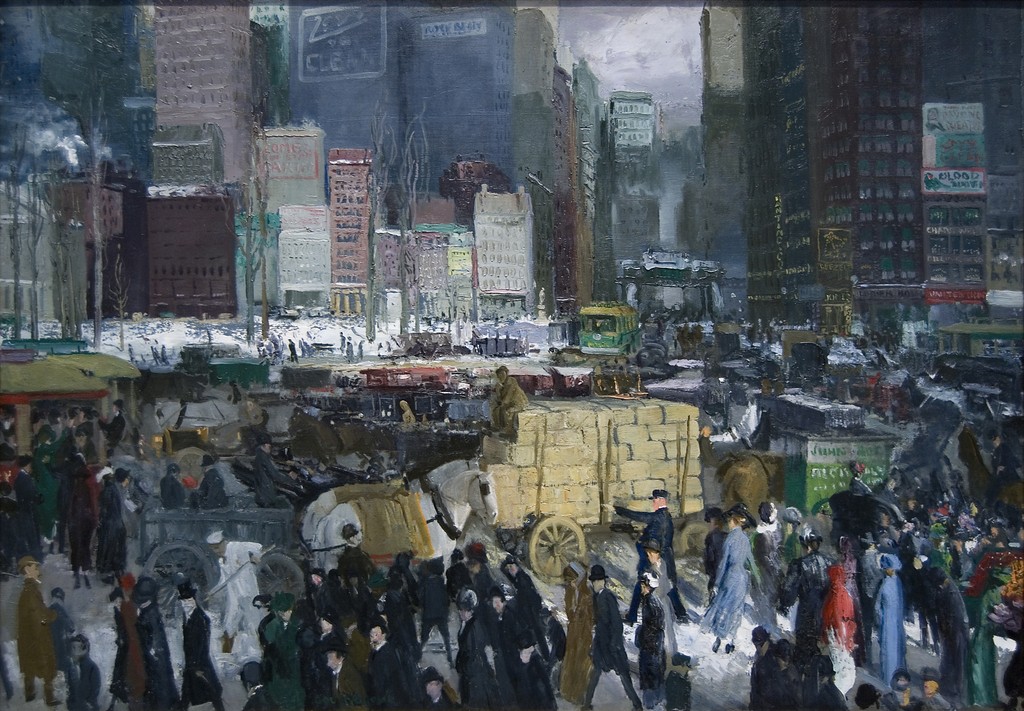
George Bellows made New York feel like a city too active to fit within one canvas. Pedestrians, streetcars, carts, signs and buildings compete for attention beneath a narrow winter sky. The apparent confusion is deliberate. Completed in 1911, the painting compresses several commercial districts into an imagined urban scene rather than recording one street corner exactly.[1][2]
At a Glance
- ArtistGeorge Bellows (1882–1925)
- Date1911; completed in February
- MediumOil on canvas
- CollectionNational Gallery of Art, Washington, DC
- Accession1986.72.1
- Dimensions106.7 × 152.4 cm (42 × 60 in.)
George Bellows in context
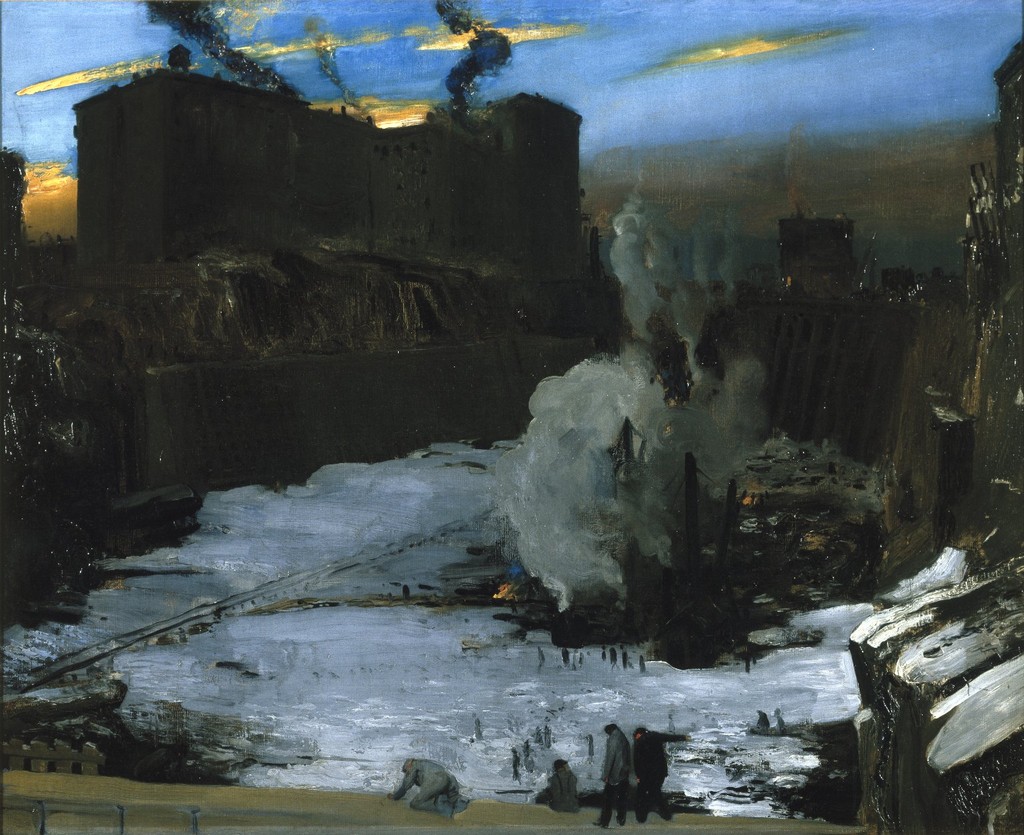
Pennsylvania Station Excavation
c. 1907–08New York
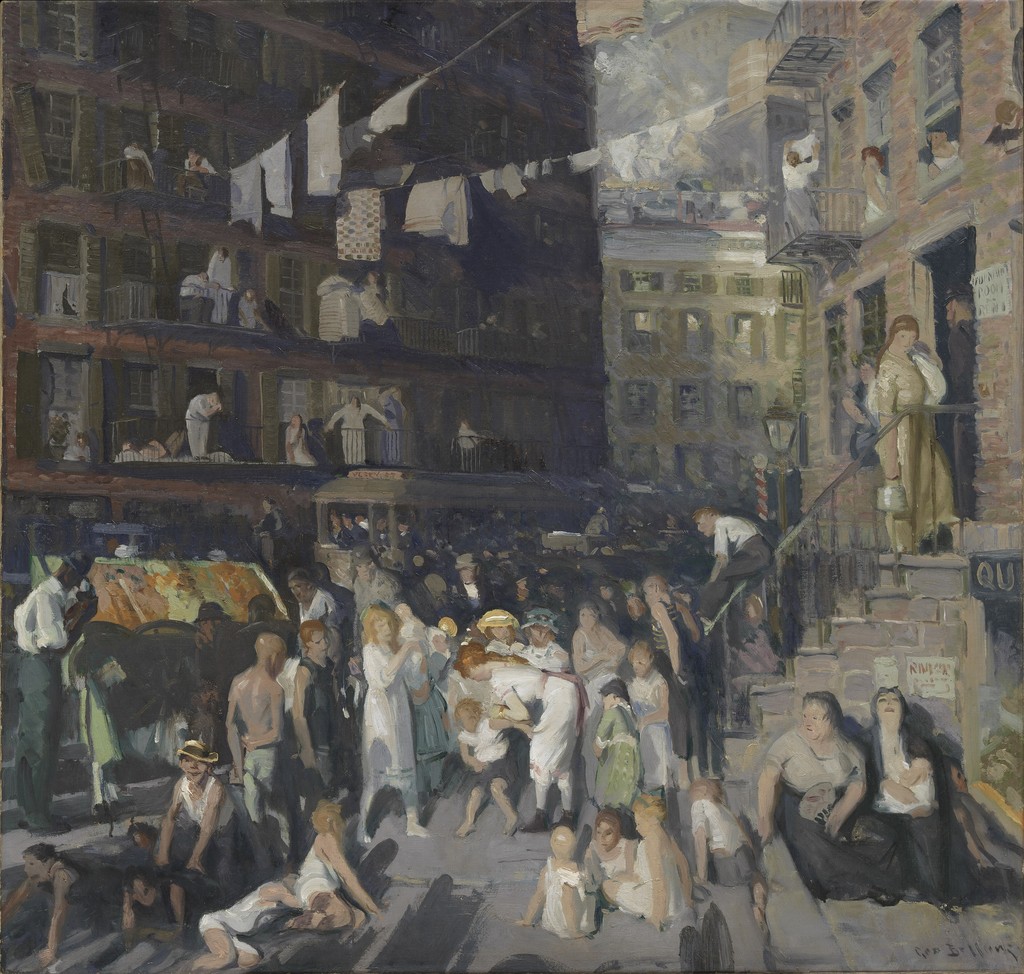
1911Cliff Dwellers
1913My Family
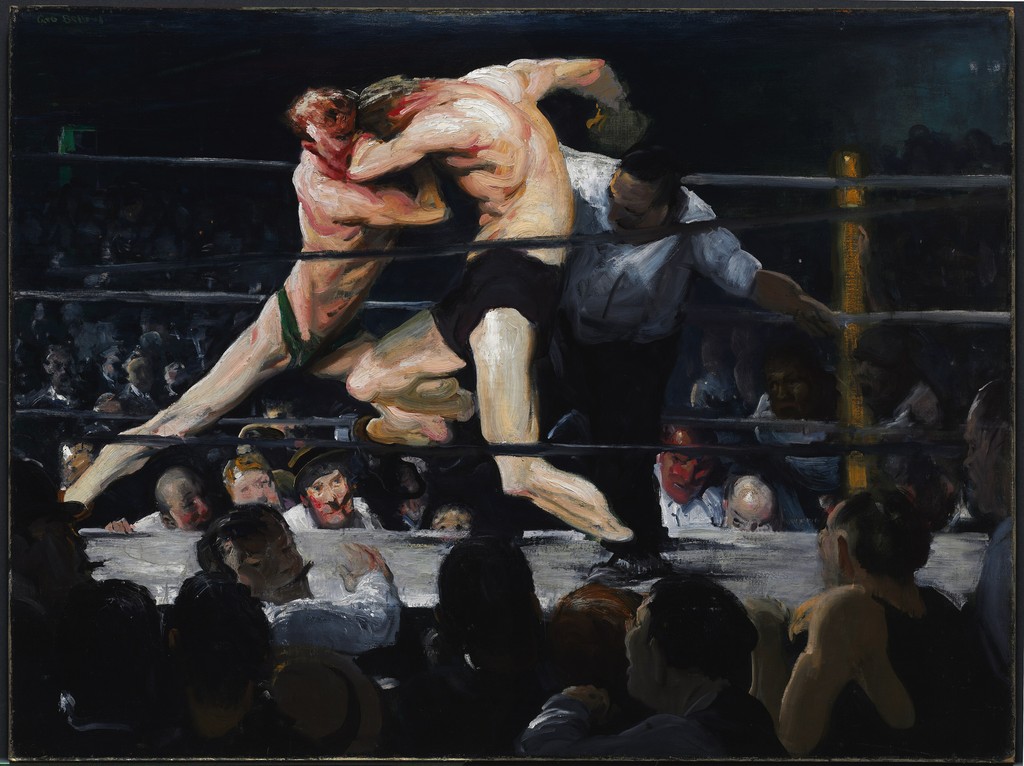
1916A Stag at Sharkey's
1917Dempsey and Firpo
1924Contents
- Introduction
- The Exact Painting
- A City Assembled Rather Than Copied
- A View with Almost No Escape
- Pedestrians, Streetcars and Carts
- Winter Light and Colour Signals
- Loose Paint, Careful Revision
- Reception: Confusion and Vitality
- Modernity Without a Simple Celebration
- How to Look at New York
The Exact Painting
The National Gallery of Art identifies New York as an oil on canvas measuring five feet across. Bellows signed it “Geo Bellows” near the lower-left corner. The work descended to his wife, Emma, and later belonged to Paul Mellon, whose 1986 gift brought it to the Gallery; its accession number is 1986.72.1.[1]
These details matter because the title is unusually broad. New York names this particular 1911 painting, not every city subject Bellows produced. The wider story of riverbanks, demolition, parks, tenements and transport belongs to his New York City pictures. Here the focus is one large canvas and the way it turns metropolitan congestion into a pictorial problem.
A City Assembled Rather Than Copied
The viewpoint is associated with Broadway and Twenty-third Street, looking uptown towards Madison Square. Yet the National Gallery’s scholarship is explicit that Bellows did not intend a topographically exact place. He drew upon several busy commercial districts and combined their features into an imaginary composite.[1][2]
That distinction changes how the work should be read. It is tempting to match every rail, façade and vehicle to a map, but the painting’s density exceeds what a single view could contain. Bellows created an urban type from particular observations. The scene proposes what entering New York’s commercial circulation might feel like: multiple directions, competing speeds and constant interruption.
This method does not make the picture detached from experience. The mix of nineteenth-century buildings and newer skyscrapers, horse-drawn freight and mechanised transport belongs to a city in transition. Bellows uses invention to bring those overlapping stages together. His realism rests in the pressure of the whole, not in literal agreement between every painted element and one set of coordinates.[2]
A View with Almost No Escape
The spectator looks slightly down into a crowded foreground. This raised position should promise clarity, but Bellows turns it into another form of entanglement. Pedestrians spread across the lower edge and mingle with wagons, carriages and streetcars. Traffic enters and leaves at several angles, preventing the eye from settling into a single route.[1][2]
Across the upper half, a wall of masonry blocks the distance. Low and mid-rise structures stand before towers that climb beyond the frame. Advertisements interrupt their surfaces, chimneys release smoke, and an elevated train appears deep in the scene. Only a modest wedge of grey sky opens between the buildings. Even the horizon seems occupied.[1]
The compressed perspective is crucial. Near and far do not unfold calmly; they stack on top of one another. A small snow-covered park with bare trees supplies the only conspicuous patch of nature, yet it does not offer release. It is enclosed by circulation and architecture. Bellows makes urban space feel finite at precisely the moment when the city appears to be growing upward and outward.[2]
Pedestrians, Streetcars and Carts
No person becomes the painting’s hero. Dark-coated figures gather into moving clusters, while individual gestures briefly separate a few bodies from the mass. A policeman directs traffic. A worker shovels snow. Passengers crowd a streetcar at the left, and a driver sits high above the street on a loaded cart. Each action is readable, but none controls the scene.[1][2]
Different systems of movement collide. People cross in front of rails; streetcars negotiate the same space as horse-drawn vehicles; carts carry goods through shoppers and commuters. An elevated line adds another layer behind them. The street is not organised as a demonstration of technological succession, with one mode neatly replacing another. Old and new operate simultaneously, creating friction.
Bellows painted many urban subjects in which bodies are measured against immense structures, from the pit in Pennsylvania Station Excavation to the tenement walls of Cliff Dwellers. In New York, the crowd itself becomes a structure. Its repeated hats, coats and faces create a shifting band across the canvas, as substantial as the architecture above it.
Winter Light and Colour Signals
The picture is set in winter, despite an early description that mistakenly imagined a summer traffic jam. Bare branches, patches of snow and heavy clothing establish the season. Bellows builds the atmosphere from burgundy, grey, brown and black, allowing white smoke and pale ground to register without turning the scene into a bright snow view.[1][2]
Small colour accents function like signals inside the crush. Red, green and yellow appear on dresses, signs, vehicles and freight. At the lower right, a patch of sunlight catches a few more vividly dressed women. Near the centre, yellow blocks stacked on a cart form a strong visual stop. These notes do not tidy the composition; they pull attention from one incident to another.
The distinction between dull atmosphere and sharp colour helps produce movement. A viewer notices a red mark, jumps to a green one, then loses both in the surrounding greys. Advertisements are present but often only nearly legible. They behave less like text to be read than like commercial flashes competing with people and traffic for the eye.[1][2]
Loose Paint, Careful Revision
At ordinary viewing distance, many faces and objects resolve into a few strokes. Broad handling makes bodies seem to arrive and vanish before close inspection. This vigorous surface connects the canvas to Bellows’s larger practice as a painter trained in Henri’s circle, where direct engagement with contemporary life mattered more than polished academic finish.[3][4]
The National Gallery’s technical study nevertheless reveals a carefully worked object. Bellows applied oil in complex layers over an off-white ground, sometimes blending wet paint into wet paint. He built preserved ridges of impasto and used a brush end or another hard, flat tool to push the surface. There is also physical evidence of compositional alteration, especially among buildings on the left.[2]
The canvas was reduced after painting along the top and left edges, and the original stretcher appears to have been reused and extended. Infrared and x-ray examination did not disclose a preparatory drawing or fully clarify the revisions.[2] Such evidence counters the idea that an energetic look must come from unconsidered speed. Bellows revised the container and its contents while preserving the sensation of a moment that refuses to hold still.
Reception: Confusion and Vitality
When New York appeared at the National Academy in 1911, critics divided over the very qualities that now make it compelling. Some found the mass of people and things harsh, disorganised or short of charm. One New York critic objected to its grime and excess while still conceding that it seemed alive. Another dismissed the hubbub, then predicted that a future audience might value the canvas as an exceptional description of its time.[2]
Other responses treated overload as the achievement. A reviewer in The Craftsman wrote that the painting worked best from a middle distance, where its motion became palpable: traffic darted, people hurried and streetcars seemed to sound. When the work travelled to a department-store exhibition in Chicago later that year, reviewers praised its sincerity and its account of a city built on a huge scale.[1][2]
The disagreement is revealing. Viewers did not merely debate whether Bellows had painted well; they argued over whether metropolitan confusion could become a coherent subject at all. The perceived lack of order mirrored the experience represented. What one critic called an artistic failure, another recognised as the truth of modern circulation.
Modernity Without a Simple Celebration
Bellows offers neither a civic panorama nor a straightforward indictment. Tall buildings and layered transport signal modern growth, but they do not open an effortless future. They narrow the sky, intensify traffic and reduce people to brief presences. The city’s energy and its claustrophobia are inseparable.[2]
That tension distinguishes the canvas from urban views organised around a gracious park, luminous atmosphere or famous landmark. The Smithsonian notes Bellows’s unusual ability to capture the energy of public crowds, while the Metropolitan Museum places his city scenes within a career that ranged far beyond them.[4][5] In New York, crowd movement is not embellishment around architecture; it is the subject that architecture contains.
The painting makes a hard visual question productive: how can a fixed rectangle represent a metropolis defined by simultaneity? Bellows layered transport, labour, commerce, weather and anonymous passage until difficulty itself became descriptive.
How to Look at New York
Begin at the lower edge and follow one pedestrian or vehicle for as long as possible. The route will soon be blocked or absorbed by another movement. Then locate the bare trees and small snow-covered park, the picture’s rare open interval, before looking upward to the cropped towers and slight opening of sky.
Next trace the colour accents rather than the outlines: red clothing, green signs, yellow cargo, white snow and smoke. From close range, notice how sparingly Bellows defines many details; from farther away, watch those marks consolidate into a crowd. Moving between distances helps explain why early reviewers could see both incoherence and formidable life in the same painting.
Researched works directory
This searchable evidence census was assembled from public museum records and a reproducible Wikidata snapshot. It is not a catalogue raisonné, not a claim to complete oeuvre coverage, and not a substitute for the published catalogue literature, which was not used to claim absolute completeness.
| Name | Date | Medium |
|---|---|---|
| A Cloudy Day / Hudson River: Coming Squall | 1908 | Painting |
| A Day in June | 1913 | Painting |
| A Fresh Breeze | 1913 | Painting |
| A Grandmother | 1914 | Painting |
| A Knockout | 1921 | |
| A Morning Snow--Hudson River | 1910 | Painting |
| A Stag at Sharkey's | 1917 | |
| A Winter Day - Under the Elevated near Brooklyn Bridge | 1907 | Painting |
| Allan Donn Puts to Sea | 1923 | |
| An Irish Girl | 1922 | Drawing |
| Anne | 1915 | Painting |
| Anne 1921 | 1923 | |
| Anne and Her Mother | 1917 | Drawing |
| Anne in Black Velvet | 1917 | Painting |
| Anne in White | 1920 | Painting |
| Anne with a Japanese Parasol | 1917 | Painting |
| Approach of Rain | 1913 | Painting |
| Approach to the Bridge at Night | 1913 | Painting |
| Arms of a Boxer | 1916 | Drawing |
| Artists' Evening | 1916 | |
| August Lundberg (No 2) | 1907 | Painting |
| Aunt Fanny | 1920 | Painting |
| Barnyard and Chickens | 1924 | Painting |
| Bethesda Fountain (Fountain in Central Park) | 1905 | Painting |
| Between Rounds, large, first stone | 1916 | |
| Between Rounds, small, second stone | 1923 | |
| Blue Morning | 1909 | Painting |
| Blue Snow, the Battery | 1910 | Painting |
| Both Members of This Club | 1909 | Painting |
| Boy in a Blue Coat | 1915 | Painting |
| Boy with Eton Collar (Portrait of Meredith Hare) | 1921 | Painting |
| Breaking Sky, Monhegan | 1916 | Painting |
| Bridge, Blackwell’s Island | 1909 | Painting |
| Builders of Ship | 1916 | Painting |
| California Headlands | 1917 | Painting |
| Caricature of Adam and Eve and Two Female Portrait Sketches | Date unknown | Drawing |
| Central Park | 1905 | Painting |
| Chester Dale | 1922 | Painting |
| Children Playing in a Park | 1905 | Drawing |
| Cleaning Fish | 1913 | Painting |
| Cliff Dwellers | 1913 | Painting |
| Cliffs | Date unknown | Painting |
| Club Night | 1907 | Painting |
| Coming Storm | 1914 | Painting |
| Coopers Lake, Woodstock | 1924 | Painting |
| Counted Out, first stone | 1921 | |
| Counted Out, second stone | 1921 | |
| Criehaven Wharf | 1916 | Painting |
| Cross-Eyed Boy | Date unknown | Painting |
| Dance in a Madhouse | 1917 | |
| Dancing Town (The Top of the World) | 1922 | Drawing |
| Dempsey and Firpo | 1923 | |
| Dempsey and Firpo | 1924 | Painting |
| Dempsey through the Ropes | 1923 | |
| Dempsey Through the Ropes | Date unknown | Painting |
| Deserted Factory | 1924 | Painting |
| Dock Builders | 1916 | Painting |
| Edge of the Pasture - Glow of the Sun | 1916 | Painting |
| Edith Cavell | 1918 | Painting |
| Elinor, Jean and Anna | 1920 | Painting |
| Elsie, Emma and Marjorie, First Stone | 1921 | |
| Elsie, Emma and Marjorie, second stone | 1921 | |
| Elsie Reading to Emma, First Stone | 1921 | |
| Elsie Reading to Emma, Second Stone | 1921 | |
| Elsie Speicher [verso] | 1920 | Drawing |
| Emma and Her Children | 1923 | Painting |
| Emma at the Piano | 1914 | Painting |
| Emma at the Window | 1920 | Painting |
| Emma, Elsie and Gene | 1921 | |
| Emma in a Purple Dress | 1920 | Painting |
| Emma in the Black Print | 1919 | Painting |
| Emma in the Purple Dress | 1919 | Painting |
| Evening Blue | 1916 | Painting |
| Evening Swell | 1911 | Painting |
| Excavation at Night | 1908 | Painting |
| Family in a Surrey | 1921 | Drawing |
| Fern Woods | Date unknown | Painting |
| Five Cows | 1919 | Painting |
| Floating Ice | 1910 | Painting |
| Florence Davey | 1914 | Painting |
| Fog Breakers | 1913 | Painting |
| Forty-two Kids | 1907 | Painting |
| Frankie, the Organ Boy | 1907 | Painting |
| Garaldine Lee, No. 2 | 1914 | Painting |
| Gardiner's Bay from Sag Harbor | 1899 | Painting |
| Ghost of Sergeant Pelly | 1918 | Drawing |
| Golf Course, California | 1917 | Painting |
| Gorge and Sea | 1911 | Painting |
| Grandma Bellows | 1919 | Painting |
| Gray Sea | 1913 | Painting |
| Harbor of Monhegan, Fish Boats | 1911 | Painting |
| Haystacks and Barn | 1909 | Painting |
| Head of Boy (aka Gray Boy) | 1905 | Painting |
| Hungry Dogs, second stone | 1916 | |
| Hunter and Mountains | 1920 | Painting |
| In a Rowboat | 1916 | Painting |
| In an Elevator | 1916 | |
| In the Park, Dark | 1916 | |
| Introducing Georges Carpentier | 1921 | |
| Introducing John L. Sullivan | 1916 | |
| Introducing John L. Sullivan | 1923 | Painting |
| Introducing the Champion | 1916 | |
| Introductions | 1921 | |
| Jackie (Jacqueline Hudson) | 1914 | Painting |
| Jean 1923 | 1923 | |
| Jean in a Black Hat | 1923 | |
| Jean with Blue Book and Apple | 1916 | Painting |
| Jim Twadell's Place | 1924 | Painting |
| Julie Hudson | 1914 | Painting |
| Katherine Rosen | 1921 | Painting |
| Kids | 1906 | Painting |
| Lady Jean | 1924 | Painting |
| Lady of 1860 - The Actress | 1922 | Drawing |
| Lady with a Fan | 1921 | |
| Launching | 1913 | Painting |
| Little Girl in White (Queenie Burnett) | 1907 | Painting |
| Love of Winter | 1914 | Painting |
| Lychnis and Her Sons | 1923 | |
| Madeline Davis | 1914 | Painting |
| Man and Dog | 1905 | Painting |
| Matinicus | 1916 | |
| Maud Dale | 1919 | Painting |
| May Day in Central Park | 1905 | Painting |
| Men of the Docks | 1912 | Painting |
| Mill Dam | 1924 | Painting |
| Miss Bentham | 1906 | Painting |
| Monhegan Island | 1913 | Painting |
| Mother and Children | 1916 | |
| Mother and Children, Second State | 1916 | |
| Mountain Farm | 1922 | Painting |
| Mr. and Mrs. Phillip Wase | 1924 | Painting |
| Mrs. Chester Dale | 1919 | Painting |
| Mrs. T. in Cream Silk, No.1 | 1919 | Painting |
| Mrs. T. in Cream Silk, No.2 | 1920 | Painting |
| Mrs. Walter H. Richter | 1922 | Painting |
| Murder of Edith Cavell | 1918 | |
| My Family | 1916 | Painting |
| My Mother | 1921 | Painting |
| New York | 1911 | Painting |
| North River | 1908 | Painting |
| Nude Girl, Miss Leslie Hall | 1909 | Painting |
| Nude Girl Reclining | 1919 | Drawing |
| Nude Study, Girl Standing on One Foot | 1923 | |
| Nude with Fan | 1920 | Painting |
| Nude with Hexagonal Quilt | 1924 | Painting |
| Nude with Parrot | 1915 | Painting |
| Nude with Red Hair | 1920 | Painting |
| Old Barn, Grey Day | 1920 | Painting |
| Old Fisherman | 1904 | Painting |
| Ox Team, Wharf at Matinicus | 1916 | Painting |
| Paddy Flannigan | 1908 | Painting |
| Padre | 1917 | Painting |
| Paradise Point | 1919 | Painting |
| Pennsylvania Station Excavation | c. 1907–1908 | Painting |
| Pigs and Donkey | 1920 | Painting |
| Polo at Lakewood | 1910 | Painting |
| Portrait of a Boy | 1921 | Painting |
| Portrait of a Laughing Boy | 1907 | Painting |
| Portrait of Florence Budd | 1914 | Painting |
| Portrait of Florence Pierce | 1914 | Painting |
| Portrait of Geraldine Lee, No. 1 | 1914 | Painting |
| Portrait of My Mother No. 1 | 1921 | Painting |
| Portrait of Prosper Invernizzi | 1907 | Painting |
| Portrait of Walter Littlefield | 1915 | Painting |
| Porträt der Anne | 1915 | Painting |
| Porträt der Laura | 1922 | Painting |
| Prayer Meeting, second stone | 1916 | |
| Preliminaries | 1916 | |
| Preliminaries | Date unknown | |
| Pueblo Tesuque, No. 2 | 1917 | Painting |
| Rain on the River | 1908 | Painting |
| Return of the Useless | 1918 | Painting |
| River Front No. 1 | 1914 | Painting |
| Rock Bound | 1913 | Painting |
| Rock Reef, Maine | 1913 | Painting |
| Rock Ridge Farm | Date unknown | Painting |
| Rocks and Coast | 1911 | Painting |
| Rolling Breakers | 1913 | Painting |
| Romance of Autumn | 1916 | Painting |
| Romance of Criehaven | 1916 | Painting |
| Roumanian Girl | 1921 | Painting |
| Samuel Knopf | 1922 | Painting |
| Santuario de Chimata | 1917 | Painting |
| Seated Female Nude (Emma Story Bellows) | Date unknown | Drawing |
| Seated Nude | 1910 | Painting |
| Self-Portrait | 1921 | |
| Shipyard Society | 1916 | Painting |
| Sixteen East Gay Street | 1923 | |
| Sketches of Heads, Including One of Chester Dale | Date unknown | Drawing |
| Sketches of Three Female Heads [recto] | Date unknown | Drawing |
| Snow-Capped River | 1911 | Painting |
| Snow Dumpers | 1911 | Painting |
| Society Ball [verso] | 1907 | Drawing |
| Splinter Beach | 1916 | |
| Stag at Sharkey's | 1909 | Painting |
| Steaming Streets | 1908 | Painting |
| Storm Sea | 1913 | Painting |
| Street Fight [recto] | 1907 | Drawing |
| Studies of Jean | 1920 | Drawing |
| Study for "Mr. and Mrs. Philip Wase | 1924 | Drawing |
| Study for Nude with Hexagonal Quilt | 1924 | Drawing |
| Study for "Riverfront No. 1 | 1915 | Drawing |
| Study of Emma and the Children | 1917 | Painting |
| Summer City | 1909 | Painting |
| Summer Fantasy | 1924 | Painting |
| Summer Night, Riverside Drive | 1909 | Painting |
| Sun Glow | 1913 | Painting |
| Sun Shadows (Rocks at Monhegan) | 1913 | Painting |
| Sunday 1897 | 1921 | |
| Sunlit surf | 1913 | Painting |
| Swans in Central Park | 1906 | Painting |
| Tennis | 1920 | |
| Tennis at Newport | 1919 | Painting |
| Tennis at Newport | 1920 | Painting |
| Tennis Tournament | 1920 | Painting |
| The Barricade | 1918 | Painting |
| The Beach, Newport (In the Sand) | 1919 | Painting |
| The Big Dory | 1913 | Painting |
| The Black Derby / Head of a man with a red nose | 1905 | Painting |
| The Brook | Date unknown | Painting |
| The Charge | 1918 | |
| The Cigarette | 1918 | |
| The Coming Storm | 1916 | Painting |
| The Dock | 1913 | Painting |
| The Donkey Cart | 1922 | Drawing |
| The Fish Wharf, Matinicus Island | 1916 | Painting |
| The Fisherman | 1917 | Painting |
| The Germans Arrive | 1918 | Painting |
| The Grove — Monhegan | 1911 | Painting |
| The Gulls, Monhegan | 1911 | Painting |
| The Harbor, Monhegan Coast, Maine | 1913 | Painting |
| The Kindliness Came Not from Her | 1922 | Drawing |
| The Launching | Date unknown | Painting |
| The Law Is Too Slow | 1923 | |
| The Lone Tenement | 1909 | Painting |
| The Newsboy | 1908 | Painting |
| The Novitiate | 1916 | |
| The Palisades | 1909 | Painting |
| The Red Vine, Matinicus Island, Maine | 1916 | Painting |
| The Sand Cart | 1917 | Painting |
| The Sea | 1911 | Painting |
| The Shower-Bath | 1917 | |
| The Studio | 1919 | Painting |
| The Teamster | 1916 | Painting |
| The Tournament | 1920 | |
| The Village Houses | 1920 | Painting |
| The Warships | 1909 | Painting |
| The White Hope | 1921 | |
| The White Horse | 1922 | Painting |
| The Widow | 1917 | Painting |
| Three Children | 1919 | Painting |
| Three Pigs and a Mountain | 1922 | Painting |
| Three Rollers | 1911 | Painting |
| Through the Trees, Monhegan Island, Maine | 1913 | Painting |
| Tumble of Waters | 1913 | Painting |
| Two Girls | 1917 | |
| Two Women | 1924 | Painting |
| Up the Gorge | 1913 | Painting |
| Up the Hudson | 1908 | Painting |
| Village on the Hill | 1916 | Painting |
| Vine Clad Shore--Monhegan Island | 1913 | Painting |
| Waldo Peirce | 1920 | Painting |
| War Series | 1918 | Painting |
| West Wind | 1913 | Painting |
| Willard in Training Quarters | 1916 | |
| Winter Afternoon, Riverside Park | 1909 | Painting |
| Winter Road | 1912 | Painting |
| Woodstock Road, Woodstock, New York | 1924 | Drawing |
Frequently Asked Questions
It belongs to the National Gallery of Art in Washington, DC. The painting entered the collection in 1986 as a gift of Paul Mellon and is catalogued as accession 1986.72.1.[1]
Bellows completed the oil in February 1911. It was shown at the National Academy of Design’s annual exhibition that March and April, and later exhibited in Chicago in October.[1][2]
Its viewpoint relates to Broadway and Twenty-third Street looking towards Madison Square, but it is not a literal record of that intersection. Bellows combined material from several busy districts to invent a more concentrated city scene.[1][2]
It is an urban realist painting with compressed space, loose brushwork, heavy tonal contrasts and selective bright colour. Bellows was closely associated with the Ashcan circle through Robert Henri, although he did not exhibit as one of The Eight in 1908.[3][4]
The painting made metropolitan excess its organising principle. Instead of presenting an orderly avenue or celebrated monument, it represented modern New York through colliding traffic, crowds, commercial signs and architecture. Its initially divided reception shows how unusual that ambition appeared in 1911.[2]
Discussion
Use this evidence-led guide as a starting point for close looking rather than a final verdict.
Share an observation about New York or a source that adds useful context.
Reader Insights
Which detail most changes your reading of New York?
How do scale, support, medium or present museum evidence shape the encounter?
What remains uncertain when visual inference is separated from documented fact?
Join the Conversation
Add your reading below, keeping observations specific and evidence clear.
References
- National Gallery of Art, “New York”, accessed 31 August 2026.
- Robert Torchia, “American Paintings, 1900–1945: New York, 1911”, National Gallery of Art, accessed 31 August 2026.
- National Gallery of Art, “George Bellows”, accessed 31 August 2026.
- Smithsonian American Art Museum, “George Bellows”, accessed 31 August 2026.
- The Metropolitan Museum of Art, “George Bellows”, accessed 31 August 2026.