 by Tom Gurney
Tom Gurney BSc (Hons) is an art history expert with over 20 years experience
Published on June 19, 2020 / Updated on October 19, 2026
Email: tomgurney1@gmail.com / Phone: +44 7429 011000
The Thames at Chelsea, Evening
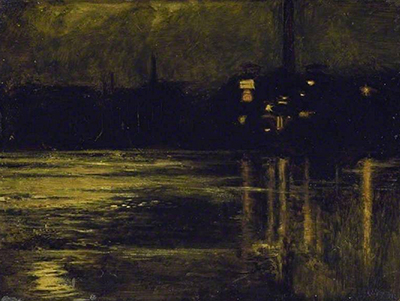
William Holman Hunt's The Thames at Chelsea, Evening is a tiny painting of a wide river at dusk. Dark buildings run along the far bank, but their shapes nearly vanish into the sky. A handful of small lights remain visible, and broken yellow reflections travel down the water. The river is more than a backdrop: it occupies much of the panel and carries the changing illumination that makes the picture legible. Painted in 1853, this oil on wood panel measures only 15.2 × 20.3 cm. It belongs to the Fitzwilliam Museum, Cambridge, accession 868. [1]
The work is a useful reminder that Hunt's search for convincing light was not confined to sunlit rural landscapes or large biblical pictures. This small urban view finds visual interest in the unstable moment when built forms lose detail but their lights remain. The Fitzwilliam included it in its “Skies and Effects” section of True to Nature, an exhibition about European outdoor painting. The museum's curatorial label places Hunt's practice in the Pre-Raphaelite interest in painting from direct observation. Here the observed effect is fleeting, and a rapid-looking sketch on panel is an apt way to hold it. [2]
At a Glance
- ArtistWilliam Holman Hunt (1827–1910)
- TraditionBritish Pre-Raphaelite art
- Work or subjectThe Thames at Chelsea, Evening
- ContextIllustrated paintings guide
- Further readingArtist biography
A view from Cheyne Walk
The most precise account of the viewpoint comes from the ink inscription on the back of the panel. It calls the painting a “sketch from a window in Cheyne Walk, Chelsea,” dates it 1853, and says Hunt gave it to John Everett Millais. Those are statements written on the object, stronger than a modern guess based on a vague skyline. The inscription locates the artist at a window but does not identify the particular house or prove that the entire image was completed in a single sitting. [1]
Cheyne Walk runs beside the Thames in Chelsea. From a window there, Hunt could study water and the changing opposite bank without placing a figure in the scene. His viewpoint is high enough to look across the river rather than along a towpath. The wide foreground of water gives the distant bank room to retreat. The built environment is present as a dark horizontal mass, punctuated by a few glowing windows or lamps. The near absence of detail is not a lack of attention; it is the effect of evening light on what can still be seen.
The panel's modest size also shapes the experience. On a screen it can fill the same area as a major exhibition painting, but the original is only just over twenty centimetres wide. At that scale, the small bright marks register as quick observations rather than painstaking architectural descriptions. Hunt was willing to leave much of the scene dark. The result depends on a few contrasts: pale water against the bank, greenish and yellowish passages across the surface, and pinpoints of artificial light against the surrounding shadow.
How the reflections work
Hunt does not draw each ripple as a separate outline. Light appears in uneven bands and short vertical breaks across the water. The strongest reflection near the right pulls the viewer from the far-bank lights down towards the lower edge. Elsewhere the water catches more diffuse illumination, so the foreground does not turn into a flat black strip. This is a visual reading of the present panel. The exact sources of every point of light are hard to identify at this scale and should not be invented.
Watch: William Holman Hunt
Begin with Hunt’s paintings, then place his work alongside two fellow Pre-Raphaelite founders.
William Holman Hunt Paintings
An overview of Hunt’s paintings from TheHistoryOfArt video archive.
Watch on YouTubeThe sky and river also seem to share colour. Both carry subdued olive, grey and brown tones, with warmer yellow concentrated in the lit patches. The skyline emerges from their meeting rather than sitting as a crisp silhouette. The effect makes the painting about a particular transition in visibility. The city has not disappeared, but it must be reconstructed from partial information. That gives the sketch a quiet atmosphere unlike Hunt's crowded and highly articulated narrative canvases.
A gift to Millais and a museum acquisition
Hunt gave the painting to fellow Pre-Raphaelite John Everett Millais, as the inscription records. It remained connected to Millais's collection until the Christie's sale of 2 July 1898, where Charles Fairfax Murray bought it. Murray later gave it to the Fitzwilliam in 1917. The museum's provenance is unusually specific for such a small study: the personal gift, the sale and the later museum donation form a traceable path. [1]
The gift makes the panel evidence of an artistic relationship as well as an evening view. Hunt and Millais were central members of the Brotherhood formed in 1848, and a small study of light could be meaningful within their shared practice. The surviving record does not explain what Millais thought of this particular picture or why Hunt chose to give it to him; those motives should remain open. Its passage through an artist's collection is notable enough without attaching an invented conversation.
Place within Hunt's landscapes
Compare the dark river with the broad daylight of Cornfield at Ewell and the secluded stream in The Haunted Manor. Those 1849 pictures attend to crops, stone and foliage; this 1853 Chelsea view tests how little of a city is left visible at evening. It anticipates Hunt's later interest in specific times and qualities of light without needing to be treated as a direct study for any particular large canvas. The paintings guide and biography put this intimate panel beside the better-known works.
The picture is currently recorded as in storage by the Fitzwilliam, so an online reproduction may be the most accessible way to see it at a given moment. Display arrangements can change; the museum's live object page is the appropriate place to check before a visit. What survives on the panel is clear enough: a brief study of a familiar river altered by darkness, and an object that moved from one painter's hand to another's before entering a public collection. [1]
The Fitzwilliam records more than one marking on the back. Alongside the ink statement about Cheyne Walk and Millais, it transcribes a later note referring to the Millais sale of 2 July 1898 and Fairfax Murray's purchase, plus a separate stencilled mark. These additions should not be mistaken for Hunt's original account of painting the river: they belong to the object's later handling. Reading the front and back together gives the panel two kinds of evidence. The painted side records an evening effect; its reverse helps trace the work's passage from a gift between artists to a sale and then a museum. [1]
Discussion
Look closely at The Thames at Chelsea, Evening, then compare your reading with the documented history.
Reader Insights
Which detail in The Thames at Chelsea, Evening most affects your reading?
How do the date, medium and collection records shape that interpretation?
What remains uncertain about this work or its history?
Join the Conversation
Share a close observation or a source-backed question about The Thames at Chelsea, Evening. The prompts above are starting points for discussion.
References
- Fitzwilliam Museum object record. View source.
- Amy Marquis, Fitzwilliam exhibition label. View source.