 by Tom Gurney
Tom Gurney BSc (Hons) is an art history expert with over 20 years experience
Published on June 19, 2020 / Updated on October 19, 2026
Email: tomgurney1@gmail.com / Phone: +44 7429 011000
Stephen Lushington
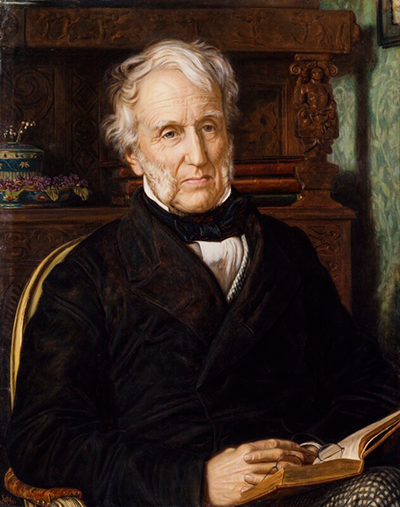
An elderly man turns toward us from an armchair, his hands resting near an open book. White hair and whiskers catch the light against a dark coat; behind him, carved furniture and a narrow strip of green wallpaper make this an inhabited room rather than a blank portrait setting. This is Stephen Lushington (1782–1873), the judge and reformer painted by William Holman Hunt in 1862. The oil on canvas measures 819 × 648 mm and belongs to the National Portrait Gallery, London, as NPG 1646. [1]
A judge seen at close range
Lushington had a long public career, but Hunt did not reduce him to an official emblem. There is no judicial robe in the picture. The sitter wears a dark coat, white shirt and necktie, and patterned waistcoat and trousers. He sits beside a book as if interrupted while reading. These details give him an intellectual presence without specifying the contents of the book or claiming to show him at work on a particular case. The National Portrait Gallery calls him a lawyer and reformer as well as a judge. A Surrey archive account also records his campaigning against slavery. The portrait leaves those causes implicit, presenting the person who held those commitments rather than illustrating them. [2] [3]
At a Glance
- ArtistWilliam Holman Hunt (1827–1910)
- TraditionBritish Pre-Raphaelite art
- Work or subjectStephen Lushington
- ContextIllustrated paintings guide
- Further readingArtist biography
The face is alert and slightly difficult to read. Light gathers around the forehead, eyes and nose, while lines beside the mouth register age without turning it into a caricature. The sitter neither smiles broadly nor stares away. His direct but measured gaze invites attention to a particular person. Hunt's handling of flesh and hair resists a smooth ideal: the white locks break irregularly around the head, and the skin has changes of colour and texture. That care fits the Pre-Raphaelite artist's commitment to close looking, but here it serves a portrait rather than a symbolic narrative.
Hunt's own account, quoted in the Gallery's extended catalogue, says Lushington's face was unusually mobile and hard to fix in one satisfying expression. Hunt first made a preliminary drawing at the sitter's home in Ockham. Those remarks help explain the finished painting's poised expression: it feels alive partly because it avoids an easy, frozen smile. They also remind us that a portrait is a choice made through sittings and revisions, not a transparent record of one moment. [2]
Vernon Lushington and the commission
The person who arranged this picture was Vernon Lushington, Stephen's son and a friend of Hunt and other Pre-Raphaelite artists. The commission dates to 1862. Keeping the two names apart matters: Stephen is the man painted; Vernon brought artist and sitter together. The Gallery's older catalogue suggests Vernon wished to help his friend as well as honour his father, though that account does not prove every motive behind the commission. The recorded family connection does show why Hunt had access to a sitter whose life extended far beyond the art world. [1] [2]
Watch: William Holman Hunt
Begin with Hunt’s paintings, then place his work alongside two fellow Pre-Raphaelite founders.
William Holman Hunt Paintings
An overview of Hunt’s paintings from TheHistoryOfArt video archive.
Watch on YouTubeThe portrait bears Hunt's monogram and the year 1862 at the lower left. It was shown at the Royal Academy in 1863. That sequence allows for a picture made in one year and publicly seen in the next; the exhibition date should not replace the date on the canvas. Letters cited in the Gallery's extended catalogue show Hunt discussing the work in October 1862 and again in August 1863, evidence that his involvement with its progress and reception extended across that period. [2]
The room around the sitter
The book brings a small area of pale paper into the lower right. Its edge meets Lushington's hands, linking thought and physical presence. A carved sideboard occupies the space behind him. On the left, a decorated green vessel and flowers introduce colour into the dark wood; at the far right, figured green wallpaper opens a sliver of room beyond the furniture. The Gallery's extended catalogue identifies violets and harebells among the flowers. These are specific observed objects, but the picture does not ask us to treat each one as a secret code for a legal achievement. [2]
The surrounding brown and black tones make the face the brightest and most legible part of the picture. Hunt still gives attention to the chair's gilt edge, the folds of the coat and the small objects behind. The eye can move outward through the room and return to Lushington without losing the portrait's centre. This balance is important: a highly detailed background could overwhelm a sitter, but here the furniture helps establish a life of reading and domestic surroundings while the face remains in charge.
The original frame is also part of the portrait's history, though the reproduction here crops it away. The National Portrait Gallery describes an arched gilt frame and notes similarities to work associated with the firm Foord & Dickinson. Its frame study treats that maker attribution as probable, and Hunt's own participation in its design as a question rather than a documented fact. He took frames seriously, but that general interest is not enough to say he designed this one. The arch would have shaped the original visitor's first view of the seated judge differently from this rectangular crop. [1]
From family portrait to public collection
The painting stayed in the family before reaching the Gallery. Susan Lushington, Stephen's granddaughter and Vernon's daughter, gave it in 1912, acting on her father's wish. In the Gallery's record she reported that Hunt considered it one of the best portraits he had made. That is valuable family testimony about the painting's esteem, but the statement reaches us through Susan rather than through a surviving direct declaration by Hunt in this record. [1]
Hunt painted many pictures with explicit stories and religious themes. Stephen Lushington works differently. Its open book, varied textures and setting help a viewer meet a public figure as an individual who sits, reads and looks back. The portrait's careful observation does not tell us every conviction he held; the collection history and archive sources supply that wider life. What the canvas preserves most directly is Hunt's sustained attempt to catch the shifting presence of an elderly man before him.
Discussion
Look closely at Stephen Lushington, then compare your reading with the documented history.
Reader Insights
Which detail in Stephen Lushington most affects your reading?
How do the date, medium and collection records shape that interpretation?
What remains uncertain about this work or its history?
Join the Conversation
Share a close observation or a source-backed question about Stephen Lushington. The prompts above are starting points for discussion.
References
- National Portrait Gallery, object record. View source.
- National Portrait Gallery, portrait catalogue. View source.
- Surrey County Council, Lushington archive context. View source.