William Holman Hunt.jpg)
 by Tom Gurney
Tom Gurney BSc (Hons) is an art history expert with over 20 years experience
Published on June 19, 2020 / Updated on October 19, 2026
Email: tomgurney1@gmail.com / Phone: +44 7429 011000
William Holman Hunt by William Blake Richmond
The man in this painting is William Holman Hunt. The painter is William Blake Richmond. Although this page's long-standing address says self-portrait-1877, the picture is not a self-portrait: Hunt sat for another artist. The National Portrait Gallery[1] identifies its oil on canvas as William Holman Hunt, by Sir William Blake Richmond, accession NPG 1901. The old address remains so that existing links still reach the corrected account.
Richmond presents Hunt close to the viewer, with the face, hair and beard emerging from a nearly black surrounding field. It is a portrait of an artist by a fellow artist and friend. Unlike Hunt's own painted images of himself, it shows how a contemporary chose to interpret his appearance. [2]
At a Glance
- ArtistWilliam Holman Hunt (1827–1910)
- TraditionBritish Pre-Raphaelite art
- Work or subjectPortrait of William Holman Hunt
- ContextIllustrated paintings guide
- Further readingArtist biography
Object at a glance
| Sitter | William Holman Hunt (1827–1910) |
| Painter | Sir William Blake Richmond (1842–1921) |
| Title | William Holman Hunt |
| Date | Circa 1877 in the NPG overview; the extended catalogue discusses a date around 1879 and a first exhibition in 1880 |
| Medium | Oil on canvas |
| Size | 61.5 × 51 cm |
| Collection | National Portrait Gallery, London, NPG 1901 |
| Provenance | Kept by Richmond; bequeathed by him to the Gallery in 1921 |
The facts and dimensions above come from the NPG object record[1]; the chronology and provenance are discussed in its extended entry[2]. The date should be read as approximate, not as a securely dated completion in 1877.
Looking at Richmond's Hunt
The head is nearly frontal, but the eyes turn slightly away. Light catches the broad forehead, nose, cheeks and pale grey eyes, then drops into the beard and dark clothing. Richmond gives the hair and beard a tawny red-brown warmth against the cool, dim background. A few grey streaks mark the hair. Rather than supplying a studio interior or an easel, he concentrates attention on Hunt's expression. The contrast makes the face feel present even in a small reproduction. [2]
The face is more worked than the shoulders and backdrop. Jan Marsh's NPG catalogue entry calls it the only fully finished area and describes the darker body and background as relatively featureless. The rapid handling around the beard helps explain why a contemporary reviewer could praise the animated likeness yet still find parts of the painting insufficiently developed. These are judgments about Richmond's pictorial choices, not evidence that Hunt painted the work himself. [2]
The furrowed brow is especially suggestive. It can be read as concentration, fatigue or anxiety, but the portrait alone cannot establish Hunt's thoughts at the sitting. Richmond recalled Hunt's striking eyes and beard with affection; the catalogue contrasts his admiring memory with the more equivocal response of Hunt's friend and critic F. G. Stephens. That difference is useful: a painted likeness is a made interpretation, even when the painter knows the sitter well. [2]
Watch: William Holman Hunt
Begin with Hunt’s paintings, then place his work alongside two fellow Pre-Raphaelite founders.
William Holman Hunt Paintings
An overview of Hunt’s paintings from TheHistoryOfArt video archive.
Watch on YouTubeTwo painters and a friendship
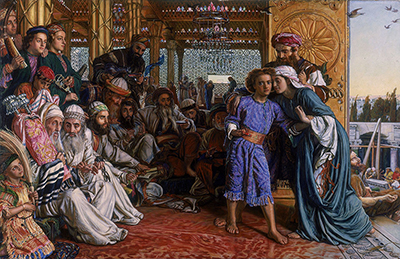
Richmond was fifteen years younger than Hunt. The NPG records that he first saw Hunt around 1852 and met him in 1859 at the home of Charles West Cope. Richmond recruited Hunt into the Artists' Rifles and visited his studio the next morning, when Hunt was working on The Finding of the Saviour in the Temple. Richmond later described a friendship that lasted until Hunt's death. This personal history gives the portrait a different setting from a commission painted by a stranger, although it does not tell us how many sittings took place. [2]
Marsh notes that Hunt stood godfather to Richmond's son Arthur in the year associated with the picture and that Richmond publicly supported Hunt's campaign to change the law restricting marriage to a deceased wife's sister. Hunt had married Edith Waugh after the death of her sister Fanny, his first wife. The catalogue proposes that the portrait belongs to a difficult period in Hunt's personal life. Those circumstances help place the friendship historically; they should not be used to diagnose every line in his face. [2]
Why the date is not simply 1877
The Gallery's public overview and image caption call the portrait circa 1877. Its fuller catalogue says Judith Bronkhurst dated it to about 1879; it also records an older Manchester exhibition date of about 1880 and a scholar's view that the picture was begun in 1877. The portrait appeared at London's Grosvenor Gallery in 1880. Taken together, these records point to work across the late 1870s rather than a proven single year of execution. Retaining “1877” in the web address preserves an established route, while the visible title and description use an approximate date. NPG overview[1] [2]
The original painting remained with Richmond. The NPG says it was included in the 1906–07 retrospective exhibitions of Hunt's work and came to the Gallery through Richmond's bequest in 1921. Labels recorded on the frame connect it to those exhibitions. The Gallery also notes conservation in 1991. Its collection record does not establish that the local site's compressed image represents the present surface colour with complete accuracy, so fine colour judgments should be made from the museum image or the original. [2]
A portrait of Hunt, beside Hunt's self-portraits
The distinction between sitter and maker becomes clearer beside Hunt's actual self-portraits[3]. The NPG lists an early self-portrait of about 1841–42 in the Ashmolean, a signed and dated 1845 self-portrait in Birmingham, and the large self-portrait begun in 1867 and completed in 1875 for the Uffizi. In the Uffizi picture Hunt holds a palette and wears a Syrian robe; it is an explicit account of his identity as a working painter. Richmond's portrait removes that equipment and makes the face itself the subject. [3]
Richmond made another oil portrait of Hunt in 1900, now NPG 2803[4]. The earlier portrait therefore also offers a point of comparison across time: one artist returned to the same sitter roughly two decades later. This page concerns the earlier picture, NPG 1901, rather than treating the two Richmond paintings or any of Hunt's self-portraits as interchangeable. [2]
For Hunt's own account of his career, continue to the biography. To browse his paintings, including the genuine early and Uffizi self-portraits, use the paintings directory.
Discussion
Look closely at Portrait of William Holman Hunt, then compare your reading with the documented history.
Reader Insights
Which detail in Portrait of William Holman Hunt most affects your reading?
How do the date, medium and collection records shape that interpretation?
What remains uncertain about this work or its history?
Join the Conversation
Share a close observation or a source-backed question about Portrait of William Holman Hunt. The prompts above are starting points for discussion.
References
- National Portrait Gallery. View source.
- NPG extended catalogue. View source.
- Hunt's actual self-portraits. View source.
- NPG 2803. View source.