 by Tom Gurney
Tom Gurney BSc (Hons) is an art history expert with over 20 years experience
Published on June 19, 2020 / Updated on October 19, 2026
Email: tomgurney1@gmail.com / Phone: +44 7429 011000
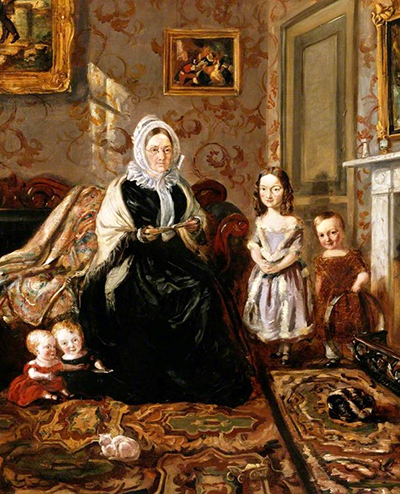
Mrs Davies with Four Clark Grandchildren
An elderly woman sits at the centre of a busy drawing room. Two small children gather on the carpet at her left, while a girl and a younger boy stand beside a doorway at her right. Hunt's group portrait shows Mrs Davies of Wormbridge Court, Hereford, with four of her Clark grandchildren in Henry Clark's home in Homerton. Christie's specialist catalogue[1] identifies the relationships and the setting. Hunt dated the picture to “about the year 1846” in a later letter to Clark.
A family gathered indoors
Mrs Davies occupies the largest dark shape in the painting. White fabric surrounds her face, and a pale shawl falls across her shoulders, setting off the black dress. Her hands hold an object at her lap. The four children are arranged at different heights and distances: two nearly at floor level, one standing near her, and one closer to the right edge. Their lighter clothes and faces draw the eye around the central figure without breaking the sense of a shared room.
At a Glance
- ArtistWilliam Holman Hunt (1827–1910)
- TraditionBritish Pre-Raphaelite art
- Work or subjectMrs Davies with Four Clark Grandchildren
- ContextIllustrated paintings guide
- Further readingArtist biography
The room is as carefully described as the people. A patterned carpet spreads across the foreground; the sofa has a curving wooden arm and bright upholstery. Pictures hang against elaborate wallpaper. Light strikes the wall and parts of the furniture, while Mrs Davies's dress remains a deep black mass. Hunt made a domestic setting that feels occupied, not a row of isolated heads. The poses suggest several degrees of attention: the children do not all turn in the same direction or perform the same action.
Christie's notes a small earlier portrait of Henry Clark fishing partly visible in the picture at upper left. At this reproduction's scale, it is easiest to see as a framed painting within the room, rather than to identify its subject from its tiny details. The catalogue also connects the sofa to a separate portrait Hunt painted of Henry Clark in 1846. These links make the furniture and wall pictures part of a particular family interior, even though the painting can be read first as a lively arrangement of people, light and objects. [1]
Henry Clark and the young Hunt
Henry Clark was an early supporter of Hunt. The Christie's account[1] describes him as a business associate and near neighbour of Hunt's father, with a button and trimming warehouse in the City of London. It cites a descendant's family account, quoted by historian Jeremy Maas, for Clark's practical help: the young painter could use a room and received brushes, paints and other materials. That testimony explains why Hunt's connection to the household mattered as more than a single commission, though its family recollection should not be confused with a surviving contemporary contract.
Clark had commissioned a portrait of himself fishing on the River Lea around 1844–45. The group portrait followed it and is of almost the same size, according to Christie's. Its catalogued medium is oil on canvas, measuring approximately 76 × 63 centimetres. In a letter dated 15 November 1876, Hunt recalled painting the family group “about the year 1846.” This is a retrospective date from the artist, rather than a claim that every child's exact age or every sitting day is known. [1]
Watch: William Holman Hunt
Begin with Hunt’s paintings, then place his work alongside two fellow Pre-Raphaelite founders.
William Holman Hunt Paintings
An overview of Hunt’s paintings from TheHistoryOfArt video archive.
Watch on YouTubeThe Homerton setting has a documented family context. Christie's places Clark and his growing family on High Street, Homerton, from about 1843, and identifies the room as his drawing room. The painting's full catalogued title is unusually descriptive, naming Mrs Davies, Wormbridge Court, the Clark grandchildren and the house. Henry Clark's mother-in-law is Mrs Davies, but the children around her belong to the next generation. That distinction matters when reading this as a family portrait, rather than as a mother seated with her own children.
Who are the children?
The two children at right are suggested by Christie's to be Mary Clark and her brother John Adolphus, using their recorded birth years and the approximate painting date. The older of the two babies at left is described as almost certainly Francis William. These are informed identifications, not names inscribed next to the figures in the picture. The fourth child's identity is not established in the accessible catalogue entry. Keeping that limit visible is better than assigning every small face a confident name. [1]
For a viewer, the children's different places also create the picture's rhythm. The pair at left are close to the carpet, one in warm red; the girl at right stands in pale lilac beside the smaller boy in brown. Their positions lead the eye from the lower edge up towards Mrs Davies's face and across to the door. Family hierarchy and pictorial balance coincide: the grandmother anchors the group, while the children's movement gives it energy.
A stage in Hunt's painting
The Christie’s specialist essay calls this Hunt's earliest original group set in an interior. It distinguishes it from copies he had made after works by David Wilkie and Theodore Lane. The painting thus shows a young artist organising several figures and many domestic details in a room of his own construction. The play of light across wallpaper, faces and furniture is already important, but it would be misleading to treat every furnishing as one of the elaborate symbols of Hunt's later religious pictures. The immediate subject is a family gathered in a recognisable household. [1]
The painting remained in Henry Clark's family for many years. Christie's records its sale on 9 March 2000, and a later catalogue entry[2] lists subsequent private ownership. Those records do not establish its location today. What is secure is the early patronage, Hunt's approximate date, the family relationship, and the room represented. Seen through those facts, the picture is both a lively group portrait and a record of the household that supported Hunt near the beginning of his career.
Christie's also identifies an earlier artistic exercise relevant to this room. Before making the Clark group, Hunt copied Theodore Lane's The Enthusiast, another interior with a worked carpet and fireplace. The catalogue proposes that it may have influenced his handling of domestic detail here; the connection is a specialist comparison, not a documented instruction from Clark. It is useful because the Homerton portrait lets Hunt move beyond copying someone else's room. He arranges a real patron's family, their furniture and the embedded picture of Clark fishing into a new composition, turning early practice into a household image with its own relationships. [1]
Discussion
Look closely at Mrs Davies with Four Clark Grandchildren, then compare your reading with the documented history.
Reader Insights
Which detail in Mrs Davies with Four Clark Grandchildren most affects your reading?
How do the date, medium and collection records shape that interpretation?
What remains uncertain about this work or its history?
Join the Conversation
Share a close observation or a source-backed question about Mrs Davies with Four Clark Grandchildren. The prompts above are starting points for discussion.
References
- Christie's specialist catalogue. View source.
- later catalogue entry. View source.