 by Tom Gurney
Tom Gurney BSc (Hons) is an art history expert with over 20 years experience
Published on June 19, 2020 / Updated on October 19, 2026
Email: tomgurney1@gmail.com / Phone: +44 7429 011000
Harold Rathbone
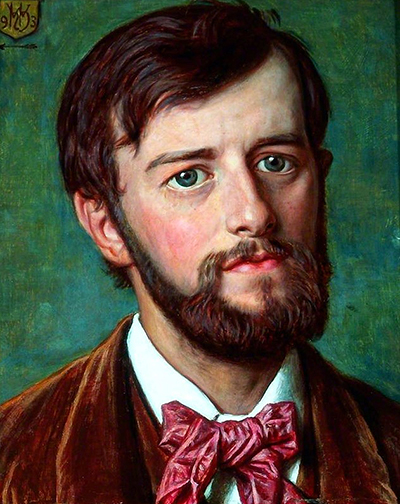
William Holman Hunt painted Harold Rathbone close up against a blue-green ground. His head turns slightly, but his eyes meet the viewer. A reddish bow at his neck, brown jacket and dark hair make a warm frame for the illuminated face. The portrait is small—about 23 × 18 cm—and dates from 1893. It belongs to the Walker Art Gallery, Liverpool. Rathbone was himself an artist and, soon after this picture was made, the founder of the Della Robbia Pottery in Birkenhead. The portrait records a person Hunt knew through art, collecting and their shared connections to Liverpool. [1] [2] [3]
A face in a small panel
The narrow field leaves little space for setting or props. Rathbone's shoulders and upper chest fill the lower part; his hair comes near the upper edge. A small date and Hunt monogram occupy a corner of the green ground. The background is active in colour but does not describe a room. Hunt directs attention to the sitter's eyes, expression and clothing. The firm contours of his nose and beard coexist with subtle shifts of pink, cream and shadow across his face.
At a Glance
- ArtistWilliam Holman Hunt (1827–1910)
- TraditionBritish Pre-Raphaelite art
- Work or subjectHarold Rathbone
- ContextIllustrated paintings guide
- Further readingArtist biography
His green eyes repeat the background colour, while the red bow picks up warmer notes in the lips and cheeks. Light falls more strongly on one side of the face. The effect is not a simple badge of character: it gives a face volume on a panel small enough to hold in one's hands. Rathbone is about thirty-five in 1893, no longer an apprentice but not yet known principally for the pottery enterprise he would establish in 1894. A family description cited in later scholarship called the likeness accurate and said it conveyed his “dreamy temperament.” That is one relative's response, not a diagnosis that the painting can establish for us. [2]
The visible picture also helps distinguish this page from other Hunt portraits. Cyril Benoni Holman Hunt shows the painter's son at fishing with a landscape and elaborate frame. Harold Rathbone removes most surroundings. The bow and velvet-like jacket still matter as material details, but they frame a mature artist rather than constructing a scene of leisure. It is a portrait of a professional peer and friend, not an illustration of a story.
Why Hunt and Rathbone knew each other
Rathbone belonged to a Liverpool family active in civic and artistic life. He trained as a painter and studied with Ford Madox Brown, another major figure connected with the Pre-Raphaelites. Research based on surviving correspondence places Rathbone and Hunt in contact by 1890. The portrait followed that relationship, rather than being the first known sign of it. Hunt and Rathbone both cared about earlier Italian art, and later scholarship traces those interests through Rathbone's ceramics. Specific conversations between the men cannot be reconstructed from the painted face, but their documented meetings give the commission a social setting. [2] [4]
Watch: William Holman Hunt
Begin with Hunt’s paintings, then place his work alongside two fellow Pre-Raphaelite founders.
William Holman Hunt Paintings
An overview of Hunt’s paintings from TheHistoryOfArt video archive.
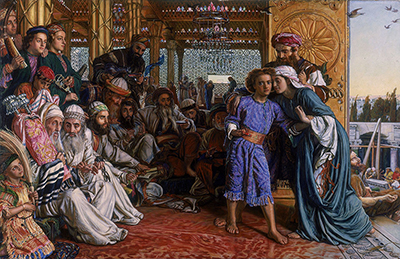
Watch on YouTubeOne decisive piece of that relationship concerns Hunt's The Triumph of the Innocents. Rathbone organised a public subscription that helped the Walker Art Gallery acquire the large painting in 1891. A gallery-supplied record on Google Arts & Culture credits the purchase to contributions collected by him. The subject painting was a major Hunt work, far larger and more elaborate than this portrait. Looking from The Triumph of the Innocents to Rathbone's small head shows two sides of the same Liverpool connection: a public collection effort and a personal image of the organiser. [5] [2]
In 1894, Rathbone founded the Della Robbia Pottery in Birkenhead, taking inspiration from Italian Renaissance glazed terracotta and the Arts and Crafts aim of joining design to making. The William Morris Society's account describes the enterprise's Italian sources and its local production. Hunt was named to its founding council, although surviving records leave the precise extent of his practical involvement uncertain. It would overstate the evidence to say Hunt designed Rathbone's ceramics or that the portrait advertises the firm. What can be said is that their friendship belonged to a wider network in which painting, sculpture, collecting and craft met. [3] [2]
The portrait in Liverpool
The Walker Art Gallery holds the portrait. Its association with Liverpool is apt because Rathbone helped bring Hunt's large painting into that same collection. An account of the 1894 Liverpool Autumn Exhibition places the portrait on view the year after it was painted; that exhibition history is plausible within Rathbone's work with Liverpool's art institutions, though the present public object references are thinner than for some Hunt paintings. The object facts used here are the 1893 date, small oil-on-panel format and Walker collection, supported by the Walker-supplied image as reproduced by Victorian Web and by academic studies. [1] [2]
The small size matters to its effect. Hunt did not need a long narrative or symbolic setting to make this likeness distinctive. The close crop draws attention to a gaze that is steady but not stiff, and to the colour shifts that make the sitter's face present. Knowing Rathbone's later work adds context, yet it should not make him a mere footnote to Hunt. He was a painter, organiser and pottery founder whose efforts helped shape what Liverpool audiences could see. Hunt's portrait gives that collaborator a face within the history of the collection he helped build.
The sequence is worth keeping clear: Rathbone helped gather support for the Walker's Triumph of the Innocents in 1891; Hunt painted his portrait in 1893; the Della Robbia Pottery followed in 1894. The portrait is therefore neither a fundraising image for the earlier acquisition nor a picture made to advertise the later ceramics. Those neighbouring events explain why Rathbone mattered to Hunt's Liverpool circle while leaving the small oil free to be read as a likeness. It is the documented relationships, rather than an invented emblem in the blue-green background, that join this face to the gallery and craft histories around it. [5] [2]
Discussion
Look closely at Harold Rathbone, then compare your reading with the documented history.
Reader Insights
Which detail in Harold Rathbone most affects your reading?
How do the date, medium and collection records shape that interpretation?
What remains uncertain about this work or its history?
Join the Conversation
Share a close observation or a source-backed question about Harold Rathbone. The prompts above are starting points for discussion.
References
- Victorian Web, Walker-supplied reproduction and object details. View source.
- Liverpool John Moores University research on Hunt and Rathbone. View source.
- William Morris Society on Della Robbia. View source.
- Christie's, biographical note on Rathbone. View source.
- Walker Art Gallery record for The Triumph of the Innocents. View source.