

 by Tom Gurney
Tom Gurney BSc (Hons) is an art history expert with over 20 years experience
Published on June 19, 2020 / Updated on July 26, 2026
Email: tomgurney1@gmail.com / Phone: +44 7429 011000
A Young Woman Standing at a Virginal by Johannes Vermeer: Introduction
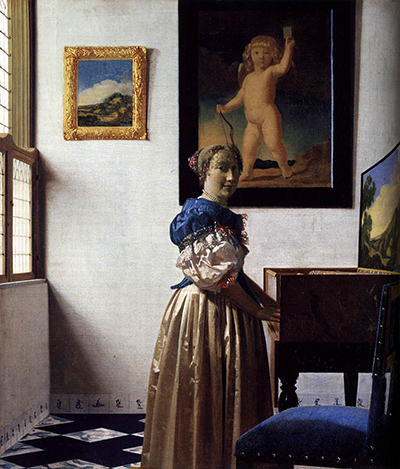
Johannes Vermeer’s A Young Woman Standing at a Virginal is one of his late music interiors. A woman stands at a virginal and looks outward toward the viewer. Behind her is a painting of Cupid. An empty chair waits in the foreground. The room is poised, bright and still, but its objects suggest music, love, fidelity and expectation.
The National Gallery in London records the painting as A Young Woman standing at a Virginal, by Johannes Vermeer, about 1670-2, oil on canvas, 51.7 by 45.2 cm, inventory number NG1383. [1] It is signed and belongs to the National Gallery’s pair of late virginal paintings by Vermeer.
At a Glance
- ArtistJohannes Vermeer
- TitleA Young Woman Standing at a Virginal
- National Gallery titleA Young Woman standing at a Virginal
- DateAbout 1670-2
- MediumOil on canvas
- CollectionNational Gallery, London
- Inventory numberNG1383
- Key themesMusic, love, fidelity, Cupid, direct gaze, late interiors
Contents
- Introduction
- At a Glance
- What the Painting Shows
- Music and Love
- Cupid on the Wall
- The Woman’s Gaze
- The Empty Chair
- Light and Late Style
- Relation to A Young Woman Seated at a Virginal
- Relation to Vermeer’s Music Paintings
- Place in Vermeer’s Work
- Frequently Asked Questions
What the Painting Shows
The painting shows a young woman standing at a virginal, a keyboard instrument associated with domestic music-making. She turns toward the viewer with a calm, direct gaze. The room is ordered and luminous. A chair stands in the foreground, while the wall behind her includes a painting of Cupid.
The scene is quiet, but not empty. Music is implied rather than heard. The empty chair suggests the possibility of another person. Cupid introduces the language of love. The woman’s direct gaze makes the viewer aware of being addressed, or at least acknowledged.
Vermeer gives the image the clarity of a late work. The forms are controlled, the space is measured and the emotional register is restrained. Nothing is acted out, but everything is prepared for interpretation.
Music and Love
Music appears often in seventeenth-century Dutch painting as a social and emotional subject. It can imply harmony, courtship, education, leisure or seduction. In Vermeer’s work, music is rarely just entertainment. It creates a structure for relationships that are suggested rather than narrated.
In A Young Woman Standing at a Virginal, the musician is alone. That solitude changes the theme. The viewer does not see a duet or lesson in progress, as in The Music Lesson. Instead, the instrument becomes a sign of potential communication.
The empty chair supports that reading. It may suggest an absent listener, an expected visitor or a companion outside the visible moment. Vermeer leaves the exact role open. The painting is less about performance than readiness.
Cupid on the Wall
The Cupid painting behind the woman is one of the work’s central interpretive features. The National Gallery connects Cupid, music, the empty chair and the woman’s gaze with themes of love and fidelity, while still treating the meaning as uncertain rather than fully resolved. [1]
That caution is important. Cupid is a strong symbol, but he does not turn the painting into a simple moral message. He gives the room a language of love, but the woman’s expression remains controlled and the narrative remains incomplete.
The comparison with Girl Reading a Letter at an Open Window is useful. In the Dresden painting, the restored Cupid intensifies the love-letter reading. In the London virginal painting, Cupid works alongside music and the empty chair to suggest emotional expectation. In both cases, Vermeer uses a picture-within-a-picture to shape the viewer’s interpretation without closing it.
The Woman’s Gaze
The woman’s gaze is direct but composed. She does not look startled or theatrically expressive. She stands beside the virginal and meets the viewer with a calmness that is difficult to define.
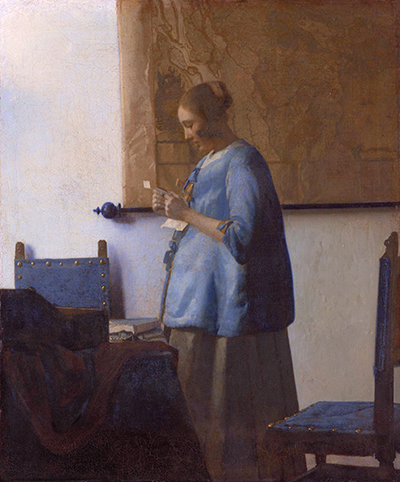
This directness distinguishes the painting from many of Vermeer’s more inward works. In Woman in Blue Reading a Letter, the reader is absorbed and unaware of us. In A Lady Writing, the woman turns toward the viewer from the act of writing. In A Young Woman Standing at a Virginal, the gaze is more frontal and sustained.
The result is an image that feels both formal and intimate. The viewer is not simply looking into a private scene. The figure appears to return the act of looking.
The Empty Chair
The empty chair is a small but important feature. It occupies the viewer’s side of the room and suggests absence. Someone may have been there, may be expected, or may be represented by the viewer’s own position.
Vermeer often uses objects to suggest human relationships without showing all the participants. Here, the chair does that work. It introduces social possibility into an otherwise solitary image.
The chair also helps structure the space. It creates a foreground pause before the eye reaches the woman and the virginal. Like curtains, tables and doorways in other Vermeer paintings, it controls access.
Light and Late Style
The painting belongs to Vermeer’s late, highly ordered interiors. The light is clear and steady. The room does not contain the bustling detail of a genre scene. Instead, Vermeer reduces the composition to figure, instrument, chair, wall, picture and light.
This reduction gives the painting its authority. Every object has interpretive weight. The virginal indicates music. Cupid indicates love. The chair indicates absence or invitation. The gaze creates encounter.
The surface is calm, but the structure is rich. Vermeer’s late style often works this way: limited action, strong geometry, controlled light and carefully chosen objects.
Relation to A Young Woman Seated at a Virginal
The National Gallery explicitly compares this painting with A Young Woman Seated at a Virginal, also in its collection. The two works are similar in size and date, and they have often been discussed together. [1] [2]
The possible pendant relationship should be phrased carefully. The paintings are clearly related, but the National Gallery presents the relationship as possible and debated rather than certain. That caution should be preserved.
The contrast is nevertheless useful. The standing woman is set in a lighter room with Cupid and an empty chair. The seated woman appears in a darker setting with a more prominent painting of The Procuress and a viol in the foreground. The two works may invite comparison between different musical and emotional situations.
Relation to Vermeer’s Music Paintings
This painting belongs with The Music Lesson, The Concert and A Young Woman Seated at a Virginal. Each painting uses music to suggest social connection, but each does so differently.
The Music Lesson includes two figures and a mirror, making the act of looking complex. The Concert presents group music-making, though the painting is now known through its stolen status. A Young Woman Standing at a Virginal is more solitary and emblematic. It compresses music, love and address into a single figure beside an instrument.
This makes the painting important for Vermeer’s music subjects. These works are not decorative interludes. They are ways of thinking about harmony, courtship, presence and absence.
Place in Vermeer’s Work
A Young Woman Standing at a Virginal is a strong late Vermeer page because it joins several mature themes: women in interiors, music, symbolic wall paintings, controlled light and direct viewer address.
It is not as famous as the major flagships, but it helps complete the picture of Vermeer’s final decade. The painting shows him working with great economy. A single figure, a keyboard, an empty chair and Cupid are enough to create a complex emotional field.
It is also important to distinguish the National Gallery’s standing and seated virginal works from the separate Leiden Collection seated-virginal attribution-history painting. Those are different objects and should not be collapsed into one story.
Frequently Asked Questions
The painting is in the National Gallery in London. [1]
The National Gallery dates the painting to about 1670-2. [1]
A virginal is a keyboard instrument. In Dutch paintings, music-making often suggests harmony, courtship, education or refined domestic culture.
The two National Gallery paintings are similar in size and date and have often been compared, but the pendant relationship should be treated cautiously rather than as settled fact. [1] [2]
Cupid introduces themes of love and fidelity, but the painting does not give a single fixed narrative. The symbol strengthens the love/music reading while preserving ambiguity.
Discussion
What feels most revealing about A Young Woman Standing at a Virginal: Vermeer's handling of light, the silence of the scene, the object details, the attribution history, or the way the painting fits within Dutch Golden Age art?
Reader Insights
Vermeer rewards slow attention. Begin with the main action, then move outward to light, edges, objects and the quiet spaces that hold the composition together.
Many of these paintings are small, but their meanings open through Delft, collecting history, technical study and comparison with related Dutch interiors.
Pair this article with the biography and one neighbouring Vermeer work to see how subject, light and attention shift across the artist's compact oeuvre.
Join the Conversation
Have a thought or observation about A Young Woman Standing at a Virginal? Share it below. Thoughtful responses may be added to this section as the Vermeer pages develop.
References
- National Gallery, London, A Young Woman standing at a Virginal, NG1383.
- National Gallery, London, A Young Woman seated at a Virginal, NG2568.
- Vermeer research notes on music paintings, pendant caution and National Gallery object records.