

 by Tom Gurney
Tom Gurney BSc (Hons) is an art history expert with over 20 years experience
Published on June 19, 2020 / Updated on July 26, 2026
Email: tomgurney1@gmail.com / Phone: +44 7429 011000
A Young Woman Seated at a Virginal by Johannes Vermeer: Introduction
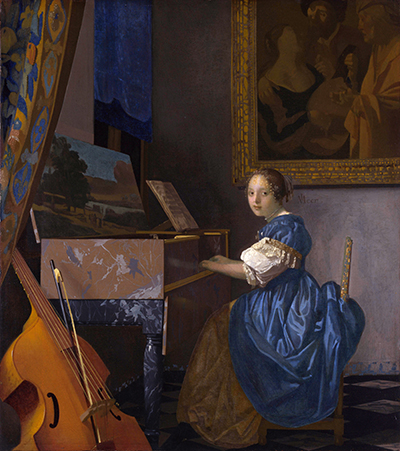
Johannes Vermeer’s A Young Woman Seated at a Virginal is one of his late music paintings in the National Gallery, London. A young woman sits at a keyboard instrument and turns toward the viewer. A viola da gamba rests in the foreground. Behind her hangs a painting associated with Dirck van Baburen’s The Procuress. The scene is elegant, but its atmosphere is darker and more suggestive than Vermeer’s standing virginal painting.
The National Gallery records the work as A Young Woman seated at a Virginal, by Johannes Vermeer, about 1670-2, oil on canvas, 51.5 by 45.5 cm, inventory number NG2568. [1] It entered the collection through the Salting Bequest in 1910.
At a Glance
- ArtistJohannes Vermeer
- TitleA Young Woman Seated at a Virginal
- National Gallery titleA Young Woman seated at a Virginal
- DateAbout 1670-2
- MediumOil on canvas
- CollectionNational Gallery, London
- Inventory numberNG2568
- Key themesMusic, courtship, Baburen, viola da gamba, late interiors, title caution
Contents
- Introduction
- At a Glance
- Title and Object Note
- What the Painting Shows
- Music and Courtship
- The Baburen Procuress
- A Darker Counterpart
- The Seated Figure
- The Viola da Gamba
- Late Style and Controlled Ambiguity
- Place in Vermeer’s Work
- Frequently Asked Questions
Title and Object Note
This article refers to the National Gallery, London painting, inventory number NG2568. It should be kept separate from the Leiden Collection work often discussed under a similar seated-virginal title. The two works are different objects with different collection histories and different attribution issues.
That distinction matters for readers. The London painting is a secure National Gallery Vermeer. The Leiden work belongs to a separate title-collision and attribution-history discussion.
What the Painting Shows
The painting shows a young woman seated at a virginal, turning outward toward the viewer. The room is darker than the brighter A Young Woman Standing at a Virginal. The instrument, foreground viol and wall painting create a rich musical and erotic context.
The young woman’s gaze is direct but reserved. She is not caught in dramatic action. Like many late Vermeer figures, she appears suspended between private activity and public address. The viewer becomes part of the scene because she turns toward us.
The foreground viol is especially important. It suggests music beyond the solo keyboard. It may imply another participant, an absent player, or the possibility of ensemble performance. Vermeer uses the instrument to make absence visible.
Music and Courtship
Music in Dutch painting often carries social and emotional meanings. It can suggest harmony, education, refinement, flirtation or courtship. In this painting, the musical theme is intensified by the presence of more than one instrument.
The virginal places the woman in a refined domestic setting. The viol in the foreground suggests a second musical voice. The room is therefore not simply a place of solitary practice. It seems ready for interaction, even if no second musician is present.
This is one reason the painting feels psychologically active despite its stillness. Vermeer creates a scene in which music has either just happened, is about to happen, or is imagined through the objects in the room.
The Baburen Procuress
The painting on the wall is one of the work’s most provocative features. The National Gallery notes the prominent presence of a Baburen Procuress painting. [1] That image introduces a sharper moral and erotic note than the Cupid in A Young Woman Standing at a Virginal.
The presence of a procuress subject does not mean the seated woman should be reduced to a simple moral type. Vermeer’s late interiors are more subtle than that. But the wall painting does alter the room’s interpretive atmosphere.
It places the music scene within a wider visual language of love, desire, exchange and social negotiation. The viewer is asked to consider the relation between cultivated music and the more worldly meanings attached to courtship imagery.
A Darker Counterpart
The National Gallery compares the painting with A Young Woman Standing at a Virginal, noting their similar size and date while treating any pendant relationship cautiously. [1] [2] The comparison is useful, but it should not be overstated.
The standing virginal painting is brighter and more open. It includes Cupid, an empty chair and a direct standing figure. The seated painting is darker, more compressed and more complex in its erotic signals. The viol and the Baburen image give it a different emotional temperature.
If the two works are read together, they can be understood as variations on music and love rather than as a simple matched pair. One leans toward fidelity and expectation; the other introduces a more ambiguous courtship atmosphere.
The Seated Figure
The seated woman is central to the painting’s tension. She is engaged with the virginal, but she turns toward the viewer. This creates a break in the musical act. We are not watching a fully absorbed performer. We are being acknowledged by someone inside the painted room.
That gaze complicates the scene. It may invite, pause, challenge or simply register the viewer’s presence. Vermeer does not make the expression easy to translate into a story.
The result is similar to A Lady Writing, where a woman turns from her task toward the viewer. In both works, an act of private culture becomes a moment of encounter.
The Viola da Gamba
The viola da gamba in the foreground is more than a musical accessory. Its placement gives the lower part of the picture weight and suggests the possibility of another performer. A keyboard and viol together imply musical partnership.
The instrument also creates a threshold. Like tables, chairs and foreground curtains in other Vermeer paintings, it slows the viewer’s entry into the scene. We look over or past it toward the seated woman.
This makes the room feel inhabited by absence. The missing player may matter as much as the visible one.
Late Style and Controlled Ambiguity
The painting belongs to Vermeer’s late style, where fewer objects can carry larger interpretive weight. The room is not crowded, but everything visible matters. Instrument, figure, gaze, wall painting and foreground object form a compact network.
The darker setting also separates the painting from the luminous calm often associated with Vermeer. It shows that his late interiors could be morally and emotionally charged without becoming theatrical.
The painting’s power lies in controlled ambiguity. Music, desire and viewer address are all present, but Vermeer refuses a fixed narrative.
Place in Vermeer’s Work
A Young Woman Seated at a Virginal is important because it completes the London virginal pair and strengthens the music route through Vermeer’s work. It connects to A Young Woman Standing at a Virginal, The Music Lesson, The Concert and The Procuress.
It also adds a darker tone to the late interiors. Where some Vermeer music paintings suggest harmony or refined sociability, this one introduces a more charged relation between music and erotic imagery.
The discussion must also make clear that the London painting is not the Leiden Collection seated-virginal work. That distinction protects both paintings from title confusion.
Frequently Asked Questions
The painting is in the National Gallery in London. [1]
The National Gallery dates the painting to about 1670-2. [1]
No. This article is about the National Gallery, London painting, inventory number NG2568. The Leiden Collection work is a separate painting with a separate attribution and collection history.
The foreground instrument is a viola da gamba. Its presence suggests musical partnership or an absent second performer.
Discussion
What feels most revealing about A Young Woman Seated at a Virginal: Vermeer's handling of light, the silence of the scene, the object details, the attribution history, or the way the painting fits within Dutch Golden Age art?
Reader Insights
Vermeer rewards slow attention. Begin with the main action, then move outward to light, edges, objects and the quiet spaces that hold the composition together.
Many of these paintings are small, but their meanings open through Delft, collecting history, technical study and comparison with related Dutch interiors.
Pair this article with the biography and one neighbouring Vermeer work to see how subject, light and attention shift across the artist's compact oeuvre.
Join the Conversation
Have a thought or observation about A Young Woman Seated at a Virginal? Share it below. Thoughtful responses may be added to this section as the Vermeer pages develop.
References
- National Gallery, London, A Young Woman seated at a Virginal, NG2568.
- National Gallery, London, A Young Woman standing at a Virginal, NG1383.
- Vermeer research notes on music paintings, Baburen, pendant caution and seated-virginal title separation.