

 by Tom Gurney
Tom Gurney BSc (Hons) is an art history expert with over 20 years experience
Published on June 19, 2020 / Updated on July 26, 2026
Email: tomgurney1@gmail.com / Phone: +44 7429 011000
The Procuress by Johannes Vermeer: Introduction
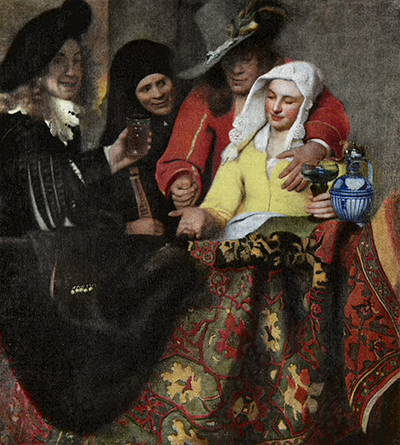
Johannes Vermeer’s The Procuress is one of the most important early works in his career. It is large, signed and dated, and very different from the quiet interiors for which he later became famous. Instead of a single absorbed figure or a still domestic room, Vermeer presents a brothel scene: a young woman receives payment, an older procuress watches, a soldier-like client leans in, and a fourth figure turns outward toward the viewer.
The Staatliche Kunstsammlungen Dresden records the painting under the title Bei der Kupplerin, by Johannes Vermeer, dated 1656, oil on canvas, 143 by 130 cm, inventory number Gal.-Nr. 1335. [1] The record also notes the signature and date at lower right: J V Meer. 1656. [1] This makes the painting a crucial anchor for Vermeer’s early chronology.
At a Glance
- ArtistJohannes Vermeer
- TitleThe Procuress / Bei der Kupplerin
- Date1656
- MediumOil on canvas
- Dimensions143 x 130 cm
- CollectionGemäldegalerie Alte Meister, Staatliche Kunstsammlungen Dresden
- Inventory numberGal.-Nr. 1335
- Key themesEarly Vermeer, brothel scene, payment, genre painting, Caravaggist influence, scale
Contents
- Introduction
- At a Glance
- What the Painting Shows
- An Early Work at Large Scale
- The Carpet and the Viewer
- Payment and Moral Ambiguity
- Utrecht and Caravaggist Context
- Colour and Early Style
- Why This Work Belongs in the Vermeer Story
- The Question of Self-Portraiture
- Provenance and Modern History
- Place in Vermeer’s Work
What the Painting Shows
The painting shows four figures gathered around a young woman. A man places a coin in her hand, while an older woman, the procuress, looks on. Another man at the left turns outward and raises a glass. A large carpet dominates the foreground, creating a bold barrier between viewer and scene.
The subject belongs to a tradition of brothel and procuress scenes in Dutch and Utrecht painting. The theme is sexual commerce, but Vermeer’s treatment should be described clearly rather than luridly. The central action is the exchange of money. The older woman mediates the transaction. The young woman’s lowered gaze and the client’s forward movement give the scene its tension.
This is not the Vermeer of hushed letter reading or measured light on pale walls. It is an early artist working with large figures, strong colour, moral subject matter and the influence of earlier genre and Caravaggist painting.
An Early Work at Large Scale
The scale of The Procuress is striking. At 143 by 130 cm, it is much larger than many of Vermeer’s later interiors. [1] The figures are close to the viewer, and the foreground carpet gives the painting a physical weight very different from the restrained spaces of the 1660s.
SKD interpretation connects the work to Vermeer’s transfer of large figure scale from early history painting into genre painting. [1] That point is important. The Procuress stands between Vermeer’s early large religious or mythological subjects and his later domestic interiors. It shows him adapting ambitious scale to a contemporary moral scene.
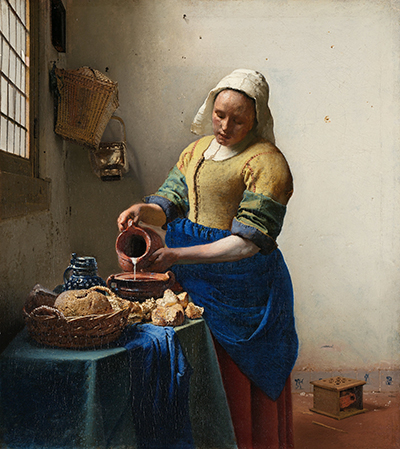
The painting therefore helps prevent a misleading picture of Vermeer’s career. He did not begin with the perfect quiet of The Milkmaid or Girl with a Pearl Earring. His mature style emerged from experiments with scale, figure groups, colour and genre subjects.
The Carpet and the Viewer
The large carpet in the foreground is one of the painting’s strongest visual features. It fills the lower part of the image, rich in pattern and colour, and separates the viewer from the transaction behind it. The carpet is not just a display of texture. It is a compositional barrier.
That barrier matters because it affects the viewer’s moral position. We are close to the scene, but not inside it. The carpet blocks immediate access, while the outward-looking figure at the left draws us into awareness of our own looking. Vermeer’s later paintings often use tables, curtains and doorways to control access. Here, the carpet performs a related function in a much bolder early mode.
The textile also links the scene to luxury, trade and display. The richness of the carpet contrasts with the moral ambiguity of the transaction. Vermeer places beauty and unease in the same field.
Payment and Moral Ambiguity
The central payment gesture gives the painting its narrative force. The client’s hand, the woman’s hand and the coin form the crucial point of exchange. The procuress watches because her role depends on that transaction. The scene is therefore about money, desire and mediation.
Dutch procuress scenes often carry moralising implications. They warn against lust, deception, greed or foolishness. Vermeer’s painting belongs to that world, but it should not be reduced to a single lesson. The figures are close, the colours strong and the mood complicated. The viewer is asked to see both the attraction of the painted surface and the moral discomfort of the subject.
This tension is part of the painting’s importance. Vermeer later became a master of restraint, but here he engages a more overtly charged subject. The painting shows that his early career included direct contact with the moral and sensual energy of Dutch genre painting.
Utrecht and Caravaggist Context
SKD interpretation connects the painting with the Utrecht Caravaggist tradition and with the broader world of early seventeenth-century brothel scenes. [1] That context matters because The Procuress does not emerge from nowhere. Vermeer is responding to existing pictorial models in which large figures, strong colour, direct address and moral ambiguity were central.
The Caravaggist connection helps explain the painting’s physical directness. The figures are large and close. The subject is bodily and transactional. Light, colour and gesture are used to create immediacy. This is far from the later Vermeer of pale walls and suspended silence, but it shows him learning from a powerful genre tradition.
The relationship to Dirck van Baburen is especially useful because Baburen’s Procuress appears as a painting-within-a-painting in later Vermeer works. That connection does not make Vermeer’s Dresden painting derivative. It shows that procuress imagery remained part of the visual culture through which Vermeer and his collectors understood moral scenes.
Colour and Early Style
The colour in The Procuress is heavier and more emphatic than in many mature Vermeer paintings. The red, yellow and patterned carpet create a strong visual field, while the figures are pressed close to the viewer. The painting’s energy is dense rather than airy.
This early colour helps make the subject feel immediate. Luxury, desire and payment are not abstract ideas; they are embodied in fabric, flesh, gesture and surface. Vermeer’s later paintings would often reduce colour into more controlled harmonies. Here, colour is part of the scene’s moral and sensual force.
The painting’s early style is sometimes described as awkward compared with Vermeer’s mature work. That can be true in a limited sense, but it should not be dismissive. The painting is ambitious, large and structurally important. Its very difference helps reveal how much Vermeer changed.
Why This Work Belongs in the Vermeer Story
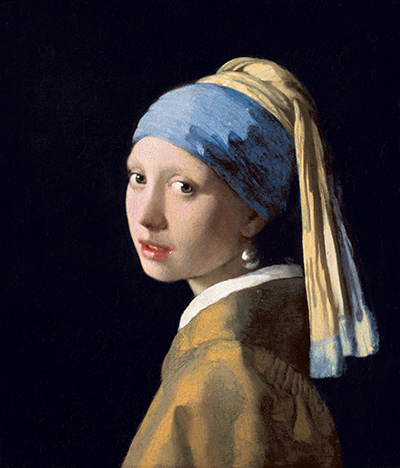
The Procuress is not as immediately attractive as Girl with a Pearl Earring or The Milkmaid, but it is indispensable for understanding Vermeer’s development. It supplies the early dated anchor that shows him working before the mature interior formula had settled.
It also broadens Vermeer’s moral range. He was not only a painter of quiet virtue, private reading and luminous women at windows. He engaged scenes of commerce, desire and social ambiguity. The later restraint becomes more meaningful when this early boldness is visible.
The Question of Self-Portraiture
The outward-looking man at the left has sometimes been discussed in relation to Vermeer himself. That possibility should be handled cautiously. The painting does not provide secure evidence that the figure is a self-portrait.
What matters more is the figure’s pictorial role. He turns toward the viewer and raises a glass, creating a link between the scene and the space outside it. He makes the viewer conscious of being addressed, implicated or at least noticed. Whether or not he resembles Vermeer, he is structurally important.
This caution is typical of responsible Vermeer biography and interpretation. Tempting identifications should not be presented as fact when the evidence is uncertain.
Provenance and Modern History
The SKD provenance route gives the painting an unusually rich later history. It was acquired in 1741 from the collection of Count Franz Josef von Waldstein/Wallenstein in Dux for Elector Friedrich August II of Saxony, who was also King August III of Poland. [1]
Its twentieth-century history is also significant. The SKD records wartime storage in Albrechtsburg Meissen and the Lohmgrund railway tunnel near Rottwerndorf, removal to the USSR in July 1945, presence in Moscow from 1945 to 1955, and return to the Dresden Gemäldegalerie in 1956. [1]
This history should be treated soberly. It is part of the painting’s modern life and of the wider history of European collections during and after the Second World War. It should not overshadow the work, but it gives the object a public history beyond Vermeer’s studio.
Place in Vermeer’s Work
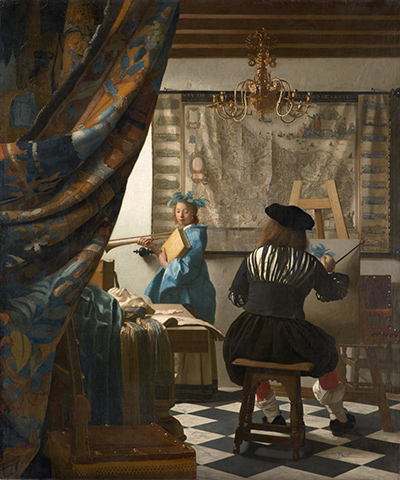
The Procuress is essential because it shows Vermeer before the mature quiet interiors. It connects to his biography through the 1656 date, shortly after his marriage and guild membership. It connects to The Art of Painting through ambition and scale, and to later interiors through the use of a foreground barrier and controlled viewer access.
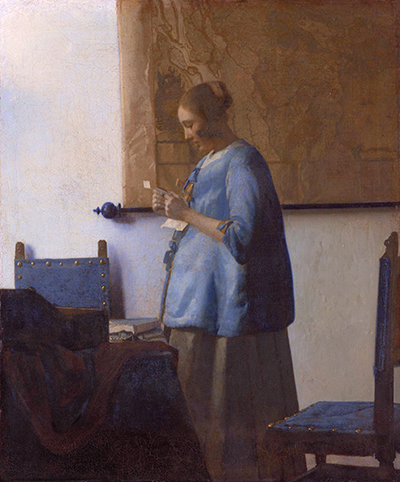
It also shows how far Vermeer’s art changed. The jump from The Procuress to The Milkmaid or Woman in Blue Reading a Letter is not a simple improvement from crude to refined. It is a change in pictorial language: from overt transaction and large figures to stillness, light and suspended attention.
Frequently Asked Questions
The Procuress is in the Gemäldegalerie Alte Meister, Staatliche Kunstsammlungen Dresden. [1]
The SKD record dates the painting to 1656 and records the signature/date J V Meer. 1656. [1]
That identification has been suggested, but it should not be stated as fact. The figure’s secure importance is compositional: he turns outward and addresses the viewer.
It is one of Vermeer’s key early works, showing his engagement with large-scale genre painting before the quieter interiors of his mature career.
It is not typical of the mature Vermeer most viewers know, but that is why it matters. It shows his early engagement with large figures, genre painting and moral subject matter.
Discussion
What feels most revealing about The Procuress: Vermeer's handling of light, the silence of the scene, the object details, the attribution history, or the way the painting fits within Dutch Golden Age art?
Reader Insights
Vermeer rewards slow attention. Begin with the main action, then move outward to light, edges, objects and the quiet spaces that hold the composition together.
Many of these paintings are small, but their meanings open through Delft, collecting history, technical study and comparison with related Dutch interiors.
Pair this article with the biography and one neighbouring Vermeer work to see how subject, light and attention shift across the artist's compact oeuvre.
Join the Conversation
Have a thought or observation about The Procuress? Share it below. Thoughtful responses may be added to this section as the Vermeer pages develop.
References
- Staatliche Kunstsammlungen Dresden, Bei der Kupplerin, Gal.-Nr. 1335.