


 by Tom Gurney
Tom Gurney BSc (Hons) is an art history expert with over 20 years experience
Published on June 19, 2020 / Updated on November 6, 2025
Email: tomgurney1@gmail.com / Phone: +44 7429 011000
Saint Proculus
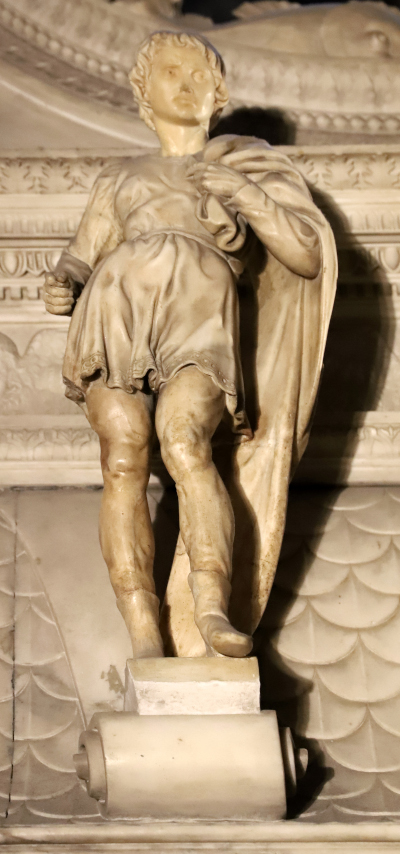
Saint Proculus looks ready to move. His short belted tunic reveals the structure of a young body; a mantle falls behind one shoulder; the right hand rises beside the hip where it once held a weapon or martyr's palm. Though only 58.5 centimetres high, he confronts the viewer with the compact tension often compared to Michelangelo's later David.
Michelangelo carved the marble in Bologna in 1494–1495 for the Arca di San Domenico. The Italian state catalogue accepts him as executor and identifies Proculus as a local martyr, while recording an important programme change: the position may originally have been intended for Saint Thomas Aquinas.[1]
The figure's present identity depends on a missing object. State cataloguers describe the lost attribute as an axe—or possibly a palm. That uncertainty should remain visible. Saint, gesture and shrine are secure; the exact thing once held is not.
At a Glance
- ArtistMichelangelo Buonarroti
- TitleSaint Proculus; also Saint Proclus or Italian San Procolo
- Date1494–1495
- MaterialMarble
- HeightApproximately 58.5 centimetres
- Current locationArca di San Domenico, Basilica of San Domenico, Bologna
- SubjectProculus, a young martyr associated with Bologna
- Original attributeMissing; catalogued as probably an axe or a palm
- Earlier programmeThe position may originally have been intended for Saint Thomas Aquinas
- Related Michelangelo works on the ArcaSaint Petronius and the kneeling candle-bearing angel
- Viewing conditionSmall figure elevated within a complex shrine
Contents
- Who Was Saint Proculus?
- A Saint Replacing Thomas Aquinas
- Michelangelo's Bologna Commission
- The Arca and Its Many Makers
- The Lost Attribute
- A Small Forerunner of David?
- Clothing and the Body
- Designed for the Beholder
- Bologna and the Formation of Style
- Proculus Beside the Kneeling Angel
- What the Missing Attribute Teaches
- How to Look at Saint Proculus
- Why Saint Proculus Matters
Who Was Saint Proculus?
Several saints named Proculus or Proclus appear in Christian tradition, and local cults do not always align cleanly. The Arca figure is understood as a young Bolognese martyr rather than a bishop or Dominican scholar.[1]
His youthful, military-looking dress and missing attribute support a martyr identity. A palm would be the conventional sign of victory through death. An axe could refer more specifically to martyrdom or a local legend.
Because the attribute is lost, costume and setting now do more work. The short tunic, belt and vigorous stance distinguish Proculus from the mitred Petronius and from learned Dominican saints.
Naming variations are linguistic, not separate objects: Proculus, Proclus and Procolo refer here to the same marble. A controlled title avoids creating duplicate pages from translations.
A Saint Replacing Thomas Aquinas
The Italian catalogue notes that Niccolò dell'Arca's original programme may have called for Saint Thomas Aquinas in this position before the identity changed to Proculus.[1] This is more than a label correction.
Thomas, a Dominican theologian, would have strengthened the shrine's order-specific intellectual identity. Proculus adds local martyrdom and civic devotion. The substitution changes how the small figure participates in the Arca's community of saints.
It also helps explain why the design may contain inherited constraints. Michelangelo may have been working with a block, location or conceptual slot developed for another figure. A saint in academic robes would require different costume and attributes from a young martyr.
How far the marble had progressed before the change is uncertain. The state record clearly presents Michelangelo as executor of Proculus, unlike Petronius, where early evidence specifically says he completed Niccolò's draperies. We should not automatically transfer the same division of hands to both works.
Programme revision nevertheless belongs to the sculpture's history. The decisive young body was made inside a monument already capable of changing its saints.
Michelangelo's Bologna Commission
Michelangelo reached Bologna after leaving Florence during the political upheaval of 1494. The fall of the Medici and arrival of the French army made the city's future uncertain. In Bologna he gained the protection of Giovan Francesco Aldrovandi.[1]
The Arca commission introduced him to a famous monument and to the work of Nicola Pisano, Niccolò dell'Arca and other sculptors. He supplied three missing elements: Proculus, Petronius and a kneeling angel holding a candlestick.
These works were small compared with the David or Pietà, but they were public and exposed. Michelangelo had to match scale, marble colour, iconography and viewing conditions established by others.
The commission also provided income and reputation at a moment of displacement. Rather than waiting in exile for a wholly self-directed masterpiece, he demonstrated his capacity to finish a prestigious ensemble.
His Bologna stay belongs to formation, not an empty interval between Florence and Rome. Proculus embodies what he learned: local intensity, optical design and the value of a figure compressed into architectural limits.
The Arca and Its Many Makers
Saint Dominic's shrine began with the carved sarcophagus made by Nicola Pisano and collaborators in the thirteenth century. Niccolò dell'Arca designed the elaborate crown in the fifteenth century, and later sculptors continued the work after him.[1]
Michelangelo's statuettes occupy this accumulated structure. They cannot be understood fully as three museum objects aligned on a shelf. Their sizes and gestures answer neighbouring prophets, saints, angels and pinnacles.
The shrine's many hands complicate the idea of Renaissance authorship productively. Michelangelo is not diminished by collaboration. His distinction appears in how he reads a crowded monument and gives each added body a different visual task.
Proculus supplies youthful secular energy within the sacred population. His short clothing and direct stance contrast with episcopal drapery and kneeling devotion.
The Arca would later receive still more additions. Its unity is historical rather than instantaneous: reverence sustained repeated making around Dominic's relics.
The Lost Attribute
The raised right hand originally held something at hip height. The state catalogue proposes an axe or palm.[1] The loss affects both silhouette and identity.
With a palm, the gesture would display the standard emblem of martyrdom. The long, slender form might rise beside the body and visually balance the mantle. With an axe, the attribute would be heavier and more specific to the manner of death.
Attachment points, old images and the hand's grip may help evaluate the alternatives. A palm could fit a narrow socket; an axe would impose different weight and angle. Without decisive physical or documentary evidence, digital or drawn reconstructions should be labelled hypothetical.
The missing object also changes modern interpretation. An empty hand can look like a clenched fist, making the saint seem more defiant than Michelangelo intended. Restoring the idea of an attribute—not necessarily one certain form—returns gesture to iconography.
Loss is therefore not peripheral. It is part of how the figure has been seen and compared with David.
A Small Forerunner of David?
Proculus is frequently described as anticipating the David carved in Florence from 1501 to 1504.[1] Both figures are youthful, stand with concentrated alertness and organise energy around a hand near the hip.
The comparison can sharpen looking. Proculus's limbs and expression suggest readiness; weight is balanced before action; the face seems focused beyond the immediate space. Michelangelo later magnified comparable tension in the colossal civic hero.
But the later masterpiece can overwhelm the earlier saint. Proculus is clothed, only a fraction of the size, elevated on a reliquary and holding a martyr's attribute. David is nude, colossal and designed for a Florentine public setting. Their political and devotional functions differ.
It is better to speak of a recurring sculptural problem than a miniature prophecy. Michelangelo learned how to make potential action visible without depicting the action itself. In Bologna he solved it within sixty centimetres; in Florence he solved it at monumental scale.
The comparison is strongest when differences remain active. It reveals development rather than destiny.
Clothing and the Body
Proculus wears a short garment cinched at the waist, with a decorated hem. A mantle hangs from the left shoulder and is held by the left hand before falling behind in dense folds.[1]
This arrangement keeps the legs comparatively free. The tunic describes rather than conceals the body's compact proportions, while the mantle adds mass to one side.
Michelangelo uses cloth to articulate action. The left hand's gathering gesture stabilises the mantle; the absent right-hand attribute would have supplied a counterweight. The two sides balance holding and display.
The face is beardless, framed by short wavy hair. Youth is communicated without soft passivity. Concentration pulls features inward.
At a high viewpoint, hem pattern and hair detail are secondary to large contrasts: bare lower legs against tunic, mantle against torso, lifted hand against open space. The carving respects that hierarchy.
Designed for the Beholder
Studies of Michelangelo's Bologna sculptures stress that their forms respond to where viewers stand.[2] Proculus was not intended for rotating inspection at eye level.
Elevated placement shortens the apparent lower body and hides upper surfaces. Clear leg separation, projected hands and strong head direction compensate. Shadows under tunic and mantle keep costume readable.
A close photograph can make the figure look more compact or reveal rough passages never meant to dominate. A full-shrine view restores its optical effectiveness.
This site intelligence became central to Michelangelo's later practice. The David was adjusted for a high intended cathedral position before civic relocation changed its setting; Sistine figures were designed for extraordinary distance. Proculus is an early exercise in making anatomy and expression reach a specific eye.
Bologna and the Formation of Style
Michelangelo saw Jacopo della Quercia's powerful reliefs and statues in Bologna, along with Niccolò dell'Arca's emotionally and rhythmically charged sculpture. Ferrarese painters active in the region offered sharply constructed bodies and folds.
Proculus's concentrated face and angular drapery have been connected with this environment. Local influence does not mean Michelangelo ceased to be Florentine. It means style grew through encounter.
The figure also shows the practical side of learning. Michelangelo could study admired art and immediately test lessons in commissioned marble. Observation became a solution to attribute, stance and silhouette.
This makes Bologna more than a footnote before Roman fame. Without these compact saints, the apparent leap from early reliefs to the Pietà becomes artificially miraculous.
Proculus Beside the Kneeling Angel
Michelangelo's three interventions on the Arca distribute movement differently. Petronius stands under the burden of a city; the candle-bearing angel kneels and turns a liturgical object into support; Proculus remains upright and alert.[1]
The contrast is useful because it prevents a single formula for the young artist. All three figures are small, elevated and made for the same monument, yet each has a distinct centre of gravity. The angel's bent leg carries devotional service, while Proculus's legs hold potential action.
Together they test three relationships to objects. Petronius carries a model with both hands. The angel's candlestick determines a kneeling pose. Proculus's lost attribute once completed a one-handed display. Damage has made his relation the hardest to recover.
This local ensemble is a better comparison than an immediate leap to David. It reveals Michelangelo adjusting one body after another within common constraints. Only then does the later colossal youth show how far the solution could expand.
What the Missing Attribute Teaches
Art history often privileges intact masterpieces, but Proculus demonstrates how a small loss can redirect centuries of response. Photographs crop the empty hand, reproductions omit the issue, and viewers begin to treat the fist as an expressive invention.
Responsible reconstruction starts with the catalogue's alternatives and the physical join. It may test palm and axe digitally at different angles, but it should not fill the hand permanently without stronger evidence. A reversible visual proposal can teach more than a confident material restoration.
The uncertainty also protects the saint from over-biographical interpretation. A clenched fist might be read as the young Michelangelo's defiance in exile. A hand designed to grip a palm says something more specific and less romantic: the sculptor was solving a conventional martyr attribute for a public shrine.
How to Look at Saint Proculus
Find him first in the whole shrine and register his height above you.
Trace the weight through the legs and waist. The stance is alert without a literal stride.
Look at the right hand and imagine the difference between palm and axe, keeping both reconstructions provisional.
Follow the left hand into the mantle. The two sides were designed as complementary acts of holding.
Compare Proculus with David only after observing costume, scale and site. Similar tension then becomes more meaningful because it survives difference.
Why Saint Proculus Matters
Proculus matters because he condenses future Michelangelo concerns—potential action, the beholder and bodily tension—without becoming a small rehearsal for later fame.
The work also demonstrates how iconography can remain physically vulnerable. One missing attribute alters the saint's silhouette and encourages modern viewers to read a fist where Michelangelo designed a grip.
Most importantly, the marble belongs to Bologna. It represents a local martyr on a multi-generational shrine, created by a displaced young Florentine who learned to make his art answer another city's history.
Frequently Asked Questions
Discussion
What details, sources or comparisons stand out to you in St Proculus?
Reader Insights
Which formal detail changes how the work reads?
Which documented source or collection history feels most useful?
Which related Michelangelo work should readers compare next?
Join the Conversation
Add a source-led observation, comparison or question for other readers.
References
- Catalogo Generale dei Beni Culturali, San Procolo,” national catalogue 0800024759:, View source.
- Ellen L. Longsworth, Michelangelo and the Eye of the Beholder: The Early Bologna Sculptures,” Artibus et Historiae 23, no. 45 (2002):, View source.
- University of Michigan Library Digital Collections, Saint Proclus / Full front view”:, View source.
- Catalogo Generale dei Beni Culturali, Arca di San Domenico related monument record:, View source.