

 by Tom Gurney
Tom Gurney BSc (Hons) is an art history expert with over 20 years experience
Published on June 19, 2020 / Updated on November 6, 2025
Email: tomgurney1@gmail.com / Phone: +44 7429 011000
The Last Judgement by Michelangelo
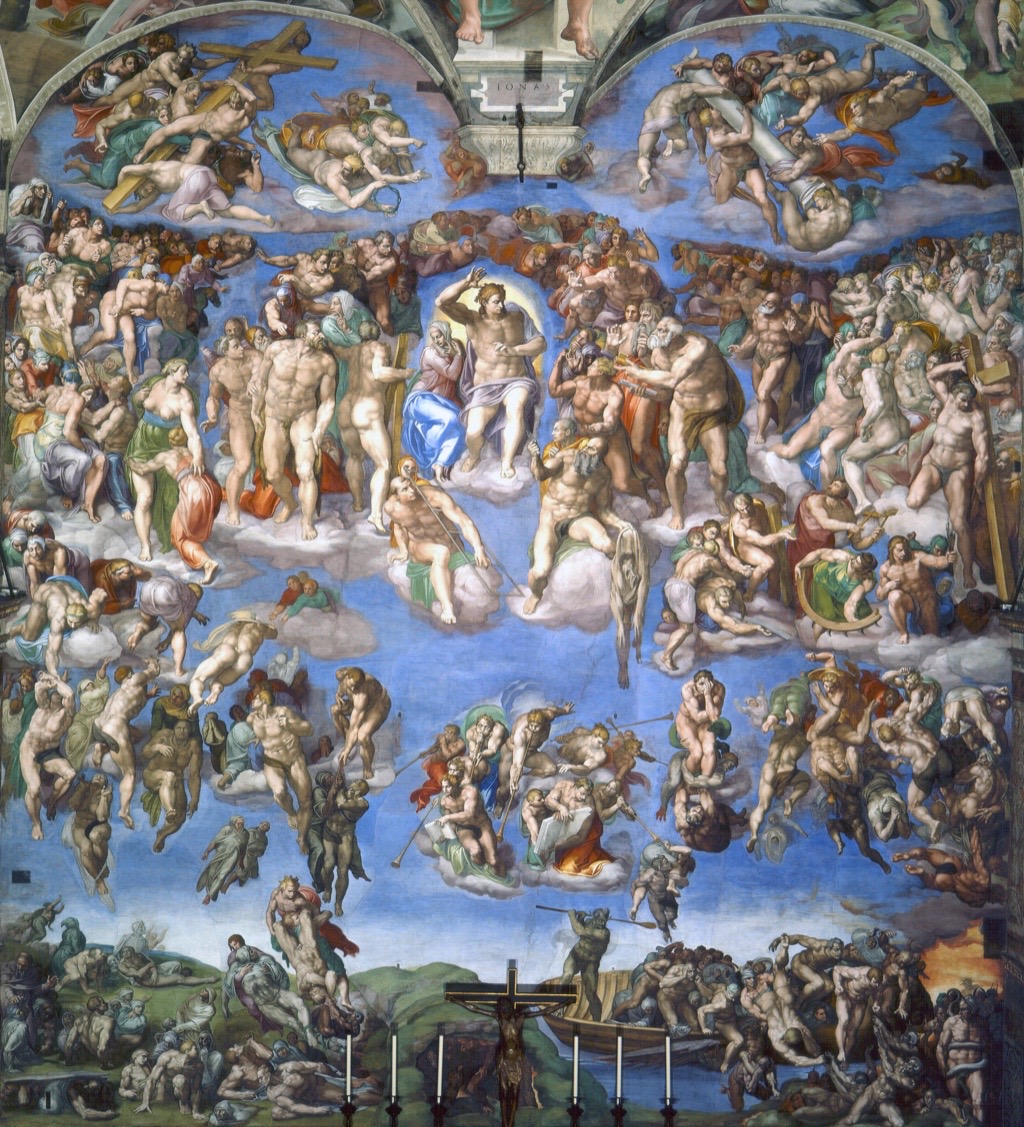
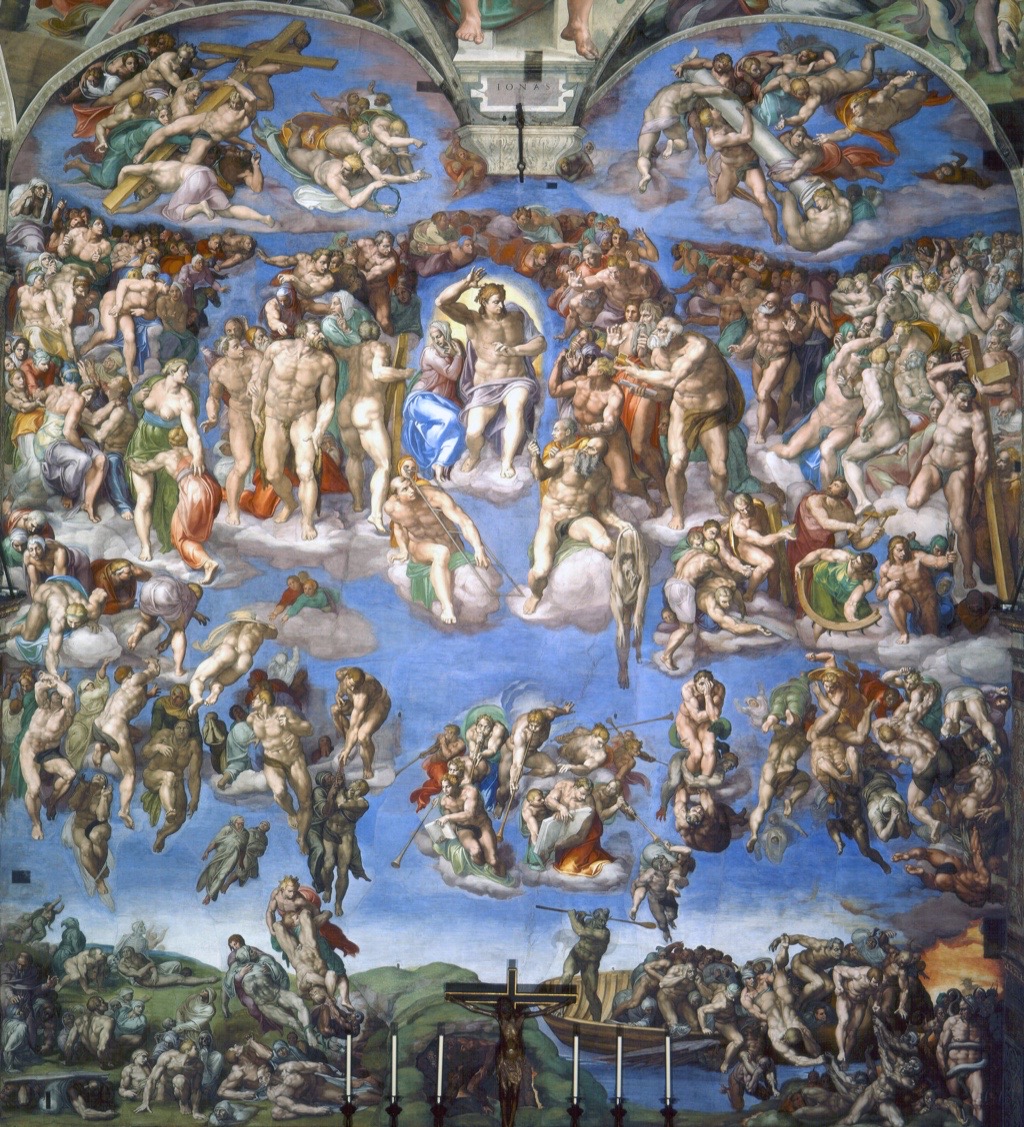
At the centre of Michelangelo's Last Judgement, Christ raises his right arm. The gesture seems to pass through the immense wall like a shock. Bodies turn around it, rise toward it or recoil from it. Mary folds close to Christ's side. Saints display the instruments of their deaths. Angels sound trumpets beneath them; graves open; skeletons regain flesh; the blessed are hauled upward and the damned fight a descent they cannot stop.
The fresco covers the altar wall of the Sistine Chapel, not its ceiling. Michelangelo began painting it more than twenty years after the ceiling was finished, under another pope and in a transformed religious and political world. The earlier programme unfolds creation, prophecy and ancestry through painted architectural compartments. The Last Judgement removes those divisions. Hundreds of figures share one blue field and one final instant.[1]
Its fame has often narrowed around two stories: the supposed self-portrait on a flayed skin and the draperies added over its nudes. Both belong to the work, but neither explains its power. The wall confronts viewers with bodies subjected to time, death, resurrection, judgement and irreversible change. Its drama lies not in nakedness alone, but in the fact that no figure can remain still.
At a Glance
- ArtistMichelangelo Buonarroti
- TitleThe Last Judgement (also spelled The Last Judgment)
- DateCommissioned in 1533; prepared during the mid-1530s; painted 1536–1541
- MediumFresco
- LocationAltar wall, Sistine Chapel, Vatican City
- First patronPope Clement VII
- Continuing patronPope Paul III
- SubjectThe return of Christ, resurrection of the dead and judgement of humanity
- Central figuresChrist and the Virgin Mary
- Upper lunettesAngels carrying instruments of the Passion
- Lower centreTrumpeting angels and books of judgement
- Lower leftResurrection and ascent
- Lower rightStruggle, descent, Charon and Minos
- Historic alterationCovering draperies begun by Daniele da Volterra in 1565
- Major modern restoration1990–1994
- Recent conservationExtraordinary maintenance completed 27 March 2026[1][2][3]
Contents
- An Ending Painted into an Existing Chapel
- A Commission That Crossed Two Papacies
- Drawing a Multitude
- Christ at the Centre of the Storm
- How One Continuous Wall Becomes Legible
- Revision as Part of the Design
- Mary Beside the Judge
- Saints and the Instruments of Memory
- Trumpets, Books and Opened Graves
- The Descent of the Damned
- Nakedness and the Meaning of the Body
- Criticism and the Campaign of Covering
- Colour, Fresco and the Restored Wall
- The 2026 Conservation Discovery
- What the Ceiling Changes
- Other Works Seen Through the Wall
- Artist Up Close
- A Wall That Will Not Settle
Annotated Details from The Last Judgement
The annotated view keeps the whole altar wall in sight while isolating four major zones: the Passion instruments above, Christ and Mary at the centre, the trumpet group below and the damned driven toward Charon and Minos.
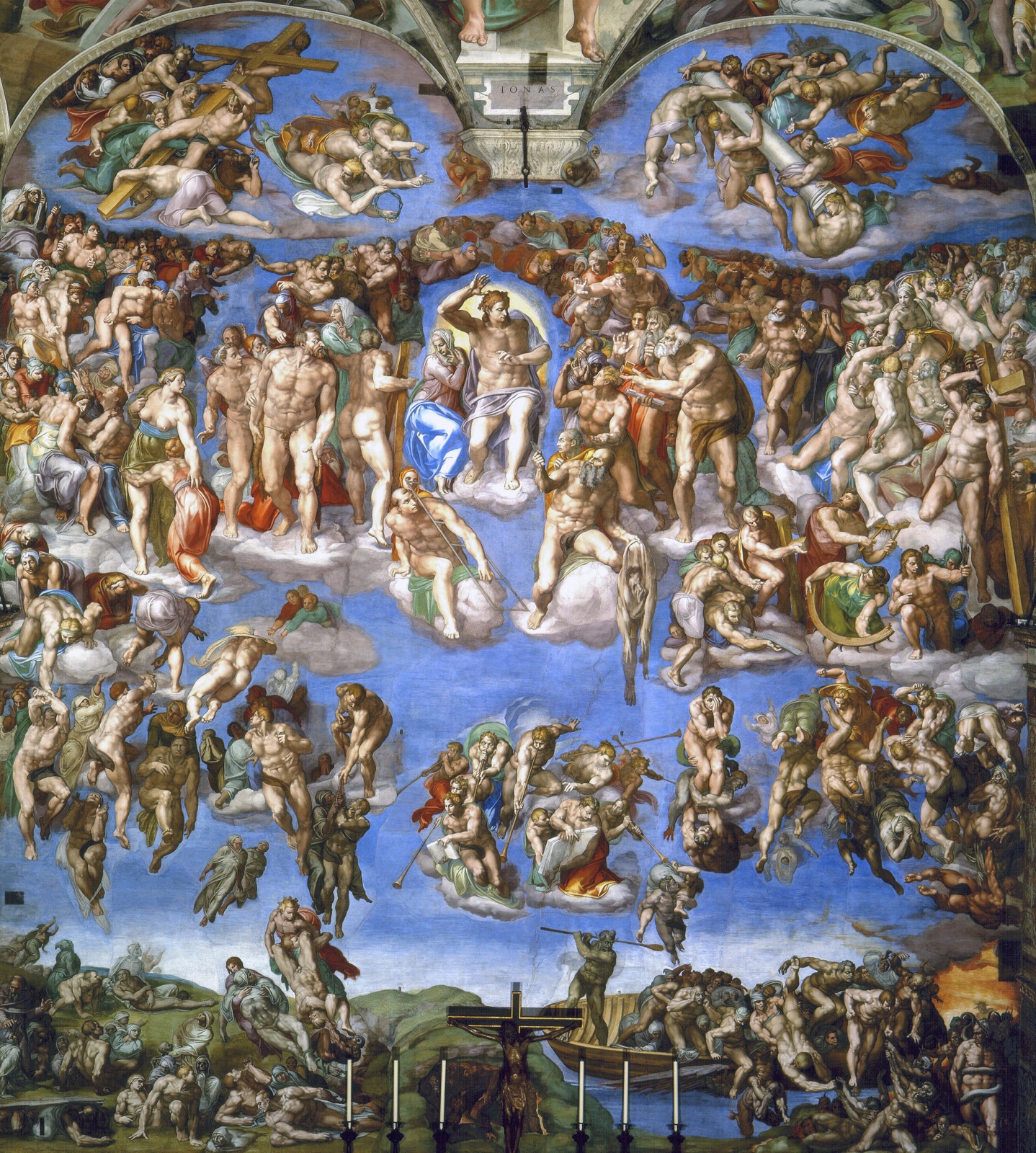
Details from THE LAST JUDGEMENT
Close looking highlights the wall's major zones while keeping image-source and rights notes in the references.
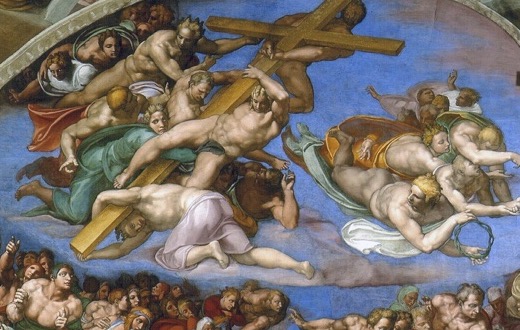
Passion instruments
Angels strain beneath the Cross and other instruments of Christ's Passion, linking judgement to sacrifice rather than to spectacle alone.
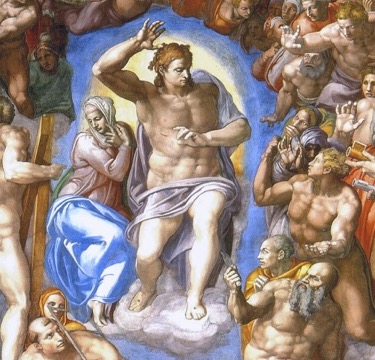
Christ and Mary
Christ's raised arm initiates the wall's movement, while Mary folds beside him in a central but very different posture.
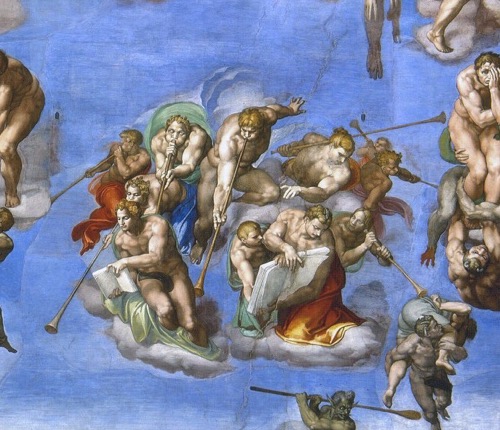
Trumpets and opened books
The trumpet angels and open books form a lower centre of announcement and record beneath the turning field of bodies.
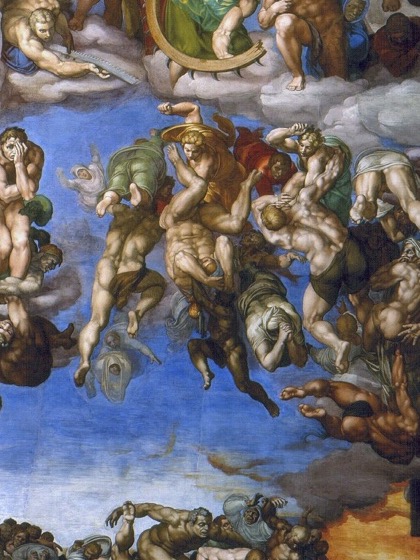
The damned, Charon and Minos
At the lower right, classical figures adapted through Dante help organise the descent into hell and the panic of the damned.
An Ending Painted into an Existing Chapel
The altar wall was already decorated when Michelangelo received the commission. Perugino's Assumption of the Virgin occupied the liturgical focus, and the first episodes of the paired Moses and Christ cycles began nearby. Two lunettes by Michelangelo sat above. Making a continuous field for the new fresco removed all of them.[2]
The loss matters because it defines the ambition of the project. The Last Judgement did not ornament an empty surface. It replaced part of a revered fifteenth-century design and interrupted the original symmetry of the long walls. The beginning of both narrative cycles disappeared so that the end of earthly history could dominate the altar.
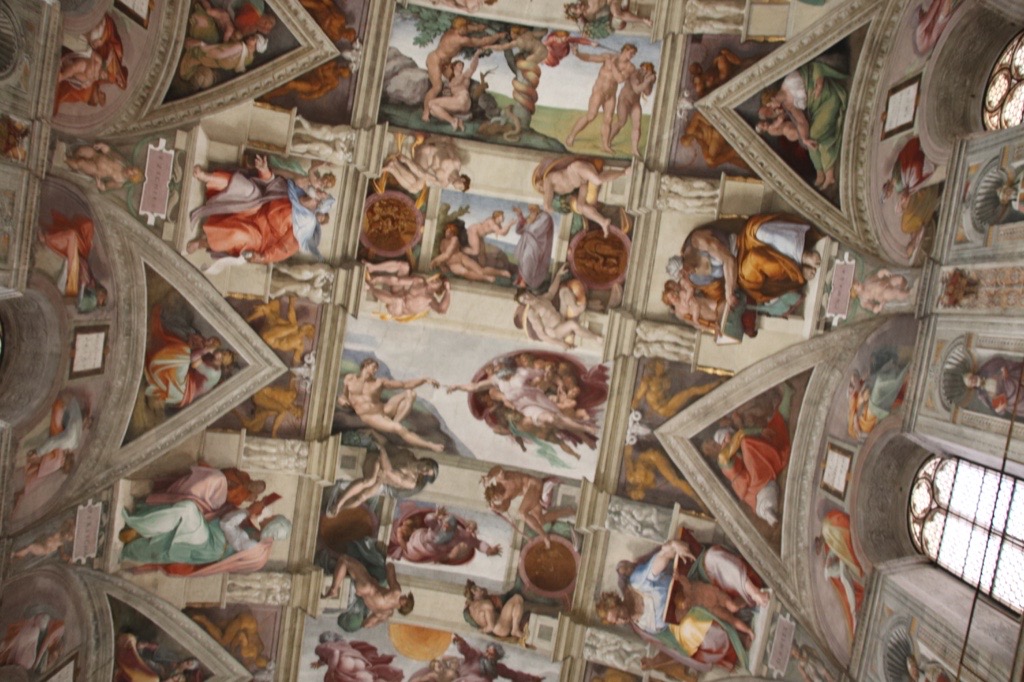
The relation to the ceiling is equally exact. Michelangelo had painted the vault and upper lunettes between 1508 and 1512. Its centre contains nine scenes from Genesis; around them are prophets, sibyls, ancestors, nude youths, medallions and four corner narratives. The later wall belongs to the same artist and room but not to the same commission.[4]
From the chapel entrance, the altar wall terminates the entire architectural axis. Its vertical field rises behind the real altar and beneath Jonah on the ceiling. Worshippers, clergy and conclave electors do not encounter it as a portable painting at comfortable eye level. They stand physically below a vision of resurrection and judgement that seems to occupy the wall rather than hang upon it.
The replacement also produced an expressive reversal. The lost Assumption had centred the Virgin, fitting the chapel's dedication to Our Lady of the Assumption. In Michelangelo's fresco Mary remains next to Christ, but the action no longer belongs to her ascent. She withdraws toward the judge as the whole of humanity rises or falls around them.
A Commission That Crossed Two Papacies
Clement VII gave Michelangelo the task late in 1533. The artist was then approaching sixty and had spent much of the preceding decade entangled in Medici projects in Florence. Clement died in September 1534 before the wall could be executed. Paul III confirmed the undertaking, drew Michelangelo permanently into Roman service and sustained the monumental plan.[2][5]
Preparation began before painting. Drawings datable to about 1534 explore falling figures, angels and clusters of bodies. The altar wall itself had to be made ready; scaffolding was erected in 1535. Michelangelo began fresco execution in 1536 and worked until 1541, when the finished wall was unveiled in the autumn.[2][3]
The separate dates prevent an apparently simple range from concealing the work's development. “1536–1541” names the painting campaign. The commission and first designs reach back to Clement VII, while the completed surface belongs to Paul III's reign. Ideas formed on paper before they were committed to wet plaster, and some continued to change during execution.
The political setting had altered sharply since the ceiling. Rome had endured the catastrophic Sack of 1527. The Protestant Reformation had fractured Western Christianity, and calls for Catholic reform had intensified. The Council of Trent would not open until 1545, after the fresco's completion, so the work should not be described as a straightforward product of Tridentine decrees. It nevertheless emerged within the spiritual anxiety and institutional pressure that made sacred representation a matter of exceptional consequence.[6]
Michelangelo's own religious life had also deepened. In Rome he formed important friendships within spiritually reforming Catholic circles, including Vittoria Colonna. Drawings and poems from his later decades return insistently to guilt, mercy, Christ's sacrifice and the limits of art. None supplies a coded explanation of every figure on the wall, but they prevent the fresco's fear and bodily exposure from being treated as mere theatrical spectacle.[5]
Drawing a Multitude
The wall feels overwhelming because it hides the labour by which it was ordered. Surviving sheets disclose a process that moved between broad groups and concentrated bodily problems. A British Museum drawing of falling figures, made about 1534, layers muscular nudes into an organic mass. Its figures do not transfer unchanged to the fresco. They show Michelangelo testing how separate bodies might lock together without becoming a rigid pattern.[7]
Another sheet studies a flying angel in extreme foreshortening. The body is seen from below and compressed into a difficult turn, with other figures added nearby. The museum records the suggestion that Michelangelo may have used a small sculptural model while developing the pose, though this remains a proposal rather than a documented fact.[8] Living models, memory of antique sculpture, drawn invention and perhaps three-dimensional aids could all contribute to a figure no ordinary body could hold in flight.
A black-chalk torso has been connected with St Bartholomew. The attribution and precise destination have been debated, and the final saint differs from the study. That distance is useful. Michelangelo did not draw merely to copy a pose onto plaster; drawing allowed him to turn, abandon and recombine possibilities.[9]
Only a small portion of the preparatory campaign survives. The absence of a sheet for a given figure does not prove spontaneous execution, and the existence of a study does not make every line a fixed instruction. The British Museum's late-career material shows stages ranging from rapidly entangled ideas to forcefully modelled limbs and bodies.[5]
Fresco then imposed another discipline. Pigment had to be applied to fresh finishing plaster in areas that could be completed before drying. The full wall could be planned for years, but each day's work required final decisions about contour, colour and modelling. Changes made while painting therefore exist within a surface divided by practical working sessions.
Christ at the Centre of the Storm
Christ is not enthroned in static symmetry. He turns. The raised right arm and the arm crossing his torso create a compact, forceful rotation, while the head turns in the opposite direction. His body is massive, youthful and exposed. The wounds of the Passion are present, but the dominant impression is active power.[1]
Around him, the composition behaves like a weather system. The surrounding saints do not line up in calm ranks. They lean, cluster and curve through cloud-bands whose stability is never certain. The movement radiates outward, then returns through the opposing currents below.
The gesture has often been described as condemning, blessing or setting the universe in motion. Its visual function can be stated more securely: every nearby body appears to answer it. Figures at Christ's right rise or turn inward; those at his left recoil and descend. The arm defines an instant before separation is complete, when judgement is becoming physical consequence.
Christ's form draws on Michelangelo's knowledge of heroic antique bodies, yet the figure is not simply a pagan god relabelled. His centrality, wounds and relation to the Passion instruments establish Christian identity. Classical bodily authority has been made to carry eschatological power.
The lack of a throne matters. Christ is supported by a cloud, but his body supplies the main structure. In earlier Last Judgements, architectural tiers or mandorlas could divide heaven from earth and the saved from the damned. Michelangelo makes anatomy do much of that organising work. An arm, turn or line of sight changes the fate of the space around it.
How One Continuous Wall Becomes Legible
The absence of painted architecture does not mean the composition is formless. Michelangelo organises the wall through several overlapping systems: horizontal bands of cloud, the central rotation around Christ, the trumpet group below, and the opposed diagonals of ascent and descent. These structures can be felt before every saint or episode is identified.
At the greatest distance, the wall resolves into large pressures. The central group forms a dense oval. Above it, the Passion instruments pull toward the upper corners. Below, a narrow horizontal interval around the trumpets separates the heavenly company from the newly rising dead. The lower corners then divide into a climbing current and a falling one.
At closer range, those broad masses break into smaller chains. A hand grips a wrist; one body supports another at the waist; a knee presses behind a shoulder; gazes lead toward Christ or away from him. Michelangelo repeatedly joins figures through contact so that no outline remains entirely independent. The composition can therefore expand from an individual touch to the fate of a multitude.
Clouds provide support without behaving like stable floors. Their curved edges echo the bodies they carry, and figures overlap them so heavily that the distinction between resting and floating becomes uncertain. The cloud-bands keep groups readable while refusing the rigid tiers common in earlier judgement imagery.
Colour takes over another task once painted frames disappear. Blue separates flesh silhouettes across most of the wall; flashes of cloth punctuate clusters; light and dark modelling help bodies detach from one another. The restored palette makes this organisation easier to perceive. Michelangelo's colour is not an ornamental layer placed on a sculptural design. It is part of the design's spatial grammar.
The Christ group remains the governing measure. Large saints crowd close to him, while bodies generally diminish toward the lower distance. Yet Michelangelo does not apply perspective mechanically. A figure may be enlarged because its gesture must carry from the floor or because it anchors a turn in the composition. Monumentality is distributed according to visual responsibility.
This double readability—mass at a distance, bodily relation in detail—helps explain why the fresco survives reproduction better than might be expected, while still losing much of its force. A full-wall image preserves the currents but miniaturises every contact. A detail restores touch and expression but removes the judgement that gives them direction.
Revision as Part of the Design
The British Museum studies show that Michelangelo did not protect every early idea. Falling bodies shift position; a proposed torso is reoriented; an angel's foreshortening is tested without becoming a fixed template.[7][8][9] The ability to relinquish a powerful drawing was essential to fitting hundreds of inventions into one field.
Revision also continued on the plaster. A composition of this scale cannot be reduced to a single lost cartoon transferred whole. Separate studies and cartoons approached different figures and groups, while daily plaster areas committed them to the wall. Adjustments of contour and relation accumulated across the five-year painting campaign.
This helps account for the wall's controlled irregularity. Symmetry is proposed and then disturbed. The rising and falling sides answer each other without becoming mirror images. Christ and Mary form a central pair whose poses are radically unequal. Figures with recognisable attributes coexist with anonymous bodies whose meanings come entirely through action.
The final result feels discovered rather than diagrammed, though discovery depended upon rigorous preparation. Michelangelo preserved the energy of alternatives inside a coherent whole. Bodies appear capable of moving beyond their positions because the process that formed them had already imagined other positions.
Mary Beside the Judge
Mary sits close against Christ and turns inward. Her body is smaller and more enclosed, her arms gathered near the torso. The Vatican Museums interprets her posture as recognition that intercession has ended: judgement is under way, and she can only await its result.[1]
That is a theological reading supported by the official account, not a caption written by Michelangelo. Visually, the contrast is unmistakable. Christ expands into the wall; Mary contracts. His limbs command surrounding space; hers preserve a private enclosure within it.
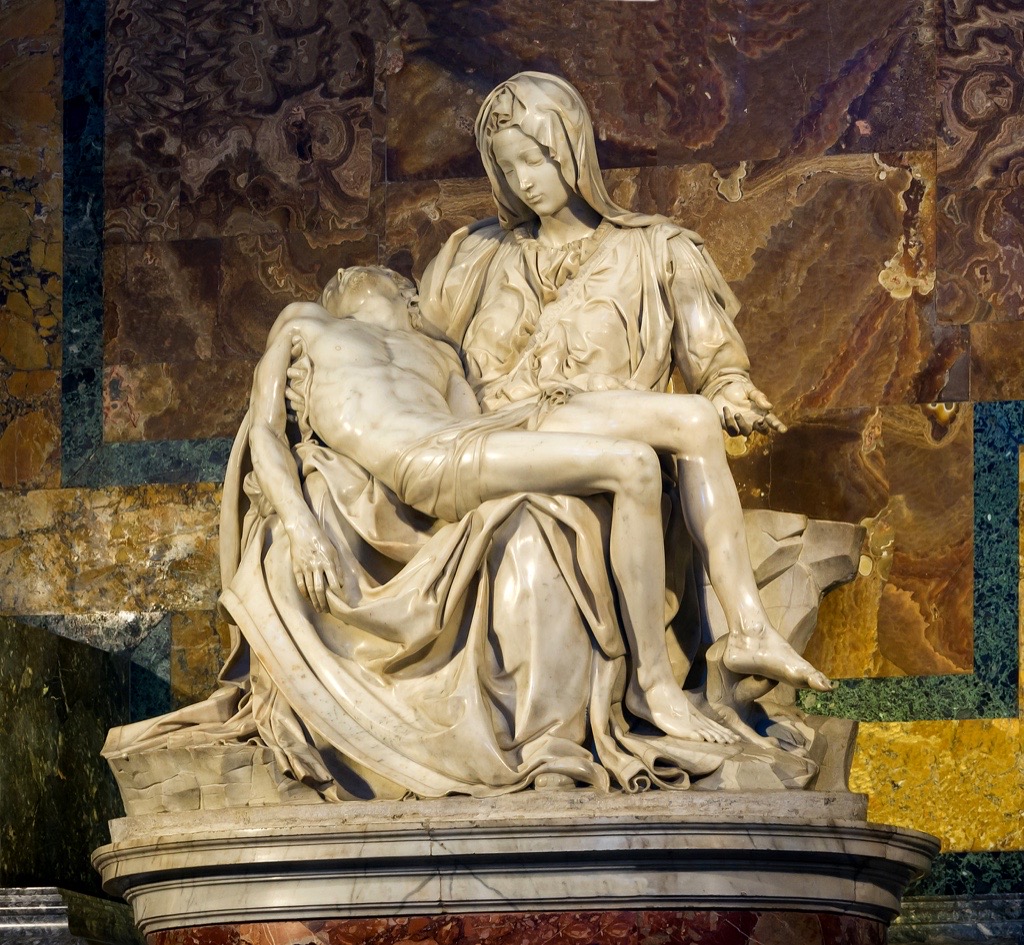
Her position gains force from what the new fresco replaced. Perugino's lost Assumption had made the Virgin the subject at the altar. Michelangelo retains her at the centre of the new wall but transforms her role. She is neither the ascending focus nor the monumental mother supporting Christ's body, as in the Vatican Pietà. She is a witness beside the risen judge.[10]
The closeness of the pair does not create tranquillity. Mary's withdrawal intensifies the judgement's finality. If the traditional intercessor turns inward, the viewer confronts a moment beyond ordinary petition. Yet her curved figure also tempers Christ's hard diagonals, giving the centre an asymmetrical unity rather than a single burst of force.
Saints and the Instruments of Memory
The dense company around Christ becomes partly legible through objects. Peter holds the keys. Lawrence carries the gridiron on which he was martyred. Catherine of Alexandria appears with a broken wheel; Sebastian holds arrows. Bartholomew displays the knife of his flaying and the loose skin removed from his body.[1]
These attributes do several things at once. They identify saints within a crowd, recall individual histories of suffering and connect those histories to the wounds of Christ. The blessed company is not physically perfected by forgetting pain. Instruments of death have entered eternity as signs of identity.
Above the central group, angels carry the column, cross, crown of thorns, nails, ladder, spear and sponge associated with the Passion. The objects are enormous and heavy. Figures strain beneath the cross and column, turning emblems into material burdens. Judgement is thereby grounded in the suffering that preceded resurrection.[1]
Bartholomew's skin produces the most disturbing variation. The saint's living body is restored, yet he holds the evidence of its destruction. On the sagging face of the skin appears a likeness long recognised as Michelangelo's. The identification is widely accepted but not signed or explained in a surviving statement by the artist.[1]
The self-reference, if intended, is profoundly unstable. Michelangelo does not place himself in the saint's glorified body but in its empty covering: a face without supporting flesh, held between Christ and the abyss below. It may evoke humility, spiritual anxiety, bodily mortality or artistic self-scrutiny. No single surviving text fixes the meaning.
The distinction between the skin and Bartholomew's face is crucial. The saint is not a portrait of Michelangelo. The likeness belongs to what has been shed. The image therefore divides identity between a resurrected body and a collapsed surface—an especially charged idea for a painter whose own image is made of pigment on plaster.
Trumpets, Books and Opened Graves
Beneath Christ, wingless angels sound long trumpets. Their compact horizontal group interrupts the broader rotation and sends a command toward the lower zones. Other angels hold two books traditionally understood as records of those judged. The larger volume opens toward the descending side.[1]
The difference in size invites interpretation, but the books contain no readable catalogue from which viewers can calculate the exact numbers of saved and damned. Their visual role is to make judgement both proclaimed and recorded. Sound travels outward while written authority appears fixed.
At lower left, the earth releases its dead. Skeletons acquire muscle and skin; bodies push free of the ground; shrouds loosen. Michelangelo compresses successive phases of resurrection into a single area. The viewer can move from bone to partially recovered flesh to complete, ascending bodies without finding one literal timeline.
The physicality is deliberate. Resurrection is not represented by transparent spirits drifting upward. Bodies return through effort, assistance and contact. One figure pulls another; rosary beads become a line by which two souls rise; cloth supports weight. Salvation has a communal current.
This upward motion remains uncertain at its lower edge. Figures look back, brace themselves and struggle against gravity. The blessed are not uniformly weightless, just as the damned do not descend without resistance. Michelangelo holds both groups in transition rather than showing a settled heaven and hell.
The recovery of flesh also connects the lower wall to the rest of his art. For decades Michelangelo had treated the body as the primary bearer of meaning in marble, paint and drawing. Here, the Christian doctrine of bodily resurrection gives that artistic commitment its largest possible subject. Anatomy becomes not a display beside theology but its visible medium.
The Descent of the Damned
At lower right, movement turns violent. Demons grip legs and hair; angels strike; bodies twist to escape. A despairing figure covers part of his face while a serpent coils around him. He has often been called the “damned soul,” but his power lies in the absence of a secure personal identity. Terror becomes legible without biography.
No boundary cleanly separates the condemned from those still struggling. Bodies knot together and directions conflict. Some plunge headfirst; others look upward as they are dragged away. The continuous blue ground makes descent feel less like entry into a separate compartment than expulsion from the central order.
At the bottom, Charon drives souls from his boat with an oar. Minos waits at the infernal threshold, a serpent wrapped around his body. Michelangelo drew these figures from classical mythology as mediated by Dante's Inferno, which gives both roles in the organisation of hell.[1]
Their inclusion does not turn the wall into an illustration of Dante. New Testament judgement, Christian resurrection, saintly attributes, Passion symbolism, classical bodies and Dantean imagery coexist. Renaissance sacred art could absorb poetic and ancient sources without surrendering its Christian subject.
A celebrated story identifies Minos's face with Biagio da Cesena, a papal official who criticised the fresco as more suitable for baths or taverns than a chapel. Vasari transmitted the anecdote, and the Vatican Museums recount it as part of the work's reception.[1] It is vivid, but it remains an anecdotal tradition rather than an independently documented statement of revenge by Michelangelo.
The lower right is often reproduced more darkly than the rest of the wall, intensifying the idea of hell as a separate black zone. In the restored fresco, vivid colour continues through the falling bodies. Damnation is defined by movement, expression and violent relation, not by a simple switch from light to darkness.
Nakedness and the Meaning of the Body
The fresco's nudity is not incidental. Humanity is judged in bodies returned by resurrection. Clothes would have supplied distinctions of rank, profession, wealth and period; Michelangelo largely strips those social markers away. Popes, martyrs, anonymous souls and mythic figures participate in one anatomical language.
This equality is not gentle. The body exposes vulnerability as well as dignity. Muscles cannot secure salvation; heroic form does not prevent fear. Some damned figures possess the same monumental strength as saints, but strength offers no escape from judgement.
Michelangelo also makes gender less easy to read than conventional costume would have done. Many women share the powerful proportions developed through studies of male models. That practice reflects the working conventions of his drawing as well as his ideal of the monumental figure. It should not be reduced either to carelessness or to a hidden code about every body.
The altar location sharpened the issue. Nude figures had occupied Michelangelo's ceiling since 1512, but the unbroken expanse behind the altar placed resurrected flesh at the centre of liturgical attention. Critics could praise the fresco's art while objecting to its decorum.
Nudity thus belongs simultaneously to doctrine, form and reception. It visualises resurrection; it permits Michelangelo to coordinate the wall through anatomical motion; and it became the focus of arguments about what sacred art should show. Removing any one of those histories oversimplifies the work.
Criticism and the Campaign of Covering
Objections accompanied the fresco's unveiling and intensified during the era of Catholic reform. They were neither a unanimous verdict nor a single event. Admirers recognised an astonishing achievement; critics questioned the exposure and contorted display of holy bodies.[1][6]
In January 1564, a decision was taken to cover parts judged indecent. Michelangelo died on 18 February. The following year Daniele da Volterra began adding draperies, earning the nickname Braghettone, the “breeches maker.” Later hands added further coverings and made other alterations.[1][3]
Daniele was not simply a hostile stranger defacing the wall. He knew Michelangelo and worked within the older artist's circle. His intervention was authorised, and in some areas it involved more than dry paint laid harmlessly over the surface. Catherine and Blaise, for example, were partly altered rather than merely dressed.
The distinction between campaigns matters. “The breeches” are not one uniform layer. Some belong to the immediate post-Michelangelo response; others were added later. During twentieth-century restoration, conservators retained selected early coverings as historically significant while removing some later additions.[3]
The resulting wall is neither the exact state of 1541 nor a wholesale repainting. Michelangelo's composition remains dominant, carrying visible signs of institutional unease and adaptation. Those layers record a real history of sacred display. To erase them all would produce another modern interpretation rather than an uncomplicated return to origin.
Engravings and copies help reconstruct earlier states, but they also interpret. A print may reverse the image, clarify outlines, omit colour and alter covered details. Its value lies in being dated and understood as a separate object, not in pretending to be the wall itself.
Colour, Fresco and the Restored Wall
Before modern restoration, grime, dust, smoke and altered coatings muted the fresco. Dark reproduction encouraged a view of the late Michelangelo as almost monochromatic: a sculptor modelling bodies through sombre shadow. The 1990–1994 campaign revealed a far more varied surface.[3]
The blue ground is not empty. It separates silhouettes, sustains clouds and lets flesh tones remain distinct within the crowd. Green, rose, violet, orange and yellow move through drapery and bodies. Colour helps determine distance and direction where architecture no longer supplies frames.
Michelangelo's brushwork was made for viewing from the chapel floor. Close inspection can expose rapid passages and economical modelling that merge at distance. The enormous wall invites digital magnification, but an extreme close-up can misrepresent the intended relation among stroke, body and space.
Restoration required decisions about what belonged to Michelangelo's fresco, what had accumulated on it and what later interventions merited preservation. The Vatican conservation chronology situates the work within the larger programme that began in the chapel in 1979 and continued through the 1990s.[3] The intervention did not make the fresco “new”; it changed the balance of visible historical layers in accordance with documented conservation judgements.
The brighter result reactivated old questions. Does vivid colour intensify bodily violence or make the wall more beautiful? Does the separation of figures clarify judgement or reduce the sombre unity familiar from earlier photographs? Such responses show that condition affects interpretation. The work people thought they knew was partly an image made by centuries of deposits.
The 2026 Conservation Discovery
Continuing monitoring detected another change. By 2024, a faint whitish film had spread across The Last Judgement. It was almost invisible in ordinary looking but softened Michelangelo's shifting hues and vigorous light-dark contrasts. Scientific examination identified the deposit as calcium lactate.[11]
Vatican researchers detected lactic acid in the chapel atmosphere. They explained that its reaction with calcium ions naturally present in the fresco produced the pale salt. Because calcium lactate dissolves readily in water, the film could be removed through a controlled treatment using Japanese paper and distilled water.[11]
The extraordinary maintenance ran from 1 February to 27 March 2026. The chapel remained open behind a high-definition screen while restorers worked from scaffolding. Curators, conservators, scientific staff, restorers and building engineers collaborated, and the access allowed them to update the full condition record and review earlier reintegration as well as clean the surface.[11]
This was not a repetition of the 1990–1994 restoration. It was a targeted response within preventive care. Its significance lies partly in the small scale of the cause: chemistry in the air had altered how a monumental masterpiece looked. Human presence, climate control, surface materials and interpretation had become connected.
The Vatican's account also emphasises recurrence prevention. Air systems can adjust temperature, humidity, circulation and filtration, but conservation in a crowded living chapel cannot eliminate every variable. Regular inspection makes change visible before it becomes severe.
What the Ceiling Changes
Looking upward after facing the altar wall reveals two radically different systems. The ceiling establishes compartments. Its painted cornices and thrones separate Genesis stories, prophets, sibyls, ancestors, pendentives, ignudi and medallions. The altar wall refuses comparable barriers.[4]
The difference makes time visible. Genesis unfolds in episodes: creation of the universe, creation and fall of humanity, destruction and survival through Noah. Prophets and sibyls wait. The Last Judgement occurs all at once. Narrative sequence gives way to irreversible simultaneity.
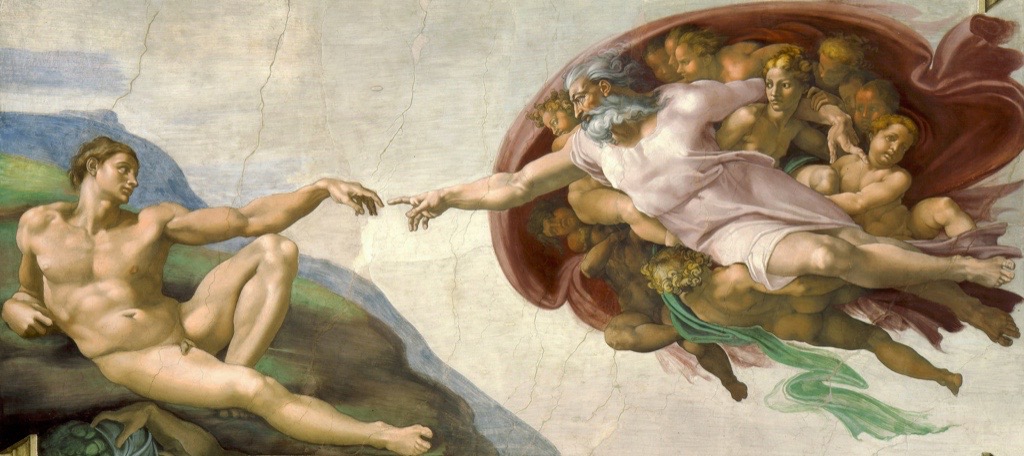
Bodies connect the campaigns. The creator God of the ceiling moves with enormous physical energy; Christ on the wall concentrates an even larger field around his gesture. The twisting Libyan Sibyl anticipates the rotations of resurrected bodies. Jonah's foreshortened pose directly above the altar makes the ceiling seem to open toward the judgement below.
Yet the later fresco is not merely the ceiling made darker or more crowded. Its continuous blue denies the stabilising fiction of architecture. Many bodies depend upon one another for ascent or become entangled in descent. The confident isolated monumentality of the earlier seated figures gives way to collective exposure.
The wall also changes the meaning of the whole chapel. Stories of creation and salvation now culminate visibly behind the altar, but the price of that culmination was the loss of earlier paintings. The masterpiece completes an arc while preserving, in its very dimensions, evidence of interruption.
Other Works Seen Through the Wall
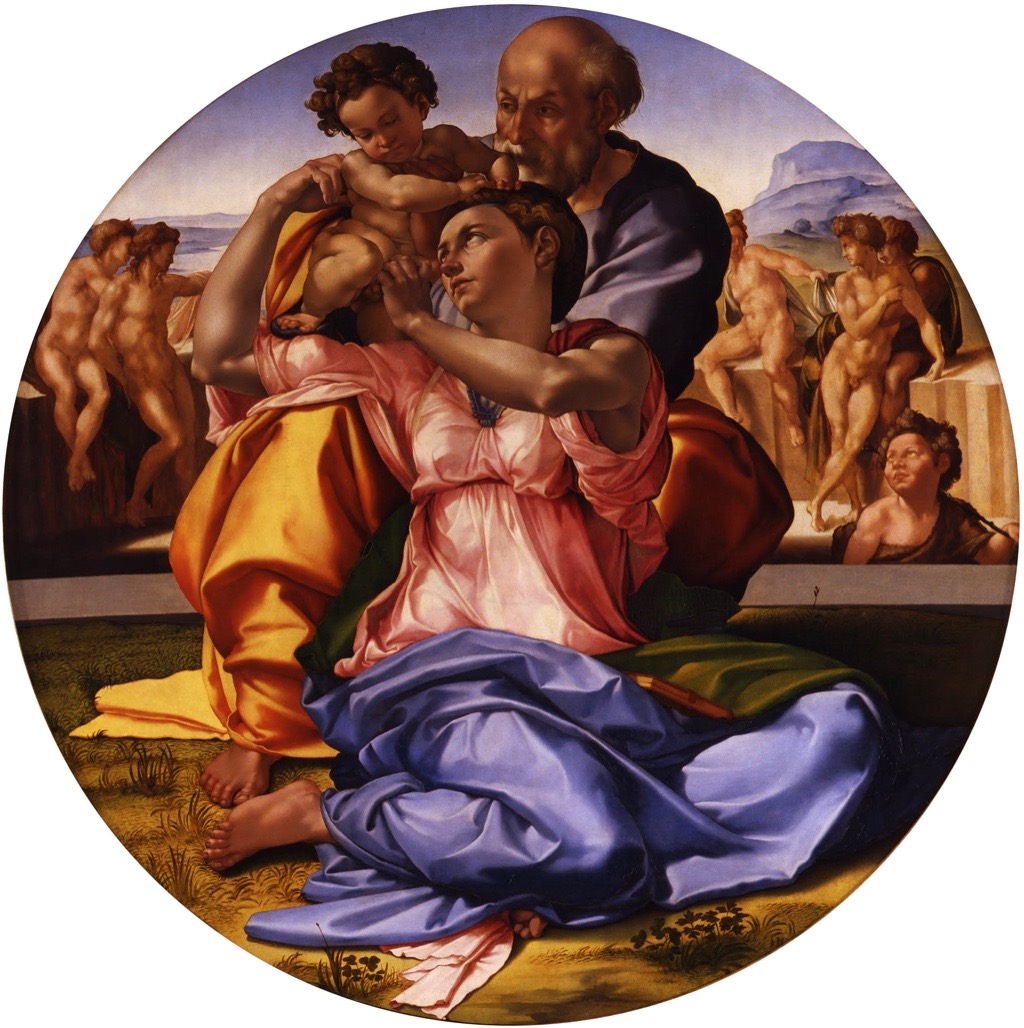
Michelangelo carried bodily problems across media. The Doni Tondo, painted around 1505–1506, turns the Holy Family into an interlocking spiral of limbs. Its portable circular panel and tempera grassa differ fundamentally from fresco, but the rotation anticipates the way bodies in the judgement generate structure rather than merely fill it.[12]
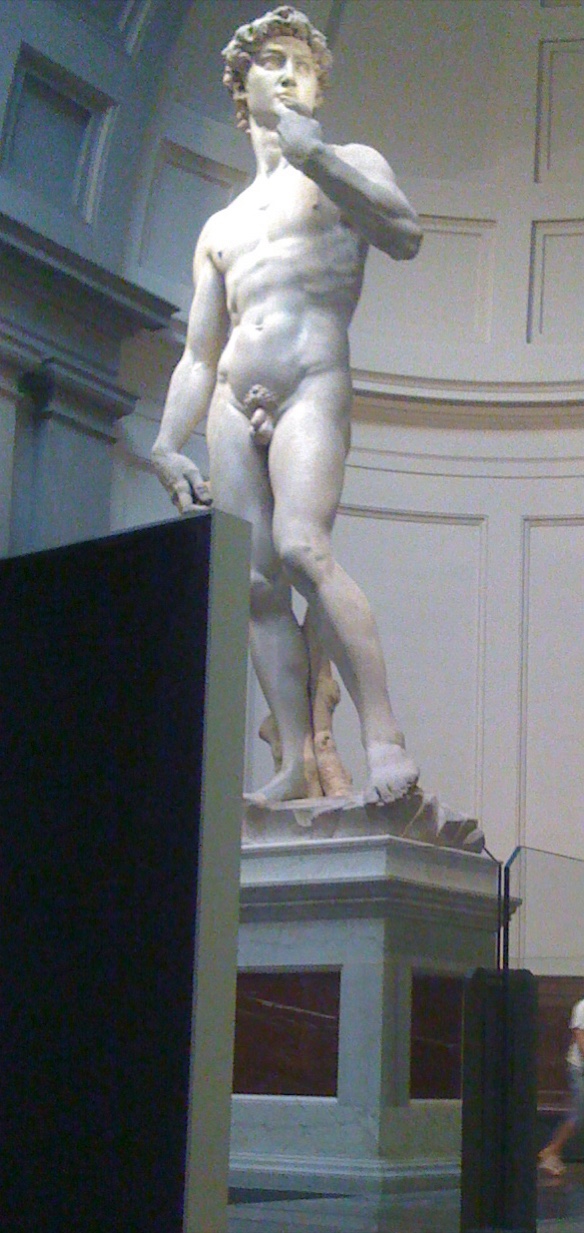
The David isolates a single figure before action. Every adjustment of weight serves withheld decision. The Last Judgement multiplies such moments until no solitary pose is sufficient: each body acts upon another, and the invisible opponent has become an all-encompassing divine verdict.[13]
In the Vatican Pietà, Mary supports Christ's dead body across a broad lap. Marble makes death heavy and touch tender. On the altar wall, the risen Christ no longer requires support; Mary contracts beside his active body. The comparison spans Michelangelo's career without turning one composition into a revision of the other.[10]
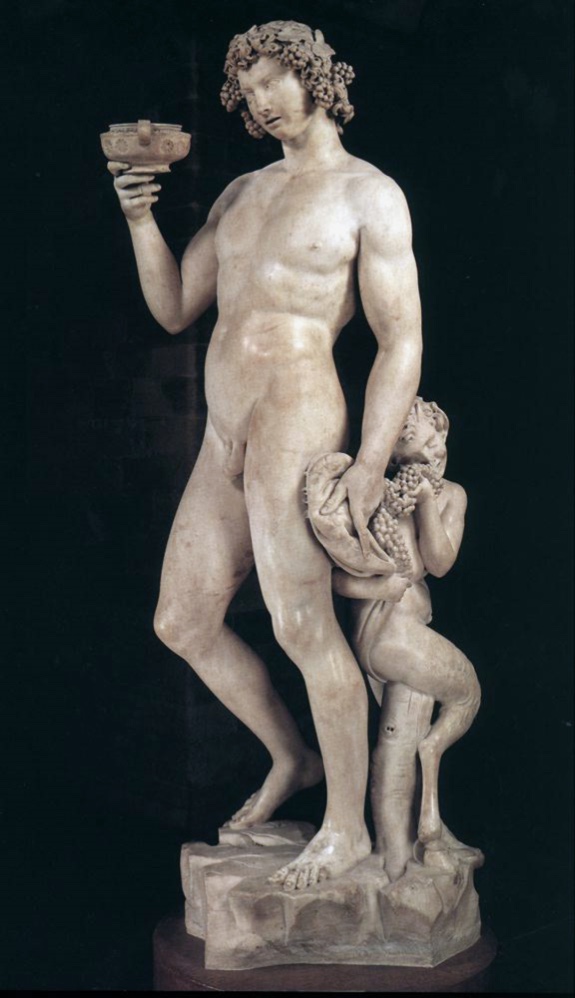
The early Bacchus tests instability through a swaying marble god and a small satyr. Charon and Minos show classical mythology re-entering Michelangelo's art under wholly different conditions. Ancient bodies and poetic characters have become participants at the boundary of Christian hell.[14]
Late drawings of the Crucifixion and Pietà would continue to reduce the number of figures and concentrate on Christ's sacrifice. The huge wall is therefore not the final form of Michelangelo's religious imagination. It stands at the beginning of decades in which he moved between public architecture, private drawings, unfinished marble and poetry.[5]
Artist Up Close
Michelangelo was about sixty-one when fresco painting began. The physical scale of the undertaking is extraordinary at any age, but its late position matters more than a simple story of endurance. The British Museum places the commission at the opening of his final, permanent Roman period, when papal demands would increasingly draw him from painting and sculpture into architecture.[15] By 1536 he had spent decades thinking through the ideal body. The Last Judgement tests whether bodily perfection can answer death.
The answer is unsettling. Resurrected flesh can become glorious, yet beauty does not guarantee salvation. Damned bodies remain powerfully made. Saints carry the tools that destroyed them. Michelangelo's own possible likeness inhabits a skin from which the body has gone. Anatomy is honoured and stripped of security at the same time.
His drawing practice made this complexity possible. Rather than relying on one general formula, he studied backs, torsos, legs, falls, flights and grips. Forms developed through revision. The finished wall creates immediacy out of preparation, a defining paradox of his art.
He also worked within authority while resisting simplification. Two popes maintained the commission; papal institutions altered the chapel for it; later authority required coverings. Michelangelo's fame did not place the work beyond governance, liturgy or controversy. Its history shows artistic invention negotiating institutions before, during and after execution.
The presumed self-image on the flayed skin has become emblematic because it condenses those tensions. A renowned maker inserts a likeness where authorship appears most fragile: a limp painted face held by someone else. It is tempting to read this as a final confession, but Michelangelo lived for another twenty-three years. The image is not his last word. It is one severe thought within a much longer late career.
A Wall That Will Not Settle
The event depicted is final, yet the fresco denies visual finality. Bodies remain in passage. Trumpets are sounding; flesh is forming; hands are pulling; demons are seizing; Christ's gesture has not completed its arc. The viewer sees judgement as motion before seeing it as destination.
Its later history continues that instability. Draperies changed bodies. Cleaning changed colour. Conservation revealed atmospheric chemistry altering the surface. Copies fixed states the wall no longer retains. The physical work has survived by being watched, debated and intervened upon.
What holds these histories together is not a single sensational detail but the fresco's demand that spiritual meaning become bodily relation. Weight, touch, strain and direction communicate who rises, who falls, who helps and who withdraws. Even the empty skin speaks through the way it hangs.
From the chapel floor, individual faces are difficult to possess. The whole field presses first: a human multitude gathered around an action no one controls except Christ. Close study can identify saints and sources, but distance restores the central truth. Michelangelo painted an ending too large for any one body to comprehend.
Frequently Asked Questions
Discussion
Choose one British Museum preparatory drawing and note what Michelangelo retained, moved or abandoned. Treat difference as evidence of design rather than error.
Reader Insights
Begin with Christ’s raised arm. Trace how bodies rotate around him, then compare the rising current at lower left with the downward pull at lower right.
Identify the altar wall, ceiling and fifteenth-century side-wall cycles. Ask how the room changes when the Last Judgement is treated as a later peer to the ceiling rather than part of it.
Find the keys, gridiron, skin, wheel and arrows. Consider how objects allow saints to remain recognisable inside a dense field of bodies.
Join the Conversation
Place a pre-restoration photograph beside an institutional image made after 1994 or 2026. Record changes in colour, contrast, crop and visible coverings before drawing conclusions about style.
References
- Vatican Museums, The Last Judgement, View source.
- Vatican Museums, Sistine Chapel: History, View source.
- Vatican Museums, The Sistine Chapel Twenty Years Later: New Breath, New Light, View source.
- Vatican Museums, Sistine Chapel: Ceiling, View source.
- British Museum, Michelangelo: The Last Decades—Large Print Guide, View source.
- Metropolitan Museum of Art, Michelangelo: Divine Draftsman and Designer—Exhibition Galleries, View source.
- British Museum, Studies for the Last Judgement: Groups of Falling Figures, View source.
- British Museum, Studies for the Last Judgement: A Flying Angel and Other Figures, View source.
- British Museum, Studies for Saint Bartholomew in the Last Judgement, View source.
- Vatican Museums, The Casts of the Three Pietà, View source.
- Vatican Museums, Completion of the Extraordinary Maintenance of Michelangelo's Last Judgement, View source.
- Uffizi Galleries, Holy Family, Known as the Doni Tondo, View source.
- Galleria dell'Accademia, Michelangelo's David, View source.
- Musei del Bargello, Michelangelo: The Fullness of the Renaissance, View source.
- British Museum, Michelangelo: The Last Decades, View source.