

 by Tom Gurney
Tom Gurney BSc (Hons) is an art history expert with over 20 years experience
Published on June 19, 2020 / Updated on November 6, 2025
Email: tomgurney1@gmail.com / Phone: +44 7429 011000
Bacchus by Michelangelo
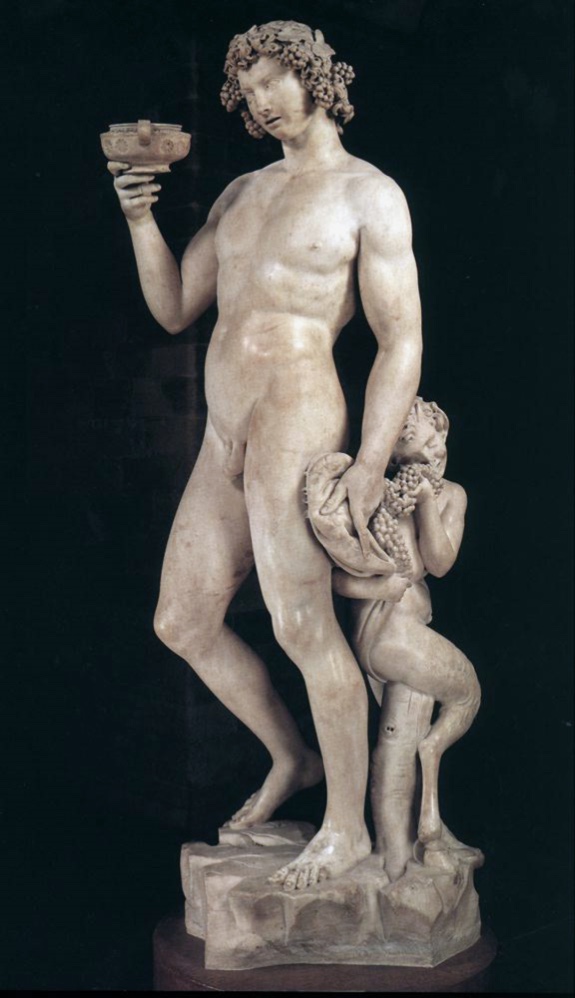
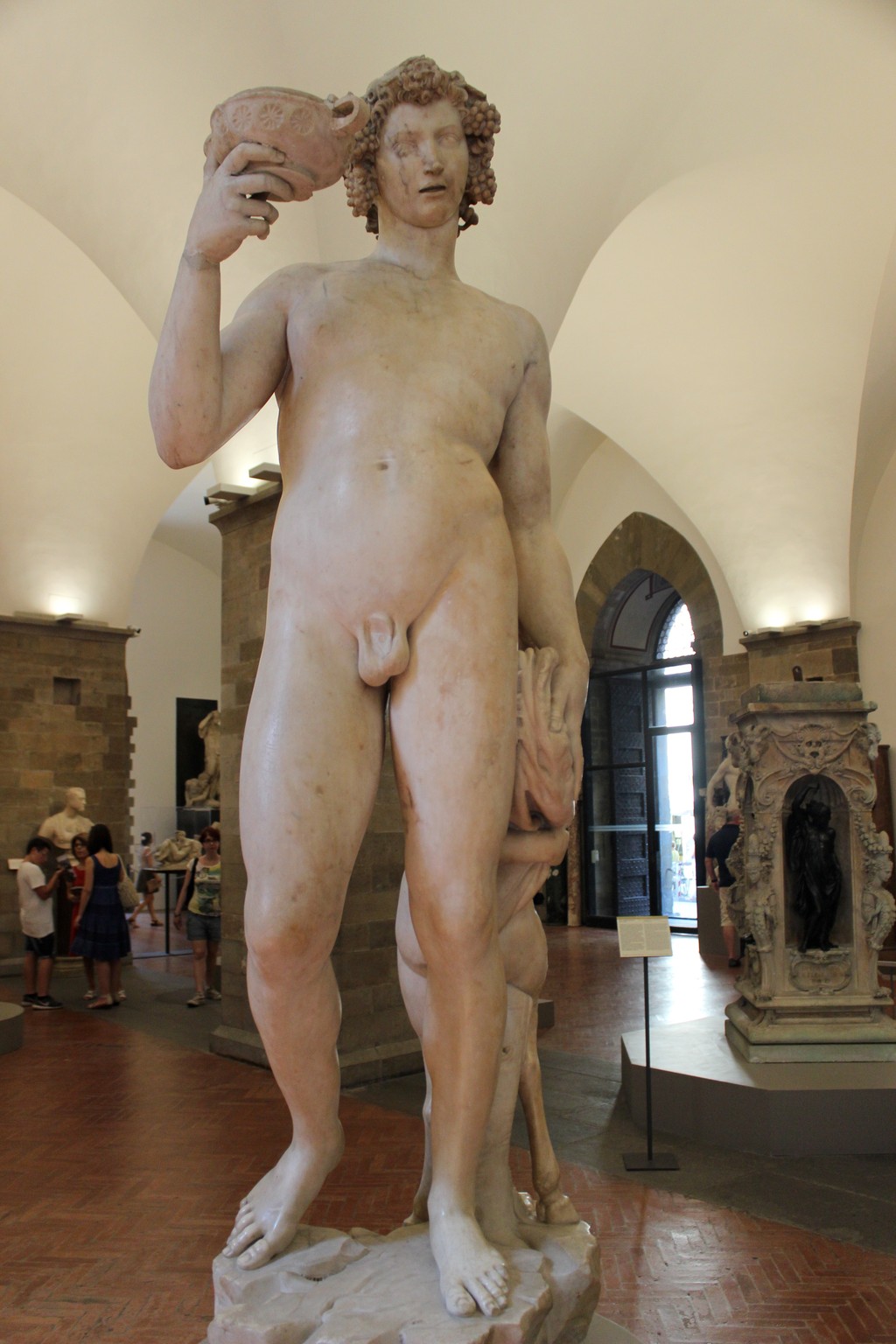
Michelangelo’s Bacchus is a life-size marble god who seems to be losing command of his own body. He raises a wine cup, but his gaze does not settle firmly upon it. His shoulders turn, his belly relaxes and his weight shifts through a standing pose that looks stable from one angle and precarious from another. Behind his left leg, a small satyr eats grapes from the bunch in the god’s lowered hand. The support is therefore also a participant in the story: appetite gathers around a figure altered by wine.
Carved in Rome in 1496–1497, the group belongs to the beginning of Michelangelo’s public career. Cardinal Raffaele Sansoni Riario commissioned it, but it passed to the Roman banker and collector Jacopo Galli after the cardinal was dissatisfied. It later entered the Medici collections and is now in the Museo Nazionale del Bargello in Florence. The history matters because the work was first seen among antiquities in a Roman garden, not in the Florentine museum where it stands today.
The sculpture’s unusual power lies in its refusal to present a simple heroic ideal. Michelangelo studied the language of ancient statuary, then used it to embody intoxication: beauty is joined to soft flesh, an unfocused expression and a balance that continually threatens to fail. That combination has encouraged moral, erotic, religious and autobiographical readings. None should be mistaken for a surviving statement of Michelangelo’s complete intention.
At a Glance
- ArtistMichelangelo Buonarroti
- TitleBacchus; catalogued in Italy as Bacco e satiro (Bacchus and Satyr)
- DateJuly 1496–July 1497
- MediumWhite marble
- Height207 centimetres including the base
- Current locationMuseo Nazionale del Bargello, Florence
- InventoryBargello Sculture 10
- PatronCardinal Raffaele Sansoni Riario
- First documented owner after the commissionJacopo Galli
- SubjectThe wine god Bacchus, intoxicated and accompanied by a grape-eating satyr
- Primary attributesWine cup, grapes, vine leaves, animal pelt and satyr
- Condition cautionEarly drawings record damage to the raised right hand and losses elsewhere; the dates, agents and motives behind every alteration are not known
- Interpretive cautionDrunkenness is visible, but its moral, religious or personal meaning must remain attributed
Contents
- The original marble in the Bargello
- Cardinal Riario, Jacopo Galli and the first Roman setting
- A wine god made physically drunk
- Balance that changes as the viewer moves
- The satyr, grapes, cup and pelt
- Classical form without a single known prototype
- Carving softness, tension and support from marble
- Damage, repair and the limits of the surviving object
- From Roman garden to Florentine museum
- Bacchus within Michelangelo’s early sculpture
- Artist Up Close
Annotated Details from Bacchus
The annotated view follows the statue’s deliberate instability, from the cup and wreath to the small satyr and shifting balance. The approved annotation image uses Tom’s selected option A source, with source and licence recorded in the references.[14]
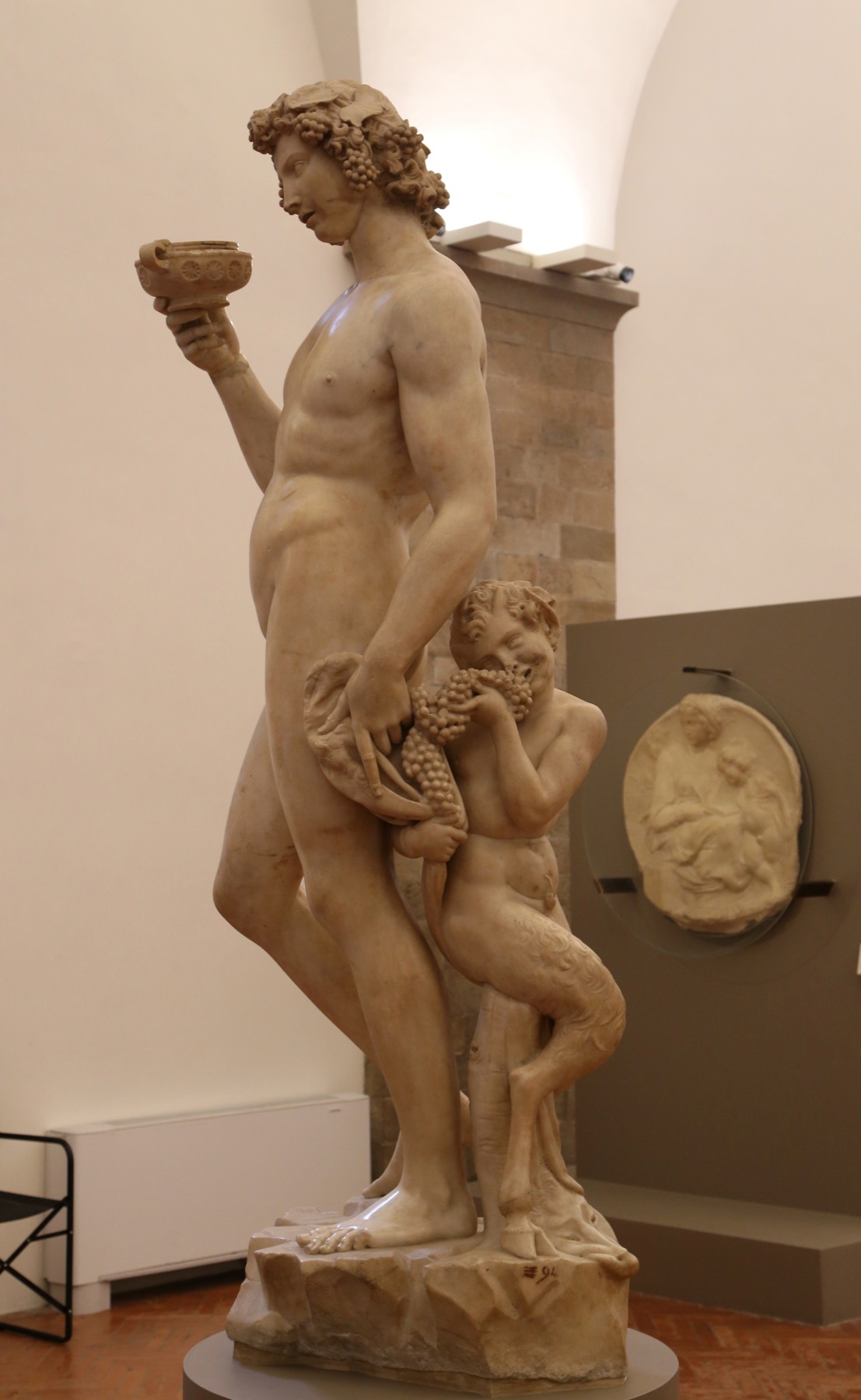
Details from BACCHUS
Close looking highlights the visual details that matter most on this Michelangelo page while keeping image-source and rights notes in the references.
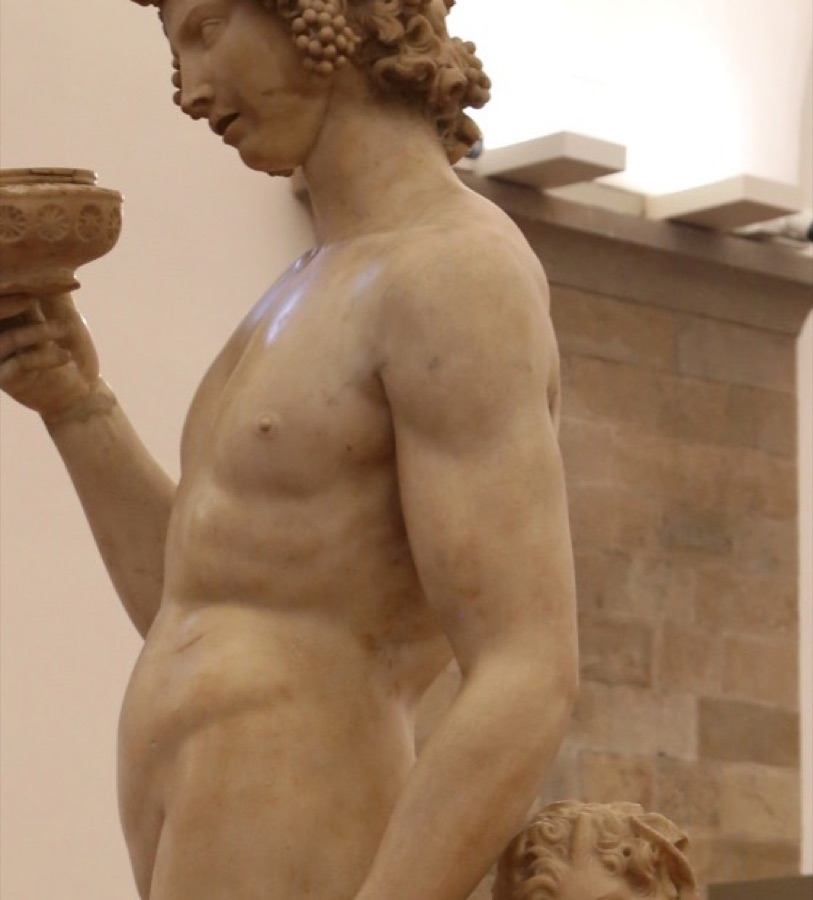
Cup and torso
The raised cup and soft torso establish Bacchus as both divine and physically unsteady.
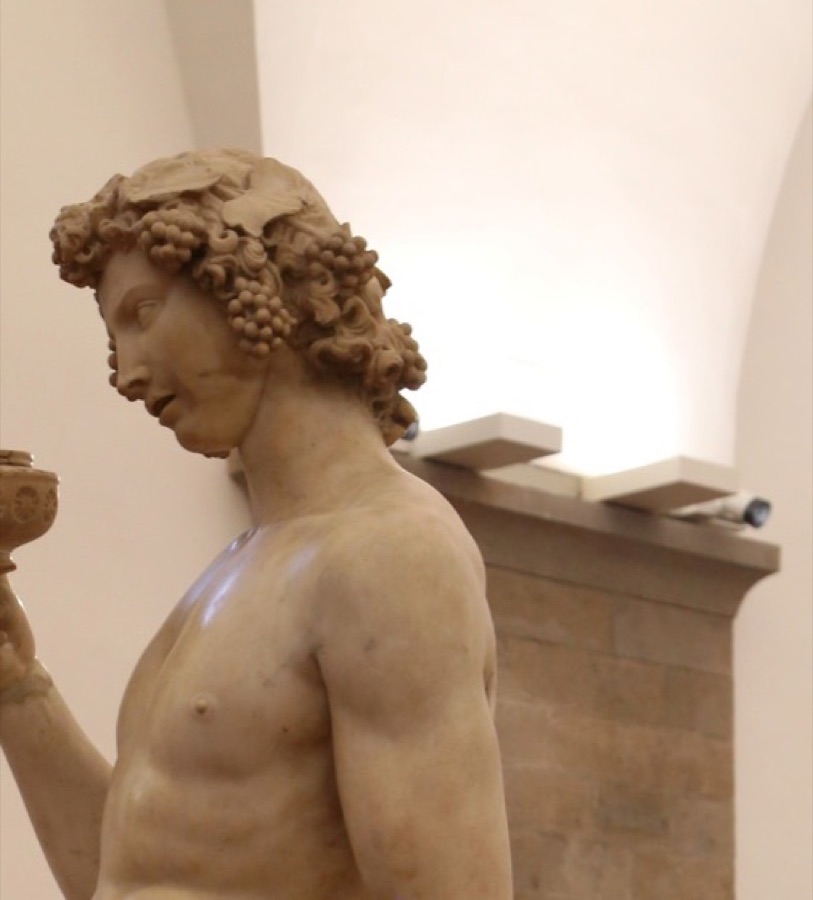
Wreath and face
The vine wreath and lowered gaze frame the god’s intoxicated, inward-looking presence.
Satyr and grapes
The small satyr behind the leg turns the mythological subject into a sly narrative exchange.
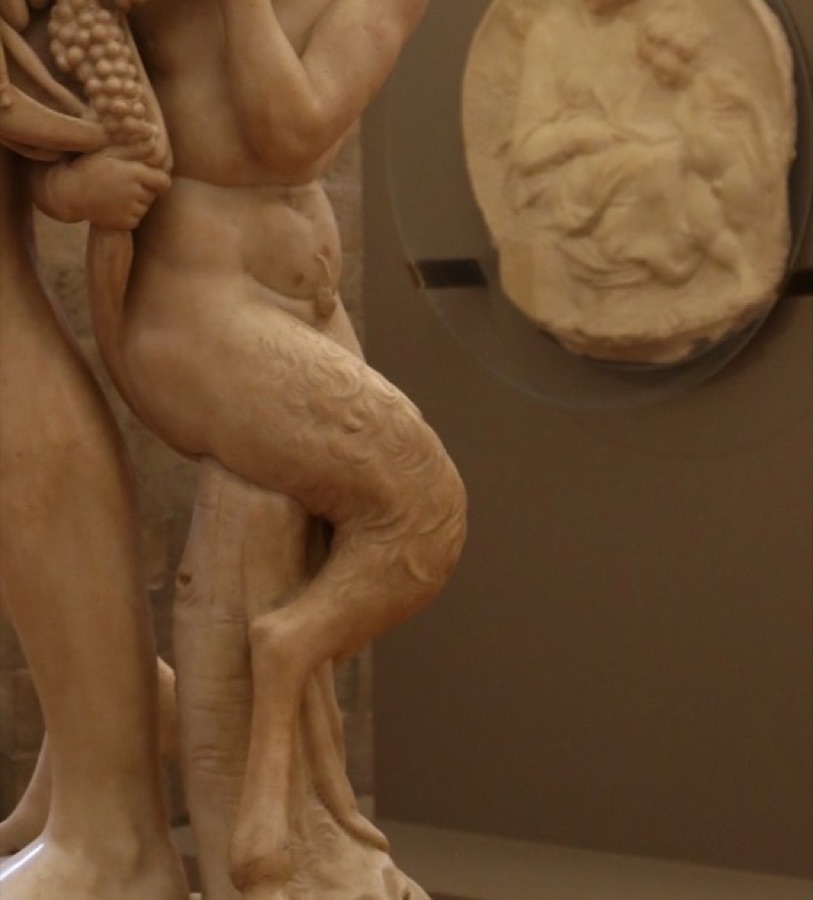
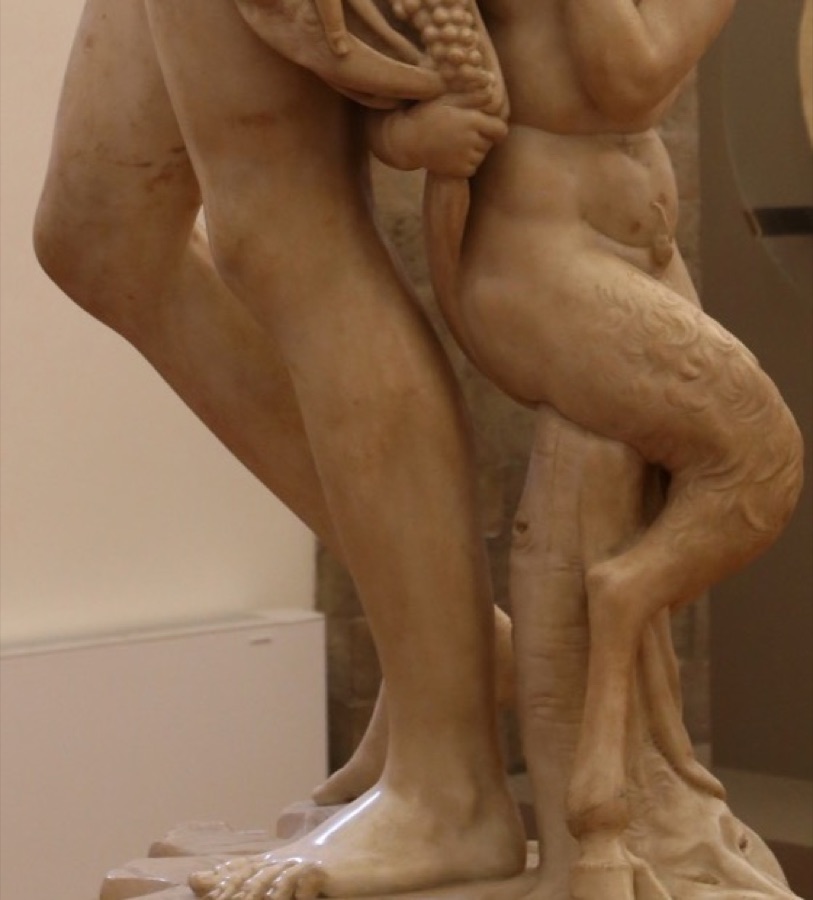
Legs and balance
The legs carry the statue’s swaying rhythm, making balance feel precarious rather than heroic.
The original marble in the Bargello
Italy’s national cultural catalogue identifies the object as Bacco e satiro, a white-marble sculpture by Michelangelo dated 1496–1497. It measures 207 centimetres high including its base and belongs to the Italian state. Its current holding institution is the Museo Nazionale del Bargello in Florence, where it carries the inventory number Sculture 10.[1]
The original is distinct from paintings of Bacchus, ancient statues, plaster casts, later bronzes and prints after the marble. Reproductions document its reception and changed appearance without sharing its physical history.
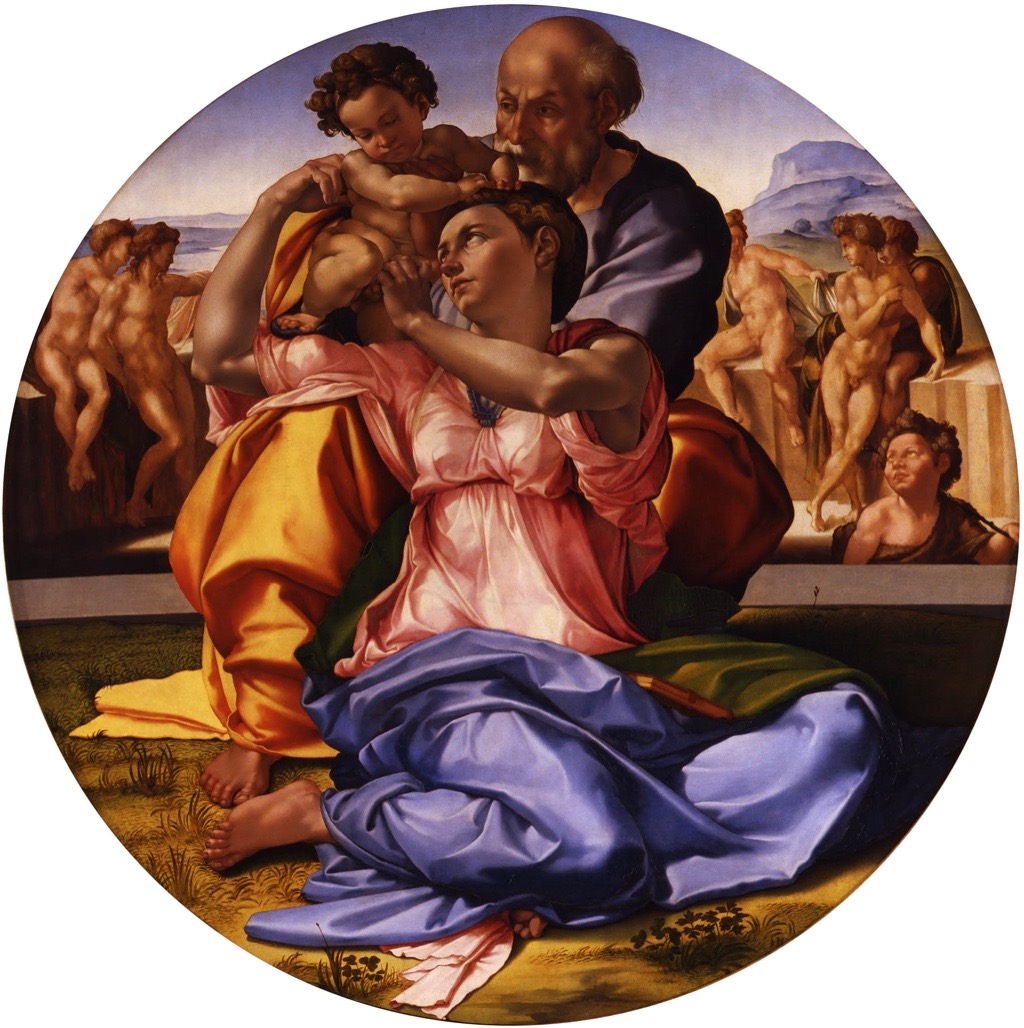
The Bargello presents the youthful, drunken Bacchus within a major group of Michelangelo sculptures. The same museum holds the Pitti Tondo, Brutus and the unfinished work known as David-Apollo. Its Michelangelo room also places the artist in relation to later Renaissance sculptors, including Jacopo Sansovino and Giambologna.[2] This setting encourages comparison across works and generations, but it is not the sculpture’s original environment.
The current title needs a little care. “Bacchus” names the principal figure and is the familiar English title. “Bacchus and Satyr” makes the second figure visible. The satyr is much smaller and partly concealed behind the god’s left leg, yet he is not an optional accessory. His body braces the composition, his action explains the grapes and his appetite intensifies the theme of wine.
The work also survives in a changed state. The raised hand holding the cup has a history of damage and reattachment, while other losses cannot be securely dated. A present-day photograph records the sculpture as it now appears; it does not automatically reproduce every detail of its appearance in 1497. Object identity therefore includes both Michelangelo’s carving and the later history carried by the marble.
Cardinal Riario, Jacopo Galli and the first Roman setting
Michelangelo made the sculpture during his first sustained period in Rome. The national catalogue states that Cardinal Raffaele Sansoni Riario commissioned it and that Michelangelo completed the work in one year, from July 1496 to July 1497. The result did not satisfy the cardinal, and the marble passed immediately to Jacopo Galli, a banker and collector who placed it in the garden of his Roman residence.[1]
This account corrects a long-standing problem in the biographies. Giorgio Vasari and Ascanio Condivi assigned the commission directly to Galli. Later documentary evidence, including a letter by Michelangelo that records his dealings with Riario, supports the cardinal’s role. Galli remains essential, but as the collector who took possession after the commission rather than necessarily its first patron.[1]
The reason for Riario’s dissatisfaction is not documented with equal security. It is plausible that the sculpture’s visible intoxication, soft body or departure from a more elevated classical ideal troubled him. A modern museum guide from the National Gallery of Denmark develops that contrast: the cardinal wanted a work aligned with exalted antiquity, while Michelangelo presented an unsteady god with a soft belly and unfocused eyes.[3] That is a well-grounded interpretation, not a recovered rejection letter explaining a single motive.
Claims that the cardinal rejected the work because it was “too sexual,” because it celebrated debauchery or because he regarded it as a moral warning go beyond the surviving commission history. Dissatisfaction is documented; its complete psychology is not. The distinction protects the work from being turned into a tidy scandal.
Galli’s garden created a different context. The marble stood among ancient fragments and could be encountered as part of a collection shaped by Rome’s classical remains. It was available to artists and visitors from more than one angle. The setting helped the sculpture appear simultaneously modern and antique: it was made by a young living artist, yet later drawings could place it among excavated marbles as though it belonged to the ancient world.
A wine god made physically drunk
Bacchus is the Roman name for Dionysus, god of wine, fertility and ecstatic release. Michelangelo identifies him through a compact group of attributes rather than a written label. Vine leaves circle his hair. He raises a cup in his right hand and holds grapes and a pelt in his left. The satyr behind him feeds on the fruit.
The most important attribute is the body itself. This is not a composed god merely carrying wine. His head tilts, his eyes appear unfocused and his mouth is slightly open. The shoulders do not align neatly with the pelvis. The abdomen is soft, and the supporting leg does not generate the calm authority expected of a perfectly controlled standing figure.
The Danish museum guide describes him as close to spilling the wine while the satyr eats behind him.[3] That observation explains why the sculpture cannot be understood from an inventory of objects alone. Cup and grapes tell the viewer who the figure is; posture and expression show what wine has done.
Michelangelo’s treatment is neither a medical illustration of drunkenness nor a comic collapse. The god remains beautiful, upright and capable of displaying the cup. His loss of control is held at the threshold. The sculpture asks the viewer to see intoxication without allowing the figure simply to fall.
That threshold supports several readings:
- the work may expose the instability hidden beneath ideal beauty;
- may celebrate wine’s power to loosen ordinary control;
- may make excess physically unattractive or morally dangerous;
- may treat divine intoxication as different from human drunkenness;
- may test whether a modern sculptor can animate an ancient subject more vividly than an antique model.
These readings are not equally provable, and they are not mutually exclusive. The body can appear sensuous and compromised at once. The satyr can register pleasure while also showing appetite without restraint. The work’s complexity lies in keeping those possibilities active.
Gendered description requires the same care. Vasari famously praised Michelangelo for combining youthful masculine slenderness with feminine softness and roundness. Modern museum accounts continue to note the figure’s androgynous qualities.[3] The visible evidence is a body that departs from the hard, muscular type associated with many of Michelangelo’s later male figures. Whether that mixture should be understood through ancient literary description, Renaissance ideals, erotic appeal or the physical effects of intoxication is interpretive.
Balance that changes as the viewer moves
From the front, Bacchus may seem to stand in an exaggerated contrapposto. One leg bears most of the weight while the other bends; the hips and shoulders answer one another across a curving body. But the pose is not a settled version of classical balance. The raised cup pulls attention upward and outward, the head shifts, the torso seems to drift and the bent leg does not promise a confident next step.
Ralph Lieberman’s study argues that the group becomes fully legible only as a viewer moves around it. From some angles Bacchus appears to lurch; from others he regains a graceful poise. The sequence creates a temporal effect: losing balance, recovering it and threatening to lose it again.[4] This interpretation is persuasive because it begins with changes a viewer can test rather than claiming a hidden symbol.
The front therefore should not control every reproduction. A side view clarifies the forward and backward displacement of the body. A three-quarter view can show the satyr’s relation to the left leg and the way the pelt and grapes connect the figures. A rear view reveals how much structural and narrative work is hidden from the conventional frontal photograph.
The apparent instability is precisely controlled. Marble does not sway, and a two-metre figure cannot actually correct its balance. Michelangelo had to distribute weight through the standing leg, base, tree or pelt-like support and satyr while making the body appear less secure than the stone must be. The engineering and the fiction move in opposite directions.
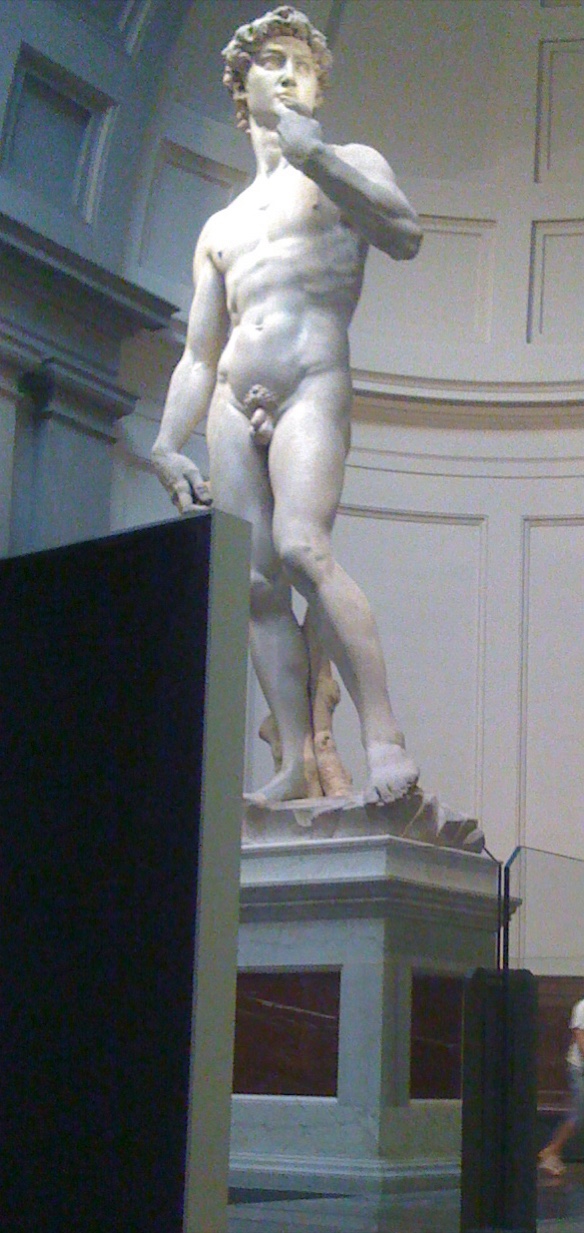
This opposition distinguishes Bacchus from David. The later Florentine colossus stores action in an alert, concentrated body. Bacchus disperses attention through raised cup, unfocused gaze, softened abdomen, offset limbs and the satyr behind. Both figures are standing nudes, but they use asymmetry for different psychological effects.
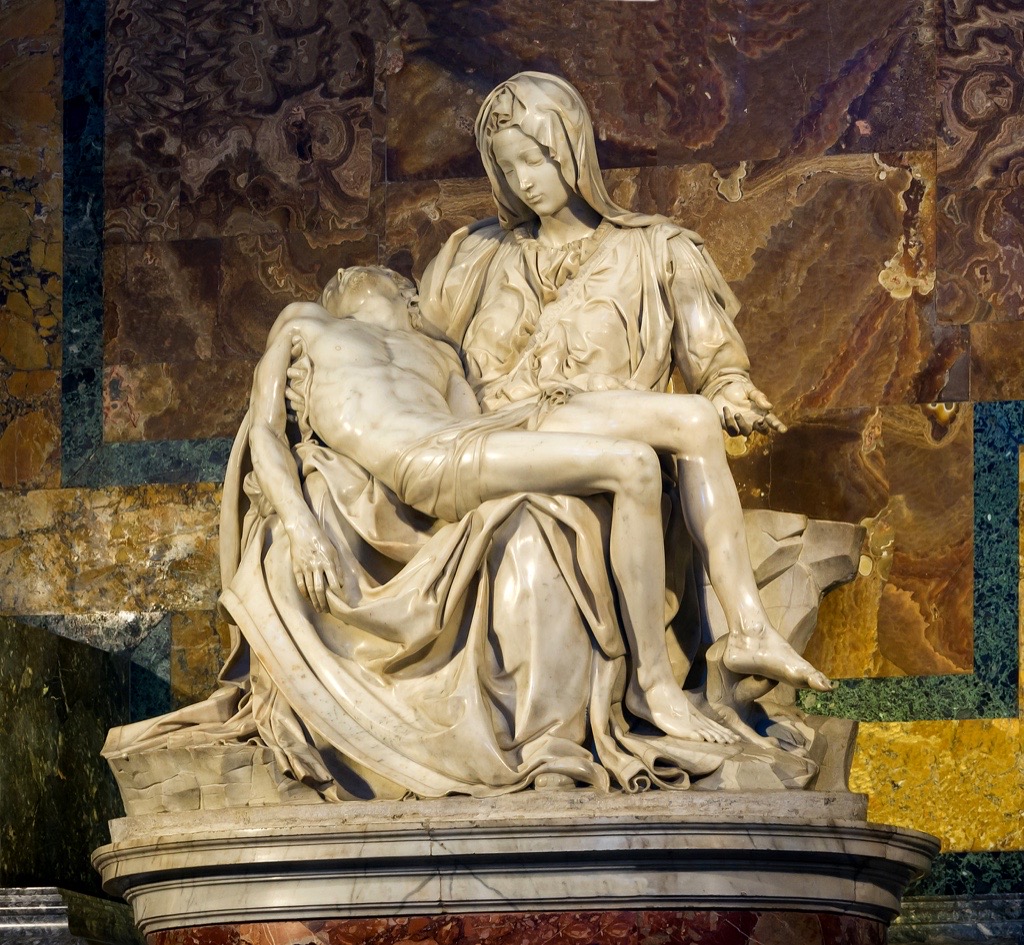
The sculpture also differs from the Vatican Pietà. In that group, Christ’s dead weight is visibly carried by Mary and stabilised within a broad pyramid. In Bacchus, the principal figure is alive but cannot be trusted to hold himself with complete command. One work makes support explicit; the other conceals it beneath the fiction of a god wavering on his feet.
The satyr, grapes, cup and pelt
The satyr crouches behind Bacchus’s left leg and bites into a bunch of grapes. His smaller scale initially makes him easy to miss. Once found, he changes the group from a solitary nude into an unequal pair joined by touch, food and support.
The two figures embody different moments of appetite. Bacchus raises the product of fermentation in a cup; the satyr consumes the fruit directly. The god’s expression turns inward toward intoxication, while the satyr acts with concentrated animal energy. Wine and grape, cultivated ritual and bodily hunger, are held within one block.
The satyr is also structural. His head, back and position behind the leg help fill the vulnerable lower part of the group. The pelt and grapes form further bridges between the principal body and the supporting mass. Michelangelo makes these connections serve the subject so that they do not read simply as props required to keep marble upright.
It is safer to call the hanging object an animal pelt than to insist upon a lion, panther or another species without a controlled object record. Different animals carry different Bacchic and moral associations. If the species is uncertain, an elaborate symbolic argument built upon it is uncertain too.
The cup presents a similar problem. Its upward position makes it an immediate identifying attribute, but its history includes damage and repair. A close reading should distinguish the intended action—Bacchus regarding or presenting wine—from the exact condition of the surviving hand and vessel. The visible gesture belongs to the work; every present surface in that area may not belong unchanged to 1497.
The satyr’s presence also prevents a purely tragic interpretation. Bacchus may be unstable, but the smaller creature is actively enjoying the grapes. There is humour in the covert theft behind the god’s leg, sensuous pleasure in the handling of flesh and fruit, and unease in the animal character of the companion. The group does not instruct the viewer to select only one response.
Classical form without a single known prototype
Michelangelo made Bacchus in a Rome saturated with ancient sculpture, fragments, literary descriptions and newly formed collections. The national catalogue connects the adolescent form to the Hellenistic statues he studied during his first Roman stay. It also states that no single ancient prototype has been identified.[1]
That distinction matters. The sculpture is deeply classical without being a straightforward copy of one surviving statue. Michelangelo could absorb contrapposto, the freestanding nude, Bacchic attributes and types of youthful softness, then combine them around the unprecedented problem of visible drunkenness.
The work’s classical aura was strong enough to confuse later classification. A drawing in the mid-sixteenth-century Codex Cantabrigensis labelled the figure as though it were an excavated antiquity.[1] The mistake is evidence of reception, not proof that the marble actually came from an ancient site.
The Victoria and Albert Museum has described Michelangelo’s figure as based on ancient work and notable for androgynous qualities and soft rather than strongly muscular flesh.[5] Such comparisons help explain the sculpture’s afterlife: later artists could treat it as a model of Renaissance invention and as a credible bearer of antiquity at the same time.
Antiquity did not provide Michelangelo with one fixed moral meaning. Bacchus could signify cultivated pleasure, sacred frenzy, theatre, fertility, disorder or loss of reason in different texts and images. The sculpture’s cup, vine, satyr and swaying body activate that field without resolving it.
One scholarly interpretation reads Bacchus as part of Michelangelo’s self-formation in Rome—an ambitious work through which a young Florentine sculptor established a reputation among collectors and patrons.[6] This approach is valuable when kept attributed. The work certainly affected his position; it does not follow that every grape, curve or glance is an encoded autobiography.
Carving softness, tension and support from marble
The sculpture is carved from white marble, a material that must bear real weight while imitating soft flesh, leaves, hair, fur and fruit.[1] Bacchus’s relaxed abdomen is especially important. Michelangelo did not simply omit muscular definition; he made softness an active sign of the god’s altered physical state.
The surface changes across the group. The torso and limbs invite broad passages of light. Hair and vine leaves break that light into smaller accents. Grapes create a clustered rhythm, while the satyr’s compact form contrasts with the open sweep of the principal body.
The group’s deepest technical problem is support. A raised arm, narrow ankle and displaced torso create risks in marble. Michelangelo uses connections at the base and behind the left side to stabilise the carving. The satyr, pelt and adjacent forms make necessary mass appear narratively inevitable.
Carving is subtractive: once too much stone is removed from a wrist, ankle or bridge, it cannot be restored by returning the original block. That fact makes the controlled imbalance more remarkable, but it does not justify a detailed day-by-day account of Michelangelo’s tools without material study.
The Metropolitan Museum of Art’s Michelangelo: Divine Draftsman and Designer places disegno—the joining of conception and drawing—at the centre of his work across media.[7] Bacchus should be understood within that designed practice, even though a complete series of preparatory sheets does not survive. The changing silhouette, supports and multiview sequence are evidence of planning.
Casa Buonarroti in Florence preserves Michelangelo’s family archive, drawings and early works, giving a broader institutional context for the artist’s formation.[8] Two youthful reliefs displayed there—the Battle of the Centaurs and Madonna of the Stairs—precede the Roman Bacchus.[9] The comparison shows both continuity and change: compressed figures carved into shallow fields give way to a freestanding group that depends upon bodily movement through space.
The legacy of those early reliefs should not be reduced to a claim that Michelangelo was “born knowing” how to carve. The Roman statue demonstrates rapid development, but also a new problem posed by a commission, a full-size block, classical collections and viewers able to circle the work.
Damage, repair and the limits of the surviving object
Historical drawings show that Bacchus did not reach the present unchanged. Maarten van Heemskerck drew the sculpture in the Galli garden in the 1530s with the right arm broken above the wrist. Lieberman reports that the hand and cup were preserved and appear to have been reattached by the time Condivi described the work. The same early evidence also records a loss at the genitals, but does not establish when it occurred or whether every missing part had originally been carved in the form later viewers assumed.[4]
This is a case where uncertainty is part of responsible description. The early drawing establishes a damaged state. It does not identify the accident, person or motive. A theory that the work was deliberately broken to appear antique is possible within the sculpture’s collecting history, but it is not a secure object fact.
Later prints document a repaired appearance. A seventeenth-century etching catalogued by the British Museum explicitly shows Bacchus with the right hand restored.[10] The printmaker selected a viewpoint, translated stone into line and represented a condition later than Heemskerck’s garden drawing.
The surviving object can therefore be read through several layers:
| Layer | What it can establish |
|---|---|
| Michelangelo’s marble group | Scale, composition, principal forms and carving |
| Heemskerck’s garden drawing | The work’s Galli setting and a damaged right-arm state in the 1530s |
| Later prints | Circulation of the design and repaired/restored appearances |
| Modern photography | Present condition, selected viewpoint, lighting and museum display |
No one layer answers every question. An old print may preserve a form obscured in a modern crop, but it also translates the object. A high-resolution photograph can show surface and repair, but it flattens depth and may conceal the satyr. A condition claim should therefore identify its evidence rather than treating all reproductions as interchangeable.
Colour and finish also vary with illumination. Warm light does not prove the marble’s original colour, while bright frontal exposure can erase carving depth. The object’s surface is more complex than any one tonal record.
From Roman garden to Florentine museum
After the commission, Bacchus remained in Jacopo Galli’s garden until 1572. The national catalogue records its sale for 240 ducats to the Medici family and a later transfer to Florence and the Uffizi during the seventeenth century.[1] It eventually entered the Bargello, the national museum that now defines its public location.
Each setting encouraged a different reading. In the Galli garden, the work stood among antiquities and could test the boundary between ancient fragment and modern invention. In the Medici collections, it became part of a dynastic accumulation of sculpture. In the Bargello, it belongs to a historical account of Renaissance art and Michelangelo’s career.
Printed reproductions extended that movement beyond the physical object. The National Gallery of Art holds an eighteenth-century engraving after the statue, part of a published collection of ancient and modern sculpture.[11] Its inclusion under that combined heading is telling: Michelangelo’s modern marble had become a canonical model circulated alongside antiquity.
Reproduction also alters scale. A two-metre marble can become a miniature figure, and a complex walk around the group becomes one selected view. The satyr may disappear, the repaired cup may become more prominent and the surface can become a pattern of engraved lines. Such works are historical witnesses, not transparent copies.
The present Bargello display restores the possibility of bodily comparison. A viewer can register the figure’s near-life-size scale, shift position and compare Michelangelo’s drunken god with other sculptural solutions in the museum. Even there, plinth height, movement through the gallery, lighting and barriers mediate the encounter. Direct access remains shaped by display.
Bacchus within Michelangelo’s early sculpture
Bacchus stands between Michelangelo’s early Florentine reliefs and the works that made his reputation in Rome and Florence. In the Battle of the Centaurs and Madonna of the Stairs, he had already commanded crowded, shallow relief. Bacchus expands that control into a freestanding group whose meaning changes as the viewer circles it.
The Vatican Pietà, begun soon afterwards, answers a different Roman commission with a broad, polished two-figure group. Its composition carries the dead Christ securely across Mary’s lap. Bacchus instead makes a living god appear unable to secure himself. Both works depend upon support, surface and the relation between two bodies, but they direct those elements toward different emotional ends.
David transforms instability again. The colossal youth is asymmetrical, yet his attention is concentrated and his stance reads as purposeful. The comparison should not become a ladder in which each later work “improves” upon Bacchus. The drunken figure attempts something the others do not: a standing marble that seems to pass through changing states of bodily control.
The Madonna of Bruges, carved in the following decade and now in the Church of Our Lady Museum, joins a seated mother and standing child in Carrara marble.[12] Its devotional subject, paired figures and contained movement make another productive comparison. It should not be presented as a direct sequel to Bacchus, but it shows Michelangelo continuing to explore how one figure’s body and action depend upon another.
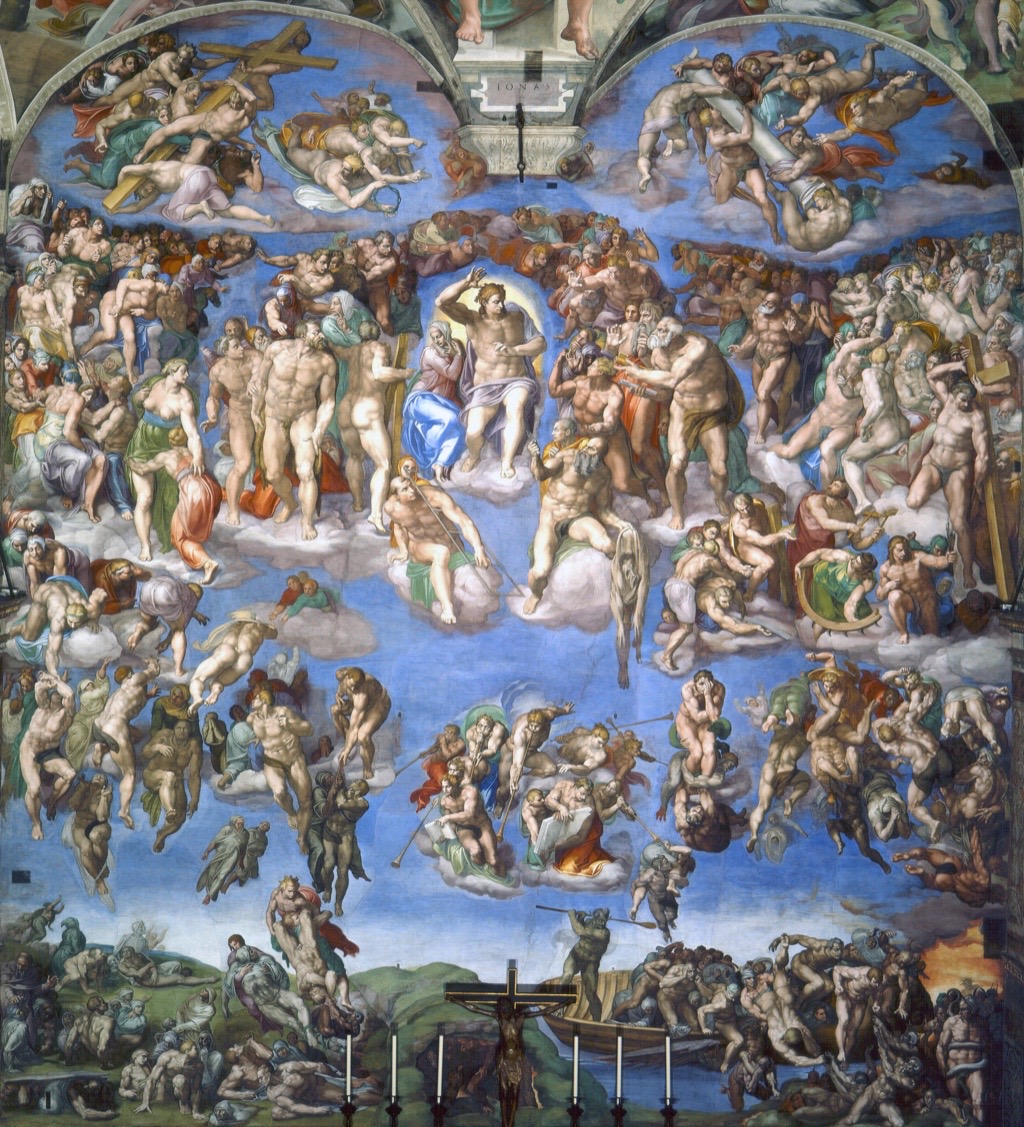
Within Michelangelo’s sculpture, Bacchus also belongs beside the Angel, saints made for the Arca di San Domenico, the disputed or lost Cupid works, the Pitti Tondo and later standing figures such as the Risen Christ. Together they reveal changing solutions for scale, finish, support and bodily movement.
The early Roman marble remains distinctive because its beauty is inseparable from vulnerability. Bacchus is a god, but his body is subject to wine. The figure stands, but not with complete authority. The satyr supports the sculpture while consuming its grapes. Ancient form promises ideal permanence, while the object’s damaged and repaired history makes change visible.
That tension is the work’s enduring achievement. Michelangelo did not merely carve a handsome nude and add a cup. He made intoxication legible through the organisation of a marble body—and made the viewer’s own movement part of recognising it.
Artist Up Close
The young Michelangelo did not compete with antiquity by making a generic ideal. He chose a god whose identity depends on altered consciousness and gave instability structural precision. The relaxed belly, wandering gaze, raised cup and hidden satyr turn classical form into an experiment in how marble can suggest time.
The sculpture also announces a career built on productive difficulty. A dissatisfied patron, ambiguous ancient appearance and later damage did not diminish the object’s capacity to shape Michelangelo’s reputation. Its early rejection became part of the work’s long power to unsettle expectations.
Frequently Asked Questions
Discussion
How would seeing Bacchus among broken ancient statues differ from encountering it in the Bargello’s Michelangelo room?
Reader Insights
Compare frontal, side and three-quarter views. Where does Bacchus appear most stable, and where does the body seem closest to lurching?
Trace the marble connections from Bacchus’s legs to the satyr, pelt, grapes and base. Which forms carry both story and structure?
Separate visible details—cup, soft abdomen, unfocused eyes, grapes and satyr—from moral, erotic and classical readings that require attribution.
Join the Conversation
Set Bacchus, the Vatican Pietà and David beside one another. How does each work organise weight, support, finish, attention and the viewer’s movement?
References
- Catalogo Generale dei Beni Culturali, Bacco e satiro, View source.
- Musei del Bargello, Michelangelo: the Bloom of Renaissance Art, View source.
- National Gallery of Denmark, Michelangelo: Imperfect — Digital Guide, View source.
- Ralph Lieberman, Regarding Michelangelo’s ‘Bacchus’,” Artibus et Historiae 22, no. 43 (2001), View source.
- Victoria and Albert Museum, ‘Authentically antique’ …, View source.
- Linda A. Koch, Michelangelo’s Bacchus and the Art of Self-Formation,” Renaissance Studies, View source.
- Metropolitan Museum of Art, Michelangelo: Divine Draftsman and Designer, View source.
- Fondazione Casa Buonarroti, museum and Michelangelo collection, View source.
- Fondazione Casa Buonarroti, Michelangelo’s Marbles, View source.
- British Museum, Statue of Bacchus with Satyr, print after Michelangelo, View source.
- National Gallery of Art, Statue of Bacchus by Michelangelo, print, View source.
- Musea Brugge, Madonna and Child, View source.
- Annotated image source: Michelangelo, Bacchus, 1496–1497, Museo Nazionale del Bargello, Florence. Photograph from Tom’s approved option A, Wikimedia Commons file Bacchus, Michelangelo, 1496-97, Bargello Florenz-02.jpg, licensed CC BY-SA 3.0. Page-ready image resized proportionally and detail images cropped for the annotated module, View source.