

 by Tom Gurney
Tom Gurney BSc (Hons) is an art history expert with over 20 years experience
Published on June 19, 2020 / Updated on November 6, 2025
Email: tomgurney1@gmail.com / Phone: +44 7429 011000
Michelangelo’s Rondanini Pietà
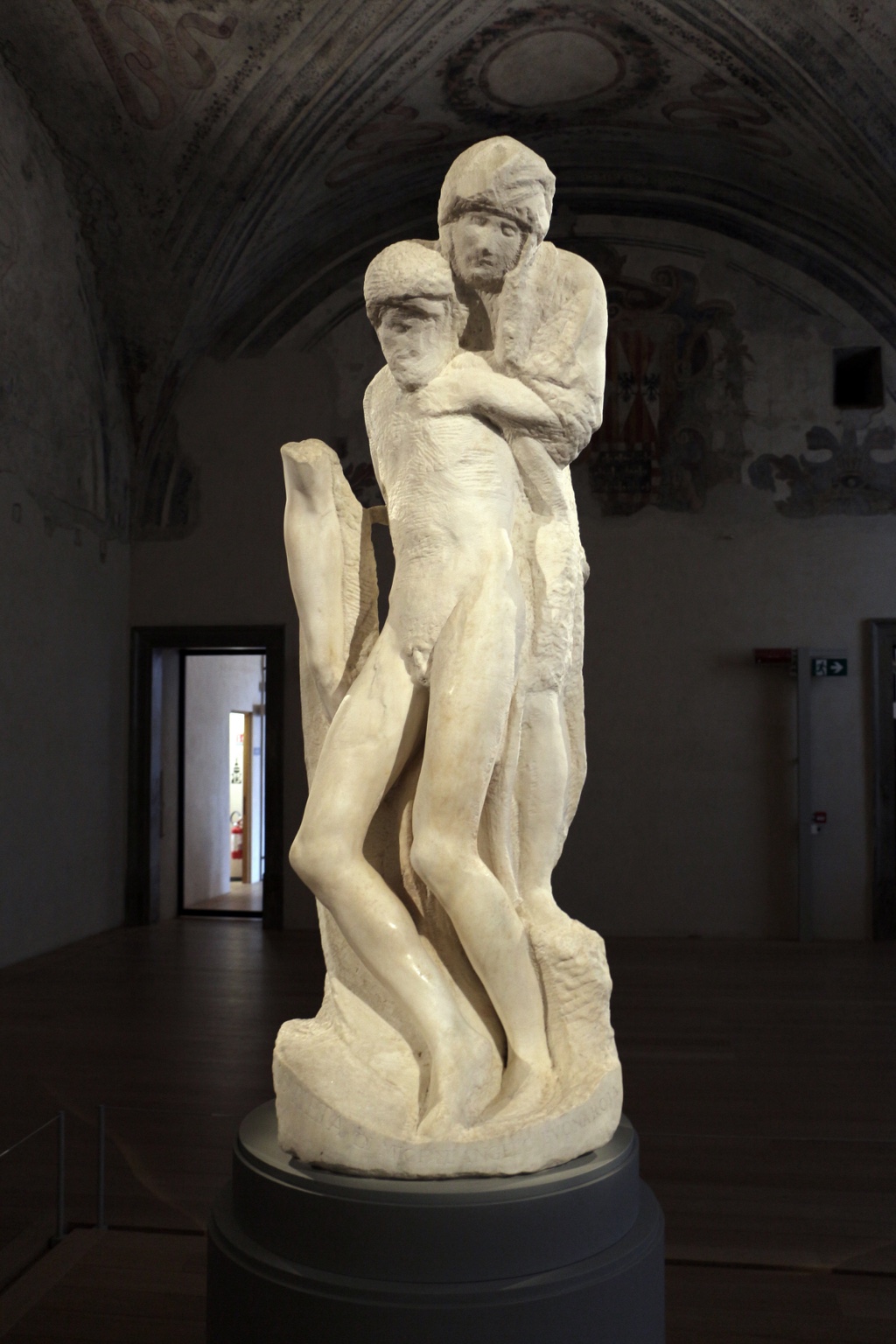
The Rondanini Pietà is Michelangelo’s last known sculpture: an unfinished marble group of the Virgin Mary supporting the dead Christ. Michelangelo repeatedly transformed the block during the final decade of his life and was still working on it shortly before his death in Rome in 1564. Today it stands in a museum devoted to the work at the Castello Sforzesco in Milan.[1]
Its narrow silhouette is only the latest state of a much-changed design. A broken arm, more fully developed legs and forms surviving behind the present figures belong to an earlier conception. Michelangelo cut back the bodies, altered their proportions and brought Mary and Christ into an increasingly close vertical union. The result is not a finished late style preserved intact, nor merely an abandoned block. It is material evidence of sustained revision interrupted by death.
At a Glance
- ArtistMichelangelo Buonarroti
- WorkRondanini Pietà
- SubjectThe Virgin Mary supporting the dead Christ
- DateBegun during the 1550s and worked on until 1564; institutional summaries use starting dates between 1552 and 1555
- MediumMarble
- Dimensions196 × 70 × 73 cm in the Castello Sforzesco highlights guide
- StateUnfinished and repeatedly recut
- Current locationMuseo Pietà Rondanini, Castello Sforzesco, Milan
- Documentary anchorAn unfinished joined Christ-and-second-figure group recorded in Michelangelo’s studio immediately after his death
- NameDerived from the Roman Rondinini family and palace; “Rondanini” became the established form
- Provenance cautionThe trail is insecure between the 1564 studio inventory and a documented reappearance in 1807
- Attribution cautionAn early nineteenth-century inventory rejected Michelangelo’s authorship; acceptance emerged through later study
- Carving cautionVisible parts belong to different design phases
- Interpretive cautionSpiritual, funerary and resurrection readings require attribution rather than presentation as Michelangelo’s documented programme
- Viewing cautionThe surviving earlier and later forms become legible only by moving around the marble
Contents
- What the Rondanini Pietà is
- Why it is called Rondanini
- The documentary chronology
- A composition repeatedly remade
- Subtraction as a Form of Thought
- Mary and Christ: support, descent and embrace
- Earlier and later forms in one block
- What “unfinished” means here
- Provenance and the history of attribution
- Conservation and the marble surface
- Display at the Castello Sforzesco
- A Room Built Around an Unfinished Work
- The Rondanini, Bandini and Vatican Pietàs
- Artist Up Close
What the Rondanini Pietà is
The current group consists of two principal figures. Christ’s elongated body descends in front, while the Virgin rises behind and bends over him. Their heads incline in different directions, their upper bodies press closely together and their lower forms remain partly joined to surrounding marble.
The Castello Sforzesco calls the subject a deposition of the dead Christ supported by his standing mother before burial.[1] “Pietà” places the group within the wider devotional tradition of Mary mourning Christ. The term does not require one fixed pose: Michelangelo’s Vatican work places Christ across Mary’s lap, the Bandini group surrounds him with four figures, and the Rondanini group brings mother and son into a narrow upright structure.
The museum’s English guide describes the bodies as elongated and almost filiform, unlike the forceful, anatomically expansive figures associated with many earlier Michelangelo works.[2] That comparison is visually useful, but it should not become a simple story in which the old artist rejected everything he had previously valued. The sculpture’s present appearance results from removal and revision as well as positive modelling.
Why it is called Rondanini
The name does not come from Michelangelo. Secure evidence places the sculpture in 1807 with the Roman collector Marquis Giuseppe Rondinini. The family name was later altered in usage to Rondanini, and the established title followed that form.[3]
This history makes “Rondanini” a provenance name, like “Bandini” for Michelangelo’s Florentine Pietà. It does not indicate the subject, original destination or place of carving. Michelangelo worked on the marble in Rome, and it did not reach Milan until the twentieth century.
The title also preserves an episode of neglect. In an inventory made after Giuseppe Rondinini’s death, the sculptor and valuer Carlo Albacini denied Michelangelo’s authorship and treated the group as modern. For much of the nineteenth century it remained with the palace without attracting the attention now expected of a Michelangelo.[3]
Calling the sculpture an undisputed masterpiece “for centuries” would therefore erase its attribution history. The title became famous only after scholarship reconnected the marble with Michelangelo’s late work and after Milan acquired and displayed it publicly.
The documentary chronology
The beginning is not fixed to one exact year. Ascanio Condivi’s 1553 biography of Michelangelo does not mention this group. In 1555, Giorgio Vasari referred to another Pietà, different from and smaller than the damaged Bandini work, that Michelangelo had begun to carve. The Castello Sforzesco identifies this with the Rondanini Pietà and cautiously places its beginning between 1553 and 1555.[1]
Other official summaries use 1552–1564 or 1553–1564.[3][4] These are catalogue ranges, not proof of a signed contract or an uninterrupted twelve-year campaign. The safest chronology is that Michelangelo began the marble during the first half of the 1550s, returned to it repeatedly, and continued revising it into 1564.
After Michelangelo died on 18 February 1564, an inventory was drawn up in his Roman workshop the next day. It recorded another begun statue for a Christ joined to another figure, rough-hewn and unfinished. The Castello Sforzesco identifies that entry with the Rondanini group.[3]
Daniele da Volterra’s letters written after Michelangelo’s death add that he had continued to work on the sculpture until only days before he died.[1] This evidence supports “last known sculpture” and “unfinished at death.” It does not tell us that Michelangelo considered every remaining rough surface desirable or that he had reached a final composition.
The work was private rather than a documented public commission. The 1564 studio inventory places the unfinished group in Michelangelo’s workshop, but no secure patron, chapel contract or installation plan controls its design.[3]
A composition repeatedly remade
The most important fact about the carving is transformation. Michelangelo did not merely refine one stable group. The Castello account says that he changed Christ’s proportions, thinning the torso and legs, lowering and reducing the head, and altering the arms so that they rest against and merge with Mary’s body. Mary’s head also changed direction and relation to Christ.[1]
Forms from the earlier design survive. Christ’s broken right arm extends separately down one side as far as the elbow. The legs, although already narrowed, retain a greater degree of finish than much of the reworked torso. The back of Mary preserves mass that Michelangelo had not yet cut down to rebalance the revised group.[1]
These remains make the marble unusually legible as process. One body seems to pass through another version of itself. A more robust anatomy is visible beside and beneath the attenuated later forms. The block does not present two finished sculptures; it preserves incompatible stages because Michelangelo removed some earlier elements and left others.
The sequence cannot be reconstructed simply from finish. A smooth passage may belong to an earlier conception, while a rough passage may be the newest active revision. “More finished” therefore does not automatically mean “closer to Michelangelo’s final intention.”
The holding institution makes this point through examples: Christ’s right arm belongs to an advanced earlier part, Mary’s face carries traces of a previous elaboration, and Christ’s torso remained in the course of reworking.[1] These areas preserve phases of the design, not a certain hand-by-hand chronology.
Subtraction as a Form of Thought
Revising marble is unlike changing a drawing. A line can be erased and redrawn; a clay limb can be added; stone removed from a torso cannot be restored. Michelangelo’s repeated recutting therefore turned decision into irreversible loss.
The narrowing of the figures is not simply a late preference applied to fresh material. It had to be achieved by cutting into an already substantial conception. Earlier anatomy became the quarry from which the later union of Mary and Christ was extracted. The sculptor worked against his own advanced forms.
This process helps explain the object’s apparent fragility. The thin bodies are not weakly imagined substitutes for Michelangelo’s earlier monumentality. They are what remained possible after mass had been deliberately spent. Their closeness is born from reduction.
The broken earlier arm is particularly eloquent because it refuses disappearance. It projects as evidence that the group once opened into another gesture. Beside the later body, it makes change spatially simultaneous: viewers see a past action and a present action in the same stone.
The sculpture thus records thought through incompatibility. It cannot become visually seamless without losing the very evidence that makes its late history extraordinary.
Mary and Christ: support, descent and embrace
The museum describes Mary as standing and supporting her son after the Crucifixion.[2] From the front, Christ appears to lean outward and downward while Mary’s upper body follows closely behind. Her arms and torso do not create a broad cradle. Support is concentrated into the joined vertical mass.
That verticality can produce several impressions at once. Christ descends, but the bodies also rise from the base. Mary holds him, yet their shared axis can make it difficult to decide where one figure’s support ends and the other’s begins. The group asks the viewer to move around it rather than settle the relation from one photograph.
The surviving earlier right arm intensifies this ambiguity. It hangs away from the current torso and makes the history of another pose visible. The later arms, closer to Mary, belong to the revised union of the bodies. What looks like anatomical impossibility from one viewpoint can be evidence of overlapping designs.
The faces are only broadly developed. Their lowered and inclined heads establish relation without detailed expression. It is possible to describe proximity, weight, direction and surface; it is not possible to recover a fixed thought from either face.
The Castello interprets the changing heights and fusion of the figures as potentially holding together deposition, burial and even resurrection.[5] This is a museum interpretation, not a documented statement by Michelangelo. Its value lies in drawing attention to movement that is neither simply downward nor fully static.
Earlier and later forms in one block
The lower body can appear more conventional because the legs are comparatively smooth and anatomically continuous. Above, Christ’s torso narrows and loses independent mass as it approaches Mary. The passage between them is not a deliberate contrast executed once; it records recutting.
The earlier right arm is one of the clearest visual keys. It belongs to a broader position than the later body. Rather than hiding it, Michelangelo left it attached to the surrounding marble while developing a new arm relation closer to Mary. Whether he would eventually have removed the remnant cannot be proved, although the holding institution considers that probable.[1]
Mary also contains chronological layers. The back retains bulk from the first conception. Her head and face show alteration. Because Michelangelo died before he could reconcile the whole block, the viewer sees an uneven distribution of old and new decisions.
This makes close reading inseparable from material history. Elongation is not only a “style”; it is something Michelangelo produced by cutting a more robust conception thinner. Fusion is not merely symbolism; it is also the physical result of retaining joined marble while redefining two bodies.
The Castello’s highlights guide lists the marble at 196 × 70 × 73 cm.[4] The measurement describes the surviving object; it does not establish the intended dimensions of a completed later conception.
What “unfinished” means here
The official English guide states that the sculpture remained unfinished because Michelangelo died while still working on it.[2] This establishes an external interruption. It rules out the legacy claim that the existing object may simply be wholly complete in the form Michelangelo intended.
That does not make every rough area meaningless. In a work developed by removal, roughness can mark an active new form; smoothness can belong to an abandoned earlier one. The viewer can experience the contrast aesthetically without declaring all incompletion deliberate.
Several different conditions coexist:
- surfaces carried further in an earlier conception;
- mbs and masses partly cut down during revision;
- w forms broadly established but not resolved;
- mnants likely intended for later removal;
- eas in which the bodies remain attached to surrounding stone;
- rface deposits and treatment history added after Michelangelo.
“Unfinished” is therefore a historical description, not a quality judgement. It explains why the sculpture contains unresolved stages. “Final” should similarly mean last in chronology, not the perfected conclusion of a career-long plan.
Modern admiration has sometimes turned the work into a prophecy of Expressionism or abstraction. Such comparisons may describe later reception, but they do not establish Michelangelo’s intention. The sculpture belongs first to sixteenth-century carving, Christian subject matter and Michelangelo’s late working process.
Provenance and the history of attribution
After the 1564 workshop inventory, the sculpture’s path becomes uncertain. The Castello records only a doubtful notice in 1652 before secure evidence resumes on 13 August 1807 in Giuseppe Rondinini’s collection.[3]
The later inventory that rejected Michelangelo’s authorship helps explain the work’s obscurity. In 1857, John Charles Robinson connected the sculpture with Michelangelo drawings in the Ashmolean Museum, but the proposal attracted little response. The relationship between the marble and the five Pietà sketches remains part of the study history rather than proof that every sketch is a preparatory stage for the present block.[1][3]
In 1904, Prince Odescalchi sold Palazzo Rondinini and its furnishings, including the sculpture, to Count Roberto Sanseverino Vimercati. The Italian state did not exercise the available right to acquire it. Scholarly interest revived from 1909, and after a dispute among heirs the work was offered for sale in 1949.[3]
The City of Milan bought it in 1952 with public funds and transferred it to the Castello Sforzesco collections.[2][3] This purchase did not discover an unknown sculpture; it concluded a modern process of reattribution, valuation and public advocacy.
The provenance has two large gaps that must remain visible: the centuries after Michelangelo’s death and the uneven nineteenth-century recognition. A smooth owner list should not be invented across them.
Conservation and the marble surface
The Castello began a major conservation project in 1999. An interdisciplinary team first examined the surface, collected micro-samples of materials foreign to the marble and made photogrammetric surveys for structural and dimensional analysis. Documentary and scientific study then informed treatment.[6]
Cleaning removed widespread patina and accumulated dust. The project concluded in 2005. The museum says the sculpture had fortunately avoided destructive restoration over the centuries, but that statement does not mean it reached the present without dirt, display changes or lighter maintenance.[6]
When the sculpture moved to its dedicated museum in 2015, conservators carried out a further, lighter cleaning using the method established by the earlier campaign.[6] The 1999–2005 project and 2015 treatment should not be collapsed into one date.
Conservation affects reading. Cleaning can clarify tooth marks, planes and transitions between phases, while photogrammetry can test dimensions and structure. It cannot by itself determine what Michelangelo would have removed next or turn a provisional surface into a completed design.
The sculpture’s appearance before the 2005 campaign, between treatments and after the later cleaning must be understood as different conservation states. Lighting also matters: pale marble, deep joins and shallow tool marks change dramatically under directional illumination.
Display at the Castello Sforzesco
Milan first displayed the sculpture at the Castello after acquiring it in 1952. From 1956 it occupied the celebrated BBPR installation in the Sala degli Scarlioni, set apart within a larger Renaissance sculpture display.[2][7]
The setting became part of the work’s modern reception, but it also constrained access and viewpoint. Later discussion led to a new museum in the restored Spanish Hospital within the Castello’s Cortile delle Armi. The Michele De Lucchi installation opened on 2 May 2015.[3][7]
The dedicated room allows the group to be seen from every side.[5] This is particularly important for a sculpture whose front view compresses its different phases. Walking around reveals the retained earlier arm, the mass behind Mary, the joining of bodies and the irregular profile of the block.
The Spanish Hospital has its own sixteenth-century history and surviving religious decoration. The museum interprets its former care for sick soldiers as a resonant context for the Pietà.[5] That association belongs to the 2015 display, not Michelangelo’s original destination.
Even the phrase “two-figure group” needs a material qualification. The current subject is Mary and Christ, but the block contains remnants of an earlier solution. The Vatican Museums has proposed that a surviving garment form near the left knee may indicate that an early conception included a male bearer, possibly Nicodemus.[8] That is a reconstruction from the marble, not another figure completed and then preserved intact.
A Room Built Around an Unfinished Work
Dedicated display reverses the sculpture’s long uncertainty of status. A marble once rejected as Michelangelo and passed through private ownership now occupies a museum organised around its singular presence.[3][5]
The Spanish Hospital setting does not recreate a lost chapel or studio. It creates a modern contemplative environment in which distance, circulation and light can be controlled. The work’s narrow lateral dimensions and tall silhouette gain emphasis because surrounding objects do not compete with it.
All-around access also makes the viewer a participant in reconstruction. From one position, Mary and Christ appear fused; from another, earlier legs and the residual arm interrupt that unity. No single view is final. Walking becomes a way of reading chronological layers.
This museography supports spiritual interpretations, but it also risks making accidental incompletion seem perfectly ordained. The room is complete even when the sculpture is not. Keeping that distinction visible preserves the tension between Michelangelo’s interrupted labour and Milan’s accomplished act of presentation.[7]
The Rondanini, Bandini and Vatican Pietàs
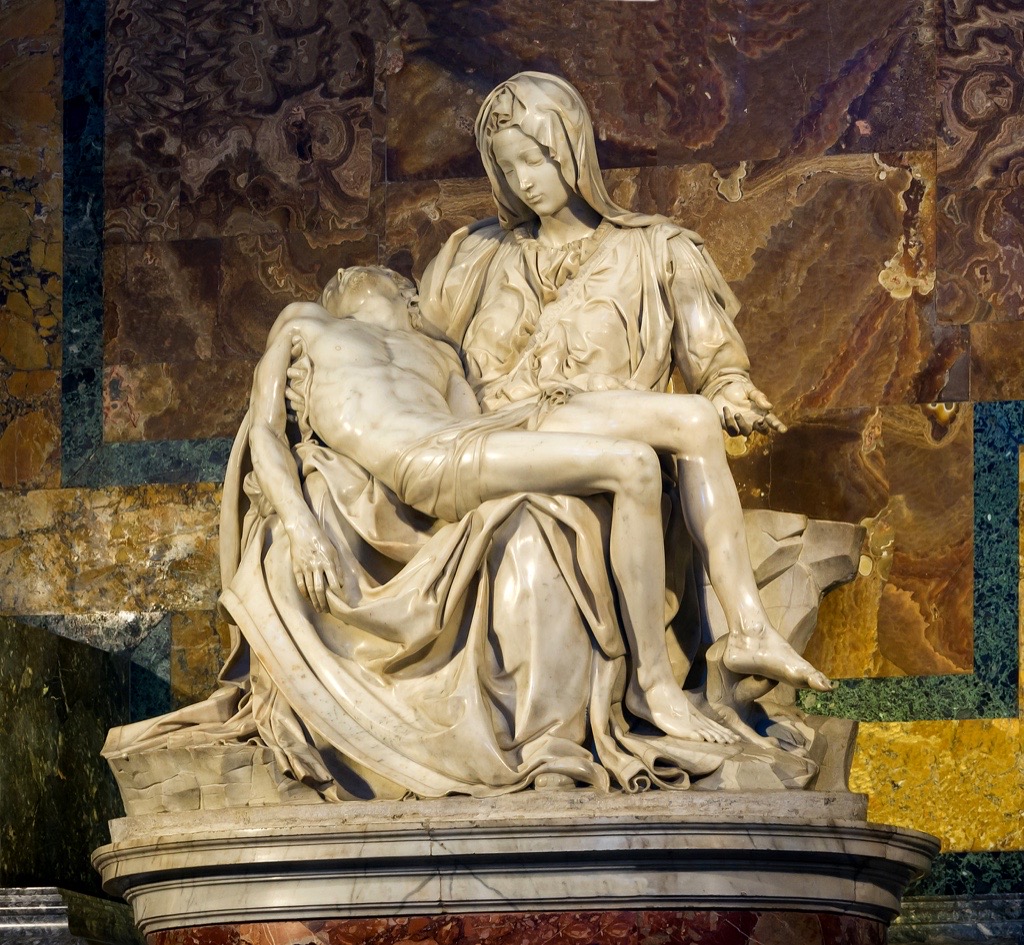
Michelangelo’s three securely documented marble Pietà projects are separate works. The Vatican Pietà was commissioned in 1498 and completed as a broad, polished two-figure group for a French cardinal’s funerary chapel in Old St Peter’s. The Bandini Pietà, now in Florence, is a four-figure late group damaged by Michelangelo and subsequently altered by Tiberio Calcagni. The Rondanini Pietà is the repeatedly recut two-figure marble left unfinished in Michelangelo’s studio.[8][9][10]
| Work | Date | Structure and state | Current location |
|---|---|---|---|
| Vatican Pietà | 1498–1499 | finished and signed; Christ across Mary’s lap | St Peter’s Basilica , Vatican City |
| Bandini Pietà or Deposition | about 1547–1555 | four figures; damaged, unfinished and altered by Calcagni | Museo dell’Opera del Duomo, Florence |
| Rondanini Pietà | begun in the 1550s; unfinished in 1564 | Mary and Christ; radically recut vertical group | Castello Sforzesco, Milan |
Exhibitions using casts have made direct comparison possible, but an original and a cast must be labelled separately.[11] A cast can clarify scale and silhouette; it cannot reproduce original surface, colour, tool marks or conservation history.
The three works do not form a planned trilogy. Michelangelo returned to a shared subject at different ages and under different circumstances. The Rondanini marble does not “complete” the Vatican work, and its roughness does not overturn the achievement of polish. It records a final, unresolved act of making.
Michelangelo’s late work also extended far beyond this block. During the same Roman period he was directing St Peter’s and developing major architectural projects.[12] The private Pietà should be placed beside that public workload, not treated as the only expression of his final years.
Artist Up Close
The Rondanini Pietà makes Michelangelo’s act of reconsideration physically present. Instead of hiding an abandoned version beneath a final surface, the block preserves incompatible bodies and proportions together. The artist’s late practice appears not as loss of decision but as the courage to cut into work already achieved.
This radical subtraction differs from the additive revision possible in clay or paint. Once a marble torso is narrowed or a limb removed, the former design cannot simply be restored. Every change spends material. The surviving group is therefore an archive of irreversible thought.
Frequently Asked Questions
Discussion
Use these questions to distinguish visible form from the documentary evidence about recutting, incompletion and display.
Reader Insights
Which visible parts belong to an earlier conception, and how do they change the reading of the later bodies?
How should “unfinished” differ from “rough,” “revised” and “abandoned”?
How does all-around viewing alter the sculpture’s meaning compared with a frontal photograph?
Join the Conversation
Share an evidence-led reading, and note where a claim depends on viewpoint, phase reconstruction or later interpretation.
References
- Castello Sforzesco / Comune di Milano, La Pietà Rondanini, View source.
- Castello Sforzesco / Comune di Milano, Pietà Rondanini – Michelangelo Museum Guide, View source.
- Castello Sforzesco / Comune di Milano, A Sculpture by Michelangelo in Milan, View source.
- Castello Sforzesco / Comune di Milano, Sforza Castle Museums’ Highlights, View source.
- Castello Sforzesco / Comune di Milano, Michelangelo at the Castello Sforzesco, View source.
- Castello Sforzesco / Comune di Milano, The Restoration of the Rondanini Pietà, View source.
- Castello Sforzesco / Comune di Milano, Museum Installations, View source.
- Vatican Museums, The Casts of the Three Pietà, View source.
- Opera di Santa Maria del Fiore, Michelangelo Buonarroti, Pietà Bandini, View source.
- Papal Basilicas / Holy See, Michelangelo’s Pietà, View source.
- Comune di Milano, Michelangelo’s Three Pietàs, View source.
- Metropolitan Museum of Art, Michelangelo: Divine Draftsman and Designer — Exhibition Galleries, View source.