

 by Tom Gurney
Tom Gurney BSc (Hons) is an art history expert with over 20 years experience
Published on June 19, 2020 / Updated on August 8, 2026
Email: tomgurney1@gmail.com / Phone: +44 7429 011000
Night by Michelangelo
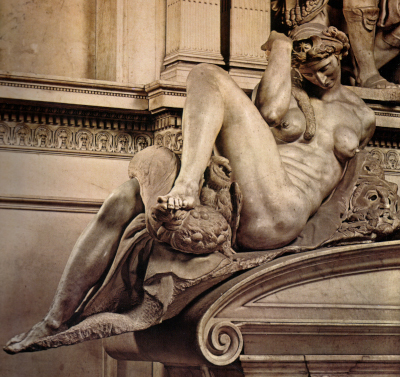
Michelangelo’s Night sleeps with the strength of someone who could wake, yet the tomb beneath her makes sleep inseparable from death. One arm supports the lowered head, one leg rises, and the enormous body folds into a pose too complex for untroubled rest. Around her appear the signs of darkness: poppies, an owl, a mask, moon and star.[1] The allegory is unmistakable; its emotional meaning remains unsettled.
Carved in Carrara marble around 1524–1526, Notte lies on the Tomb of Giuliano de’ Medici, Duke of Nemours, in the New Sacristy.[1][2] Day reclines beside her. Across the room, Dawn and Dusk occupy Lorenzo’s sarcophagus.[3] Of the four Times, Night acquired the richest independent reception through poetry, copies, casts and photographs. None of that afterlife should detach her completely from the funerary architecture that made sleep mortal.
Sweet is my sleep, but more to be mere stone...
At a Glance
- ArtistMichelangelo Buonarroti
- TitleNight, or Notte
- DateAbout 1524–1526 according to the official object record[1]
- MediumCarrara marble
- SubjectFemale personification of night and sleep
- MonumentTomb of Giuliano de’ Medici, Duke of Nemours
- CompanionDay[1][2]
- LocationGiuliano’s monument in Florence’s New Sacristy, part of the Medici Chapels[3]
- AttributesPoppies, barn owl, mask, moon and star[1]
- Technical historyThe left arm was remade after damage; modern study has reconstructed modelling and carving stages[1]
- ConservationA 2013–2020 campaign addressed deposits and stains associated in part with earlier casting practices[1]
- ReceptionWidely reproduced in terracotta, plaster and photography[7][8][9]
- Central tensionSleep appears protective and vulnerable on an object made to commemorate death
Contents
- Night on Giuliano’s Tomb
- A Sleeping Body That Cannot Relax
- Poppies and the Barn Owl
- Why Night Needs So Many Signs
- The Mask
- Sleep and Death
- The Female Nude and Monumental Vulnerability
- Night and Day
- Night Beside Dawn and Dusk
- Making the Left Arm Twice
- From Drawings and Clay to Marble
- The Politics of Silence
- Copies in Terracotta
- Photography and the Invention of a View
- Conservation and the History of Casting
- How to Look at Night
- Why Night Matters
- Artist Up Close
Night on Giuliano’s Tomb
The placement identifies the allegory before any attribute is noticed. Night lies on a sarcophagus because time passes over the dead. Above her, Giuliano appears awake and commanding in ideal armour. The contrast joins unconscious withdrawal below with perpetual public readiness above.
Her partner, Day, is an immense male nude with a famously unresolved head. Together they form the largest opposition of the daily cycle: darkness and light, sleep and wakeful activity. Michelangelo avoids making the pair visually symmetrical. Their bodies differ in sex, orientation, finish and emotional access.
The tomb is not an illustration of Giuliano’s personality. It is a memorial structure where ideal rulership is surrounded by forces that outlast him. Night returns after every day, indifferent to dynastic power.
A Sleeping Body That Cannot Relax
The official record describes a semi-reclining young woman deeply asleep, her head resting against the back of her right hand.[1] Yet the rest of the body seems required to work. One leg rises, the torso counterturns and an elbow braces against the support.
This complexity prevents sleep from reading as limpness. Muscles remain articulated; weight gathers at several contact points; balance on the sloping sarcophagus appears precarious. The figure is unconscious but not formless.
Michelangelo thus distinguishes internal state from external construction. Night may sleep, but marble must bear weight. The technical necessity of supporting a monumental figure becomes the source of psychological unease.
Poppies and the Barn Owl
Attributes make the personification legible. Poppies have long been associated with sleep and oblivion. The barn owl belongs to darkness and nocturnal vision. Moon and star locate the figure in the night sky, while the mask adds a more ambiguous presence.[1]
These objects do not merely decorate the sarcophagus. They perform the naming that the human body alone cannot guarantee. A sleeping nude could represent rest, dream, death or a mythological individual. Owl, poppies and celestial signs close the identification around Night.
At the same time, the body exceeds the label. Attributes tell us what she is; posture makes us ask what night feels like. The work’s power lies in cooperation between iconography and anatomy.
Why Night Needs So Many Signs
Among the four Times, Night carries an unusually dense cluster of identifiers. Darkness itself cannot be carved, and a sleeper alone might remain a generic resting figure. Owl, poppies, moon, star and mask gather several nocturnal associations around one body until the title becomes secure.[1]
Their abundance creates a useful imbalance. The small emblems are precise, while the monumental nude remains psychologically open. A spectator can confidently say “this is Night” and still remain uncertain whether her sleep is protective, troubled, erotic, mortal or politically charged.
That distinction explains how allegory can be both clear and inexhaustible. Iconography settles the category. Sculpture preserves the experience from being reduced to it.
Meaning continues after recognition.
The Mask
The mask is the most interpretively unstable attribute. Masks can suggest dream, deception, theatrical performance, abandoned identity or the empty face of death. Its proximity to a sleeping figure invites all of those associations.
No single meaning should be imposed without a specific programme text. Within the tomb, the mask at least intensifies the separation between conscious social identity and sleep. Giuliano above wears the public “mask” of ideal ducal portraiture; Night withdraws from identity while a literal mask lies nearby.
The object also creates a second face within the composition. One face is alive in marble but unconscious; the other is an inanimate shell. Their proximity makes the border between sleep, representation and death disturbingly thin.
Sleep and Death
Western poetry and art have long treated sleep as death’s sibling. Both close the eyes, still the body and remove the person from ordinary social contact. On a sarcophagus, the analogy cannot remain ornamental.
Night offers the gentler possibility of temporary withdrawal. A sleeper may wake, just as a new dawn follows darkness. The tomb answers that the deceased duke will not return through the natural cycle. Christian belief supplies resurrection on another temporal scale, represented more directly by the chapel’s sacred focus around Mary and Christ.
Michelangelo keeps those meanings in tension. Night is not a corpse. Her body retains warmth and potential through its muscular articulation. Yet stone will never awaken. Sculpture makes temporary sleep permanent.
The Female Nude and Monumental Vulnerability
The figure’s exposed body is both idealised and vulnerable. Unlike the armoured duke, Night possesses no social rank or defensive shell. Allegorical nudity presents a force universal enough to transcend costume.
Michelangelo’s anatomy gives her strength, but the sleeping state removes agency. The spectator can look while she cannot return the gaze. This asymmetry contributes to the sculpture’s beauty and discomfort.
Her pose also resists the smooth availability of a reclining Venus. Limbs and torso do not unfold for effortless inspection. The body folds, braces and turns, making sleep an inward condition rather than an invitation.
Night and Day
The paired male Day turns with tremendous bodily force, his face left roughly unresolved. Night’s head is more legible but withdrawn into sleep. One figure makes wakeful energy bodily even without a finished expression; the other makes unconsciousness palpable through a complex resolved pose.
Their gender difference participates in the chapel’s alternation, but no surviving source establishes a single code that makes femininity naturally nocturnal and masculinity naturally diurnal. Classical language, formal variation and Michelangelo’s study of both body types all shaped the pair.
On the curved lid, they lean away and toward different zones. Their relationship is architectural: together they distribute mass across Giuliano’s base and create a temporal polarity strong enough to support the commander above.
Night Beside Dawn and Dusk
Dawn and Dusk are transitions. Night is a state. The comparison clarifies why Night’s sleep feels more complete than Dawn’s stirring and why her inward fold goes beyond Dusk’s fatigue.
All three figures nonetheless involve reduced awareness. Morning struggles out of it, evening approaches it, and darkness occupies it. Michelangelo uses different anatomies rather than a repeated pose to chart that progression.
The chapel-wide cycle requires actual movement by the visitor. Looking from one sarcophagus to the other turns spatial distance into temporal succession.
Making the Left Arm Twice
The official catalogue records that Michelangelo had to remake the left arm after damage, a rare technical detail that interrupts the myth of effortless mastery.[1] Marble sculpture is exposed to breakage during creation, handling and installation. A projecting limb concentrates risk.
Remaking does not mean replacing a detachable part as simply as repairing a machine. The new form must join the composition, preserve bodily plausibility and accommodate the remaining stone. Damage can force design to adapt.
This episode gives the figure’s braced structure another dimension. The pose appears inevitable now, but its material execution included failure and renewed labour. Night’s permanent sleep was made through an unstable process.
From Drawings and Clay to Marble
British Museum tomb studies show Michelangelo considering free-standing and double arrangements before the surviving wall scheme.[4][5] They document the movement of the programme rather than a literal, final cartoon for Night.
The object record reconstructs further stages, including early concepts around 1520–1521, clay models ready by 1524 and marble carving through 1524–1526.[1] This sequence demonstrates how monumental figure design moved between media and scales.
The Metropolitan Museum’s scholarly synthesis situates those operations within Michelangelo’s practice of disegno, where thought, drawing and design were continuous.[6] The sleeping body was intellectually active long before marble became still.
The Politics of Silence
A famous episode in the sculpture’s reception links Night with a poem praising her lifelike sleep and Michelangelo’s poetic response that sleep—and even being of stone—was dear while shame and ruin endured. The exchange has often been read against Florence’s political condition under Medici rule.
The poem’s sentiment is powerful: silence protects the figure from witnessing calamity. Yet it belongs to the interpretation and reception of Night, not to proof that every anatomical decision was designed as a direct anti-Medici statement. The sculpture was made for a Medici tomb within a commission of deep political complication.
The safest synthesis holds political resonance and artistic function together. Night’s closed eyes could carry the desire not to see, while her place still serves dynastic commemoration.
Copies in Terracotta
The pose became famous enough to circulate outside the chapel. VIVE preserves a smaller terracotta interpretation made in a Florentine milieu between roughly 1650 and 1750, noting changes and omitted attributes.[7] The Smithsonian records another terracotta copy, assigned to an unidentified sixteenth-century maker working after Michelangelo.[8]
These objects reveal how later artists studied, reduced and transformed the figure. A copy may emphasise the body while losing the architectural pressures and nocturnal signs. It creates a new object from the original’s fame.
The distinction must remain clear. Neither terracotta is Michelangelo’s marble, and neither can govern claims about its exact surface or condition. They document reception rather than replace the source.
Photography and the Invention of a View
Fondazione Federico Zeri catalogues historical photographs of Night and details of the Medici tomb, including images associated with the Brogi firm.[9] Photography extended the figure’s reach far beyond Florence.
It also selected viewpoints. A camera can isolate the reclining nude, minimise the sarcophagus or bring the face to a level no ordinary visitor occupies. Each image produces an interpretation through framing.
Historical photographs are therefore evidence of both condition and looking. They help trace how Night became an autonomous icon while reminding us that the original remains architecturally embedded.
Conservation and the History of Casting
The official record notes a conservation campaign from 2013 to 2020 that addressed deposits and stains, including residues linked with protective substances used during earlier casting.[1] The detail connects fame with physical consequence.
Casting allowed the sculpture to be reproduced for academies and collections, but contact and protective treatments could affect the marble. Reproduction was not a purely visual process. The afterlife of Night touched its surface.
Conservation aims to clarify and stabilise without pretending to return the work to an untouched moment. Tool marks, aging, past intervention and material history all belong to the object now preserved.
How to Look at Night
Start with the support. Locate the right hand beneath the head, the braced elbow and the raised leg. Ask how a sleeping body remains balanced on the sarcophagus.
Then identify owl, poppies, mask and celestial signs. Notice how small objects secure a meaning that the monumental nude makes emotionally complex.
Finally compare Night with Day above and beside, then cross toward Dawn and Dusk. The figure’s solitude is compelling, but the chapel gives her sleep its full temporal and funerary consequence.
Why Night Matters
Night matters because Michelangelo made unconsciousness monumental without making it peaceful. The body is powerful, vulnerable, intricately supported and withdrawn from the spectator.
It matters as a record of artistic labour. A remade arm, model sequence, carving campaign, centuries of copying and modern conservation complicate the illusion that the sleeper appeared whole and effortless.
Most of all, the statue makes time inseparable from bodies. Night is identified by attributes, experienced through posture and placed on a tomb. Darkness becomes a state through which every life passes and from which this marble figure—unlike a living sleeper—will never rise.
Artist Up Close
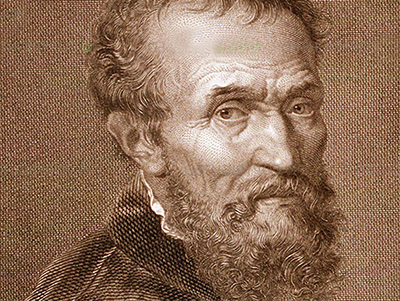
Michelangelo was both sculptor and poet, and Night drew those practices together in its reception. His marble gives sleep anatomical credibility; the poetic response associated with it turns stony silence into protection from political shame. Neither medium supplies a simple confession. Together they show how Michelangelo could make a body, an allegory and a public condition resonate without collapsing them into one meaning.
Frequently Asked Questions
Discussion
How does Michelangelo make sleep feel both vulnerable and monumental?
Reader Insights
How does Night's pose change the emotional tone of Giuliano's tomb?
Why do the poppies, owl, mask, moon and star matter for reading the sculpture?
What changes when later copies are treated as reception evidence rather than substitutes for the original?
Join the Conversation
Set Night beside Day, Dawn and Dusk. Which figure makes time feel most physical?
References
- Catalogo generale dei Beni Culturali, Notte”:, View source.
- Catalogo generale dei Beni Culturali, Michelangelo e la Sagrestia Nuova in Firenze — Un progetto innovativo”:, View source.
- Musei del Bargello, Cappelle Medicee”:, View source.
- British Museum, The Medici Tombs in the New Sacristy: Studies for a Free-standing Sepulchral Monument”:, View source.
- British Museum, The Medici Tombs in the New Sacristy: A Study for a Double Tomb with Figures”:, View source.
- The Metropolitan Museum of Art, Michelangelo: Divine Draftsman and Designer”:, View source.
- VIVE — Vittoriano and Palazzo Venezia, The Night”:, View source.
- Smithsonian American Art Museum, Night”:, View source.
- Fondazione Federico Zeri, Buonarroti Michelangelo, Allegoria della Notte”:, View source.
- Michelangelo Buonarroti and Tommaso Campanella, The Sonnets of Michael Angelo Buonarroti and Tommaso Campanella, translated by John Addington Symonds, Project Gutenberg, Symonds translations, including the epigram for Night, View source.