

 by Tom Gurney
Tom Gurney BSc (Hons) is an art history expert with over 20 years experience
Published on July 26, 2026 / Updated on September 6, 2026
Email: tomgurney1@gmail.com / Phone: +44 7429 011000
Louisiana Heron: Introduction
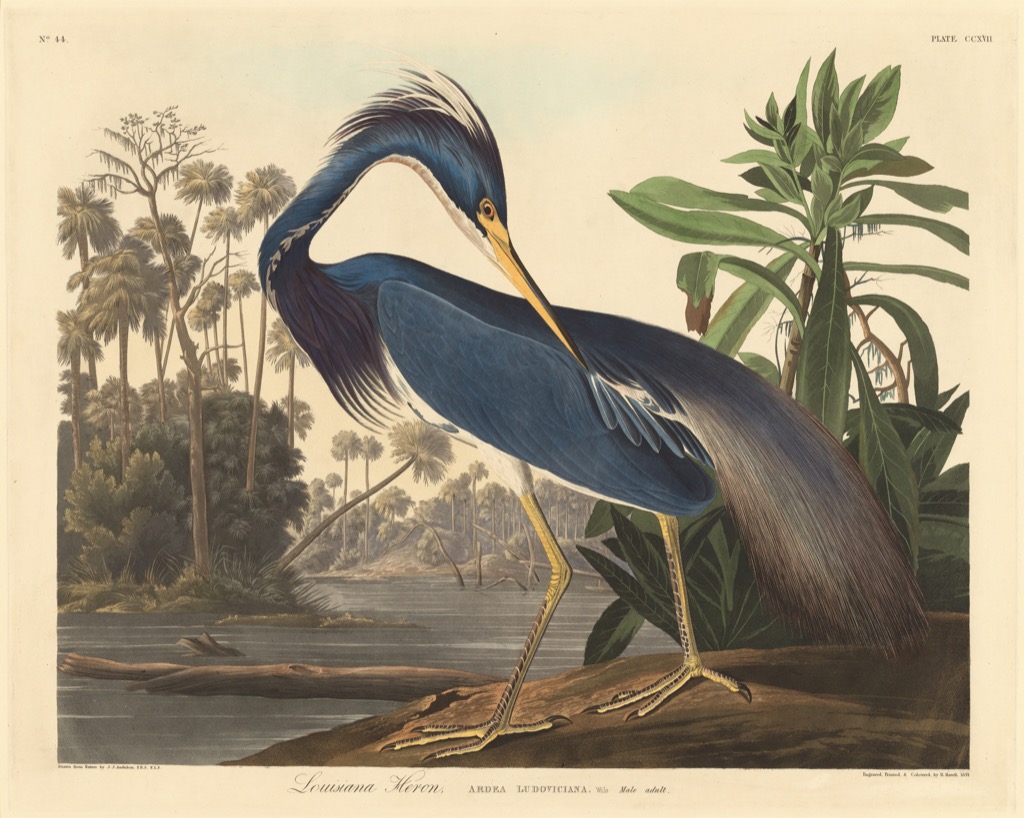
John James Audubon's Louisiana Heron is an elegant wading-bird plate from The Birds of America. It shows a slender blue heron standing in a lush wetland, its body turned one way and its head twisted back toward the viewer. The plate title belongs to Audubon's nineteenth-century language. Modern bird sources now generally call this species the Tricolored Heron, Egretta tricolor. [1], [3]
That name shift is the first thing to understand about the image. Louisiana Heron is the historical artwork title. Tricolored Heron is the current species name used by Cornell's All About Birds and other modern bird references. The difference should not be treated as an error in Audubon or as a reason to rename the artwork. It is a reminder that natural history names change while prints, captions and collection records preserve earlier language. [1], [3]
Audubon's plate is valuable because it brings art and identification together. The bird is not simply labelled. It is posed, coloured and placed in a wetland world. Its long body, bent neck, yellowish bill and legs, blue and purple plumage, white neck stripe and open landscape all help the viewer read it as a living heron rather than as a flat specimen. [1], [4]
At a Glance
- Public titleLouisiana Heron
- SeriesThe Birds of America, Plate CCXVII [1]
- Catalogue referenceBirds of America, no. 217 [1]
- Date1834 [1]
- Maker lineRobert Havell after John James Audubon [1]
- Mediumhand-colored engraving and aquatint on Whatman wove paper [1]
- AccessionNational Gallery of Art, 1945.8.217 [1]
- Historic scientific wordingArdea ludoviciana [1]
- Current species nameTricolored Heron, Egretta tricolor [3]
- Image statusNGA public-domain media route [1]
Contents
- Introduction
- Annotated Details
- Object Facts
- What the Plate Shows
- Historic Title and Modern Name
- The Bird Behind the Image
- Wetland Gesture and Foraging Energy
- Place in The Birds of America
- How to Read the Plate Today
- Conservation Context
- Why This Plate Matters
Annotated Details from Louisiana Heron
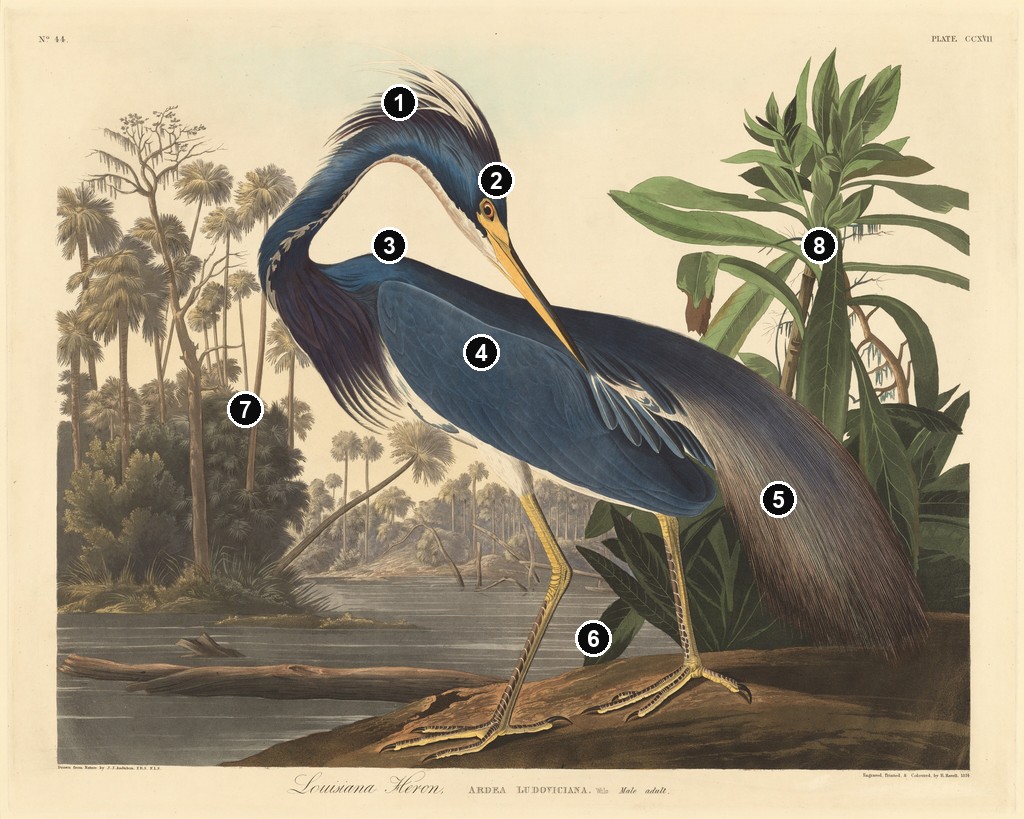
These annotated details follow Audubon's Louisiana Heron through the crest, eye and bill, curved neck, blue body, long train of tail feathers, legs, wetland distance and broad green foliage.
Details from LOUISIANA HERON
Close looking keeps the historical plate title in view while showing the slender bird now commonly discussed as the Tricolored Heron through posture, colour and wetland setting.
Sweeping crest plumes
Long crest plumes sweep backward above the head. Their pale tips make the bird look both elegant and alert.
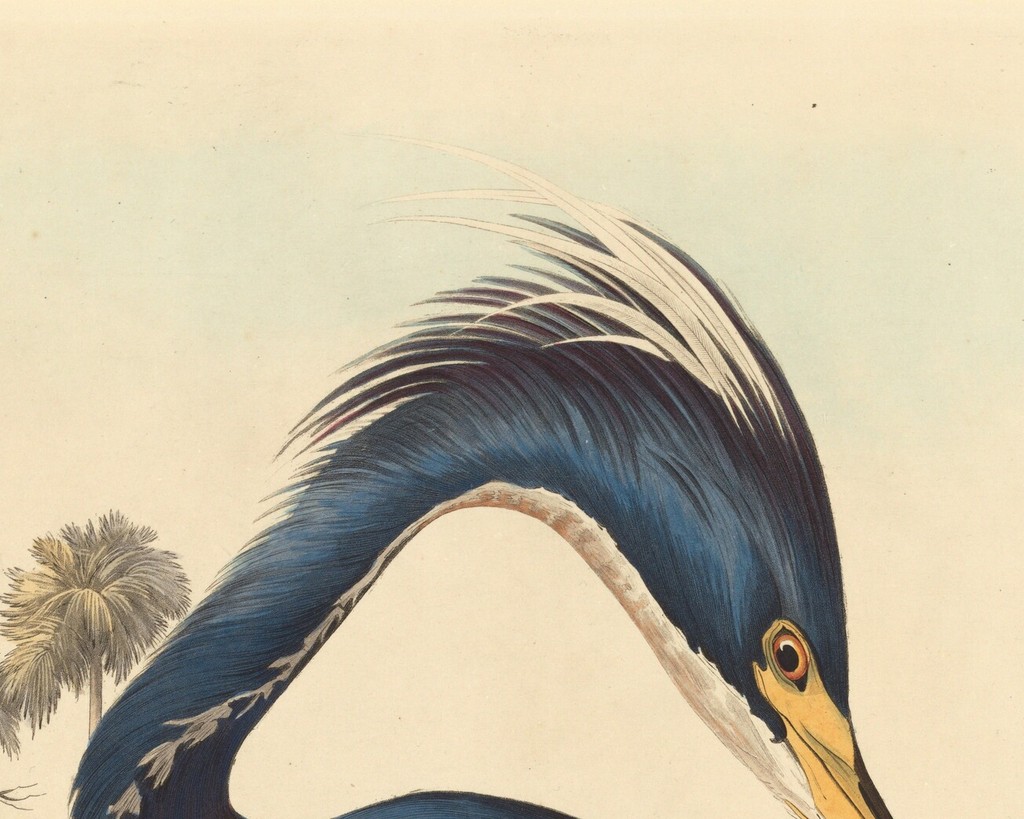
Eye and yellow bill
The bright eye and yellow bill form a small focal point inside the long curve of the neck.
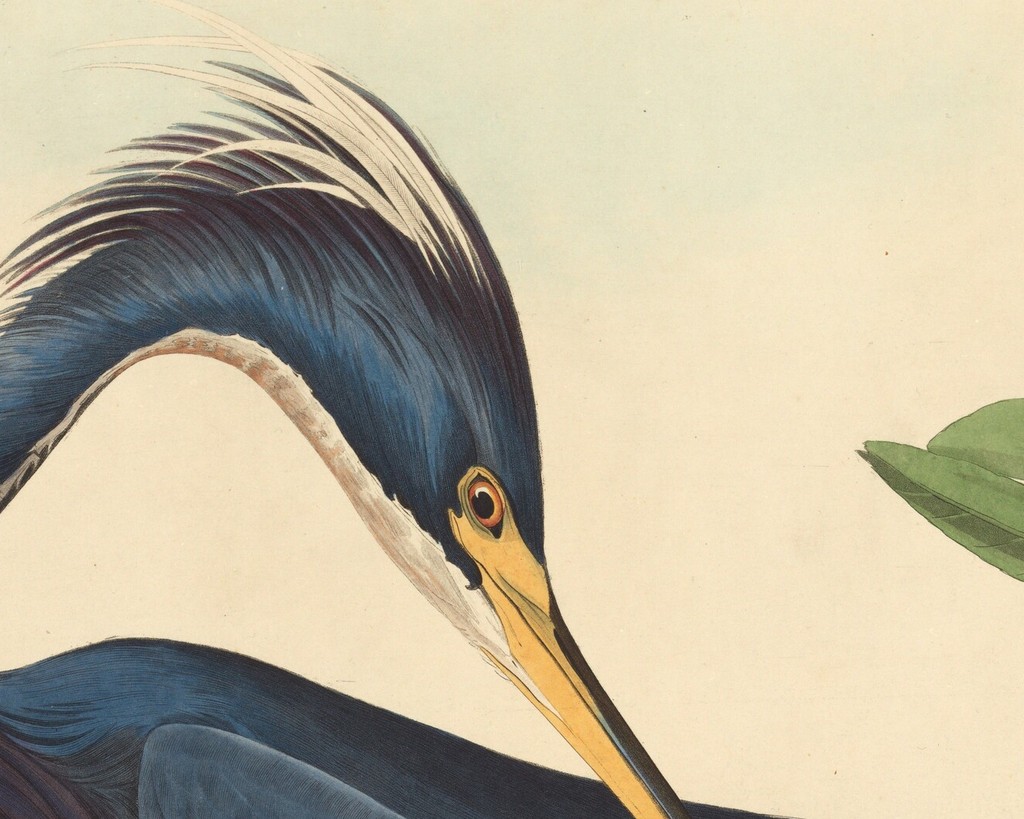
Curved white neck
The white neck bends in a broad arc. That curve is the plate's main structural line before the bill points downward.
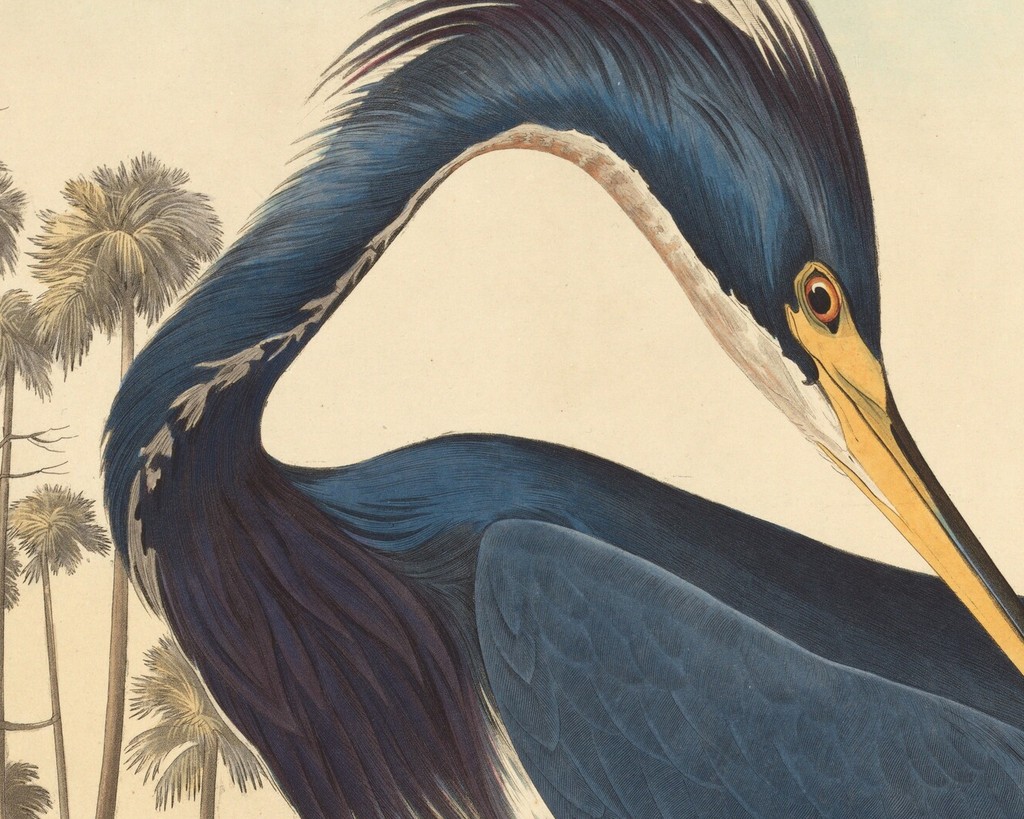
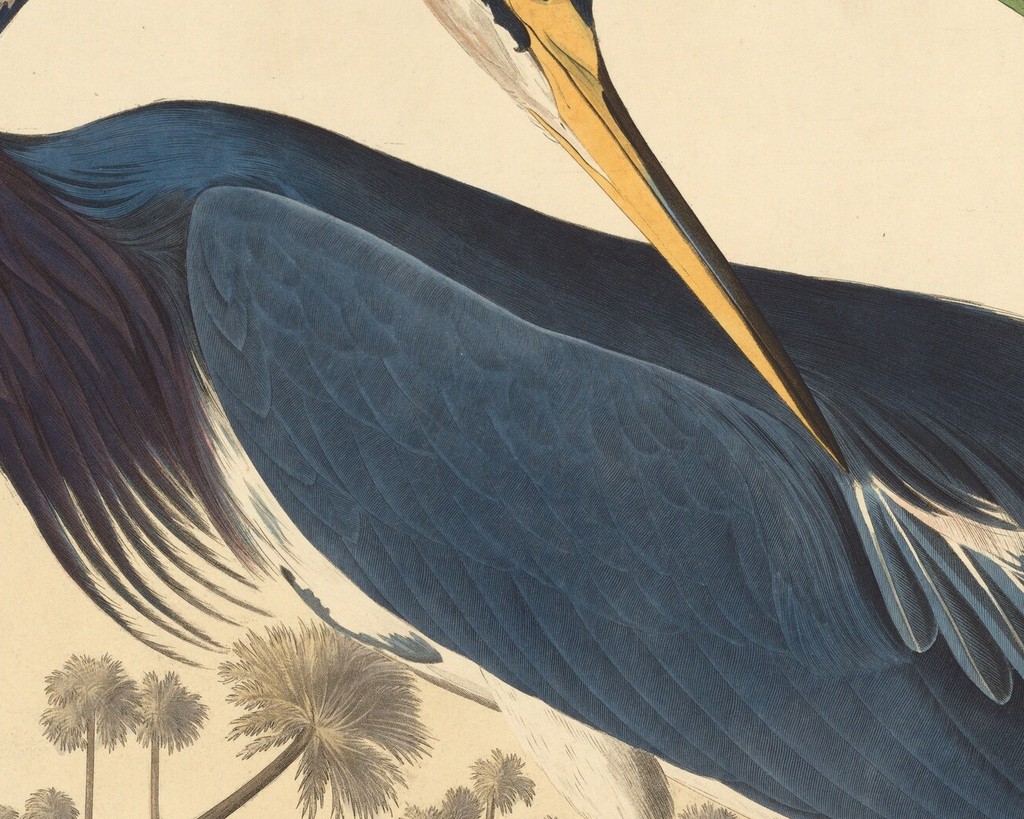
Blue wing and body
The blue wing and body are built from layered tones rather than a single flat colour. The surface turns the bird into a study of cool dark plumage.
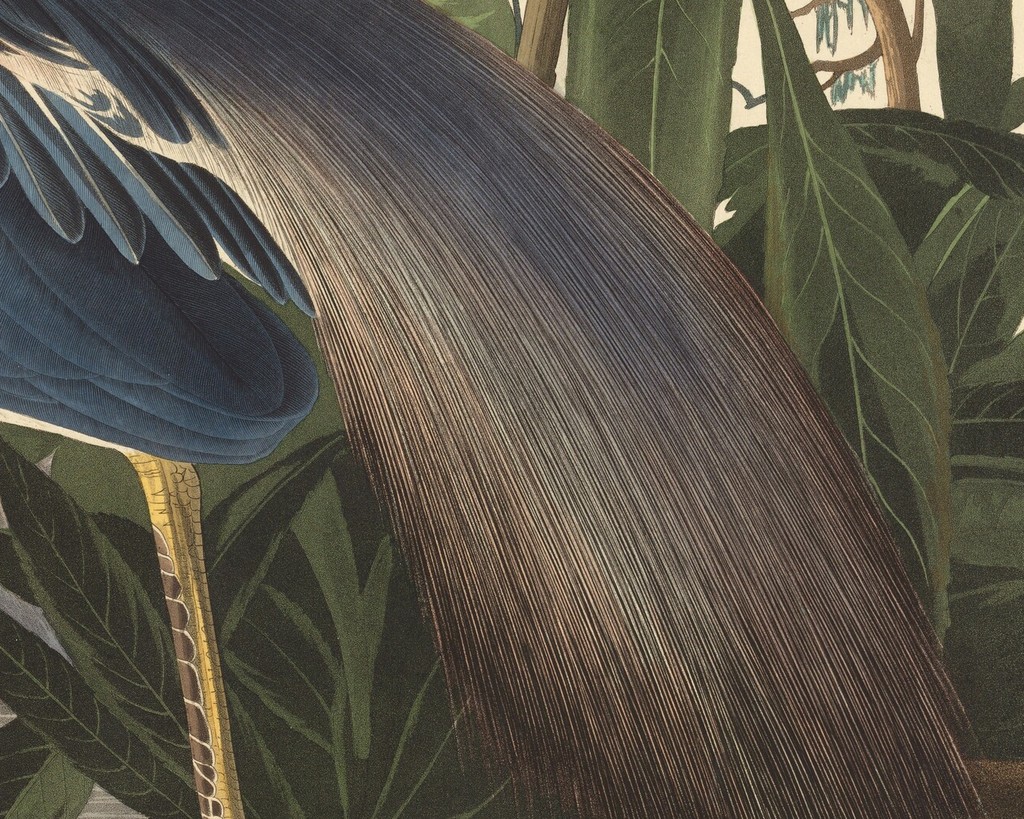
Long trailing feathers
Long trailing feathers fall down the right side in fine vertical strokes. Their length gives the bird unusual elegance and scale.
Yellow legs and feet
The long yellow legs and spread toes anchor the heron on the branch. Their thinness contrasts with the large blue body above.
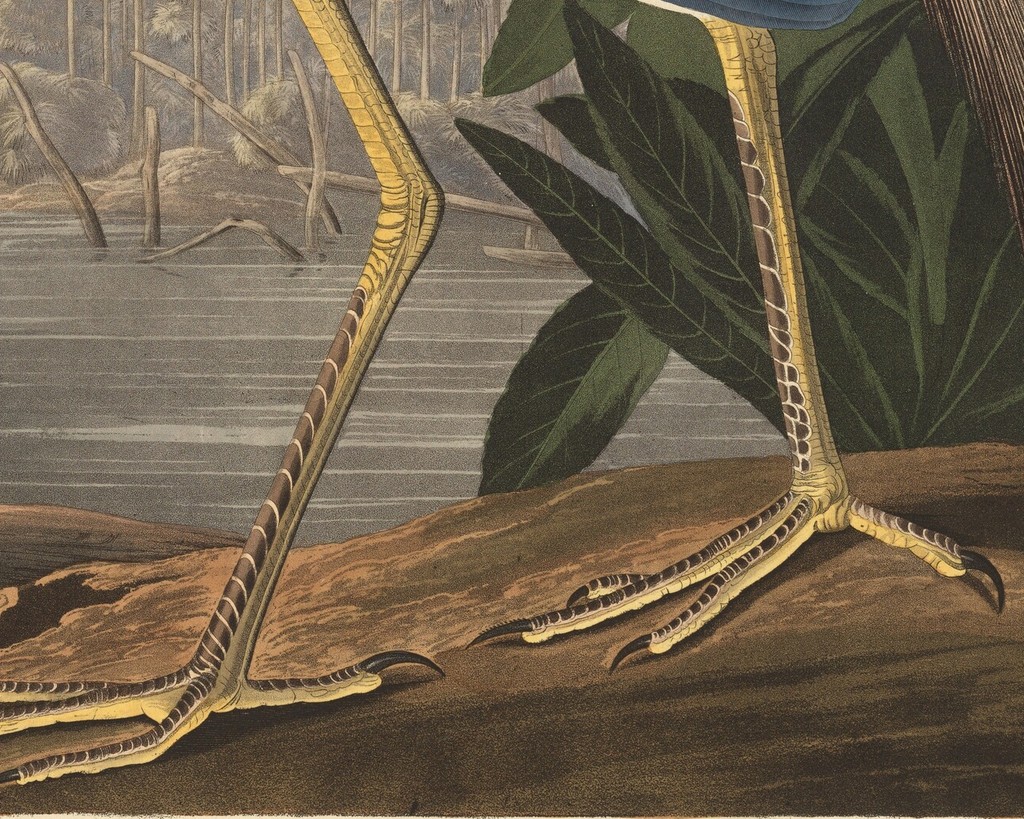
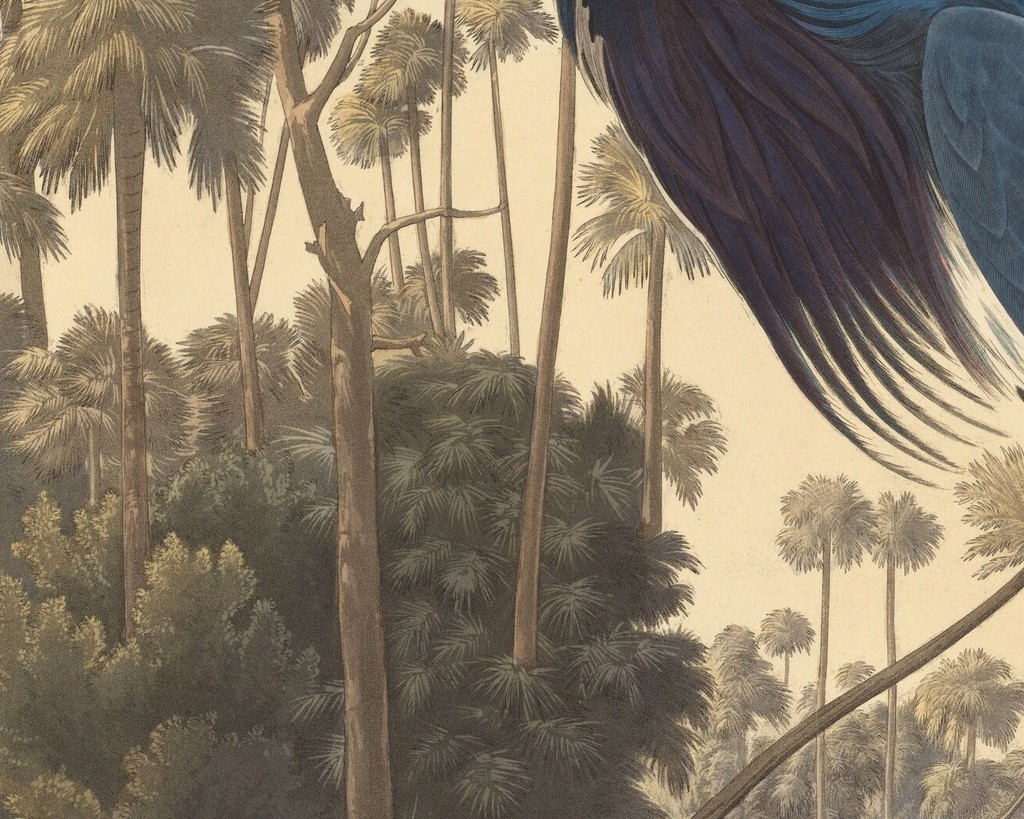
Wetland distance
Palmettos, water and distant trunks widen the plate into a wetland setting. The landscape remains secondary but gives the bird a habitat.
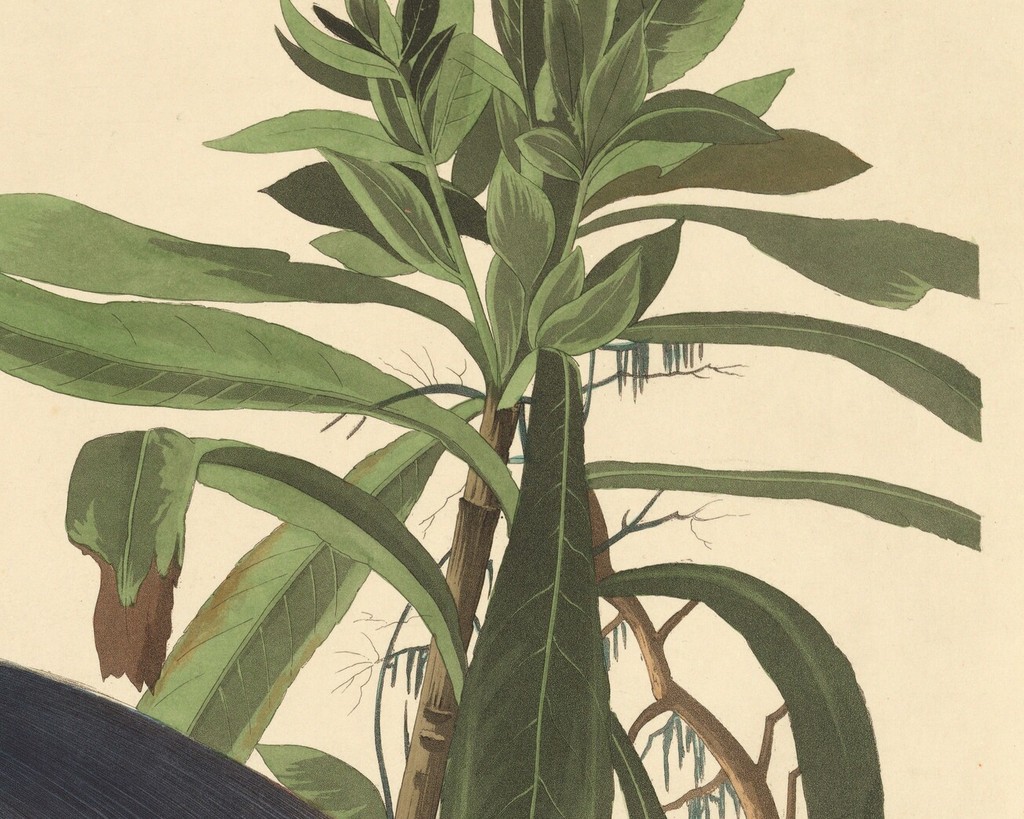
Broad green leaves
Large green leaves rise behind the heron on the right. The plant mass balances the distant trees on the left side of the sheet.
Object Facts
The National Gallery of Art records Louisiana Heron as an 1834 hand-colored engraving and aquatint on Whatman wove paper by Robert Havell after John James Audubon. The accession number is 1945.8.217. The catalogue reference is The Birds of America, no. 217, and the series title identifies it as Plate CCXVII. [1]
The NGA record gives the plate size as 52.8 by 66 centimetres and the sheet size as 68.5 by 101.2 centimetres. The wide sheet gives the bird room to stand in a landscape rather than as a cropped specimen. The setting, inscriptions and surrounding margin all remain part of the printed object. [1]
NGA also states that the object's media is free and in the public domain. That makes the museum the strongest primary institutional path for this illustrated page. The Saint Louis Art Museum holds another Louisiana Heron, Plate CCXVII from The Birds of America, dated 1834, with Public Domain rights listed. That record is useful as a backup metadata and rights comparison, though the NGA object remains the locked primary source here. [1], [2]
What the Plate Shows
The bird stands in profile on a low mound, facing left, but its head turns sharply back to the right. That twist gives the image its alertness. The heron seems both still and aware, poised in the landscape while looking out from it. Audubon uses the long neck and slender legs to create a graceful curve, then sharpens the pose with the tilted bill and direct eye. [1]
The National Gallery's description emphasizes the ocean-blue body, flax-yellow beak and legs, plum-purple throat feathers and white feathers along the underside of the neck and head. These are not casual colour notes. They help explain why the modern name Tricolored Heron fits the bird so well. Blue-grey, lavender and white all contribute to the species' appearance, and the white stripe down the neck remains a key visual marker. [1], [3]
The setting is as important as the body. The heron stands beside a tall plant. A river or wet channel moves through the composition, separating the foreground bird from palms, reeds, bushes and bare tree trunks in the distance. The print is full of wetland atmosphere without overwhelming the bird. The landscape frames the heron as a coastal or marshland creature.
Audubon often made his bird plates feel theatrical, but this one is restrained. There is no violent action, no prey in the bill, no flock. The drama is in posture and place. The turned head makes the bird feel momentary, as if it has paused mid-wade and noticed movement nearby.
Historic Title and Modern Name
The name Louisiana Heron can be confusing for modern readers because the bird is now normally called the Tricolored Heron. Cornell's overview states the current name and scientific name, then directly notes that the bird was once known as the Louisiana Heron. That makes the taxonomy issue unusually straightforward. [3]
Audubon's plate should retain its historical title because it is the title printed and catalogued with the artwork. At the same time, any modern explanation should mention Tricolored Heron early so readers looking for the living species can connect the plate to current bird knowledge. The historical title belongs to the print; the modern name belongs to present ornithology.
The older scientific name also helps show the distance between Audubon's time and ours. The NGA inscription includes Ardea ludoviciana, while current Cornell usage is Egretta tricolor. A careful article does not need to turn that into a technical taxonomy essay. It simply needs to avoid implying that Audubon used the current name or that the old name means a different bird in this context. [1], [3]
This title/name explanation is one reason Louisiana Heron deserves its own concise plate article. The page is not only about a beautiful heron image. It is also a useful example of how nineteenth-century natural history art and modern bird naming meet.
The Bird Behind the Image
Cornell places the Tricolored Heron in the order Pelecaniformes and family Ardeidae. It describes the bird as a sleek, slender heron with blue-gray, lavender and white colouring. It wades through coastal waters in search of small fish and often moves with quick turns and stops. It is common in southern saltmarshes and uses coastal estuaries, saltmarshes, mangroves and lagoons during the breeding season. [3], [4]
Those details make Audubon's plate easier to read. The bird's thin body, long legs and bent neck all suit a fish-hunting wader. Cornell's life-history account describes Tricolored Herons as skilled at stalking, chasing and standing still before striking. They may forage alone or at the edge of groups of other wading birds. In the plate, Audubon chooses stillness rather than chase, but the body is built for sudden movement. [4]
The landscape also fits the species. Palms, reeds, shallow water and wet ground place the bird in a southern coastal or marshy world. The composition does not need to be a literal field-guide habitat diagram. It is enough that Audubon makes the bird's form and setting work together. The heron belongs to the wet edge of land and water.
Wetland Gesture and Foraging Energy
The plate is quiet, but the bird Audubon shows was not simply a slow, decorative wader. Cornell describes Tricolored Herons as active fish hunters that may stalk, stand, chase, run, stop sharply, turn quickly and use wing movements while pursuing fish. That behaviour helps explain why the pose in Louisiana Heron feels alert rather than static. The bird is paused, but it seems capable of sudden change. [4]
Audubon does not show the heron lunging after prey. Instead, he builds the possibility of movement into the body. The long legs hold the bird above wet ground. The neck can fold and spring. The bill points downward after the backward turn of the head, so the viewer senses both looking and readiness. The posture is elegant, but it is also functional.
The wetland setting supports that reading. Cornell places Tricolored Herons in coastal estuaries, saltmarshes, mangroves, lagoons and freshwater marsh edges. The NGA plate gives the bird water, palms, reeds, low earth and distant trunks. It does not need a labelled map to evoke habitat. The visual grammar of shallow water and dense growth does that work. [1], [4]
This is where Audubon's art remains useful for modern readers. A field guide might isolate the identifying marks more directly. A museum specimen might preserve structure more precisely. Audubon's print gives the bird a world: water to hunt in, vegetation to stand beside, open space for the turn of the head, and enough colour contrast to make the heron legible at first glance.
Place in The Birds of America
Louisiana Heron belongs to The Birds of America, Audubon's great large-format publication of North American birds. The National Gallery records it as no. 217 in the catalogue and Plate CCXVII in the series. Published during the mature Havell period of the project, it shows the polished combination of Audubon's bird design and London printmaking that defines the mature book. [1], [5], [6]
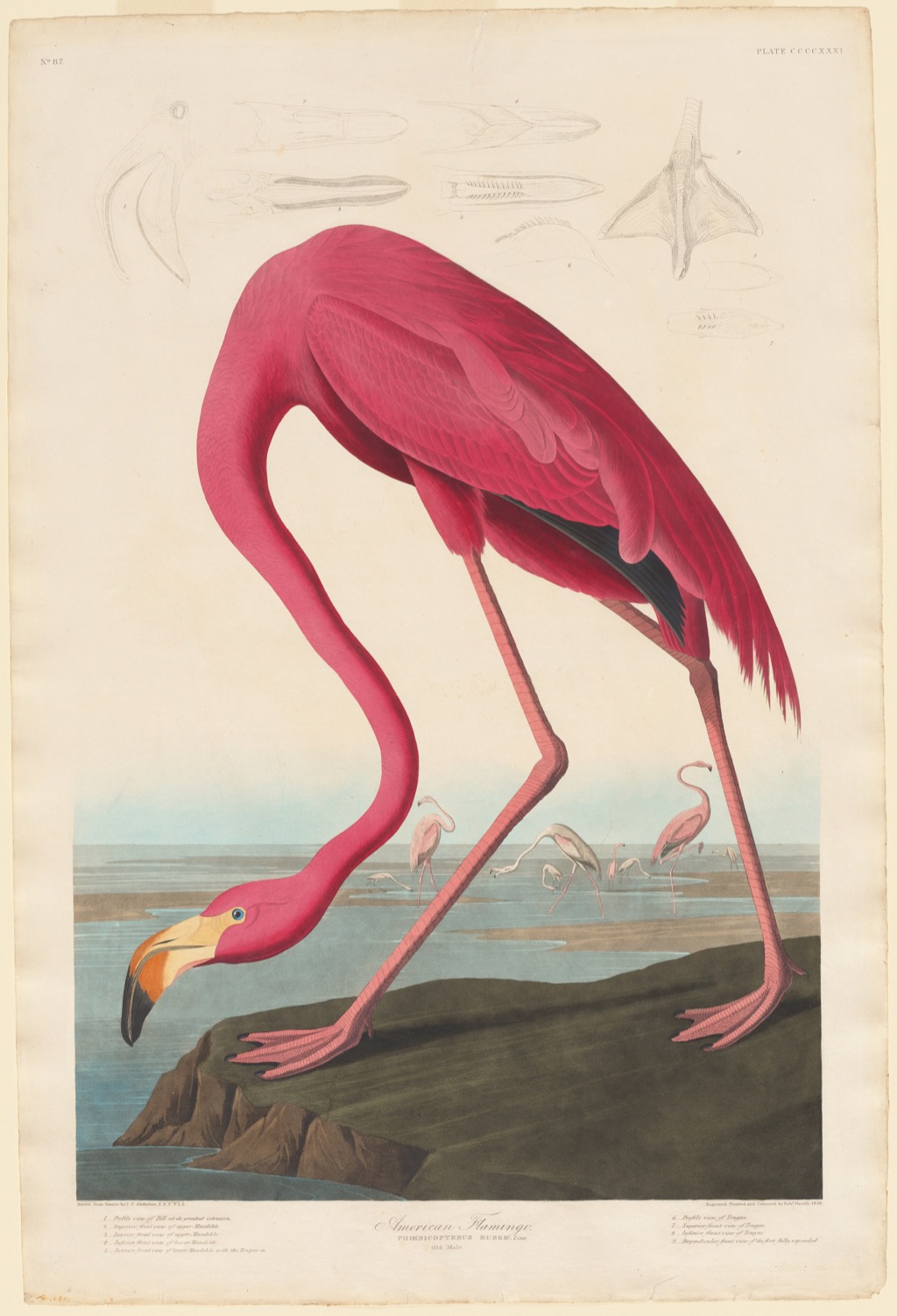
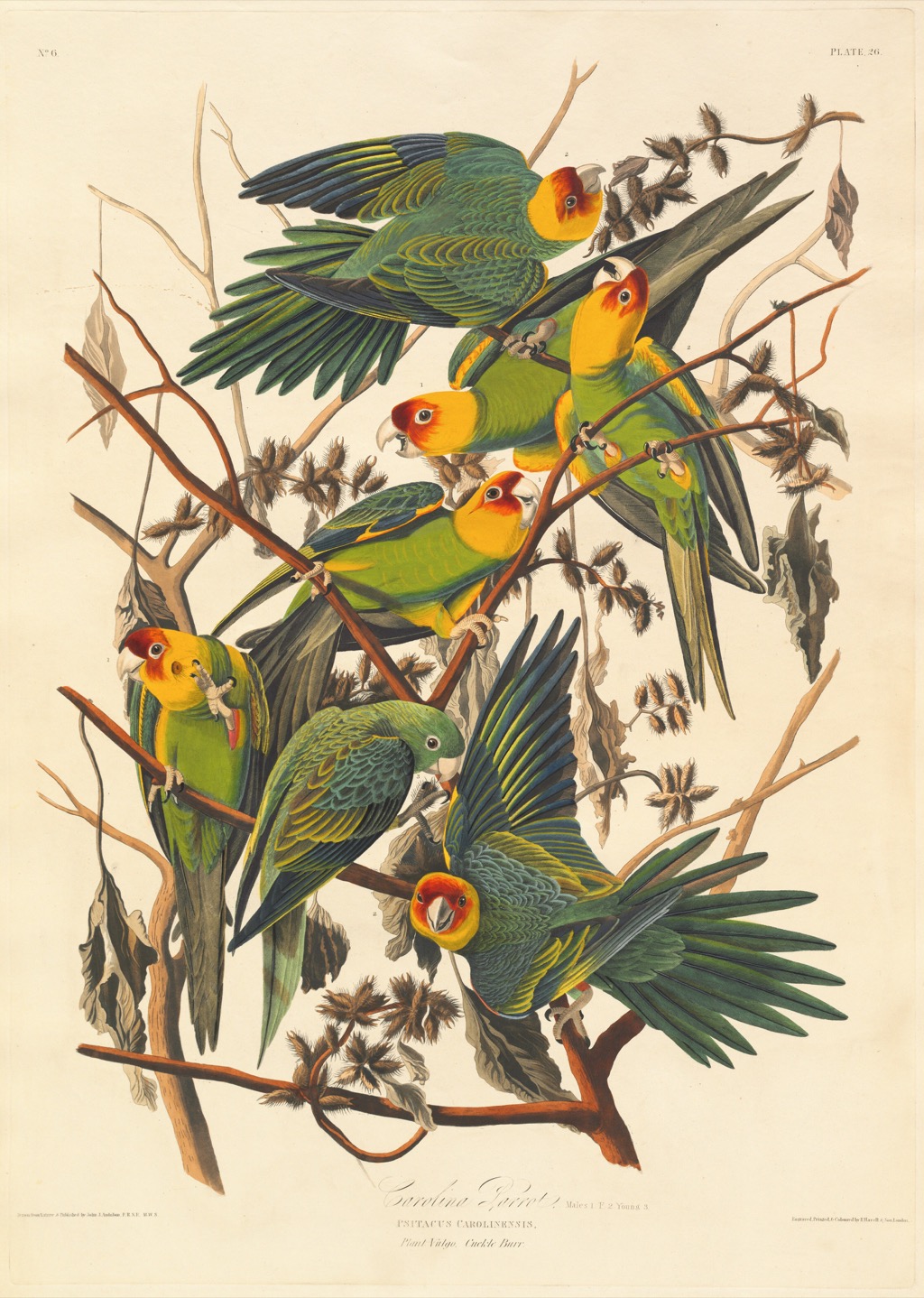
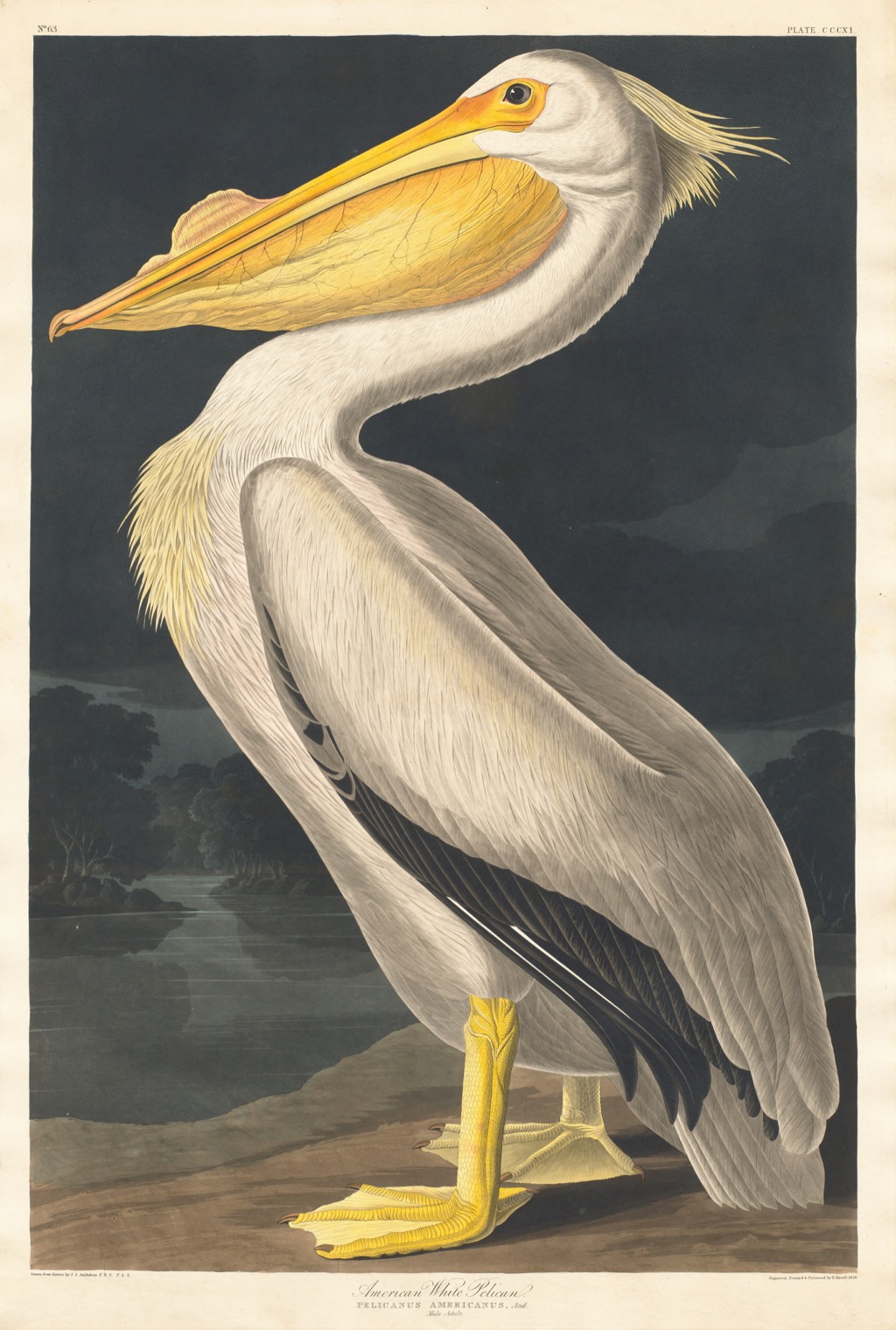
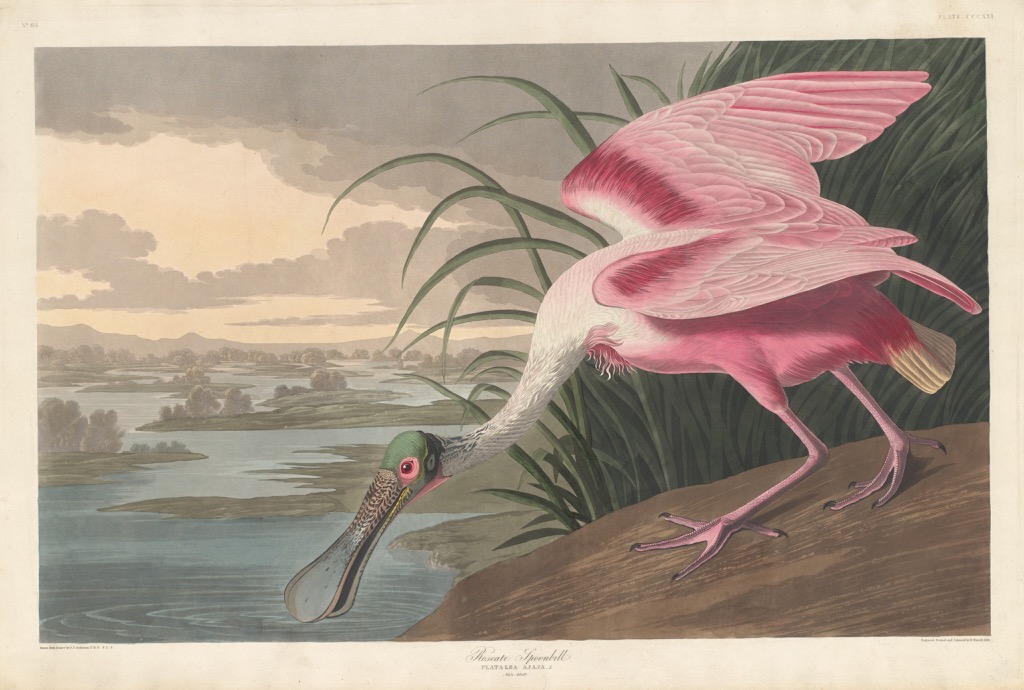
The plate sits naturally beside Audubon's other wading and waterbird subjects. Readers can move from it to Great Blue Heron for a larger, more familiar heron subject, to Roseate Spoonbill for another coastal wetland bird with striking colour, or to American White Pelican for a very different large waterbird composition.
Those comparisons help define the plate's particular mood. Great Blue Heron is more imposing, with a larger bird and a stronger sense of vertical scale. Roseate Spoonbill is more colour-driven, built around pink plumage and an unmistakable bill. American White Pelican is more monumental and pale, shaped by mass and breadth. Louisiana Heron is more delicate. Its drama lies in the backward turn of the head, the narrow legs, the white stripe on the neck and the way a slender bird claims space in a damp, crowded landscape.
For the larger publication story, The Birds of America explains the book's scale, production and publication history. John James Audubon Works places the plate among drawings, prints, paintings and other image-led routes through Audubon's art.
How to Read the Plate Today
A first reading begins with posture. The heron stands quietly, but the backward twist of the head makes the image active. Audubon catches a pose that suggests attention rather than rest.
A second reading begins with colour. Blue, lavender, white and yellow help the bird stand apart from the muted wetland behind it. The colours are subtle enough to remain naturalistic but strong enough to make the heron memorable.
A third reading begins with water. The wet channel, plants and distant trunks place the bird in a landscape that feels southern and low-lying. The setting does not merely decorate the print; it helps identify the bird's way of life.
A fourth reading begins with names. Louisiana Heron and Tricolored Heron are not competing page identities. They are two moments in the history of describing the same bird: one preserved in Audubon's plate, one used by current bird sources.
Conservation Context
Modern conservation context is less dramatic here than on Audubon's extinct or possibly lost bird pages. Cornell's overview labels Tricolored Heron as Low Concern, but the life-history page gives a more detailed regional picture. It notes stable survey trends from 1966 to 2015, a U.S. breeding population estimate below 194,000 birds in the 2002 North American Waterbird Conservation Plan, and state or regional variation in concern. [3], [4]
The Florida context is especially important. Cornell notes a major decline in breeding pairs in the central Everglades across the late 1990s and 2000s, with Florida listing the species as state threatened. It also notes that declines may be linked to reduced freshwater flows and habitat loss, while some artificial wetland or dredging contexts can benefit nesting opportunities. [4]
That keeps the tone balanced. This is not an extinction memorial, but it is still a bird shaped by wetland conditions. A careful reading avoids turning Low Concern into a blanket reassurance, and also avoids overstating the species as globally endangered.
Why This Plate Matters
Louisiana Heron matters because it shows Audubon at his most graceful. The subject is not one of the cluster's tragedy-laden birds, but it is still rich. The plate combines a precise body, a poised gesture, a wetland setting and a useful naming history.
It also broadens the Audubon cluster beyond the most famous images. The page gives readers another way into The Birds of America: not through extinction, monumental scale or spectacular colour alone, but through elegance, coastal ecology and the changing language of bird names.
For readers interested in the wider tradition of bird art, the site's bird drawings section offers another path. Louisiana Heron belongs in that tradition as an image where observation, printmaking and natural history naming remain visibly intertwined.
Frequently Asked Questions
Discussion
Louisiana Heron combines wetland atmosphere, a poised backward turn and a clear lesson in changing bird names.
Use the prompts below to think about naming, posture and the way Audubon turns a slender heron into a full landscape image.
Reader Insights
How does the historic title change your reading of a bird now called Tricolored Heron?
What does the backward turn of the head add to an otherwise quiet pose?
How does the river, plant life and distant grove shape the bird's identity?
Join the Conversation
Share your reading of Audubon's Louisiana Heron and its balance of elegance, habitat and changing bird language below.
References
- National Gallery of Art, Louisiana Heron, accession 1945.8.217, accessed 26 July 2026.
- Saint Louis Art Museum, Louisiana Heron, Plate CCXVII from the series The Birds of America, object 73:1953, accessed 26 July 2026.
- Cornell Lab of Ornithology, All About Birds, Tricolored Heron overview, accessed 26 July 2026.
- Cornell Lab of Ornithology, All About Birds, Tricolored Heron life history, accessed 26 July 2026.
- Biodiversity Heritage Library, The Birds of America, accessed 26 July 2026.
- Yale Beinecke Library, The Double Elephant Folio, accessed 26 July 2026.