

 by Tom Gurney
Tom Gurney BSc (Hons) is an art history expert with over 20 years experience
Published on July 26, 2026 / Updated on September 6, 2026
Email: tomgurney1@gmail.com / Phone: +44 7429 011000
Carolina Parakeet: Introduction
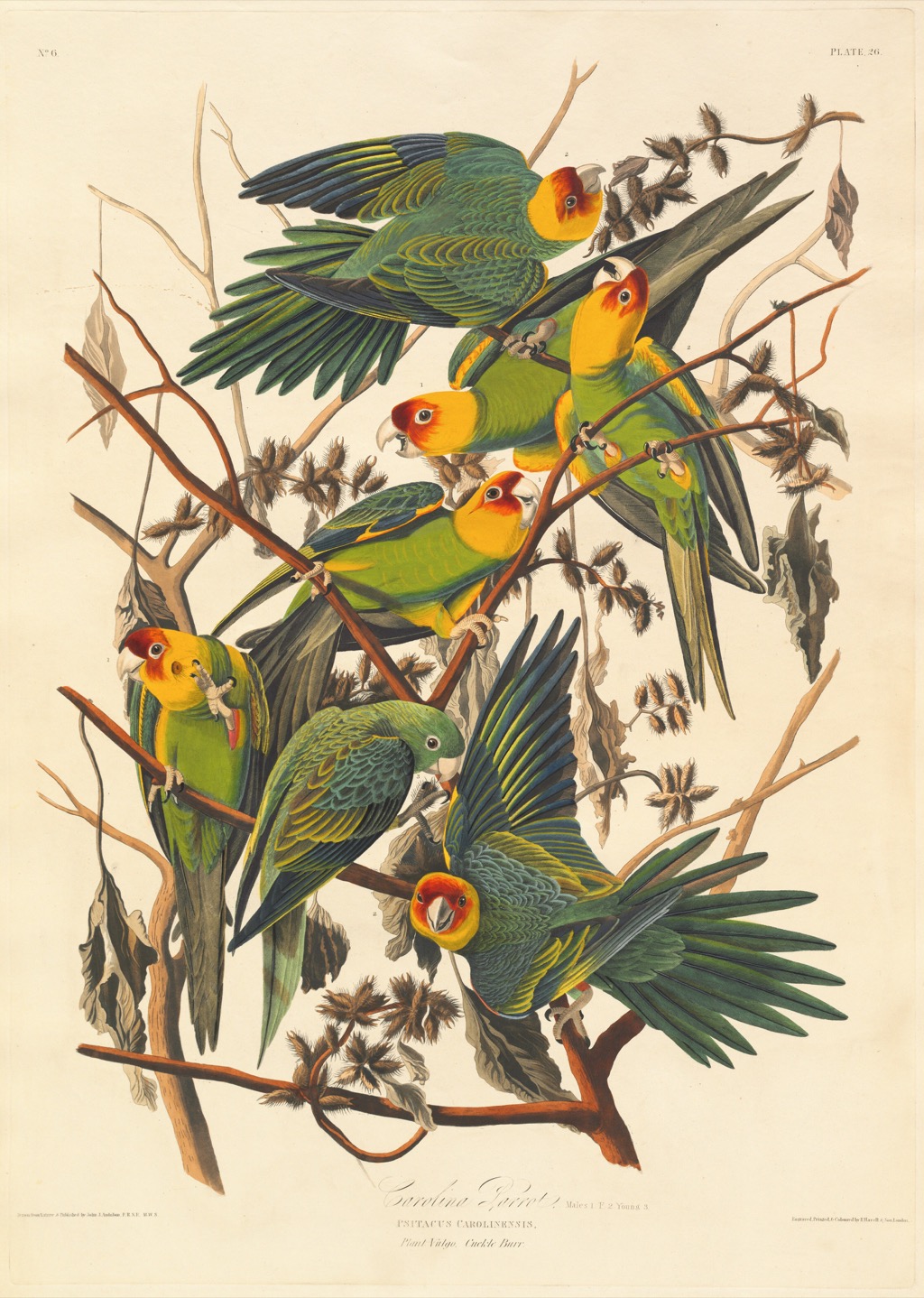
John James Audubon's Carolina Parakeet is one of the most haunting plates in The Birds of America. It is bright, sociable and full of motion, yet every living bird it represents belongs to a lost species. The print was published under the historic title Carolina Parrot, with the Latin name then used in Audubon's plate legend. Modern sources generally identify the bird as the Carolina Parakeet, Conuropsis carolinensis, the only parrot native to the eastern United States.
That double identity gives the image much of its force. It is a nineteenth-century natural history print, made to show a living bird in a recognisable setting, but it is also a modern memorial. The green bodies, yellow heads and orange faces still feel immediate. The clustered branches still suggest noise, feeding and flock behaviour. The spiny burrs still tie the birds to a particular plant and landscape. Yet the species itself is extinct, and the plate now asks readers to look at beauty and disappearance at the same time.
Audubon made this image early in the enormous project that became The Birds of America. It appears as Plate 26, among the first group of large-format aquatints issued in London. Robert Havell and his workshop engraved, printed and coloured the plate after Audubon's design, translating the artist's drawing into a hand-coloured print on a sheet large enough to make the birds feel physically present. The result is neither a quiet specimen study nor a sentimental bird picture. It is an image of a flock, a feeding plant, a vanished species and an ambitious book learning how far natural history illustration could go.
At a Glance
- Historic titleCarolina Parrot [1]
- Public titleCarolina Parakeet
- Date1827 [1]
- MakerRobert Havell after John James Audubon [1]
- Mediumhand-colored engraving and aquatint on Whatman wove paper [1]
- Dimensionsplate: 84.3 x 60.2 cm; sheet: 99.7 x 66.7 cm [1]
- CatalogueThe Birds of America, no. 26 / Plate XXVI [1], [2]
- SpeciesCarolina Parakeet, Conuropsis carolinensis [3]
Contents
- Introduction
- Annotated Details
- Object Facts
- What the Plate Shows
- Colour, Plant and Behaviour
- Historic Title and Current Name
- Place in The Birds of America
- Extinction and Conservation Memory
- How to Read the Plate Today
- Why This Plate Matters
Annotated Details from Carolina Parakeet
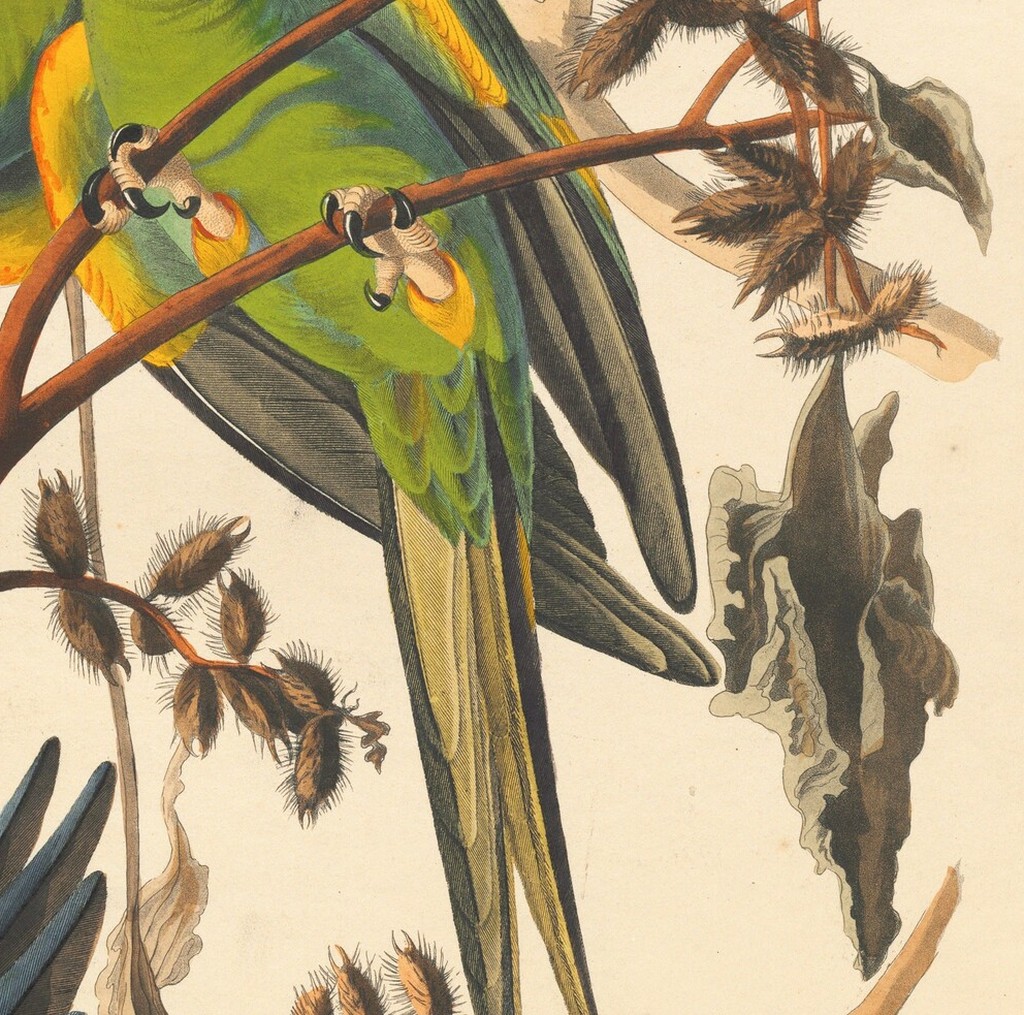
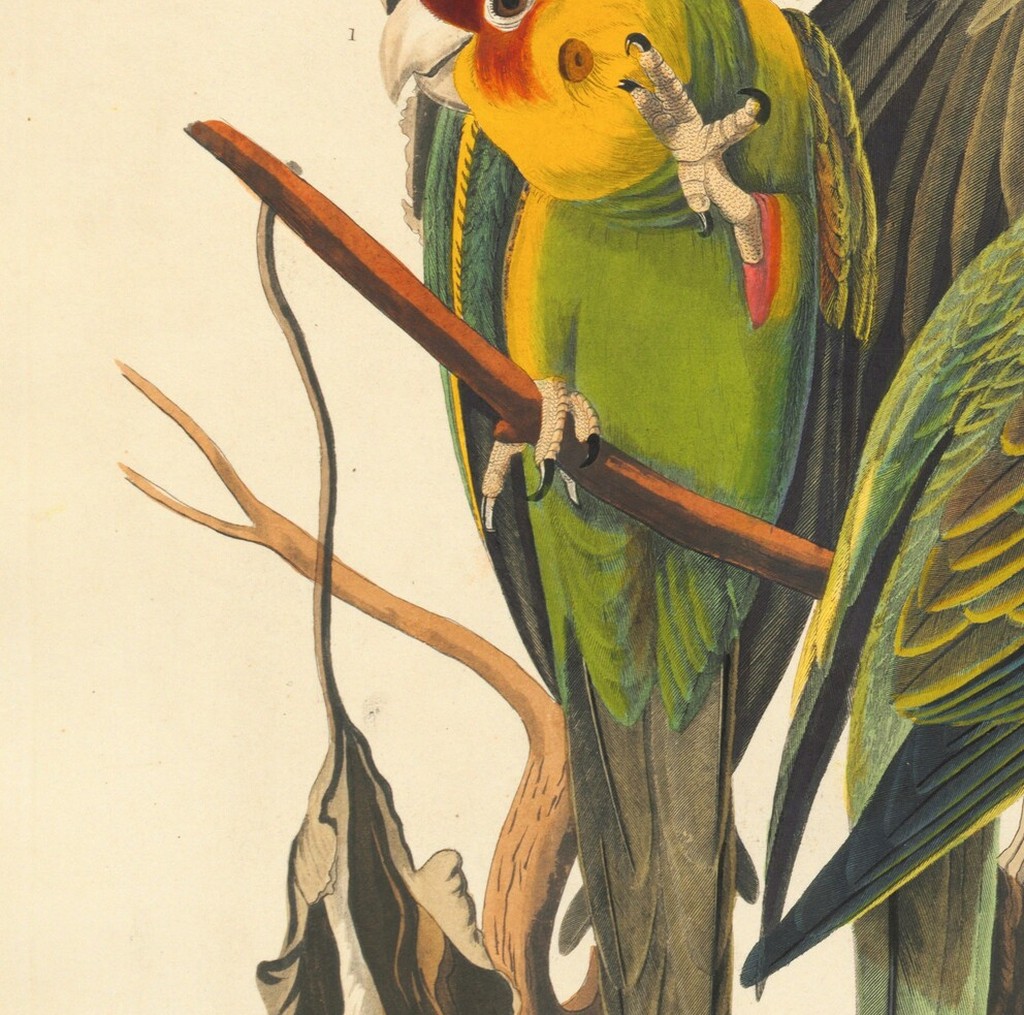
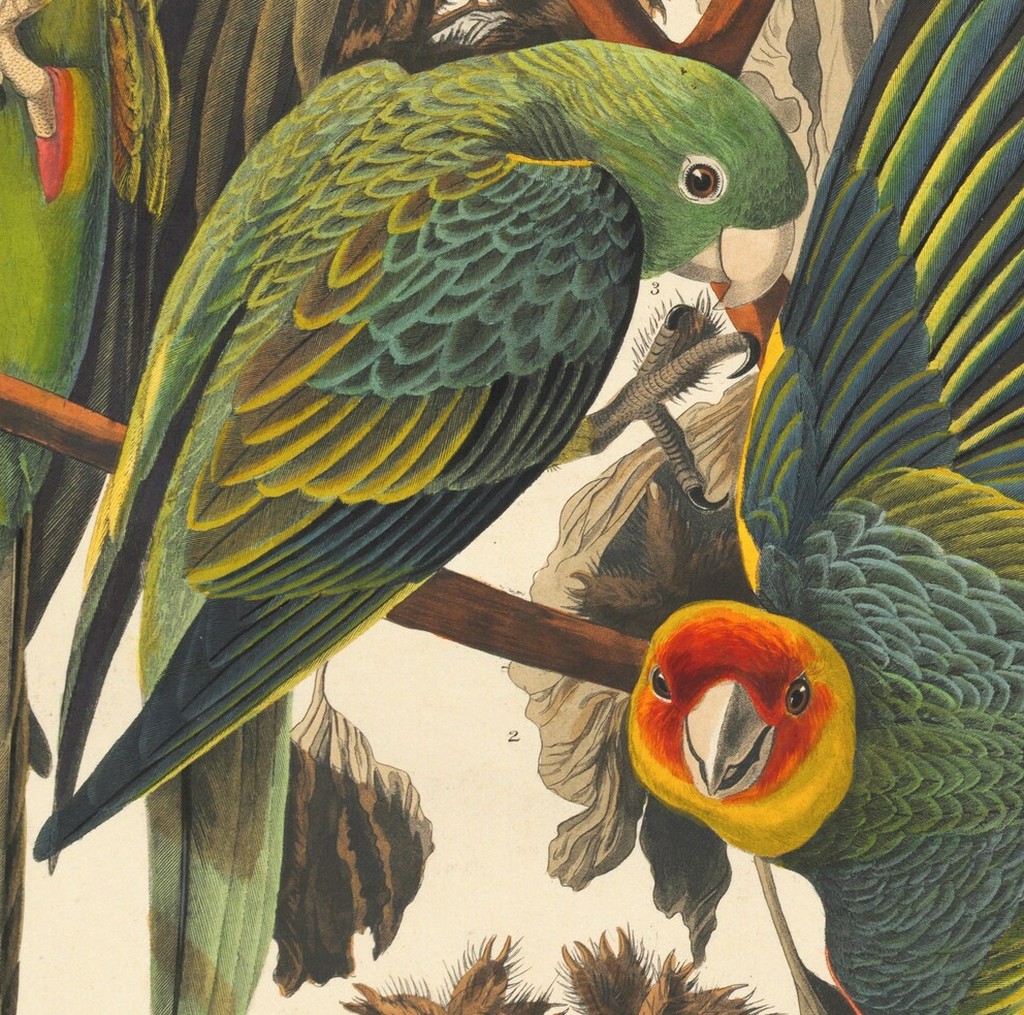
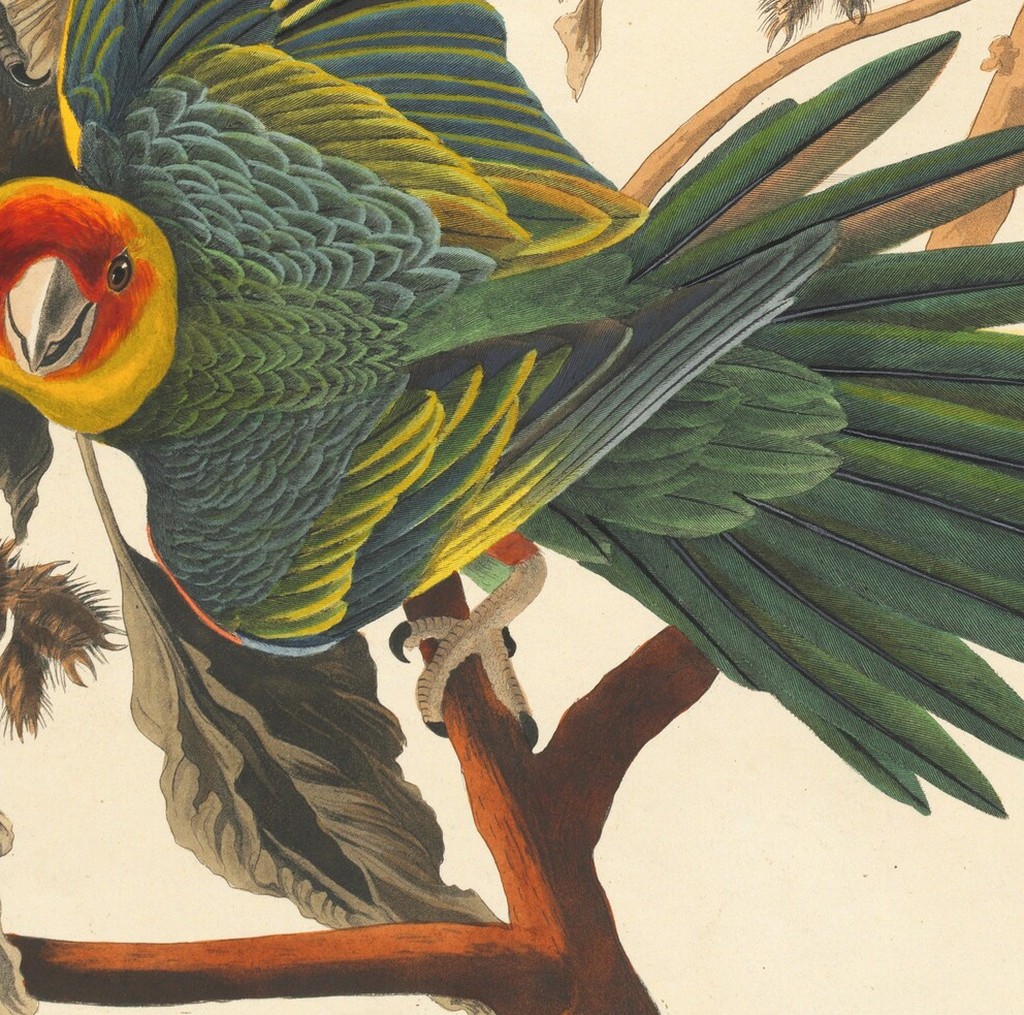
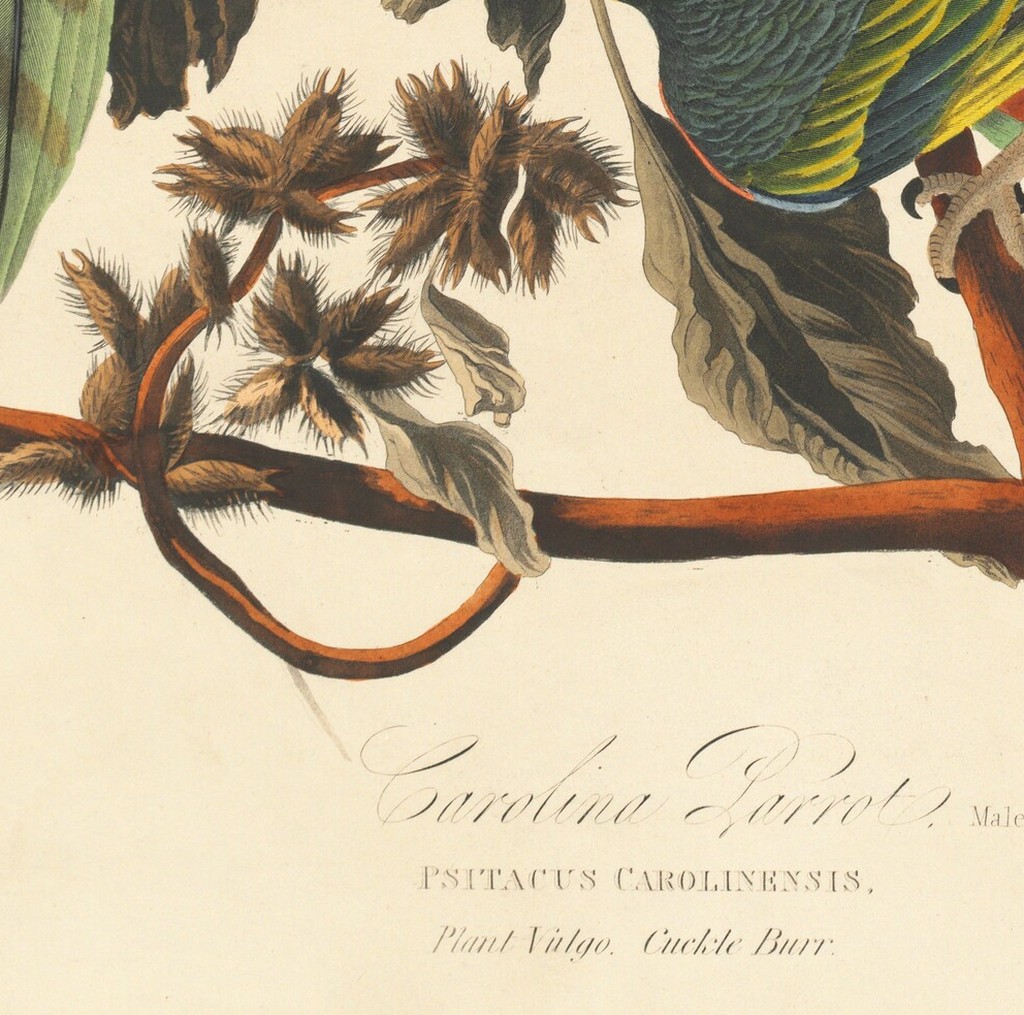
These annotated details follow Audubon's Carolina Parakeet through the clustered birds, red and yellow heads, layered green wings, grasping feet, dry burrs and branch network that make the plate feel crowded with movement.
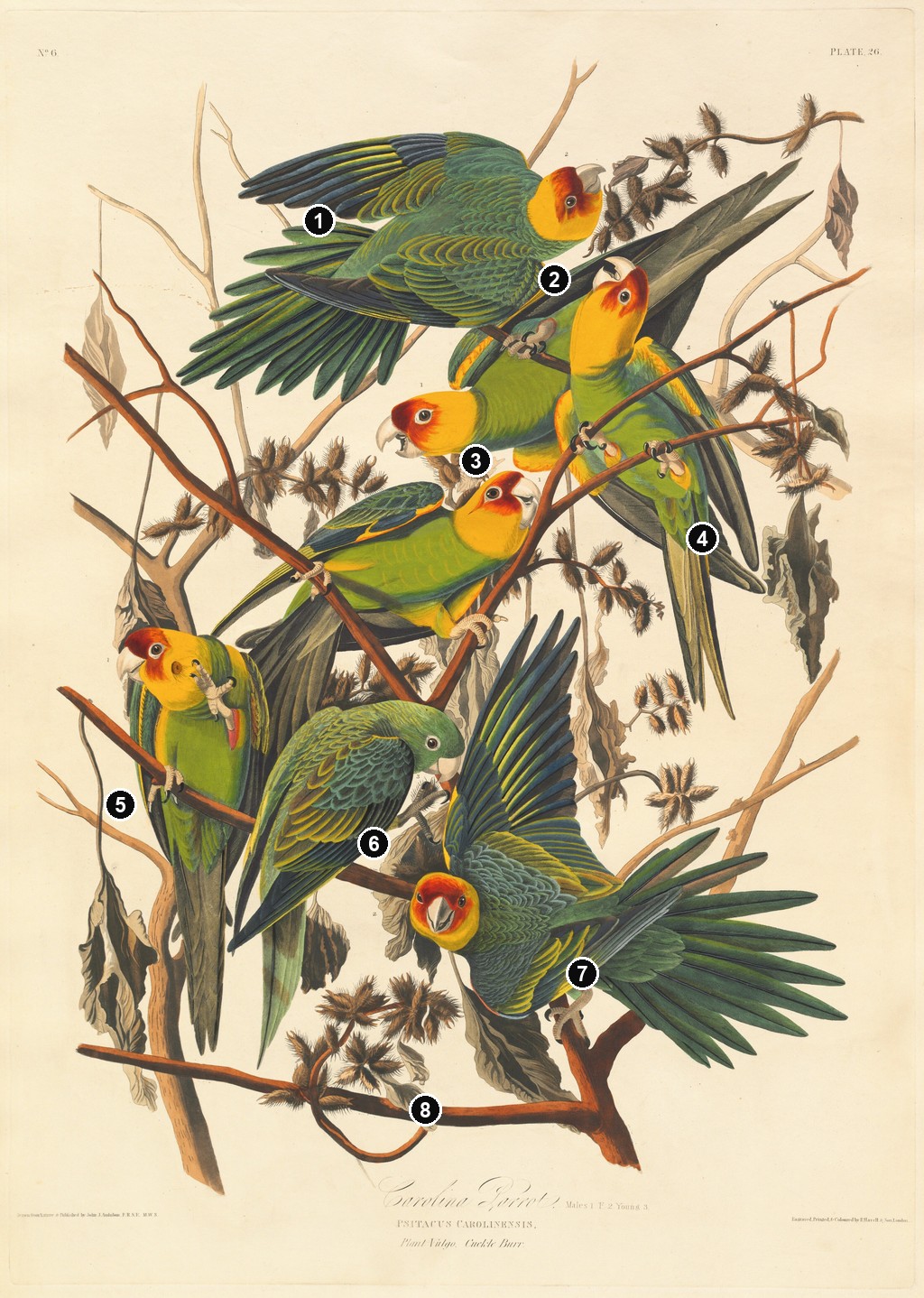
Details from CAROLINA PARAKEET
Close looking shows how Audubon turns a group of now-extinct birds into a lively arrangement of colour, repeated poses and interlocking branches.
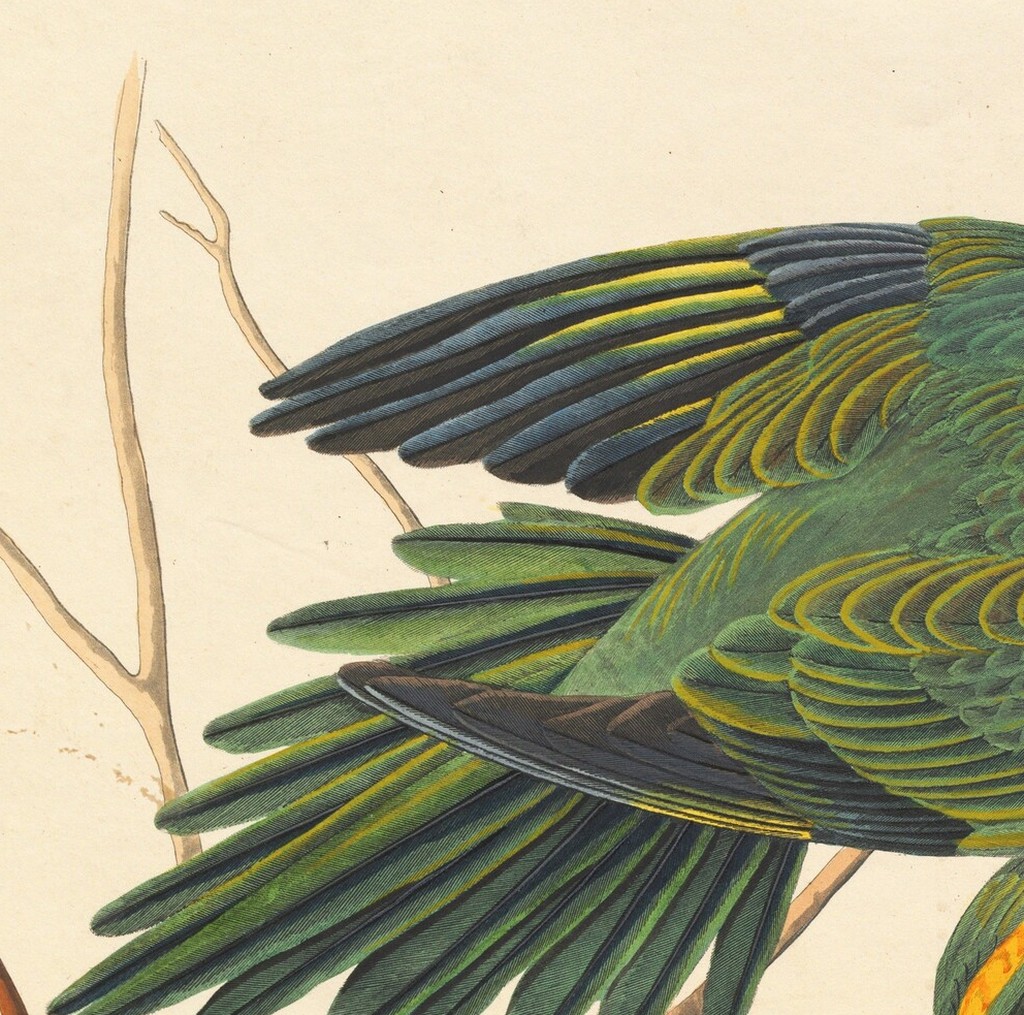
Spread upper wing
The upper bird opens a wing across the page. Green, blue and yellow feather bands give the group its strongest diagonal movement.
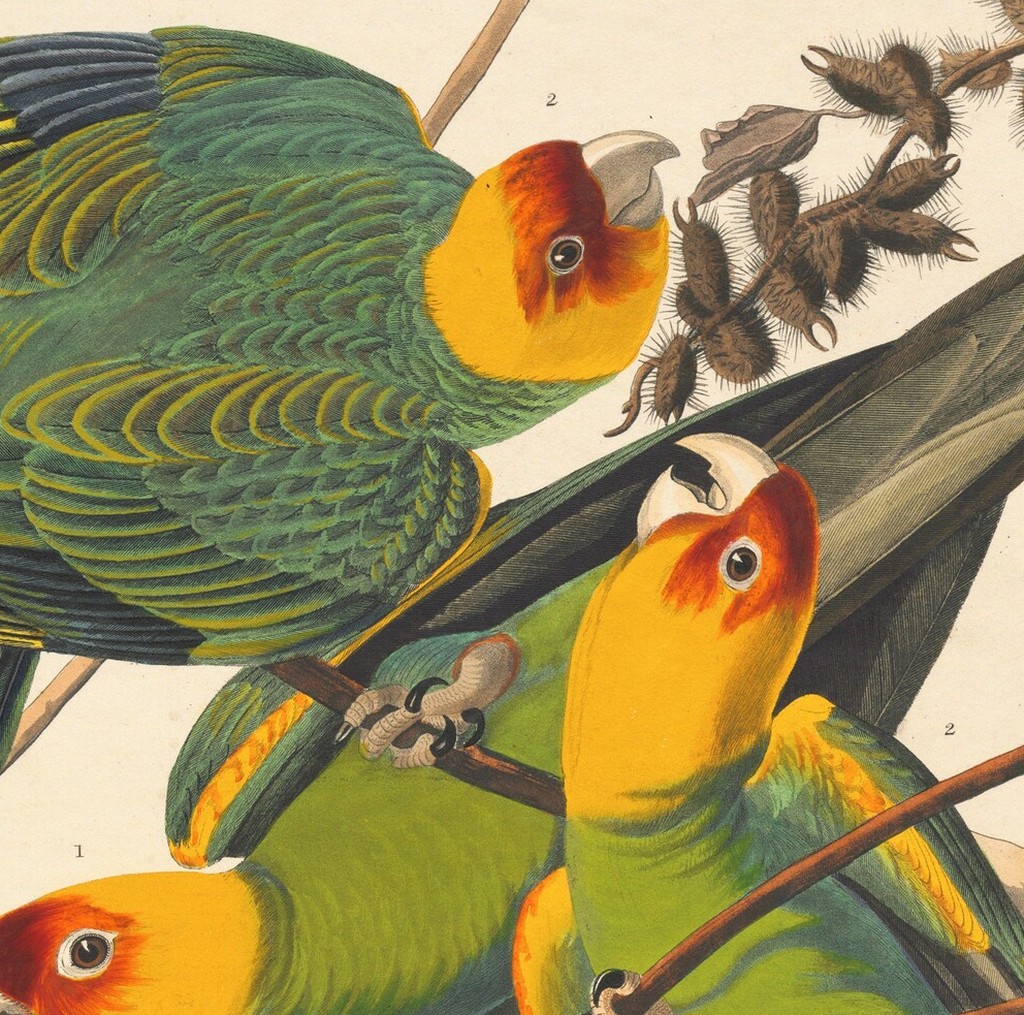
Red and yellow head
The red-orange face and yellow head make a small bird immediately legible inside the busy cluster. Audubon uses the bright head as a visual anchor.
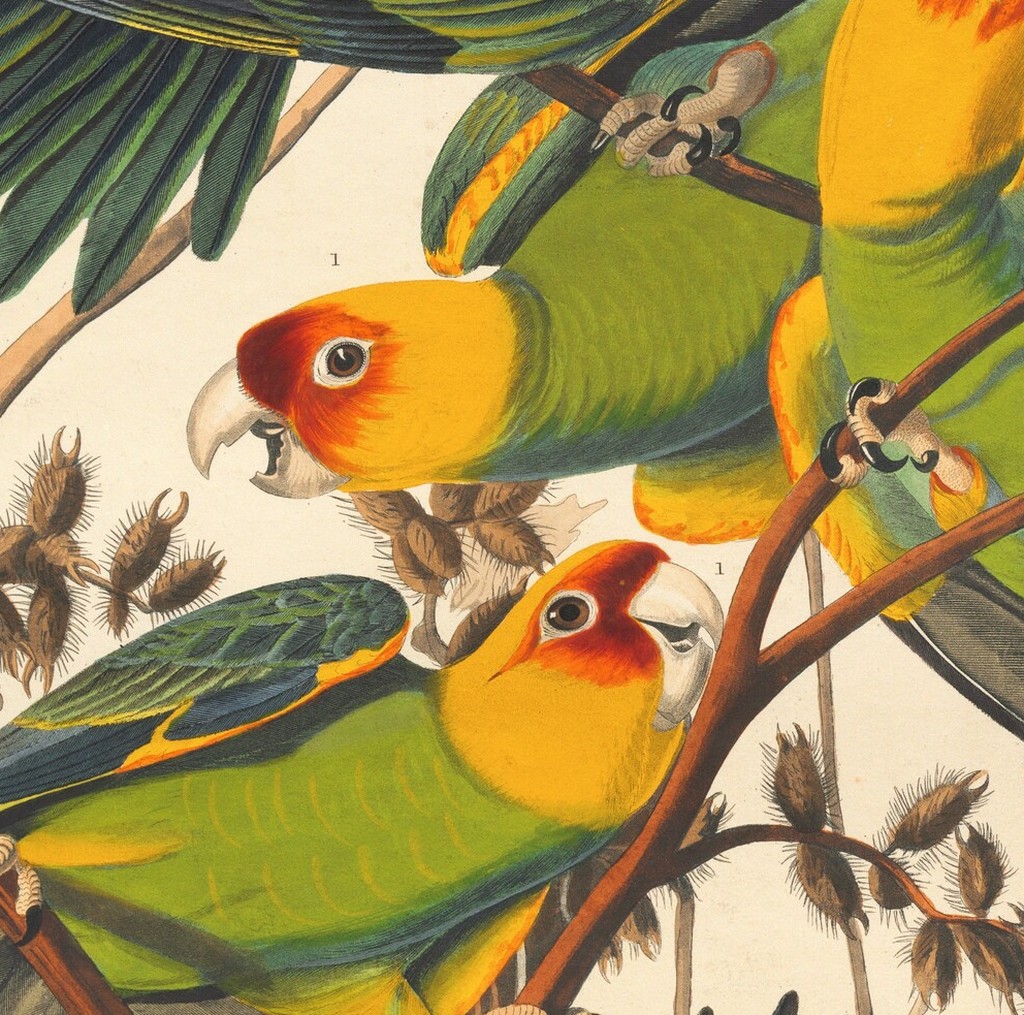
Central perch and claws
Small feet curl around the branch at the centre of the plate. This tight detail helps the overlapping birds feel physically attached to the tangle of wood.
Right bird and tail
The upright bird on the right adds a different pose to the group. Its long dark tail cuts through the branches and keeps the composition from becoming a simple stack of heads.
Lower feeding bird
The lower-left bird holds food close to its bill. The pose gives the plate a narrative detail without needing a separate landscape scene.
Scalloped green back
Fine scalloped feathers turn the green back into a patterned surface. Audubon keeps the bird decorative while still describing individual feather layers.
Lower spread wing
The lower bird spreads a wing toward the right edge. The fan of dark and green feathers repeats the upper bird's motion on a different scale.
Burrs and dry leaves
The burrs and dry leaves make the branch setting more than a perch. Their rough texture sets off the birds' smooth, saturated colour.
Object Facts
Audubon's Carolina Parakeet was published as Carolina Parrot in 1827. The National Gallery of Art records the object as a hand-coloured engraving and aquatint on Whatman wove paper, made by Robert Havell after John James Audubon. Its plate measures 84.3 by 60.2 centimetres, with a sheet size of 99.7 by 66.7 centimetres. The work belongs to The Birds of America, where it is catalogued as number 26.
The Fitzwilliam Museum preserves the fuller historic plate wording: Plate 26: Carolina Parrot, Males 1. F. 2. Young 3. Psittacus Carolinensis. Plant Vulgo, Cockle Burr. That wording matters because it shows how much Audubon tried to pack into the plate itself. The title names the bird; the numbered figures distinguish adult males, female and young; the plant note identifies the cocklebur; and the production line credits Audubon as publisher with Havell and Son as engravers, printers and colourists.
The current page title, Carolina Parakeet, follows modern usage rather than Audubon's original title. The modern scientific name is Conuropsis carolinensis. That current name should be read as a present-day identification, not as a claim that Audubon used modern taxonomy. The plate belongs to an older naming system, while the page uses current species language to help readers connect the artwork with present scholarship.
The National Gallery of Art record also gives this article a clear institutional image reference because its media is listed as free and in the public domain. Other institutional records are valuable for comparison and metadata, but the NGA object record remains the main source for the image used here. For readers, the important point is simpler: this article discusses a well-documented public-domain object while keeping the historical title, modern species name and publication context clearly separated.
What the Plate Shows
The plate shows seven Carolina Parakeets packed into a vertical branch structure. Most are green-bodied, with yellow heads and orange facial markings. Their bodies twist in different directions. One bends toward the burrs. Another lifts its head from the group. One near the bottom faces outward with an open beak, giving the whole image a sudden sense of address. The birds do not sit in an orderly row. They press, turn, grip, lean and overlap.
This crowded design is central to the plate's character. Audubon often wanted to show birds in action rather than as isolated museum specimens. Here the action is social and botanical. The birds are gathered around cocklebur, a plant associated with their food habits in modern species accounts. Spiked seed heads and dry leaves interrupt the green bodies, creating a rough, bristling environment that is visually different from the birds' smooth feathers.
The composition also makes the viewer aware of scale. In many plates from The Birds of America, Audubon tried to represent birds at or near life size. The Carolina Parakeet was not one of the largest subjects in the book, but the double-elephant folio format still gives the birds room to behave. They fill the sheet in a way that would be difficult in a small field guide illustration. Their flocking becomes a structural feature of the page.
The National Gallery of Art's visual description emphasises the brilliance of the birds against the rust-brown branches. That contrast is not merely decorative. The green, yellow and orange make the parakeets instantly legible, while the branch system holds them together as one animated group. Audubon and Havell create a picture that can be read both as scientific illustration and as a drama of colour.
Colour, Plant and Behaviour
Modern descriptions of the Carolina Parakeet help explain why the plate is so visually striking. Adult birds were largely green, with yellow heads and orange facial markings around the forehead and face. Young birds were greener overall and lacked the full yellow and orange colouring. Audubon's plate uses those differences to turn identification into pictorial variety. The birds are related in form, but they are not identical copies.
The cocklebur is equally important. Animal Diversity Web describes cocklebur seeds as a primary food for Carolina Parakeets, alongside other fruits, seeds, flower buds and occasional insects. That makes the plant more than a botanical accessory. It connects the flock to feeding behaviour and to the habitats where people encountered the species. The stiff burrs also give Audubon a useful visual counterpoint: sharp pods beside rounded heads, dry plant matter beside vivid plumage.
The image is unusually lively because its movement is distributed across the whole group. Some birds seem absorbed in feeding. Others look alert. The open-beaked bird near the bottom adds sound to the imagined scene. Species accounts describe Carolina Parakeets as loud in flight and socially responsive to one another, especially in flocks. The plate cannot prove every detail of behaviour, but it does capture the impression of a noisy, responsive, communal bird.
This social quality is one reason the image now feels so poignant. A single extinct bird can become an emblem. A group of seven birds reminds us that extinction erases relationships as well as individuals. The lost species was not simply a colour pattern or a taxonomic name. It was a flocking animal, moving through river woods, swamps, orchards and farms, feeding, calling and responding to its own kind.
Historic Title and Current Name
Audubon's plate uses the title Carolina Parrot. The modern common name Carolina Parakeet is now more familiar, and the scientific name Conuropsis carolinensis is used by current zoological sources. Both names point to the same lost bird, but they belong to different moments in the history of classification.
The distinction matters because Audubon was working in a period when natural history names were still shifting, and his plates served several kinds of audience at once. They needed to satisfy subscribers interested in science, appeal to collectors who valued ambitious prints, and support the later written accounts in Ornithological Biography. A plate title could carry common names, sex and age markers, plant notes and Latin terminology, all in the engraved margin.
Today, a clear account should not flatten that history. Carolina Parrot is the artwork's historic title. Carolina Parakeet is the reader-facing species name. Conuropsis carolinensis is the modern scientific identification. Keeping those labels separate lets the image remain historically honest while still helping a present-day reader find the bird through modern terms.
This also protects the plate from an anachronistic reading. Audubon did not make an extinction image. He made a picture of a species still alive in his world. The loss came later. The modern viewer brings knowledge that Audubon did not have, and that gap is part of the image's emotional charge.
Place in The Birds of America
The Birds of America was published between 1827 and 1838 and eventually comprised 435 colour plates in four double-elephant folio volumes. The Natural History Museum describes the format as about 90 by 67 centimetres, an immense scale for a natural history book. That size was part of Audubon's ambition. He wanted birds to appear with presence, movement and drama, not as small diagrammatic figures.
Carolina Parakeet belongs to the early years of the publication. The Fitzwilliam Museum record dates its issue to 1827-1830 and notes its place in the sixth of the 87 parts. It was engraved, printed and coloured by R. Havell and Son in London, the workshop that became essential to the project's visual identity after the earliest plates. Havell's aquatint process and hand colouring helped transform Audubon's drawings into marketable, large-scale prints.
The plate also demonstrates what made the book different from many earlier ornithological publications. The birds are not stiffly arranged against blank space. They are shown in a setting that suggests food, plant life and behaviour. The Natural History Museum singles out this quality across the book: birds are presented with drama and life in natural surroundings rather than as mounted specimens.
Within the Audubon cluster, this page naturally belongs beside the broader The Birds of America overview and the John James Audubon Works hub. The publication page explains the scale and making of the book. The works page places the plate among drawings, prints, paintings and editions. This page stays closer to one image, one species and one vanished ecological presence.
Extinction and Conservation Memory
The Carolina Parakeet is extinct, but the story of its disappearance should be told carefully. Smithsonian reporting identifies it as the only parrot native to the eastern United States and records the death of the last captive bird, Incas, at the Cincinnati Zoo on February 21, 1918. It also notes a last confirmed wild bird killed in Florida in 1904, while acknowledging later claimed sightings and continuing uncertainty around the exact causes of extinction.
That uncertainty is important. Accounts often point to several pressures rather than one simple explanation: clearing of eastern forests, killing by farmers who saw the birds as crop pests, use of bright feathers in fashion, possible disease and other ecological stresses. The birds' social behaviour may also have made them vulnerable, because injured flock members could draw others close rather than scatter them. None of these factors should be turned into a neat single cause unless a source is explicit about the limits of the evidence.
The plate does not document extinction directly. It documents a bird that was still visible enough in Audubon's world to be drawn, published and described. Its modern meaning changed because the species disappeared. That makes Carolina Parakeet different from many other Audubon bird images. It is admired for composition and colour, but it also belongs to the visual memory of American extinction.
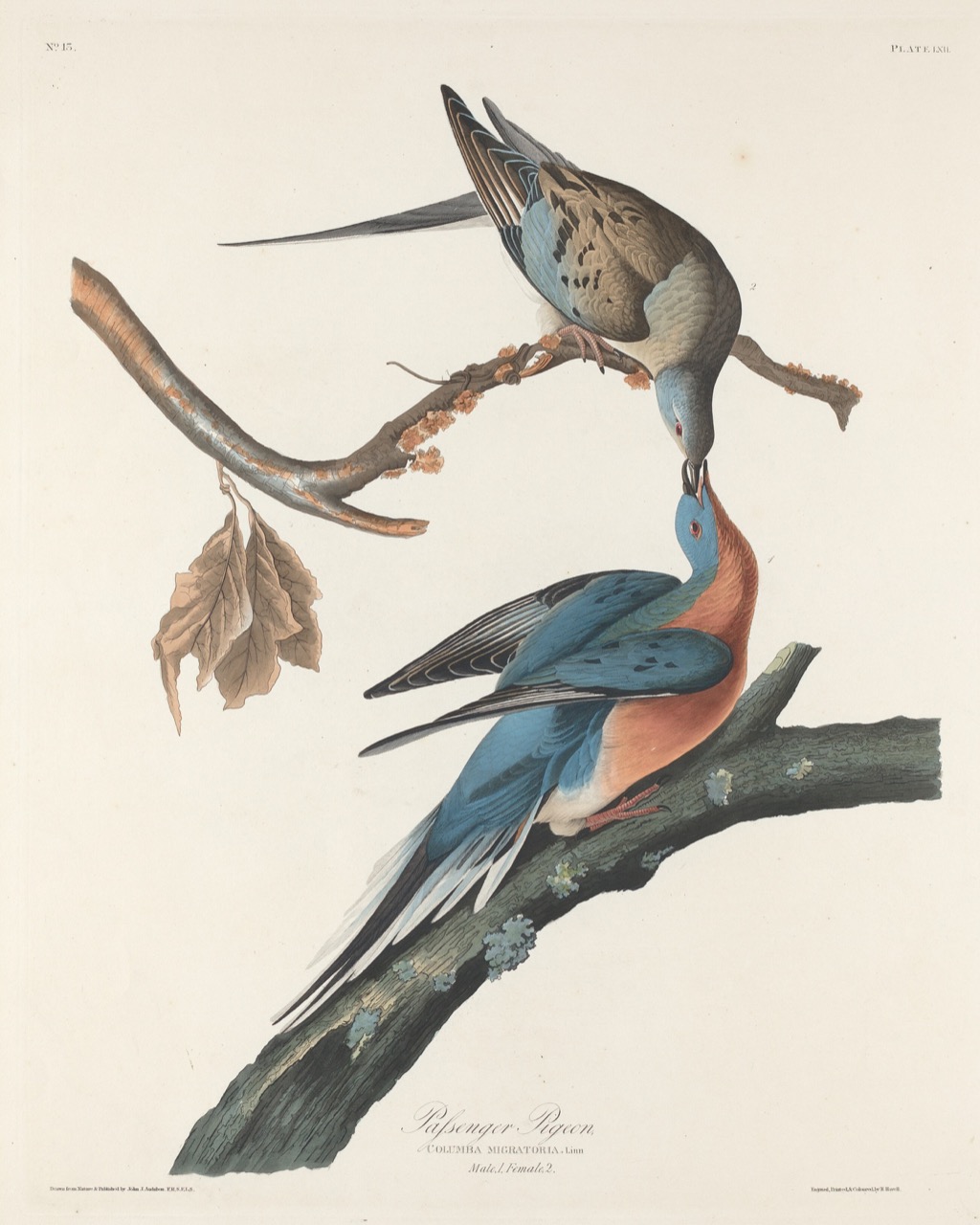
This is why Carolina Parakeet belongs near Audubon's other lost or endangered-bird subjects, especially Passenger Pigeon and Ivory-billed Woodpecker. Those plates are not the same kind of story, but together they show how nineteenth-century natural history images have become evidence, warning and cultural memory in the present.
How to Read the Plate Today
A first reading of Carolina Parakeet begins with colour. The green bodies and yellow-orange heads are so vivid that the extinction context can almost feel unreal. The birds seem too immediate to be gone. That visual contradiction is part of the plate's continuing pull. It gives modern readers the sensation of meeting a lost species through an image that still feels alive.
A second reading begins with grouping. The birds are not isolated symbols. They form a cluster, with every head, wing and foot contributing to a shared rhythm. Audubon turns flock behaviour into composition. The eye moves from one bird to another, then back through the branches and burrs. The group feels restless but stable, compressed but animated.
A third reading begins with the plant. Cocklebur anchors the image in feeding behaviour and habitat. It also complicates the beauty of the plate. The burrs are dry, hooked and rough, not lush decorative foliage. They remind us that Audubon often wanted the bird and its environment to work together. Even when the natural history is filtered through artistic arrangement, the plate asks us to see a relationship between animal, food and place.
A fourth reading begins with the margin. The historic title, numbers and production credits tell us that this is a print made for publication, not a private sketch. Audubon's field image had to become an engraved and hand-coloured object that subscribers could buy, bind and preserve. The plate is therefore both natural history and book history.
The best reading holds all four levels at once: colour, flock, plant and print. Carolina Parakeet is beautiful because of its design, valuable because of its documentary ambition, and moving because the species no longer survives.
Why This Plate Matters
Carolina Parakeet matters because it brings several Audubon themes into one image. It shows his preference for active birds in dynamic settings. It reveals the role of Havell's printmaking in giving The Birds of America its finish and scale. It preserves a historic name beside a modern species identity. It links art history to natural history without letting either field absorb the other completely.
It also matters because it changes as the reader learns more. At first, it may look like one of the most decorative plates in the book: seven brilliant green birds arranged in a lively vertical design. With context, it becomes sharper. Those colours belonged to a bird no longer present in eastern American woods and wetlands. The cockleburs no longer carry a living flock of this species. The social energy of the group has become part of an archive.
Audubon's plate cannot answer every question about the Carolina Parakeet's life or extinction. It can, however, keep the bird visible. It asks us to notice the exactness of colour, the physical pressure of bodies on branches, the relationship between feeding and habitat, and the strange afterlife of natural history images. In that sense, Carolina Parakeet is not only one of the memorable plates from The Birds of America. It is a reminder that art can outlast the world it once described.
Readers who want the wider story should continue to John James Audubon Biography for the artist's life and to The Birds of America for the publication history. For a broader visual context, the site's bird drawings section places Audubon's image-led natural history beside other traditions of bird art.
Frequently Asked Questions
Discussion
Carolina Parakeet asks readers to hold vivid natural history illustration and extinction memory in the same view.
Use the prompts below to look closely at the plate's flock, plant setting and modern afterlife without flattening its historic title or taxonomy.
Reader Insights
Which bird first catches your attention, and how does the group pull your eye around the branches?
How does the historic title Carolina Parrot change your reading of the modern title Carolina Parakeet?
How does knowing the species is extinct alter the plate's colour, energy and sense of life?
Join the Conversation
Share your reading of Audubon's Carolina Parakeet plate, its beauty and its modern meaning below.
References
- National Gallery of Art, Carolina Parrot, accessed 26 July 2026.
- The Fitzwilliam Museum, Plate 26: Carolina Parrot, accessed 26 July 2026.
- Animal Diversity Web, Conuropsis carolinensis species account, accessed 26 July 2026.
- Smithsonian Magazine, Carolina Parakeet extinction article, 2025, accessed 26 July 2026.
- Smithsonian Magazine, why the Carolina Parakeet went extinct, 2018, accessed 26 July 2026.
- Natural History Museum, London, The Birds of America overview, accessed 26 July 2026.