

 by Tom Gurney
Tom Gurney BSc (Hons) is an art history expert with over 20 years experience
Published on July 26, 2026 / Updated on September 6, 2026
Email: tomgurney1@gmail.com / Phone: +44 7429 011000
Cardinal Grosbeak: Introduction
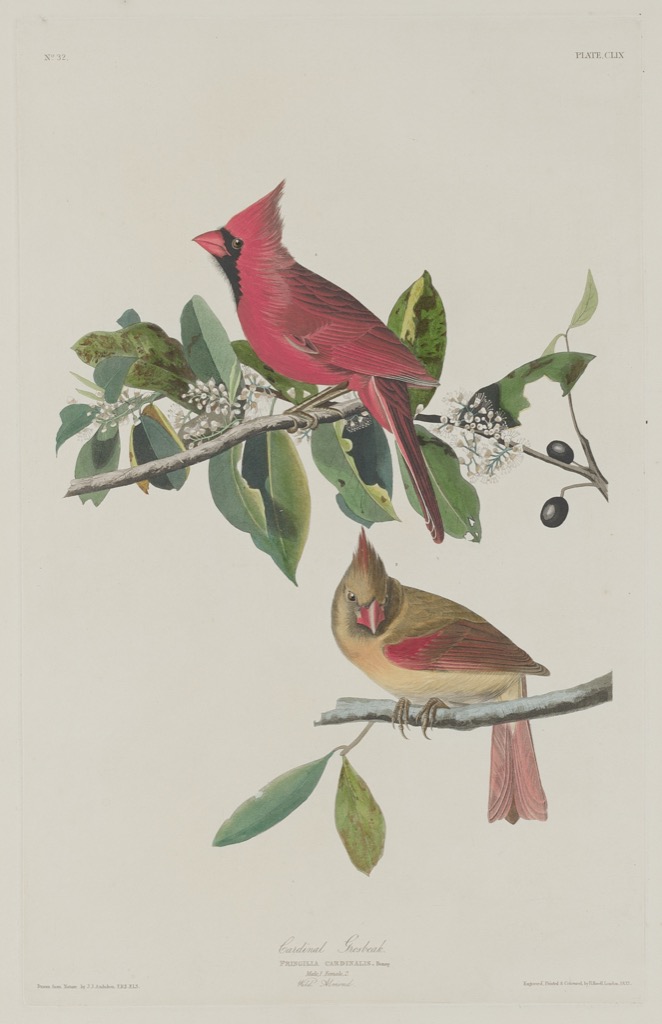
John James Audubon's Cardinal Grosbeak is a vivid plate from The Birds of America, showing the bird now known as the Northern Cardinal. The historic title preserves nineteenth-century naming, while the current species name is Cardinalis cardinalis. That difference is not a problem to smooth away. It is one of the page's main points: Audubon's plate belongs to an older ornithological language, but the subject is one of the most familiar red birds in North America today. [1], [6]
The National Gallery of Art records the work as Cardinal Grosbeak, dated 1833, by Robert Havell after John James Audubon. It is a hand-colored engraving and aquatint on Whatman wove paper, accession number 1945.8.159, and catalogued as Birds of America, no. 159. NGA also states that the object's media is free and in the public domain. These details make the plate unusually well anchored: it is not just a generic cardinal image, but a specific folio print from Audubon's great publication. [1]
The modern Northern Cardinal is a year-round, low-concern species of open woodlands, shrub edges, towns and backyards. Cornell identifies it in the order Passeriformes and family Cardinalidae, with seeds, fruit and insects among its foods. The bird's familiarity can make Audubon's image feel immediately accessible, but the plate is more than a red-bird picture. It is a work of title history, sex contrast, plant setting, printmaking and public memory. [6], [7]
At a Glance
- Public titleCardinal Grosbeak
- SeriesThe Birds of America, Plate CLIX [1]
- Catalogue referenceBirds of America, no. 159 [1]
- Date1833 [1]
- Maker lineRobert Havell after John James Audubon [1]
- Mediumhand-colored engraving and aquatint on Whatman wove paper [1]
- AccessionNational Gallery of Art, 1945.8.159 [1]
- Current species nameNorthern Cardinal, Cardinalis cardinalis [6]
- Image statusNGA public-domain media route [1]
Contents
- Introduction
- Annotated Details
- Object Facts
- What the Plate Shows
- Historic Title and Modern Name
- Colour and Familiarity
- The Bird Behind the Image
- Place in The Birds of America
- Printmaking and Collaboration
- How to Look at Cardinal Grosbeak
- Why This Plate Matters
Annotated Details from Cardinal Grosbeak
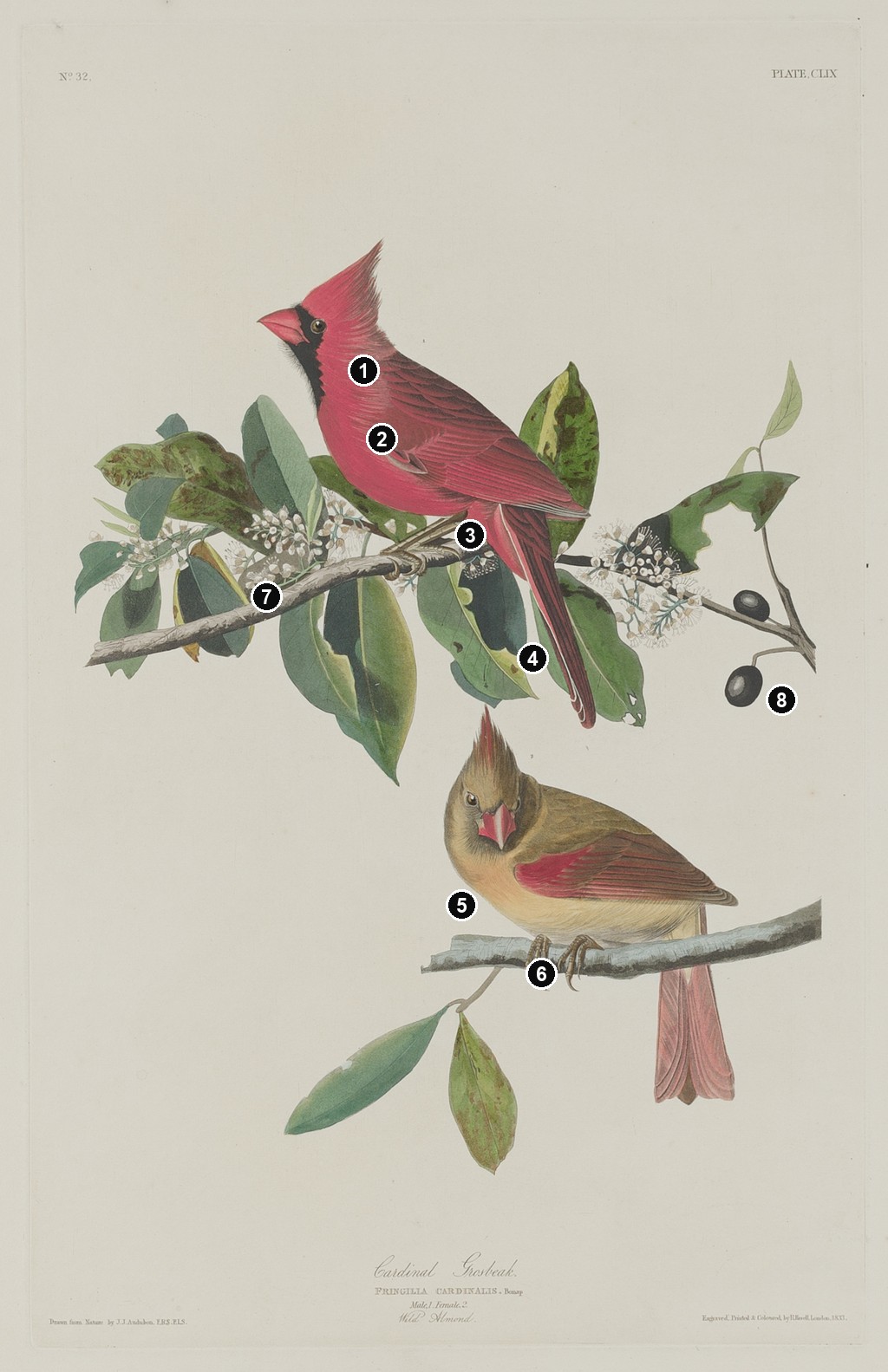
These annotated details follow Audubon's Cardinal Grosbeak through the male crest and mask, red body and wing, the female bird, branch, blossoms, leaves and dark fruit.
Details from CARDINAL GROSBEAK
Close looking shows how Audubon balances brilliant red plumage with quieter botanical details and the contrasting pose of the female bird below.
Male crest and bill
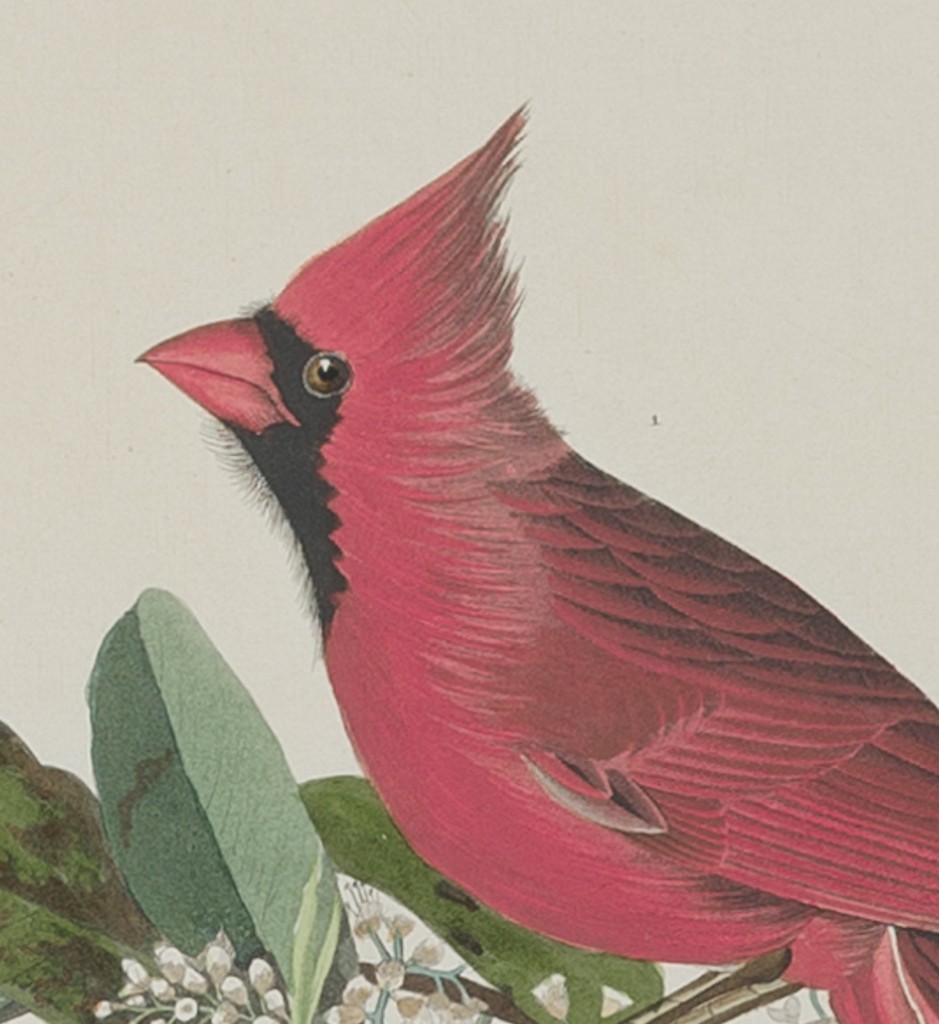
The pointed crest and pink bill give the male bird a sharp profile. The head is the plate's strongest first signal.
Black mask and eye
The black mask surrounds the eye and sets off the red head. Audubon uses a small dark shape to focus the bird's expression.
Red body feathers
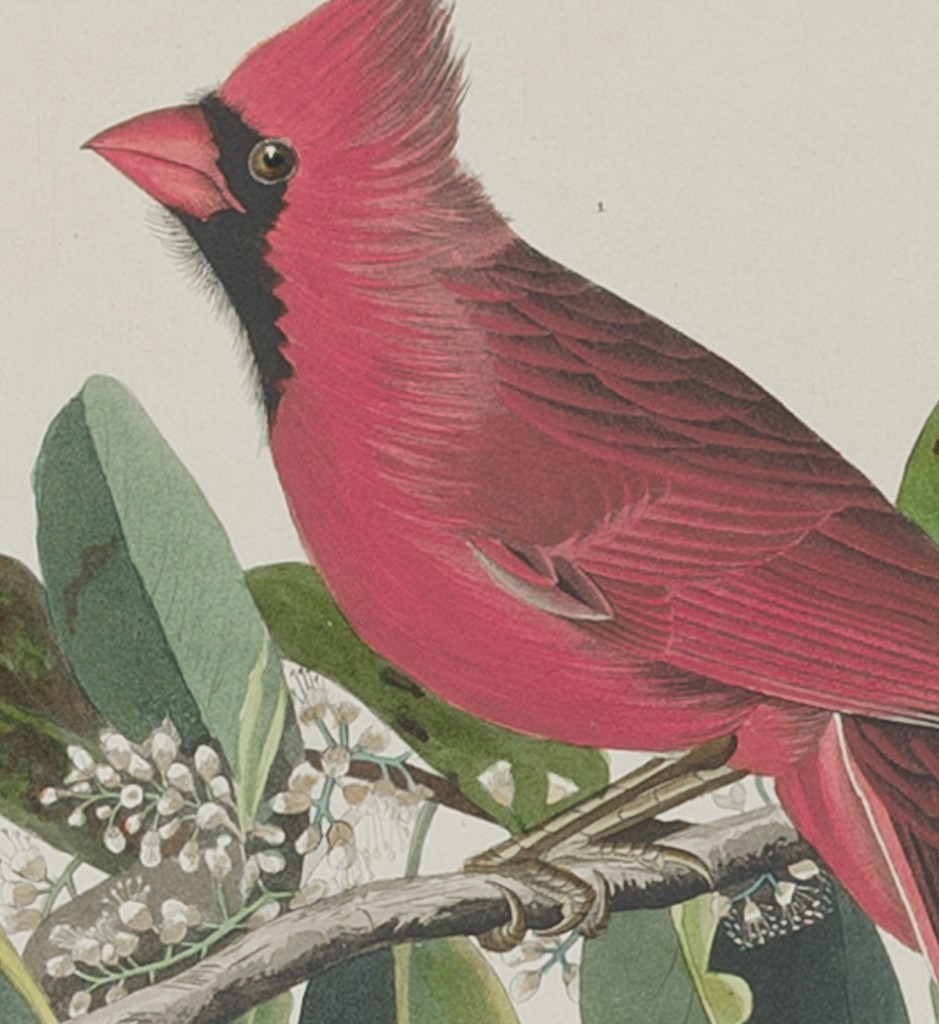
Layered red feathers across the body prevent the colour from becoming flat. The surface shifts from saturated red to darker maroon.
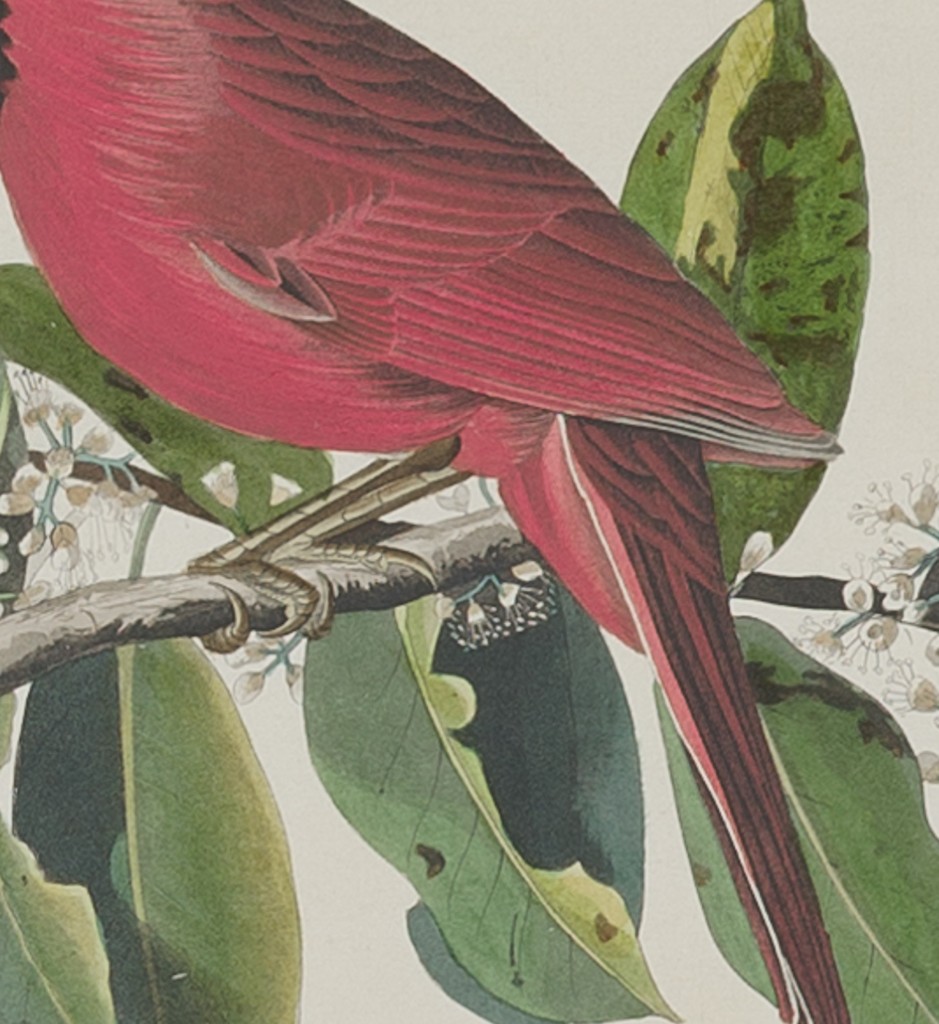
Male wing and tail
The wing and tail extend the red body into longer feather forms. Dark edges help define the bird against the pale page.
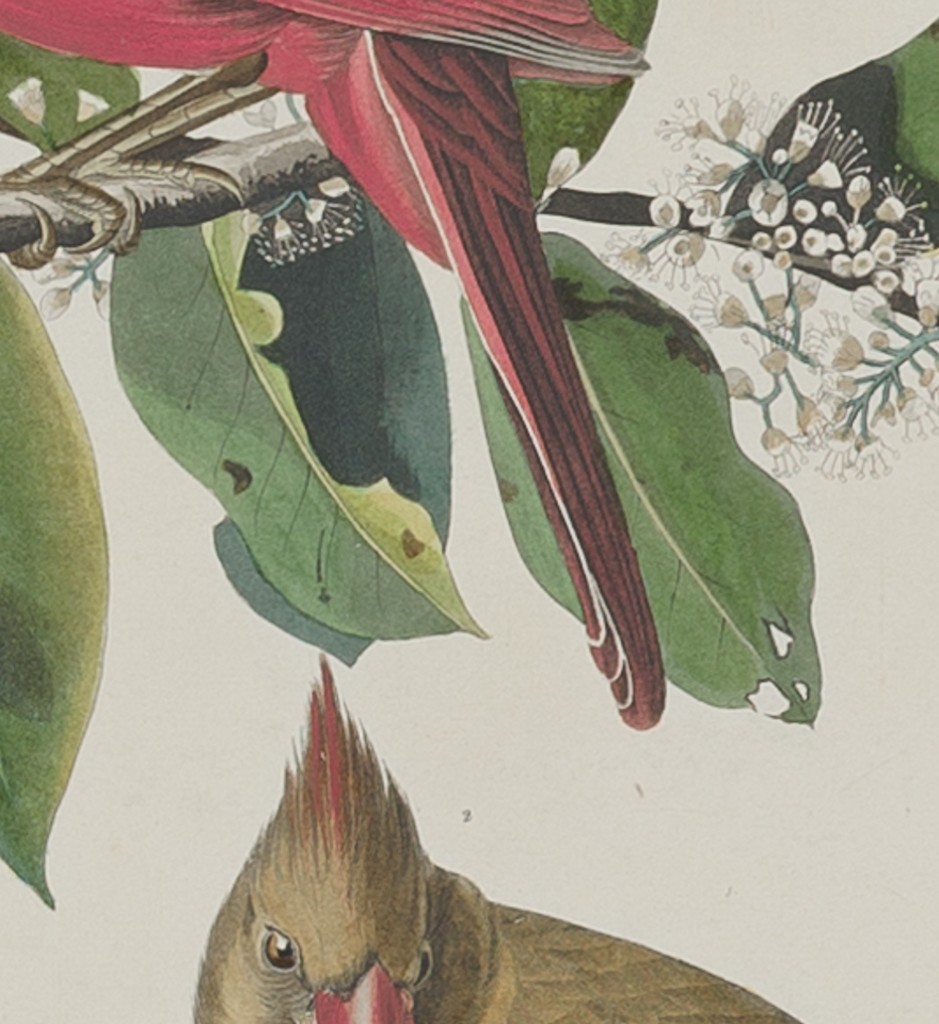
Female head and bill
The female bird faces forward with a pink bill and soft crest. Her quieter colouring creates a clear contrast with the male above.
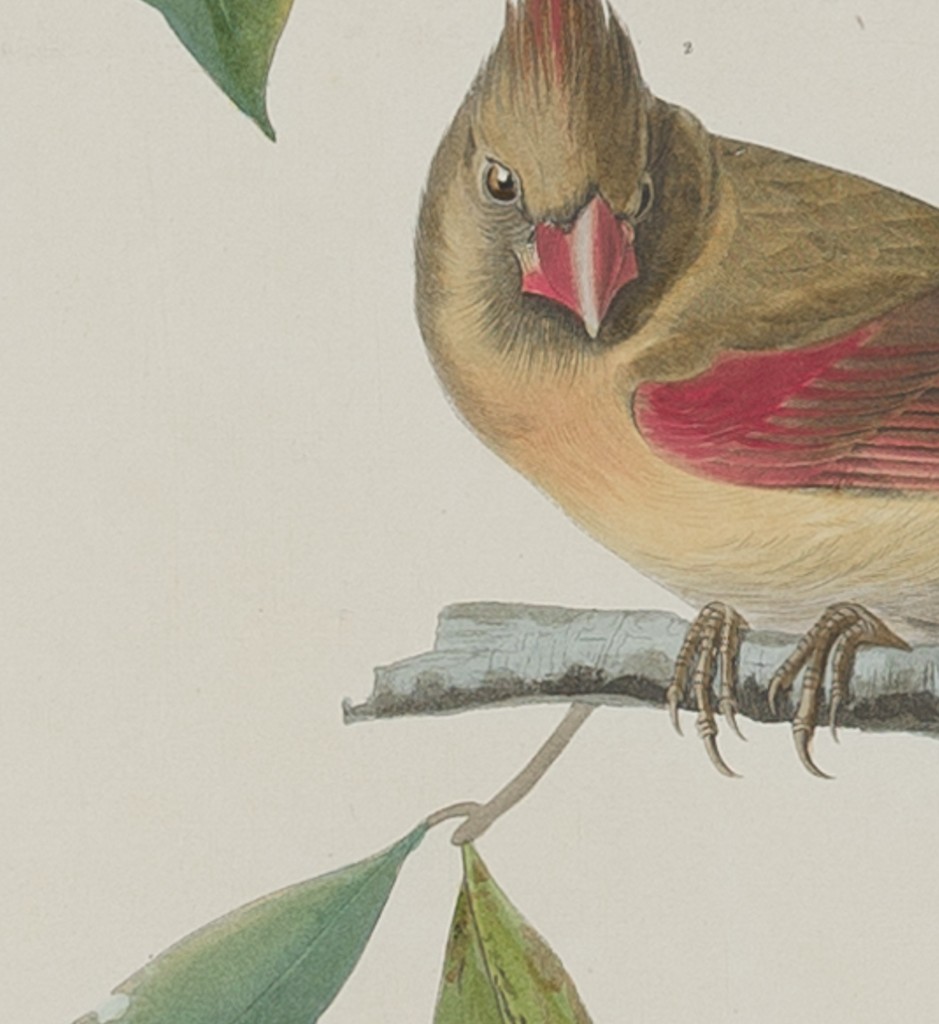
Female wing patch
The red wing patch links the female to the male's colour without overwhelming her brown body. It is a small echo across the plate.
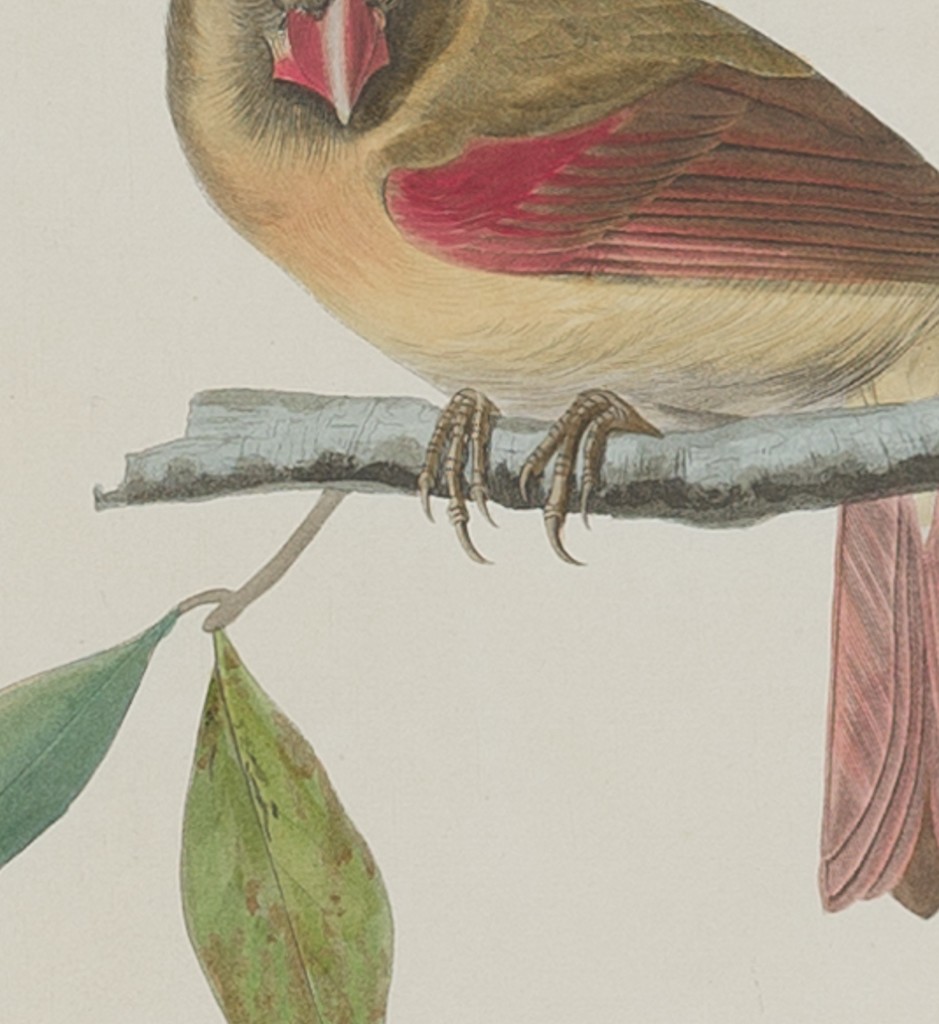
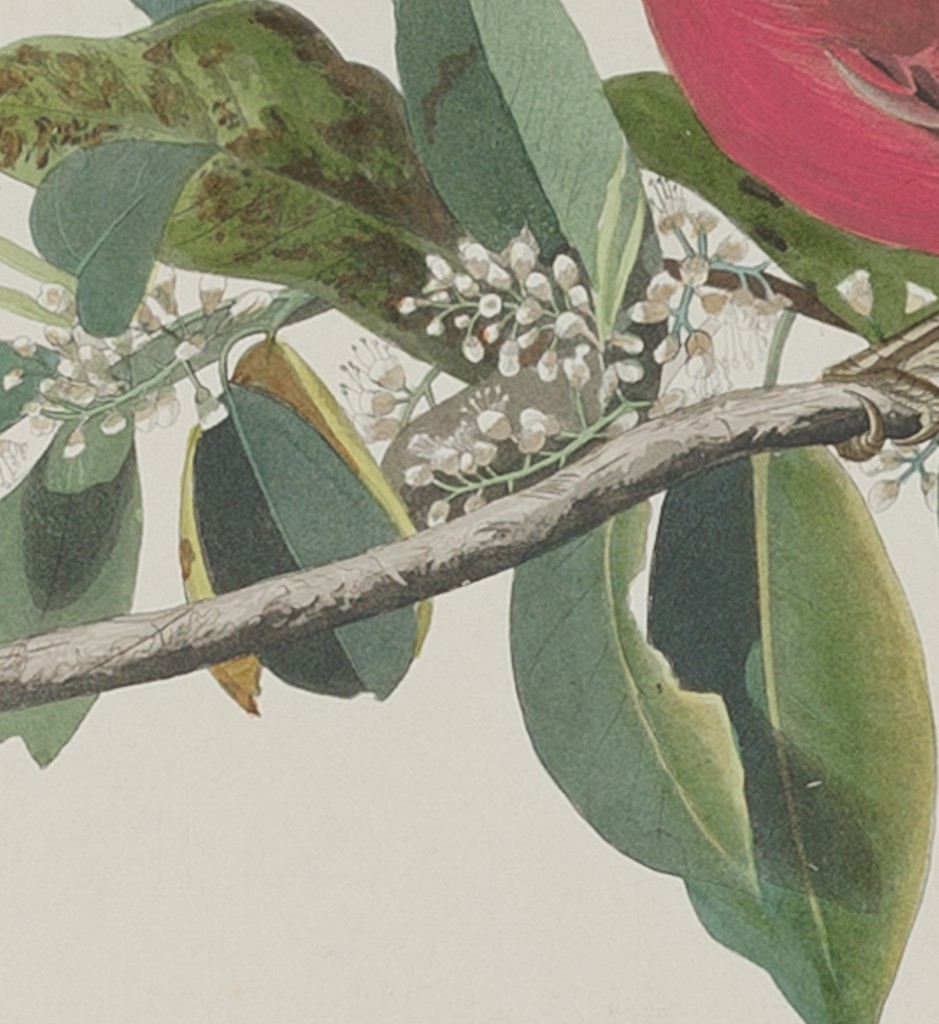
Blossoms and leaves
White blossoms and green leaves form a decorative band behind the branch. The plant detail softens the simple structure supporting the birds.
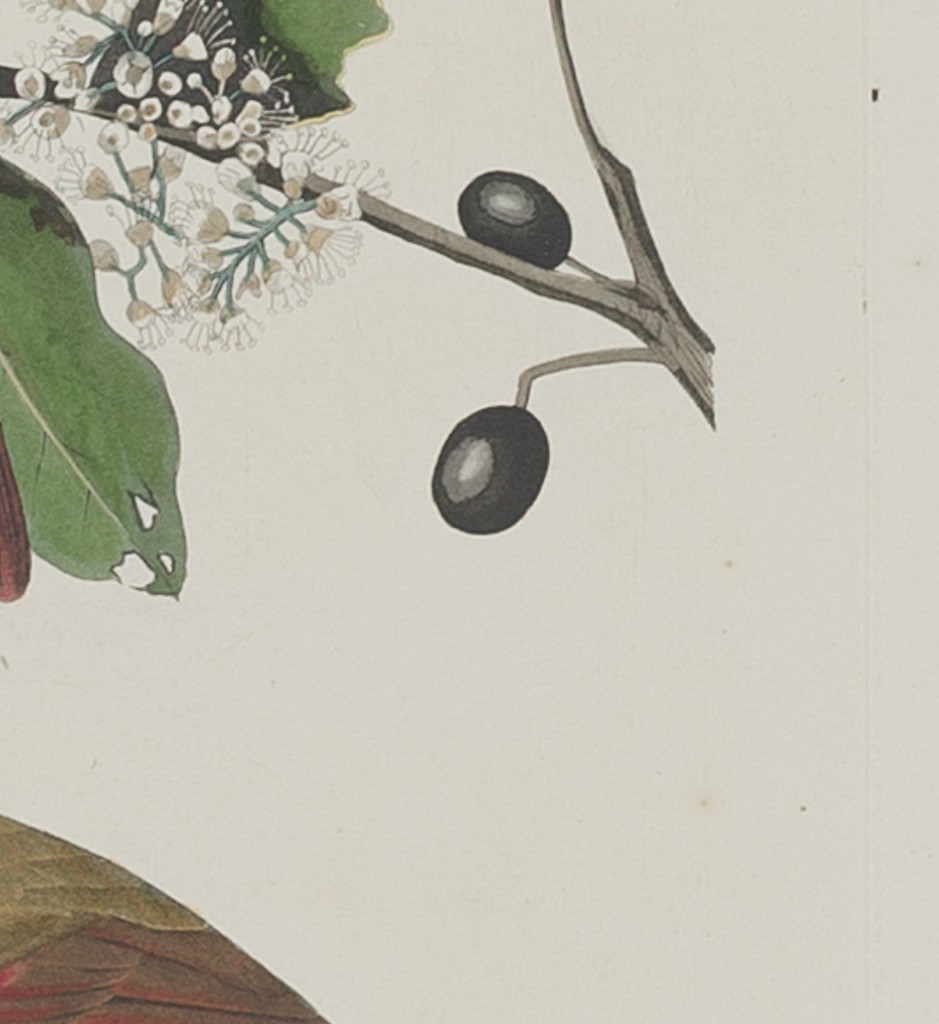
Dark fruit and branch
Dark fruit punctuates the right side of the composition. The branch and fruit extend the plate beyond the two birds without adding a full landscape.
Object Facts
Cardinal Grosbeak belongs to The Birds of America, Audubon's double-elephant folio publication of North American birds. NGA gives the date as 1833 and the maker line as Robert Havell after John James Audubon. That line is important because the finished plate is a collaborative printed object. Audubon supplied the design and bird image; Havell translated it into engraving, aquatint, printing and hand coloring. [1], [2]
The NGA record gives the medium as hand-colored engraving and aquatint on Whatman wove paper. It records the plate size as 49.2 by 31.1 centimetres and the sheet size as 99.7 by 67.3 centimetres. Those numbers reveal something useful about the plate. A cardinal is not a huge bird, so the printed image does not need to occupy the entire sheet in the way a pelican, flamingo or heron might. The double-elephant format gives room for the birds, branch, leaves and white paper to work together. [1], [5]
The plate's credit line is the Gift of Mrs. Walter B. James. NGA also notes that the object's media is free and in the public domain. That institutional record gives the image unusually clear provenance, because title, maker line, dimensions, accession number, catalogue reference and public-domain media note can all be checked in one place. [1]
What the Plate Shows
The plate presents a male and female cardinal on branches. The male appears above, red and crested, with the intense colour that has made the species one of the most recognizable birds in North America. The female is lower and quieter in tone, with warmer browns and red accents rather than the full red body of the male. This sex contrast is central to the image. [6]
Audubon does not simply place one red male in isolation. By pairing male and female, he makes the viewer compare difference within the species. The male carries immediate display. The female rewards a slower look: crest, bill, warmer edges, subtler colour and a quieter relation to the branch.
Lilly Library's contextual notes for its Audubon selection identify the upper branch as wild or mock orange and attribute that branch work to Audubon's assistant Joseph Mason. That detail is useful because it reminds us that Audubon's plates often include botanical settings and collaborative labor, not only bird bodies. The plant is not a heavy landscape; it is a stage for the birds, a structure of branch, leaf and open paper. [8]
Historic Title and Modern Name
The title Cardinal Grosbeak reflects the naming world of Audubon's century. Modern readers usually know the subject as the Northern Cardinal. Cornell uses Northern Cardinal, Cardinalis cardinalis, and places it among cardinals and allies in the family Cardinalidae. The historic title should remain visible because it is the name attached to the plate, but the modern name should appear early so readers know exactly which bird they are seeing. [1], [6]
The word grosbeak points toward the bird's thick, seed-cracking bill. Today, Northern Cardinal is not normally introduced to casual readers as a grosbeak, but it remains part of the same broader family group as grosbeaks and buntings. This makes the old name legible. It is not random; it is a record of how form, feeding and classification were understood and described. [6], [7]
The difference between plate title and current common name also helps keep the artwork grounded. Searchers may arrive looking for Audubon's cardinal. Art history gives them Cardinal Grosbeak. Modern bird language gives them Northern Cardinal. The best reading holds both names together.
Colour and Familiarity
For many readers, the Northern Cardinal is almost the definition of a recognizable bird. Cornell describes the male as conspicuous, familiar and brilliantly red, while females are brown with red accents and a sharp crest. That modern familiarity changes how Audubon's plate is received. Some Audubon subjects need introduction because the species is rare, extinct, geographically limited or taxonomically confusing. The cardinal often feels known before the article begins. [6]
That familiarity is useful, but it can also make the plate easy to underestimate. A common bird is not a simple subject. Audubon had to organize strong colour without letting it become flat. He had to show male display without reducing the species to the male. He had to make a small songbird worth the large publication format.
The male's red body does much of the first work. It catches the eye from a distance and gives the plate a decorative strength that still explains its popularity. But the female is where the image becomes more observant. Her tones are less spectacular, yet they make the species fuller. A single red male would have been a sharper emblem. A pair makes the plate more useful as natural history.
The Bird Behind the Image
Modern Northern Cardinals are associated with open woodlands, dense edges, shrubs, gardens, towns and backyards. Cornell describes them as ground foragers and birds of open woodland. It also notes that they do not migrate and do not fade into dull winter plumage. This year-round visibility is a major reason the species became so beloved. [6], [7]
The bird's behavior gives Audubon's plate a modern echo. Cardinals often move through low branches and dense cover, then become suddenly visible as a flash of red or a sharp crest. Cornell notes that they hop through low branches, forage on or near the ground, and commonly sing from shrubs. Audubon's paired birds on branches sit comfortably within that world of low vegetation and watchful presence. [6], [7]
Conservation language should stay measured. Cornell lists Northern Cardinal as Low Concern and records a large global breeding population estimate. It also notes that agricultural and suburban habitats over the last two centuries have benefited the species in eastern and central North America. This is not a loss narrative like Passenger Pigeon or Carolina Parakeet. It is a living, common-bird page with a strong modern recognition story. [6], [7]
Place in The Birds of America
As plate number 159, Cardinal Grosbeak belongs to the middle stretch of The Birds of America. The publication as a whole was issued between 1827 and 1838 and contained 435 color plates in a double-elephant folio format. Natural History Museum and Yale Beinecke sources both emphasize the scale and ambition of the book, while NGA's object record anchors this particular plate within the sequence. [1], [4], [5]
The cardinal shows how the large folio could serve small birds. A flamingo or pelican tests the sheet by size. A cardinal tests it by concentration. The bird itself is modest in scale, so the composition needs contrast, branch structure and open space rather than sheer bodily magnitude. Audubon makes the plate work by letting red, brown, crest, bill and branch carry the viewer's attention.
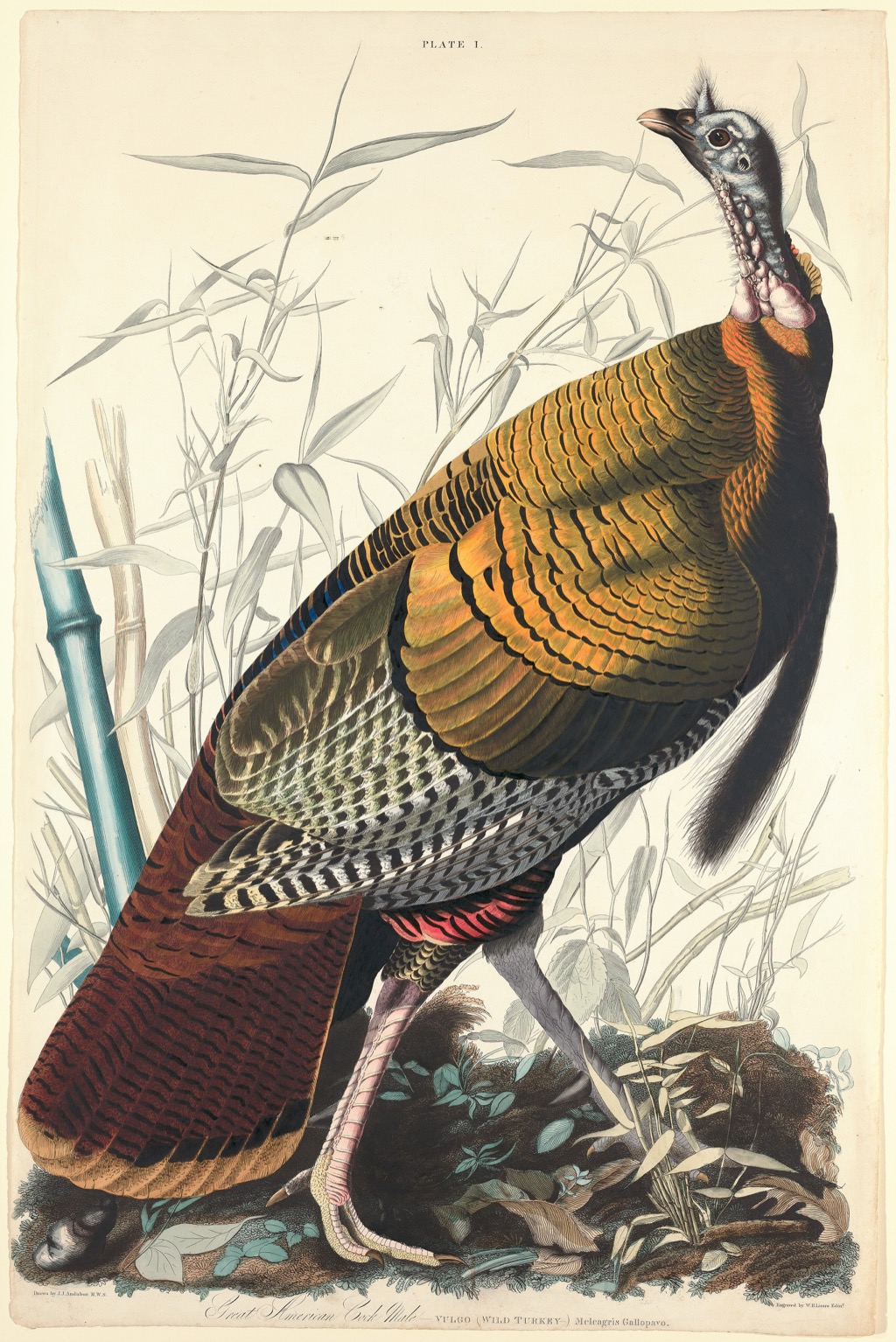
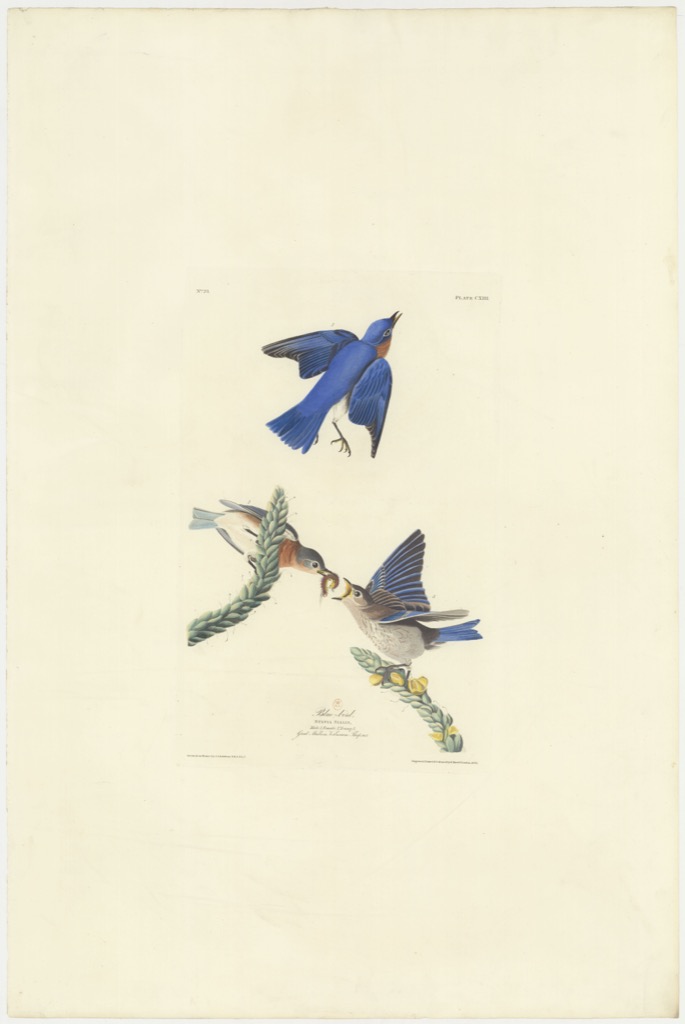
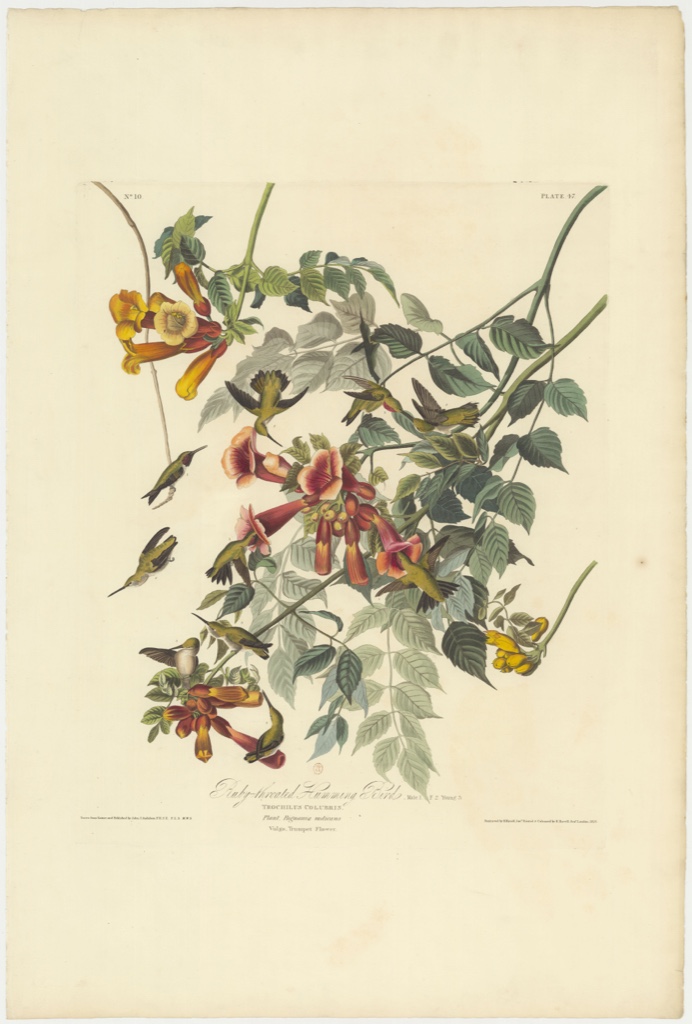
This makes Cardinal Grosbeak a useful companion to Eastern Bluebird and Ruby-throated Hummingbird, where familiar smaller birds depend on colour, plant setting and modern reader recognition. It also links back to Wild Turkey as another subject whose American familiarity gives the plate cultural force beyond formal natural history.
Printmaking and Collaboration
The qualities that make Cardinal Grosbeak persuasive are print qualities as well as drawing qualities. The red of the male needs hand coloring strong enough to command attention but controlled enough to preserve feathers and form. The female needs subtler color so she does not vanish beside the male. The branch and leaves need enough structure to hold the birds without overcrowding the sheet.
Havell's role matters here. Engraving and aquatint gave the plate its printed structure; hand coloring gave it its final life. The result is not simply an image of a bird copied onto paper. It is a manufactured artwork made through drawing, plate work, printing, coloring, paper and publication. [1], [2]
The Joseph Mason branch note also helps widen the idea of collaboration. Audubon's name dominates the plate, but the finished images often depended on assistants, engravers, colorists and print-shop labor. In Cardinal Grosbeak, the botanical support is part of the image's intelligence. It gives the birds a believable perch, a compositional frame and a reminder that natural history art often depends on more than one pair of hands. [8]
How to Look at Cardinal Grosbeak
Begin with the names. Cardinal Grosbeak is the historic artwork title; Northern Cardinal is the modern bird name. Keeping both in mind prevents two mistakes: treating the old title as obsolete clutter, or ignoring the current species identity.
Then look at the pair. The male's red body is the immediate center, but the female is essential. She slows the image down and makes it about comparison rather than display alone. Notice how the two birds occupy different branches and visual weights. The upper bird declares; the lower bird steadies.
Next, look at the bill. The old grosbeak language points toward a heavy seed-eating form. The bill connects title, anatomy and feeding. In a familiar bird, such details can disappear because recognition happens so quickly. Audubon's plate rewards resisting that quick recognition.
Why This Plate Matters
Cardinal Grosbeak matters because it turns a familiar bird into a precise historical object. The plate is accessible at once: red bird, branch, pair, songbird. But it also carries layers that reward close reading: old title, modern species name, sex difference, bill form, botanical setting, print collaboration and public-domain institutional record.
It is also one of the best Audubon pages for readers who arrive through everyday bird recognition. Not everyone has seen a flamingo, spoonbill or pelican in the wild. Many readers have seen a cardinal at a feeder, in a shrub, on a fence or against winter ground. That familiarity gives the plate a gentle authority.
Within the Audubon cluster, Cardinal Grosbeak helps balance the spectacular and the intimate. It does not need extinction, huge scale or violent action to matter. It shows how Audubon could make a common songbird visually durable through color, pairing, branch structure and printmaking. For broader comparisons in bird art, the site's bird drawings section offers another route into the tradition.
Frequently Asked Questions
Discussion
Cardinal Grosbeak turns a familiar red bird into a precise folio image about title history, sex contrast and printmaking.
Use the prompts below to think about recognition, naming and the difference between a popular bird image and a carefully built natural-history plate.
Reader Insights
How does the historic title change your reading of a bird you may know as Northern Cardinal?
What does the female bird add that a single red male would not?
How do the leaves and open paper control the male bird's bright red presence?
Join the Conversation
Share your reading of Audubon's Cardinal Grosbeak and its balance of familiarity and close observation below.
References
- National Gallery of Art, Cardinal Grosbeak, accession 1945.8.159, accessed 26 July 2026.
- Biodiversity Heritage Library, The Birds of America, accessed 26 July 2026.
- Biodiversity Heritage Library, Ornithological Biography, accessed 26 July 2026.
- Natural History Museum, London, The Birds of American Animals, accessed 26 July 2026.
- Yale Beinecke Library, The Double Elephant Folio, accessed 26 July 2026.
- Cornell Lab of Ornithology, All About Birds, Northern Cardinal overview, accessed 26 July 2026.
- Cornell Lab of Ornithology, All About Birds, Northern Cardinal life history, accessed 26 July 2026.
- Lilly Library / Indiana University Audubon selection, Cardinal Grosbeak, accessed 26 July 2026.