Buy Art Prints Now
from Amazon
* As an Amazon Associate I earn from qualifying purchases.
 by Tom Gurney
Tom Gurney BSc (Hons) is an art history expert with over 20 years experience
Published on June 19, 2020 / Updated on October 16, 2026
Email: tomgurney1@gmail.com / Phone: +44 7429 011000
The Loves of Paris and Helen: Introduction
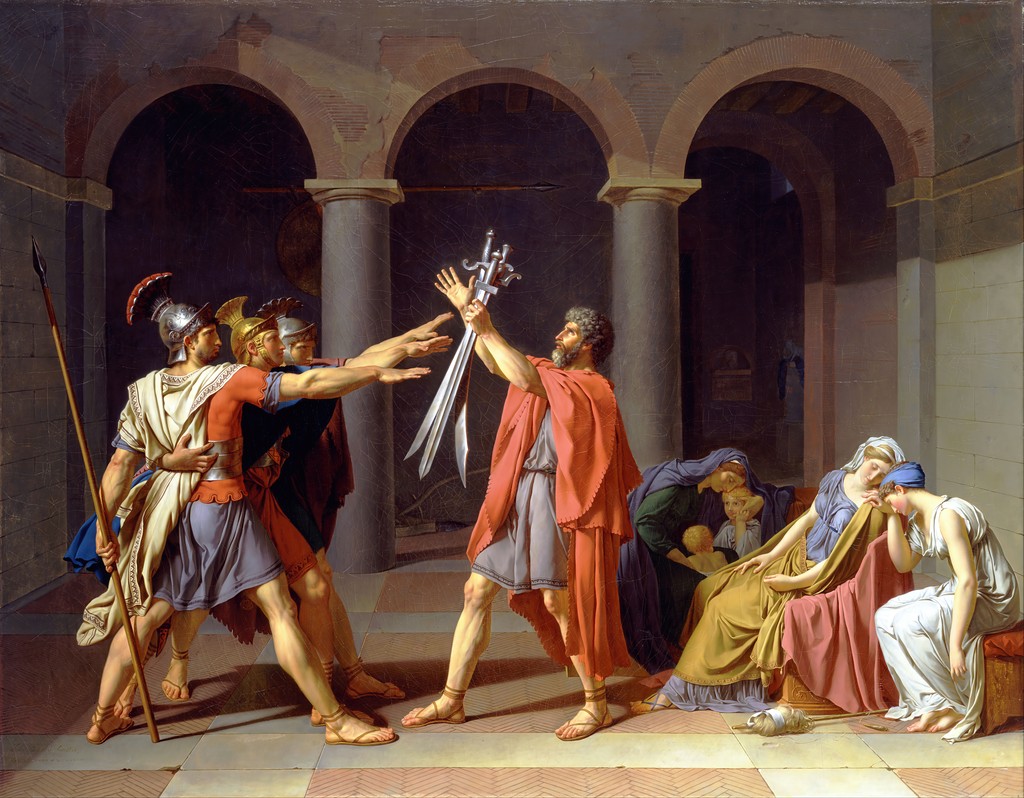
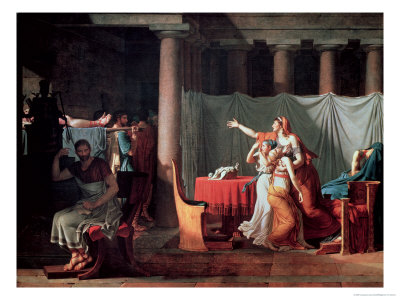
Jacques-Louis David is usually introduced through civic severity: the raised arms of The Oath of the Horatii, the contained grief of Lictors Bearing to Brutus the Bodies of His Sons, the martyr image of The Death of Marat or the imperial theatre of The Coronation of Napoleon. The Loves of Paris and Helen asks for a different kind of attention. Painted in 1788, it is still antique, disciplined and highly designed, but it replaces public oath and republican sacrifice with music, touch, luxury and desire. [1] [2] [6]
The painting belongs to the Louvre and is recorded as Les amours de Paris et d'Helene. It is an oil on canvas, dated 1788, measuring about 1.46 metres high by 1.81 metres wide. The Louvre identifies David as the artist and preserves the work under inventory numbers INV 3696 and MR 1439. Today it sits within the same museum world that holds many of David's best-known works, but its first setting was not the public museum. It was commissioned by Charles-Philippe de France, comte d'Artois, later Charles X, probably in 1785 or 1786, and the Louvre history connects it with the comte's pleasure residence near Paris. [1] [2] [6]
That origin matters. This is not David addressing the state through a public commission, nor David making a revolutionary memorial, nor David constructing Napoleon's authority in paint. It is a private court picture using myth as a refined language of seduction. The Trojan subject gives it literary gravity, but the visual mood is chamber-like rather than epic. David uses antiquity as a vocabulary of bodies, furniture, rhythm and controlled luxury. The result is a work that complicates the usual idea of David as only severe, moral and political. [1] [2] [6]
At a Glance
- ArtistJacques-Louis David [1]
- French TitleLes amours de Paris et d'Helene [1] [2]
- Date1788 [1] [2]
- MediumOil on canvas [1] [2]
- CollectionLouvre, Department of Paintings [1]
- InventoryINV 3696; MR 1439 [1] [2]
- Dimensions1.46 by 1.81 m [1]
- PatronCharles-Philippe de France, comte d'Artois [1] [5]
- First Public MomentSalon of 1789 [1] [6]
- Related StudiesMet black chalk study and Getty 1786 drawing [3] [4]
- SubjectParis and Helen before the Trojan War narrative dominates [1] [2]
- Image CautionLegacy local Louvre-painting image retained pending source-chain review [1] [2]
Contents
- Introduction
- Object Identity
- Artois and Private Court Painting
- Paris, Helen and the Trojan Frame
- Looking at the Painting
- From Drawing to Finished Painting
- Salon 1789 and Revolutionary Afterlife
- Classical Decoration, Furniture and Desire
- Image and Source Cautions
- Why It Matters
Object Identity
The Loves of Paris and Helen shows two famous figures from the Trojan cycle before the full violence of their story takes over. Paris, a Trojan prince, and Helen, wife of Menelaus of Sparta, are among the mythic causes of the Trojan War. Ancient and later traditions tell their meeting through divine judgement, erotic choice, abduction, betrayal and catastrophe. David does not paint the war, the fleet, the city, the duel or the ruined aftermath. He narrows the subject to an interior moment of intimacy. [1] [2]
Paris sits as a beautiful young man associated with music rather than battle. Helen is close to him, her body arranged in a fluent curve that turns the subject away from narrative action and toward cultivated looking. Their closeness is framed by a bed or daybed, drapery, classical furniture and sculptural decoration. The painting is filled with signs of antiquity, but they are polished and domestic rather than archaeological in a dry sense. David builds a world where the antique past becomes an elegant private room. [1] [2]
This object identity also separates the painting from David's later mythological works. In Sappho and Phaon, Love and Psyche, The Farewell of Telemachus and Eucharis and Mars Being Disarmed by Venus, David repeatedly returns to ancient love, parting and erotic tension. The Loves of Paris and Helen is earlier than those Brussels and late-career paintings, but it already shows how flexible his classical language could be. Antiquity could be moral architecture, but it could also become a stage for desire. [1] [2]
Artois and Private Court Painting
The patron was not incidental. Charles-Philippe de France, comte d'Artois, belonged to the royal family and would later become Charles X. The Louvre records the commission in the mid-1780s and notes the likely connection with Artois's pleasure house near Paris. This context helps explain the painting's tone. It is a David painting made for an aristocratic setting, shaped by taste, display, sensuality and elite classicism. [1] [5] [6]
The commission was also linked to a pendant by Francois-Andre Vincent, Renaud and Armide. The Louvre notes that Vincent's pendant is now lost, but the pairing is revealing. Renaud and Armide comes from an epic of enchantment and erotic delay; Paris and Helen belongs to the mythic prehistory of the Trojan War. Both subjects suited an aristocratic culture that could treat ancient or literary passion as decoration, conversation and self-image. David's painting was therefore not isolated. It belonged to a decorative and intellectual environment in which love stories from antiquity and literature could adorn private interiors. [1] [5] [6]
This is why The Loves of Paris and Helen should not be flattened into a generic myth painting. It sits at a sharp intersection of court patronage and Neoclassical design. David had already made his reputation with large works of antique virtue, especially The Oath of the Horatii. For Artois, he adapted that command of anatomy, profile, contour and classical setting to a subject that is softer, more intimate and more openly sensual. The same draughtsmanly control is present, but the emotional temperature is different. [1] [5] [6]
The court context also gives the painting a historical irony. It was completed in 1788 and exhibited at the Salon in 1789, the year in which France's political order began to break apart. Artois emigrated in July 1789, and the Louvre provenance traces the later seizure and movement of his property through revolutionary administrative channels. A painting made for royal private pleasure entered the public story of confiscation, storage, state control and museum display. The object's history therefore passes from aristocratic bedroom or cabinet to revolutionary seizure and eventually to the Louvre. [1] [5] [6]
Paris, Helen and the Trojan Frame
The story of Paris and Helen was one of the most charged erotic myths available to an artist. Paris is the Trojan prince who chooses Aphrodite in the judgement of the goddesses and receives the promise of Helen. Helen is famed for beauty, but she is never just an ornament in the myth. She is also the figure around whom questions of desire, persuasion, guilt and war gather. When later writers and artists return to the pair, they often decide how much emphasis to place on romance, abduction, responsibility or disaster. [1] [2] [3] [4]
David chooses the calm before catastrophe. The painting does not lecture the viewer about the destruction to come. Instead, it concentrates on attraction. That choice is not neutral, but it is controlled. Paris appears not as a soldier at Troy but as a refined lover. Music replaces military action. The room is ordered, the bodies are idealised, and the atmosphere is deliberately enclosed. The mythic future of war is present by implication, but the visible moment is one of cultivated erotic suspension. [1] [2] [3] [4]
That makes the painting especially useful for understanding David's range. The moral gravity of The Death of Socrates depends on the contrast between bodily calm and philosophical resolve. The Loves of Paris and Helen uses a related formal discipline, but toward a different end. Here controlled bodies do not model stoic death. They model beauty, persuasion and luxurious nearness. David does not abandon Neoclassicism; he bends it toward a courtly and erotic register. [1] [2] [3] [4]
The Trojan subject also guards against reducing the picture to pretty surfaces. The viewer knows, or can learn, that Paris and Helen carry the seed of war. The painting's pleasure is therefore touched by danger. Its softness is not the whole story. The stillness of the chamber, the refined antique decoration and the music all sit against a myth in which desire becomes historical violence. David leaves that larger arc outside the frame, but the title brings it into the mind. [1] [2] [3] [4]
Looking at the Painting
The composition is carefully staged around bodies and objects that echo each other. Paris and Helen are not scattered in a busy narrative field. They occupy an intimate architectural setting where every contour, prop and decorative element contributes to the mood. Paris is presented through youthful beauty and musical leisure. The instrument in his hands or near his body turns him away from heroic combat and toward the arts of seduction. Helen's pose answers him through closeness, softness and bodily curve. [1] [2] [5] [6]
David's classical setting is not a generic backdrop. The room includes a bed or couch, ornamental supports, a statue of Venus and furnishings that speak the language of antique taste. The Musee des Arts Decoratifs, in describing an early copy after David's painting, connects the decor with Neoclassical furniture forms and with David's interest in turning bodies into statue-like ideals. That observation suits the Louvre painting. Flesh, marble, furniture and drapery all become parts of a controlled visual system. [1] [2] [5] [6]
The caryatid-like supports are especially important because they make the interior feel both architectural and theatrical. They do not simply fill space. They place Paris and Helen inside a world of classical ornament that has been made for display. A viewer is encouraged to read the figures as living bodies among sculptural forms. The painting asks us to notice the tension between warmth and artifice: real desire is being staged through the perfected language of ancient art. [1] [2] [5] [6]
Colour and light further soften the severity associated with David's more public canvases. The forms are clear, but the subject is not austere. Drapery, skin, bed and ornament create a polished surface world. The painting has the finish and discipline of David's mature pre-Revolutionary style, yet its pleasure is not hidden. It shows how an artist known for masculine oath, sacrifice and civic virtue could also produce a highly refined image of erotic leisure for a royal patron. [1] [2] [5] [6]
From Drawing to Finished Painting
The surviving drawing evidence is valuable because it shows David thinking through the subject over time. The Metropolitan Museum of Art holds a black chalk study for Paris and Helen, dated around 1782 to 1786. The Met connects that sheet with ancient-vase imagery circulating through the collection of Sir William Hamilton and notes that David transformed the antique model rather than copying it mechanically. The study helps place the finished painting within David's broader practice of adapting ancient visual sources through disciplined drawing. [3] [4]
The Getty also preserves a drawing related to the composition, dated 1786. The Getty account places the comte d'Artois commission as early as 1786 and describes the finished painting as the result of at least two years of work. In that drawing, elements later changed or removed appear as part of the process. This matters because it resists the idea that the painting is merely decorative ease. Its polished sensuality was designed through revision. [3] [4]
Drawing was central to David's art. His large public works depended on studies, figure arrangements and compositional control; the same is true here. The difference is not seriousness versus frivolity. The difference is purpose. In the Horatii, drawing clarifies oath and conflict. In Paris and Helen, drawing clarifies closeness, balance and erotic rhythm. David gives the private mythological subject a level of planning comparable to his more famous public inventions. [3] [4]
The drawings also help keep the final painting specific. They show Paris and Helen as a composed pictorial problem, not as a vague illustration of ancient love. David had to decide how the bodies met, what Paris held, how Helen leaned, what furniture framed them, which decorative objects stayed and which disappeared. Those decisions make the Louvre canvas an object of design, not merely a narrative scene. [3] [4]
Salon 1789 and Revolutionary Afterlife
The Loves of Paris and Helen was shown at the Salon of 1789. That date now dominates any historical reading of the painting. The Salon opened in August, after the fall of the Bastille and after Artois had left France. A private mythological painting commissioned by a royal prince entered public exhibition at the very moment when the political meaning of aristocratic taste was changing. [1] [6]
This does not mean the painting should be reduced to a neat political message. Its subject is Paris and Helen, its commission is courtly, and its visual language is erotic and antique. But the timing makes the object's social life unusually charged. It belonged to the culture of the old regime and then passed into the institutional mechanisms created by revolution. The Louvre provenance traces that movement through confiscation and state custody before the painting eventually entered museum display. [1] [6]
That afterlife is important for David's biography. The painter who made The Loves of Paris and Helen for Artois soon became one of the most visible artists of the Revolution. He would paint Marat, engage in political life and help shape republican visual culture. Later he would serve Napoleon and create images of imperial authority. The Paris and Helen commission therefore catches him at a threshold: celebrated by aristocratic patrons, already famous as a Neoclassical painter, and about to become historically inseparable from revolutionary politics. [1] [6]
The contrast with Lictors Bearing to Brutus the Bodies of His Sons is especially sharp. Brutus, also shown at the Salon of 1789, offered Roman republican sacrifice in a tense public key. Paris and Helen offered erotic antiquity for a royal patron. Together they show how David's antique language could move between political severity and private pleasure in the same historical moment. [1] [6]
Classical Decoration, Furniture and Desire
One of the pleasures of The Loves of Paris and Helen is that it treats objects as part of the drama. Furniture, drapery, sculpture and setting do not merely support the figures. They make desire look educated, expensive and antique. Paris and Helen are surrounded by a world in which love is mediated through taste. [1] [5] [6]
This was central to late eighteenth-century Neoclassicism. Antiquity was not only a set of stories. It was also a design language for interiors, clothes, furniture, ceremonies and self-presentation. David's painting participates in that world. The bodies are idealised like sculpture; the furniture recalls ancient forms; the setting makes private sensuality appear culturally elevated. The result is seductive and self-conscious at once. [1] [5] [6]
That self-consciousness gives the painting its edge. David does not paint a rustic encounter, a battlefield episode or a chaotic abduction. He paints an interior of chosen surfaces. Paris and Helen seem to inhabit a space where every object has been arranged to make desire legitimate through classical taste. The painting is therefore not only about mythic love; it is also about how elite culture aestheticises love. [1] [5] [6]
This is why the work belongs beside David's other mythological pages rather than being treated as an exception. Mars Being Disarmed by Venus turns myth into a late meditation on beauty and disarmament. The Farewell of Telemachus and Eucharis turns ancient story into a scene of parting and restraint. Love and Psyche examines erotic revelation with a chillier, more modern clarity. The Loves of Paris and Helen comes earlier, but it opens the same question: what happens when David's antique discipline is directed toward intimacy rather than civic command? [1] [5] [6]
Image and Source Cautions
Image reference: the Louvre and POP/Joconde records give the main object identity, while any painting image should be tied to the Louvre/RMN record or another clearly cited source. The Met and Getty drawings are useful process evidence and have stronger open-access routes, but they are not substitutes for the Louvre canvas. The MAD Paris copy is contextual evidence only unless a separate image permission path is clear. [1] [2] [3] [4] [5]
Why The Loves of Paris and Helen Matters
The painting matters because it broadens the idea of David. It does not replace the stern revolutionary and Napoleonic David. It complicates him. The same artist who created images of oath, murder, execution, ceremony and state power could also construct a polished private myth of erotic luxury. That range is essential to his achievement. [1] [2] [6]
It also matters because it captures a fragile historical moment. Painted for Artois and shown in 1789, the work belongs to a world that was about to be transformed. Its later path through seizure, state custody and the museum is part of its meaning. The painting survived not simply as a mythological image, but as an object carried from royal patronage into the public museum culture of modern France. [1] [2] [6]
Finally, The Loves of Paris and Helen matters because it demonstrates David's command of antique invention on a smaller emotional scale. The painting is not monumental in the manner of the Horatii, Brutus or the Coronation. Its drama is slower, closer and more luxurious. It asks the viewer to see Neoclassicism not only as moral austerity, but as an art capable of controlled sensuality. [1] [2] [6]
For David's wider life and career, see the Jacques-Louis David biography and the David paintings hub. For the heroic public language that surrounds this painting chronologically, compare The Oath of the Horatii and Lictors Bearing to Brutus the Bodies of His Sons. For later mythological and erotic works, continue to Sappho and Phaon, Love and Psyche, The Farewell of Telemachus and Eucharis and Mars Being Disarmed by Venus. [1] [2] [6]
Frequently Asked Questions
Discussion
The Loves of Paris and Helen shows David turning antique discipline toward private luxury, music and desire.
Use the prompts below to think about how the painting balances courtly pleasure, Trojan danger and the charged history of 1789.
Reader Insights
How does this painting change the usual severe image of David as painter of oath, martyrdom and state power?
What happens when the quiet interior is read against the larger Trojan story of desire and war?
How does the Salon of 1789 alter the afterlife of a private painting made for Artois?
Join the Conversation
Share your reading of The Loves of Paris and Helen below.
References
- Louvre Collections, Les amours de Paris et d'Helene, accessed 27 July 2026.
- POP: Plateforme ouverte du patrimoine, Les amours de Paris et d'Helene, accessed 27 July 2026.
- The Metropolitan Museum of Art, Paris and Helen, object 2022.415.2, accessed 27 July 2026.
- Getty Museum / Google Arts and Culture, Paris and Helen, accessed 27 July 2026.
- Musee des Arts Decoratifs, Jacques-Louis David - Paris and Helen, accessed 27 July 2026.
- Web Gallery of Art, Paris and Helen, accessed 27 July 2026.