Buy Art Prints Now
from Amazon
* As an Amazon Associate I earn from qualifying purchases.
 by Tom Gurney
Tom Gurney BSc (Hons) is an art history expert with over 20 years experience
Published on June 19, 2020 / Updated on October 16, 2026
Email: tomgurney1@gmail.com / Phone: +44 7429 011000
The Intervention of the Sabine Women: Introduction
Jacques-Louis David's The Intervention of the Sabine Women is a painting about stopping violence. Its subject comes from the legendary history of ancient Rome, but its emotional force belongs to France after the Terror. At the centre of the picture, Hersilia throws herself between two armies. On one side is Romulus, her husband and the legendary first king of Rome. On the other is Tatius, king of the Sabines and, in the story David used, Hersilia's father. Around them, women and children enter the battlefield to halt a war between husbands, fathers, sons and kin. [1] [2] [3]
The painting is often remembered for its heroic bodies, pale classical light and grand scale. Yet its deepest subject is interruption. Spears are raised but not yet thrown. Romulus is poised to attack, Tatius waits to answer, and Hersilia opens her arms in the dangerous space between them. David chooses the moment when conflict is suspended by human appeal. That choice makes the painting one of his most searching works after the French Revolution. [1] [2] [3]
David began thinking about the subject after the fall of Robespierre, when he himself had been imprisoned for his Revolutionary role. The Louvre's recent exhibition text frames the work as an appeal to reconciliation: David, reflecting on his recent political past and the fractures of French society, used the Roman story to call for peace among the French and for the Revolution's work to be completed without further bloodshed. That context is essential. The painting is not generic Roman mythology. It is ancient history made urgent by modern civil trauma. [1] [2] [3]
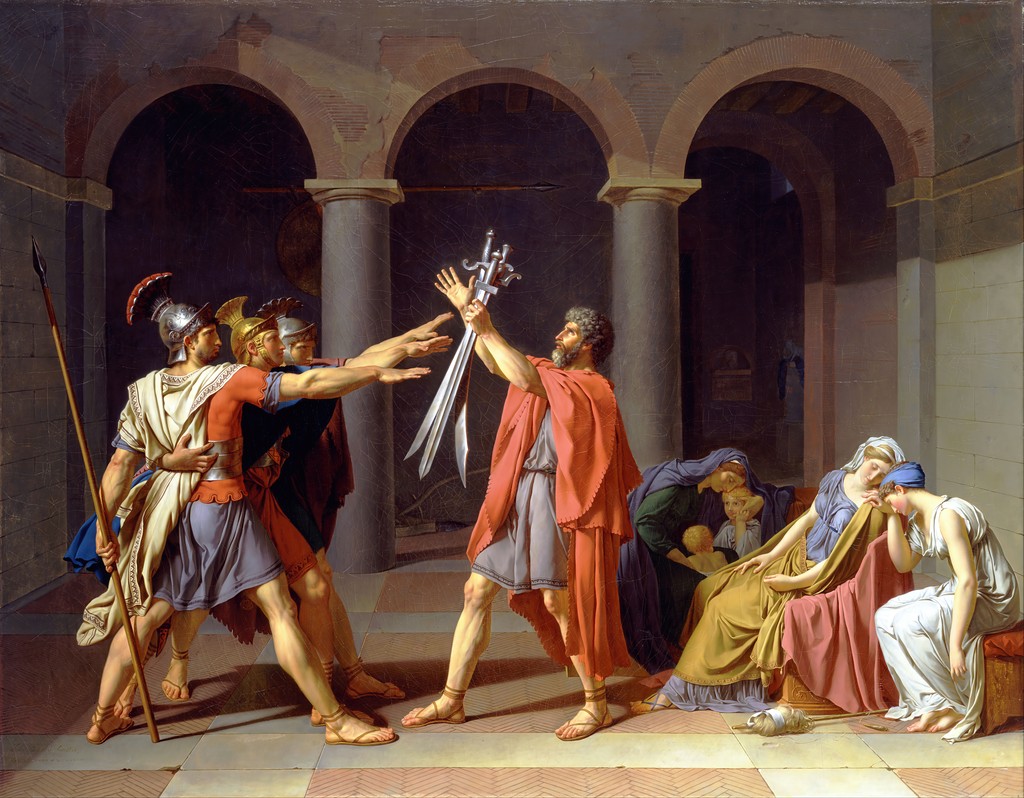
The work also changes the gendered structure of David's earlier history painting. In The Oath of the Horatii, men perform the central civic action while women collapse in grief at the side. In The Intervention of the Sabine Women, the women move to the centre and stop the action. They are not passive witnesses. They become the agents through whom history can continue. [1] [2] [3]
At a Glance
- ArtistJacques-Louis David [1] [2]
- Louvre TitleLes Sabines [1]
- Common English TitleThe Intervention of the Sabine Women [1] [2]
- Date1799 [1]
- MediumOil on canvas [1]
- Dimensions3.85 by 5.22 metres [1]
- CollectionMusee du Louvre, INV 3691 / L 3710 [1]
- Subject CautionDavid paints the later intervention to stop violence, not the abduction of the Sabine women [1] [2]
Contents
- Introduction
- Object Facts
- Roman Story
- After the Terror
- Hersilia
- Suspended Violence
- Annotated Details
- Reconciliation
- Exhibition and Reception
- Related David Works
- How to Look
Object Facts and the Louvre Record
The Louvre records the painting under the title Les Sabines. It was painted by Jacques-Louis David and is dated 1799. The inventory numbers are INV 3691 and L 3710. The work belongs to the Department of Paintings and is currently visible in the Denon wing, Salle 702, Salle Daru, among the Louvre's Neoclassical paintings. [1]
The medium is oil on canvas. The Louvre gives the dimensions as 3.85 metres high by 5.22 metres wide, with larger framed dimensions also recorded. The scale is important. This is a large public history painting, made to confront the viewer with bodies at or near heroic size. It is smaller than David's later Coronation of Napoleon, but it already shows his ability to turn a crowd, a crisis and a political idea into a staged visual event. [1]
The painting is signed and dated on a stone fragment near the lower left, between the legs of Tatius. The Louvre records the inscription as David's signature with the year 1799. That date places the painting at the end of the Directory and just before Napoleon's coup of 18 Brumaire. It belongs to a moment when France was exhausted by faction, violence and political instability, and when many public voices were searching for forms of order after the Revolution's most destructive phase. [1]
The work was not begun as a private or public commission. According to the Louvre record, the project probably arose during David's captivity in the Luxembourg in September 1794, though he resumed work in autumn 1795. In February 1796 he received permission from Interior Minister Pierre Benezech to use a Louvre restoration workshop for the canvas. The picture was completed in autumn 1799. [1]
This independence matters. David was not executing a royal, state or imperial order. He was making a public statement under his own initiative, shaped by the political aftershock of his imprisonment. The subject let him return to large-scale history painting while recasting heroic action as reconciliation rather than oath, sacrifice or martyrdom. [1]
Annotated Details from The Intervention of the Sabine Women
This annotated view shows how David turns a legendary conflict into an image of exposed bodies, halted violence and public reconciliation.
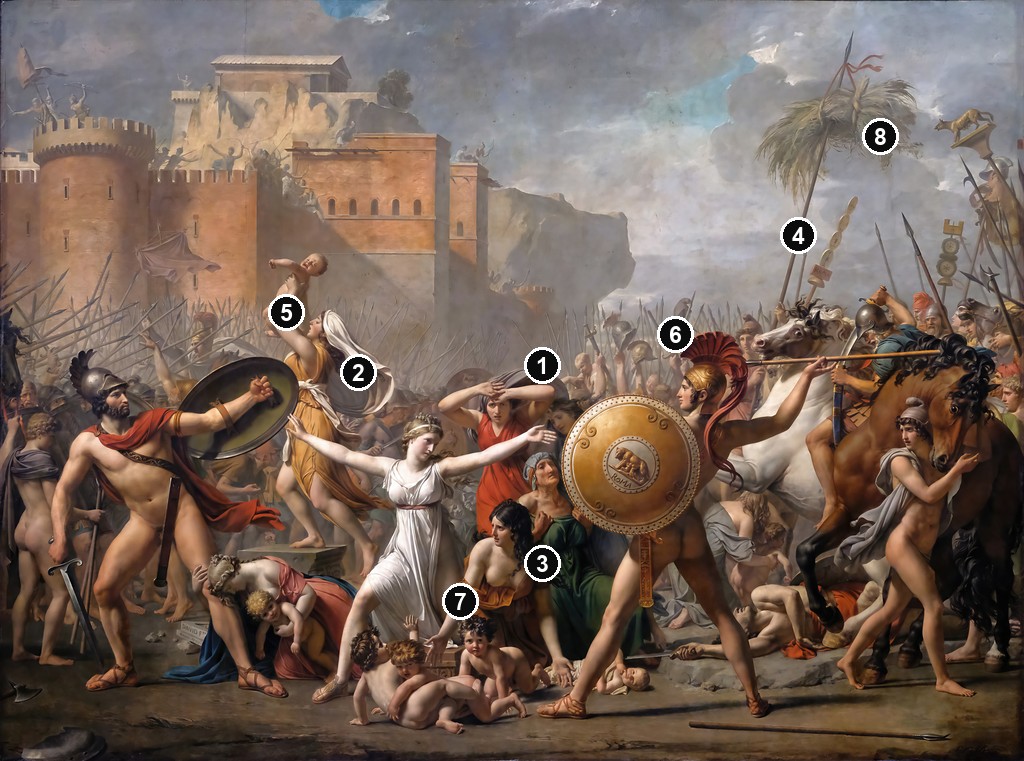
Details from THE INTERVENTION OF THE SABINE WOMEN
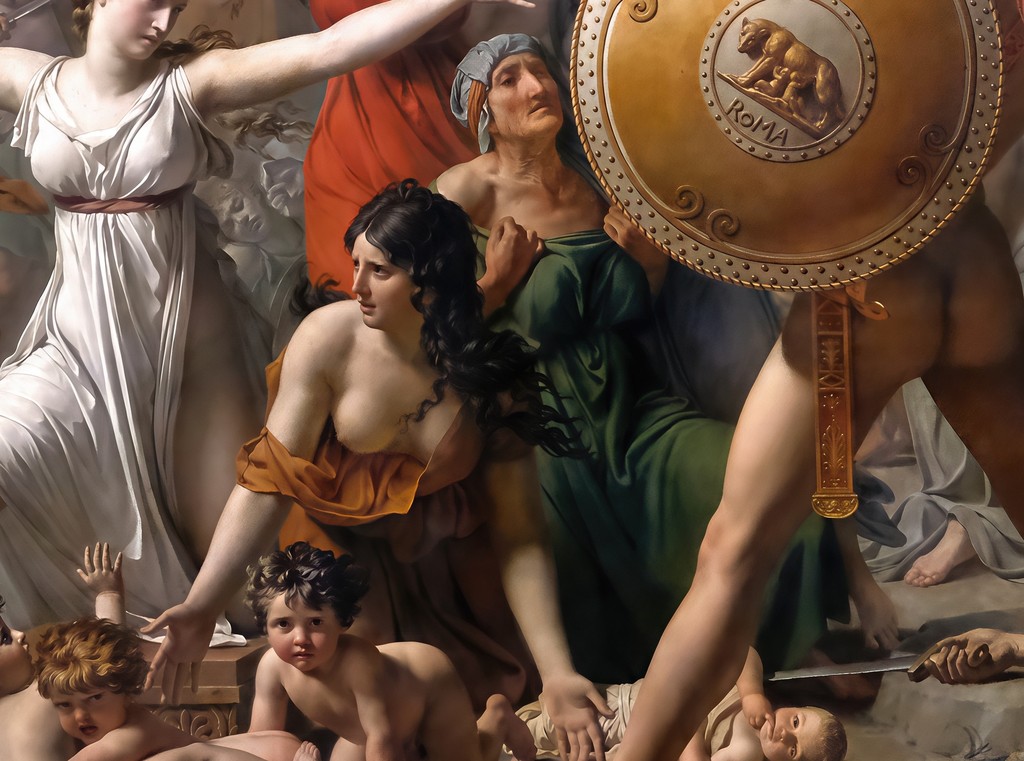
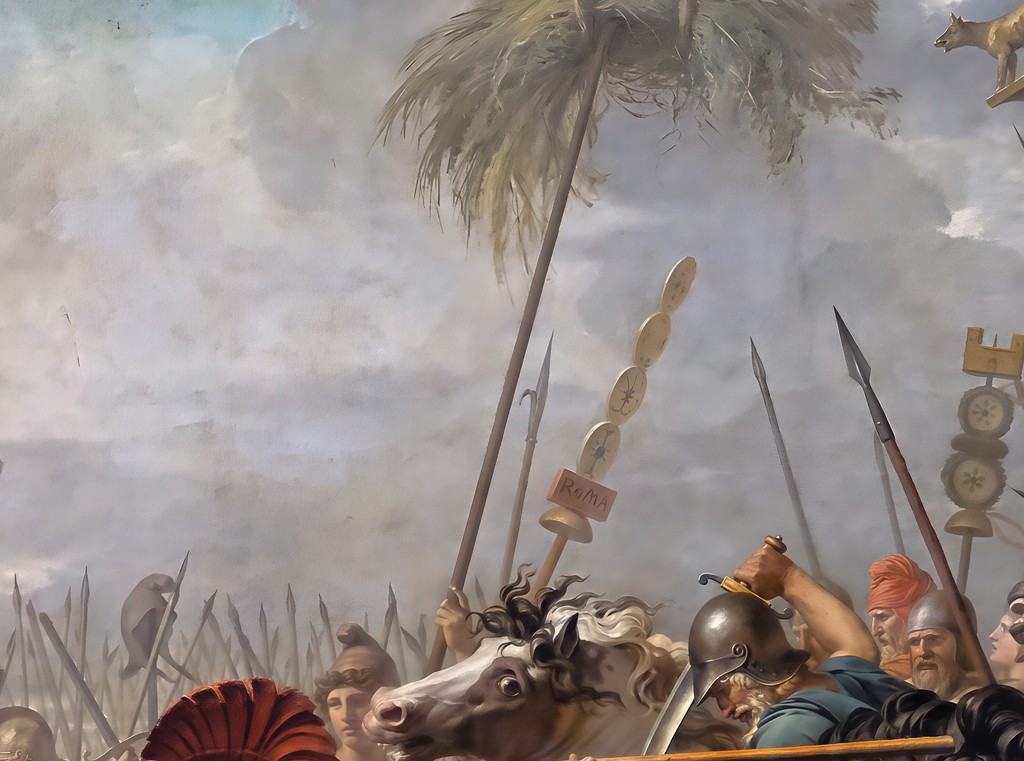
The details focus on the central mediator, the opposing male figures, the families at ground level and the crowd that turns myth into civic drama.
Central mediation
The central female figure interrupts violence by making her body the image's moral barrier.
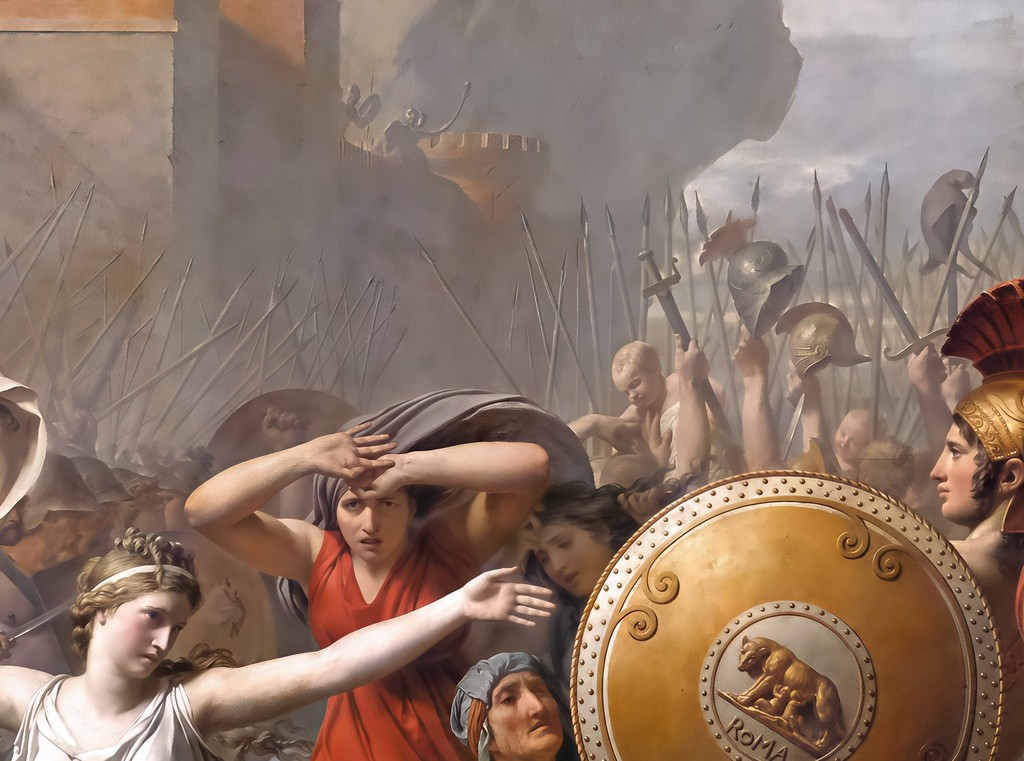
Opposing force
The armed body at the left keeps the scene tense even as the action pauses.
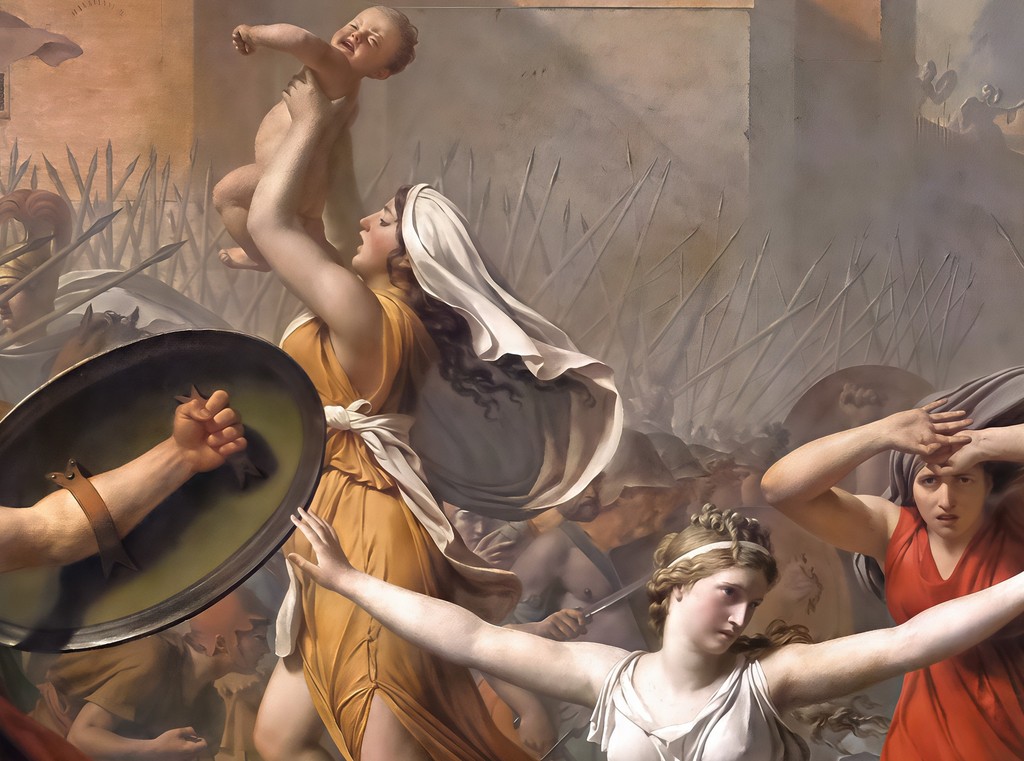
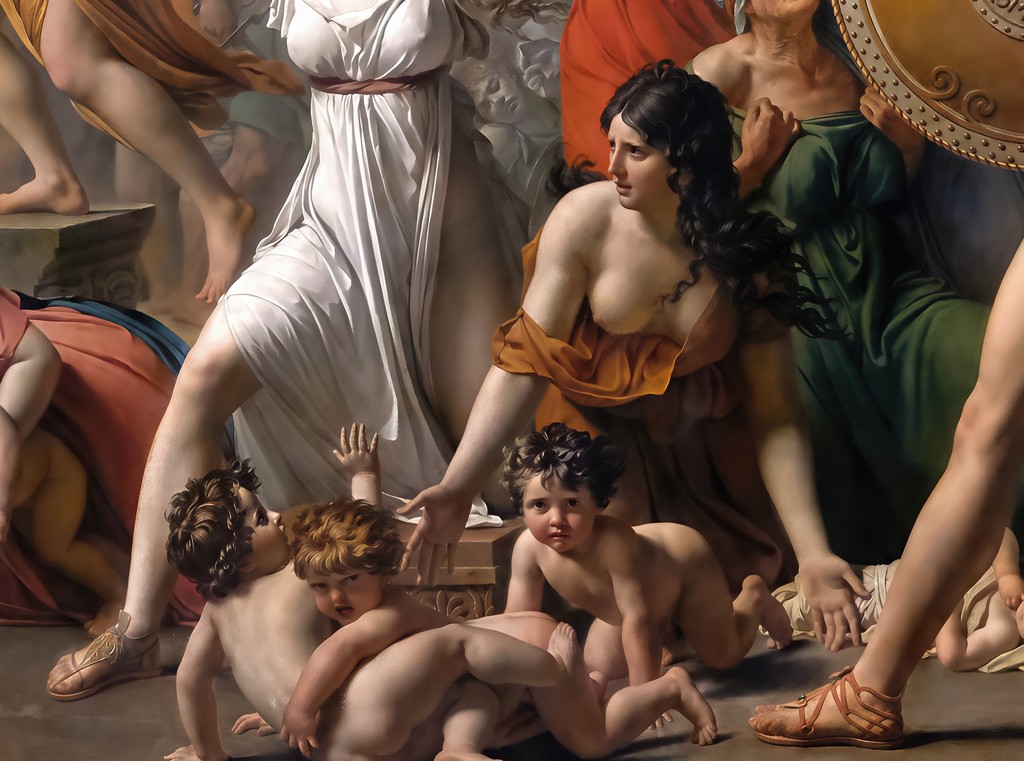
Family at ground level
Children and lowered figures turn public conflict into a family crisis.
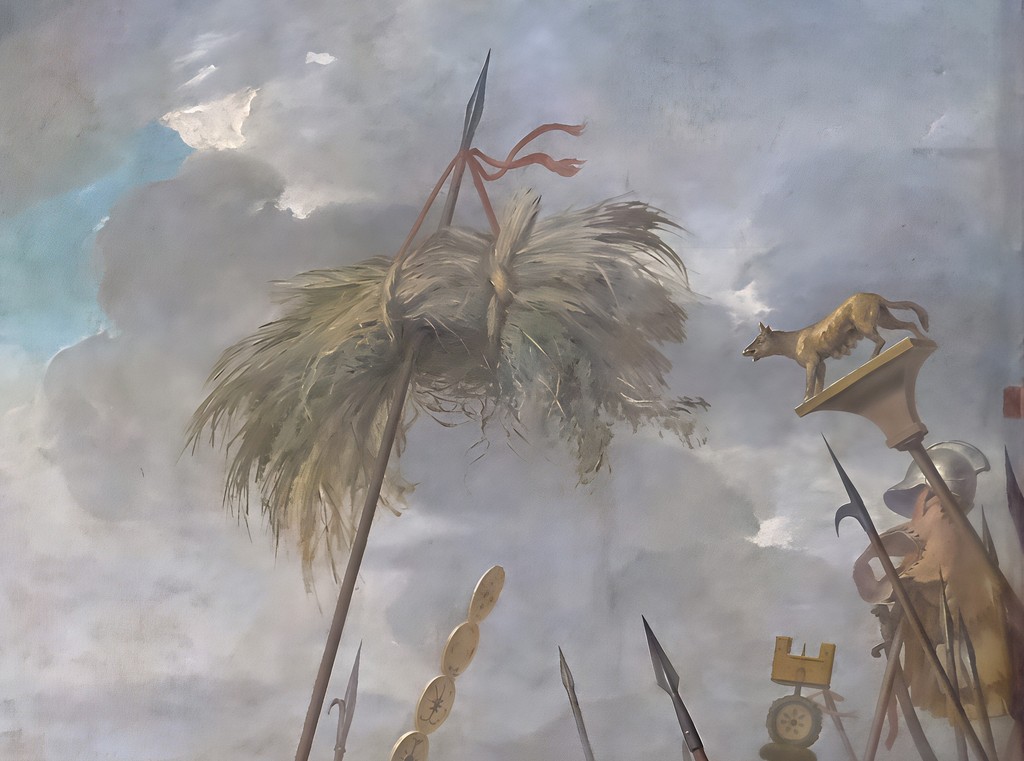
Crowd and architecture
The background crowd and architecture enlarge the scene from mythic encounter to public history.
Raised shield
The shield and tense arm preserve the threat of combat even as the central figure halts the action.
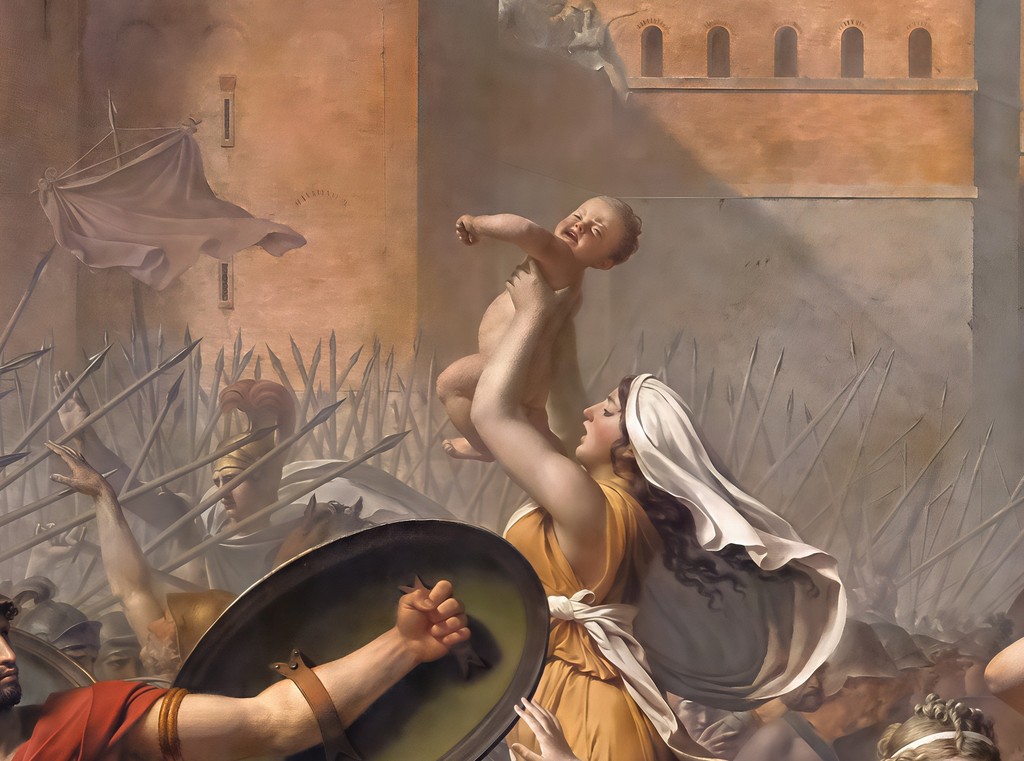
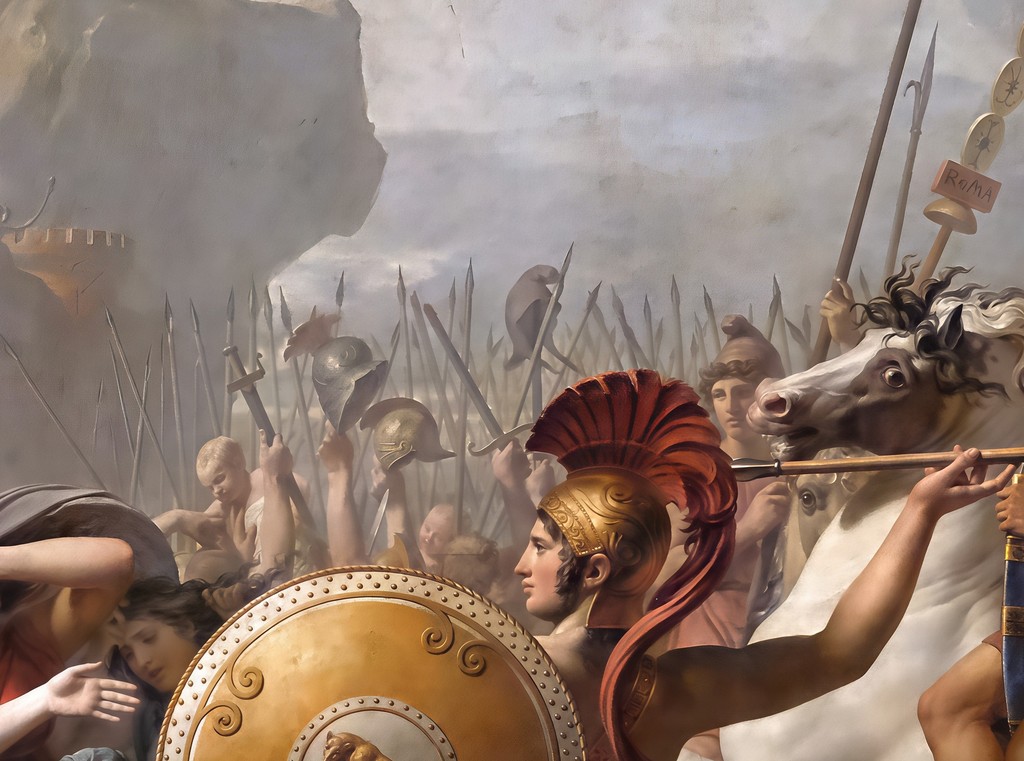
Confronting warrior
The warrior opposite the mediator gives the scene its second pole of force and resistance.
Infant at the centre
The infant turns political reconciliation into a question of future generations.
Standards and fortress
The standards and distant fortress expand the myth into a public conflict over city and people.
The Roman Story
The story begins with Rome's legendary foundation. Romulus and his followers, lacking women, seize women from the neighbouring Sabines. The abduction leads to war. Later, the Sabine forces attack Rome, and the conflict brings fathers and former abductors into direct combat. David does not paint the abduction itself. He paints the later intervention, when the Sabine women, now wives and mothers in Rome, step between the two sides to stop the killing. [1] [2]
The Louvre's 1820 catalogue description, preserved in the object record, gives the narrative with great specificity. The Sabines rush through spears and swords to prevent further bloodshed between their husbands and fathers. Hersilia, wife of Romulus, throws herself between Romulus and Tatius. Other women raise or present their children, transforming the battlefield into a scene of family recognition. [1] [2]
This choice separates David from painters who focused on the violent seizure of the Sabine women. The Louvre exhibition essay explicitly contrasts David's subject with Nicolas Poussin's treatment of the abduction. David turns away from the moment of seizure and toward the moment when violence is stopped. The moral centre is not possession, conquest or revenge, but the effort to interrupt war. [1] [2]
Hersilia's pose makes that moral centre visible. She stands with arms extended between the male leaders. Her body creates a barrier, but not by force. She has no weapon. Her power comes from exposure, courage and relational claim: she is connected to both sides. The painting asks viewers to see kinship, memory and future generations as stronger than immediate vengeance. [1] [2]
The surrounding women deepen that argument. One mother lifts a child into danger. Another kneels with children at the feet of the fighters. An older woman exposes herself as if offering her own body in place of her family. These figures do not decorate the story. They turn abstract reconciliation into bodies at risk. [1] [2]
David After the Terror
The Intervention of the Sabine Women cannot be understood apart from David's own political crisis. He had been deeply involved in Revolutionary politics and had supported Robespierre. After Robespierre's fall in July 1794, David was imprisoned. The Louvre exhibition text notes that while incarcerated he reflected on his recent past and Revolutionary commitment, and that his first sketch for the Sabines may have been made at the end of 1794 or during the summer of 1795. [2] [3]
That biographical context gives the painting its emotional charge. David was not merely selecting a classical story because antiquity was fashionable. He was returning to history painting after a period in which political ideals had produced terror, denunciation and death. The question the painting asks is not simply "What happened in early Rome?" It is "How can a divided people stop killing one another?" [2] [3]
The answer is not triumphant in the old Davidian mode. The Oath of the Horatii had made civic duty severe, masculine and absolute. The Death of Socrates had turned philosophical conviction into controlled martyrdom. The Death of Marat had presented a Revolutionary leader as political saint. The Sabines moves into a different register. Its heroism is still classical, but it now needs pity, family and interruption. [2] [3]
The Louvre exhibition essay says that after years of trouble and violence, heroism could no longer be separated from humanity. That is a concise way to understand the painting's historical position. David's art still seeks grandeur, but grandeur now has to include supplication, fear and maternal courage. The painting does not abandon Neoclassical discipline. It softens and reorients it. [2] [3]
This makes the work one of David's key post-Thermidor images. It looks backward to the Revolution's injuries and forward to a possible civic settlement. It does not solve the politics of the Directory. It gives them an image: a field of suspended weapons, halted by those who have most to lose if civil violence continues. [2] [3]
Hersilia at the Centre
Hersilia is the painting's hinge. She is not simply a beautiful central figure; she is the one who changes the direction of the scene. Romulus and Tatius face one another in a deadly relationship of attack and response. Hersilia opens that closed circuit. Her body interrupts the line of violence. [1] [2] [3]
Her centrality also changes the emotional architecture of David's history painting. In earlier works, women often register the cost of male action. Here, women determine the action. The Louvre exhibition text emphasizes that they are no longer passive, as in the Horatii, but occupy the centre of the composition, expressing revolt, horror, supplication and courage. They stop the bloody course of events so that Rome can have a future. [1] [2] [3]
The children are essential to that claim. They make the war look absurd. The men are not fighting faceless enemies; they are threatening the families that bind the two peoples together. Children turn battle into civil war in the most intimate sense. The future stands exposed before the weapons of the present. [1] [2] [3]
David's handling of Hersilia is also tied to the antique style of the Directory. The Louvre notes that the painting belongs to the same moment as David's portraits of women such as Madame Recamier and Henriette de Verninac, and that in these works he paid close attention to antique fashion, a style he had promoted in theatre. Hersilia's classical dress is therefore both historical costume and contemporary fashion language. [1] [2] [3]
That connection should be handled carefully. The painting is not a fashion plate, and Hersilia is not a modern Parisian sitter in disguise. But David's antique styling allowed ancient subject and contemporary society to speak to one another. The Roman heroine could address a French public that had learned to see antique dress, public virtue and modern identity as intertwined. [1] [2] [3]
Norman Bryson's Hersilia's Sisters, published by Getty Research Institute, gives this context special weight. The book frames The Intervention of the Sabines within the rebuilding of civil society in post-Revolutionary France and examines how women's culture under the Directory influenced David's art between the Sabines and Bonaparte Crossing the Alps. The manuscript does not need to reproduce Bryson's detailed argument to benefit from the frame: the painting belongs to a moment when women, sociability, fashion and public morality were newly central to the imagination of civic repair. [1] [2] [3]
Composition and Suspended Violence
The composition is built around a pause. The eye moves first to Hersilia and the two men around her. Romulus stands nude and armed, raising his spear. Tatius faces him, shield ready, body angled for impact. Between them, Hersilia spreads her arms. The picture is full of motion, but its subject is the instant before motion becomes slaughter. [1] [2]
This suspended moment is one of David's great pictorial solutions. If he had shown the battle already resolved, the painting would have become a scene of peace. If he had shown the battle in full violence, reconciliation would be overwhelmed. Instead, he paints the critical threshold. The viewer sees the danger and the possibility of stopping it at the same time. [1] [2]
The Louvre's older catalogue description gives a battlefield filled with individual appeals: a mother raising a nursing child, a kneeling woman with three children, an older woman offering herself, soldiers halted by cries, a commander sheathing his sword. These details are not just narrative ornaments. They multiply Hersilia's central intervention across the canvas. The whole field begins to change because the women enter it. [1] [2]
The background anchors the subject near Rome's walls and the Tarpeian Rock. Roman signs appear among the standards, including the wolf and a bundle of hay attached to a lance, recorded in the Louvre's preserved description as an early Roman standard. These details place the event in Rome's legendary past, but the painting's emotional address remains contemporary. [1] [2]
David's bodies are idealized, but they are not calm in the same way as the Horatii. The warriors have polished classical form, but the women and children bring disorder, hair loosened, clothes disturbed and bodies exposed to danger. That mixture of antique beauty and emotional disturbance is central to the painting's effect. [1] [2]
The work also stages a debate about masculinity. The men are brave, but their bravery has become destructive. The women are vulnerable, but their vulnerability becomes politically powerful. David does not abolish heroic male bodies; he subjects them to a different moral test. Can force be stopped before it destroys the community it claims to defend? [1] [2]
Reconciliation and Public Meaning
The Louvre's exhibition title for the work, "An appeal to reconciliation," names the painting's public meaning directly. The Sabines asks its viewers to imagine a way out of political revenge. The Roman legend offered David a language in which reconciliation could be heroic without looking weak. [2] [3]
That was crucial after the Terror. In the mid-1790s, calls for peace could seem like retreat, compromise or opportunism. David's painting gives reconciliation grandeur. Hersilia does not plead from a safe distance; she enters the killing zone. The women do not end violence by sentimental withdrawal; they risk their bodies in public action. [2] [3]
The painting therefore complicates simple ideas of Neoclassicism as cold or rigid. Its design is highly ordered, but its moral force depends on emotion. Supplication, maternal fear and embodied vulnerability become civic powers. The image says that political repair requires feeling as well as discipline. [2] [3]
At the same time, the painting is not an easy modern feminist statement. It still imagines women through motherhood, marriage and family bonds. Hersilia's authority comes partly from being wife, daughter and mother. But within those constraints, David gives women the decisive role. They do what male warriors cannot do: stop the cycle of retaliation. [2] [3]
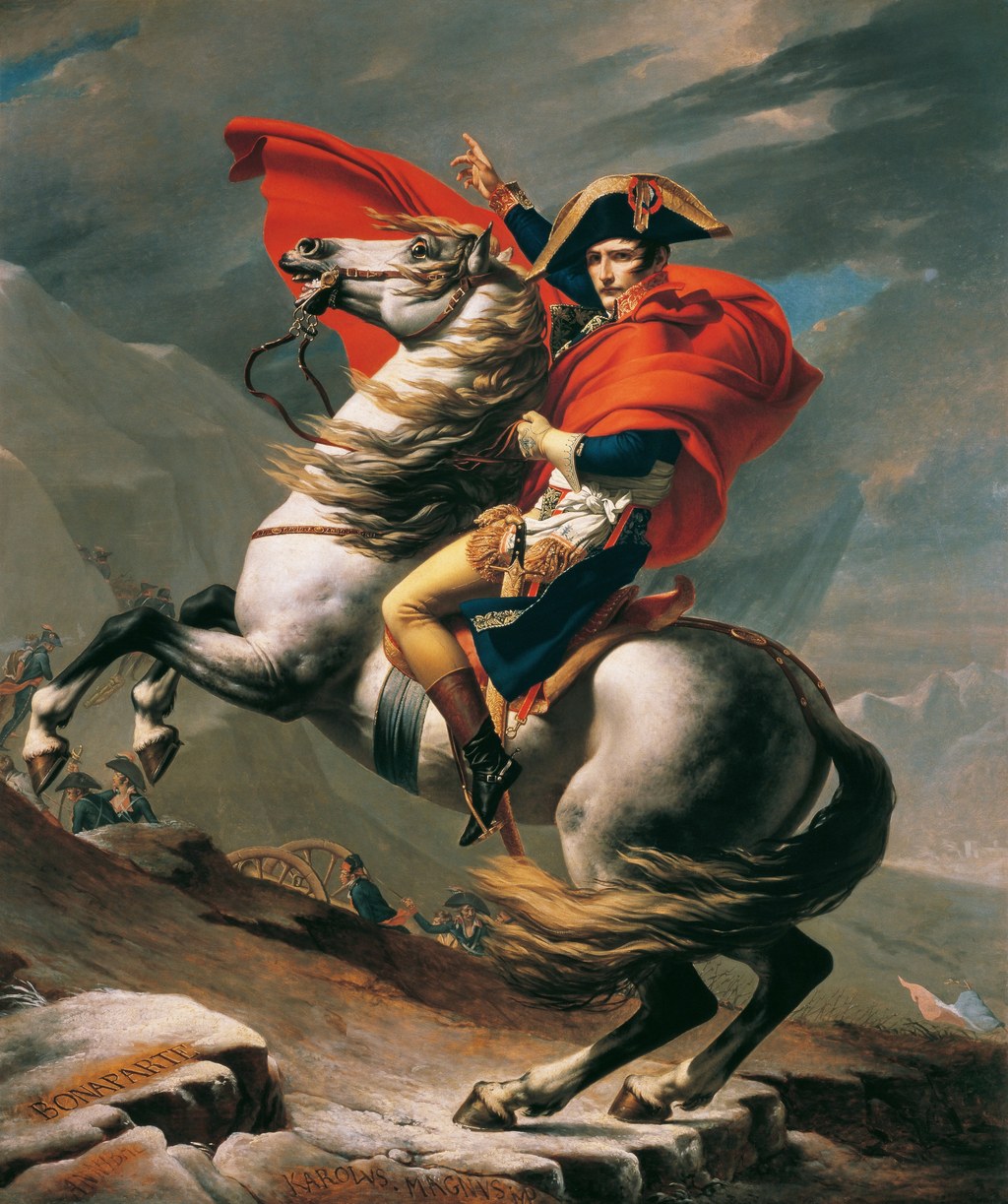
This is why the work makes such a strong bridge between David's Revolutionary paintings and his later Napoleonic images. In The Sabines, the question is how civil violence might cease. In Napoleon Crossing the Alps, first shown near the Sabines in 1801 according to the Louvre exhibition text, the question becomes how a new leader might complete the Revolution and direct France's destiny. The relationship between the two images is not accidental. One freezes conflict; the other releases movement. [2] [3]
Exhibition, Mirror and Reception
The painting's first display was unusually theatrical. The Louvre record states that it was presented in the former meeting room of the Academy of Architecture, in a space made available by the museum, and that a paid exhibition opened on 21 December 1799 with an entrance fee of 1.80 francs. The Louvre exhibition essay adds that the picture was shown before a large mirror, immersing visitors in the painting. The same mirror device would later be used for The Coronation of Napoleon. [1] [2]
That display matters because it shows David controlling not only the image, but also the viewing experience. The painting was not simply hung as one work among many. It was staged. The mirror allowed viewers to see themselves in relation to the scene, intensifying the sense that this Roman story addressed their own civic world. [1] [2]
The paid exhibition also tells us something about David's independence after the Revolution. Since the work had no original commission, its public life began through a kind of entrepreneurial exhibition. Visitors paid to see a major new David in a controlled setting. The painting was both moral appeal and public spectacle. [1] [2]
Its later history is equally revealing. The Louvre record states that the canvas was transferred in 1805 to David's new studio in the chapel of the former College de Cluny, then shown temporarily at the Musee Napoleon in 1810 for the Prix decennaux exhibition. In 1819, through a complicated sale arrangement involving Jean-Louis Delahaye, it was acquired by the royal administration under Louis XVIII together with Leonidas at Thermopylae. It entered the Musee du Luxembourg and later moved to the Louvre in 1826. [1] [2]
That afterlife places the painting across political regimes. Conceived after the fall of Robespierre, completed under the Directory, displayed at the dawn of Bonaparte's rise, moved under the Empire and acquired under the restored monarchy, it survived the collapse of the very political worlds it tried to address. Its call for reconciliation outlived its first audience. [1] [2]
Relation to David's Other Works
The Sabines is one of the best pages through which to understand David's transformation. It looks back to The Oath of the Horatii, not only because both are Roman subjects, but because the later painting answers the earlier one. The Horatii shows the absolute commitment of men to civic duty. The Sabines asks what happens when absolute commitment threatens to destroy families and the future. [1] [2] [3]
It also speaks to The Death of Socrates, another classical scene in which David used antiquity to think about moral conviction. But Socrates accepts death through philosophical composure, while Hersilia prevents death through bodily intervention. One image honours steadfastness; the other honours interruption. [1] [2] [3]
The connection with The Lictors Bearing to Brutus the Bodies of His Sons is especially useful. Brutus turns political duty into domestic devastation. The Sabines refuses that logic. It brings family feeling into public space and makes it a force against further bloodshed. [1] [2] [3]
The painting also anticipates Leonidas at Thermopylae, which was later acquired with it by Louis XVIII. Both are large classical canvases concerned with heroic bodies and public destiny. But Leonidas is a scene of martial self-sacrifice, while the Sabines is a scene of anti-martial courage. Their pairing helps show the range of David's late classical imagination. [1] [2] [3]
Finally, the work stands near David's portraits of women, especially Madame Recamier. The Louvre connects the Sabines with David's attention to antique fashion in the same years. In the portrait, antique simplicity becomes a language of modern elegance and public identity. In the Sabines, antique dress becomes a language of civic intervention. [1] [2] [3]
How to Look at the Painting
Begin with Hersilia. Her outstretched arms divide and connect the two armies. She is neither on the Roman side nor the Sabine side alone. She belongs to both, and that double belonging gives her the authority to stop the battle. [1] [2]
Then look at Romulus and Tatius. Their bodies are poised for action, but their attention is interrupted. The drama depends on their stillness as much as their threat. David makes the viewer wait for a blow that may now never fall. [1] [2]
Next follow the women and children. Their gestures repeat Hersilia's appeal in different emotional registers: terror, supplication, protection, exposure and grief. The painting's central argument spreads through them. Reconciliation is not one figure's private wish; it becomes a collective pressure on the warriors. [1] [2]
Look also at the classical setting and signs of Rome. The walls, standards and legendary markers keep the story in antiquity, but the emotional problem is modern. David uses Rome as a mirror for France after Revolutionary violence. [1] [2]
Finally, remember the first exhibition. The painting was once shown with an actual mirror behind the viewing experience, inviting spectators to feel drawn into the image. Even now, the work asks viewers where they stand: with the raised weapons, with the exposed women, or with the possibility that civic life begins when vengeance is interrupted. [1] [2]
Why It Still Matters
The Intervention of the Sabine Women remains important because it shows David rethinking heroism after political catastrophe. He does not abandon grandeur, antiquity or public meaning. He redirects them. The hero is no longer only the man who swears, dies or commands. The hero can also be the woman who enters danger to stop men from destroying the community they claim to defend. [1] [2] [3]
The painting is also a reminder that Neoclassical art was not only about ancient stories. For David, antiquity was a way of thinking about modern France. In 1799, the Roman legend became a language for civil repair after Revolution, prison, vengeance and fear. Its beauty cannot be separated from that historical pressure. [1] [2] [3]
For the Jacques-Louis David cluster, the Sabines is a crucial pivot. It stands between the severe republican moral world of the 1780s and early 1790s and the Napoleonic image-making that would soon follow. It shows David after the Terror, searching for a public image that could admit violence and still imagine peace. [1] [2] [3]
That search gives the painting its lasting power. The canvas is full of ideal bodies, antique dress and staged grandeur, but it is not cold. It is a plea made through composition. It asks whether history can pause before another act of bloodshed, and whether those most exposed to violence might be the ones who make a future possible. [1] [2] [3]
Related Pages
The Jacques-Louis David biography places The Intervention of the Sabine Women within the artist's Revolutionary crisis, imprisonment, post-Terror recovery and later service to Napoleon. The David paintings hub sets it among his major history paintings and portraits. [1] [2] [3]
For related classical and Revolutionary works, compare The Oath of the Horatii, The Death of Socrates, The Lictors Bearing to Brutus the Bodies of His Sons, The Death of Marat and Leonidas at Thermopylae. For the Napoleonic turn after the Sabines, see Napoleon Crossing the Alps, The Coronation of Napoleon and Madame Recamier. [1] [2] [3]
Frequently Asked Questions
Discussion
The Intervention of the Sabine Women is a painting about the exact instant violence might still be stopped.
Use the prompts below to think about how David turns family, battlefield and reconciliation into public history.
Reader Insights
Which gesture most strongly interrupts the battle: Hersilia's open arms, the women lifting children, or the warriors' suspended weapons?
How does the painting's call for reconciliation change when seen after David's Revolutionary crisis and imprisonment?
Does David make peace look heroic, fragile, theatrical, or all three?
Join the Conversation
Share your reading of The Intervention of the Sabine Women below.
References
- Musee du Louvre, Les Sabines, INV 3691 / L 3710, accessed 26 July 2026.
- Musee du Louvre, Jacques-Louis David exhibition feature, Un appel a la reconciliation, accessed 26 July 2026.
- Getty Research Institute / JSTOR, Norman Bryson, Hersilia's Sisters, accessed 26 July 2026.