by Tom Gurney
Tom Gurney BSc (Hons) is an art history expert with over 20 years experience
Published on June 19, 2020 / Updated on October 16, 2026
Email: tomgurney1@gmail.com / Phone: +44 7429 011000
Jacques-Louis David: Introduction
Jacques-Louis David was the painter who gave French Neoclassicism its most severe public voice. His art looks back to ancient Rome and Greece, but it belongs just as much to the volatile modern world of the French Revolution, the rise of Napoleon and the political aftershocks that sent David into exile. Across history paintings, portraits, drawings and official commissions, he turned the human body into a language of oath, sacrifice, authority and memory. [1] [2] [3]
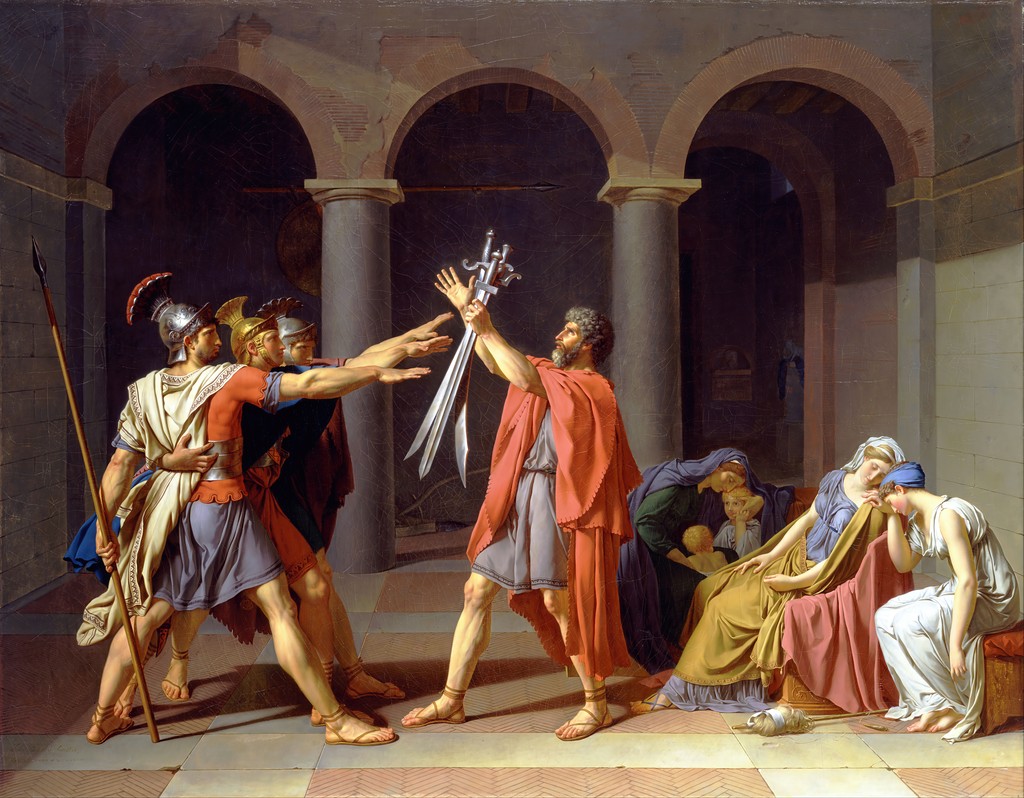
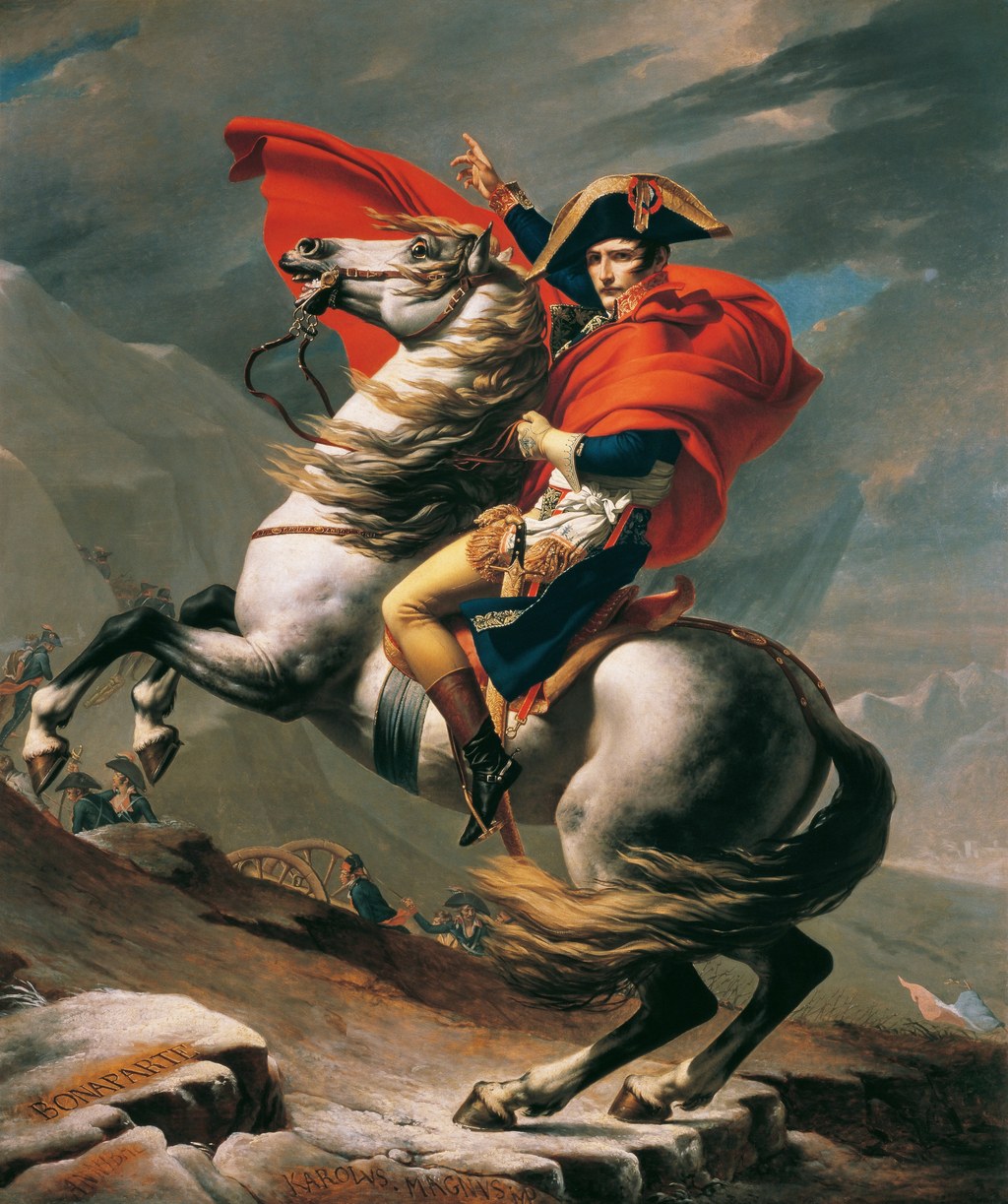
David matters because he made painting feel like a public act. In The Oath of the Horatii, Roman brothers stretch their arms toward swords as if private life has been forced into a civic trial. In The Death of Socrates, philosophy becomes a scene of chosen death and moral instruction. In The Death of Marat, a murdered revolutionary is transformed into a stark martyr of the new republic. In Napoleon Crossing the Alps and The Coronation of Napoleon, David helped turn Bonaparte from soldier and ruler into a historical image. [5] [6] [7] [8]
The same artist could also be intimate, precise and unsettlingly modern. His portraits of figures such as Madame Recamier, Antoine-Laurent and Marie-Anne Lavoisier, Napoleon in his study and Jacobus Blauw show a painter alert to dress, gesture, social role and psychological control. His drawings reveal the discipline behind that public clarity, while the many prints made after his compositions show how far his images travelled beyond the original canvases. [9] [10] [11] [12]
At a Glance
- Born30 August 1748, Paris [2] [4]
- Died29 December 1825, Brussels [2] [4]
- NationalityFrench [2]
- MovementNeoclassicism [1] [2]
- TrainingJoseph-Marie Vien, Prix de Rome and extended study in Italy [2] [4]
- Public RolesRevolutionary deputy, republican image-maker and Napoleon's court painter [2] [3] [4]
- Core MediaHistory painting, portraiture, drawings and works circulated through prints [1] [4] [12]
- Key WorksThe Oath of the Horatii, The Death of Socrates, The Death of Marat, Napoleon Crossing the Alps and The Coronation of Napoleon [5] [6] [7] [8]
Contents
- Introduction
- David's Artistic Connections
- Artist Journey Map
- Training, Rome and Neoclassicism
- How David's Style Works
- History Painting and Civic Virtue
- David and the French Revolution
- Napoleon and the Theatre of Power
- Portraits, Drawings and Public Life
- Late Works and Exile
Training, Rome and the Making of a Neoclassical Language
David's art began inside the academic world of eighteenth-century Paris. The Royal Academy still shaped artistic ambition, and history painting remained the highest category in the hierarchy of genres. The young David trained with Joseph-Marie Vien, whose own interest in antique subjects helped prepare the path toward the cleaner, more archaeological classicism that David would sharpen into something far more commanding. [1] [2] [4]
His early path was not effortless. David competed several times for the Prix de Rome before winning it, and his years in Italy gave him sustained exposure to ancient sculpture, Renaissance painting and the disciplined study of the figure. Rome mattered because it gave him more than costume and subject matter. It gave him a way to organise bodies in space so that action felt legible, compressed and morally charged. In his mature work, a raised arm, a turned head or a rigid leg often carries as much meaning as an entire narrative episode. [1] [2] [4]
Neoclassicism in David's hands was not a decorative revival of antique taste. It was a visual system. Forms were clarified, compositions were tightened and gestures were made almost architectural. The result can look severe, but that severity was part of the point. Against the softness and playful surfaces associated with much Rococo art, David offered contour, discipline and ethical pressure. He made the ancient world appear less like a distant style than a testing ground for modern conduct. [1] [2] [4]
The Louvre's collection and recent David exhibition make clear how large his range was: he was not only the painter of a few famous political icons, but an artist who moved between monumental history, portraiture, preparatory drawing, state commission and late myth. Still, the foundation of his authority was established by his ability to make antique subjects speak to contemporary viewers without spelling out every modern parallel. [1] [2] [4]
How David's Style Works
David's style is often described through its classical subjects, but the subjects alone do not explain the effect. Many eighteenth-century painters used antique themes. David's distinctiveness lies in how he made form, gesture and space enforce the argument of a scene. His backgrounds often refuse distraction. His figures are arranged with sharp readability. His surfaces tend to suppress painterly looseness in favour of contour, balance and deliberate pause. [1] [5] [6]
This is why his paintings can seem still even when they depict action. In The Oath of the Horatii, the drama is not a chaotic battlefield but a chosen instant before the consequences unfold. In The Death of Socrates, the most important movement is the philosopher's calm reach toward the cup. In The Death of Marat, the body's slump and the paper held in the hand create a quiet aftermath rather than theatrical violence. David turns action into moral evidence. [1] [5] [6]
Gesture is central. Raised arms, outstretched hands, fallen heads and rigid torsos organise the viewer's response. The gestures rarely feel casual. They are constructed to be read across distance, whether in the Salon, in a public ceremony, in an engraved reproduction or now on a museum wall. That readability helped his works become public images rather than private puzzles. The figures speak in a language of bodies before the viewer begins to untangle the historical details. [1] [5] [6]
Colour also serves this discipline. David was not colourless, and his paintings can be rich, but colour is usually subordinated to structure. Reds, whites, flesh tones, dark grounds and polished surfaces guide attention toward the ethical and political centre of the composition. Costume and furniture are equally purposeful. A Roman tunic, an imperial uniform, a writing table or a Directoire sofa can identify a world, but also a set of values: austerity, ambition, intellect, wealth, ceremony or cultivated restraint. [1] [5] [6]
The result is a style that feels lucid but not simple. David's clarity can make his paintings appear to declare their meanings, yet their meanings often remain unstable. Is Brutus heroic or cruel? Is Marat a saint, a political construction or both? Is Napoleon in the Alpine portrait a modern Caesar or an image of calculated fiction? David's art keeps returning to these tensions because its formal order does not remove conflict. It makes conflict visible. [1] [5] [6]
History Painting and Civic Virtue
David's breakthrough came through history painting: large, serious works in which ancient stories were arranged as moral drama. The Oath of the Horatii is the clearest early example. Commissioned under the old monarchy and painted in the years before the Revolution, it shows three brothers pledging themselves to combat while the women and children collapse into grief at the side. The picture does not need an explicit political caption to feel public. Its entire structure opposes hardness and tenderness, civic duty and family pain, male resolve and domestic consequence. [5] [8] [1]
That structure helps explain why David's paintings could be read in different political climates. A royal administration could commission an image of Roman virtue; later viewers could see it as a pre-Revolutionary emblem of sacrifice to the state. The painting's power lies partly in that openness. David did not merely illustrate a Roman story. He created an image in which the body is asked to choose between private feeling and collective obligation. [5] [8] [1]
The Death of Socrates works differently but shares the same moral architecture. The philosopher, condemned by Athens, reaches toward the cup of hemlock while continuing to instruct his followers. The Metropolitan Museum of Art's record stresses the sophistication of David's gestures and expressions, and the composition shows how carefully he studied the ancient sources and the emotional positions of each figure. Socrates is not presented as a broken victim. He becomes an image of intellectual courage, staged with a clarity that turns a prison room into a philosophical theatre. [5] [8] [1]
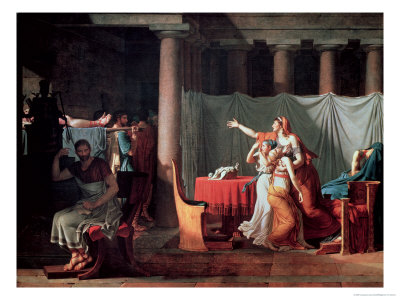
Other early and pre-Revolutionary works extend this language. Lictors Bearing to Brutus the Bodies of His Sons turns Roman republican severity into a domestic tragedy. Andromache Mourning Hector shows David's interest in grief, dynastic memory and the aftermath of heroic action. Belisarius Begging for Alms presents fallen greatness and recognition as a public lesson in virtue and instability. These paintings established David as an artist who could make classical subject matter feel immediate because he treated history as a moral pressure system rather than a storehouse of elegant scenes. [5] [8] [1]
The Salon made this public ambition sharper. Paintings were not only objects for private study; they entered crowded exhibitions where viewers compared artists, argued over moral meaning and judged whether art could speak to contemporary life. David understood that a large history painting had to operate at several distances. From across a room, the composition needed force. Up close, the surface, expression and detail had to reward attention. In memory, the arrangement had to remain clear enough to become almost emblematic. [5] [8] [1]
That combination explains his unusual historical reach. A David composition can be remembered as a diagram of conviction before its full literary or political context is known. Three sons swear an oath. Socrates reaches for hemlock. Marat falls beside a letter. Napoleon points from a rearing horse. These images work because they reduce complex narratives to unforgettable visual decisions without reducing them to emptiness. [5] [8] [1]
David's reliance on antiquity also changed over time. In the 1780s, Roman and Greek examples gave him a language of civic virtue, philosophical endurance and tragic choice. During the Revolution, the antique model helped him frame modern deaths as public memory. Under Napoleon, classical reference gave new authority to a regime that wanted to look inevitable, historical and ceremonial. In exile, myth could become more private, elegiac and sensual. The antique world was never a single message in David's art. It was a flexible structure through which different kinds of modern pressure could pass. [5] [8] [1]
David and the French Revolution
David did not remain an observer of political change. During the French Revolution he became directly involved in public life. Institutional biographies record his role as a deputy, his association with the Jacobin Club and his participation in the political structures of the early 1790s. The same career that had flourished in the Royal Academy became tied to the abolition of the old academic system and to the visual culture of the new republic. [2] [4] [6]
This political commitment cannot be separated from his art, but it also needs careful handling. David's revolutionary paintings are not neutral historical documents, and they are not merely illustrations of events. They are images designed to shape memory, emotion and public allegiance. The question is not whether art and politics met in his work. They did. The more useful question is how his earlier language of antique virtue was adapted to modern revolutionary martyrdom. [2] [4] [6]
The Death of Marat is the central example. Jean-Paul Marat was assassinated in 1793 by Charlotte Corday, and David produced a painting that strips the scene of anecdote. Marat appears in his bath, his body lowered, his hand still near the written evidence of political betrayal. The painting's plain background and controlled arrangement make the image feel less like a crime scene than a civic relic. Its dedication and dating mark it as a revolutionary memorial, while its composition draws on the long European tradition of sacred lamentation without turning Marat into a conventional saint. [2] [4] [6]
The force of the painting comes from restraint. David does not fill the canvas with witnesses, spectacle or theatrical violence. He isolates the body, the wound, the letter and the tools of writing. That spareness gives the work an extraordinary afterlife: it can be read as grief, propaganda, memorial, accusation and artifice at once. It is also a reminder that David's political art was powerful because it used the discipline of classicism to produce modern emotional intensity. [2] [4] [6]
The Revolution also brought risk. David's closeness to Robespierre and revolutionary politics led to imprisonment after the fall of the Jacobin leadership. The later arc of his career cannot be understood without this rupture. He survived the Terror's aftermath and returned to major work, but the authority of his painting had changed. The artist who had turned antique history into civic example had also experienced how quickly public virtue could become political danger. [2] [4] [6]
Several revolutionary projects sharpen that problem. The lost or unfinished memorial subjects around Michel Lepeletier and Joseph Bara show David working within a culture that converted political death into exemplary sacrifice. These works are harder to approach today because survival, reproduction and later memory complicate the evidence. They nevertheless belong to the same larger question as The Death of Marat: how could a modern state create images of martyrdom without the inherited stability of old religious art? [2] [4] [6]
David's answer was to borrow the emotional gravity of older visual traditions while changing their political destination. The body, the wound, the inscription, the letter and the public display all become instruments of civic memory. That makes the paintings compelling and uncomfortable. They show artistic invention at a very high level, but they also show invention working inside a system of political persuasion. [2] [4] [6]
Napoleon and the Theatre of Power
David's relationship with Napoleon created some of the most recognisable images of modern political authority. Under Napoleon he became an official painter of imperial power, but his Napoleonic works are not all the same kind of image. Some are heroic invention; some are state ceremony; some are controlled portraits of labour, command and administrative identity. [3] [7] [9]
Napoleon Crossing the Alps is a constructed legend. The painting does not present Napoleon as a cold documentary record of the Alpine crossing. It imagines him on a rearing horse, cloak blown by the wind, pointing upward and forward, linked by inscription to earlier conquerors who crossed the Alps. Its purpose is not simple likeness but historical elevation. The image makes movement, command and destiny visible in one theatrical pose. [3] [7] [9]
The Coronation of Napoleon works on a different scale. It is not a single heroic body but an immense choreography of ceremony, costume, hierarchy and political invention. The Louvre object record anchors the painting as one of David's great imperial canvases, and its visual complexity reflects the ceremony's ambition. Napoleon crowns Josephine before a gathered court, while the picture uses scale and placement to turn a contemporary event into dynastic history. [3] [7] [9]
David's imperial art did not rely only on spectacle. Napoleon Bonaparte in His Study at the Tuileries presents the ruler as tireless administrator. The National Gallery of Art identifies the work as an oil painting from 1812, now in Washington, and its details shape a very different kind of authority: papers, furniture, clock, uniform and posture all support the myth of concentrated labour. The painting is carefully artificial, but its fiction is quieter than the Alpine portrait. It imagines power as discipline. [3] [7] [9]
These Napoleonic pictures raise the central problem of David's later career. He was a brilliant image-maker for authority, and that brilliance carried political consequences. Yet reducing these works to propaganda alone flattens them. Their authority depends on David's control of composition, costume, gesture, scale and historical reference. They deserve to be read as political images and as complex works of art. [3] [7] [9]
The imperial commissions also reveal David's instinct for different registers of power. The Alpine portrait is fast, elevated and almost wind-driven. The Coronation is slow, massive and theatrical, organised around a ceremonial instant that the painting enlarges into historical destiny. Napoleon in the Study is smaller and more inward, presenting command through wakefulness, documents and controlled fatigue. Together, these images show that David did not simply repeat one formula for political greatness. He adjusted the formula to the function of the image. [3] [7] [9]
There is also a strong difference between a ruler represented as action and a ruler represented as institution. In the Alpine portrait, Napoleon appears as heroic motion. In the Coronation, he is embedded in court, church, family and state. In the Study, he becomes the administrative mind behind the empire. The viewer is not asked to see the same person in three moods only. The viewer is asked to see three forms of authority: conquest, ceremony and government. [3] [7] [9]
Portraits, Drawings and the Private Face of Public Life
David's portraits show another side of his intelligence. He could make a sitter appear socially exact without making the painting feel casual. His portraiture often balances intimacy and performance, turning dress, furniture, pose and setting into signs of a person's place in the world. [9] [10] [11]
Portrait of Antoine-Laurent Lavoisier and His Wife is one of the great examples. The Metropolitan Museum of Art presents it as a major portrait of the chemist Antoine-Laurent Lavoisier and Marie-Anne Lavoisier, painted in 1788. The instruments and papers are not decorative accessories. They identify science, collaboration, status and Enlightenment culture. The later fate of Lavoisier, who was executed in 1794, gives the image a retrospective political charge that David could not have painted into it in the same way at the time. [9] [10] [11]
Madame Recamier is more restrained and famously unfinished. The Louvre record identifies the painting as begun in 1800 and left incomplete, remaining with David until his death. Its spareness is part of its modern appeal: the sitter reclines on a long sofa, surrounded by a cool economy of line, space and furniture. The unfinished state makes the portrait feel suspended between classical ideal and social observation. [9] [10] [11]
Portraits such as Portrait of Pope Pius VII, Self-Portrait, Madame David and Jacobus Blauw widen this picture of the artist. They show how David could adjust his language to papal diplomacy, personal identity, family intimacy or republican politics. Even when the scale is smaller than the great history paintings, the sitter is rarely allowed to dissolve into anecdote. David keeps attention on posture, costume, face and public role. [9] [10] [11]
His drawings are essential to understanding how this control was built. The drawings page in this cluster gives a route into studies, compositional planning and the discipline of figure design. Drawing was not secondary to the finished painting; it was where David tested the body's power to speak. The British Museum's large group of related objects and the Louvre's graphic arts resources both show the importance of works on paper for understanding David's process and reception. [9] [10] [11]
Looking at the drawings also prevents a common misunderstanding of David's art. The finished paintings can appear so controlled that they seem inevitable, as though the composition arrived fully formed. Studies and works on paper reveal a slower practice of selection, adjustment and condensation. Poses were tested; groupings were clarified; narrative weight was redistributed. The apparent severity of the final image often rests on a long process of experiment. [9] [10] [11]
The portraits benefit from the same close attention. David's best sitters do not merely occupy social roles; they negotiate them. Lavoisier and Marie-Anne Paulze Lavoisier appear with instruments and papers that make marriage, science and intellectual labour visible. Madame Recamier appears through the relation between body, furniture and empty space. Napoleon at the Tuileries becomes a study of authority staged as work. In each case, the portrait is a constructed public identity rather than a simple record of appearance. [9] [10] [11]
Late Works and Exile
After Napoleon's fall, David went into self-exile in Brussels. The late career is sometimes treated as an afterword, but it is more revealing than that. The public theatre of Revolution and Empire had receded, yet David continued to use mythological and literary subjects to think about desire, conflict, beauty and memory. [3] [1]
Works such as The Anger of Achilles, Love and Psyche and The Farewell of Telemachus and Eucharis belong to this later atmosphere of myth and emotional refinement. They are not simply retreats from politics. They show an older artist adapting his classical language to subjects in which erotic tension, parting and vulnerability matter as much as public duty. [3] [1]
Getty's exhibition on David from Empire to Exile focused attention on this later period, making clear that the years after the mid-1790s deserve more than a summary. David remained famous, controversial and productive. His late work asks readers to look beyond the most familiar revolutionary and Napoleonic icons without forgetting the history that made his name inseparable from them. [3] [1]
The exile also changes the moral shape of his career. David had helped picture political power at moments when images mattered intensely. He then lived with the consequences of those commitments. The late paintings do not cancel the earlier ones, and they do not offer a simple confession. They expand the story of an artist whose style could serve ideal virtue, revolutionary death, imperial ceremony and private myth. [3] [1]
How the Major Works Connect
The strongest way through David's career is chronological, but another useful route is thematic. His art repeatedly returns to five problems: how virtue is made visible, how the body carries political meaning, how public memory is constructed, how portraiture stages identity and how classical form survives changing regimes. [5] [6] [7]
The virtue problem runs from Horatii to Socrates to Brutus. These works are not identical, but they all ask what happens when principle demands a terrible cost. The body problem is most vivid in Marat, Socrates and the Napoleonic portraits, where a gesture or posture can define the whole image. The memory problem appears in revolutionary martyr paintings and imperial ceremonies, where the painting does not simply remember an event but helps decide how that event will be imagined. [5] [6] [7]
Portraiture forms the bridge between public history and private presence. Lavoisier, Recamier, Pius VII, Blauw and Madame David remind us that David's severity could also be social, personal and psychologically controlled. He could place a sitter inside a structure of meaning without turning the sitter into an allegory. That ability matters because it keeps his portraiture connected to his history painting. Both depend on the legibility of a human figure in a charged setting. [5] [6] [7]
Finally, classical form is the thread that does not break even when the politics change. David's antique language served monarchy, Revolution, empire and exile, but it never meant exactly the same thing in each setting. The style remained recognisable because the drawing stayed disciplined and the compositions stayed clear. The meanings changed because the historical world around the images changed. That is the core drama of David's career. [5] [6] [7]
Studio, Pupils and Afterlife
David's influence extended through his studio as well as through his paintings. The British Museum identifies him as a master of Jean-Auguste-Dominique Ingres, and his teaching reached many younger artists who would carry, revise or resist his example. David helped define what ambitious French painting could look like at the turn of the nineteenth century: clear contours, disciplined drawing, antique reference, serious subject matter and a belief that painting could intervene in public culture. [4] [12]
That influence was not uniform. Some pupils preserved the linear discipline of his art. Others softened, romanticised or redirected it. Ingres inherited aspects of David's precision while pushing them toward a different kind of elegance and distortion. Later artists reacted against the moral severity of Davidian classicism, but they still worked in a world his career had helped shape. [4] [12]
His afterlife is also carried by reproduction. Prints after David's compositions spread his images far beyond the collections that held the original paintings. Revolutionary subjects, Napoleonic portraits and celebrated history paintings circulated through engraved and printed forms, helping turn his compositions into shared political and cultural memory. This is why the prints associated with David matter even though he is primarily understood as a painter and draughtsman. [4] [12]
Modern viewers often meet David through a handful of iconic images. That is understandable, but it can narrow the artist. The best route is to keep the famous works central while also noticing how much else they connect: academic training, Roman study, Salon culture, revolutionary ritual, state ceremony, portrait identity, paper studies, reproductive media and exile myth. [4] [12]
Where to Start
Start with The Oath of the Horatii to see how David made ancient history into a language of civic duty. Move to The Death of Socrates for a different model of moral courage, one based on philosophical composure rather than military action. Then read The Death of Marat to understand how that classical discipline could be converted into revolutionary memorial. [5] [6] [7]
For Napoleon, begin with Napoleon Crossing the Alps and The Coronation of Napoleon. The first is a compact heroic myth; the second is a vast ceremonial machine. Add Napoleon Bonaparte in His Study at the Tuileries to see how David could picture power through labour and administrative control rather than battlefield drama. [5] [6] [7]
For portraiture, compare Portrait of Antoine-Laurent Lavoisier and His Wife with Madame Recamier. One is dense with scientific, social and marital identity; the other is spare, unfinished and almost abstract in its control of space. For the full career, continue to the Biography and Paintings pages, then use the drawings and prints sections to follow how David's images were made and circulated. [5] [6] [7]
David's career is difficult because it is not only a story of style. It is a story of art entering history with unusual force. He painted virtue before the Revolution, martyrdom during it, authority under Napoleon and exile after the empire collapsed. His greatest works still ask uncomfortable questions about beauty, conviction, political service and the power of images to make history feel inevitable. [5] [6] [7]
Frequently Asked Questions
Discussion
David's art often looks controlled at first glance, but the control is where much of the tension lives.
Use the prompts below to compare the moral pressure of his history paintings with the quieter performances of identity in his portraits.
Reader Insights
Which gesture in a David painting most clearly turns a private moment into a public statement?
How does your reading change when the same classical language serves monarchy, Revolution, empire and exile?
Where do David's images feel most persuasive, and where do they reveal the strain of persuasion?
Join the Conversation
Share your reading of Jacques-Louis David's paintings, portraits and political imagery below.
References
- Louvre, Jacques-Louis David exhibition, accessed 26 July 2026.
- The National Gallery, London, Jacques-Louis David artist biography, accessed 26 July 2026.
- The J. Paul Getty Museum, Jacques-Louis David: Empire to Exile, accessed 26 July 2026.
- The British Museum, Jacques-Louis David collection biography BIOG24584, accessed 26 July 2026.
- Louvre Collections, Le Serment des Horaces, INV 3692, accessed 26 July 2026.
- Royal Museums of Fine Arts of Belgium, Marat assassine, Inv. 3260, accessed 26 July 2026.
- Louvre Collections, Sacre de l'empereur Napoleon Ier, INV 3699, accessed 26 July 2026.
- The Metropolitan Museum of Art, The Death of Socrates, 31.45, accessed 26 July 2026.
- National Gallery of Art, The Emperor Napoleon in His Study at the Tuileries, 1961.9.15, accessed 26 July 2026.
- The Metropolitan Museum of Art, Antoine-Laurent Lavoisier and His Wife, 1977.10, accessed 26 July 2026.
- Louvre Collections, Madame Recamier, INV 3708, accessed 26 July 2026.
- Louvre, Departement des Arts graphiques, Jacques-Louis David resource, accessed 26 July 2026.