by Tom Gurney
Tom Gurney BSc (Hons) is an art history expert with over 20 years experience
Published on June 19, 2020 / Updated on October 16, 2026
Email: tomgurney1@gmail.com / Phone: +44 7429 011000
Jacques-Louis David Biography: Introduction
Jacques-Louis David's life followed the main political fault lines of France from the last decades of the monarchy to the aftermath of Napoleon. Born in Paris in 1748, trained inside the old academic system, celebrated before the French Revolution, politically exposed during it and exiled after the empire collapsed, he became one of the clearest examples of an artist whose career cannot be separated from public history. [1] [2] [3]
David is usually introduced as the leading French Neoclassical painter, but that label only begins the biography. He was a student, prizewinner, teacher, revolutionary deputy, organiser of civic imagery, painter of Napoleon and exile in Brussels. The same artist who painted The Oath of the Horatii under the old monarchy later painted The Death of Marat for the revolutionary republic and imperial ceremonies for Napoleon. His life shows how quickly artistic authority could change its political meaning. [1] [2] [3]
This biography follows David through that sequence: early training, Rome, academic success, Revolutionary politics, imprisonment after Thermidor, imperial service, Brussels exile and legacy. It keeps the life story central, while linking the major paintings only where they clarify a change in David's career. [1] [2] [3]
At a Glance
- Born30 August 1748, Paris [2] [4]
- Died29 December 1825, Brussels [2] [4]
- TrainingJoseph-Marie Vien, Prix de Rome and study in Rome [2] [4]
- Known ForNeoclassical history painting, portraiture and public political imagery [1] [2] [3]
- Public RolesRevolutionary deputy and Napoleon's court painter [2] [4]
- Late CareerSelf-exile in Brussels after Napoleon's fall [2] [3] [4]
Contents
- Introduction
- Early Life in Paris
- Training With Vien
- Rome and Public Style
- Academy Success
- Revolution
- Marat, Lepeletier and Bara
- Thermidor and Imprisonment
- Napoleon
- Exile in Brussels
Early Life in Paris
Jacques-Louis David was born in Paris on 30 August 1748. The city into which he was born was still organised around royal patronage, academies, church commissions, aristocratic collections and public exhibitions. For a young painter with ambition, the key institution was the Royal Academy of Painting and Sculpture. It controlled training, status, competition and public visibility. David's early career was therefore shaped not by a free market of modern artists but by a formal system that rewarded discipline, hierarchy and success in official contests. [2] [4]
The surviving outlines of David's childhood point toward a Parisian family background with enough social and educational support to place him on an artistic path. The most important early decision was his movement toward professional painting rather than another respectable career. Once that direction was set, his future depended on the Academy's demanding ladder: drawing, study from the model, competition, patronage and the possibility of a Roman education. [2] [4]
David's training also placed him near two different artistic worlds. One was the still-powerful culture of elegant eighteenth-century French painting, associated with grace, surface and courtly pleasure. The other was the emerging taste for antique seriousness, moral subject matter and simplified form. David's later severity did not appear fully formed. It developed through the academic system, through competition and through exposure to artists who were already moving away from Rococo softness. [2] [4]
Training With Vien
David trained with Joseph-Marie Vien, a painter who helped turn French art toward classical subject matter and a more restrained style. Vien was not David's endpoint, but he gave the younger artist an important route into antique taste at a time when classical reform was becoming a serious artistic programme. The National Gallery identifies Vien as David's teacher and places this training before David's years in Rome. [2] [4]
The relationship matters because David would later make Neoclassicism far more rigorous than Vien's version. In David's mature works, antique dress and Roman subject matter are only the surface of a deeper change. Composition becomes severe. Gesture becomes public. Emotion is controlled until it carries the weight of law, duty or death. That development began with training, but it was intensified by ambition and by the pressure of academic competition. [2] [4]
The Prix de Rome was the great prize for a young French painter. It offered the chance to study in Italy, where ancient sculpture, Renaissance painting and the Roman environment could form an artist's eye. David competed repeatedly before winning. The delays matter because they show a career built through persistence rather than instant institutional favour. By the time he reached Rome, he had already learned that official success was both necessary and difficult. [2] [4]
Rome and the Formation of a Public Style
David spent the years 1775 to 1780 in Rome after winning the Prix de Rome. The British Museum records this Italian period and notes his study of classical statues. Rome did not simply supply David with antique costumes or architectural backgrounds. It gave him a way to think about bodies as instruments of meaning. Ancient sculpture, Renaissance composition and the discipline of figure drawing helped him develop the language that would later define his history paintings. [2] [4]
In Rome, David encountered an art of clarity and weight. Figures could be arranged so that their poses created moral argument. A body could stand for resolve, hesitation, grief or command. The lesson was not nostalgia for the ancient world; it was a method for making human action legible. David would later use that method to address Roman stories, revolutionary martyrdom and Napoleonic authority. [2] [4]
Returning to Paris, David faced the task of converting Roman study into public success. That meant the Salon, the Academy and the judgement of patrons and critics. His early works still show an artist finding his full authority, but the direction is already clear: he wanted history painting to matter again. He wanted large figure compositions to feel serious, memorable and morally charged. [2] [4]
Academy Success
David became a member of the Royal Academy in 1783. That same period brought important early public works, including Andromache Mourning Hector and Belisarius Begging for Alms. These paintings helped establish his reputation before the Revolution made his career politically dangerous. [2] [4] [5]
Andromache Mourning Hector shows David's interest in grief after heroic death. Its subject comes from the world of Homeric tragedy, but the importance for David's biography is institutional as well as literary. It belongs to the moment when he was securing academic recognition. The painting helped place him inside the official art world he would later help overturn. [2] [4] [5]
Belisarius Begging for Alms also reveals a young artist drawn to moral reversal. Belisarius, the once-great general reduced to dependence, allowed David to paint recognition, pity and fallen public status. The subject suited a painter who was increasingly interested in virtue under pressure. Before David became a revolutionary, his art was already concerned with the instability of fame, power and civic identity. [2] [4] [5]
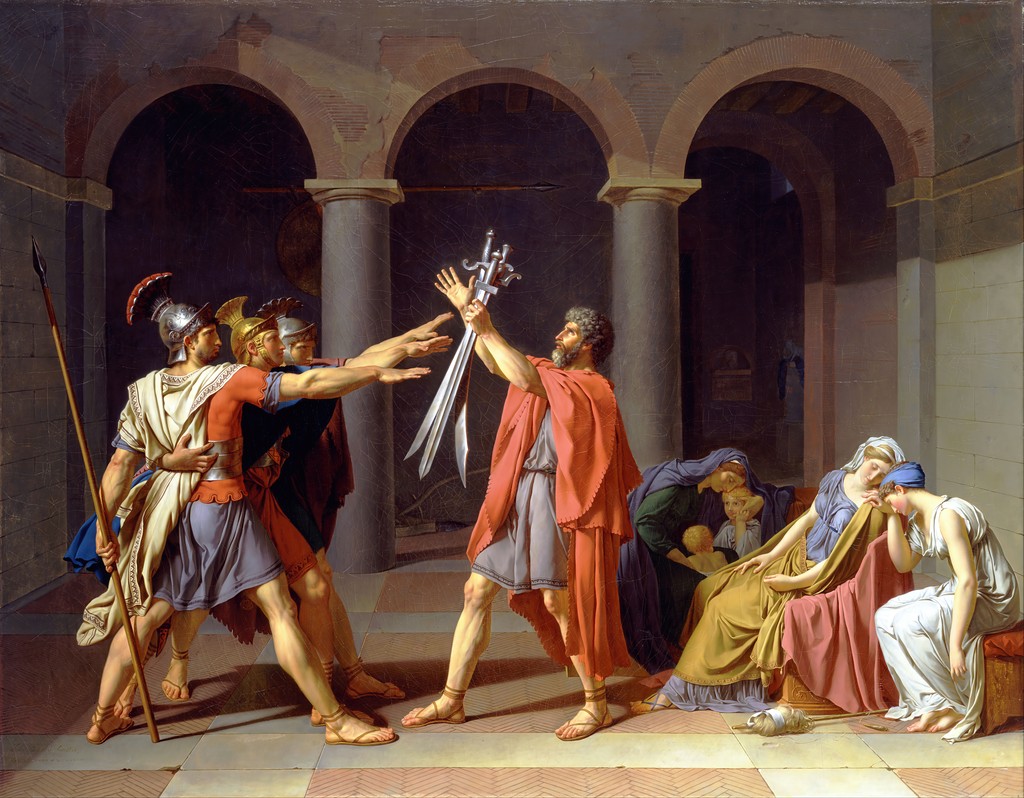
The 1780s then brought the works that made his reputation unmistakable. The Oath of the Horatii was commissioned under Louis XVI and painted in Rome before its Parisian success. The Louvre's object record identifies the work as a royal commission made through the comte d'Angiviller and traces its making, display and later history. In biographical terms, the painting marks David's transformation from promising academic painter into the artist who could redefine the visual language of French history painting. [2] [4] [5]
The 1780s and the Problem of Civic Virtue
The Oath of the Horatii became famous because it seemed to give painting a new moral backbone. Three brothers swear to fight for Rome while women and children collapse in sorrow beside them. It is a family scene organised as a public trial. David's composition made duty look hard, clear and terrible. This was not yet revolutionary art, but it had the severity that later revolutionary viewers could recognise as politically useful. [5] [7] [2]
The Death of Socrates followed in 1787 and strengthened David's reputation as the painter of ethical crisis. The Metropolitan Museum of Art identifies the painting as an oil on canvas from that year and connects it to the story of Socrates' death as told through ancient literary tradition. For David's biography, Socrates matters because it shows him turning classical antiquity into a drama of choice. Socrates does not merely die; he demonstrates the authority of thought over fear. [5] [7] [2]
These works gave David a public identity before the Revolution. He was not an outsider rejecting the old system from the margins. He was a highly successful painter formed by that system, recognised by it and commissioned through it. That fact makes his later revolutionary role more complex. David's art did not enter politics because he had failed as an academic painter. It entered politics after he had already become one of the most powerful artists in France. [5] [7] [2]
Portraiture developed alongside these history paintings. The National Gallery notes that David became known for accomplished portraits during the same decade. This side of his career matters because it connects public history to social identity. The later Portrait of Antoine-Laurent Lavoisier and His Wife would show how precisely David could place individuals within the intellectual and social world of late eighteenth-century France. [5] [7] [2]
Portraits and Social Networks Before 1789
David's biography should not be reduced to public history painting, because his portraits show how closely he observed the society around him before it was transformed by Revolution. In the 1780s, he was already painting sitters whose lives belonged to the worlds of science, public service, international politics and educated social ambition. These portraits do not interrupt the career story. They help explain how David learned to make identity visible. [10] [2]
The Lavoisier portrait is especially important. The Metropolitan Museum of Art identifies it as an 1788 portrait of Antoine-Laurent Lavoisier and Marie-Anne Pierrette Paulze Lavoisier. The couple appear with papers and scientific instruments, which makes the painting a record of intellectual culture as well as social status. Because Lavoisier would be executed during the Revolution, the portrait now carries a tragic hindsight that belongs to the biography of the sitter and to David's world. [10] [2]
Portraits also connected David to political circles beyond France. The National Gallery's Portrait of Jacobus Blauw belongs to the later revolutionary period, but it shows how portraiture could register international republican identities. Blauw was connected to the Batavian Republic, and David's portrait gives him the controlled presence of a public man rather than the decorative ease of a court sitter. [10] [2]
These portraits matter because David's later political art depended on the same skills. He understood how clothing, papers, furniture, facial expression and posture could create public character. That knowledge was useful whether he was painting a scientist, a revolutionary, a pope or an emperor. It also means that the boundary between portrait and history painting in David's career is less rigid than it first appears. Both genres ask how a human figure can carry public meaning. [10] [2]
Revolution
The French Revolution transformed David's career from artistic prominence into political participation. The National Gallery records that he took an active part in the Revolution of 1789, was elected a deputy to the new parliament and helped abolish the Royal Academy. The British Museum adds more specific political offices: Deputy of Paris in 1792, president of the Jacobin Club in 1793 and president of the National Convention in 1794. [1] [2] [4]
These facts must be stated plainly. David was not only painting near political events. He entered political life. He supported revolutionary institutions and aligned himself with the Jacobin world around Robespierre. This made him more than a witness to the age. The Louvre's 2025 exhibition frames him as an artist who actively participated in the Revolution and sought a public role inside the period's political culture. [1] [2] [4]
The abolition of the old Academy was especially significant for an artist formed by that same institution. David had risen through academic training, prizes and royal structures, yet he took part in dismantling the system that had helped make him. This contradiction is not a footnote. It is one of the central tensions of his biography. David's career moves from academic success to institutional revolution without a clean break between the two. [1] [2] [4]
His revolutionary art also changed the function of history painting. Antique subjects had allowed him to imagine civic duty at a distance. The Revolution demanded images of recent political death, public ceremony and collective memory. David's skill in producing clear, severe compositions suddenly had a new use: it could turn modern events into images with the force of historical exempla. [1] [2] [4]
David also became involved in revolutionary visual culture beyond finished easel paintings. The Louvre's exhibition record draws attention to the incomplete Tennis Court Oath, a major project connected to the Revolution's foundational memory. That kind of work shows the scale of David's ambition in these years. He wanted art to participate in public commemoration, not merely decorate private collections. [1] [2] [4]
The Revolution made ceremony and image inseparable. Festivals, funerary honours, portraits, prints and large public projects all helped shape political feeling. David's training in legible composition gave him unusual power in this environment. He could design images that seemed clear enough to belong to public memory, even when the politics behind them were unstable or violent. [1] [2] [4]
This also explains why his biography is often uncomfortable. David's artistic gifts were not insulated from power. His clarity, restraint and control made his works effective because they simplified complex events into forceful images. That simplification could serve grief, but it could also serve persuasion. Any account of David's revolutionary years has to recognise both the artistic achievement and the political danger. [1] [2] [4]
Marat, Lepeletier and Bara
The Death of Marat is the most famous surviving revolutionary painting from David's career. Jean-Paul Marat was assassinated in 1793, and David painted him as a fallen revolutionary martyr. The Royal Museums of Fine Arts of Belgium identify the painting as Marat assassine, dated 1793, with the dedication and date that tie it directly to the revolutionary calendar. The work's biography is inseparable from David's political life: it was made by an artist who knew the revolutionary world from within. [6] [1]
Marat's image shows how David adapted his earlier classical discipline to a modern political subject. The setting is spare. The body is isolated. The written paper, wound and wooden support carry the narrative. Instead of multiplying details, David removes them until the painting becomes a memorial object. The result is powerful because it is both intimate and public. [6] [1]
The lost or unfinished revolutionary memorials around Michel Lepeletier and Joseph Bara belong to the same chapter. The Last Moments of Michel Lepeletier and The Death of Young Bara need careful treatment because the evidence and survival history are more complicated than Marat. Still, they show David's role in shaping revolutionary memory. He was not simply describing deaths; he was helping decide how a new political order would remember them. [6] [1]
This part of David's biography is also where admiration for his artistic control must remain separate from judgement about his politics. The paintings are formally extraordinary, but they were made in a world of violence, ideological struggle and public persuasion. David's gift for clarity made them memorable. It also made them politically useful. [6] [1]
Thermidor and Imprisonment
David's revolutionary prominence became dangerous after the fall of Robespierre in 1794. The National Gallery records that David was briefly imprisoned in 1794/5, while the British Museum links that imprisonment to the aftermath of Robespierre's execution. This was the moment when the political commitments that had given David influence also threatened his future. [2] [4]
The imprisonment changed the direction of his life and art. He did not simply continue as if nothing had happened. After Thermidor, the revolutionary certainty that had surrounded the Jacobin period gave way to a more unstable political and personal situation. David had to survive the collapse of the political network with which he had been associated. [2] [4]
His 1794 Self-Portrait belongs to this broader moment of self-scrutiny and danger. A self-portrait made around imprisonment is not merely an image of likeness. It raises questions about how an artist presents himself after political exposure. David's later career would never fully escape this tension between public conviction, self-preservation and artistic authority. [2] [4]
After leaving prison, David gave up direct political activity according to the British Museum biography. That did not mean his work became apolitical. Instead, his art moved into a new political configuration as France passed through the Directory, the Consulate and the rise of Napoleon. The revolutionary deputy became the artist who would help picture a new form of power. [2] [4]
The Directory and Return to Painting
The years after Thermidor required David to rebuild his position. France was still politically unstable, and the old institutional world had not simply returned. David remained famous, but his revolutionary record was now a liability as well as a badge of conviction. He continued to paint, teach and develop large subjects, while younger artists around him watched the changing relation between art and public life. [1] [2] [4]
The Intervention of the Sabine Women belongs to this post-Terror atmosphere. It is not a simple return to antique subject matter as before. The story of Hersilia intervening between warring Romans and Sabines could be read in relation to reconciliation after civic violence. In David's biography, the painting suggests an artist trying to imagine public repair after revolutionary fracture. [1] [2] [4]
This period also confirms the importance of David's studio. From the outbreak of the Revolution to the fall of Napoleon, the National Gallery notes that David and the members of his studio exercised major influence over the arts in France. The studio was more than a workshop for assistants. It was a place where younger artists learned how to compete, draw, compose and think about painting as a public art. [1] [2] [4]
David's students did not all remain within his exact style. Some carried Neoclassical discipline forward; others moved toward more emotional, colourful or Romantic directions. But the authority of his teaching shaped French art well beyond his own canvases. His biography is therefore also a story of institutional succession: the artist trained by the Academy became the teacher of a generation that would inherit a transformed art world. [1] [2] [4]
David's own drawings help explain why the studio mattered so much. Drawing was the foundation of his authority as a painter and teacher. Studies of figures, poses and compositions show how the finished clarity of his paintings depended on repeated decisions. The public canvas might look inevitable, but it was built from choices about anatomy, gesture and arrangement. [1] [2] [4]
This practice shaped the studio culture around him. Students learned that a painting's meaning could be disciplined through the position of a hand, the angle of a head or the relation between bodies. That lesson outlived David's own political moment. Even artists who later moved away from his severity had to reckon with the standard of structure and draughtsmanship that he represented. [1] [2] [4]
Napoleon
Napoleon gave David's career a new public stage. The British Museum records that David became court painter to Napoleon I in 1804 and received the Legion d'Honneur. The National Gallery states that his images of Napoleon as general, consul and emperor helped glorify the French leader. Getty's Empire to Exile exhibition similarly frames David as an image-maker for Napoleon and a political exile. [3] [4] [8] [9]
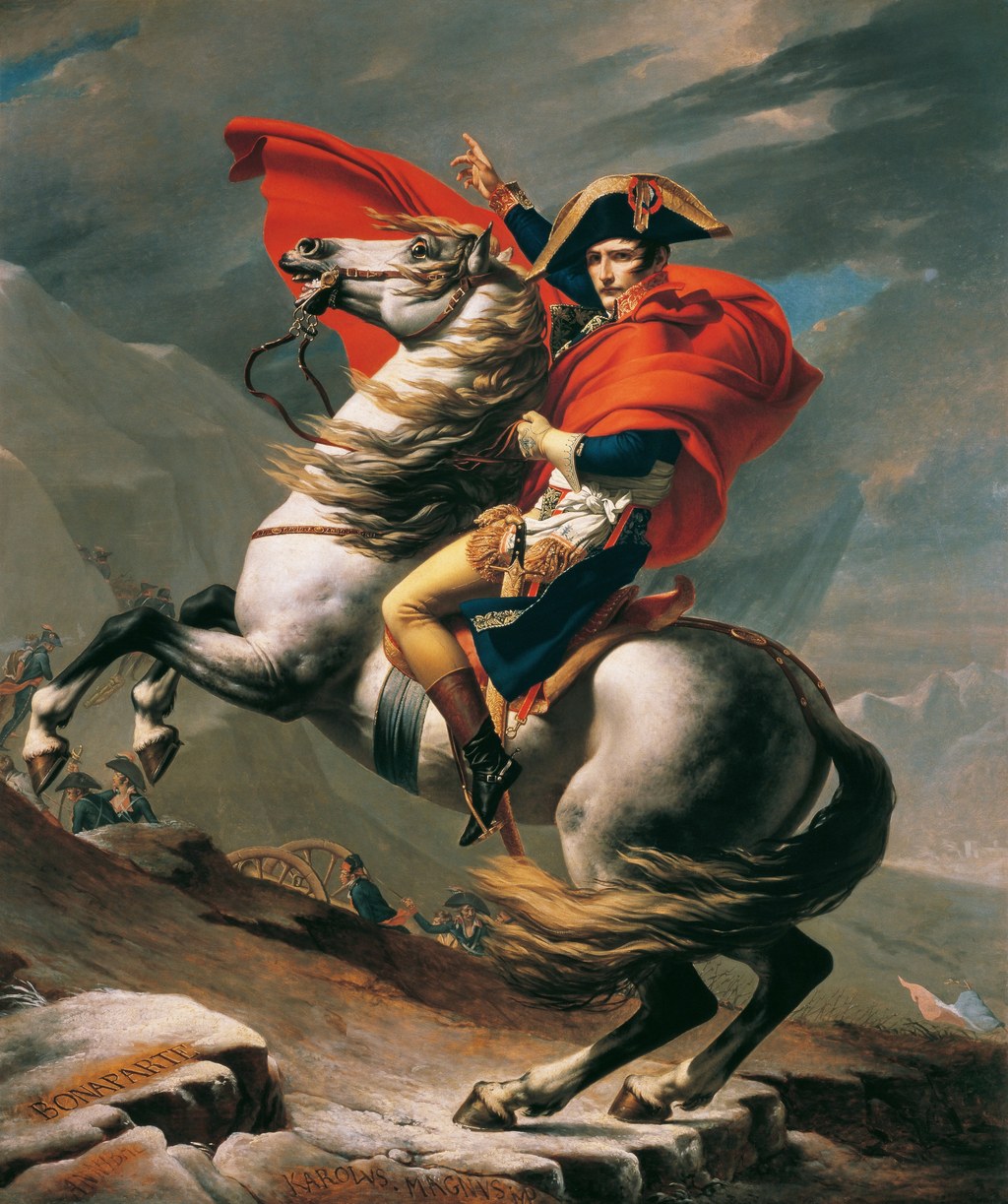
David's attraction to Napoleon did not require him to abandon his lifelong interest in heroic action. Napoleon offered a modern subject who could be represented through the language of antiquity, command and destiny. Napoleon Crossing the Alps presents the ruler as movement and ascent. It is a constructed image of history rather than a neutral record of travel. [3] [4] [8] [9]
The Napoleonic period also tested David's ability to handle ceremony. The Coronation of Napoleon was a vast official project tied to imperial self-fashioning. The Louvre's object record identifies it as the coronation of Napoleon and Josephine in Notre-Dame on 2 December 1804. Biographically, the painting marks David's movement from revolutionary public memory to imperial spectacle. He was now making images for a regime that wanted legitimacy, splendour and historical continuity. [3] [4] [8] [9]
Napoleon Bonaparte in His Study at the Tuileries shows another aspect of the same relationship. Instead of battlefield motion or cathedral ceremony, the painting presents Napoleon through work, documents, uniform and controlled posture. It turns authority into disciplined administration. For David, this was a different use of portraiture: a modern ruler represented not just as hero but as tireless governor. [3] [4] [8] [9]
Official Artist and Political Survivor
David's service to Napoleon can look like a contradiction after his revolutionary republican career. The contradiction is real, but it should not be simplified into opportunism alone. David had long believed that painting could serve public history. Under Napoleon, that belief found a new patron and a new language of power. The regime changed; the ambition to make painting historically effective remained. [3] [4] [8] [9]
Still, the political consequences were serious. David had supported revolutionary politics, helped picture revolutionary martyrdom and then served the empire. Each stage added another layer to his public identity. By the time Napoleon fell, David was not simply an old painter attached to a defeated regime. He was a man with a record that the restored Bourbon monarchy could not easily ignore. [3] [4] [8] [9]
The Napoleonic works also show David's capacity to adjust style to function. The Alpine image is compact and heroic. The Coronation is immense and ceremonial. The Study portrait is controlled and administrative. Portrait of Pope Pius VII brings yet another register, connecting art to diplomacy, religion and imperial ceremony. David's biography during these years is therefore not only political. It is artistic: he kept adapting a rigorous visual language to changing forms of authority. [3] [4] [8] [9]
The same period increased the importance of copies, repetitions and reproductive images. Imperial power needed recognisable forms. Portraits of Napoleon, ceremonial canvases and engraved images after David's compositions helped make the ruler visible to audiences far beyond the court. The prints connected with David's works are therefore part of his biography in a broader sense. They show how his images travelled through public culture. [3] [4] [8] [9]
This circulation also affected David's reputation. A painting made for a particular patron or political setting could become a wider symbol. Napoleon on horseback, Napoleon crowning Josephine or Marat in the bath became images that later generations continued to reinterpret. David's life was tied to regimes that changed quickly, but his compositions survived because they were visually concise enough to be remembered after those regimes fell. [3] [4] [8] [9]
Exile in Brussels
Napoleon's fall in 1815 brought David's French career to an end. The British Museum records that after Napoleon's fall, David, who had voted in favour of Louis XVI's death, was proscribed as a regicide and chose self-exile in Brussels despite amnesty from Louis XVIII. The National Gallery similarly states that he continued to paint in exile in Brussels, where he died. [1] [2] [3] [4]
Exile was not silence. David continued to paint portraits and mythological subjects, and the late works have become an important part of modern reassessment. Getty's Empire to Exile exhibition concentrated on the period from the mid-1790s to David's death in 1825, stressing that this later career produced complex images and should not be treated as a minor ending. [1] [2] [3] [4]
In Brussels, David no longer occupied the centre of French public power, but he did not abandon ambition. Works such as Love and Psyche, The Farewell of Telemachus and Eucharis and The Anger of Achilles show the late artist turning toward myth, youth, desire, conflict and parting. These subjects are not as publicly ceremonial as the Napoleonic works, yet they still use classical form to explore charged human situations. [1] [2] [3] [4]
The late portraits are also significant. Brussels gave David new sitters and a different social world. The National Gallery's works by David include portraits connected to this exile period, including Belgian sitters. These paintings show an artist still capable of precise social observation after the great political stages of Paris had closed to him. [1] [2] [3] [4]
David died in Brussels on 29 December 1825. The Louvre's 2025 exhibition marked the bicentennial of that death in exile, bringing renewed attention to the full range of his work. The ending matters because it completes a life shaped by public power and its reversals: royal Academy, revolutionary Convention, imperial court and exile after restoration. [1] [2] [3] [4]
The exile years also alter how the earlier life is read. If David had died at the height of Napoleonic favour, his biography might look like a march toward official power. Because he lived long enough to lose that position, the career becomes more complicated. It becomes a study of ambition, conviction, compromise and consequence. Brussels was not simply a geographical ending. It was the place from which David's earlier choices could be seen as history. [1] [2] [3] [4]
Late portraits such as Madame Recamier and the Brussels sitters connected to the National Gallery's collection show that exile did not erase his ability to observe style, status and psychological reserve. The public stages had changed, but the painter's eye remained exact. That continuity is one reason the late career deserves attention alongside the famous revolutionary and imperial works. [1] [2] [3] [4]
Studio and Pupils
David's legacy cannot be measured only by his own paintings. The British Museum identifies him as master of Ingres, and his studio shaped many artists who would define French painting after him. Jean-Auguste-Dominique Ingres inherited aspects of David's linear discipline while transforming them into a highly personal art of contour, surface and controlled distortion. Other pupils moved in different directions, but the shared starting point was David's insistence on drawing, composition and seriousness. [2] [4]
The studio was also a social and competitive environment. Young painters learned from David, but they also competed with one another and reacted to the political pressures of their time. The French art world around 1800 was not stable. Institutions had been abolished, reformed and reimagined. Patronage moved between state, private collectors and imperial structures. In this atmosphere, David's studio offered both training and a model of artistic ambition. [2] [4]
His influence extended through reproduction as well. The British Museum's many related objects after David show how prints and book illustrations carried his images into wider circulation. A painting such as Marat or Napoleon Crossing the Alps did not remain only where the original canvas was located. Its composition could be known through copies, prints and later visual culture. This made David's art part of collective memory across Europe. [2] [4]
Character of the Career
David's biography is difficult because each stage of his life can tempt a single explanation. The early years suggest academic ambition. The 1780s suggest moral classicism. The Revolution suggests political conviction. The Napoleonic period suggests service to power. The exile suggests consequence and survival. None of these explanations is wrong, but none is enough on its own. [1] [3] [4]
What makes David historically important is the continuity across those changes. He kept trying to make painting act on public life. Sometimes that meant antique heroes. Sometimes it meant revolutionary martyrs. Sometimes it meant an emperor, a pope, a scientist, a social figure or a mythological pair. The subject changed, but the ambition remained: to make a figure, a gesture and a composition carry historical force. [1] [3] [4]
That force is why David's life still matters beyond biography. He shows how art can become entangled with institutions, ideology and public memory. He also shows the danger of that entanglement. His paintings can be beautiful, severe, moving and politically troubling at the same time. A responsible account of his life has to keep all of that in view. [1] [3] [4]
Why David Still Matters
David died in exile, but his art did not remain exiled from history. His major works still shape how many viewers picture the French Revolution, Napoleon and the moral drama of Neoclassicism. The Louvre's recent exhibition emphasises both the richness of his work and the intensity behind its apparent rigour. That is the key to his biography as well. David was not a cold illustrator of official ideas. He was an artist of feeling disciplined into form, and that discipline could serve very different political worlds. [1] [2] [3] [4]
For readers, the best route through his life is to connect the biography to the works. Begin with the early academic pages such as Belisarius Begging for Alms and Andromache. Move to Horatii and Socrates for the 1780s breakthrough. Read Marat, Lepeletier and Bara for the Revolution. Follow Napoleon Crossing, the Coronation and Napoleon in the Study for the empire. End with the Brussels works, including Telemachus, Love and Psyche and Achilles. [1] [2] [3] [4]
The result is not a simple rise and fall. It is a life in which artistic discipline, public ambition and political risk became inseparable. Jacques-Louis David made paintings that could survive regime change because they were more than documents of regimes. They were images of how power, virtue, memory and self-presentation could be made visible. [1] [2] [3] [4]
Frequently Asked Questions
Discussion
David's biography moves through monarchy, Revolution, empire and exile, so each stage changes how his paintings feel.
Use the prompts below to think about where artistic conviction, public power and personal survival meet in his life.
Reader Insights
Which moment changes your reading of David most: Rome, the Revolution, Napoleon, or exile?
How should a biography balance David's artistic achievement with the political uses of his images?
Does David's late exile make his earlier public success look more heroic, more compromised, or more fragile?
Join the Conversation
Share your view of Jacques-Louis David's life, career and political imagery below.
References
- Louvre, Jacques-Louis David exhibition, accessed 26 July 2026.
- The National Gallery, London, Jacques-Louis David artist biography, accessed 26 July 2026.
- The J. Paul Getty Museum, Jacques-Louis David: Empire to Exile, accessed 26 July 2026.
- The British Museum, Jacques-Louis David collection biography BIOG24584, accessed 26 July 2026.
- Louvre Collections, Le Serment des Horaces, INV 3692, accessed 26 July 2026.
- Royal Museums of Fine Arts of Belgium, Marat assassine, Inv. 3260, accessed 26 July 2026.
- The Metropolitan Museum of Art, The Death of Socrates, 31.45, accessed 26 July 2026.
- Louvre Collections, Sacre de l'empereur Napoleon Ier, INV 3699, accessed 26 July 2026.
- National Gallery of Art, The Emperor Napoleon in His Study at the Tuileries, 1961.9.15, accessed 26 July 2026.
- The Metropolitan Museum of Art, Antoine-Laurent Lavoisier and His Wife, 1977.10, accessed 26 July 2026.