Buy Art Prints Now
from Amazon
* As an Amazon Associate I earn from qualifying purchases.
 by Tom Gurney
Tom Gurney BSc (Hons) is an art history expert with over 20 years experience
Published on June 19, 2020 / Updated on October 16, 2026
Email: tomgurney1@gmail.com / Phone: +44 7429 011000
Jupiter and Antiope: Introduction
Jupiter and Antiope is a very early mythological painting associated with Jacques-Louis David. It belongs to the period before his Prix de Rome success, before Rome, and before the severe public style that later made him the painter of Horatii, Socrates, Marat and Napoleon. The work is useful precisely because it is not yet that David. It shows a young artist still close to the world of François Boucher, Rococo mythology and decorative sensuality. [1] [2]
The strongest object record is the POP/Joconde notice for Nymphe endormie et satyre ; Jupiter et Antiope, held by the municipal museum in Sens. The record identifies the artist as David, dates the work to 1771, gives the medium as oil on canvas and records dimensions of 87 by 79 cm without the frame. It also gives the inventory number 896.1.1 and notes the presence of a sketch on the reverse showing a woman and a fish seller. [1] [2]
This route carries more caution than David's major museum pages. The painting is early, smaller, and tied to source records that emphasise formation and attribution context rather than broad art-historical fame. It should be treated as a support page for David's beginnings, not as a major Neoclassical milestone. [1] [2]
At a Glance
- ArtistJacques-Louis David [1]
- Fuller TitleNymphe endormie et satyre ; Jupiter et Antiope [1]
- Date1771 [1]
- MediumOil on canvas [1]
- CollectionMunicipal museum in Sens [1]
- Inventory896.1.1 [1] [2]
- Dimensions87 by 79 cm without frame [1]
- Early ContextRecorded by POP/Joconde as David's first known work [1]
- InfluenceMarked by David's teachers, especially Boucher [1]
- SubjectJupiter approaches Antiope in satyr form [1] [3] [4]
- Page StatusCompact reserve/watch artwork page for David's early formation [1]
- Image ReferenceSens and Commons records provide the safest image-credit check for this subject [1] [2]
Contents
- Introduction
- Object and Early Context
- The Mythological Subject
- Looking at the Painting
- Image and Source Cautions
- Why It Matters
Object and Early Context
The POP/Joconde record describes the work as the first known work by the artist and says it remains strongly marked by the influence of David's teachers, especially Boucher. That is the key to the painting. Instead of the hard, architectural severity of later David, Jupiter and Antiope belongs to a softer mythological idiom: sleeping nude, satyr, drapery, desire and private viewing. [1]
The Sens record gives a family path for the painting. It says David gave the work, when he was in his early twenties, to Mme Baudry of Sens, granddaughter of Buron, in whose household David had been raised. It later belonged to Adolphe Guillon and entered the Sens municipal museum in 1896. Those details help explain why this early, intimate mythological work is in Sens rather than in the Louvre or another central Paris collection. [1]
The reverse of the canvas is also important. POP/Joconde identifies a sketch of a woman and a fish seller on the back. That small fact makes the object more interesting than a simple mythological image: both sides preserve evidence of David's early practice and working environment. [1]
The Mythological Subject
The subject is taken from the story of Jupiter and Antiope, part of the larger cycle of Jupiter's erotic transformations. POP/Joconde links the theme to Ovid's Metamorphoses. In that literary tradition, Jupiter approaches Antiope in the form of a satyr. The ancient story belongs to a mythological world in which divine desire often appears as disguise, pursuit and coercion. [1] [3] [4]
That needs plain handling. Older art labels often describe scenes like this in soft erotic terms, but the myth itself is not simply romantic. Antiope is shown sleeping or vulnerable, and Jupiter appears in satyr form. David's painting should therefore be read as a mythological image shaped by eighteenth-century conventions, not as an uncomplicated love scene. [1] [3] [4]
The title variants also matter. POP/Joconde uses Nymphe endormie et satyre ; Jupiter et Antiope, which makes the sleeping-nymph and satyr structure explicit. The active English title, Jupiter and Antiope, is shorter and more familiar, but it can hide the visual and ethical asymmetry of the scene. [1] [3] [4]
Looking at the Painting
The composition presents Antiope reclining, nude or partly draped, while Jupiter appears as a satyr at the right. POP/Joconde describes him as nude, with a skin over his back, lifting a drapery to reveal the sleeping nymph. That action gives the painting its tension: it is built around looking, exposure and imbalance. [1]
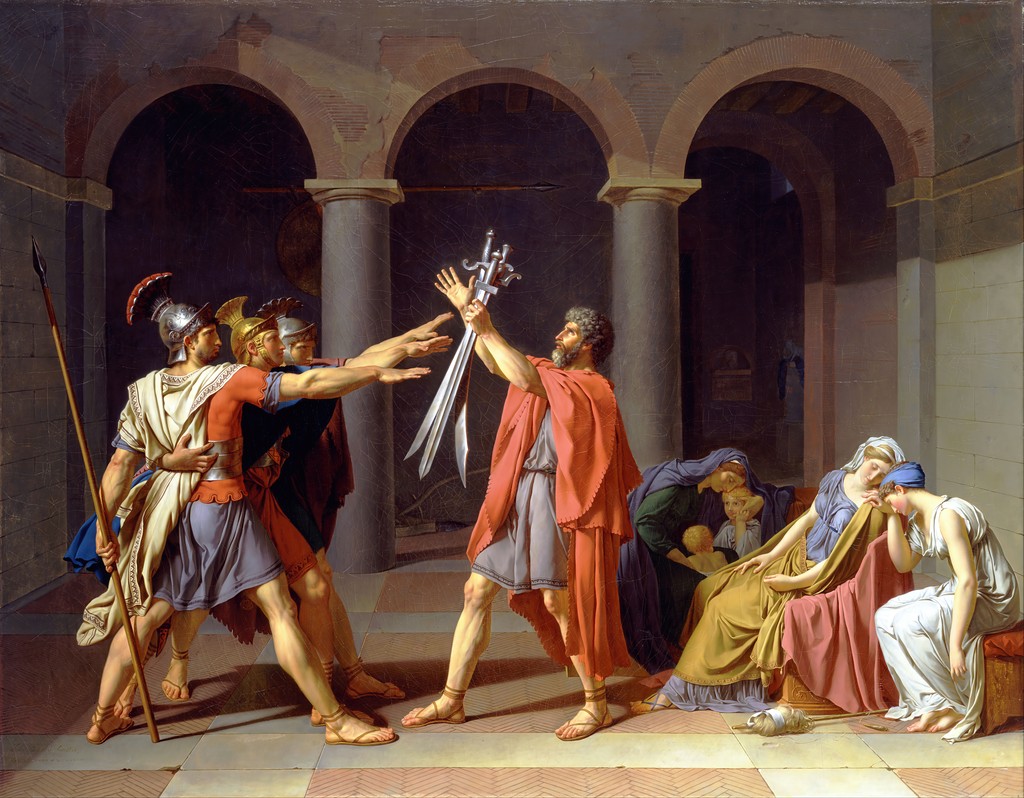
This is far from the public drama of The Oath of the Horatii or The Death of Socrates. The young David is not yet arranging citizens, philosophers or heroes into stern moral geometry. He is working inside a mythological language inherited from Rococo art, where beauty, touch, fabric and erotic encounter carry the picture. [1]
For that reason, the painting belongs near Minerva Fighting Mars, Diana and Apollo Killing Niobe's Children and The Death of Seneca as evidence of David before his mature style. It also contrasts with later mythological paintings such as Sappho and Phaon and Love and Psyche, where desire remains central but David's handling is more polished and self-conscious. [1]
Image and Source Cautions
The object record is strong enough for a compact public page, while image evidence remains source-sensitive. POP/Joconde supplies the main Sens museum facts and Commons offers a public-domain verification path, so credit and reproduction wording should stay tied to that record chain. The verso sketch mentioned by POP is also treated as an object fact, not as a displayed image on this page. [1] [2]
Why It Matters
Jupiter and Antiope matters because it preserves a beginning. The painting is small, source-sensitive and lower in public importance than David's major works, but it helps readers see what David had to leave behind. The later Neoclassical painter did not arrive fully formed. He emerged from a world of family connections, Boucher's influence, academy training, mythological subjects and experiments in figure painting. [1]
The painting also helps make the David cluster more honest. A career is not only its masterpieces. This work shows a young artist before the severe line, before Revolutionary politics and before imperial ceremony. It is a glimpse of David still testing inherited formulas. [1]
For David's wider formation, see the Jacques-Louis David biography and the David paintings hub. For early comparison pages, continue to Minerva Fighting Mars, Erasistratus Discovering the Cause of Antiochus' Disease, Belisarius Begging for Alms and Andromache Mourning Hector. [1]
Frequently Asked Questions
Discussion
Jupiter and Antiope is a small page with a difficult subject, and that is part of why it needs careful reading.
Use the prompts below to think about David's early style, the myth's imbalance and the difference between inherited erotic convention and modern interpretation.
Reader Insights
What does this painting reveal about David before the severe public style of Horatii and Socrates?
How does Jupiter's satyr disguise change the moral tone of the scene?
How should a viewer handle a scene built around sleep, looking and exposure?
Join the Conversation
Share your reading of Jupiter and Antiope below.
References
- POP: Plateforme ouverte du patrimoine, Nymphe endormie et satyre ; Jupiter et Antiope, accessed 27 July 2026.
- Wikimedia Commons, File: Jacques-Louis David - Jupiter et Antiope.jpg, accessed 27 July 2026.
- Theoi, Antiope, accessed 27 July 2026.
- Ovid, Metamorphoses Book 6, Internet Classics Archive, accessed 27 July 2026.