 by Tom Gurney
Tom Gurney BSc (Hons) is an art history expert with over 20 years experience
Page Created on / Page Updated on
Email: tomgurney1@gmail.com / Phone: +44 7429 011000
A View of Constantinople by Moonlight: Introduction
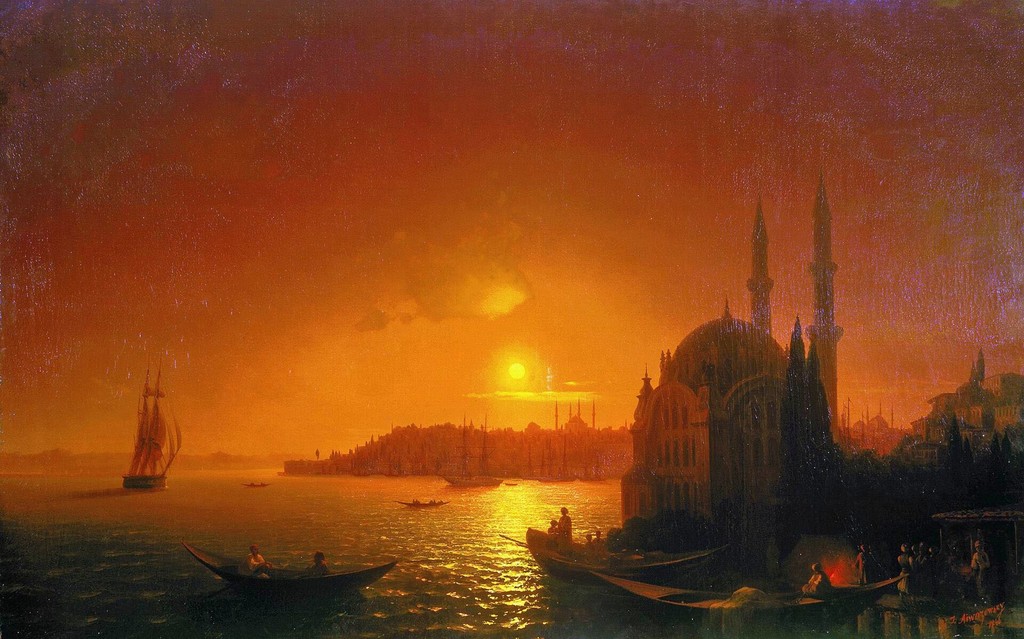
In A View of Constantinople by Moonlight, Ivan Aivazovsky makes the city emerge through illumination rather than daylight description. A low orange moon opens a reflective route across the water, while a mosque and its minarets stand dark at the right. Boats, distant buildings and figures beside a small fire turn the nocturne into an inhabited harbour rather than an empty dream of architecture.
This is the State Russian Museum painting of 1846, inventory Ж-1787: an oil on canvas measuring 124 by 192.5 centimetres.[1] Those details are essential because Aivazovsky returned many times to Constantinople—present-day Istanbul—and numerous English titles built from “moonlight”, “Bosphorus” and the city’s name circulate around distinct pictures. The reading here follows the complete locked image and this museum object alone.
At a Glance
- Date and medium1846, oil on canvas.[1]
- Dimensions124 by 192.5 centimetres.[1]
- CollectionState Russian Museum, inventory Ж-1787.[1]
- Subjecta moonlit Constantinople waterfront with mosque, shipping and small boats.
- Makingbegun on 15 January and completed on 16 March 1846.[1]
- First displayshown in Feodosia on 18 March 1846.[1]
Ivan Aivazovsky in context
Contents
- Introduction
- Why the exact title and inventory matter
- City, water and the moon’s path
- Silhouette and selective detail
- Boats, shore fire and human scale
- Constantinople in the 1840s itinerary
- Memory and the completed studio image
- Distinguishing later Bosphorus nocturnes
Why the exact title and inventory matter
The Russian Museum’s record fixes the object through five joined facts: title, date, medium, dimensions and inventory. The unusually precise working dates add another safeguard. Aivazovsky began the canvas on 15 January 1846, finished it on 16 March, and displayed it in Feodosia two days later at an exhibition marking ten years of his artistic activity.[1] A similar moonlit city is not therefore sufficient evidence of a match.
The museum records the painting as entering its collection in 1935. Its proposed earlier history is less certain: purchase from Aivazovsky by Nicholas I, subsequent ownership by Grand Duke Konstantin Nikolayevich and a place in the Marble Palace collection are all presented with question marks.[1] These possibilities should remain possibilities. Secure object data and tentative provenance do not have the same evidential status.
The exact title identifies Constantinople, but not a pinpoint viewpoint or every building. Nor does it license the name of a mosque based on resemblance alone. The city identity is institutional; finer architectural claims require separate evidence that the object record does not provide.
City, water and the moon’s path
The moon sits low, slightly left of the composition’s centre, within a broad orange opening. Its brightest reflection descends and widens as it approaches the foreground. This broken path is not a hard stripe: dark ripples interrupt it, causing the light to advance in short, uneven bands. The water becomes the principal route into the city.
That route also divides two kinds of space. On the left, open water surrounds a tall sailing vessel and a few much smaller craft. On the right, architecture presses forward and the shore becomes crowded. The illuminated middle keeps the halves in contact. A boat crossing the glow can be read at once as a human action and as a dark measure against the brightness.
The colour range is concentrated rather than simply black and silver. Deep blue-violet and brown-red enclose a gold-orange centre; the lower water shifts between green-black shadow and copper reflection. Because the moon’s hue spreads into cloud, buildings and water, it appears to organise the whole atmosphere. The effect can be compared with Aivazovsky’s wider handling of illumination in Light, Memory and Marine Technique.
The moon’s low position matters to that organisation. It does not preside remotely above the scene; it meets the skyline and seems almost to open a passage through it. A bright horizontal band around the horizon is answered by the reflection’s vertical descent, so the eye first travels into depth and then across the harbour. Dark boats repeatedly obstruct that journey without closing it. Each interruption makes the next patch of light more distinct, turning atmosphere into a sequence of spatial cues.
Cloud contributes to the same measured transition. The brightest vapour gathers near the moon, while heavier masses close over the upper corners and the architecture at right. The surrounding darkness therefore has variation rather than functioning as a flat frame. It allows the centre to expand gradually, as if the city, sky and water were all receiving different quantities of one light.
Silhouette and selective detail
The largest architectural mass occupies the right foreground. A broad dome and two slender minarets rise into the warm sky, their dark shapes clear even where surface detail is subdued. Smaller domes, roofs and vertical accents continue behind them towards the central distance. Across the water, the farther city forms a layered band rather than an itemised map.
Silhouette lets Aivazovsky be selective. The skyline remains recognisably associated with Constantinople, yet its force depends on intervals: a minaret separated from cloud, a low roof beside a dome, a dark façade cut against reflection. Close foreground architecture receives more internal variation, while remote buildings merge into atmosphere. Detail decreases with distance without allowing the city to disappear.
This is why the picture is both cityscape and seascape. Architecture establishes place, but water controls access to it; moonlight makes the connection visible. Tretyakov scholarship notes that Aivazovsky’s travel drawings could record Constantinople’s minarets, tower and steep streets with precision.[2] The finished nocturne transforms that knowledge into a hierarchy of seen and withheld information.
That hierarchy prevents the foreground monument from becoming a detached architectural portrait. Its nearest wall is absorbed into the shore, and its paired minarets direct attention upward before the descending reflection draws it back towards the water. Beyond it, repeated verticals become thinner and less emphatic. The skyline is legible as a succession of distances, not as a row of equally described landmarks. Refusing to assign an unsupported building name preserves this visual relationship: the mosque can be analysed securely as the composition’s dominant mass without being made to carry an unverified identity.
Boats, shore fire and human scale
Vessels occupy several distances. The sailing ship at far left stands vertically against open sky. Tiny boats nearer the centre interrupt the horizontal city band, while longer craft in the foreground sit almost at the viewer’s level. Their changing sizes turn the reflective path into measurable depth rather than a purely decorative glow.
At the lower right, a small orange fire gathers figures beside the dark shoreline. It is much weaker than the moon but locally intense, warming bodies and nearby objects that would otherwise merge into shadow. The pairing creates two lights with different reach: celestial illumination spans sky and harbour; the fire defines a close social space.
The figures remain small, but the image is not depopulated. Rowers, passengers and the shore group suggest work, passage and pause after dark. None needs an invented biography. Their principal visual function is to show that the waterway continues to be used at night and that the monumental skyline belongs to a living city.
Scale is established through comparison rather than exact narrative. The foreground craft stretches laterally beneath the mosque, the central boats shrink within the reflection, and the ship at left is tall but set farther away. These placements keep the harbour active across its full width. The shore fire then anchors the nearest interval: its compact flame is small enough to confirm the moon’s dominance, yet bright enough to prevent the right foreground from becoming an unreadable block.
Constantinople in the 1840s itinerary
The Russian Museum connects the subject with Aivazovsky’s travel alongside the navigator Fyodor Litke, during which he visited Turkey, Greece and Asia Minor.[1] Tretyakov scholarship places drawings and watercolours of Constantinople within the 1845 voyage with Grand Duke Konstantin Nikolayevich.[2] The completed oil followed in 1846, so travel experience and finished object should not be collapsed into one date.
Constantinople mattered beyond this first encounter. Ivan Samarine describes repeated visits and a sustained cycle of city pictures that appealed strongly to Turkish as well as Russian and European audiences.[3] Aivazovsky’s water-based views could combine a recognisable city with the marine effects for which he was already known. The subject consequently belonged to his travel and international career, not to a single isolated commission.
The city’s historical name is retained because it appears in the painting’s title and nineteenth-century itinerary. Calling the present city Istanbul supplies current orientation; silently substituting the modern name inside an object title would blur the wording under which the work is catalogued.
The documented dates set out a useful sequence. The 1845 material belongs to the voyage and its immediate records; the large oil was worked from January to March 1846; its Feodosia display followed almost at once.[1][2] That sequence is firmer than guessing whether every architectural feature came from one sketch or one viewpoint. It also explains how the painting can preserve credible knowledge of the city while arranging moon, shoreline and vessels for a self-contained exhibition canvas. The itinerary establishes contact with the place, but the dated object records the later act of synthesis.
Memory and the completed studio image
The dated record resists a romantic tale of a canvas finished in one moonlit sitting. Aivazovsky worked on it across two months after the relevant voyage, then exhibited it in Feodosia.[1] Earlier drawings could preserve architectural information, while visual and emotional memory allowed impressions to be recombined. Tretyakov scholarship explicitly associates his practice with moving weather and illumination between remembered places while retaining recognisable topography.[2]
Construction does not make the view arbitrary. The mosque silhouette, distant skyline and boats establish an urban harbour, but their placement has been coordinated around the moon’s reflection. A real city supplies forms; the completed painting determines which forms are darkened, isolated or joined by light. Observation and invention operate at different stages of the same process.
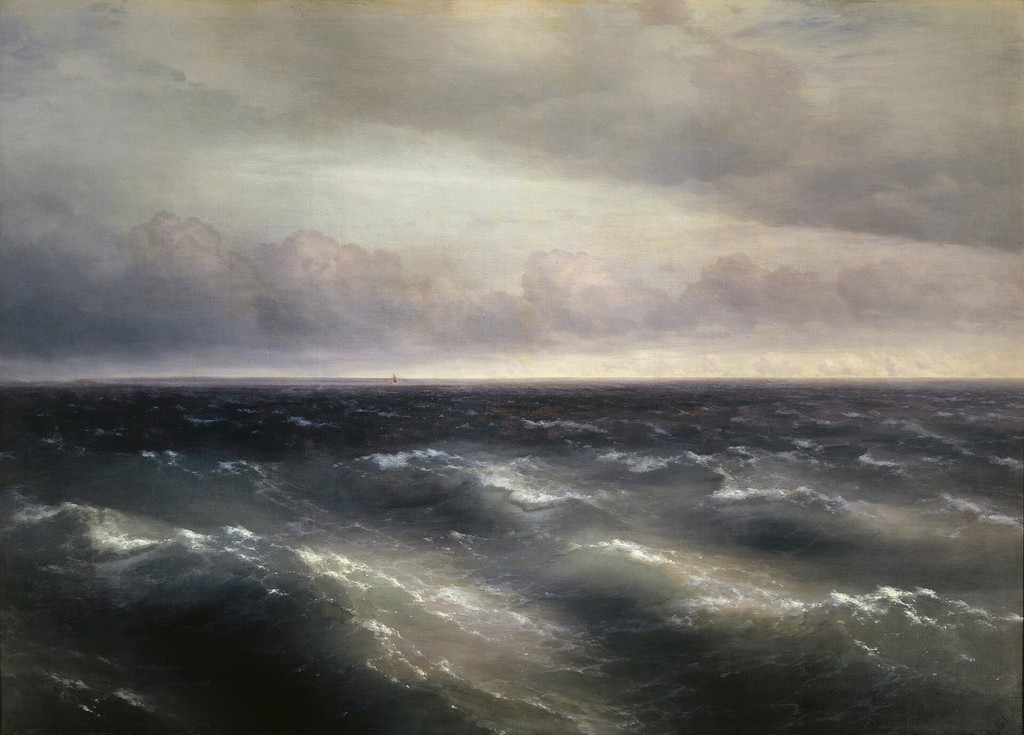
The exact image also discourages a formulaic account of Aivazovsky’s nocturnes. Moonlight does not merely sit above water. It creates a channel through the boats, separates the skyline from the sky and competes with the human fire. In The Black Sea, a narrow distant brightness faces gathering weather; here radiance makes the city spatially traversable. Related devices answer distinct subjects.
Distinguishing later Bosphorus nocturnes
Aivazovsky’s popularity and repeated return to Istanbul produced many waterfront pictures, while translated titles often vary across languages, collections and sales. Samarine also notes the frequency with which old marine paintings in Istanbul acquired imitations of Aivazovsky’s signature.[3] Title familiarity or a plausible signature cannot replace collection identity.
The most important local distinction is chronological. The Russian Museum A View of Constantinople by Moonlight is the 1846 canvas, Ж-1787, measuring 124 by 192.5 centimetres.[1] The Tretyakov Gallery’s Moonlit Night on the Bosphorus dates from 1894 and is a different object. Neither should be used as an image, provenance or measurement source for the other.
Other phrases such as “Constantinople at night” or “moonlit Bosphorus” may describe still more works. Begin with institution and inventory, then confirm date, support, dimensions and image. The wider paintings guide explains why this object-led approach is necessary across a large and dispersed oeuvre; the biography supplies the career chronology around the 1845–46 journey.
Researched works directory
This searchable evidence census was assembled from public museum records and a reproducible Wikidata snapshot. It is not a catalogue raisonné, not a claim to complete oeuvre coverage, and not a substitute for the published catalogue literature, which was not used to claim absolute completeness.
| Name | Date | Medium |
|---|---|---|
| A bay at dawn. | 1896 | Painting |
| A bay near Venice | 1842 | Painting |
| A Moonlit Night at Sea | 1885 | Painting |
| A Moonlit Night on the Bosphorus | 1894 | Painting |
| A Moonlit Night on the Crimean Coast | Date unknown | Painting |
| A Rocky Coastal Landscape in the Aegean with Ships in the Distance (detail) | 1884 | Painting |
| A. S. Pushkin and Countess M. N. Raevskaya by the sea near Gurzuf | 1886 | Painting |
| A. S. Pushkin at the Black Sea coast | 1887 | Painting |
| A. S. Pushkin at the Black Sea coast | 1897 | Painting |
| A Ship in a Stormy Sea | 1892 | Painting |
| A ship in peril | 1894 | Painting |
| A Ship of the Russian Navy off the Coast | Date unknown | Painting |
| A storm on rocky shores | 1875 | Painting |
| A Summer’s Day in Crimea | 1867 | Painting |
| A View of Constantinople by Moonlight | 1846 | Painting |
| A View of the Bosporus with the Hagia Sophia and the Maiden's Tower in the Moonlight | 1884 | Painting |
| A Wagon Train in the Desert | Date unknown | Painting |
| Abandoning Ship | 1882 | Painting |
| After the Storm | 1854 | Painting |
| Aiju-Dag | Date unknown | Painting |
| Aivazovsky Ivan Konstantinovic - Colon Sortint de Palos | 1892 | Painting |
| Aivazovsky - Oath befory Battle of Avarayr | 1892 | Painting |
| Aivazovsky with Friends | 1893 | Painting |
| Alexander II Crossing the Danube | 1878 | Painting |
| Alexander Pushkin at the Top of Ai-Petri at Sunrise | 1899 | Painting |
| Along the Coast | 1850 | Painting |
| Alushta | 1878 | Painting |
| American Shipping off the Rock of Gibraltar | 1873 | Painting |
| Among the Waves | 1898 | Painting |
| Arrival of Catherine II in Feodosia | 1883 | Painting |
| Azure Grotto, Naples | 1841 | Painting |
| Barge at Sea Shore | 1860–1870 | Painting |
| Battle of Chesma | 1848 | Painting |
| Battle of Chesma (1886) | Date unknown | Painting |
| Battle of Chios on 24 June, 1770 | 1848 | Painting |
| Battle of Sinope | 1853 | Painting |
| Beach | 1845 | Painting |
| Before the Storm: Theodosia | Date unknown | Painting |
| Biarritz | 1889 | Painting |
| Black Sea Fleet in the Bay of Theodosia, just before the Crimean War | 1890 | Painting |
| Boat Ride by Kumkapi in Constantinople | 1846 | Painting |
| Bosphorus | 1878 | Painting |
| Bosporuse väin öösel. | 1890 | Painting |
| Bracing The Waves | Date unknown | Painting |
| Breaking Wave | Date unknown | Painting |
| Brig “Mercury” Attacked by Two Turkish Ships | 1892 | Painting |
| Brig ''Mercury'' meets with the Russian squadron after the victory over two Turkish ships | 1848 | Painting |
| Broad landscape with settlers | 1856 | Painting |
| Byron in Venice | Date unknown | Painting |
| Byron's visit to the Mekhitarists in Surb Ghazar Island | 1899 | Painting |
| Byron's visit to the Mekhitarists on San Lazzaro | 1899 | Painting |
| Ca d'Oro | 1878 | Painting |
| Calm early evening sea | 1884 | Painting |
| Calm Sea | 1887 | Painting |
| Carriage in a Storm | Date unknown | Painting |
| Catholicos Khrimyan Airik near Echmiadzin | 1895 | Painting |
| Caucasus from the Sea | 1894 | Painting |
| Chaos. The Genesis | 1841 | Painting |
| Chapel by the sea | 1847 | Painting |
| Chumaks in Little Russia | Date unknown | Painting |
| Chumaks leisure | 1885 | Painting |
| Chumaks Waggons | 1862 | Painting |
| Clashes between the Shirvans and the Murids on Gunib | 1869 | Painting |
| Clouds | 1865 | Painting |
| Clouds Over a Calm Sea | 1873 | Painting |
| Clouds over the Sea, Calm | 1889 | Painting |
| Coast | 1840 | Painting |
| Coast of Amalfi | 1841 | Painting |
| Coffee-house by the Ortaköy Mosque in Constantinople | 1846 | Painting |
| Constantinople, la mosquée de Top-Kahné | 1884 | Painting |
| Constantinople Sunset | 1899 | Painting |
| Crimean coast by moonlight | 1853 | Painting |
| Crimean Coast by Moonlight | 1898 | Painting |
| Crimean scene. Gurzuf at night | 1865 | Painting |
| Crimean Tartars on the Sea Shore | 1850 | Painting |
| Crimean Views | 1850 | Painting |
| Cruiser in the sea at night | 1844 | Painting |
| Dante Shows an Artist Some Unusual Clouds | 1883 | Painting |
| Daryal Gorge | 1868 | Painting |
| Deluge | 1864 | Painting |
| Der Fluss Rioni in Georgien | 1870 | Painting |
| Descent of Noah from Ararat | 1887 | Painting |
| Destruction of Pompeii | 1889 | Painting |
| Distributing Supplies | 1892 | Painting |
| Dusk on the Golden Horn | 1845 | Painting |
| End of Storm | 1839 | Painting |
| Entrance to the Sevastopol Bay. | 1852 | Painting |
| Entrée de port | 1846 | Painting |
| Exchange Of Peterburg | 1840–1847 | Painting |
| Exploding Ship | 1900 | Painting |
| Farm House and Windmill by moonlight | 1863 | Painting |
| Fight of the steamer Vesta with the Turkish battleship Fehti-Bulend in the Black Sea on July 11, 1877 | 1877 | Painting |
| Figures on a moonlit coast | 1858 | Painting |
| Fishermen and their Families on the Shore of the Bay of Naples | 1873 | Painting |
| Fishermen on the Beach | 1852 | Painting |
| Fishermen on the shore | Date unknown | Painting |
| Fishermen Returning Near Naples | 1874 | Painting |
| Fishing Boats In A Harbor | 1854 | Painting |
| Foggy day on the shores of Italy | Date unknown | Painting |
| French Ships Departing the Black Sea | 1871 | Painting |
| Frigate under sail | 1838 | Painting |
| From Mleta to Gudauri | 1868 | Painting |
| Frozen Bosphorus Under Snow (detail) | 1874 | Painting |
| Gathering Storm | 1899 | Painting |
| Golden Horn Bay Turkey | 1846 | Painting |
| Gondolier on the Sea at Night | 1843 | Painting |
| Gulf of Naples | 1874 | Painting |
| Gunboat off Crete | 1897 | Painting |
| Gurzuf at night | 1849 | Painting |
| Harbour Scene | Date unknown | Painting |
| Ice-Breakers on the Frozen Neva in St. Petersburg | 1877 | Painting |
| Ice on Dnipro | 1872 | Painting |
| Icebergs in the Atlantic | 1870 | Painting |
| In the harbor | 1840 | Painting |
| In the roads, Evening | 1867 | Painting |
| Italian Landscape | 1855 | Painting |
| Italian Landscape (Lago Maggiore), Evening | 1858 | Painting |
| Iwan Konstantinowitsch Aiwasowskij 001 | 1864 | Painting |
| Jalta | 1838 | Painting |
| Jude's the Apostol betrayal | 1834 | Drawing |
| La Vague | 1886 | Painting |
| Landscape in Crimea. | 1860 | Painting |
| Landscape with Windmills | 1860 | Painting |
| Large raid in Kronstadt | 1836 | Painting |
| Little Russian Ox Cart in Winter | 1866 | Painting |
| Loading Provisions off the Crimean Coast | 1876 | Painting |
| Look to the Large Cascade and Large Petergof Palace | 1837 | Painting |
| Marine scene | Date unknown | Painting |
| Marine View | 1899 | Painting |
| Mercury Brig Meeting a Russian Squadron after her Victory over Two Turkish Vessels | 1848 | Painting |
| Meri | Date unknown | Painting |
| Mine attack by boats of the steamer Grand Duke Constantine on the Turkish battleship Assari-Shevket on the Sukhum roadstead on August 12, 1877 | 1877 | Painting |
| Moon night on the Crimea, Gurzuf | 1839 | Painting |
| Moonlight at night near the spring | 1877 | Painting |
| Moonlight in Naples | 1842 | Painting |
| Moonlit coast | 1864 | Painting |
| Moonlit Landing | 1895 | Painting |
| Moonlit Night | 1850 | Painting |
| Moonlit Night | 1878 | Painting |
| Moonlit Night (1958) | 1858 | Painting |
| Moonlit Night (Aivazovsky) | Date unknown | Painting |
| Moonlit night in Crimea | 1859 | Painting |
| Moonlit night on the seashore in Crimea | 1852 | Painting |
| Moonlit Seascape With Shipwreck | 1863 | Painting |
| Morning on the sea | 1883 | Painting |
| Morning on the shore of the bay | 1853 | Painting |
| Mountain Village Gunib in Daghestan. View from the East. | 1869 | Painting |
| Naples Bay | 1842 | Painting |
| Naples with a poet amongst fishermen | 1845 | Painting |
| Naufragiul 1886 | 1886 | Painting |
| Neapolitan lighthouse. | 1842 | Painting |
| Night at Gurzof | 1891 | Painting |
| Night at the Rodos island | 1850 | Painting |
| Night in Constantinople | 1862 | Painting |
| Night in Venice | 1847 | Painting |
| Night. The Tragedy at the Sea of Marmara | 1897 | Painting |
| Nocturnal Voyage | Date unknown | Painting |
| Odessa at Moonlight | 1846 | Painting |
| Odessa, view from the Sea | 1865 | Painting |
| Old Feodosia | 1839 | Painting |
| Old Theodosia | 1845 | Painting |
| Ox-carts in the Ukrainian steppe | 1888 | Painting |
| Panorama of Constantinopole (detail) | 1856 | Painting |
| Parade of the Black Sea Fleet | 1886 | Painting |
| Passage of the Jews through the Red Sea | 1891 | Painting |
| Passing Ship on a Moonlit Night | 1868 | Painting |
| Peter | 1846 | Painting |
| Peter I at Krasnaya Gorka Lighting a Fire on the Shore to Signal to his Sinking Ships | 1900 | Painting |
| Petersburg. Crossing the Neva. | 1870 | Painting |
| Port of Theodosia | Date unknown | Painting |
| Portrait of A. Kaznacheev | 1847 | Painting |
| Portrait of a man | Date unknown | Drawing |
| Portrait of a Teenager | Date unknown | Painting |
| Portrait of archbishop Gabriel Aivazyan (brother of I. Aivazovsky) | 1883 | Painting |
| Portrait of the grandmother of painter Ashhen | 1858 | Painting |
| Portrait of vice admiral M.P. Lazarev | 1839 | Painting |
| Pushkin and Raevskaya in Gurzuf | 1900 | Painting |
| Pushkin in Crimea near Gurzuf rocks | 1880 | Painting |
| Pushkin's Farewell to the sea | 1887 | Painting |
| Q108330660 | 1847 | Painting |
| Q138511047 | 1857 | Painting |
| Q27074794 | Date unknown | Painting |
| Quiet Night: Armenians Thrown Overboard off the Turkish Ships | 1897 | Painting |
| Rainbow | 1873 | Painting |
| Reeds on the Dnieper | 1857 | Painting |
| Rescuers from the shipwreck | 1844 | Painting |
| Reval (Tallinn) | 1845 | Painting |
| Road in the Forest | 1857 | Painting |
| Rocky Cliffs | 1891 | Painting |
| Rocky Seashore | 1876 | Painting |
| Russian squadron at the Sevastopol roadstead | 1849 | Painting |
| Sailboat . | 1859 | Painting |
| Sailing Boat | Date unknown | Drawing |
| Sailing Ship on a calm sea by Moonlight | 1897 | Painting |
| Sailing Ship on the Sea at Moonlight. | 1840 | Painting |
| Sailing Ships on a Calm Day. | 1887 | Painting |
| Sarkizova Ann, second wife of I. Aivazovsky | 1882 | Painting |
| Scenes from Cairo's life | 1881 | Painting |
| Sea | 1864 | Painting |
| Sea Battle at Navarino on October 20, 1827 | 1846 | Painting |
| Sea coast | 1886 | Painting |
| Sea coast at night. Near the beacon | 1837 | Painting |
| Sea on a Moonlit Night | 1857 | Painting |
| Sea on a Moonlit Night | 1858 | Painting |
| Sea View | 1855 | Painting |
| Sea View | 1875 | Painting |
| Sea view from the chapel on the shore | 1845 | Painting |
| Seascape | 1885 | Painting |
| Seascape | Date unknown | Painting |
| Seascape with a steamer. | 1897 | Painting |
| Seascape with full moon | 1857 | Painting |
| Sebastopol | 1852 | Painting |
| Selbstportrait | 1881 | Painting |
| Selbstporträt | 1892 | Painting |
| Self-portrait | 1874 | Painting |
| Self-Portrait | 1898 | Painting |
| Sheep driven by the storm into the sea. | 1855 | Painting |
| Shepherds' Camp | 1858 | Painting |
| Shepherds with a flock of sheep. | 1872 | Painting |
| Ship Amid the Stormy Sea | 1887 | Painting |
| Ship by Moonlight | 1868 | Painting |
| Ship, castle and sea | 1847 | Painting |
| Ship ''Empress Maria'' in a Storm | 1892 | Painting |
| Ship in a storm | 1899 | Painting |
| Ship in a Stormy Sea off the Coast | 1895 | Painting |
| Ship on Stormy Seas | 1850 | Painting |
| Ship "Twelve Apostles | 1897 | Painting |
| Ships at the raging sea | 1866 | Painting |
| Ships on a misty morning | Date unknown | Painting |
| Ships on Stormy Sea, Sunrise | 1871 | Painting |
| Shipwreck | 1843 | Painting |
| shipwreck | 1876 | Painting |
| Shipwreck in the North Sea | 1875 | Painting |
| Shipwreck of "Lefort | 1858 | Painting |
| Shipwreck off the Black Sea Coast | 1887 | Painting |
| Shipwreck on a Stormy Morning | 1895 | Painting |
| Shipwreck on Stormy Seas | 1886 | Painting |
| Shoreline | 1851 | Painting |
| Sinking Ship | 1854 | Drawing |
| Smolny Abbey. Sunset. | 1847 | Painting |
| Solar Eclipse in Feodosia | 1876 | Painting |
| St. George Monastery. Cape Fiolent | 1846 | Painting |
| St. Petersburg | 1850 | Painting |
| St. Petersburg - Galleon on the docks | 1850 | Painting |
| Steamboat on a Moonlit Night | 1884 | Painting |
| Storm | 1851 | Painting |
| Storm | 1854 | Drawing |
| Storm | 1861 | Painting |
| Storm | 1872 | Painting |
| Storm | 1880 | Painting |
| Storm | 1886 | Painting |
| Storm | 1899 | Painting |
| Storm (1871) | 1871 | Painting |
| Storm at sea | 1850 | Painting |
| Storm at sea | 1873 | Painting |
| Storm at Sea on a Moonlit Night | 1866 | Painting |
| Storm off the coast of Odessa | 1898 | Painting |
| Storm on Sea | 1899 | Painting |
| Storm on the Sea | 1876 | Painting |
| Storm over Eupatoria | 1900 | Painting |
| Stormy Sea | 1844 | Painting |
| Stormy Sea | 1850 | Painting |
| Stormy sea at night | 1849 | Painting |
| Strong Wind | 1856 | Painting |
| Stürmische See im Abendrot. | 1896 | Painting |
| Suez Canal | 1869 | Painting |
| Sunny Day | 1884 | Painting |
| Sunset | 1879 | Artwork |
| Sunset at Sea | 1851 | Painting |
| Sunset at sea | 1877 | Painting |
| Sunset at the Sea | 1848 | Painting |
| Sunset over the Golden Horn | 1866 | Painting |
| Sunset over Yalta | 1861 | Painting |
| Survivors | 1844 | Painting |
| Sveaborg | 1844 | Painting |
| The Baptism of the Armenian People. Gregory the Illuminator | 1892 | Painting |
| The Battle of Revel | 1846 | Painting |
| The Battle of Sinope on 18 November 1853 (Night after Battle) | 1853 | Painting |
| The Battle of Vyborg Bay in 1790. | Date unknown | Painting |
| The Battle of Wyborg Bay | 1846 | Painting |
| The Bay of Naples | 1841 | Painting |
| The Bay of Naples | 1844 | Painting |
| The Bay of Naples | 1845 | Painting |
| The Bay of Naples | 1878 | Painting |
| The Bay of Naples. | Date unknown | Painting |
| The Bay of Naples with Capri | 1891 | Painting |
| The Bay of Yalta with the Magobi and Ai Petri mountains | 1850 | Painting |
| The Beach at Biarritz | Date unknown | Painting |
| The birth of Aphrodite | Date unknown | Painting |
| The Black Sea | 1881 | Painting |
| The Black Sea at night | 1879 | Painting |
| The Black Sea Fleet in Feodosia | 1890 | Painting |
| The Black Sea (Marina) | 1882 | Painting |
| The Burning of the Turkish Flagship by Kanaris | 1881 | Painting |
| The Canal Grande with a view of Santa Maria della Salute at sunset. | 1848 | Painting |
| The Caucasus | 1863 | Painting |
| The Disembarkation of Christopher Columbus with Companions on Three Launches, on Friday 12th October 1492, At Sunrise, on an American Island Named San Salvador by Him on the Very Same Day | Date unknown | Painting |
| The Galata Tower by Moonlight | 1845 | Painting |
| The Great Pyramid at Giza | 1871 | Painting |
| The Harbor at Odessa on the Black Sea | 1852 | Painting |
| The Island of Ischia at Sunset (Sunset over Ischia) | 1857 | Painting |
| The Island of Rhodes | 1861 | Painting |
| The Landing of N. N. Raevskyi at Subashi | 1839 | Painting |
| The Maiden's Tower | 1848 | Painting |
| The Massacre of Armenians in Trebizond in 1895 | 1897 | Painting |
| The Mekhitarist Fathers on Lazarus Island, Venice | 1843 | Painting |
| The Mekhitarist Fathers on San Lazzaro Island. Venice | 1843 | Painting |
| The Ninth Wave | 1850 | Painting |
| The Relief Ship | 1892 | Painting |
| The Rescue | Date unknown | Painting |
| The Russian Squadron on the Sebastopol Roads | 1846 | Painting |
| The Sea | 1865 | Painting |
| The Shipwreck | 1873 | Painting |
| The Shipwreck | Date unknown | Painting |
| The Shores of the Mediterranean | 1892 | Painting |
| The storm at Cape Aya | 1899 | Painting |
| The storm at sea | 1850 | Painting |
| The Storm on the Turkish Coast | 1858 | Painting |
| The strip "Swetlana | Date unknown | Painting |
| The Survivor | 1880 | Painting |
| The survivors | 1895 | Painting |
| The Tide | 1870 | Painting |
| The Wrath of the Seas | 1886 | Painting |
| Theodosia Bay, sunrise | 1855 | Painting |
| Theodosia, end of day | 1865 | Painting |
| Theodosia. Moonlight night | 1852 | Painting |
| Trebizond from the sea | 1875 | Painting |
| Ukrainian Landscape at Night | 1870 | Painting |
| Ukrainian landscape with chumaks in the moonlight | 1869 | Painting |
| untitled | Date unknown | Painting |
| Venetian lagoon. View of the island of San Giorgio. | 1844 | Painting |
| Venice | 1844 | Painting |
| Venice at Sunset | 1873 | Painting |
| View in Crimea at sunset | 1862 | Painting |
| View of a bay with numerous sailing-ships (Feodosia?) | Date unknown | Drawing |
| View of Constantinople and the Bosphorus | 1856 | Painting |
| View of Constantinople by evening light | 1846 | Painting |
| View of Moscow from the Sparrow Hills | 1851 | Painting |
| View of Odessa on a moonlit night | 1855 | Painting |
| View Of The Ayu Dag Crimea | 1868 | Painting |
| View Of The Sea From The Mountains At Sunset. Crimea | 1900 | Painting |
| View of Vico near Naples | 1855 | Painting |
| View to the Crim | 1851 | Painting |
| View to the sea coast near St. Petersburg | 1835 | Painting |
| Volga near the Zhiguli Mountains | 1887 | Painting |
| Walking on Water | 1888 | Painting |
| Walking on Water | 1890 | Painting |
| Wave | 1889 | Painting |
| Wave hitting a Rock | 1860 | Painting |
| Wave. Two Ships | Date unknown | Painting |
| Windmill by the Sea | 1837 | Painting |
| Winter Caravan on Road | 1857 | Painting |
| Winter in Ukraine | 1874 | Drawing |
| Winter landscape | 1876 | Painting |
| Winter Scene in Little Russia | 1868 | Painting |
| Wreck of the ship "Ingermanland" in Skagerrak on the night of August 30, 1842. | Date unknown | Painting |
| Yalta | 1899 | Painting |
Frequently Asked Questions
It belongs to the State Russian Museum and is recorded as inventory Ж-1787. The oil on canvas dates from 1846 and measures 124 by 192.5 centimetres.[1] Its current placement within the museum may change, so the collection record is more stable than a room number.
Yes. Constantinople is the historical name used in Aivazovsky’s title and in accounts of his nineteenth-century travel; Istanbul is the city’s present name. Retaining the historic wording identifies the artwork accurately without denying modern geography.
The image clearly shows a large domed mosque with two minarets, but the Russian Museum record does not name it.[1] Identifying a specific building from visual resemblance alone would exceed the locked evidence, especially given Aivazovsky’s selective studio construction.
The museum says it was begun on 15 January and finished on 16 March 1846, after travel that included Turkey, and displayed in Feodosia on 18 March.[1] Scholarship describes Aivazovsky combining travel studies with visual memory.[2] The evidence supports a developed composition, not a one-night outdoor transcript.
No. This page concerns the 1846 Russian Museum painting, inventory Ж-1787. The similarly titled Tretyakov work of 1894 is a separate canvas. Date, institution, dimensions and image must remain attached to their respective objects.
Discussion
Use this evidence-led guide as a starting point for close looking rather than a final verdict.
Share an observation about A View of Constantinople by Moonlight or a source that adds useful context.
Reader Insights
Which detail most changes your reading of A View of Constantinople by Moonlight?
How do scale, support, medium or present museum evidence shape the encounter?
What remains uncertain when visual inference is separated from documented fact?
Join the Conversation
Add your reading below, keeping observations specific and evidence clear.
References
- State Russian Museum, “A View of Constantinople by Moonlight”, accessed 30 August 2026.
- Galina Churak, “An Artist of ‘Hellenic’ Spirit”, Tretyakov Gallery Magazine, accessed 30 August 2026.
- Ivan Samarine, “Aivazovsky Outside Russia”, Tretyakov Gallery Magazine, accessed 30 August 2026.