 by Tom Gurney
Tom Gurney BSc (Hons) is an art history expert with over 20 years experience
Page Created on / Page Updated on
Email: tomgurney1@gmail.com / Phone: +44 7429 011000
Armenian Identity: Introduction
Ivan Aivazovsky’s Armenian identity is visible not in one biographical footnote but across his names, education, family, correspondence, religious life, subjects and public giving. He was born Hovhannes Aivazian in an Armenian household at Feodosia in Crimea, then within the Russian Empire and now in Ukraine. As Ivan Aivazovsky, he also built a career at the centre of nineteenth-century Russian art. These histories operated together rather than cancelling one another.[2][3][4][5]
The evidence is strongest when identity is treated as something practised. Armenian was part of his early learning and later correspondence; churches and schools received his support; his brother Gabriel connected him to Armenian scholarship and ecclesiastical networks; artists and community leaders entered his household. Meanwhile, the Imperial Academy, the navy and court patronage supplied the professional system through which his fame grew. The main overview brings those strands together, while this page follows their Armenian dimensions more closely.
At a Glance
- NamesHovhannes Aivazian and Ivan Aivazovsky are historically grounded forms, not rival identities.[1][5]
- BirthplaceFeodosia’s established Armenian community shaped his earliest family, parish and linguistic setting.[2][3]
- ProfessionAcademy training and imperial appointments made him a major figure in Russian art.[3][4]
- ReligionSurb Sarkis in Feodosia marked his baptism, schooling, philanthropy and burial.[3][5]
- Family networkHis elder brother Gabriel was an Armenian churchman, educator, historian and translator.[5]
- Public commitmentAivazovsky aided Armenian institutions while also working for Feodosia as a whole.[5][6]
Contents
- Introduction
- Hovhannes Aivazian and Ivan Aivazovsky
- An Armenian family in Feodosia
- Academy and imperial career
- Gabriel Aivazovsky and wider networks
- Church, language and community
- Art, aid and civic responsibility
- How museums name him today
Hovhannes Aivazian and Ivan Aivazovsky
The two best-known name forms belong to different linguistic and institutional settings. A Feodosia church record identified the child as Hovhannes, son of Gevorg Aivazian. Russian education and public service established Ivan Konstantinovich Aivazovsky, with Ivan corresponding to Hovhannes and the patronymic formed from his father’s Russian name, Konstantin.[3][5] Transliteration then produced further English spellings, especially Aivazovsky and Ayvazovsky.
Tretyakov scholarship relates that Ivan and Gabriel, meeting in Venice in 1840, agreed to use Aivazovsky in Russian and Aivazian in Armenian.[5] The story makes the naming logic unusually explicit: one form did not expose the other as false. Each allowed the brothers to work within a particular language. Getty’s authority record now prefers Ivan Ayvazovsky, but also preserves Aivazovsky, Hovhannes Aivazian, Hovhannes Ayvazyan and many additional variants.[1]
An authority vocabulary is designed to bring scattered records together, so its preferred heading should not be mistaken for a judgement about personal authenticity. The many forms reflect Armenian, Russian and western European scripts, different transliteration conventions, and the markets or institutions through which objects travelled. Recognising them prevents the historical record from being split into several imaginary artists.
This site uses Ivan Aivazovsky after explaining that history because it is the familiar English form. Searches for archival records, collection entries or older publications may still require the alternatives. The names are evidence of movement between alphabets and communities, not a reason to alternate spellings for colour.
An Armenian family in Feodosia
Aivazovsky grew up within a large Armenian family. His father appears as Gevorg Aivazian in Armenian contexts and Konstantin Gaivazovsky in Russian ones; his mother, Hripsime, came from Feodosia’s Armenian community. Their children were baptised at Surb Sarkis. From 1825 to 1830 Hovhannes attended the parish school associated with that church, where he learnt to read and write Armenian.[3][5]
The port itself had a much older Armenian presence. Tretyakov scholarship describes medieval and early modern Feodosia as an important centre of Armenian settlement and culture in Crimea.[5] That setting complicates any assumption that Armenian affiliation entered Aivazovsky’s life only after he became famous. It belonged to childhood, worship and first literacy in the same town whose shore trained his attention to ships and water.
Nor was this a closed local enclave. Feodosian families were connected to Armenian communities and institutions across the Black Sea, the Ottoman world and the Mediterranean. Gabriel’s path to Venice is one example; Ivan’s later visits to Constantinople, Smyrna and Tiflis are others.[3][5] A port could sustain an inherited culture while continually exposing its residents to other languages and political systems.
His later attachment to the Black Sea and Feodosia was therefore both civic and communal. Parish, household and harbour occupied one local world, even though they generated different kinds of loyalty.
Academy and imperial career
Leaving Crimea for St Petersburg changed Aivazovsky’s opportunities, not his ancestry. He entered the Imperial Academy of Arts in 1833, studied landscape with Maxim Vorobyov, and developed within Russian academic and cultural circles.[3][5] Later honours, naval employment and imperial patronage placed his work securely inside the public history of Russian art. Aghasyan likewise describes him as a leading representative of that tradition while insisting that his Armenian public and cultural ties endured.[4]
It is misleading to turn this into a choice between private ethnicity and professional nationality. The imperial system gave Aivazovsky training, rank, patrons and mobility. He used those resources as a Russian academician and naval painter, but also as a Feodosian advocate and an Armenian benefactor. The fuller sequence of appointments belongs in the biography; here their importance lies in the reach they gave his other commitments.
“Russian art” in this context names a professional field shaped by academies, exhibitions, criticism and state service across a multi-ethnic empire. It need not imply that every participant shared one ancestry or abandoned other cultural obligations. Conversely, Armenian identity was not dependent on citizenship in a modern Armenian state. The historical record is clearest when institutional belonging and cultural descent are described on their own evidence.
Gabriel Aivazovsky and wider networks
Gabriel makes the family’s Armenian intellectual world especially clear. Born Alexander in 1812, he went as a teenager to the Mekhitarist monastery of San Lazzaro near Venice, took the monastic name Gabriel and became a linguist, historian, teacher and pastor. His work included scholarship in Armenian, translations and the founding in 1843 of Bazmavep, a historical and philological periodical.[5]
When the brothers reunited at San Lazzaro in 1840, Ivan encountered an institution devoted to Armenian language, manuscripts and historical study. He returned to the island, donated paintings and represented the Mekhitarist community in his art. Gabriel’s career later moved through Paris, New Nakhichevan, Feodosia, Etchmiadzin and Tiflis, creating connections among religious education, publishing and diaspora institutions.[5]
Gabriel was not merely the painter’s learned relative. His command of numerous languages enabled translation in several directions, and his journals addressed Armenian readers living across borders. In Paris in 1857 the brothers met frequently while Gabriel was deciding on his next move; his subsequent educational and church appointments drew Ivan into practical questions about schools, publications and leadership.[5] Family conversation thereby opened onto public institutions.
The relationship was reciprocal rather than symbolic. The brothers assisted one another and valued the other’s vocation; Ivan used his connections on Gabriel’s behalf, while Gabriel offered an informed route into Armenian history and church life. Their geographically dispersed work also shows why Armenian identity cannot be confined to the modern territory of Armenia. A network extending from Crimea to Venice, Paris and the Caucasus sustained it. That wider movement sits alongside Aivazovsky’s travel and international career.
Church, language and community
Surb Sarkis formed a durable line through Aivazovsky’s life. He was baptised and educated in its orbit, later supported the parish, left part of his property to the church, and was buried in its courtyard in 1900.[3][5] His church connections also reached beyond Feodosia. Scholarship records gifts of money and paintings to Armenian congregations, support for building and restoration, and commissions for religious images in places including the Ottoman Empire.[3][5]
Language provides equally direct evidence. Early parish schooling taught him Armenian literacy. In maturity he corresponded with Armenian cultural and church figures in Armenian and could sign Aivazean in Armenian script.[3] These acts are more informative than guessing an identity from the spelling on any single canvas. They show purposeful choices about audience and affiliation.
The religious network itself was not denominationally simple. Gabriel’s early career belonged to the Armenian Catholic Mekhitarists at San Lazzaro; he later joined the Armenian Apostolic Church and eventually became an archbishop.[5] Ivan maintained relations with Mekhitarists, Apostolic leaders and local parish institutions. Treating “the Armenian Church” as one undifferentiated body would hide the routes by which learning, patronage and community authority moved between Venice, Crimea and the Caucasus.
The home at Feodosia became another point of contact. Catholicos Mkrtich Khrimian stayed with Aivazovsky in 1895, and Armenian painters including Emmanuel Magdesian, Vardges Sureniants, Arsene Chabanian and Vartan Makhokhian visited his house, studio or gallery at different times.[7] Some copied works or sought encouragement; their presence places the celebrated marine painter inside an emerging artistic network rather than above it.
Art, aid and civic responsibility
Armenian themes became particularly explicit in Aivazovsky’s later art. Aghasyan and Tretyakov scholarship identify canvases treating Armenia’s conversion to Christianity, Gregory the Illuminator and the fifth-century Avarayr oath, alongside repeated images of Ararat and Sevan.[3][5] These works should not be used to claim that he lived or trained in Armenia: Aghasyan notes that he never reached the ancestral homeland and relied on photographs for some landscapes.[3] Cultural investment did not require invented travel.
Style alone offers a less secure test of identity. A beam of hope in a storm may invite an Armenian cultural reading, but light was also fundamental to Aivazovsky’s marine method and to the wider Romantic art in which he worked.[3][4][5] Firmer evidence comes from subjects, recipients, inscriptions, letters and documented acts of support. These sources allow interpretation without turning every seascape into a coded national allegory.
Community action accompanied subject matter. Aivazovsky supported Armenian schools, churches, publications and scholarships across several cities. He donated exhibition income and paintings, assisted artists, and responded to anti-Armenian violence in the Ottoman Empire during the 1890s through images and relief efforts. Proceeds from his 1897 Odessa exhibition were directed to Armenian and Greek victims.[3][5] Identity here took material form through money, access and public advocacy as well as iconography.
His work for Feodosia had a broader civic constituency. He gave the town water from his estate, supported a public library and antiquities museum, argued for transport improvements, and ultimately left his picture gallery to the municipality.[6] The house and adjoining gallery also accommodated instruction, concerts and visiting artists.[7] These projects did not dilute his Armenian commitments; they show a local ethic addressed to neighbours across the port’s communities. The distinction matters because philanthropy can be both culturally specific and shared.
The paintings guide reveals the corresponding breadth of his subjects. Marine fame, Armenian history and civic life were not separate careers. They were different uses of the visibility and resources earned through one artistic practice.
How museums name him today
Modern collection labels make different editorial choices. Getty prefers Ayvazovsky and classifies him under both Russian and Armenian nationalities, while retaining a long list of alternate names.[1] The Metropolitan Museum of Art places Ivan Konstantinovich Aivazovsky beside Hovhannes Aivazian and describes him as Armenian, born in the Russian Empire in a place now within Ukraine.[2] Neither format is a complete biography, but together they demonstrate why aliases and historical geography matter.
A responsible short description should therefore keep four facts visible: Armenian origin and continuing commitments; birth at Feodosia in Crimea; a career formed through Russian imperial institutions and central to Russian art; and the city’s present location in Ukraine. Museums may compress those facts differently according to their cataloguing systems. Readers should treat the differences as prompts to recover context, not invitations to assign exclusive modern ownership.
Labels also change as museums revise terminology and research. Their present wording is valuable evidence of institutional practice, not a timeless substitute for letters, parish records or historical scholarship. A layered description remains useful even when one catalogue field can accommodate only a single preferred name.
Researched works directory
This searchable evidence census was assembled from public museum records and a reproducible Wikidata snapshot. It is not a catalogue raisonné, not a claim to complete oeuvre coverage, and not a substitute for the published catalogue literature, which was not used to claim absolute completeness.
| Name | Date | Medium |
|---|---|---|
| A bay at dawn. | 1896 | Painting |
| A bay near Venice | 1842 | Painting |
| A Moonlit Night at Sea | 1885 | Painting |
| A Moonlit Night on the Bosphorus | 1894 | Painting |
| A Moonlit Night on the Crimean Coast | Date unknown | Painting |
| A Rocky Coastal Landscape in the Aegean with Ships in the Distance (detail) | 1884 | Painting |
| A. S. Pushkin and Countess M. N. Raevskaya by the sea near Gurzuf | 1886 | Painting |
| A. S. Pushkin at the Black Sea coast | 1887 | Painting |
| A. S. Pushkin at the Black Sea coast | 1897 | Painting |
| A Ship in a Stormy Sea | 1892 | Painting |
| A ship in peril | 1894 | Painting |
| A Ship of the Russian Navy off the Coast | Date unknown | Painting |
| A storm on rocky shores | 1875 | Painting |
| A Summer’s Day in Crimea | 1867 | Painting |
| A View of Constantinople by Moonlight | 1846 | Painting |
| A View of the Bosporus with the Hagia Sophia and the Maiden's Tower in the Moonlight | 1884 | Painting |
| A Wagon Train in the Desert | Date unknown | Painting |
| Abandoning Ship | 1882 | Painting |
| After the Storm | 1854 | Painting |
| Aiju-Dag | Date unknown | Painting |
| Aivazovsky Ivan Konstantinovic - Colon Sortint de Palos | 1892 | Painting |
| Aivazovsky - Oath befory Battle of Avarayr | 1892 | Painting |
| Aivazovsky with Friends | 1893 | Painting |
| Alexander II Crossing the Danube | 1878 | Painting |
| Alexander Pushkin at the Top of Ai-Petri at Sunrise | 1899 | Painting |
| Along the Coast | 1850 | Painting |
| Alushta | 1878 | Painting |
| American Shipping off the Rock of Gibraltar | 1873 | Painting |
| Among the Waves | 1898 | Painting |
| Arrival of Catherine II in Feodosia | 1883 | Painting |
| Azure Grotto, Naples | 1841 | Painting |
| Barge at Sea Shore | 1860–1870 | Painting |
| Battle of Chesma | 1848 | Painting |
| Battle of Chesma (1886) | Date unknown | Painting |
| Battle of Chios on 24 June, 1770 | 1848 | Painting |
| Battle of Sinope | 1853 | Painting |
| Beach | 1845 | Painting |
| Before the Storm: Theodosia | Date unknown | Painting |
| Biarritz | 1889 | Painting |
| Black Sea Fleet in the Bay of Theodosia, just before the Crimean War | 1890 | Painting |
| Boat Ride by Kumkapi in Constantinople | 1846 | Painting |
| Bosphorus | 1878 | Painting |
| Bosporuse väin öösel. | 1890 | Painting |
| Bracing The Waves | Date unknown | Painting |
| Breaking Wave | Date unknown | Painting |
| Brig “Mercury” Attacked by Two Turkish Ships | 1892 | Painting |
| Brig ''Mercury'' meets with the Russian squadron after the victory over two Turkish ships | 1848 | Painting |
| Broad landscape with settlers | 1856 | Painting |
| Byron in Venice | Date unknown | Painting |
| Byron's visit to the Mekhitarists in Surb Ghazar Island | 1899 | Painting |
| Byron's visit to the Mekhitarists on San Lazzaro | 1899 | Painting |
| Ca d'Oro | 1878 | Painting |
| Calm early evening sea | 1884 | Painting |
| Calm Sea | 1887 | Painting |
| Carriage in a Storm | Date unknown | Painting |
| Catholicos Khrimyan Airik near Echmiadzin | 1895 | Painting |
| Caucasus from the Sea | 1894 | Painting |
| Chaos. The Genesis | 1841 | Painting |
| Chapel by the sea | 1847 | Painting |
| Chumaks in Little Russia | Date unknown | Painting |
| Chumaks leisure | 1885 | Painting |
| Chumaks Waggons | 1862 | Painting |
| Clashes between the Shirvans and the Murids on Gunib | 1869 | Painting |
| Clouds | 1865 | Painting |
| Clouds Over a Calm Sea | 1873 | Painting |
| Clouds over the Sea, Calm | 1889 | Painting |
| Coast | 1840 | Painting |
| Coast of Amalfi | 1841 | Painting |
| Coffee-house by the Ortaköy Mosque in Constantinople | 1846 | Painting |
| Constantinople, la mosquée de Top-Kahné | 1884 | Painting |
| Constantinople Sunset | 1899 | Painting |
| Crimean coast by moonlight | 1853 | Painting |
| Crimean Coast by Moonlight | 1898 | Painting |
| Crimean scene. Gurzuf at night | 1865 | Painting |
| Crimean Tartars on the Sea Shore | 1850 | Painting |
| Crimean Views | 1850 | Painting |
| Cruiser in the sea at night | 1844 | Painting |
| Dante Shows an Artist Some Unusual Clouds | 1883 | Painting |
| Daryal Gorge | 1868 | Painting |
| Deluge | 1864 | Painting |
| Der Fluss Rioni in Georgien | 1870 | Painting |
| Descent of Noah from Ararat | 1887 | Painting |
| Destruction of Pompeii | 1889 | Painting |
| Distributing Supplies | 1892 | Painting |
| Dusk on the Golden Horn | 1845 | Painting |
| End of Storm | 1839 | Painting |
| Entrance to the Sevastopol Bay. | 1852 | Painting |
| Entrée de port | 1846 | Painting |
| Exchange Of Peterburg | 1840–1847 | Painting |
| Exploding Ship | 1900 | Painting |
| Farm House and Windmill by moonlight | 1863 | Painting |
| Fight of the steamer Vesta with the Turkish battleship Fehti-Bulend in the Black Sea on July 11, 1877 | 1877 | Painting |
| Figures on a moonlit coast | 1858 | Painting |
| Fishermen and their Families on the Shore of the Bay of Naples | 1873 | Painting |
| Fishermen on the Beach | 1852 | Painting |
| Fishermen on the shore | Date unknown | Painting |
| Fishermen Returning Near Naples | 1874 | Painting |
| Fishing Boats In A Harbor | 1854 | Painting |
| Foggy day on the shores of Italy | Date unknown | Painting |
| French Ships Departing the Black Sea | 1871 | Painting |
| Frigate under sail | 1838 | Painting |
| From Mleta to Gudauri | 1868 | Painting |
| Frozen Bosphorus Under Snow (detail) | 1874 | Painting |
| Gathering Storm | 1899 | Painting |
| Golden Horn Bay Turkey | 1846 | Painting |
| Gondolier on the Sea at Night | 1843 | Painting |
| Gulf of Naples | 1874 | Painting |
| Gunboat off Crete | 1897 | Painting |
| Gurzuf at night | 1849 | Painting |
| Harbour Scene | Date unknown | Painting |
| Ice-Breakers on the Frozen Neva in St. Petersburg | 1877 | Painting |
| Ice on Dnipro | 1872 | Painting |
| Icebergs in the Atlantic | 1870 | Painting |
| In the harbor | 1840 | Painting |
| In the roads, Evening | 1867 | Painting |
| Italian Landscape | 1855 | Painting |
| Italian Landscape (Lago Maggiore), Evening | 1858 | Painting |
| Iwan Konstantinowitsch Aiwasowskij 001 | 1864 | Painting |
| Jalta | 1838 | Painting |
| Jude's the Apostol betrayal | 1834 | Drawing |
| La Vague | 1886 | Painting |
| Landscape in Crimea. | 1860 | Painting |
| Landscape with Windmills | 1860 | Painting |
| Large raid in Kronstadt | 1836 | Painting |
| Little Russian Ox Cart in Winter | 1866 | Painting |
| Loading Provisions off the Crimean Coast | 1876 | Painting |
| Look to the Large Cascade and Large Petergof Palace | 1837 | Painting |
| Marine scene | Date unknown | Painting |
| Marine View | 1899 | Painting |
| Mercury Brig Meeting a Russian Squadron after her Victory over Two Turkish Vessels | 1848 | Painting |
| Meri | Date unknown | Painting |
| Mine attack by boats of the steamer Grand Duke Constantine on the Turkish battleship Assari-Shevket on the Sukhum roadstead on August 12, 1877 | 1877 | Painting |
| Moon night on the Crimea, Gurzuf | 1839 | Painting |
| Moonlight at night near the spring | 1877 | Painting |
| Moonlight in Naples | 1842 | Painting |
| Moonlit coast | 1864 | Painting |
| Moonlit Landing | 1895 | Painting |
| Moonlit Night | 1850 | Painting |
| Moonlit Night | 1878 | Painting |
| Moonlit Night (1958) | 1858 | Painting |
| Moonlit Night (Aivazovsky) | Date unknown | Painting |
| Moonlit night in Crimea | 1859 | Painting |
| Moonlit night on the seashore in Crimea | 1852 | Painting |
| Moonlit Seascape With Shipwreck | 1863 | Painting |
| Morning on the sea | 1883 | Painting |
| Morning on the shore of the bay | 1853 | Painting |
| Mountain Village Gunib in Daghestan. View from the East. | 1869 | Painting |
| Naples Bay | 1842 | Painting |
| Naples with a poet amongst fishermen | 1845 | Painting |
| Naufragiul 1886 | 1886 | Painting |
| Neapolitan lighthouse. | 1842 | Painting |
| Night at Gurzof | 1891 | Painting |
| Night at the Rodos island | 1850 | Painting |
| Night in Constantinople | 1862 | Painting |
| Night in Venice | 1847 | Painting |
| Night. The Tragedy at the Sea of Marmara | 1897 | Painting |
| Nocturnal Voyage | Date unknown | Painting |
| Odessa at Moonlight | 1846 | Painting |
| Odessa, view from the Sea | 1865 | Painting |
| Old Feodosia | 1839 | Painting |
| Old Theodosia | 1845 | Painting |
| Ox-carts in the Ukrainian steppe | 1888 | Painting |
| Panorama of Constantinopole (detail) | 1856 | Painting |
| Parade of the Black Sea Fleet | 1886 | Painting |
| Passage of the Jews through the Red Sea | 1891 | Painting |
| Passing Ship on a Moonlit Night | 1868 | Painting |
| Peter | 1846 | Painting |
| Peter I at Krasnaya Gorka Lighting a Fire on the Shore to Signal to his Sinking Ships | 1900 | Painting |
| Petersburg. Crossing the Neva. | 1870 | Painting |
| Port of Theodosia | Date unknown | Painting |
| Portrait of A. Kaznacheev | 1847 | Painting |
| Portrait of a man | Date unknown | Drawing |
| Portrait of a Teenager | Date unknown | Painting |
| Portrait of archbishop Gabriel Aivazyan (brother of I. Aivazovsky) | 1883 | Painting |
| Portrait of the grandmother of painter Ashhen | 1858 | Painting |
| Portrait of vice admiral M.P. Lazarev | 1839 | Painting |
| Pushkin and Raevskaya in Gurzuf | 1900 | Painting |
| Pushkin in Crimea near Gurzuf rocks | 1880 | Painting |
| Pushkin's Farewell to the sea | 1887 | Painting |
| Q108330660 | 1847 | Painting |
| Q138511047 | 1857 | Painting |
| Q27074794 | Date unknown | Painting |
| Quiet Night: Armenians Thrown Overboard off the Turkish Ships | 1897 | Painting |
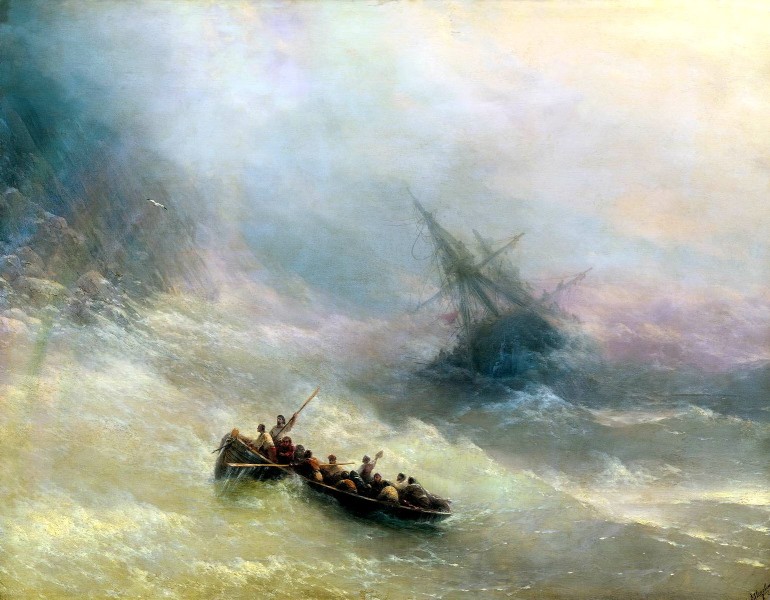
| Rainbow | 1873 | Painting |
| Reeds on the Dnieper | 1857 | Painting |
| Rescuers from the shipwreck | 1844 | Painting |
| Reval (Tallinn) | 1845 | Painting |
| Road in the Forest | 1857 | Painting |
| Rocky Cliffs | 1891 | Painting |
| Rocky Seashore | 1876 | Painting |
| Russian squadron at the Sevastopol roadstead | 1849 | Painting |
| Sailboat . | 1859 | Painting |
| Sailing Boat | Date unknown | Drawing |
| Sailing Ship on a calm sea by Moonlight | 1897 | Painting |
| Sailing Ship on the Sea at Moonlight. | 1840 | Painting |
| Sailing Ships on a Calm Day. | 1887 | Painting |
| Sarkizova Ann, second wife of I. Aivazovsky | 1882 | Painting |
| Scenes from Cairo's life | 1881 | Painting |
| Sea | 1864 | Painting |
| Sea Battle at Navarino on October 20, 1827 | 1846 | Painting |
| Sea coast | 1886 | Painting |
| Sea coast at night. Near the beacon | 1837 | Painting |
| Sea on a Moonlit Night | 1857 | Painting |
| Sea on a Moonlit Night | 1858 | Painting |
| Sea View | 1855 | Painting |
| Sea View | 1875 | Painting |
| Sea view from the chapel on the shore | 1845 | Painting |
| Seascape | 1885 | Painting |
| Seascape | Date unknown | Painting |
| Seascape with a steamer. | 1897 | Painting |
| Seascape with full moon | 1857 | Painting |
| Sebastopol | 1852 | Painting |
| Selbstportrait | 1881 | Painting |
| Selbstporträt | 1892 | Painting |
| Self-portrait | 1874 | Painting |
| Self-Portrait | 1898 | Painting |
| Sheep driven by the storm into the sea. | 1855 | Painting |
| Shepherds' Camp | 1858 | Painting |
| Shepherds with a flock of sheep. | 1872 | Painting |
| Ship Amid the Stormy Sea | 1887 | Painting |
| Ship by Moonlight | 1868 | Painting |
| Ship, castle and sea | 1847 | Painting |
| Ship ''Empress Maria'' in a Storm | 1892 | Painting |
| Ship in a storm | 1899 | Painting |
| Ship in a Stormy Sea off the Coast | 1895 | Painting |
| Ship on Stormy Seas | 1850 | Painting |
| Ship "Twelve Apostles | 1897 | Painting |
| Ships at the raging sea | 1866 | Painting |
| Ships on a misty morning | Date unknown | Painting |
| Ships on Stormy Sea, Sunrise | 1871 | Painting |
| Shipwreck | 1843 | Painting |
| shipwreck | 1876 | Painting |
| Shipwreck in the North Sea | 1875 | Painting |
| Shipwreck of "Lefort | 1858 | Painting |
| Shipwreck off the Black Sea Coast | 1887 | Painting |
| Shipwreck on a Stormy Morning | 1895 | Painting |
| Shipwreck on Stormy Seas | 1886 | Painting |
| Shoreline | 1851 | Painting |
| Sinking Ship | 1854 | Drawing |
| Smolny Abbey. Sunset. | 1847 | Painting |
| Solar Eclipse in Feodosia | 1876 | Painting |
| St. George Monastery. Cape Fiolent | 1846 | Painting |
| St. Petersburg | 1850 | Painting |
| St. Petersburg - Galleon on the docks | 1850 | Painting |
| Steamboat on a Moonlit Night | 1884 | Painting |
| Storm | 1851 | Painting |
| Storm | 1854 | Drawing |
| Storm | 1861 | Painting |
| Storm | 1872 | Painting |
| Storm | 1880 | Painting |
| Storm | 1886 | Painting |
| Storm | 1899 | Painting |
| Storm (1871) | 1871 | Painting |
| Storm at sea | 1850 | Painting |
| Storm at sea | 1873 | Painting |
| Storm at Sea on a Moonlit Night | 1866 | Painting |
| Storm off the coast of Odessa | 1898 | Painting |
| Storm on Sea | 1899 | Painting |
| Storm on the Sea | 1876 | Painting |
| Storm over Eupatoria | 1900 | Painting |
| Stormy Sea | 1844 | Painting |
| Stormy Sea | 1850 | Painting |
| Stormy sea at night | 1849 | Painting |
| Strong Wind | 1856 | Painting |
| Stürmische See im Abendrot. | 1896 | Painting |
| Suez Canal | 1869 | Painting |
| Sunny Day | 1884 | Painting |
| Sunset | 1879 | Artwork |
| Sunset at Sea | 1851 | Painting |
| Sunset at sea | 1877 | Painting |
| Sunset at the Sea | 1848 | Painting |
| Sunset over the Golden Horn | 1866 | Painting |
| Sunset over Yalta | 1861 | Painting |
| Survivors | 1844 | Painting |
| Sveaborg | 1844 | Painting |
| The Baptism of the Armenian People. Gregory the Illuminator | 1892 | Painting |
| The Battle of Revel | 1846 | Painting |
| The Battle of Sinope on 18 November 1853 (Night after Battle) | 1853 | Painting |
| The Battle of Vyborg Bay in 1790. | Date unknown | Painting |
| The Battle of Wyborg Bay | 1846 | Painting |
| The Bay of Naples | 1841 | Painting |
| The Bay of Naples | 1844 | Painting |
| The Bay of Naples | 1845 | Painting |
| The Bay of Naples | 1878 | Painting |
| The Bay of Naples. | Date unknown | Painting |
| The Bay of Naples with Capri | 1891 | Painting |
| The Bay of Yalta with the Magobi and Ai Petri mountains | 1850 | Painting |
| The Beach at Biarritz | Date unknown | Painting |
| The birth of Aphrodite | Date unknown | Painting |
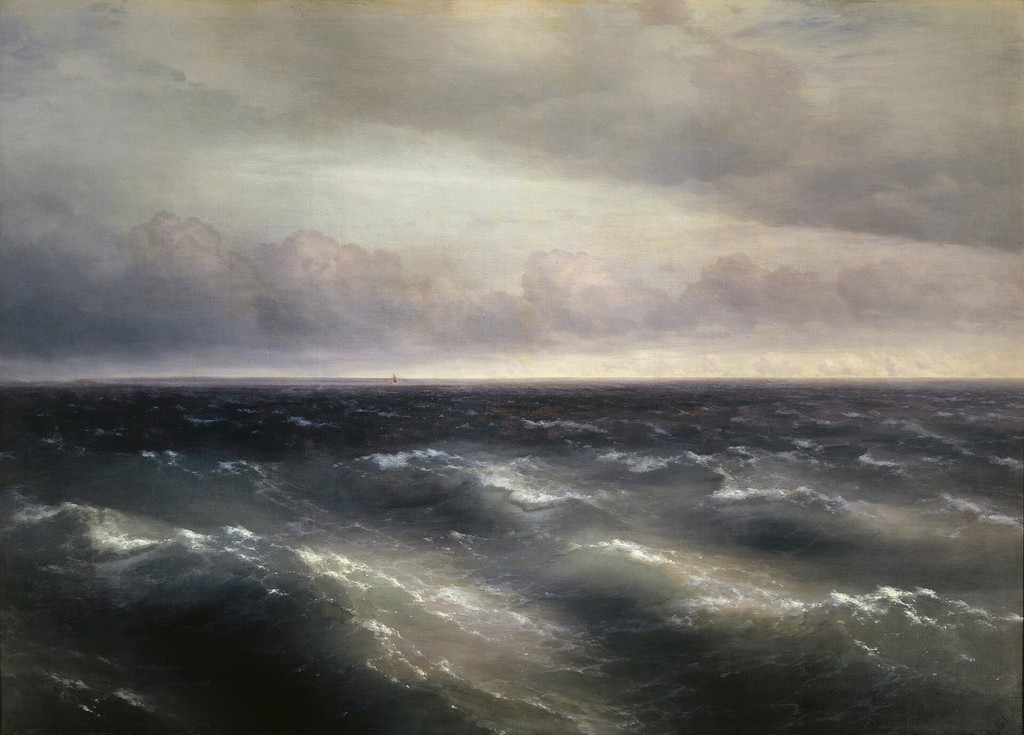
| The Black Sea | 1881 | Painting |
| The Black Sea at night | 1879 | Painting |
| The Black Sea Fleet in Feodosia | 1890 | Painting |
| The Black Sea (Marina) | 1882 | Painting |
| The Burning of the Turkish Flagship by Kanaris | 1881 | Painting |
| The Canal Grande with a view of Santa Maria della Salute at sunset. | 1848 | Painting |
| The Caucasus | 1863 | Painting |
| The Disembarkation of Christopher Columbus with Companions on Three Launches, on Friday 12th October 1492, At Sunrise, on an American Island Named San Salvador by Him on the Very Same Day | Date unknown | Painting |
| The Galata Tower by Moonlight | 1845 | Painting |
| The Great Pyramid at Giza | 1871 | Painting |
| The Harbor at Odessa on the Black Sea | 1852 | Painting |
| The Island of Ischia at Sunset (Sunset over Ischia) | 1857 | Painting |
| The Island of Rhodes | 1861 | Painting |
| The Landing of N. N. Raevskyi at Subashi | 1839 | Painting |
| The Maiden's Tower | 1848 | Painting |
| The Massacre of Armenians in Trebizond in 1895 | 1897 | Painting |
| The Mekhitarist Fathers on Lazarus Island, Venice | 1843 | Painting |
| The Mekhitarist Fathers on San Lazzaro Island. Venice | 1843 | Painting |
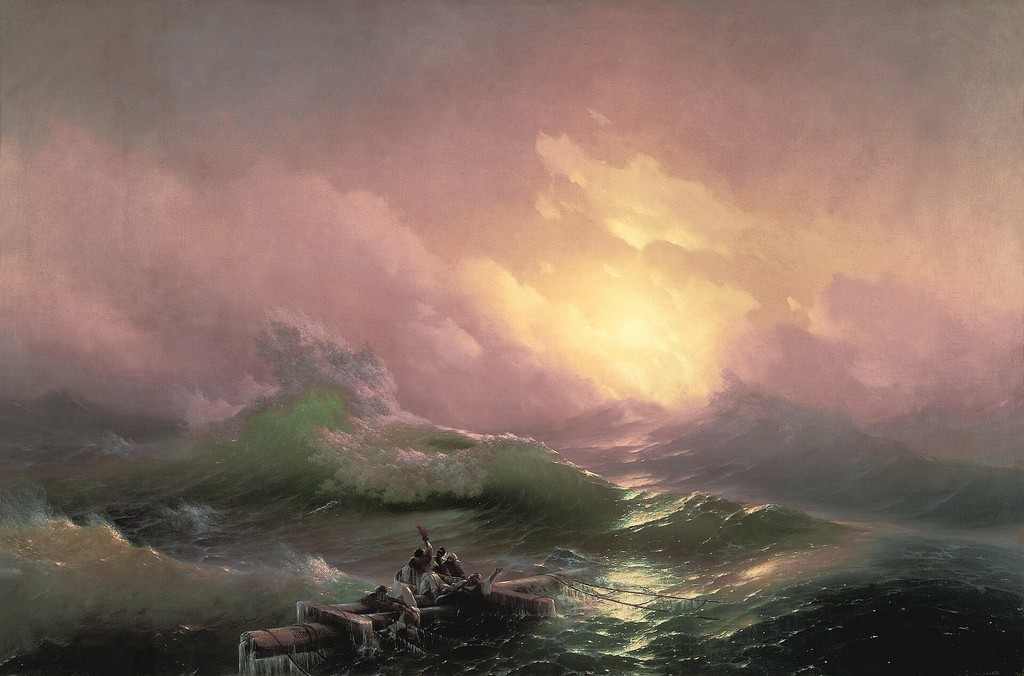
| The Ninth Wave | 1850 | Painting |
| The Relief Ship | 1892 | Painting |
| The Rescue | Date unknown | Painting |
| The Russian Squadron on the Sebastopol Roads | 1846 | Painting |
| The Sea | 1865 | Painting |
| The Shipwreck | 1873 | Painting |
| The Shipwreck | Date unknown | Painting |
| The Shores of the Mediterranean | 1892 | Painting |
| The storm at Cape Aya | 1899 | Painting |
| The storm at sea | 1850 | Painting |
| The Storm on the Turkish Coast | 1858 | Painting |
| The strip "Swetlana | Date unknown | Painting |
| The Survivor | 1880 | Painting |
| The survivors | 1895 | Painting |
| The Tide | 1870 | Painting |
| The Wrath of the Seas | 1886 | Painting |
| Theodosia Bay, sunrise | 1855 | Painting |
| Theodosia, end of day | 1865 | Painting |
| Theodosia. Moonlight night | 1852 | Painting |
| Trebizond from the sea | 1875 | Painting |
| Ukrainian Landscape at Night | 1870 | Painting |
| Ukrainian landscape with chumaks in the moonlight | 1869 | Painting |
| untitled | Date unknown | Painting |
| Venetian lagoon. View of the island of San Giorgio. | 1844 | Painting |
| Venice | 1844 | Painting |
| Venice at Sunset | 1873 | Painting |
| View in Crimea at sunset | 1862 | Painting |
| View of a bay with numerous sailing-ships (Feodosia?) | Date unknown | Drawing |
| View of Constantinople and the Bosphorus | 1856 | Painting |
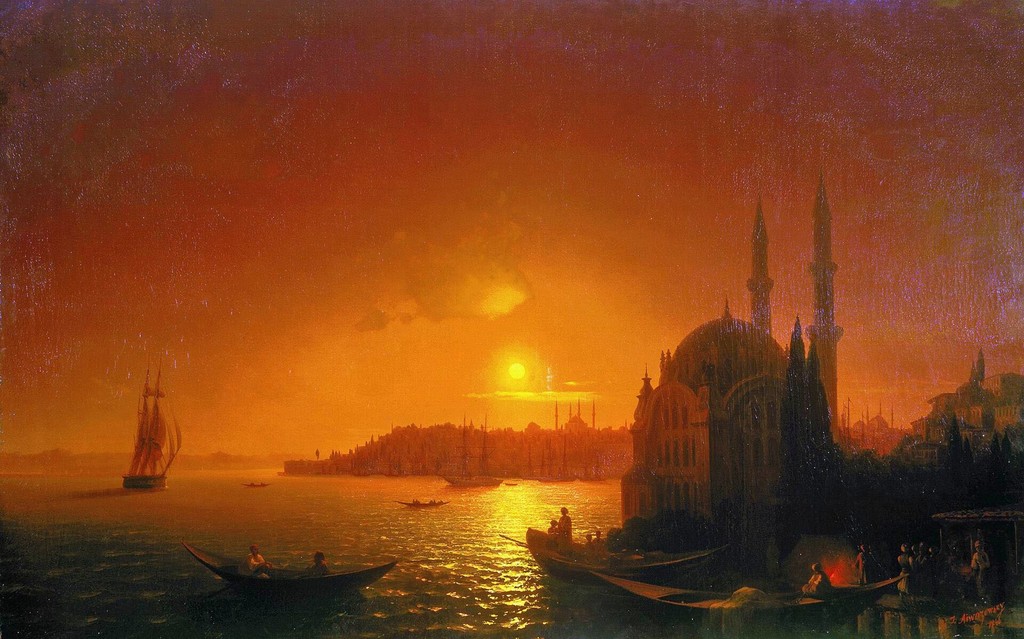
| View of Constantinople by evening light | 1846 | Painting |
| View of Moscow from the Sparrow Hills | 1851 | Painting |
| View of Odessa on a moonlit night | 1855 | Painting |
| View Of The Ayu Dag Crimea | 1868 | Painting |
| View Of The Sea From The Mountains At Sunset. Crimea | 1900 | Painting |
| View of Vico near Naples | 1855 | Painting |
| View to the Crim | 1851 | Painting |
| View to the sea coast near St. Petersburg | 1835 | Painting |
| Volga near the Zhiguli Mountains | 1887 | Painting |
| Walking on Water | 1888 | Painting |
| Walking on Water | 1890 | Painting |
| Wave | 1889 | Painting |
| Wave hitting a Rock | 1860 | Painting |
| Wave. Two Ships | Date unknown | Painting |
| Windmill by the Sea | 1837 | Painting |
| Winter Caravan on Road | 1857 | Painting |
| Winter in Ukraine | 1874 | Drawing |
| Winter landscape | 1876 | Painting |
| Winter Scene in Little Russia | 1868 | Painting |
| Wreck of the ship "Ingermanland" in Skagerrak on the night of August 30, 1842. | Date unknown | Painting |
| Yalta | 1899 | Painting |
Frequently Asked Questions
He was Armenian by family, language, church life and sustained cultural commitment, while his education, official career and artistic prominence developed within the Russian Empire.[3][4][5] Feodosia in Crimea was then imperial territory and is now in Ukraine. An accurate answer retains all these coordinates instead of forcing one to erase another.
Both the Armenian and Russian forms had historical functions. Hovhannes Aivazian belonged to Armenian family and linguistic usage; Ivan Konstantinovich Aivazovsky became established through Russian schooling and public service.[1][5] Treating either form as uniquely authentic would misrepresent a multilingual practice.
Yes. Aghasyan records correspondence with Armenian religious and cultural figures written in Armenian, as well as signatures using Aivazean in Armenian script.[3] This later use continues the literacy he first acquired through the parish school at Surb Sarkis.
Gabriel was Ivan’s elder brother, an Armenian clergyman, educator, historian, linguist and translator. His career connected San Lazzaro, Paris, Crimea and the Caucasus, and his conversations with Ivan deepened the painter’s engagement with Armenian scholarship and religious culture.[5]
Catalogues must compress complex histories into short fields. Getty preserves both Russian and Armenian classifications and prefers Ayvazovsky; the Met foregrounds Armenian identity while stating the Russian-imperial and present-day Ukrainian geography of his birthplace.[1][2] The labels are best read together with biography, not as mutually exclusive verdicts.
Discussion
Use this evidence-led guide as a starting point for close looking rather than a final verdict.
Share an observation about Armenian Identity or a source that adds useful context.
Reader Insights
Which work most clearly complicates the familiar image of Aivazovsky as a painter of spectacular storms?
Where do Feodosia, Armenian identity, academy training, travel or naval service most productively alter your reading?
Which source or surviving object would you investigate next?
Join the Conversation
Add your reading below, keeping observations specific and evidence clear.
References
- Getty Research Institute, “ULAN 500021161: Ivan Ayvazovsky”, accessed 30 August 2026.
- Metropolitan Museum of Art, “Ship by Moonlight”, accessed 30 August 2026.
- Ararat Aghasyan, Enchanted by the Sea: Ivan (Hovhannes) Aivazovsky, National Academy of Sciences of Armenia, accessed 30 August 2026.
- Ararat Aghasyan, “The Exceptional Master of Seascapes”, National Academy of Sciences of Armenia, accessed 30 August 2026.
- Tretyakov Gallery Magazine, “The Aivazovsky Brothers”, accessed 30 August 2026.
- Tretyakov Gallery Magazine, “Father of the Town: Ivan Aivazovsky and Feodosia”, accessed 30 August 2026.
- Tretyakov Gallery Magazine, “Aivazovsky’s House and Guests”, accessed 30 August 2026.