


 by Tom Gurney
Tom Gurney BSc (Hons) is an art history expert with over 20 years experience
Page Created on / Page Updated on
Email: tomgurney1@gmail.com / Phone: +44 7429 011000
Ivan Aivazovsky Paintings: Introduction
Ivan Aivazovsky’s paintings are best approached as variations on a demanding set of pictorial problems: how to make water appear weighty or transparent, how to turn light into atmosphere, and how to place human action within a space that can seem immeasurable. Calm seas, storms, moonlit harbours, shipwrecks, coastal cities and episodes from naval history belong to one practice, but they do not all ask to be read in the same way.
The crucial starting point is his working method. Aivazovsky observed coasts, vessels and changing weather closely, yet scholarly accounts emphasise that he usually developed marine paintings through visual and emotional memory rather than by copying a scene directly in front of him.[1][2][4] Memory was not a substitute for looking. It let him reorganise accumulated observations into clear effects of time, motion and scale.
That breadth reflects a layered career. Aivazovsky was an Armenian artist born in Feodosia, Crimea—then within the Russian Empire and now in Ukraine—who became central to nineteenth-century Russian art while sustaining important Armenian commitments.[1][3] His paintings likewise connect local knowledge of the Black Sea with extensive travel, academic training and the visual culture of the imperial navy. The sections below offer ways to compare those strands without forcing them into a single formula.
At a Glance
- Methodobservation supplied material that Aivazovsky reshaped from memory in the studio.[1][2]
- Marine statesstill water, rising weather and catastrophic seas are constructed differently, not merely graded by wave height.[4]
- Lightmoonlight, sunrise, mist and refracted colour establish both time and emotional register.
- Human scaleships, wreckage and sailors turn marine space into narrative without making nature a backdrop.
- Long careerearly Mediterranean views lead to, but do not simply predict, the monumental late seas.[2][4]
- Directory357 researched entries provide a navigational census rather than an exhaustive catalogue raisonné.
Selected Ivan Aivazovsky paintings
Contents
- Introduction
- Painting the sea from memory
- Calm and storm as constructed states
- Moonlight, sunrise and refracted colour
- Ships, sailors and narrative scale
- Naval history versus marine landscape
- From early travel views to late monumental seas
- Six works to start with
- How to use the researched works directory
Painting the sea from memory
Aivazovsky’s studio practice is often reduced to the claim that he could paint the sea without looking at it. That formulation misses the discipline behind the result. His memory was stocked by repeated observation: the Black Sea around Feodosia, journeys with naval vessels, Mediterranean travel and sustained attention to clouds, coastlines and the behaviour of ships. Ararat Aghasyan describes a method in which remembered impressions and imagination supported rapid execution, while compositional structure, tonal unity and gradual colour transitions held the image together.[1][2]
The distinction between source and construction helps correct an eyewitness myth. A picture may identify a real port, vessel or historical episode without recording one uninterrupted instant. Tretyakov Gallery scholarship notes that Aivazovsky could combine visual and emotional impressions gathered in different places, even transferring a kind of weather or illumination between coasts while keeping a locality recognisable.[4] The painted event is therefore a synthesis: exact knowledge is reorganised to make wind, distance and light immediately intelligible.
This method is explored in more detail in Light, Memory and Marine Technique. On any individual canvas, it encourages practical questions. Where does the brightest interval occur? How are near and distant waves separated? Does a vessel clarify the direction of the wind, or interrupt it? Such questions are more useful than trying to decide whether every detail was seen at once.
Calm and storm as constructed states
A calm Aivazovsky is not simply a storm painting with smaller waves. Open water can be organised through long horizontals, distant sails, coastal silhouettes and broad passages in which small differences of tone carry the surface. Storm pictures need another grammar: tilted vessels, broken intervals, denser contrasts and waves whose overlapping directions create instability. His range from stillness to violence was recognised as a defining feature of the marine oeuvre.[4]
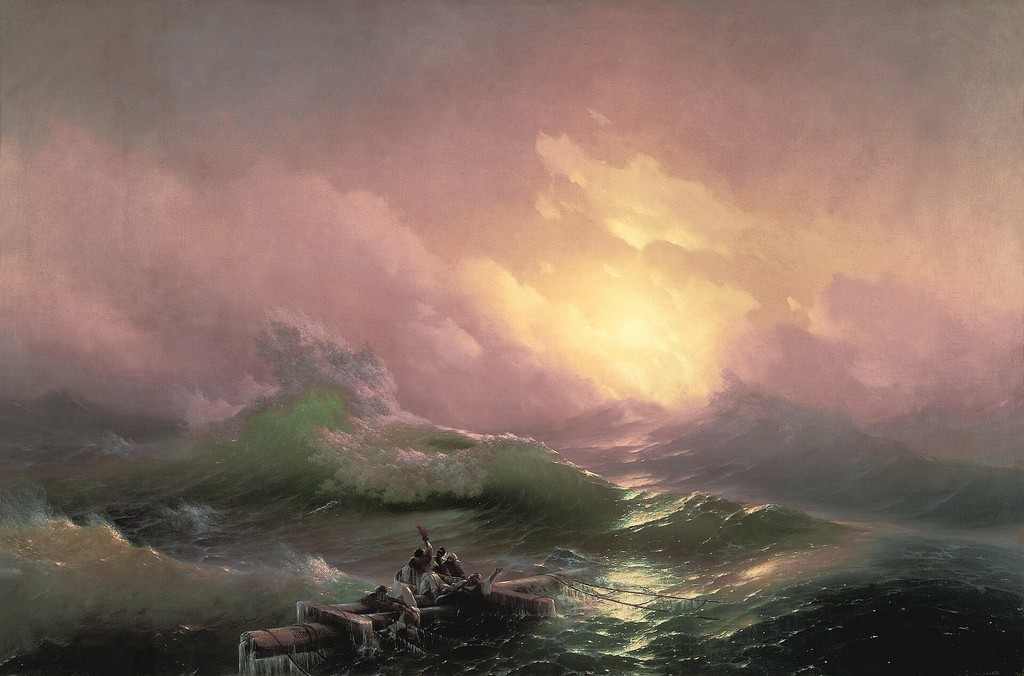
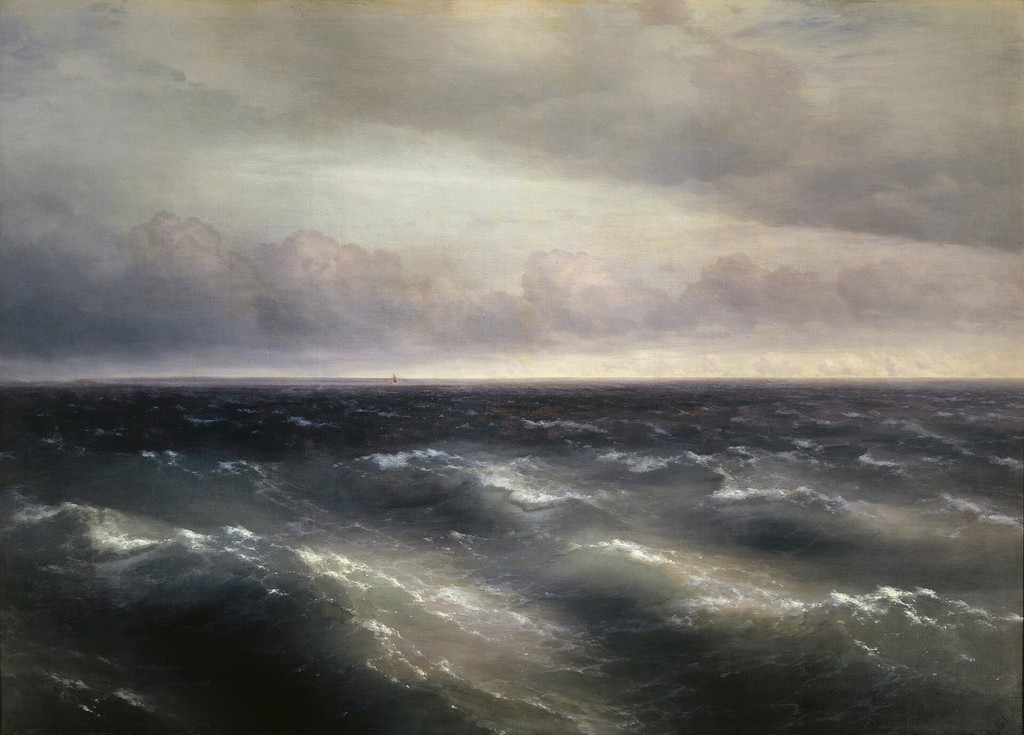
The comparison also exposes different kinds of suspense. Calm may delay action and make distance the subject; an approaching storm can suggest change before disaster occurs; a wreck scene begins after control has already failed. The Black Sea makes a rising sea monumental through restraint, whereas The Ninth Wave places survivors within the radiant morning after a storm.[5][9] Neither painting is a neutral description of weather. Each selects a distinct temporal and emotional state.
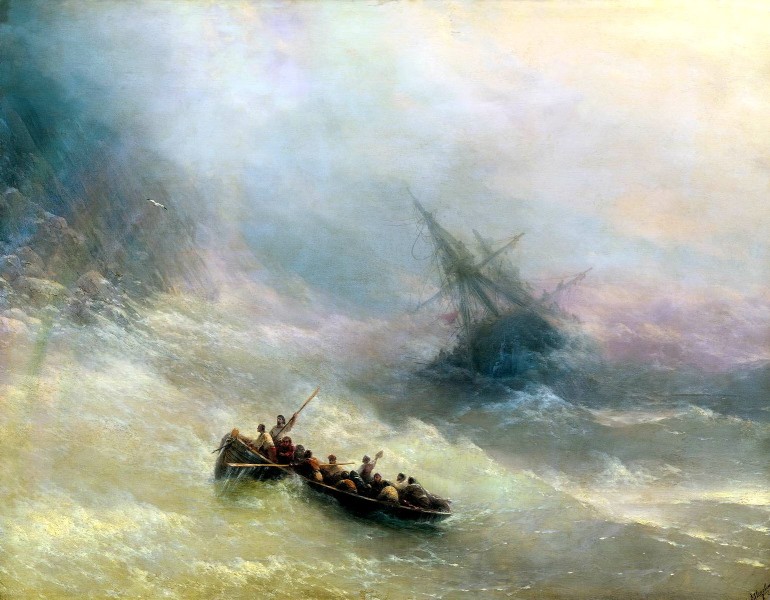
Those states do not carry fixed meanings. Smooth water may imply release, expectation or exposure, depending on the vessel and shore; violent water may contain a route towards survival. Both The Ninth Wave and Rainbow set human vulnerability against a light effect that opens the composition beyond immediate disaster.[5][11] Weather becomes expressive through its relationship with the figures, not through a simple code in which calm is reassuring and every storm ends in despair.
Moonlight, sunrise and refracted colour
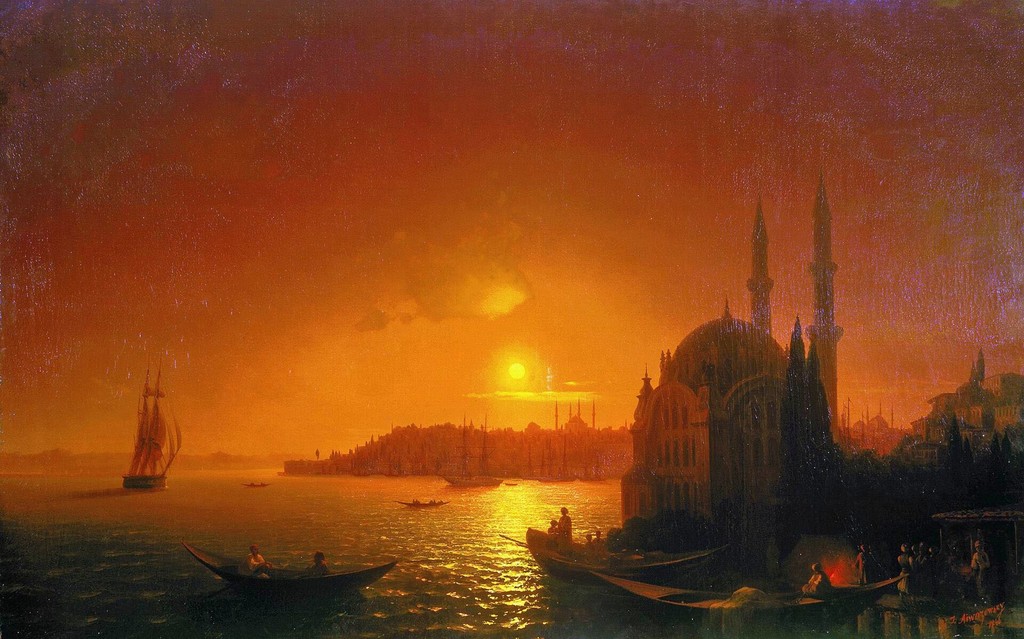
Light gives Aivazovsky a way to make marine space legible without outlining every form. In a nocturne, the moon can establish a vertical path across water and separate architecture from sky. A View of Constantinople by Moonlight, painted in 1846 after journeys that included Turkey, Greece and Asia Minor, turns the historical city—present-day Istanbul—into a meeting of harbour, skyline and nocturnal atmosphere.[7]
Sunrise produces a different sequence of looking. The State Russian Museum identifies the light in The Ninth Wave as dawn after a destructive night, with survivors clinging to wreckage as the new day introduces the possibility of hope.[5] In Rainbow, sunlight meets spray and mist around a wreck and rescue, breaking the storm’s compressed colour into a spectrum.[11] The rainbow is therefore not ornamental decoration added to a marine scene; it depends on the same water-filled air that obscures forms elsewhere.
These paintings show why colour should be read structurally. Warm and cool passages can distinguish distance, signal a change in weather or redirect attention towards vulnerable figures. Aivazovsky’s light is persuasive because it organises the whole field, not because one luminous detail has been isolated for display.
Ships, sailors and narrative scale
Ships do more than tell viewers that a painting represents the sea. Their size, rigging and angle provide measures against which water and sky can be understood. A small hull near the horizon enlarges the apparent reach of the sea; a tilted mast converts wind into a visible force; wreckage close to the viewer collapses distance and makes danger immediate.
Human figures perform a related task, but scale does not reduce them to symbols. In The Ninth Wave, survivors hold onto the remains of a mast.[5] In Rainbow, a boat carries people away from a wreck through spray.[11] Their situations invite attention to sequence: what has happened, what remains possible, and whether rescue lies within the picture or beyond it. The sea may dominate the image, yet narrative enters through the precise relation between bodies, boats and changing conditions.
When comparing works, look for what the vessel is doing rather than merely whether one is present. Full sail, damaged rigging, a low rescue boat and a distant anchored ship communicate different stages of action. They also separate paintings with superficially similar titles or weather.
Naval history versus marine landscape
Aivazovsky’s connection with the Russian navy gave him access to ships, voyages and a recognised professional role; he was appointed painter to the Main Naval Staff in 1844.[4] Even so, a naval subject should not automatically be treated as a battle painting. The exact moment represented matters.
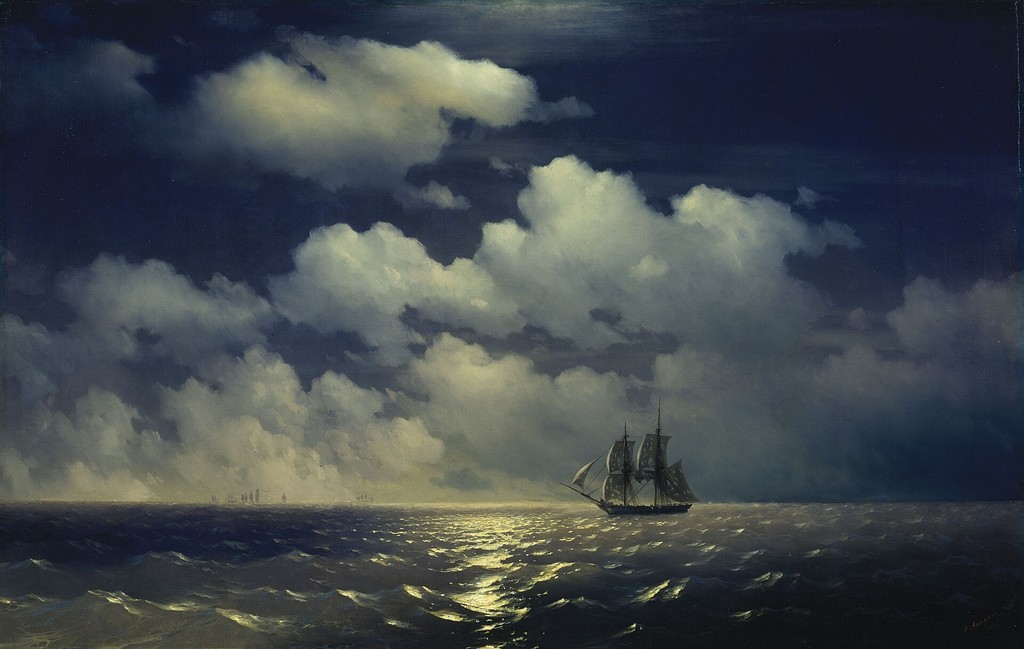
Mercury Brig Meeting the Russian Squadron after her Victory over Two Turkish Vessels is an aftermath, painted in 1848. The State Russian Museum identifies the brig under sail as it rejoins the squadron after sustaining damage, rather than showing the combat itself.[8] That choice shifts the picture from an exchange of fire to recognition, survival and return. It also demonstrates how a named historical vessel can remain part of a marine composition in which wind, spacing and open water carry much of the meaning.
The distinction guards against reading every ship as documentary evidence or every dramatic sea as a military event. Some paintings depend on a verifiable episode; others use anonymous craft to establish occupation, risk or scale. Object titles and collection records should decide which kind of claim can responsibly be made.
From early travel views to late monumental seas
Aivazovsky’s career did not progress neatly from observation to imagination, or from decorative colour to truth. In Italy during the early 1840s he studied established art and painted his own Mediterranean subjects, testing morning, evening, calm and storm as distinct pictorial conditions.[1][4] The 1846 Constantinople nocturne and 1848 Mercury Brig show how travel and naval experience could lead to different kinds of identified scene.[7][8]
By 1850, The Ninth Wave brought shipwreck narrative, sunrise and a commanding open sea together on a large canvas.[5] Later works revisit rather than abandon those concerns. Rainbow of 1873 places rescue within storm-lit mist; The Black Sea of 1881 reduces anecdotal incident and colouristic display to a more austere confrontation with gathering water.[9][11] Tretyakov scholarship treats that restraint as a significant late development rather than proof that the earlier paintings lacked seriousness.[4]
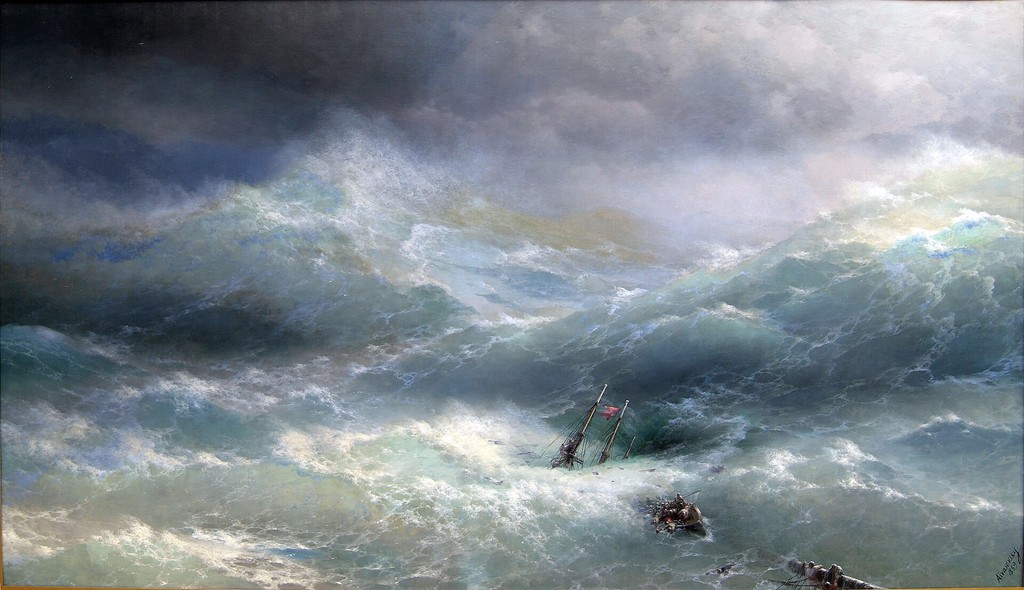
The immense Wave of 1889 carries this late concentration into a wreck scene dominated by cold, dark water. The Russian Museum describes it as a work of Aivazovsky’s later period, when a more sober treatment of nature displaced some earlier Romantic colour effects.[6] It remains distinct from both The Ninth Wave of 1850 and the still later Among the Waves of 1898. Repeated sea imagery should sharpen object identification, not blur separate paintings into one famous title.
Reading the dates in sequence reveals recurrence as clearly as change. A nocturne, a naval return, a luminous shipwreck and a darkening open sea answer different commissions and ambitions, yet all depend on the placement of light against water. Late restraint is therefore one option within a long practice, not the inevitable destination of every earlier experiment. This prevents chronology from becoming a story in which colour, narrative or public appeal must simply be outgrown.
This chronology is easier to understand alongside The Black Sea and Feodosia. Feodosia was not merely his birthplace or a single motif; it remained a base from which a travelling, internationally visible career repeatedly returned to Black Sea experience.[1][3]
Six works to start with
- The Ninth Wave (1850) is the clearest introduction to Aivazovsky’s shipwreck narrative. The State Russian Museum records the oil on canvas as 221 by 332 centimetres. Dawn, dangerous water and survivors on wreckage hold terror and hope in unresolved balance.[5]
- The Black Sea (1881) removes the rescue plot and concentrates on gathering weather. The current State Tretyakov Gallery record gives 149 by 210 centimetres, while its affiliated catalogue publishes 149 by 208 centimetres; the discrepancy should be retained rather than silently reconciled.[9][10]
- Rainbow (1873) joins wreck, rescue, spray and refracted light in one unstable space. The Tretyakov’s current record measures it at 105 by 136 centimetres, whereas the affiliated catalogue gives 102 by 132 centimetres.[11][12]
- A View of Constantinople by Moonlight (1846), in the State Russian Museum, measures 124 by 192.5 centimetres. It demonstrates that the marine practice includes an urban nocturne shaped by water and reflected light.[7]
- Mercury Brig after Victory (1848) measures 123.5 by 190 centimetres in the Russian Museum’s record. Begin with its precise aftermath subject: the damaged brig is returning to the squadron, not fighting the battle.[8]
- Wave (1889) is a 304 by 505 centimetre Russian Museum canvas. Its vast scale, darkened weather and wrecked vessel make a strong endpoint for comparison, provided it is not confused with The Ninth Wave or Among the Waves.[6]
Together, these six paintings provide a compact route through nocturne, sunrise, storm, rescue, naval history and the increasingly monumental late sea. Their dates also discourage a simple division between an early lyrical artist and a late severe one: narrative, light and the testing of human scale recur in altered combinations.
How to use the researched works directory
The directory on this page contains 357 entries gathered as a dated online census: 349 paintings, seven drawings and one work recorded only under the broader category “artwork”. It is designed for discovery across titles, dates, media and collections. It is not a catalogue raisonné, a claim of exhaustive survival or an independent verdict on attribution. Records without enough information to establish a usable object identity are not presented as separate works, while collection evidence takes priority for the six paintings examined above.
Use the directory to trace recurring words, places and dates, then return to the object record before drawing conclusions about versions or ownership. Transliteration can produce both Aivazovsky and Ayvazovsky, and translated titles can vary even when the underlying object is the same. Conversely, similar names may conceal separate paintings. Search is therefore a starting tool; date, collection, dimensions and inventory identity provide the stronger check.
Researched works directory
This searchable evidence census was assembled from public museum records and a reproducible Wikidata snapshot. It is not a catalogue raisonné, not a claim to complete oeuvre coverage, and not a substitute for the published catalogue literature, which was not used to claim absolute completeness.
| Name | Date | Medium |
|---|---|---|
| A bay at dawn. | 1896 | Painting |
| A bay near Venice | 1842 | Painting |
| A Moonlit Night at Sea | 1885 | Painting |
| A Moonlit Night on the Bosphorus | 1894 | Painting |
| A Moonlit Night on the Crimean Coast | Date unknown | Painting |
| A Rocky Coastal Landscape in the Aegean with Ships in the Distance (detail) | 1884 | Painting |
| A. S. Pushkin and Countess M. N. Raevskaya by the sea near Gurzuf | 1886 | Painting |
| A. S. Pushkin at the Black Sea coast | 1887 | Painting |
| A. S. Pushkin at the Black Sea coast | 1897 | Painting |
| A Ship in a Stormy Sea | 1892 | Painting |
| A ship in peril | 1894 | Painting |
| A Ship of the Russian Navy off the Coast | Date unknown | Painting |
| A storm on rocky shores | 1875 | Painting |
| A Summer’s Day in Crimea | 1867 | Painting |
| A View of Constantinople by Moonlight | 1846 | Painting |
| A View of the Bosporus with the Hagia Sophia and the Maiden's Tower in the Moonlight | 1884 | Painting |
| A Wagon Train in the Desert | Date unknown | Painting |
| Abandoning Ship | 1882 | Painting |
| After the Storm | 1854 | Painting |
| Aiju-Dag | Date unknown | Painting |
| Aivazovsky Ivan Konstantinovic - Colon Sortint de Palos | 1892 | Painting |
| Aivazovsky - Oath befory Battle of Avarayr | 1892 | Painting |
| Aivazovsky with Friends | 1893 | Painting |
| Alexander II Crossing the Danube | 1878 | Painting |
| Alexander Pushkin at the Top of Ai-Petri at Sunrise | 1899 | Painting |
| Along the Coast | 1850 | Painting |
| Alushta | 1878 | Painting |
| American Shipping off the Rock of Gibraltar | 1873 | Painting |
| Among the Waves | 1898 | Painting |
| Arrival of Catherine II in Feodosia | 1883 | Painting |
| Azure Grotto, Naples | 1841 | Painting |
| Barge at Sea Shore | 1860–1870 | Painting |
| Battle of Chesma | 1848 | Painting |
| Battle of Chesma (1886) | Date unknown | Painting |
| Battle of Chios on 24 June, 1770 | 1848 | Painting |
| Battle of Sinope | 1853 | Painting |
| Beach | 1845 | Painting |
| Before the Storm: Theodosia | Date unknown | Painting |
| Biarritz | 1889 | Painting |
| Black Sea Fleet in the Bay of Theodosia, just before the Crimean War | 1890 | Painting |
| Boat Ride by Kumkapi in Constantinople | 1846 | Painting |
| Bosphorus | 1878 | Painting |
| Bosporuse väin öösel. | 1890 | Painting |
| Bracing The Waves | Date unknown | Painting |
| Breaking Wave | Date unknown | Painting |
| Brig “Mercury” Attacked by Two Turkish Ships | 1892 | Painting |
| Brig ''Mercury'' meets with the Russian squadron after the victory over two Turkish ships | 1848 | Painting |
| Broad landscape with settlers | 1856 | Painting |
| Byron in Venice | Date unknown | Painting |
| Byron's visit to the Mekhitarists in Surb Ghazar Island | 1899 | Painting |
| Byron's visit to the Mekhitarists on San Lazzaro | 1899 | Painting |
| Ca d'Oro | 1878 | Painting |
| Calm early evening sea | 1884 | Painting |
| Calm Sea | 1887 | Painting |
| Carriage in a Storm | Date unknown | Painting |
| Catholicos Khrimyan Airik near Echmiadzin | 1895 | Painting |
| Caucasus from the Sea | 1894 | Painting |
| Chaos. The Genesis | 1841 | Painting |
| Chapel by the sea | 1847 | Painting |
| Chumaks in Little Russia | Date unknown | Painting |
| Chumaks leisure | 1885 | Painting |
| Chumaks Waggons | 1862 | Painting |
| Clashes between the Shirvans and the Murids on Gunib | 1869 | Painting |
| Clouds | 1865 | Painting |
| Clouds Over a Calm Sea | 1873 | Painting |
| Clouds over the Sea, Calm | 1889 | Painting |
| Coast | 1840 | Painting |
| Coast of Amalfi | 1841 | Painting |
| Coffee-house by the Ortaköy Mosque in Constantinople | 1846 | Painting |
| Constantinople, la mosquée de Top-Kahné | 1884 | Painting |
| Constantinople Sunset | 1899 | Painting |
| Crimean coast by moonlight | 1853 | Painting |
| Crimean Coast by Moonlight | 1898 | Painting |
| Crimean scene. Gurzuf at night | 1865 | Painting |
| Crimean Tartars on the Sea Shore | 1850 | Painting |
| Crimean Views | 1850 | Painting |
| Cruiser in the sea at night | 1844 | Painting |
| Dante Shows an Artist Some Unusual Clouds | 1883 | Painting |
| Daryal Gorge | 1868 | Painting |
| Deluge | 1864 | Painting |
| Der Fluss Rioni in Georgien | 1870 | Painting |
| Descent of Noah from Ararat | 1887 | Painting |
| Destruction of Pompeii | 1889 | Painting |
| Distributing Supplies | 1892 | Painting |
| Dusk on the Golden Horn | 1845 | Painting |
| End of Storm | 1839 | Painting |
| Entrance to the Sevastopol Bay. | 1852 | Painting |
| Entrée de port | 1846 | Painting |
| Exchange Of Peterburg | 1840–1847 | Painting |
| Exploding Ship | 1900 | Painting |
| Farm House and Windmill by moonlight | 1863 | Painting |
| Fight of the steamer Vesta with the Turkish battleship Fehti-Bulend in the Black Sea on July 11, 1877 | 1877 | Painting |
| Figures on a moonlit coast | 1858 | Painting |
| Fishermen and their Families on the Shore of the Bay of Naples | 1873 | Painting |
| Fishermen on the Beach | 1852 | Painting |
| Fishermen on the shore | Date unknown | Painting |
| Fishermen Returning Near Naples | 1874 | Painting |
| Fishing Boats In A Harbor | 1854 | Painting |
| Foggy day on the shores of Italy | Date unknown | Painting |
| French Ships Departing the Black Sea | 1871 | Painting |
| Frigate under sail | 1838 | Painting |
| From Mleta to Gudauri | 1868 | Painting |
| Frozen Bosphorus Under Snow (detail) | 1874 | Painting |
| Gathering Storm | 1899 | Painting |
| Golden Horn Bay Turkey | 1846 | Painting |
| Gondolier on the Sea at Night | 1843 | Painting |
| Gulf of Naples | 1874 | Painting |
| Gunboat off Crete | 1897 | Painting |
| Gurzuf at night | 1849 | Painting |
| Harbour Scene | Date unknown | Painting |
| Ice-Breakers on the Frozen Neva in St. Petersburg | 1877 | Painting |
| Ice on Dnipro | 1872 | Painting |
| Icebergs in the Atlantic | 1870 | Painting |
| In the harbor | 1840 | Painting |
| In the roads, Evening | 1867 | Painting |
| Italian Landscape | 1855 | Painting |
| Italian Landscape (Lago Maggiore), Evening | 1858 | Painting |
| Iwan Konstantinowitsch Aiwasowskij 001 | 1864 | Painting |
| Jalta | 1838 | Painting |
| Jude's the Apostol betrayal | 1834 | Drawing |
| La Vague | 1886 | Painting |
| Landscape in Crimea. | 1860 | Painting |
| Landscape with Windmills | 1860 | Painting |
| Large raid in Kronstadt | 1836 | Painting |
| Little Russian Ox Cart in Winter | 1866 | Painting |
| Loading Provisions off the Crimean Coast | 1876 | Painting |
| Look to the Large Cascade and Large Petergof Palace | 1837 | Painting |
| Marine scene | Date unknown | Painting |
| Marine View | 1899 | Painting |
| Mercury Brig Meeting a Russian Squadron after her Victory over Two Turkish Vessels | 1848 | Painting |
| Meri | Date unknown | Painting |
| Mine attack by boats of the steamer Grand Duke Constantine on the Turkish battleship Assari-Shevket on the Sukhum roadstead on August 12, 1877 | 1877 | Painting |
| Moon night on the Crimea, Gurzuf | 1839 | Painting |
| Moonlight at night near the spring | 1877 | Painting |
| Moonlight in Naples | 1842 | Painting |
| Moonlit coast | 1864 | Painting |
| Moonlit Landing | 1895 | Painting |
| Moonlit Night | 1850 | Painting |
| Moonlit Night | 1878 | Painting |
| Moonlit Night (1958) | 1858 | Painting |
| Moonlit Night (Aivazovsky) | Date unknown | Painting |
| Moonlit night in Crimea | 1859 | Painting |
| Moonlit night on the seashore in Crimea | 1852 | Painting |
| Moonlit Seascape With Shipwreck | 1863 | Painting |
| Morning on the sea | 1883 | Painting |
| Morning on the shore of the bay | 1853 | Painting |
| Mountain Village Gunib in Daghestan. View from the East. | 1869 | Painting |
| Naples Bay | 1842 | Painting |
| Naples with a poet amongst fishermen | 1845 | Painting |
| Naufragiul 1886 | 1886 | Painting |
| Neapolitan lighthouse. | 1842 | Painting |
| Night at Gurzof | 1891 | Painting |
| Night at the Rodos island | 1850 | Painting |
| Night in Constantinople | 1862 | Painting |
| Night in Venice | 1847 | Painting |
| Night. The Tragedy at the Sea of Marmara | 1897 | Painting |
| Nocturnal Voyage | Date unknown | Painting |
| Odessa at Moonlight | 1846 | Painting |
| Odessa, view from the Sea | 1865 | Painting |
| Old Feodosia | 1839 | Painting |
| Old Theodosia | 1845 | Painting |
| Ox-carts in the Ukrainian steppe | 1888 | Painting |
| Panorama of Constantinopole (detail) | 1856 | Painting |
| Parade of the Black Sea Fleet | 1886 | Painting |
| Passage of the Jews through the Red Sea | 1891 | Painting |
| Passing Ship on a Moonlit Night | 1868 | Painting |
| Peter | 1846 | Painting |
| Peter I at Krasnaya Gorka Lighting a Fire on the Shore to Signal to his Sinking Ships | 1900 | Painting |
| Petersburg. Crossing the Neva. | 1870 | Painting |
| Port of Theodosia | Date unknown | Painting |
| Portrait of A. Kaznacheev | 1847 | Painting |
| Portrait of a man | Date unknown | Drawing |
| Portrait of a Teenager | Date unknown | Painting |
| Portrait of archbishop Gabriel Aivazyan (brother of I. Aivazovsky) | 1883 | Painting |
| Portrait of the grandmother of painter Ashhen | 1858 | Painting |
| Portrait of vice admiral M.P. Lazarev | 1839 | Painting |
| Pushkin and Raevskaya in Gurzuf | 1900 | Painting |
| Pushkin in Crimea near Gurzuf rocks | 1880 | Painting |
| Pushkin's Farewell to the sea | 1887 | Painting |
| Q108330660 | 1847 | Painting |
| Q138511047 | 1857 | Painting |
| Q27074794 | Date unknown | Painting |
| Quiet Night: Armenians Thrown Overboard off the Turkish Ships | 1897 | Painting |
| Rainbow | 1873 | Painting |
| Reeds on the Dnieper | 1857 | Painting |
| Rescuers from the shipwreck | 1844 | Painting |
| Reval (Tallinn) | 1845 | Painting |
| Road in the Forest | 1857 | Painting |
| Rocky Cliffs | 1891 | Painting |
| Rocky Seashore | 1876 | Painting |
| Russian squadron at the Sevastopol roadstead | 1849 | Painting |
| Sailboat . | 1859 | Painting |
| Sailing Boat | Date unknown | Drawing |
| Sailing Ship on a calm sea by Moonlight | 1897 | Painting |
| Sailing Ship on the Sea at Moonlight. | 1840 | Painting |
| Sailing Ships on a Calm Day. | 1887 | Painting |
| Sarkizova Ann, second wife of I. Aivazovsky | 1882 | Painting |
| Scenes from Cairo's life | 1881 | Painting |
| Sea | 1864 | Painting |
| Sea Battle at Navarino on October 20, 1827 | 1846 | Painting |
| Sea coast | 1886 | Painting |
| Sea coast at night. Near the beacon | 1837 | Painting |
| Sea on a Moonlit Night | 1857 | Painting |
| Sea on a Moonlit Night | 1858 | Painting |
| Sea View | 1855 | Painting |
| Sea View | 1875 | Painting |
| Sea view from the chapel on the shore | 1845 | Painting |
| Seascape | 1885 | Painting |
| Seascape | Date unknown | Painting |
| Seascape with a steamer. | 1897 | Painting |
| Seascape with full moon | 1857 | Painting |
| Sebastopol | 1852 | Painting |
| Selbstportrait | 1881 | Painting |
| Selbstporträt | 1892 | Painting |
| Self-portrait | 1874 | Painting |
| Self-Portrait | 1898 | Painting |
| Sheep driven by the storm into the sea. | 1855 | Painting |
| Shepherds' Camp | 1858 | Painting |
| Shepherds with a flock of sheep. | 1872 | Painting |
| Ship Amid the Stormy Sea | 1887 | Painting |
| Ship by Moonlight | 1868 | Painting |
| Ship, castle and sea | 1847 | Painting |
| Ship ''Empress Maria'' in a Storm | 1892 | Painting |
| Ship in a storm | 1899 | Painting |
| Ship in a Stormy Sea off the Coast | 1895 | Painting |
| Ship on Stormy Seas | 1850 | Painting |
| Ship "Twelve Apostles | 1897 | Painting |
| Ships at the raging sea | 1866 | Painting |
| Ships on a misty morning | Date unknown | Painting |
| Ships on Stormy Sea, Sunrise | 1871 | Painting |
| Shipwreck | 1843 | Painting |
| shipwreck | 1876 | Painting |
| Shipwreck in the North Sea | 1875 | Painting |
| Shipwreck of "Lefort | 1858 | Painting |
| Shipwreck off the Black Sea Coast | 1887 | Painting |
| Shipwreck on a Stormy Morning | 1895 | Painting |
| Shipwreck on Stormy Seas | 1886 | Painting |
| Shoreline | 1851 | Painting |
| Sinking Ship | 1854 | Drawing |
| Smolny Abbey. Sunset. | 1847 | Painting |
| Solar Eclipse in Feodosia | 1876 | Painting |
| St. George Monastery. Cape Fiolent | 1846 | Painting |
| St. Petersburg | 1850 | Painting |
| St. Petersburg - Galleon on the docks | 1850 | Painting |
| Steamboat on a Moonlit Night | 1884 | Painting |
| Storm | 1851 | Painting |
| Storm | 1854 | Drawing |
| Storm | 1861 | Painting |
| Storm | 1872 | Painting |
| Storm | 1880 | Painting |
| Storm | 1886 | Painting |
| Storm | 1899 | Painting |
| Storm (1871) | 1871 | Painting |
| Storm at sea | 1850 | Painting |
| Storm at sea | 1873 | Painting |
| Storm at Sea on a Moonlit Night | 1866 | Painting |
| Storm off the coast of Odessa | 1898 | Painting |
| Storm on Sea | 1899 | Painting |
| Storm on the Sea | 1876 | Painting |
| Storm over Eupatoria | 1900 | Painting |
| Stormy Sea | 1844 | Painting |
| Stormy Sea | 1850 | Painting |
| Stormy sea at night | 1849 | Painting |
| Strong Wind | 1856 | Painting |
| Stürmische See im Abendrot. | 1896 | Painting |
| Suez Canal | 1869 | Painting |
| Sunny Day | 1884 | Painting |
| Sunset | 1879 | Artwork |
| Sunset at Sea | 1851 | Painting |
| Sunset at sea | 1877 | Painting |
| Sunset at the Sea | 1848 | Painting |
| Sunset over the Golden Horn | 1866 | Painting |
| Sunset over Yalta | 1861 | Painting |
| Survivors | 1844 | Painting |
| Sveaborg | 1844 | Painting |
| The Baptism of the Armenian People. Gregory the Illuminator | 1892 | Painting |
| The Battle of Revel | 1846 | Painting |
| The Battle of Sinope on 18 November 1853 (Night after Battle) | 1853 | Painting |
| The Battle of Vyborg Bay in 1790. | Date unknown | Painting |
| The Battle of Wyborg Bay | 1846 | Painting |
| The Bay of Naples | 1841 | Painting |
| The Bay of Naples | 1844 | Painting |
| The Bay of Naples | 1845 | Painting |
| The Bay of Naples | 1878 | Painting |
| The Bay of Naples. | Date unknown | Painting |
| The Bay of Naples with Capri | 1891 | Painting |
| The Bay of Yalta with the Magobi and Ai Petri mountains | 1850 | Painting |
| The Beach at Biarritz | Date unknown | Painting |
| The birth of Aphrodite | Date unknown | Painting |
| The Black Sea | 1881 | Painting |
| The Black Sea at night | 1879 | Painting |
| The Black Sea Fleet in Feodosia | 1890 | Painting |
| The Black Sea (Marina) | 1882 | Painting |
| The Burning of the Turkish Flagship by Kanaris | 1881 | Painting |
| The Canal Grande with a view of Santa Maria della Salute at sunset. | 1848 | Painting |
| The Caucasus | 1863 | Painting |
| The Disembarkation of Christopher Columbus with Companions on Three Launches, on Friday 12th October 1492, At Sunrise, on an American Island Named San Salvador by Him on the Very Same Day | Date unknown | Painting |
| The Galata Tower by Moonlight | 1845 | Painting |
| The Great Pyramid at Giza | 1871 | Painting |
| The Harbor at Odessa on the Black Sea | 1852 | Painting |
| The Island of Ischia at Sunset (Sunset over Ischia) | 1857 | Painting |
| The Island of Rhodes | 1861 | Painting |
| The Landing of N. N. Raevskyi at Subashi | 1839 | Painting |
| The Maiden's Tower | 1848 | Painting |
| The Massacre of Armenians in Trebizond in 1895 | 1897 | Painting |
| The Mekhitarist Fathers on Lazarus Island, Venice | 1843 | Painting |
| The Mekhitarist Fathers on San Lazzaro Island. Venice | 1843 | Painting |
| The Ninth Wave | 1850 | Painting |
| The Relief Ship | 1892 | Painting |
| The Rescue | Date unknown | Painting |
| The Russian Squadron on the Sebastopol Roads | 1846 | Painting |
| The Sea | 1865 | Painting |
| The Shipwreck | 1873 | Painting |
| The Shipwreck | Date unknown | Painting |
| The Shores of the Mediterranean | 1892 | Painting |
| The storm at Cape Aya | 1899 | Painting |
| The storm at sea | 1850 | Painting |
| The Storm on the Turkish Coast | 1858 | Painting |
| The strip "Swetlana | Date unknown | Painting |
| The Survivor | 1880 | Painting |
| The survivors | 1895 | Painting |
| The Tide | 1870 | Painting |
| The Wrath of the Seas | 1886 | Painting |
| Theodosia Bay, sunrise | 1855 | Painting |
| Theodosia, end of day | 1865 | Painting |
| Theodosia. Moonlight night | 1852 | Painting |
| Trebizond from the sea | 1875 | Painting |
| Ukrainian Landscape at Night | 1870 | Painting |
| Ukrainian landscape with chumaks in the moonlight | 1869 | Painting |
| untitled | Date unknown | Painting |
| Venetian lagoon. View of the island of San Giorgio. | 1844 | Painting |
| Venice | 1844 | Painting |
| Venice at Sunset | 1873 | Painting |
| View in Crimea at sunset | 1862 | Painting |
| View of a bay with numerous sailing-ships (Feodosia?) | Date unknown | Drawing |
| View of Constantinople and the Bosphorus | 1856 | Painting |
| View of Constantinople by evening light | 1846 | Painting |
| View of Moscow from the Sparrow Hills | 1851 | Painting |
| View of Odessa on a moonlit night | 1855 | Painting |
| View Of The Ayu Dag Crimea | 1868 | Painting |
| View Of The Sea From The Mountains At Sunset. Crimea | 1900 | Painting |
| View of Vico near Naples | 1855 | Painting |
| View to the Crim | 1851 | Painting |
| View to the sea coast near St. Petersburg | 1835 | Painting |
| Volga near the Zhiguli Mountains | 1887 | Painting |
| Walking on Water | 1888 | Painting |
| Walking on Water | 1890 | Painting |
| Wave | 1889 | Painting |
| Wave hitting a Rock | 1860 | Painting |
| Wave. Two Ships | Date unknown | Painting |
| Windmill by the Sea | 1837 | Painting |
| Winter Caravan on Road | 1857 | Painting |
| Winter in Ukraine | 1874 | Drawing |
| Winter landscape | 1876 | Painting |
| Winter Scene in Little Russia | 1868 | Painting |
| Wreck of the ship "Ingermanland" in Skagerrak on the night of August 30, 1842. | Date unknown | Painting |
| Yalta | 1899 | Painting |
Frequently Asked Questions
He studied the sea and travelled extensively, but scholarly accounts describe most of his finished marine paintings as constructions from visual and emotional memory.[1][2][4] That method allowed him to combine observed behaviour with an organised composition. It should not be confused with inventing water without first knowing it.
He treated calm, gathering weather, moonlight, sunrise, storm and shipwreck as different pictorial situations. Each calls for another balance of horizon, colour, vessel, wave direction and human incident.[2][4] Comparison is most productive when it asks how these elements change together, rather than ranking pictures by drama alone.
The Ninth Wave is the most useful single introduction because it combines a storm’s aftermath, human survival, large scale and transformative dawn light.[5] Follow it with The Black Sea for restraint, Rainbow for rescue and refracted colour, and A View of Constantinople by Moonlight for the urban nocturne.
No. The Ninth Wave is the Russian Museum painting of 1850, while Wave is that museum’s distinct monumental canvas of 1889.[5][6] Among the Waves is another late work, dated 1898 in scholarship on the career.[4] Shortened or loosely translated titles should never override dates and collection identities.
No. It is a 357-entry online research census assembled for navigation, not a catalogue raisonné or a completeness claim. Some records are drawings, one has only a general medium classification, and exclusions reflect insufficient object identity rather than a judgement that a work cannot exist. Verify individual entries against current collection records whenever possible.
Discussion
Use this evidence-led guide as a starting point for close looking rather than a final verdict.
Share an observation about Ivan Aivazovsky Paintings or a source that adds useful context.
Reader Insights
Which use of light or water best defines Aivazovsky's practice in this group of works?
Where do you see observation and invention working together rather than as opposites?
Which work would you add to the selected group, and what would it change?
Join the Conversation
Add your reading below, keeping observations specific and evidence clear.
References
- Ararat Aghasyan, Enchanted by the Sea: Ivan (Hovhannes) Aivazovsky, National Academy of Sciences of Armenia, accessed 30 August 2026.
- Ararat Aghasyan, “The Exceptional Master of Seascapes”, National Academy of Sciences of Armenia, accessed 30 August 2026.
- Tretyakov Gallery Magazine, “The Aivazovsky Brothers”, accessed 30 August 2026.
- Tretyakov Gallery Magazine, “Artist of the Hellenic Spirit”, accessed 30 August 2026.
- State Russian Museum, “The Ninth Wave”, accessed 30 August 2026.
- State Russian Museum, “Wave”, accessed 30 August 2026.
- State Russian Museum, “A View of Constantinople by Moonlight”, accessed 30 August 2026.
- State Russian Museum, “Mercury Brig Meeting a Russian Squadron after her Victory over Two Turkish Vessels”, accessed 30 August 2026.
- State Tretyakov Gallery, “The Black Sea”, accessed 30 August 2026.
- Tretyakov Gallery Magazine, “The Black Sea” catalogue entry, accessed 30 August 2026.
- State Tretyakov Gallery, “Rainbow”, accessed 30 August 2026.
- Tretyakov Gallery Magazine, “Rainbow” catalogue entry, accessed 30 August 2026.