


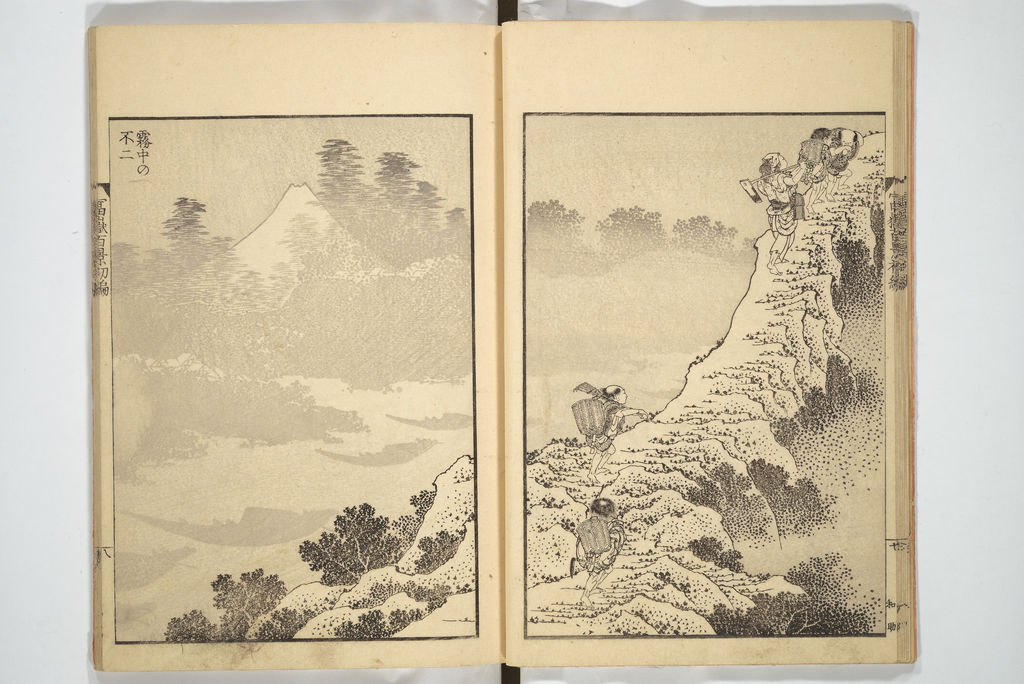
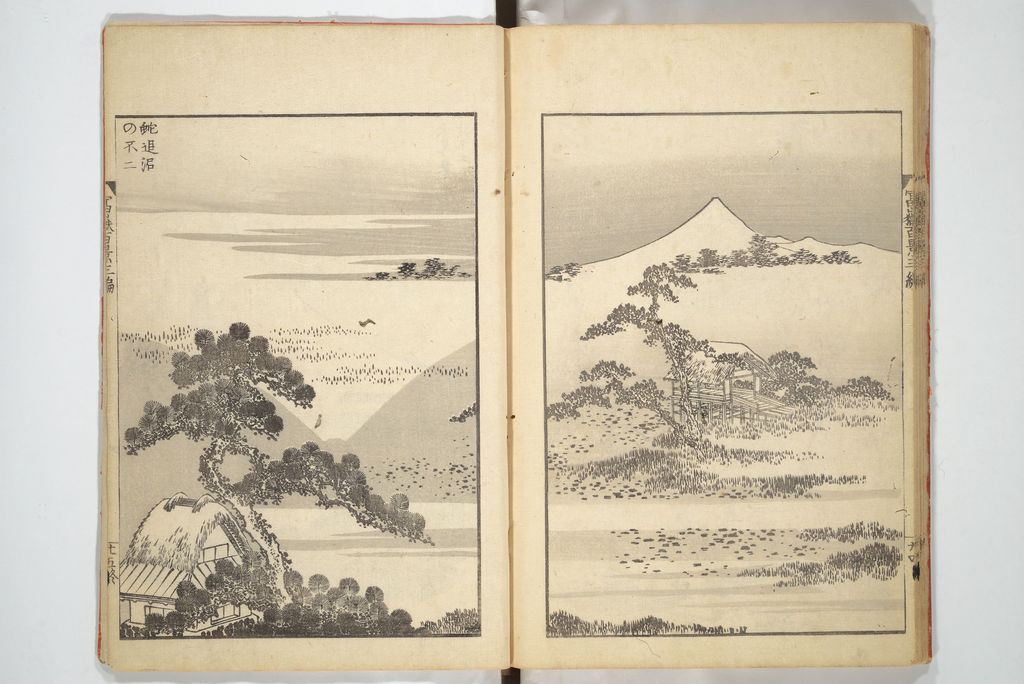
Hokusai, Fuji in Mist, volume one opening of One Hundred Views of Mount Fuji. Metropolitan Museum of Art, set 2013.732a–c; Open Access CC0. Exact printing of this copy unconfirmed.
 by Tom Gurney
Tom Gurney BSc (Hons) is an art history expert with over 20 years experience
Published on June 19, 2020 / Updated on September 23, 2026
Email: tomgurney1@gmail.com / Phone: +44 7429 011000
Hokusai’s One Hundred Views of Mount Fuji
Katsushika Hokusai's One Hundred Views of Mount Fuji (富嶽百景, Fugaku hyakkei) asks how many different ways one mountain can be seen. It is a sequence of three woodblock-printed books rather than a pile of one hundred separate colour sheets. Fuji appears through mist, across water, behind windows and nets, above travellers and beside the work of daily life. Sometimes the mountain is the largest form on the opening; elsewhere its outline is a small recognition at the end of a much busier journey for the eye. Japan's National Diet Library [1] records the first two volumes as published in 1834 and 1835. The Sumida Hokusai Museum [3] counts 102 designs in the whole work, so the round number in its title is not an exact count of illustrations.
This page follows the book as a book. The nine openings reproduced from one accessioned three-volume set at the Metropolitan Museum of Art [9] show how a design can occupy a facing pair of pages, how a changing frame makes Fuji new again, and how readers meet the mountain through the act of turning leaves. The volumes also give us a problem of dating: the third has no secure publication year. Rather than assign every page the same year, the article separates the first issues of the work, the particular books now in museum collections and the modern photographs made from those books.
Contents
- Hokusai’s One Hundred Views of Mount Fuji
- Annotated details: Fuji in Mist
- Explore the three volumes
- What kind of work is this?
- When were the three volumes published?
- Volume one: a sacred mountain and a mountain in mist
- Volume two: sea, work and framed views
- Volume three: nets, bridges and late uncertainty
- How black and grey do the work of colour
- Fuji through a later camera
- Why the book matters
- Continue exploring Hokusai
At a glance
- ArtistKatsushika Hokusai (1760–1849)
- Japanese title富嶽百景 (Fugaku hyakkei); some catalogues write 富岳百景
- FormThree bound, woodblock-printed illustrated books; primarily black and several greys
- First volumeMarch 1834, according to the National Diet Library [1]
- Second volume1835, according to the National Diet Library [1]
- Third volumeUndated in the NDL's bibliographic account [2]; institutions assign differing approximate dates
- Number of designs102, according to the Sumida Hokusai Museum [3] and British Museum [4]
- Illustrations hereNine digitised openings from the Met's set 2013.732a–c [9], plus one later historical photographic view of Fuji
Annotated details: Fuji in Mist
Follow four features across the first-volume opening. Select a numbered point to reach its explanation; select the detail image to enlarge it.
Details from FUJI IN MIST
Each enlarged detail comes from the retained 4,000-pixel Met scan, prepared as a 300 dpi working master before the site-sized JPEGs were made.
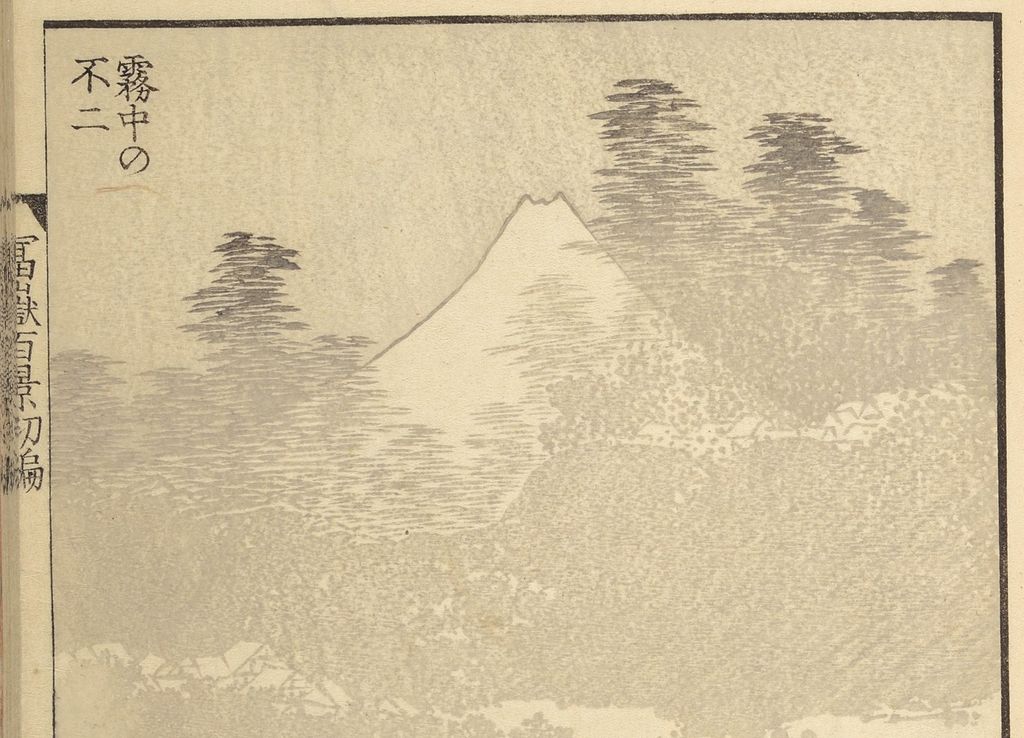
Fuji through mist
Pale grey bands partly conceal Fuji. The mountain comes into focus slowly, after the eye has registered the nearer ridges.
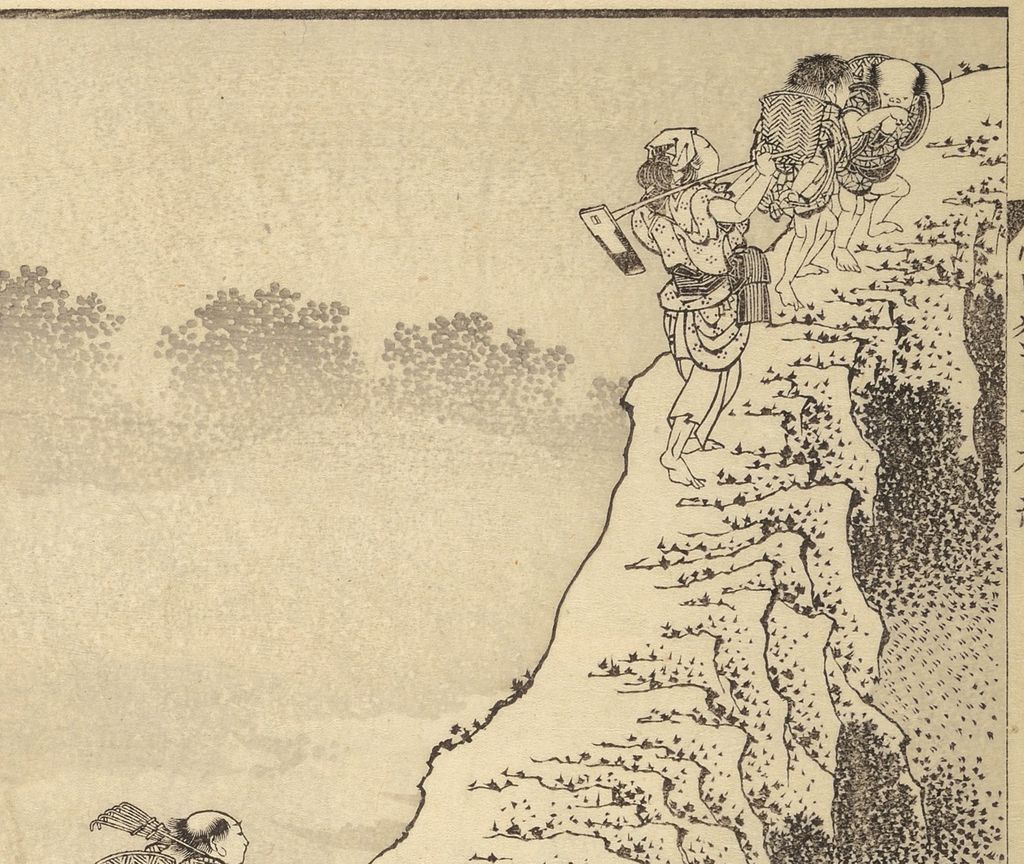
Travellers on the ridge
The figures at upper right make the steep route tangible. Their compact silhouettes differ sharply from the soft mountain beyond.
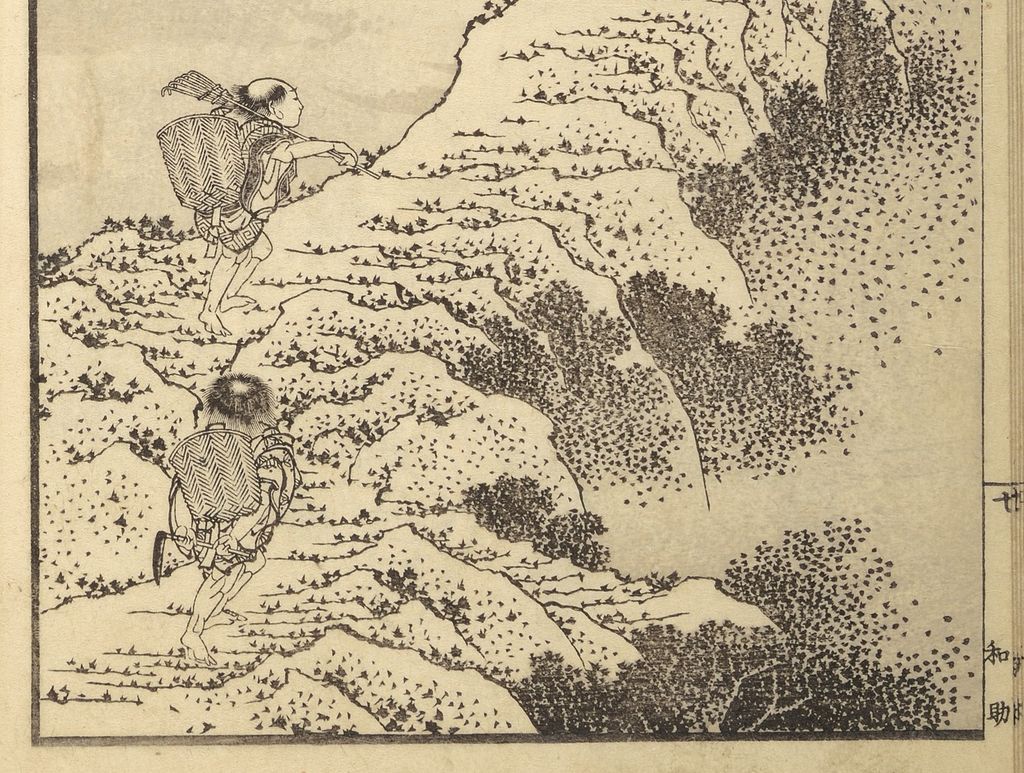
The climbing path
Figures at different heights carry the eye down the right page, then across the fold toward the distant summit.
The centre fold
The binding is part of the surviving book opening. The two facing pages work together, though the fold interrupts the image.
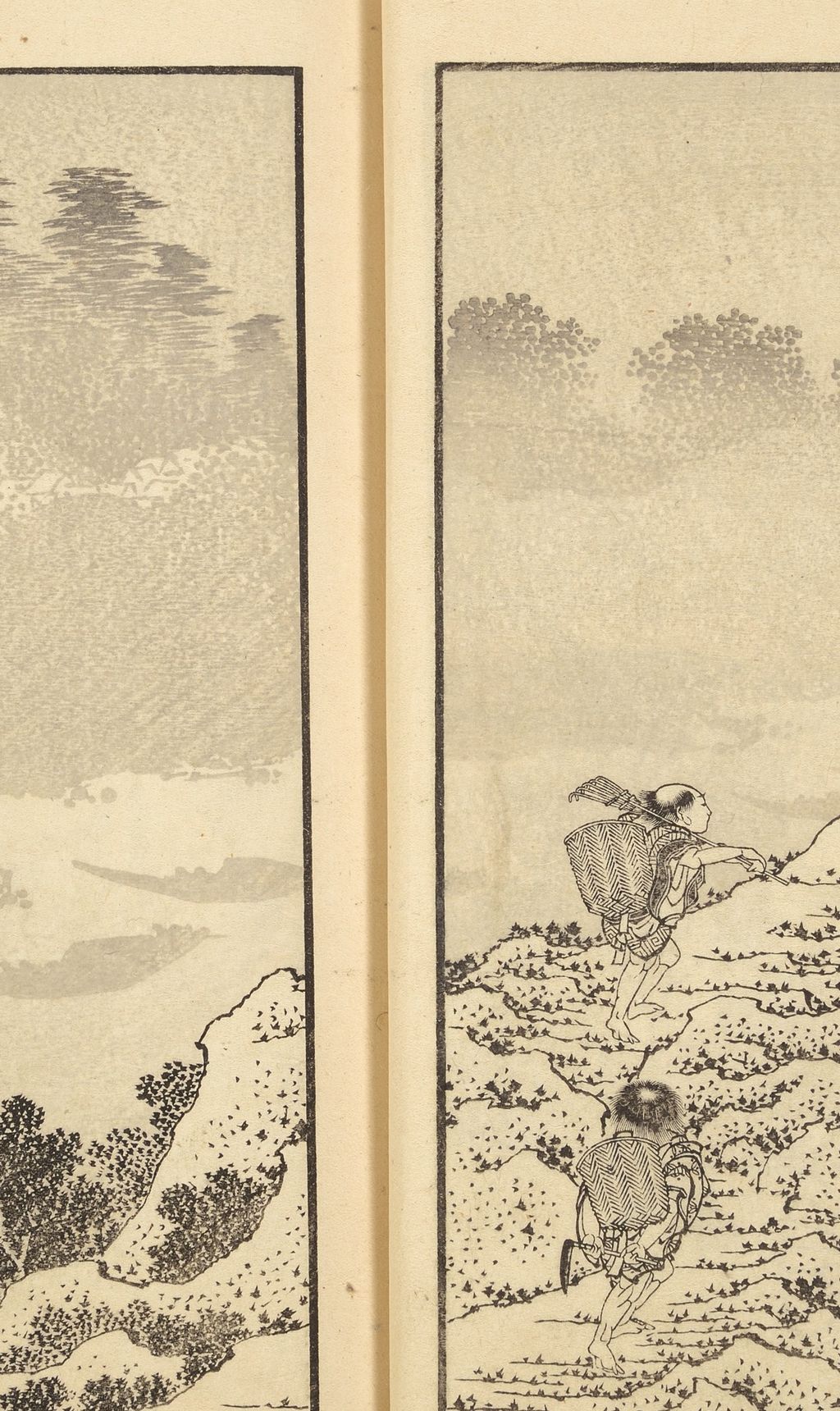
Hokusai, Fuji in Mist, volume one of One Hundred Views of Mount Fuji. The Metropolitan Museum of Art, 2013.732a–c. Detail crops from the full opening; source record and CC0 terms in references 9–10.
Explore the three volumes
Choose a volume to inspect three openings from the Met's set. Their volume letters in the museum's filenames provide a way to keep the digital views together, but do not by themselves establish the printing date of any surviving book. Each caption names what can be checked in the opening, and the original museum record remains available in the numbered references.
Volume 1
Volume 2
Volume 3
What kind of work is this?
Hokusai's earlier Thirty-six Views of Mount Fuji [4] was a colour-print series enlarged beyond its announced thirty-six designs. Its best-known sheet, Under the Wave off Kanagawa, was made to be read as a single horizontal image. One Hundred Views carries the subject forward in another physical form. The viewer handles a small book, sees black lines and graded greys rather than a broad field of Prussian blue, and encounters pictures in a sequence chosen for bound pages. The British Museum [4] describes the book's topography as less fixed than that of the earlier colour prints, with a wider range of composed visual surprises. That is a useful comparison, provided it is not inflated into the claim that the mountain in the book is imaginary. A real, recognisable Fuji remains the constant around which Hokusai invents ways of seeing.
The count also belongs to the design rather than to a modern gallery upload. A digital photograph may show a full opening with two facing pages; an opening may carry one image across the centre fold or pair different designs. Conversely, a library can scan covers, prefaces, colophons and blank leaves as well as pictures. None of those file counts answers how many views Hokusai devised. The Sumida Hokusai Museum's 102-design total [3] identifies the artistic programme, not the number of photographs in a Met or NDL viewer.
The paper object changes the tempo of looking. In the first-volume opening with Fuji in mist, a walker and sloping path occupy the right side while the mountain emerges beyond on the left. The viewer receives the approach and the revelation together when the book is open. A single isolated crop of the peak would lose the physical relationship between the human route and the distant shape. Japanese books of this period are read from what an English-language reader may call the back toward the front, with the right-hand page encountered first; the composition is not simply a left-to-right panoramic print divided in two. The facing pages, paper fold and order of turning are therefore part of the design.
The Met [9] catalogues the object used here as a set of three woodblock-printed books, with the credit line “Purchase, Mary and James G. Wallach Foundation Gift, 2013.” That statement identifies this physical set and its current collection. It should not be made to say that all copies had the same cover, paper or grey ink. The National Diet Library's description of its own three volumes [2] expressly calls its yellow-covered first volume a later printing. A book series could be reissued or assembled from volumes with different histories. Object-level language is essential when comparing editions.
When were the three volumes published?
There is strong agreement about the first two dates. The NDL Image Bank [1] specifies March 1834 for the first volume and 1835 for the second. Its bibliographic record [2] says that the earliest first-volume colophon it knows names Nishimura Yūzō and three other publishers. The British Museum's complete-book record [4] likewise assigns 1834 and 1835 to volumes one and two, and names a group of publishers that included Nishimuraya Yohachi, who had issued the colour Fuji series, and Nagoya's Eirakuya Tōshirō. This was a collaborative commercial publishing enterprise, not a private sketchbook handed directly from Hokusai to us.
Volume three is the difficult one. The NDL states simply that its publication year is unknown. The National Gallery of Victoria [6] dates it around 1839. The British Museum [4] prints a qualified “1849?” and explains that the earliest known imprints are undated and associated with Eirakuya, while some scholarship argues for an earlier date. An Ōta Memorial Museum exhibition checklist [7] uses around 1836 for some designs assigned to volume three. These are incompatible estimates, not a sequence of successive publication events proved by the objects. This page therefore dates the first two volumes clearly and leaves the third as an undated later volume with scholarly disagreement.
The issue is not a pedantic footnote. If the third book was issued within a few years of the second, its designs belong to one close period of Hokusai's late career. If a first issue came close to 1849, readers would see a much longer publishing interval, ending near his death. The visible pages alone cannot decide this. Nor can the Met's “ca. 1849” heading for its three-volume set [9] be moved onto each design: the record describes a collected object, while the NDL independently documents the first two publication years. The uncertainty is a reason to read copy-specific details and colophons carefully.
The books' material differences help explain why one catalogue date may not answer every question. The British Museum [4] describes first editions of the first two volumes with pink covers and distinctive falcon-feather title slips. It says the third volume appeared under a changed publishing arrangement and that its grey printing is less refined than the earlier pair. Those are descriptions of identified editions and copies. The later yellow first volume described by the NDL is not a contradiction: it is evidence that a reader can encounter the same design programme in a different printing. A responsible caption specifies the source copy or limits itself to the design.
Volume one: a sacred mountain and a mountain in mist
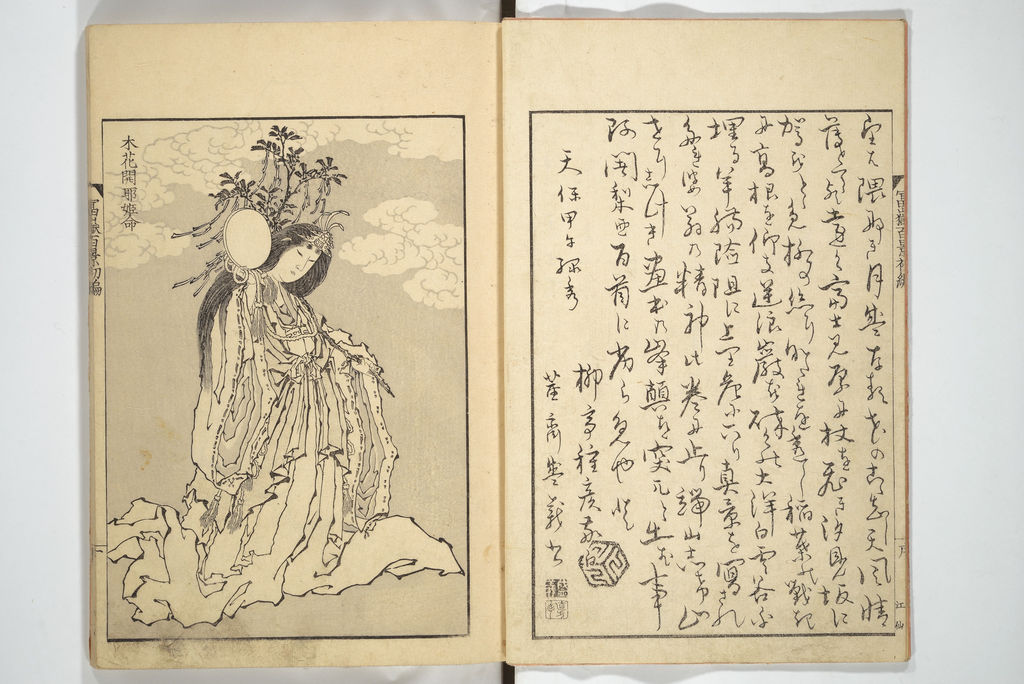
The opening of volume one introduces more than a geographical landmark. In the Met's digitisation, the goddess Konohanasakuya-hime appears among clouds opposite text. The British Museum's interpretation of its volume-one copy [5] identifies her as a deity associated with Fuji, carrying a mirror and a branch of sakaki. The page tells the reader that the mountain will not be just a distant cone on a map. It belongs to religious and imaginative experience as well as travel and observation. This interpretation is grounded in the pictured goddess; it should not be stretched into a claim that every following view has only one spiritual meaning.
That sacred opening makes the subsequent ordinary activities more interesting. Hokusai can bring Fuji into an image of movement, weather or labour without losing the mountain's distinct identity. The peak does not have to dominate a page to be felt as the subject of the book. Instead, it can wait beyond a path, complete an opening's balance or make a familiar activity seem newly situated. The viewer moves between awe and recognition. A person seeing the mountain through mist may be looking for a route or measuring the weather; the book's first image has already made another, symbolic reading possible.
In the opening titled 霧中の不二, “Fuji in the mist,” the near terrain is sharper than the mountain. A climbing or winding path guides the eye across human figures and rocky forms; grey intervals soften what lies farther away. Mist does not erase Fuji entirely. It makes its emergence an event within the page, and the mountain's triangular form becomes legible precisely because so much around it remains pale. This is a book opening well suited to slow inspection: the most famous subject is not handed over at the first glance. The Met's individual digitisation within set 2013.732a–c [9] permits the path, fold and distant contour to be studied together.
Another first-volume opening places an exposed landscape next to people and structures buffeted by wind. The movement is told through the way small bodies bend and the way lines lean, not through a large central Fuji. Black marks establish huts, trees and figures; the distant mountain is quieter. This is one reason the same black-and-grey palette can sustain so many views. Tone directs attention from a crowded foreground to an open far distance. The precise Japanese title of this Met opening has not been independently checked here, so its caption describes what is visible rather than supplying a confident-sounding but unverified translation.
Volume one also carries Hokusai's much discussed postscript. The Sumida Hokusai Museum [8] explains that he reflected on drawing since childhood while insisting that the deepest understanding of living forms and the fullest vitality of a brush mark still lay ahead. The British Museum [4] links the passage to his ambition to keep improving into very old age. These remarks belong to the book's artistic self-presentation. They are not a promise that every subsequent design can be dated from an imagined step in a personal progress chart. They make the project unusually explicit about an elderly artist's refusal to treat his practice as finished.
Volume two: sea, work and framed views
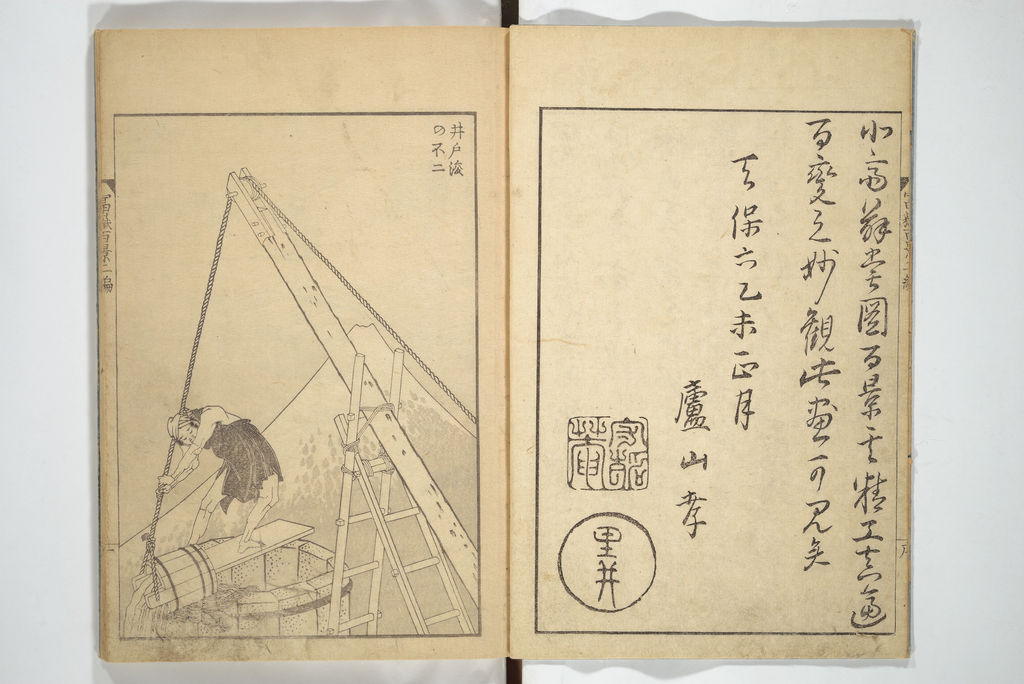
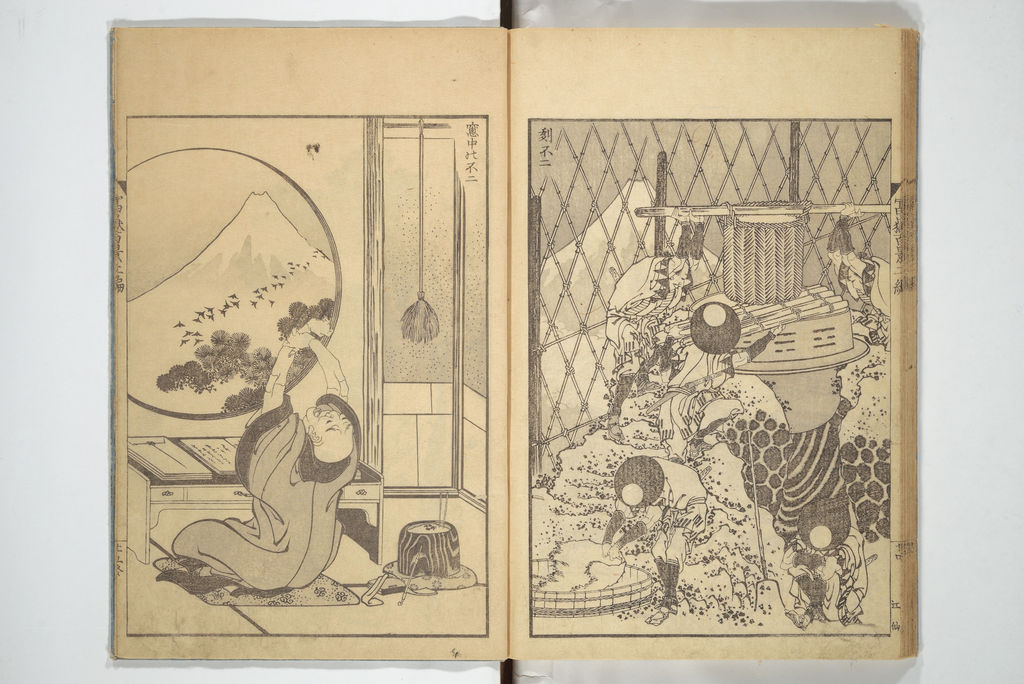
The second volume takes the same mountain into very different visual situations. One opening sets Fuji beyond a well mechanism and foreground work. The equipment interrupts a simple unbroken view, so the mountain is discovered through a device and a task. This is a recurring intelligence of the series: the foreground is rarely mere decoration. It decides who might see Fuji, how much of it is available, and what else occupies that person's day. The Met file shows a particular opening of volume two; because the tiny title has not yet been corroborated from a second institutional listing, the caption uses a descriptive label.
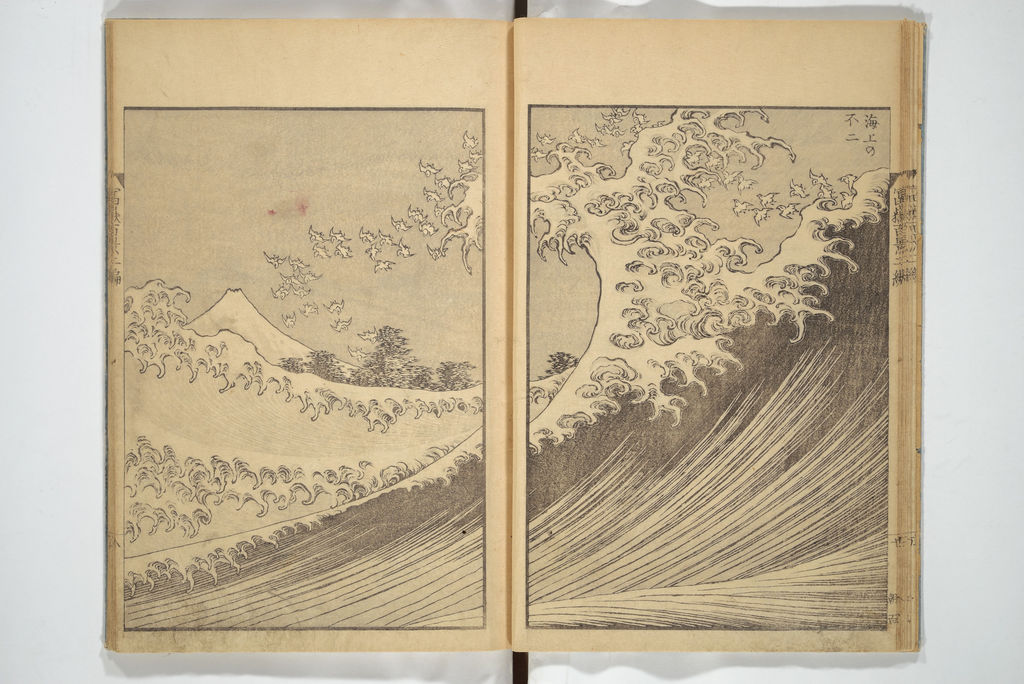
In 海上の不二, “Fuji from the Sea,” the mountain rises beyond energetic water. This is an especially useful opening to compare with Under the Wave off Kanagawa, but comparison must preserve the difference. In the colour print, a large wave reaches over boats toward a small Fuji and the sheet is a single public image. In this monochrome book view, lines and grey tones organise water and mountain within a bound opening. The presence of a wave is not enough to call it a second impression, a sequel in the same edition, or a direct copy of the earlier design. It is another solution to a problem Hokusai kept testing: how an unstable foreground can make a stable mountain feel distant, vulnerable or newly startling. The British Museum [4] sets the two Fuji projects in sequence while stressing the book's wider freedom of composition.
Water also reminds us that “view of Fuji” does not always mean a pinpointed site. Some titles supply a locality, but many openings favour an imagined relation between near form and far peak. The sea view has a horizon and a mountain recognisable to a reader; its interest is how the intervening water behaves. The book repeatedly changes scale in this way. Fuji can be large enough to seem a monument, or so small that a net, branch, wave or human structure supplies most of the page. The series is unified by recognition across those changes rather than by a traveller following one mapped itinerary.
The window opening, 窓中の不二, makes framing literal. A circular architectural opening contains the distant mountain while a human interior or nearby figure remains present. The edge of the window is a second outline against which Fuji's slopes can be read. The reader first notices the near circle, then sees the mountain through it; the object that could have obstructed vision becomes its means. This is one of the book's most direct lessons in looking. Hokusai makes an everyday built form into a visual instrument, yet the small distant mountain remains the named subject.
The adjacent opening in the Met photograph carries another design. This is a useful caution for readers of digitised books: a camera's full spread can contain more than one named view. Its file should not automatically be given the title of the design on only one side. The page gallery accordingly identifies the named window view and describes its companion separately. It links to the whole Met set, retaining the actual museum provenance rather than using a cropped anonymous scan as if it were an independent print.
Volume three: nets, bridges and late uncertainty
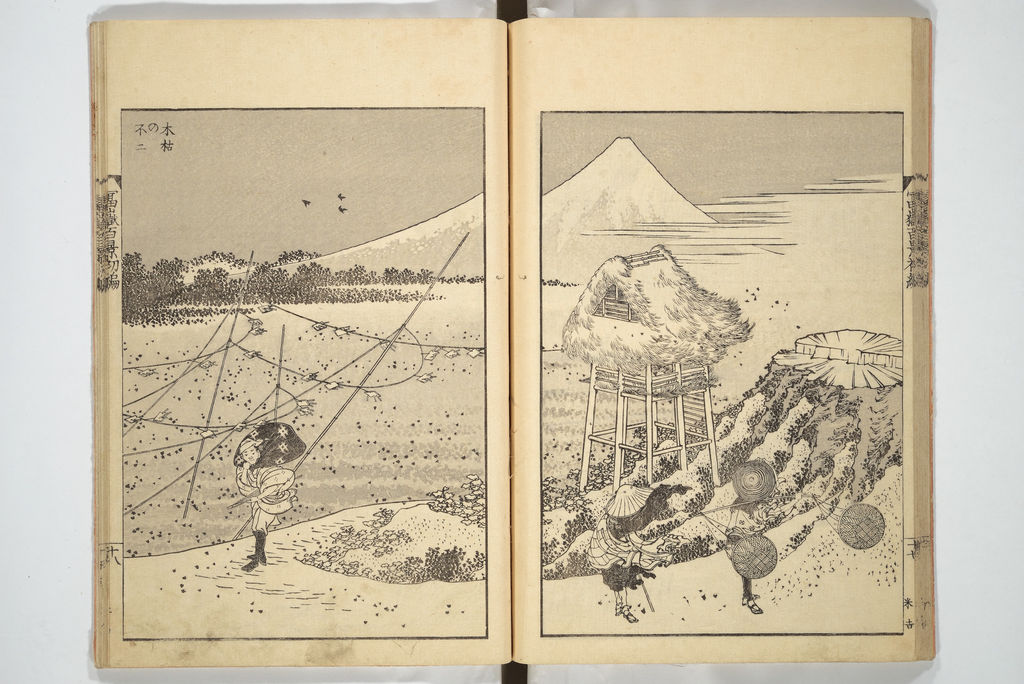
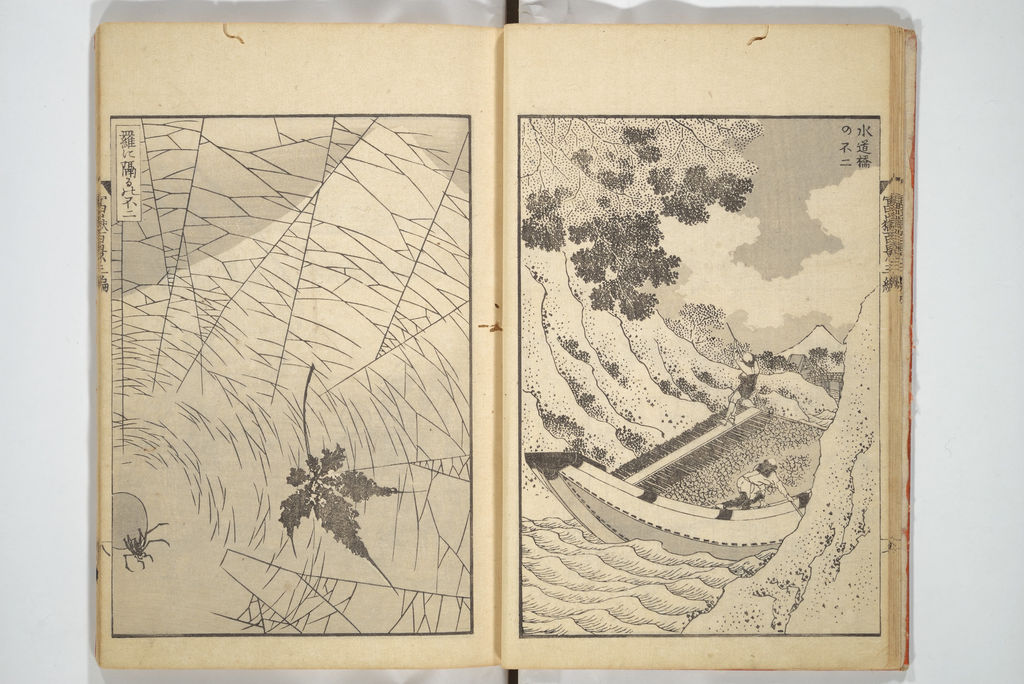
The third volume is visually inventive even as its chronology remains open. In a Met opening, a spider web spans much of the visible foreground while Fuji appears beyond; another design brings a bridge between us and the mountain. The web is a near lattice: delicate lines make us conscious of the space directly before our eyes. The peak beyond is simpler. The page asks the reader to hold two scales at once, the tiny construction of a spider and the enormous distant landform. This is an observation about the pictured forms, not a claim that the web was recorded at a known geographical coordinate.
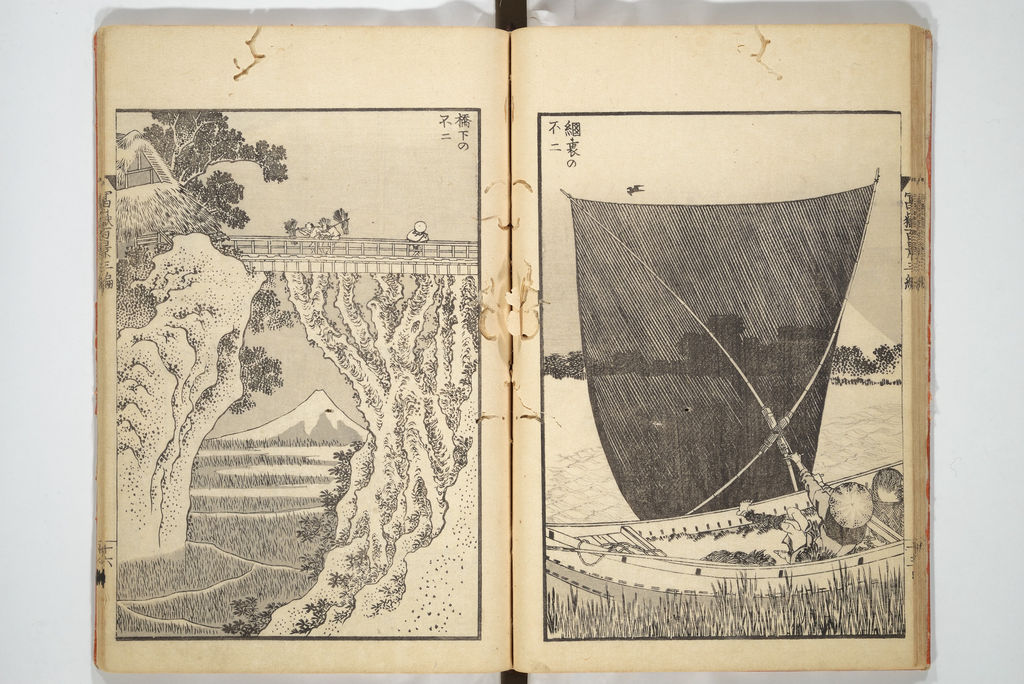
The opening that pairs 橋下の不二 (“Fuji under a bridge”) and 網裏の不二 (“Fuji behind a net”) makes the frame even more overt. A bridge is a route for people; a fishing net is a tool for work. Both become a grid in front of Fuji. The Ōta Memorial Museum's Japanese checklist [7] supplies the titles and places these designs in volume three. The difference between the two frames matters: one is permanent built infrastructure, the other a temporary arrangement made for catching fish. In both, the mountain is unchanged enough to be recognised, while the conditions of seeing it are highly specific.
The net view also keeps labour visible. A person who handles the net would not experience it as a picturesque frame made for a distant spectator; its lines are part of a task. Hokusai lets the reader enjoy a clever composition while still seeing evidence of what people do in the landscape. It would be too easy to make the book a catalogue of visual tricks alone. Across the volumes, figures walk, work, look and travel. They give the mountain a human measure without making it merely a backdrop for biography.
Near the end of the selected Met sequence, another view shows Fuji beyond modest buildings and open ground. Its unverified tiny title is not reproduced here. The picture's effect is quieter than the web or net: a low human shelter and the mountain share the page without a dramatic wave or a radiating frame. Such changes of intensity give a long book rhythm. The reader can move from an intricate novelty to a spare, calm arrangement. The volume's uncertain publication date does not prevent the visible ordering of those experiences from being described.
The Sumida Hokusai Museum [3] identifies a one-stroke Fuji at the close of the third volume. It is an apt endpoint for a project in which many elaborate frames have tested how little is needed for recognition. The selected Met files on this page do not reproduce that final leaf, so we do not label one of the images here as the one-stroke conclusion. The point belongs to the full book's documented sequence, not to a misleading caption on a different view.
How black and grey do the work of colour
The absence of the blue and red associated with Hokusai's colour Fuji sheets is not a lack of technique. The British Museum [4] attributes the carving to the workshop of Egawa Tomekichi and calls attention to the fine line and graded grey printing. Those processes turn a small opening into an image with many distances: a nearly black tree or net close to the viewer, softer middle ground, and a pale summit that can still hold the composition. If a scan makes every grey flat, some of this spatial effect disappears. Where possible, the gallery uses full Met page photographs rather than a stripped outline copied from elsewhere.
The division of work also matters. Hokusai is rightly named as the designer, but he did not single-handedly carve every line into wood and pull every sheet. Publishers organised the books, a specialist workshop cut blocks, and printers controlled impressions from them. The British Museum's object record [4] names publishers and the carver's workshop; the NDL record [2] preserves bibliographic clues in the colophons of its copies. The creative result depends on that chain. A line intended to look spontaneous might require exact cutting; a misty tonal area might depend on careful repeated printing.
The third volume presents a material question as well as a date question. The British Museum says its grey printing is less refined than the first two volumes of its set. That statement is valuable when looking at that object; it does not prove that every surviving third-volume page was printed at the same quality or that Hokusai changed his drawing ability. A modern photograph brings further variables: lighting, colour balance, paper tone and digital sharpening. This is why the gallery keeps the three volumes identified, preserves the original Met files and avoids declaring a first or later printing from a single online detail.
Fuji through a later camera
A historical photograph can offer a different encounter with the same mountain, but it cannot serve as a photograph of Hokusai's 1830s world. The Rijksmuseum's Mount Fuji seen from Tagonoura [11] is a collotype after a photographic view associated with Kazumasa Ogawa, dated approximately 1883–1893. In it a river leads the eye toward a hazy Fuji, with trees, small craft and a person on the water. The photograph is a later place record, not an identified camera view of 海上の不二 or any other opening reproduced above.
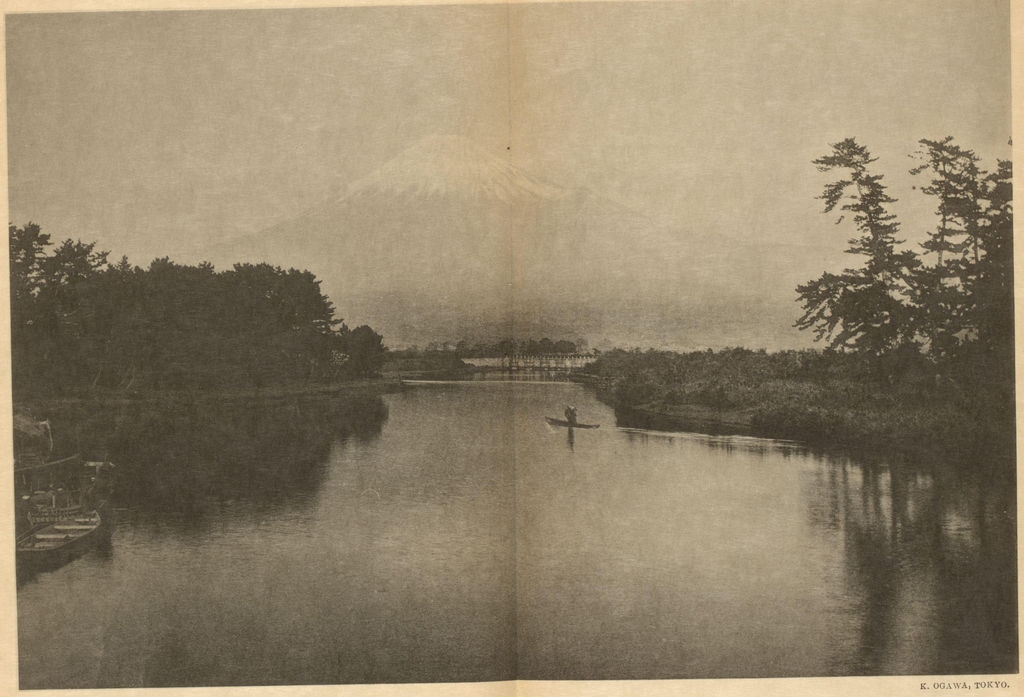
Its interest here is the act of looking across intervening space. The river and the far mountain are recognisable in one frame, yet mist, scale and foreground traffic affect the viewer's access to Fuji. That broad problem is shared with several of Hokusai's book designs. The image is shown as a disclosed crop of the photographic area of a published collotype leaf; the complete original remains retained. The Rijksmuseum object record [11] identifies the object as RP-F-2001-7-589-2 and marks it public domain.
Why the book matters
One Hundred Views develops the same subject through a different reading experience from the colour series. A person can return to a single Great Wave sheet, but a bound book makes one view lead to another, inviting memory of a window, a wave, a net or a path from a few leaves earlier. The repetition of Fuji is not mechanical. Each change in weather, scale, activity or foreground structure tests how the mountain can stay itself while the conditions of seeing alter. The National Gallery of Victoria [6] calls the three volumes Hokusai's fullest sustained treatment of one subject; the surviving design sequence gives concrete grounds for that judgment.
The book also joins personal aspiration to collaborative craft. Hokusai's first-volume postscript, as explained by the Sumida Hokusai Museum [8], imagines artistic growth continuing into ages he would never reach. The actual pages depended on other hands and on publishing decisions made across years whose exact sequence remains under study. Keeping those two truths together makes the book richer. We can admire Hokusai's ambition and close visual thinking while also noticing printers, cutters, publishers, copies and the limits of today's catalogue dates.
Continue exploring Hokusai
| Name | Date | Medium |
|---|---|---|
| Thirty-six Views of Mount Fuji | c. 1830–33 | Colour woodblock print series |
| Under the Wave off Kanagawa | c. 1830–32 | Colour woodblock print |
| Hokusai | 1760–1849 | Artist |
Frequently asked questions
No. The British Museum [4] describes Thirty-six Views as an earlier colour-print series that grew to forty-six designs. One Hundred Views is a later three-volume, predominantly black-and-grey illustrated book with 102 designs. Both return to Fuji, but their format and reading sequence differ.
No. The Sumida Hokusai Museum [3] and British Museum [4] give a total of 102 designs. The title uses a round number. Covers, colophons and photographed openings should not be counted as designs.
That date is sometimes assigned, but it is uncertain. The British Museum [4] gives 1849 with a question mark and discusses earlier proposals; the National Gallery of Victoria [6] uses c. 1839, while the National Diet Library [2] says the year is unrecorded. The page does not turn one estimate into an established publication date.
The Met [9] identifies its set and accession but does not establish that every digitised opening is a first printing. The NDL's separate set [2] includes a later printing of the first volume. A design date, a volume's initial issue and the printing date of one surviving copy are different facts.
The Rijksmuseum photograph [11] shows Fuji from Tagonoura many decades after the book's first volumes. It gives a later visual record of looking toward the same mountain across water. It does not identify the exact site or camera equivalent of Hokusai's sea design.
Discussion
Compare the pictured mountain with the paper book that carries it. The prompts below invite close looking at designs, editions and evidence.
Reader Insights
How does Fuji change when it is framed by a net, window, bridge or wave?
What becomes clearer when you see a full opening rather than a cropped individual design?
Which details of an individual surviving copy would help test the third-volume date?
Join the Conversation
Share the opening that changed how you saw Fuji, and the detail that made the difference.
References
- National Diet Library, NDL Image Bank, “Katsushika Hokusai's Fugaku hyakkei” (Japanese). Three monochrome volumes; first issue of volumes one and two.
- National Diet Library, catalogue record for Fugaku hyakkei, three volumes, bibliographic ID 000007314622 (Japanese). Third-volume date unrecorded, later printing in the displayed first volume, public-domain status of its digital set.
- Sumida Hokusai Museum, “Hokusai × Fuji” exhibition (Japanese). 102-design count and relation to the earlier colour series.
- British Museum, Fugaku hyakkei, three-volume object record, 1979,0305,0.454.3. Publishers, carver's workshop, volume dates and edition discussion.
- British Museum, Fugaku hyakkei, volume one object record, 1979,0305,0.454.1. Konohanasakuya-hime and the opening's spiritual framing.
- National Gallery of Victoria, Hokusai exhibition. Its c. 1839 assignment to volume three and interpretation of the project.
- Ōta Memorial Museum of Art, Fuji exhibition checklist (Japanese). Selected design titles and an alternative dating of third-volume items.
- Sumida Hokusai Museum, “About Hokusai” (Japanese). First-volume postscript and Hokusai's ambition for continued artistic improvement.
- The Metropolitan Museum of Art, One Hundred Views of Mount Fuji, accession 2013.732a–c. Exact digitised set supplying the nine book openings on this page.
- The Metropolitan Museum of Art, Open Access image policy. Reuse terms for Met public-domain files.
- Rijksmuseum, Kazumasa Ogawa, Mount Fuji seen from Tagonoura, RP-F-2001-7-589-2. Later photographic collotype, c. 1883–1893, and individual public-domain status.