


 by Tom Gurney
Tom Gurney BSc (Hons) is an art history expert with over 20 years experience
Published on September 23, 2026 / Updated on September 23, 2026
Email: tomgurney1@gmail.com / Phone: +44 7429 011000
Katsushika Hokusai: a life in prints, books and painting
Katsushika Hokusai lived from 1760 to 1849, through a long working life in Edo, now Tokyo. Many readers meet him through Under the Wave off Kanagawa, but he was already an established designer of prints and books before it appeared. He worked under changing art names, collaborated with writers and publishers, taught through drawing manuals, and turned increasingly to painting in his final decade. The Sumida Hokusai Museum's life chronology [1] divides his career into seven overlapping phases. The British Museum's timeline [2] independently places the Fuji prints within a career that already included theatre imagery, verse prints and illustrated books.
A biography of Hokusai also has to live with gaps. Some familiar episodes survive as later reports rather than as documents from the event. His adoption in childhood, his departure from the Katsukawa school and a possible illness in the 1820s cannot all be explained with the same certainty as the date on a surviving publication. His daughter Ōi was an artist and collaborator in the family workshop, not simply a character in a tale about an eccentric father. The objects and records below allow a fuller account, with the uncertain parts still visible.
Contents
At a glance
- Born and died1760–1849, in the Edo area; the museum locates his birth near Honjo Warigesui in today's Sumida
- Age at death89 by Western counting, 90 by the Japanese counting-age convention then used
- Main placeEdo and especially the Sumida area, with documented travel including Nagoya and a late stay in the Nagano region
- Main practicesColour woodblock print design, surimono, illustrated books, drawing manuals, drawings and paintings
- Important art namesShunrō, Sōri, Hokusai, Taito, Iitsu and Manji; names can overlap and change in longer signatures
- Family and workshopArtist daughter Eijo, known as Katsushika Ōi, worked with him in later decades; other daughters and pupils also participated in the workshop
- Best-known projectsHokusai manga; Thirty-six Views of Mount Fuji; One Hundred Views of Mount Fuji; late paintings and unfinished picture-book drawings
Seven phases of a working life
The phase labels below are guides, not airtight boxes. A name could continue to appear after another was adopted, a book could be printed after a drawing was made, and a subject might recur decades later. The Sumida Hokusai Museum [1] presents the sequence as a way to understand shifts in work. It also warns that its reported ages use traditional Japanese counting, starting at one. A modern reader should not subtract these ages from a year and assume an exact Western birthday.
1760–1777: Honjo, childhood and apprenticeship
The Sumida Hokusai Museum [1] locates Hokusai's birth near Honjo Warigesui and reports the childhood names Tokitarō and later Tetsuzō. It says he was adopted by Nakajima Ise, a maker or polisher of mirrors associated with the shogunal household, and that he spent time around a book-lending business and woodblock engraving before entering formal art training. The museum's repeated “is said” matters. The British Museum [2] agrees that the adoption occurred but says its reason is unknown. These details sketch the world of books and carving in which he grew up; they do not document a single childhood moment that predetermined his later career.
Edo's printed images depended on a division of labour. A designer, woodblock carver, printer and publisher might all be needed before a print reached its first buyer. Hokusai's reported early engraving work would have made that process familiar, but it is not evidence that he personally cut every block for his later prints. This distinction is crucial when we look at the crisp lines of a mature Fuji sheet. His hand designed the image; trained specialists and repeated printing transformed the drawing into an edition. The British Museum's description of the trade [5] makes those collaborators visible.
1778–1794: Shunrō and the Katsukawa school
By the late 1770s Hokusai was in the studio of Katsukawa Shunshō, a leading designer of actor prints. He used Shunrō and made theatre images, sumo subjects and illustrations for popular writing. The Sumida museum [1] dates this phase from his print debut in 1778 to his departure in 1794. A viewer should resist treating it as an embarrassing prelude to landscape art. Actor images had their own demanding conventions for likeness, gesture, costume and serial production, and they taught the young artist how a recognisable figure could carry a design.
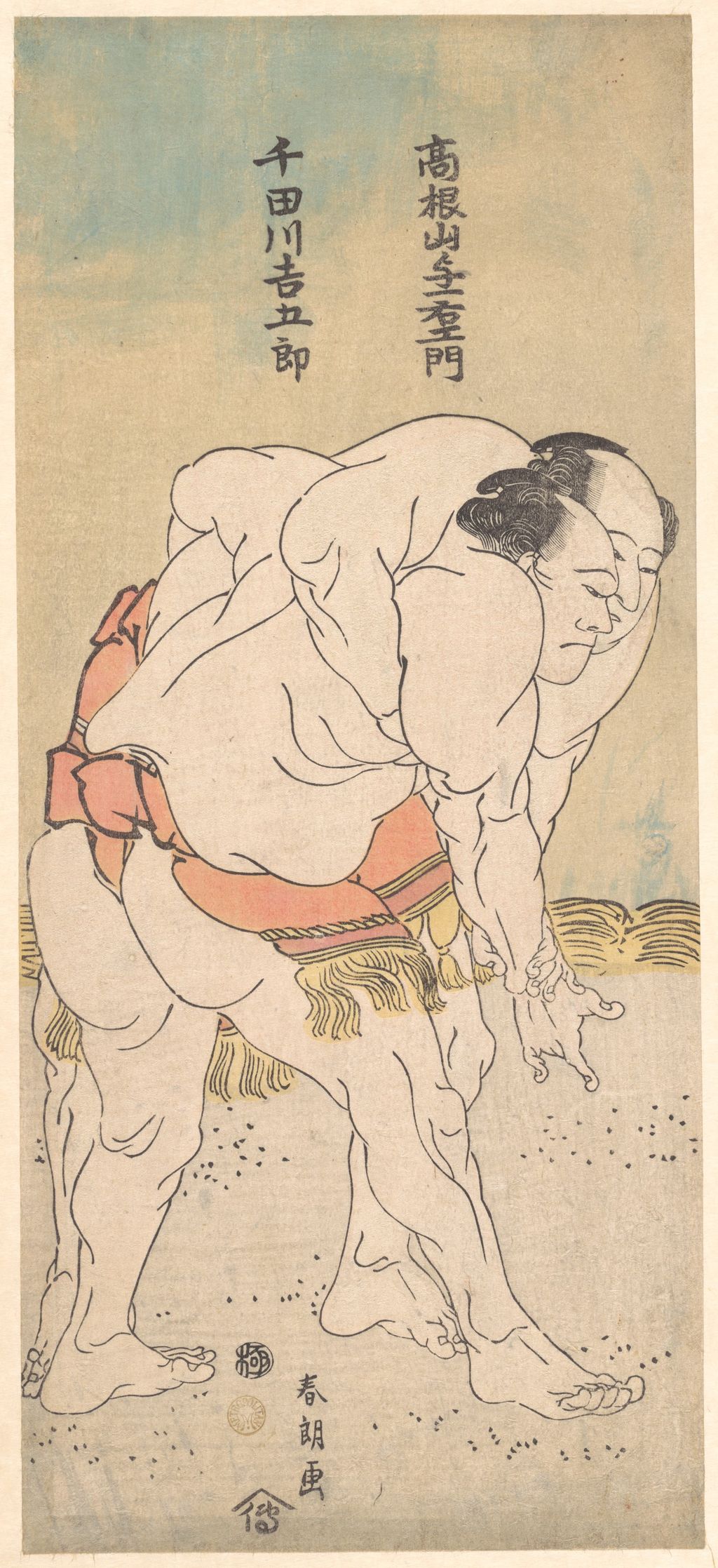
The Met's The Sumo Wrestlers Takaneyama Yoichiemon and Sendagawa Kichigorō, JP741 [7], is dated about 1790–93 and signed Shunrō. Its narrow format and wrestling subject demonstrate that the early artist's work cannot be described simply as pictures of Fuji waiting to happen. The Met notes the name on the print and compares his treatment of the sport with earlier examples. The physical Met sheet, with its own paper and history, is the object reproduced here. It gives us stronger evidence of this phase than a later generalisation about what Hokusai “must have” wanted from his apprenticeship.
Shunshō died in 1793, and Hokusai left the Katsukawa school soon after. The British Museum timeline [2] states that the reason for his expulsion is unknown. Later accounts can make the break sound like an inevitable declaration of artistic freedom, but the documentary gap should remain. What is visible in the work is a subsequent shift toward verse circles, books and a different name.
1794–1804: Sōri, poetry circles and independence
From the mid-1790s Hokusai joined circles that made kyōka, witty verse, and designed privately commissioned surimono and illustrated poetry books. He took the name Sōri in a setting connected to Edo Rinpa, then passed it to a pupil in 1798 and used forms of Hokusai. The Sumida museum [1] and the British Museum [2] agree on the broad shift, though a signature can be longer or more variable than a neat timeline label. His adoption of Hokusai was tied to devotion to Myōken and the North Star. A name was part of artistic identity and social affiliation, as well as a useful clue for modern dating.
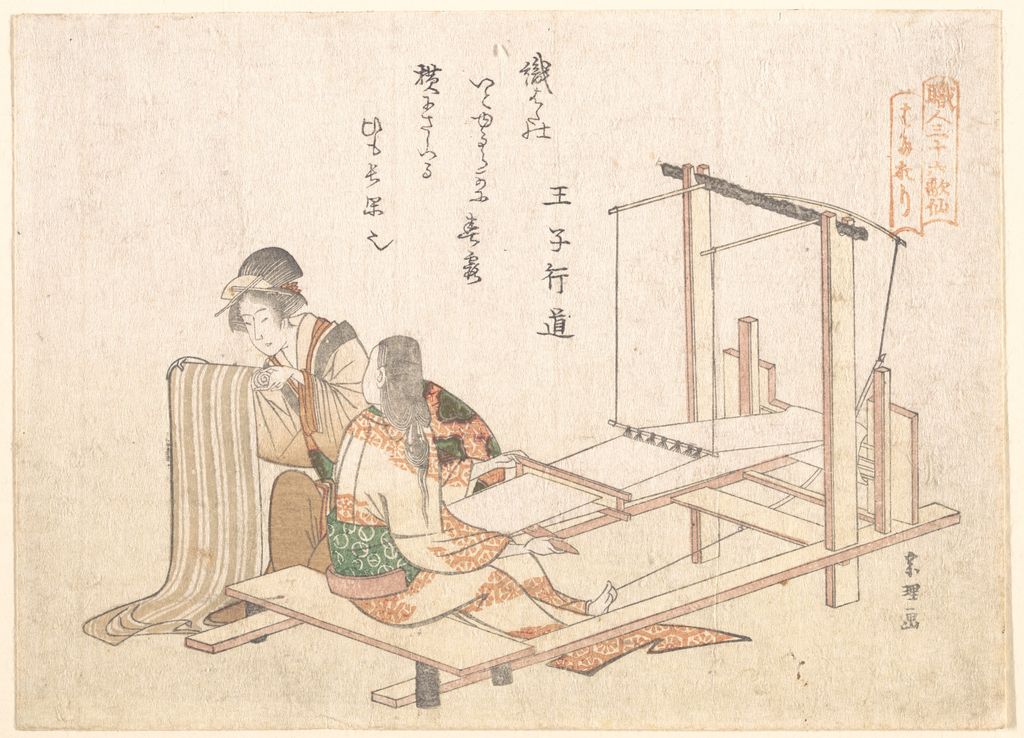
Privately commissioned prints addressed readers who could appreciate the combined image, verse, allusion and finish. In the Met's The Weaving Factory, JP2575 [8], dated about 1802, a work scene sits with printed poetry. Its small scale asks for close reading. The image's material and words remind us that Hokusai's audience was not a faceless future crowd of museum visitors. Some works were made for particular gatherings, while his commercial books could reach a much wider network of readers.
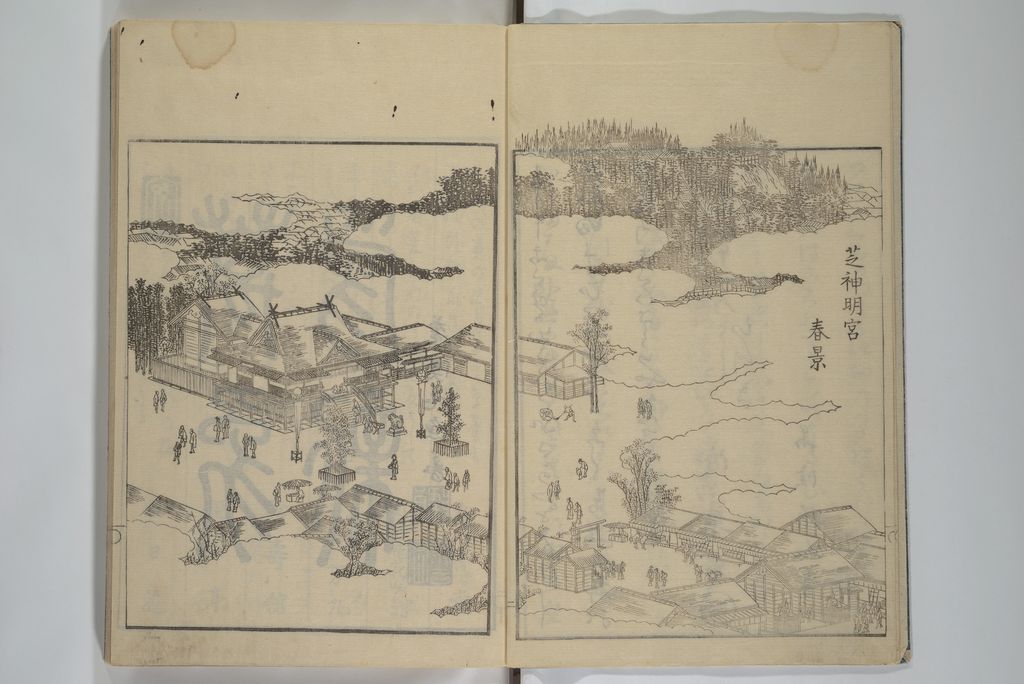
The Met's Picture Book of the Pleasures of the East, 2013.711 [9], gives another view of the same years. The 1802 book opening shown here places an Edo scene across two leaves. Even if one can lift a digital page from its binding, the reading experience depended on sequence and a central fold. The book belongs to Hokusai's early maturity rather than to the late landscape-print boom. It also grounds an important biographical fact: his success in 1800–10 was built in part through books, as the British Museum timeline [2] makes clear.
This work also ties a life to a city. Edo was not merely Hokusai's address. Its bridges, shops, entertainments, religious sites and river traffic furnished subjects and prospective buyers. The Sumida Hokusai Museum [6] emphasizes his sustained association with the Sumida area, while the 1802 book makes a city's pleasures into a sequence of views. Books could travel beyond the neighbourhood in which they were conceived. That helps explain how the artist could be strongly rooted in Edo and still become widely known in Japan long before international collectors made his prints famous abroad. A biography should therefore follow both where he worked and how a printed object travelled after leaving a publisher.
1804–1812: fiction, public demonstrations and broad recognition
Hokusai's work with popular illustrated fiction increased in the 1800s. He collaborated with the novelist Kyokutei Bakin, whose Strange Tales of the Bow Moon appeared from 1807 to 1811. The British Museum [2] identifies that collaboration as one route to wider Japanese attention, while the Sumida museum [1] stresses his use of varied ink density and daring space in yomihon illustrations. The artist was responding to pages that had to sustain narrative over many openings, not just a single framed composition.
The British Museum also records public painting demonstrations and a performance before the shogun. These are evidence of a recognised painter in the 1800s. Some retellings focus on an immense Bodhidharma made with a huge brush, but reported dimensions vary. The historically useful point is the documented place of performance in his reputation; an unsupported exact size would add spectacle without accuracy. By this stage, he had repeatedly changed how and for whom he worked. The international fame of The Great Wave came later, but Japanese recognition had not waited for it.
1812–1829: manuals, the Manga and years of uncertainty
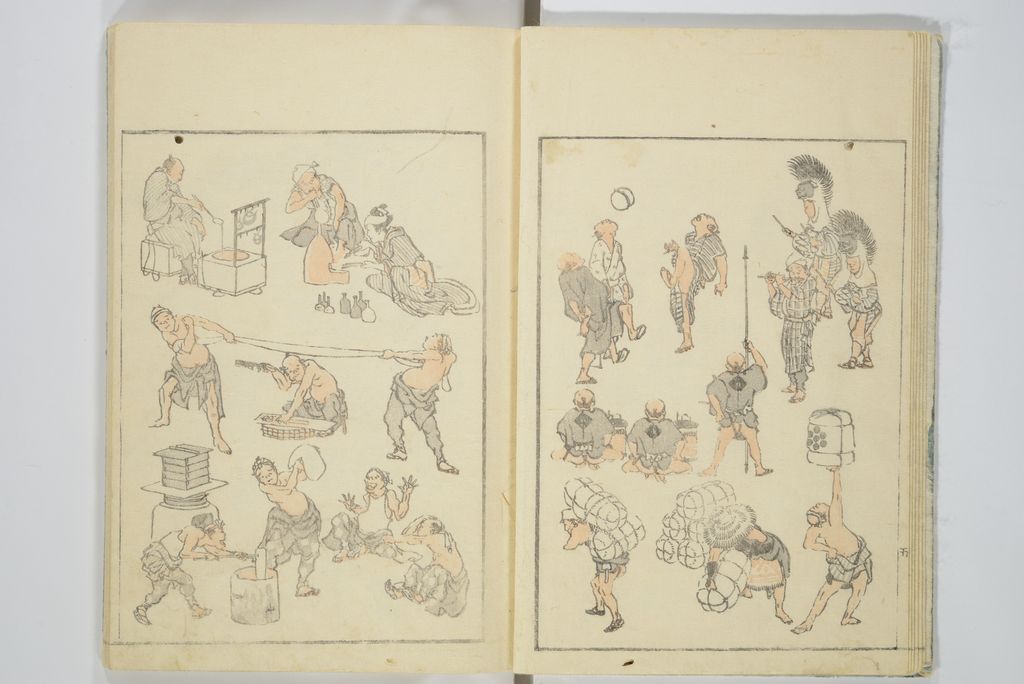
Around 1810–12 Hokusai developed books that taught and displayed drawing. The British Museum timeline [2] dates Basic Instruction in Sketching to 1812 and describes his journey that year to Nagoya, where he met Maki Bokusen and other painting enthusiasts. Drawings from this activity helped feed the series known as Hokusai manga. The first volume appeared in 1814; later volumes continued well beyond Hokusai's death, with the fifteenth published in 1878. The Met's fifteen-volume set, 2013.720a–s [10], contains a first-volume opening reproduced here. Its small figures and varied poses show a book to browse, copy, discuss and revisit. The historic title does not make it a modern continuous-story comic; the British Museum's explanation [11] keeps that distinction clear.
Books like these also extended his reach through pupils and readers who might never buy an expensive individual painting. The Sumida museum [1] says drawing manuals served not only as pictures to look at but as design patterns for other crafts. They are therefore both artworks and tools in an active visual culture. Their many printed leaves should not be counted as if every digitised file were a distinct original composition; editions and later impressions also need to be separated from the date of an initial drawing.
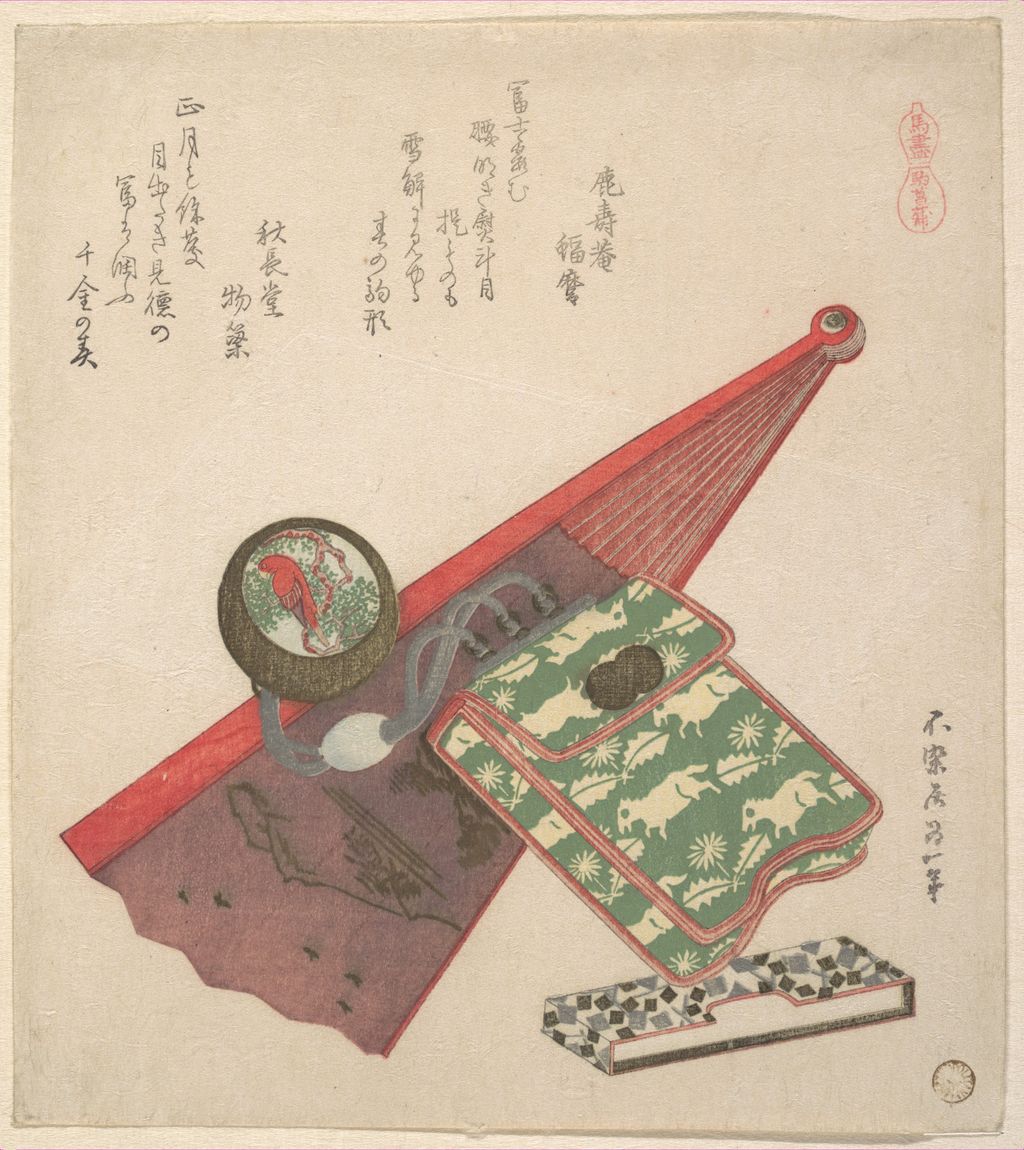
The name Iitsu, “one again,” marked Hokusai's entrance into another sixty-year calendrical cycle around 1819–20. The Met's 1822 Horse Pattern, JP1393 [12], makes the name concrete: its playful signature describes Iitsu painting in his “Nonpainting Studio.” The print belongs to a set for the Year of the Horse, though its pictured fan and tobacco pouch are not literal horse portraits. It preserves the wit and social code of surimono in a decade often described only through hardship. A lull in known commissions later in the 1820s should not make this inventive early-1820s work vanish from the life story.
The British Museum [2] reports family losses, money difficulties linked to a grandson and a possible stroke in the 1820s. Relatively few works are known from the middle and later part of that decade. These facts warrant an honest pause, not an invented account of artistic collapse. Survival of works is uneven, and a medical diagnosis cannot be made certain by repetition in modern summaries. By the decade's end, Eijo, who worked as Katsushika Ōi, had returned to work with him after a failed marriage. Their shared final decades need their own place in the narrative.
What “few known works” means also depends on the form being counted. A surviving single-sheet print, an illustrated book whose blocks were reused, a sketch in a later volume and a painting preserved by a patron enter catalogues through different routes. The Met's Hokusai manga set [10] itself bears the broad date 1814–78 because its volumes were published over a long period; that range is not a claim that Hokusai lived until 1878. Similarly, the 1822 Horse Pattern is an exact object from a named occasion, while an undocumented story about a quiet year cannot explain all the images that may have been made or lost. The biographical timeline is strongest when it says what an object and its record actually date.
1830–1835: colour landscapes and Fuji books
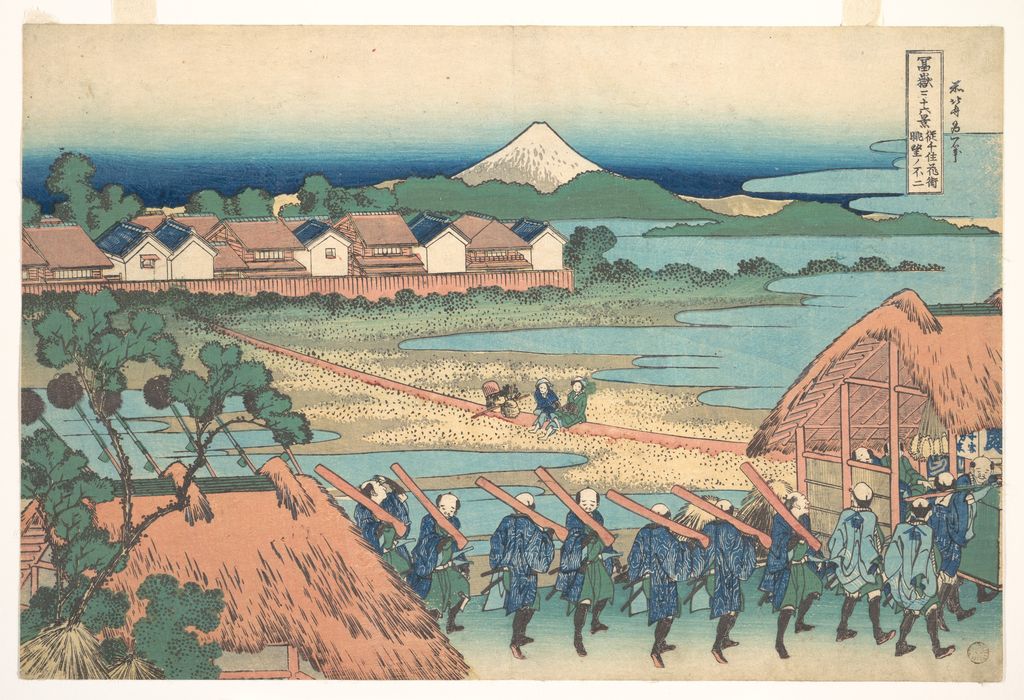
Commercial publishers again commissioned Hokusai heavily around 1830. The British Museum timeline [2] describes the renewed prints as landscapes and bird-and-flower designs, many with roots in earlier books. Thirty-six Views of Mount Fuji was issued around 1830–33 and ultimately contained forty-six designs. The Met's Fuji Seen in the Distance from Senju Pleasure Quarter, JP1326 [13], offers a useful counterweight to the famous wave: a group of people and built space command the foreground while Fuji is a distant landmark. A series could make the mountain recognisable through radically different viewpoints and scales.
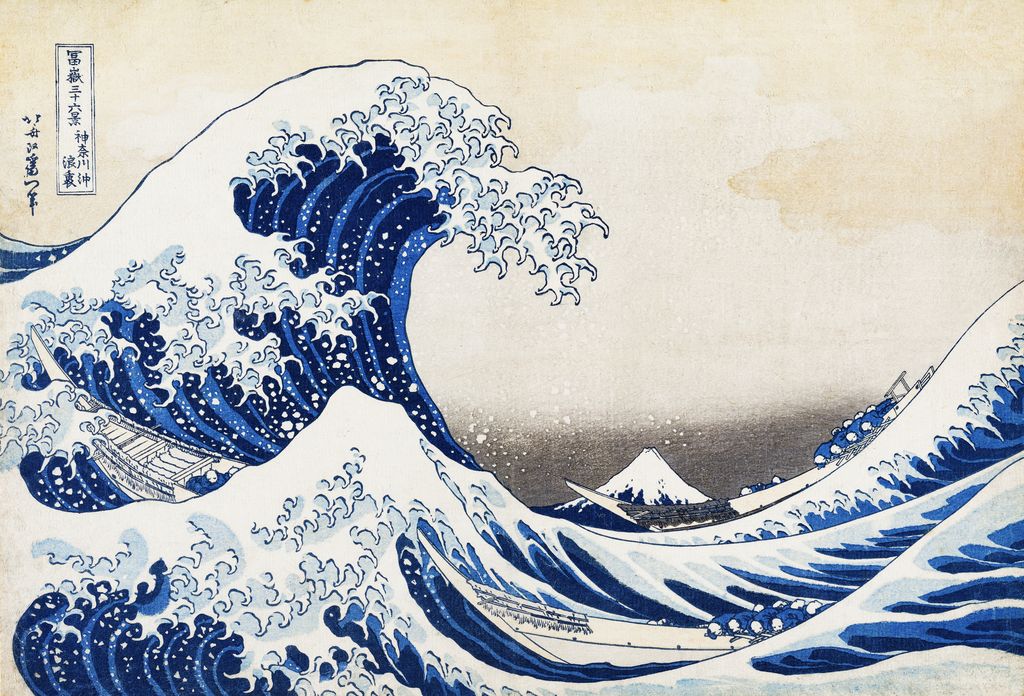
Under the Wave off Kanagawa became the best-known design from the colour series. The image shown here is a public-domain reproduction of that design, with its physical impression unidentified. The Met's accessioned example [14] provides a secure museum comparison; it is not the source of the displayed sheet. The dedicated Great Wave study follows exact impressions and their differing details. In a biography, the sheet matters because it was part of a late-career renewal, not the first occasion on which Japan noticed Hokusai.
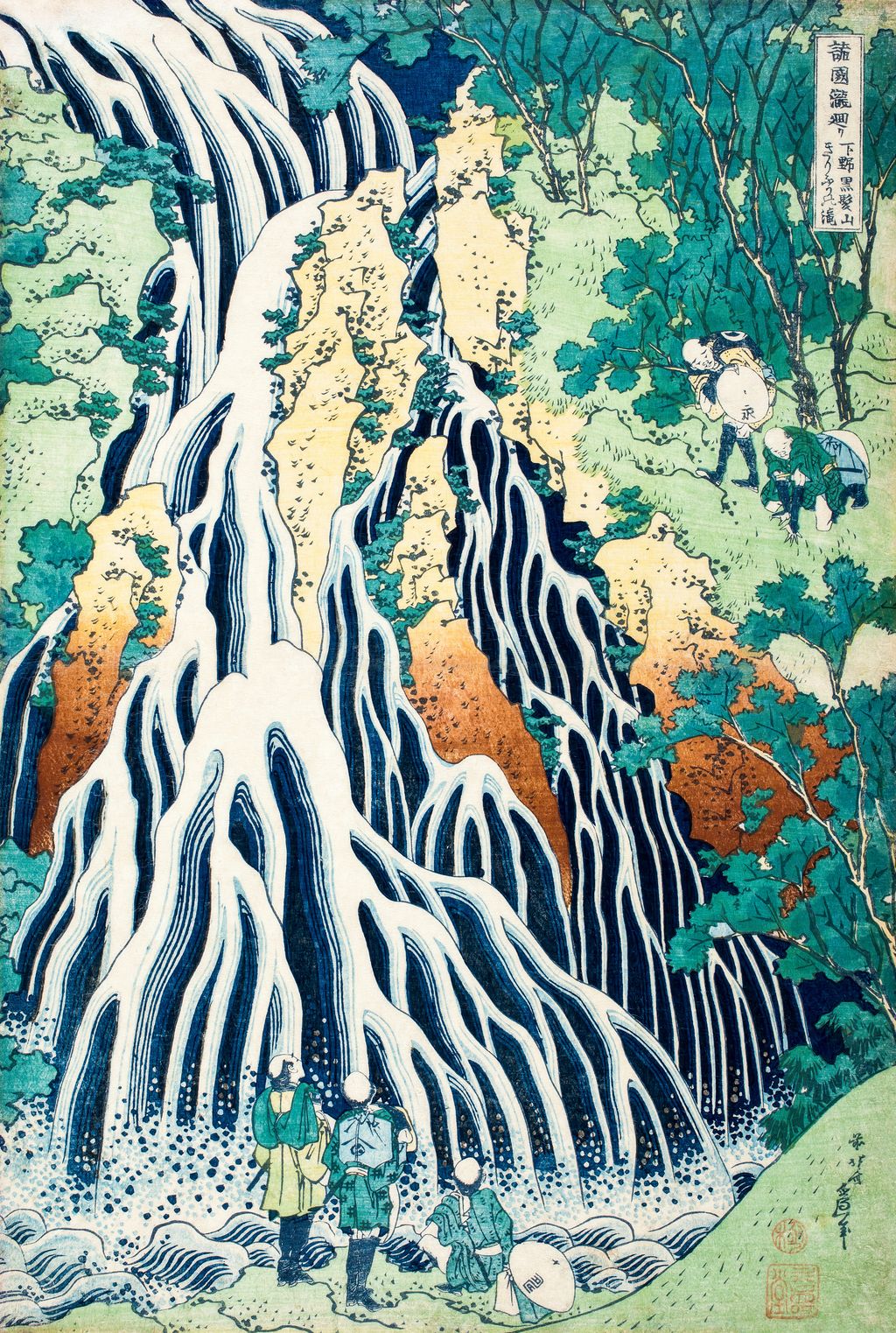
His subjects spread beyond Fuji in the early 1830s. A Tour of Waterfalls in Various Provinces turns falling water into markedly different compositions. The Met's Kirifuri Waterfall object [15] verifies the design shown in the reproduction here, whose physical impression is unidentified. Looking closely, the white branches of water and tiny travellers tell different stories at once: the scale of a site and the act of moving through it. Its place name is a research lead, not proof that every stone or path matches a modern camera view. An old photograph of a named site can be shown alongside such a work only when it is precisely identified and dated as later.
In 1834 Hokusai began the black-and-grey illustrated books One Hundred Views of Mount Fuji. Their first two volumes are dated 1834 and 1835 by the National Diet Library [16]; the third volume's date is debated. The site's book-series study explains that evidence and shows complete Met openings. The book is neither the same project as the colour Thirty-six Views nor simply one hundred single-sheet prints. By bringing printers, carvers and binders into a long sequence, it also shows the artist continuing to work through a medium that had supported him for decades.
1836–1849: painting, Ōi and unfinished ambition
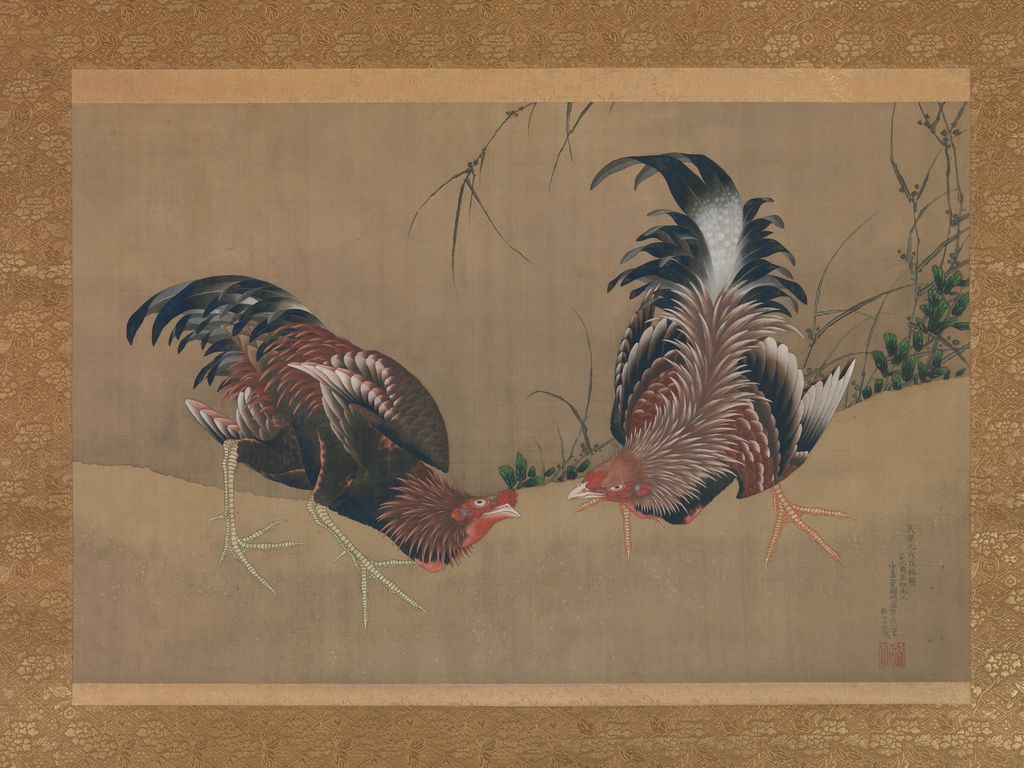
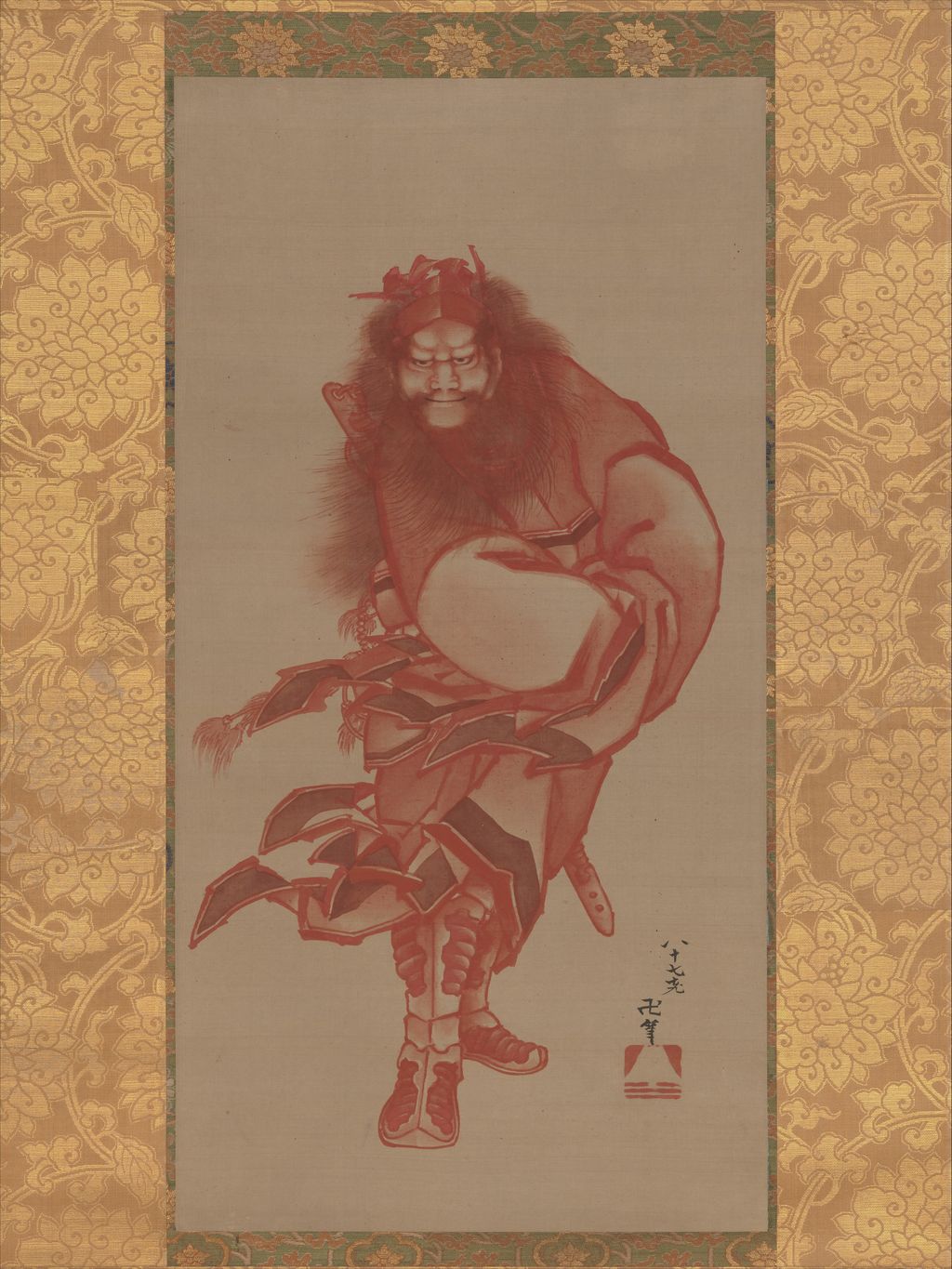
Hokusai increasingly painted and drew for direct viewing in his final years. The Met's Gamecocks, dated 1838 [17], is a hanging-scroll painting of birds, a subject far from the scale and hue of Fuji. Its signature and exact object record allow it to anchor this stage without an assumption that printmaking ended on one date. The Met's Red Zhong Kui, the Demon Queller, 14.76.37 [18], dated 1846, depicts a protective figure in emphatic red on silk. These two dated paintings make the claim of an inevitable late decline hard to sustain. They show changed purposes and media as well as continued technical control.
The work of Eijo, known as Ōi, was part of this period. Julie Nelson Davis's British Museum essay [4] describes her as a skilled artist in her own right, trained within a family workshop in which other daughters also helped. She returned after her marriage ended and worked near her father during his later decades. Davis discusses later testimony and the possibility of collaboration or an uncredited “ghost brush,” while avoiding the claim that every painting signed Hokusai can be reassigned to Ōi. The British Museum's book research [19] also frames her role in some unpublished drawings as an open question. This uncertainty is a reason to give Ōi her name and agency, not to erase her from the studio.
Davis records that Ōi grew up learning work needed in a painter's household, from preparing materials to composing images. After her marriage to a pupil of her father ended, she returned to the family workshop in the late 1820s; later accounts remember her proximity to Hokusai in their rented rooms. These details matter because “studio assistant” can hide a range of skilled tasks. It also assumes a single master's mark tells us whose labour touched every part of a work. The evidence does not let us rewrite object labels wholesale, but it does support a more honest model of a shared working environment. Ōi produced independent images and books, and Hokusai is reported to have praised her ability with pictures of women. She belongs in the account both as a maker of her own art and as a close participant in his final working years. Her signed works deserve to be read on their own terms, rather than as an appendix to her father.
Hokusai had patrons as well as publishers. The British Museum timeline [2] records at least one extended stay with the merchant Takai Kōzan in the mountainous Nagano region in the 1840s. That visit complicates the picture of an artist fixed in one cramped Edo room. The Sumida museum [6] says he spent most of his life in the Sumida area and reports that he moved residence many times; “more than ninety moves” should remain a reported tradition, not a verified address count. Working locations, patrons and family support shifted even when Edo remained his centre.
His ambitions also outlasted finished publications. The British Museum's Great Picture Book of Everything research [5] documents 103 block-ready drawings for an encyclopedia-like project that was not published as intended. Surviving letters to a publisher point to continuing work into his final years. The drawings offer rare access to designs before a woodblock cutter translated them into relief blocks. They also resist the tidy story that Hokusai spent the 1840s only painting scrolls. He could pursue books, drawings and paintings at once, even when a planned edition never appeared.
The Sumida chronology [1] says he fell ill in spring 1849. Tim Clark's British Museum account [3] places his death in Edo on the eighteenth day of the fourth lunar month, equivalent to 10 May 1849. Ōi sent a short note to his pupil Hokushin that her father had died from illness. The often repeated wish for five or ten more years to become a true artist belongs to the recorded final tradition, but his daughter's practical note is more direct evidence of the death itself. Hokusai was 90 by the Japanese counting-age convention, or 89 by modern Western counting. Neither number should be described as an error without explaining the calendar.
Names, seals and the limits of a signature
A short sequence—Shunrō, Sōri, Hokusai, Taito, Iitsu and Manji—is useful, but his signatures were not a set of rigid chapter titles. A print might carry a longer formula referring to a previous name, religious affiliation or a playful studio title. The Met's Horse Pattern [12] is one example of wordplay in a signature. The Sumida museum [6] describes his late Gakyō Rōjin, often rendered “old man mad about painting,” as an expression of ambition to continue learning. An art name can help place a design in a broad phase; it does not alone prove a particular impression was printed in the first edition. Paper, seals, publisher information and comparison with securely identified objects must also be read.
The names are also reminders that “Hokusai” is a convenient umbrella for decades of changing artistic identities. It would be equally misleading to claim that he discarded every earlier interest each time a new signature appeared. He returned to birds, people, mythic figures, streets, water and Mount Fuji in multiple forms. MFA Boston's accessible Hokusai's Landscapes preview [20] explains how print cartouches, signatures and publisher marks can be read, while noting that the sheets themselves often carry no publication date. This is why object-specific museum evidence accompanies the images in this biography.
What the records establish, and what remains a story
The sources do not all have equal weight for every claim. A dated book, a signed print, a letter to a publisher, a pupil's memory and a modern museum summary answer different questions. The British Museum's account of Ōi [4] uses a later drawing by a pupil to evoke the father and daughter's shared room; it is a later recollection, not a photograph of them at work. The Sumida museum's childhood account [1] preserves early names and an adoption tradition while qualifying both. The British Museum timeline [2] leaves the Katsukawa departure unexplained. Those qualifications are not obstacles to an interesting life story. They tell us where the evidence actually starts and stops.
The strongest corrective to a one-line biography is the work itself. Before the famous wave came actor and sumo prints, social verse commissions, Edo books, fiction, manuals and an increasingly wide teaching network. After it came bound Fuji openings, bird paintings, protective figures and unfinished book drawings. Hokusai's life cannot be reduced either to a miraculous old-age breakthrough or to an eccentric anecdote. The better question is how he kept finding new problems to draw—and how the people around him helped those drawings reach readers and viewers.
The story of reception also belongs after the lifetime events it can document. The Sumida Hokusai Museum [6] notes that images from Hokusai manga appeared in Philipp Franz von Siebold's Nippon during Hokusai's lifetime. That fact prevents a simple claim that his images remained entirely inside Japan until the mid-nineteenth century. Later European admiration, Japonisme and museum collecting formed another phase of the works' history; they should not be projected backwards as though Hokusai designed his 1802 book for French painters. His own working world consisted first of Japanese readers, patrons, poets, publishers, students and family members. The later international career of the images is important precisely because it took those objects into settings their maker did not control.
Where to continue
The Hokusai homepage compares prints, books and painting as ways into the whole career. Thirty-six Views of Mount Fuji follows the colour series; Under the Wave off Kanagawa studies the best-known design and individual impressions; One Hundred Views of Mount Fuji examines the later illustrated books. These are distinct projects made at different moments, and each makes a different part of the life visible.
Frequently asked questions
No. The British Museum timeline [2] records popular success through fiction, performances and books before the 1830s. The wave belongs to a later renewal in his career.
He died in 1849, aged 89 by Western counting. The Japanese counting-age system then started at one and added a year at New Year, giving 90. Tim Clark explains the difference [3].
The Sumida Hokusai Museum [6] says this is reported about him and confirms a lifelong association with Sumida. A complete verified list of ninety addresses is not established by that account.
No. She was a trained artist who made works under her own name and collaborated in the family studio. Julie Nelson Davis [4] discusses both her independent skill and the limits of assigning an unsigned brushstroke to her.
No. The Met's 1838 Gamecocks [17], 1846 Red Zhong Kui [18] and the British Museum's unpublished picture-book drawings [5] document substantial later work.
It is the historical title of illustrated sketchbooks begun in 1814, with a fifteenth volume published after Hokusai's death. The British Museum [11] explains why it should not be equated directly with a modern story comic.
Discussion
Compare the dates and objects in Hokusai’s career, then consider where the evidence is strongest.
Reader Insights
Which pre-1830 object most changes the story that the Great Wave began his career?
How should a biography describe Ōi when a particular work cannot be confidently assigned to her hand?
Which late painting or book drawing best shows Hokusai still testing a new idea?
Join the Conversation
Share an early or late work that changed how you understood Hokusai’s life.
References
- Sumida Hokusai Museum, “The Life of Hokusai”. Seven phases; age convention; place, names and media.
- British Museum, “A timeline of Japanese artist Katsushika Hokusai”. Independent detailed chronology with explicit uncertainty.
- British Museum, Tim Clark, “Hokusai: old master”. Death date, counting-age explanation, Ōi's note and late setting.
- British Museum, Julie Nelson Davis, “Hokusai and Ōi: art runs in the family”. Family workshop and Ōi as artist.
- British Museum, Hokusai resources. Books, publishers and unpublished drawings.
- Sumida Hokusai Museum, “Hokusai”. Sumida and reported many moves; names and artistic ambition.
- The Met, Shunrō-period sumo print, JP741. Exact object and early signature.
- The Met, The Weaving Factory, JP2575. Exact early surimono.
- The Met, Picture Book of the Pleasures of the East, 2013.711. Exact book, selected internal opening.
- The Met, Hokusai manga, 2013.720a–s. Exact set and selected first-volume opening.
- British Museum, “Hokusai: the father of manga?”. Historic and modern meanings.
- The Met, Horse Pattern, JP1393. 1822 surimono and Iitsu signature.
- The Met, Fuji Seen in the Distance from Senju Pleasure Quarter. Exact landscape object.
- The Met, Under the Wave off Kanagawa. Exact museum comparator, not the user-owned reproduction.
- The Met, Kirifuri Waterfall. Exact museum comparator, not the user-owned reproduction.
- National Diet Library, Fugaku hyakkei (Japanese). First two volume publication dates.
- The Met, Gamecocks. Dated 1838 painting.
- The Met, Red Zhong Kui, 14.76.37. Dated 1846 painting.
- British Museum, “Hokusai and The Great Picture Book of Everything: the latest research”. Ōi collaboration and open research questions.
- MFA Boston, Sarah E. Thompson, Hokusai’s Landscapes accessible preview. Printed p. 20 used for print reading.
- The Met, Open Access policy. Rights for accessioned Met files.