


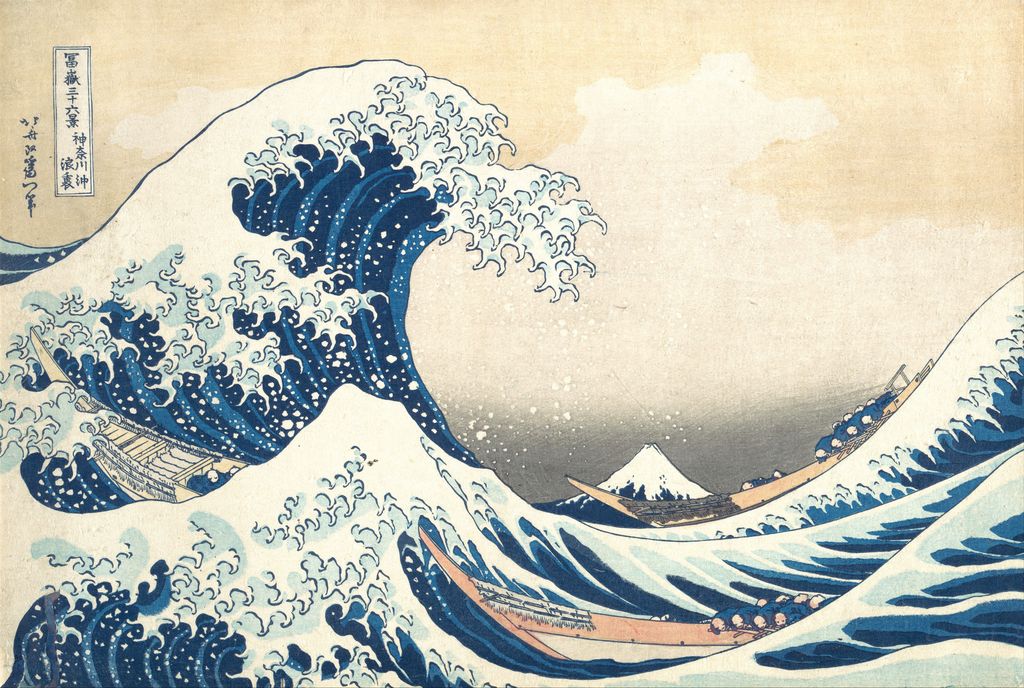
Katsushika Hokusai, Under the Wave off Kanagawa, c. 1830–32. The Metropolitan Museum of Art, JP1847; H. O. Havemeyer Collection, Bequest of Mrs. H. O. Havemeyer, 1929. Object record · Open Access CC0.
 by Tom Gurney
Tom Gurney BSc (Hons) is an art history expert with over 20 years experience
Published on June 19, 2020 / Updated on September 23, 2026
Email: tomgurney1@gmail.com / Phone: +44 7429 011000
Hokusai’s Great Wave
Katsushika Hokusai's Under the Wave off Kanagawa (神奈川沖浪裏, Kanagawa-oki nami-ura) shows three narrow boats caught beneath a cresting wave, with Mount Fuji small and still in the distance. The colour woodblock print was published in the early 1830s as one design in Thirty-six Views of Mount Fuji. It is now usually called The Great Wave. Its extraordinary force comes from a deliberate visual reversal: Fuji, the immense subject of the series, seems fragile beside a wave close to the viewer. The boats and their crews make the space between those two forms a human place rather than an abstract contest of shapes. The Sumida Hokusai Museum's object account [1] places the view in waters associated with Kanagawa and identifies the vessels as fast cargo boats for fresh fish.
The picture is famous enough to be encountered without its title, series or medium. Yet those facts change how it can be read. Hokusai designed a print to be carved into blocks and printed repeatedly by a team working for a publisher. Museums now hold different physical impressions made from that design. Their blues, clouds and fine lines are not all the same, and a few later sheets have been retouched. This page follows both stories: what the composition asks us to see, and what surviving sheets reveal about how it was made. The Metropolitan Museum's technical study [4] and British Museum conservation research [3] make the latter story unusually detailed.
Contents
- Hokusai’s Great Wave
- Where are we looking?
- The boats make the danger legible
- Look closely at the Great Wave
- Why Fuji looks so small
- A late achievement built on earlier experiments
- The publisher and the people who printed it
- Why the blue matters
- There is no single surviving “original”
- Compare two original impressions
- The Great Wave within forty-six Fuji views
- Where the wave sits in Hokusai’s career
- From an Edo print to a global emblem
- How to look closely at an impression
- Search the 46 Fuji designs
At a glance
- Japanese title
冨嶽三十六景 神奈川沖浪裏(Fugaku sanjūrokkei: Kanagawa-oki nami-ura) - Common English namesUnder the Wave off Kanagawa; The Great Wave off Kanagawa; The Great Wave
- ArtistKatsushika Hokusai (1760–1849)
- FormColour woodblock print on paper, designed for multiple impressions
- DateAround 1830–32; the British Museum records 1831, probably late 1831, for one early impression
- PublisherNishimuraya Yohachi, whose publishing house used the name Eijudō
- SeriesThirty-six Views of Mount Fuji: thirty-six initial designs plus ten additions
- SubjectA wave, three fast fish-carrying boats and Fuji seen from waters off Kanagawa
These are facts about the design, apart from the dating and condition of any one surviving sheet. The British Museum's accession 2008,3008.1 [2] and the Met's JP1847 [4] are separate objects. Each can show us something about the same composition, but their collection histories and physical condition belong to individual sheets. No physical impression should be called “the original” without explanation.
Where are we looking?
The Japanese title means that the scene is off Kanagawa, a Tōkaidō post town now within Yokohama. Sumida places the view over what is now Tokyo Bay. It names the boats oshiokuribune (押送船), swift vessels carrying fresh seafood from around the bay and nearby coasts to Edo. That use matters. The men are neither ornamental figures added for scale nor a fleet of deep-sea ships: they are workers moving food through an important local maritime economy. Sumida's Japanese object entry [1] gives the transport identification, while its English exhibition guide [1] explains the boats' speed and cargo.
How precisely the named location should be read is debated. In a published lecture on the series for Iwanami Shoten [7], Japanese print scholar Hinohara Kenji describes two plausible associations: the water near Kanagawa post station and the coast farther south around Honmoku. An earlier Hokusai print explicitly names Honmoku and shows a more forceful shore, but The Great Wave itself supplies no buildings, headlands or other marker that can settle the matter. Hinohara argues that the wave, Fuji and boats matter more to this composition than a recoverable viewing point. We can locate its named region without placing Hokusai at one exact coordinate.
The image is a named place, but it is not a topographical map or a record of a particular storm. The title points toward Kanagawa and Fuji, while the composition puts the eye impossibly close to the breaking wave. No source identifies a documented wave, precise hour or weather report behind the design. It is more useful to ask what Hokusai does with a recognisable setting than to pretend we can reconstruct a single witnessed event. The highest wave, low mountain and compressed boats are artistic decisions organised inside a small sheet.
Kanagawa was one of the named stops on the Tōkaidō road, the route linking Edo and Kyoto. The shore and the mountain therefore joined two kinds of familiarity: travel geography and a distant landmark known far beyond one province. The title does not tell us where a boat carrying fish had departed or where each man was headed. Sumida's account names the broader cargo trade from the Bōsō and Izu regions toward Edo. That gives the vessels a believable economic role without turning this particular scene into a documented voyage. Hokusai can show working maritime traffic in a print purchased by people who might never have been in those boats.
It is also easy to describe the wave as a tsunami. That term implies a particular physical cause which the print does not document. Neither the title nor the museum object records establish one. A breaking offshore wave is all that the image itself warrants. Calling it a tsunami may be a later response to its power, but it should not be presented as Hokusai's stated subject. Christine Guth's book description [8] notes that later viewers have associated the image with tsunami and environmental disaster; that is a history of interpretation, not proof about the depicted sea.
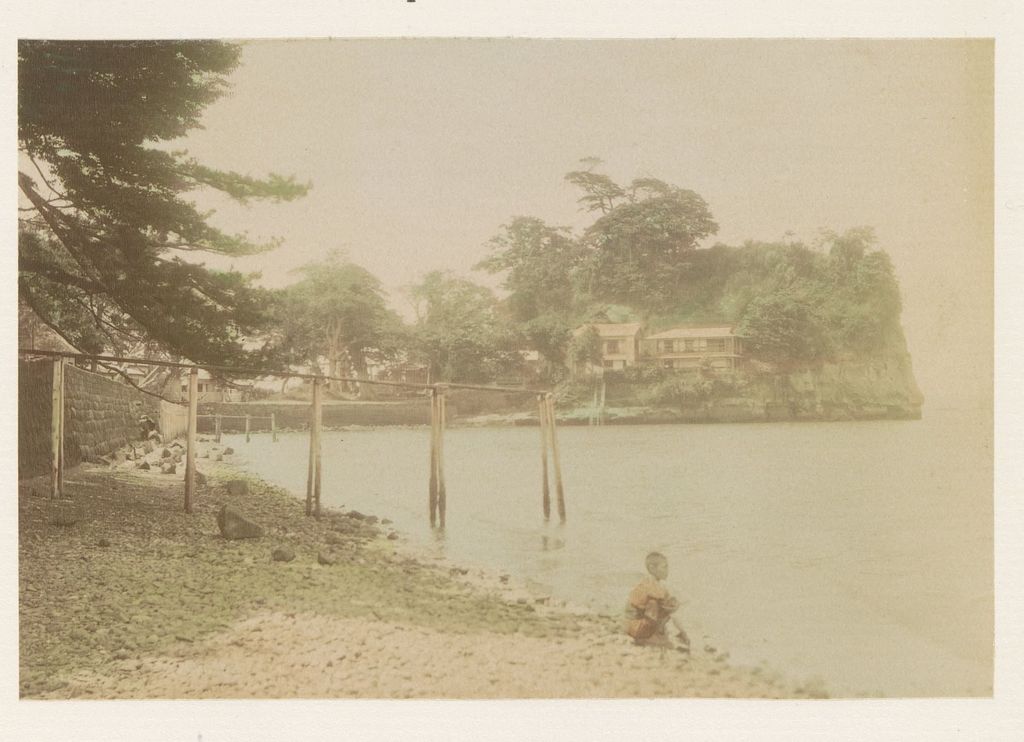
A later photograph makes the Honmoku possibility more tangible without solving the print's viewpoint. The Rijksmuseum's Seaside resort at Honmoku [12] was made between about 1887 and 1897. It shows a wooded shore and a coastal bluff at a place Hinohara names as one possible association. Made more than fifty years after Hokusai's print, it cannot establish his exact viewpoint or the coast's appearance in the 1830s.
The boats make the danger legible
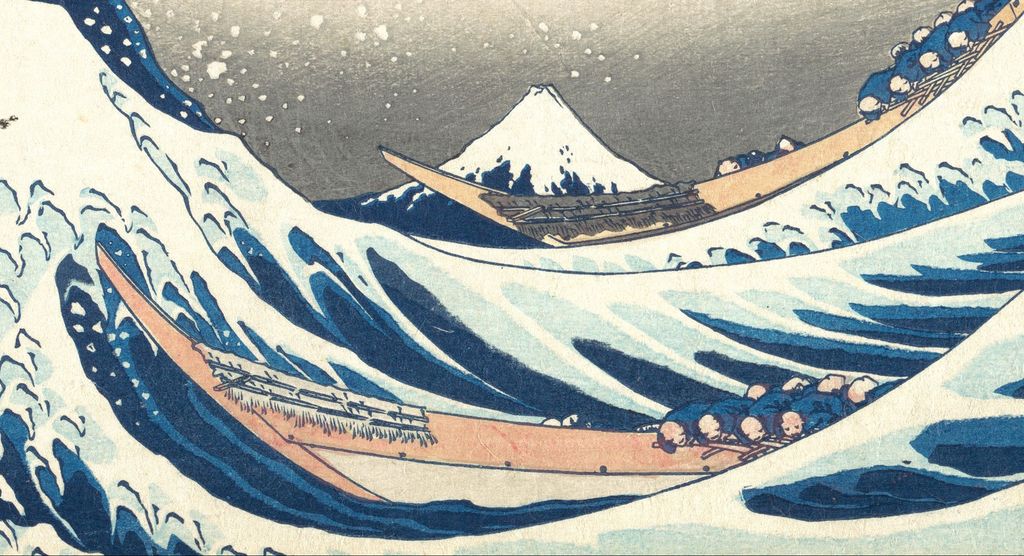
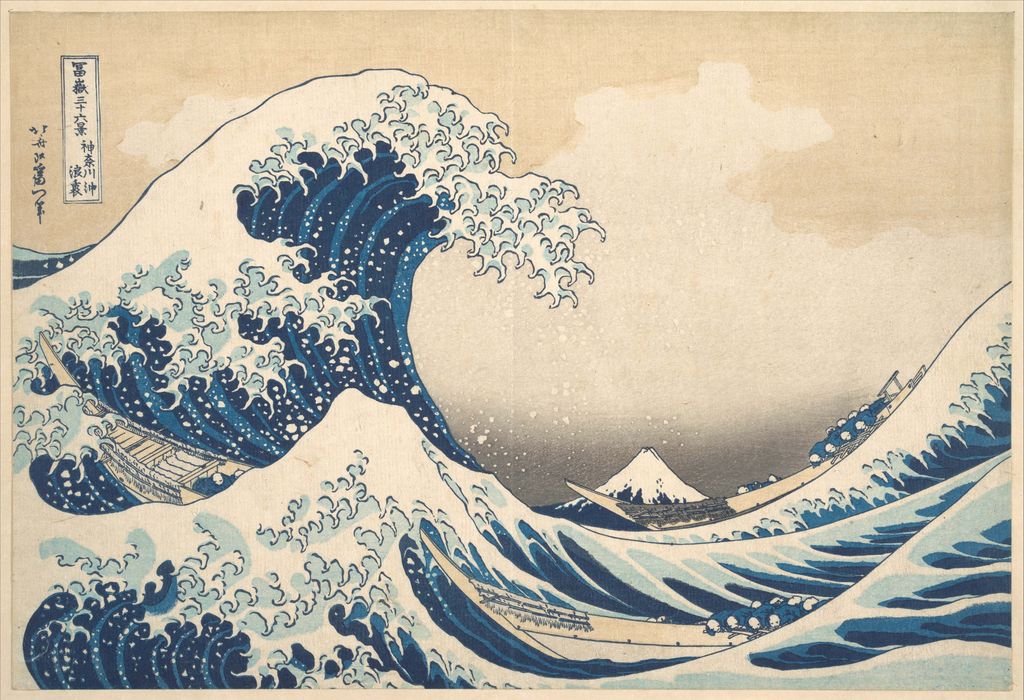
Look first at the long, low hulls. One boat rises along the right-hand wave; another crosses the trough before Fuji; a third is partly swallowed by spray at the left. Their pale sides and dark outlines give the eye repeated lines that run against the wave's great curve. The boatmen crouch together, reduced to a rhythm of backs and heads. Seen at a normal screen size, individuals are easy to miss. Seen closely, they make the picture's scale and risk immediately understandable. The British Museum describes three fish-carrying skiffs [2], and the Met's JP1847 object [4] provides a sharp public-domain impression for looking at their forms.
The boats do not supply a tidy narrative ending. The crest has not yet fallen; the men have not clearly escaped. Hokusai holds the scene at a point of suspended action. The left boat has entered the wave's thickest turbulence, while the right boat still rides a rising ridge. Each gives a different position within the same hazardous stretch of water. A viewer may feel the pressure of the next instant without being shown it. This reading comes from the visible design rather than a claim that Hokusai recorded a specific accident.
The little figures also resist easy counting. Their bodies overlap, some are partly hidden by the hulls, and several faces become only pale dots at ordinary display size. A confident number of crew members can therefore be misleading unless an identified high-resolution impression is specified. What matters for the composition is their repeated low posture, set against the wave's upward reach. The shape of the boatman's body and the angle of the vessel are more immediate than any portrait identity. This is a picture of shared labour and collective exposure, with individual stories deliberately left untold.
The repeated bows and the forceful diagonal of the right-hand boat also guide the eye toward Fuji. In the middle boat, a long brown hull passes just in front of the mountain. That contact puts everyday traffic into the same visual field as a sacred and famous landmark. One of the strengths of the wider Fuji series is exactly this connection between a fixed mountain and people moving through changing places. The Sumida Hokusai Museum's series account [9] and the MFA Boston preview of Sarah E. Thompson's Hokusai's Landscapes [5] situate The Great Wave within that publishing project.
Look closely at the Great Wave
Choose a marker to inspect a feature of the Met's early JP1847 impression. The notes remain readable below the image without interaction.
Annotated image details
Select a numbered point to read below; select a detail image to enlarge it. Detail crops come from a retained high-resolution 300 dpi working master.
Fuji
Fuji: the small white summit sits inside the wave's hollow, turning an enormous mountain into a distant point of calm.
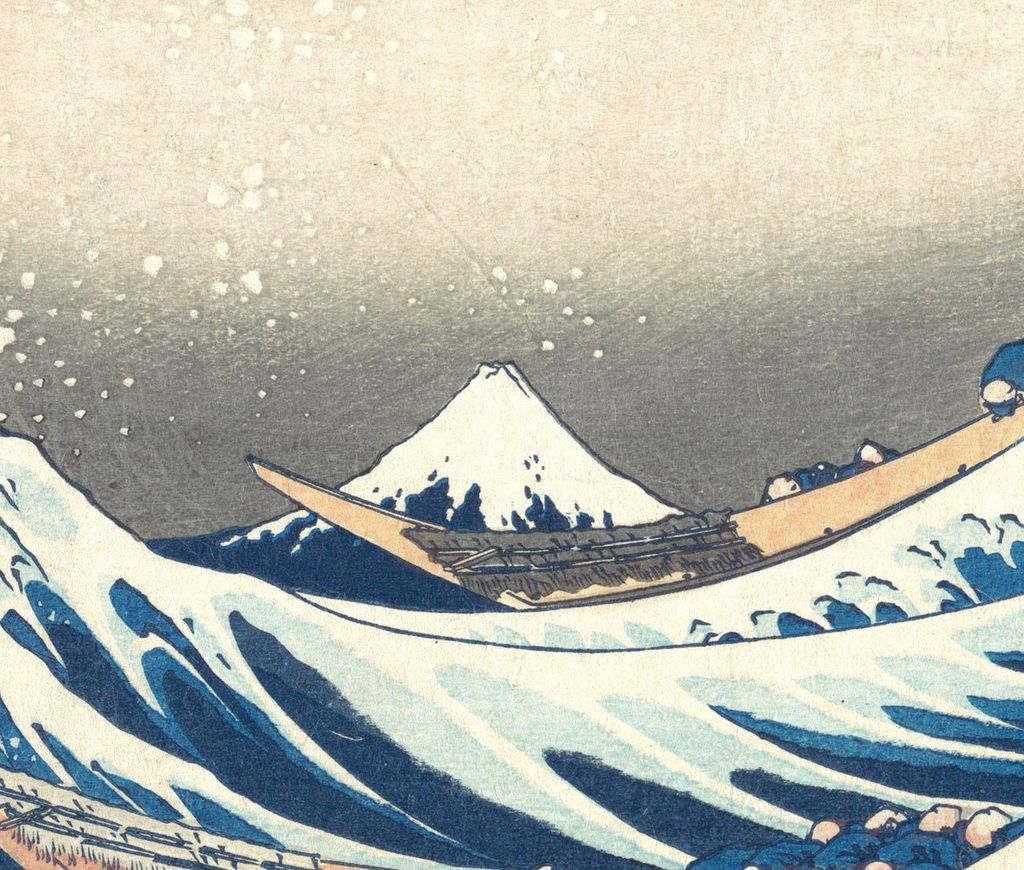
Boats
Boats: three swift oshiokuribune carry working crews beneath the crest; the Sumida Hokusai Museum identifies these vessels as fish transports.
Cartouche
Cartouche: the framed writing gives the Fuji series and Kanagawa design title. Tiny losses in printed lines help scholars compare different impressions.
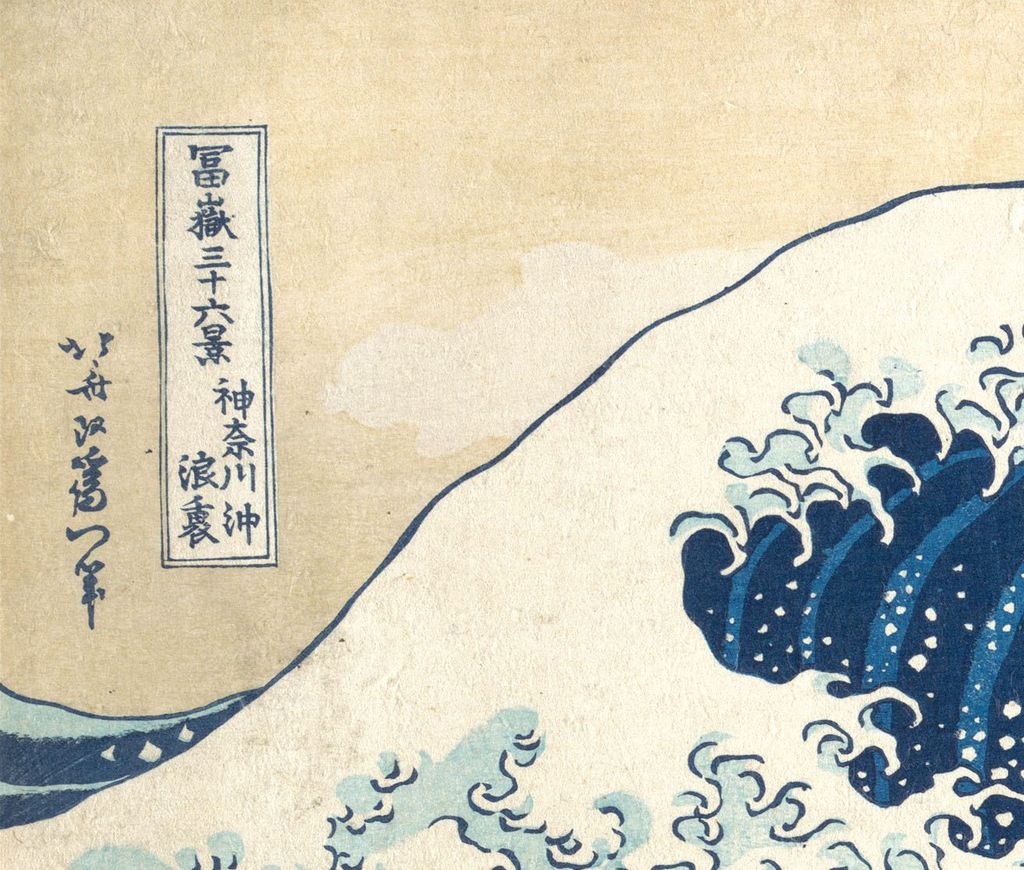
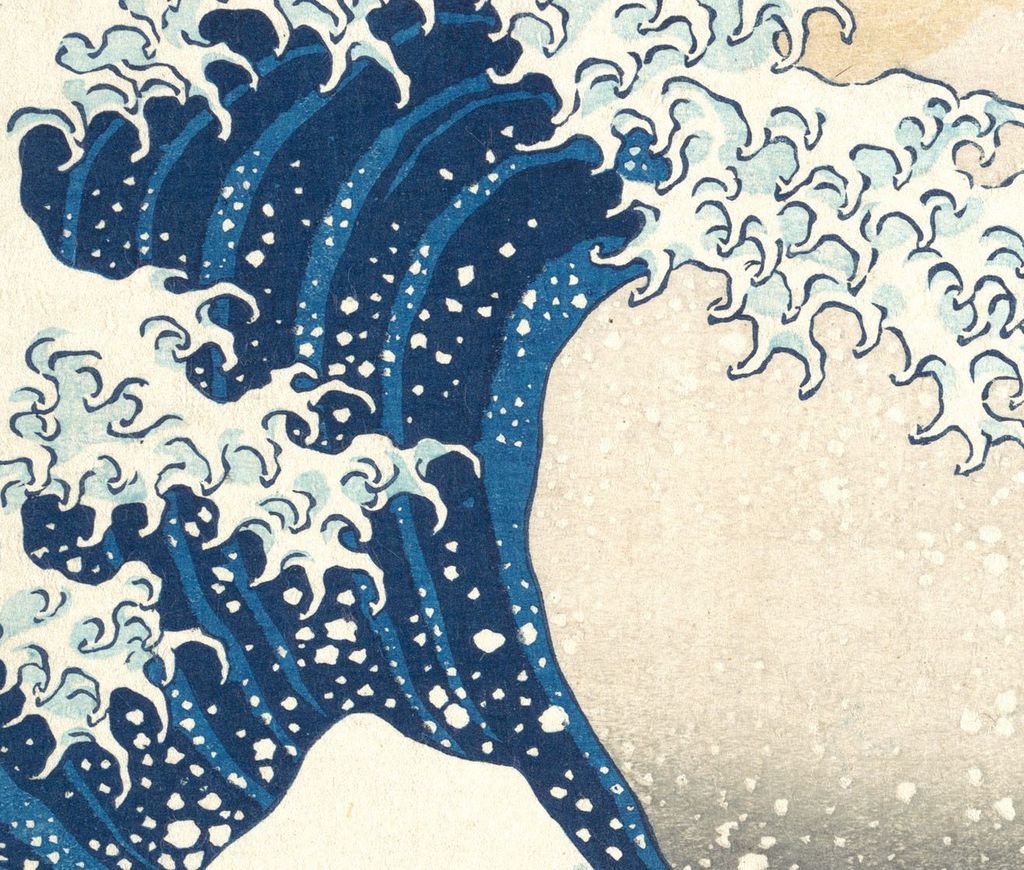
Blue
Blue: the Met's technical examination of this JP1847 sheet found indigo mixed with Prussian blue in the outlines and overprinted blue in parts of the wave.
Katsushika Hokusai, Under the Wave off Kanagawa, c. 1830–32. The Metropolitan Museum of Art, JP1847; H. O. Havemeyer Collection, Bequest of Mrs. H. O. Havemeyer, 1929. Object and original image [4] · Open Access CC0 [4]. Numbered markers are editorial annotations to this image.
Why Fuji looks so small
Fuji is nearly at the centre of the design, but it occupies little of the paper. Its white peak sits below the dark hollow of the foreground wave. If the eye reads both shapes as triangles, a mountain of enduring geographical and cultural importance briefly resembles a minor crest at sea. The Met's JP1847 record [4] describes this play with perspective, and the British Museum [2] connects the apparently dwarfed mountain to Hokusai's command of spatial design.
The distant mountain does not disappear when the wave dominates. It offers a still point against the curving boats, falling foam and swells. The eye moves between near danger and far permanence. That movement may account for much of the work's hold on viewers: the composition is dramatic, but it also gives the viewer a place to orient themselves. The wave's hollow functions almost as a frame for Fuji. A few strokes of snow against the dark horizon make the mountain unmistakable without giving it the largest area or strongest colour.
The crest is much more than a single curved outline. Its fingers of spray branch and curl across open sky; smaller crests echo them below. Those forms have invited comparisons with claws or living creatures. The Met's JP2972 object description [4] makes that comparison as an interpretation of the wave's visual character. It is not necessary to turn the sea into a literal monster. Its force can remain natural while its shape gives the viewer an animal-like sense of pursuit.
The edges of the design add to the effect. Water enters from both sides, so the viewer cannot see the full extent of the sea. A cut-off lower swell throws up spray close to the bottom edge, while a high right-hand slope presses the boats toward the centre. These partial forms imply motion beyond the paper. By contrast, Fuji is complete enough to be recognised with a few lines. The difference between cropped, restless water and the small finished mountain shape helps make the print both unstable and orderly. Hokusai gives the eye a clear route through apparent chaos.
A late achievement built on earlier experiments
Hokusai made The Great Wave when he was in his seventies, after decades of work in prints, illustrated books and paintings. The Sumida Hokusai Museum's 2024 exhibition [1] treats it as the result of a long development, showing earlier Kanagawa wave imagery, a scene in an illustrated novel and a later wave in One Hundred Views of Mount Fuji. Its exhibition sequence is a useful corrective to the notion that this single image appeared from nowhere.
Hokusai had also absorbed ways of making space that were available in Edo-period Japan through prints and books. Sumida's exhibition explains that Western linear perspective and shadow modelling had entered Japanese visual culture and that Hokusai had experimented with perspective prints and Western-style effects before the Fuji series. Sarah E. Thompson's MFA Boston preview, p. 14 [5], likewise describes Hokusai's early engagement with uki-e, perspective pictures. Those sources support a history of visual experiment; they do not reduce The Great Wave to an imitation of one European model. Its strong flat shapes, abrupt scale change and deliberate rhythm are Hokusai's own combination of resources.
Sumida's exhibition places Kanagawa-oki honmoku no zu (賀奈川沖本杢之図), an earlier Kanagawa offshore view, in its account of the wave's emergence. It also shows a dramatic sea scene from Hokusai's illustrations for the novel Chinsetsu yumiharizuki. Those works have different purposes and formats, so they are not alternative editions of The Great Wave. Together they show that Hokusai returned to sea imagery over time. The earlier print does not supply an eyewitness key to the later one, but it makes the long artistic preparation visible. Sumida Hokusai Museum, exhibition chapter 2 [1]. Hinohara dates two related early wave images to around 1804–07 and also points to wave studies in Hokusai Manga volume two and a 1823 comb-design book; his published lecture [7] gives a much longer sequence of experimentation than a single rough draft followed by the famous print.
The British Museum's Hokusai timeline [2] places the Fuji series among a surge of landscape and nature-print commissions in the early 1830s. An earlier print with a rearing wave and boats is visible in museum research, but The Great Wave makes the relation of water, vessels and distant land unusually immediate. The later One Hundred Views of Mount Fuji is a different work: a three-volume illustrated book, not a continuation of the same colour-print edition. Sumida's 2024 exhibition [1] includes a wave design from that later book precisely to trace change across Hokusai's career.
The publisher and the people who printed it
Hokusai's name is printed on the sheet, yet the physical print depended on several hands. Nishimuraya Yohachi, using the Eijudō publishing name, organised and sold the series. The artist supplied the design; a cutter made the blocks; printers applied ink and colour to paper. The Sumida Hokusai Museum explains the division of labour [1], and the Met's research essay [4] stresses that the anonymous printers' choices were central to the effect of the blue. The original publisher's title cartouche and Hokusai's signature are therefore only two visible parts of a larger production process.
The series was advertised for sale as sheets rather than a single original painting. The Met's essay [4] points to an Eijudō advertisement around New Year 1831, while a Japanese study held by the National Diet Library [6] quotes an 1831 notice promising successive blue-printed Fuji views. These are evidence for a commercial, staged project. They do not fix the exact day on which the first Great Wave sheets reached buyers.
The business arrangement helps explain why the image circulated widely. A print design could be carved once and pulled repeatedly while there were customers. Demand encouraged additional sheets and, when necessary, changes to blocks. Yet the existence of many impressions does not mean every one looked identical when it left the shop. Printers could vary the amount and placement of colour by hand, and later runs could involve worn or replacement blocks. The British Museum's explanation of woodblock printing [10] makes clear that effects such as colour gradation were worked at the printing stage. That is a reason to credit the publisher and craftspeople as part of the work's history, without erasing Hokusai's design.
The title cartouche is useful in more than one way. In Hokusai's Landscapes, p. 20 [5], Thompson explains that the series name and individual design title were carved into the blocks, with Hokusai's changing art name nearby. The sheets themselves are undated. When a museum dates one impression more narrowly than another, it is drawing on stylistic, documentary or physical evidence beyond a printed calendar date. The British Museum dates its accession 2008,3008.1 to 1831, probably late 1831 [2]; the Met uses about 1830–32 for JP1847 [4]. That variation is more honest than a fictitious exact publication day.
Why the blue matters
The bright blue is not simply a modern reproduction effect. Prussian blue, an imported synthetic pigment known in Japan as bero-ai, played a distinctive part in the Fuji series. The British Museum's printmaking account [10] distinguishes early blue-only designs from later designs that added other colours; The Great Wave uses blue with muted tones in the boats, clouds and sky. The material had a saturated colour that suited printed water and atmosphere, but it still took skill to use it well.
The Met's scientific team studied its JP1847 impression. They found that the dark blue outlines involved a mixture of Prussian blue and indigo, and that printers overprinted one blue on another in parts of the wave. In the hollow, darker stripes were printed first and a brighter blue was applied over them. The result is both a colour contrast and a shallow physical layering in the paper. These observations come from Marco Leona's technical account [4]. They are claims about a studied sheet and its printing process; without examination, we should not state that every surviving impression has exactly the same pigment mixture or microscopic surface.
The sky and clouds show why colour must be read with care. Capucine Korenberg's British Museum study [3] found that clouds were not discernible in 26 of the 111 impressions gathered. It judged fading the most likely explanation in many cases, while leaving open that they might not have been printed on every sheet. Ultraviolet examination revealed barely visible clouds on one British Museum impression. A pale or seemingly blank sky in a photograph may thus reflect the sheet's later condition as well as the printer's original choices.
The physical build of the image is surprisingly complex beneath its apparent clarity. Korenberg found evidence for at least seven distinct carved printing surfaces in early impressions. A colour was not always a single flat application: some areas received overlapping impressions, and a grey tone used elsewhere could be printed twice. None of the original 1830s blocks survives, so their number is inferred from the sheets rather than counted from surviving tools. That difference between observed paper and reconstructed process is crucial. Modern demonstrations can show how a print might be made, but the old impressions remain the evidence for this particular production. Korenberg, pp. 10–12 [3].
There is no single surviving “original”
An impression is a particular piece of paper produced from printing blocks. It is not the entire design. Hokusai's drawing, the original blocks and the sheets sold in Edo are different stages in the history of the work. The original blocks used for The Great Wave have not survived, according to Korenberg's conservation study [3]. What we can compare today are surviving impressions and their photographs, with the limits of each collection's records.
To trace the design's physical history, Korenberg assembled photographs of 111 original impressions. Her team compared breaks in the title cartouche, the line of the wave and Fuji's slope, along with changes to colour blocks. The study defined eight states: a state is a recurring configuration produced by damage, recutting or replacement of printing surfaces. Its first state has no identified cartouche breaks; later states include particular breaks and then replacement colour blocks. The British Museum's accessible study, especially pp. 20–21 and 26 [3], explains why some previously claimed tiny breaks were too inconsistent to serve as reliable markers.
This is a chronology of printing evidence, not a ranking of artistic merit. The state numbers do not tell us the exact year of an impression or who first bought it. Twenty-six of the 111 photographs lacked sufficient visible detail for placement within the first six states, so the paper does not claim that every known sheet can be dated by a web image. Its census also distinguished original Edo-period impressions from modern reproductions; not every online Great Wave is one of the former. The British Museum's shorter comparison guide [2] introduces the visible line breaks that make this research possible.
Korenberg's distinction between a break and an apparent gap also matters. Ink can fail to reach a tiny part of the paper, or printing pressure can vary, creating a line interruption in one sheet that is not a permanent loss from the block. Her study reduced a much larger proposed sequence of cartouche damage to the few breaks that recur consistently across impressions. It also looked for changes in the wave line and Fuji's outline and identified replacement colour surfaces. A reader comparing two files can look for differences, but assigning a state requires the whole pattern of markers and a sufficiently clear image. It cannot be done responsibly from one enlarged blemish alone. Korenberg, pp. 2–3 and 20–22 [3].
Three Met sheets show why exact accession numbers matter. Korenberg places JP1847 [4] and JP2569 [4] in state 1, while JP2972 [4] is listed in state 6. She also finds evidence that JP2972's clouds were probably retouched after the earlier colour faded. All three are public-domain Met images, but they cannot stand in for one another. The Met's pigment findings concern JP1847; a comparison with JP2972 can demonstrate a later state and conservation history only when those distinctions stay visible in captions. Korenberg, pp. 7 and 21 [3].
The numerical scale of original production is uncertain. Korenberg cites an estimate of up to 8,000 printed impressions, whereas another British Museum resource [11] gives a wider 5,000–15,000 range. Neither is a count of surviving sheets. The secure conclusion is that the design was produced in multiples and was popular enough for its blocks to be used, damaged and partly replaced. Calling a photographed museum sheet “the one original” erases that history.
An impression's present appearance has a second history after printing. Light exposure can fade sensitive colours; trimming can remove edges; repairs or retouching can change details; and photography can alter the tones a screen shows. Korenberg identified likely retouching on several of the sheets she examined. Her examples include the Met's JP2972 clouds and a filled-in wave-line break on a Bristol impression. That does not make either museum object an inauthentic design. It means a careful viewer distinguishes Hokusai-era printing from later changes to a physical sheet. Korenberg, pp. 6–9 [3].
Compare two original impressions
These are separate Edo-period sheets of the same design. Capucine Korenberg's British Museum study places JP2569 in state 1 and JP2972 in state 6; she also identifies JP2972's clouds as probably retouched after fading.
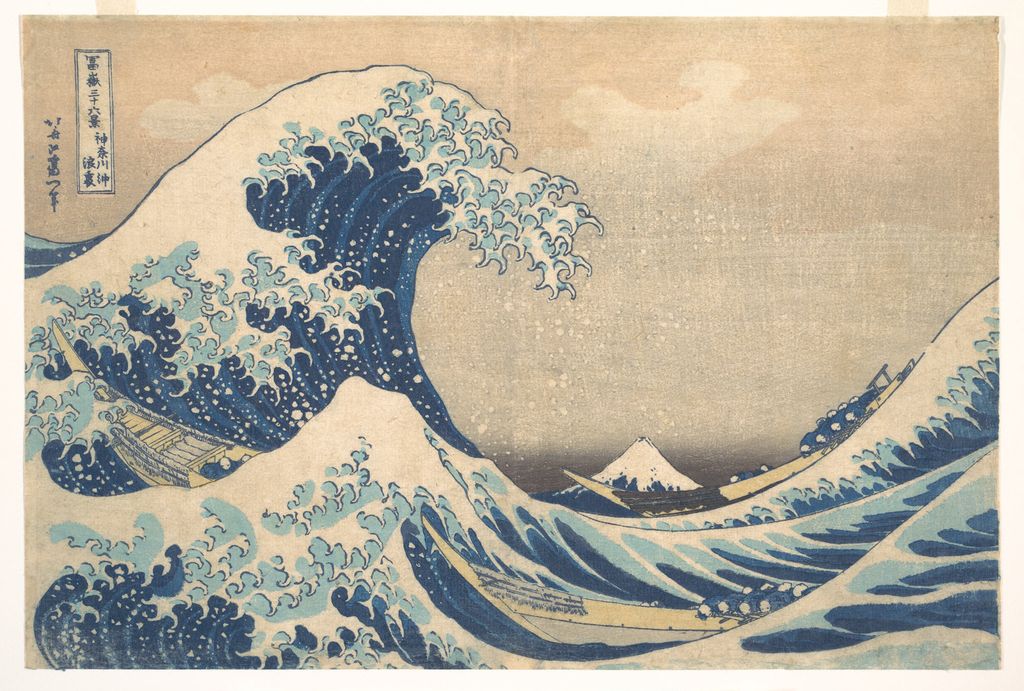
Both image files are from The Metropolitan Museum of Art, Open Access CC0 [4]. State and cloud notes: Korenberg, pp. 7 and 20–21 [3]. The images have different borders and should not be read as pixel-aligned photographs.
The Great Wave within forty-six Fuji views
The title of Hokusai's series promises thirty-six views, but ten more designs were added, producing forty-six in all. Fuji appears in each, though it may dominate, recede, be framed by a bridge or be seen above working people. The Sumida Hokusai Museum's exhibition and checklist [9] documents the expanded set. The series guide on this site follows all forty-six and compares subjects, print phases and named places.
The Great Wave is one answer to the series' central problem: how can a familiar mountain look new again and again? The design does not add detail to Fuji. It changes the situation of the viewer. The mountain becomes a far point to hold onto while the boats and water press forward. Compare South Wind, Clear Sky—often called Red Fuji—where the mountain fills almost the whole picture, or Kajikazawa in Kai Province, where a worker's angled body and fishing lines guide the eye to a smaller peak. The series is richer when these very different decisions are read alongside one another rather than when the most famous sheet stands for all forty-six.
The later One Hundred Views of Mount Fuji should not be mistaken for an enlarged edition of these colour prints. It is an illustrated book project in three volumes. Sumida's Great Wave influence exhibition [1] showed a wave design from its second volume beside earlier works, making a useful career-long visual comparison. Whether an image belongs to the colour-print series, to the later book or to a modern reproduction changes how we describe its publisher, date and technique.
Where the wave sits in Hokusai’s career
View of Honmoku off Kanagawa
c. 1804–07Under the Wave off Kanagawa
c. 1830–32The Fuji at Sea, One Hundred Views
mid-1830sFrom an Edo print to a global emblem
The work's first audience lived in a Japanese print market. The boats, Fuji and blue belong to that setting, and the fact that it later became familiar abroad should not be projected back as its original purpose. By the late nineteenth century, Japanese prints were circulating among European artists and collectors; the wave was eventually reproduced and adapted across media. The Sumida Hokusai Museum's 2024 exhibition [1] deliberately traces both Japanese artistic responses and later design uses, from the work of Hokusai's pupils and Utagawa Kuniyoshi to modern objects. Christine Guth's Hokusai's Great Wave: Biography of a Global Icon [8] is a substantial published study of that longer circulation; its full text should be consulted before drawing on a specific chapter argument.
One current Japanese use is especially visible: the back of the redesigned ¥1,000 note introduced in July 2024 features Under the Wave off Kanagawa. The Sumida Hokusai Museum [1] links the banknote to the picture's modern familiarity. A banknote is a reproduction of a design, not an Edo-period print impression. Its crisp graphic form demonstrates how readily the wave can be carried into a new setting, while an actual old sheet still has paper, fading, trimming and printing history that a reproduced symbol cannot show.
The image is sometimes described as inspiring specific European works, including Debussy's La Mer. The Met's object text [4] uses cautious “said to have inspired” language. Direct influence claims require their own documentary evidence, and should be distinguished from the visible fact that Hokusai's wave later became a motif for artists and publishers. Its reception is a story worth telling, but it should not crowd out the people and production practices in the Japanese picture itself.
How to look closely at an impression
Begin with the full composition: find Fuji and count the boats. Then look at the tall crest, the small curls of foam and the narrow interval between the left boat and the wave above it. Return to the title cartouche at the upper left, where the series and design names are part of the printed surface. If the image source is a museum, check its accession before comparing a second photograph. A different paper border, cloud tone or line gap may signal a different impression, later intervention or simply a different crop. The exact object's record is the starting point for any explanation.
The most revealing details are small: the repeated backs of the men, Fuji's dark lower slope, the title cartouche and the difference between brilliant and overprinted blue in the hollow. A second impression may make clouds or line breaks easier to see, provided its object identity is kept beside it. Close looking here is not a hunt for a secret symbol. It is a way to follow Hokusai's design through the hands of the people who printed it and through the later lives of the sheets they made.
Search the 46 Fuji designs
| Name | Date | Medium |
|---|---|---|
| Under the Wave off Kanagawa | early 1830s | Woodblock print |
| Rainstorm beneath the Summit | early 1830s | Woodblock print |
| A Mild Breeze of a Fine Day | early 1830s | Woodblock print |
| Fujimigahara in Owari Province | early 1830s | Woodblock print |
| The Mitsui Shop at Surugachō in Edo | early 1830s | Woodblock print |
| Kajikazawa in Kai Province | early 1830s | Woodblock print |
| Under the Mannenbashi Bridge at Fukagawa | early 1830s | Woodblock print |
| Nihonbashi Bridge in Edo | early 1830s | Woodblock print |
| Viewing Sunset over the Ryōgokubashi Bridge from the Ommayagashi Embankment | early 1830s | Woodblock print |
| The Enza-no-matsu Pine Tree at Aoyama | early 1830s | Woodblock print |
| The Sazaidō Hall of the Gohyaku Rakanji Temple | early 1830s | Woodblock print |
| Mishima Pass in Kai Province | early 1830s | Woodblock print |
| In the Mountains of Tōtōmi Province | early 1830s | Woodblock print |
| Hongwanji Temple at Asakusa in Edo | early 1830s | Woodblock print |
| Lake Suwako in Shinano Province | early 1830s | Woodblock print |
| Reflection in the Surface of Lake Misaka | early 1830s | Woodblock print |
| The Coast of Nobuto | early 1830s | Woodblock print |
| Inumetōge Pass in Kai Province | early 1830s | Woodblock print |
| Ejiri in Suruga Province | early 1830s | Woodblock print |
| Shichirigahama Beach in Sagami Province | early 1830s | Woodblock print |
| Dawn at Isawa in Kai Province | early 1830s | Woodblock print |
| Umezawa Manor in Sagami Province | early 1830s | Woodblock print |
| The Tamagawa River in Musashi Province | early 1830s | Woodblock print |
| Hakone Lake in Sagami Province | early 1830s | Woodblock print |
| Snowy Morning at Koishikawa | early 1830s | Woodblock print |
| Mount Fuji from Kanaya on the Tōkaidō Road | early 1830s | Woodblock print |
| Mount Fuji from Goten'yama at Shinagawa on the Tōkaidō Road | early 1830s | Woodblock print |
| Yoshida on the Tōkaidō Road | early 1830s | Woodblock print |
| Sekiya Village on the Sumida River | early 1830s | Woodblock print |
| Mount Fuji Seen in the Distance from Senju Pleasure Quarter | early 1830s | Woodblock print |
| Back View of Mount Fuji from the Minobugawa River | early 1830s | Woodblock print |
| Enoshima in Sagami Province | early 1830s | Woodblock print |
| Mount Fuji from the Tea Plantation at Katakura in Suruga Province | early 1830s | Woodblock print |
| Simplified View of Tagonoura Beach at Ejiri on the Tōkaidō Road | early 1830s | Woodblock print |
| Tsukudajima Island in Musashi Province | early 1830s | Woodblock print |
| Pilgrims Climbing in the Mountain | early 1830s | Woodblock print |
| Hodogaya on the Tōkaidō Road | early 1830s | Woodblock print |
| Nakahara in Sagami Province | early 1830s | Woodblock print |
| Senju in Musashi Province | early 1830s | Woodblock print |
| Shimomeguro | early 1830s | Woodblock print |
| Waterwheel at Onden | early 1830s | Woodblock print |
| Surugadai in Edo | early 1830s | Woodblock print |
| Tatekawa at Honjo | early 1830s | Woodblock print |
| Ōno-shinden in Suruga Province | early 1830s | Woodblock print |
| Sea Lane off Kazusa Province | early 1830s | Woodblock print |
| Ushibori in Hitachi Province | early 1830s | Woodblock print |
Frequently asked questions
The Japanese design title is 神奈川沖浪裏, commonly translated Under the Wave off Kanagawa. The Great Wave off Kanagawa and The Great Wave are familiar English names. It belongs to 冨嶽三十六景, Thirty-six Views of Mount Fuji. The British Museum's object record [2] gives the title and series together.
The print does not identify a tsunami or its physical cause. It shows a towering breaking wave offshore with three boats beneath it. Later associations with tsunami belong to the image's reception, discussed in the description of Guth's study [8].
The Sumida Hokusai Museum [1] identifies them as oshiokuribune, fast boats used to carry fresh fish toward Edo. The image does not state the precise catch or name the boatmen.
Hokusai places it far away beneath the hollow of a large near wave. The contrast makes the mountain look visually vulnerable even though it is geographically immense. This is a compositional reading supported by the Met's discussion of JP1847 [4].
No complete surviving-impression census exists. Korenberg's British Museum research [3] assembled 111 original impressions for a comparative study, not every sheet that survives worldwide. Estimates of how many were printed in the nineteenth century are much larger and differ by source.
Yes. Different impressions can have different printed colour and later fading. Some were retouched. Korenberg specifically reports probably retouched clouds on the Met's JP2972 [4], while the Met's scientifically studied JP1847 [4] is a separate early impression. The difference calls for precise captions, not a declaration that one photographed image is the only real Great Wave.
Discussion
The same design survives in different impressions, and each can change what a viewer notices.
Reader Insights
Where does your eye go first, and when do you notice Mount Fuji?
What changes when you look from the early Met JP2569 to the later JP2972?
How do the working boats change your reading of the wave?
Join the Conversation
Share a detail or comparison that changed how you see Hokusai’s Great Wave.
References
- Sumida Hokusai Museum,
冨嶽三十六景 神奈川沖浪裏object entry (Japanese), 2025 English exhibition guide, and 2024 Great Wave influence exhibition (Japanese). - British Museum, accession 2008,3008.1, The Great Wave: spot the difference, and Hokusai timeline.
- Capucine Korenberg, The making and evolution of Hokusai's Great Wave, British Museum research PDF, especially pp. 4–7, 10 and 20–26.
- Metropolitan Museum of Art, accession JP1847, accession JP2569, and accession JP2972; Marco Leona, The Great Wave: Anatomy of an Icon (2020); Open Access CC0 policy.
- Sarah E. Thompson, Hokusai's Landscapes: The Complete Series, MFA Publications, Boston, available preview pp. 14 and 20.
- National Diet Library-hosted Japanese study quoting the Eijudō advertisement.
- Hinohara Kenji, Iwanami Shoten lecture on The Great Wave and Thirty-six Views (Japanese), 2019; compare the National Diet Library catalogue for Hinohara's 2019 edited volume.
- book description
- Sumida Hokusai Museum's series account
- British Museum's explanation of woodblock printing
- British Museum resource
- Rijksmuseum, Seaside resort at Honmoku, RP-F-2001-7-1557B-3. Hand-coloured albumen photograph, c. 1887–1897; Public Domain.