 by Tom Gurney
Tom Gurney BSc (Hons) is an art history expert with over 20 years experience
Published on August 21, 2026 / Updated on October 23, 2026
Email: tomgurney1@gmail.com / Phone: +44 7429 011000
About Fruit Garden with Roses
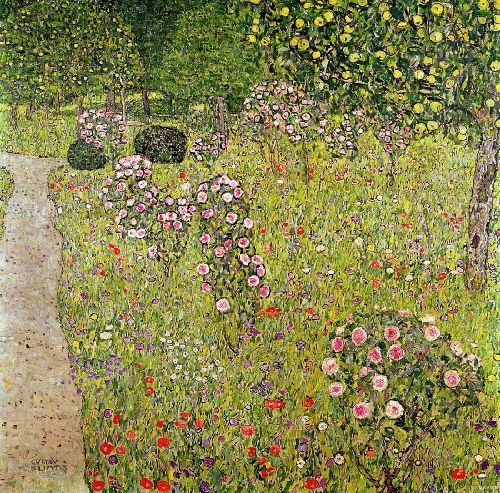
The Gustav Klimt painting sometimes shortened in English to Fruit Garden is the 1912 Orchard with Roses (Obstgarten mit Rosen), also known as Fruit Garden with Roses. It is one privately owned oil painting on canvas, measuring 110 × 110 centimetres.[1][3][4]
Its more precise title matters. Roses occupy much of the lower and middle field, while fruit trees rise above them. A narrow path enters at the left and then disappears. On the right, a tree is brought so close that its trunk, branches and crown press against or pass beyond the limits of the square. The painting is not a generic summary of Klimt's gardens: it is a closely selected view whose particular structure can be compared with photographs of his last studio garden in Vienna.
Current Klimt scholarship considers that match persuasive. Moriz Nähr photographed the garden at Feldmühlgasse in 1917, five years after the canvas was painted. The photographs show rose bushes beneath fruit trees and a forked path whose arrangement resembles the painting.[2] They make the studio garden a probable location, but they are later documents, not preparatory images or proof of an exactly recoverable viewpoint.
At a Glance
- ArtistGustav Klimt
- Preferred English titleOrchard with Roses
- Alternative English titleFruit Garden with Roses
- German titleObstgarten mit Rosen
- Additional German titleRosengarten
- Date1912; some image records use circa 1911–12
- MediumOil on canvas
- Dimensions110 × 110 centimetres
- Current collectionPrivate collection
- Probable siteThe garden of Klimt's Feldmühlgasse studio in Hietzing, Vienna
- Documented lifetime exhibitionPrague, 1914
- Current accessNo verified public display as of 10 August 2026
Correcting a Generic Title
“Fruit Garden” can sound like the name of a theme rather than a single object. Klimt painted several orchards, flower gardens and cultivated landscapes, and English translations have not always separated them clearly. The composition here is securely identified by its roses: Obstgarten mit Rosen, normally translated as Orchard with Roses or Fruit Garden with Roses.[1][2][3]
The Bridgeman image record uses a circa 1911–12 range, while the Klimt Database gives the work the firmer date 1912.[1][3] These are dating conventions for one canvas, not an early and a late state. No published photograph or technical examination cited here divides the work into two versions.
The correction also excludes several tempting collisions. Orchard in the Evening belongs to 1898. Carnegie's Orchard (A Summer's Day) is a separate painting. Flower Garden, Cottage Garden with Sunflowers, Rose Bushes under Trees and Landscape of a Garden each possess their own compositions and histories. The image in scope is the square with the left-hand path, pink rose growth and closely cropped right-side fruit tree.
The title does not provide a complete botanical inventory. It justifies recognising an orchard and roses. It does not certify every flower species, tree variety or stage of bloom, and it supplies no count of bushes or fruit.
A Path That Offers Entry
The path begins near the lower-left edge as one of the painting's least densely worked spaces. Against the surrounding vegetation, its paler course acts as an invitation into the garden. It does not travel in a straight line toward a distant monument. Almost immediately, flowers and foliage interrupt it.
That interruption is important. A conventional garden prospect might use a path to organise stable recession from foreground to background. Klimt lets the path propose depth, then allows plant growth to obscure the route. The viewer can enter imaginatively but cannot survey the whole garden from a detached position.
The painted course also turns or divides. Its relation to the fork visible in Nähr's later photographs is one reason scholars connect the canvas with Feldmühlgasse.[2] Yet the image does not furnish a precise plan. We cannot assign an endpoint, measure an angle or identify the exact place where Klimt stood.
Near the bottom edge, the path competes with the flowered ground rather than dominating it. Small marks cross and soften its margins. This makes movement feel provisional: vegetation continually reclaims the clarity that a garden path would normally impose.
The path distinguishes the work from the earlier Fruit Trees. There, lake water opens behind an orchard screen; here, movement begins within cultivated ground. That concise difference is enough. The 1901 canvas's Secession history and ownership chain belong to its own account.
Roses across the Middle Field
The rose bushes spread laterally rather than forming one isolated bouquet. Pink and red notes gather into loose masses, with darker foliage supporting them. Some blooms read distinctly; others merge into the larger colour field. Their repetitions connect the lower garden with the trees above.
This distribution creates abundance without a single centre. The eye may begin at a vivid cluster, move to another patch, and then discover the path or tree by contrast. No flower functions like a portrait sitter surrounded by secondary detail.
The roses also mediate between space and surface. Their overlapping growth suggests bushes occupying different positions. At the same time, related colours recur across the square, binding separate plants into one pictorial texture. The Klimt Database emphasises these contrasting colour values and the way texture becomes an artistic value in its own right.[1]
Calling the field decorative does not mean it lacks depth. Leaves cover other leaves, branches pass before blooms, and the path disappears behind growth. Conversely, calling it naturalistic would miss how insistently repeated marks and colours hold the image near the canvas.
Broader symbolism should remain optional. Roses have long histories as signs of love, transience, devotion and beauty, but no retained object-specific statement says Klimt encoded one fixed meaning here. The painting can produce intimacy or luxuriance without becoming a private confession.
The Cropped Fruit Tree
The fruit tree at the right is pushed conspicuously forward. Its position brings a large plant form close to the viewer, while the frame cuts its growth. The Klimt Database treats this cropping as an important feature of the late landscape language.[1]
Its vertical trunk and branching crown answer the path's diagonal movement. Follow the path and the eye moves inward; follow the tree and it rises toward and beyond the upper edge. The two directions keep the square active without creating a symmetrical design.
The tree also changes scale relations. Smaller marks across the flowered ground can imply depth, but the nearer trunk refuses a uniformly distant garden view. It makes the composition feel selected from within vegetation rather than observed from an open overlook.
No responsible source cited here names the fruit variety, counts the fruit or establishes that the individual tree survives. The title supports a fruit garden; visual evidence supports branches, foliage and orchard growth. Anything more exact would turn paint into horticultural documentation.
At lower left, the artist's name is visible in the matched image.[3] Because no current-holder catalogue supplies an inscription transcription, it should be treated as visible-image evidence. Its presence does not establish when Klimt signed the canvas, whether he revised it afterward or what conservation it has received.
The Feldmühlgasse Studio Garden
Klimt moved into the secluded studio at Feldmühlgasse 11—then numbered 9—in 1911. The small house stood in Hietzing, Vienna's thirteenth district, and included an orchard and flower garden. Nähr's 1917 photographs preserve views of the house, pavilion, rose bushes, fruit trees and paths.[2]
The timing makes the proposed location plausible. Orchard with Roses dates from the year after the move, and the garden provided a flowering subject close to Klimt's workplace. Unlike most of his landscapes, which arose from summer stays away from Vienna, this one may record his own private garden.[1][2]
The visual comparison is more specific than simple proximity. The Klimt Database points to rose bushes growing under fruit trees and to the same broad forked-path configuration. It concludes that the painting very likely shows the Feldmühlgasse garden.[2]
“Very likely” is not “mechanically proven.” Nähr photographed the site in May 1917, not during the painting's creation in 1912. Plants grew, died, were pruned and changed with the seasons. The photographs do not capture one certified instant from which Klimt copied the canvas.
Nor are they preparatory studies. Their value lies in comparison after the event. They show that the painting's basic combination of roses, fruit trees and branching path belonged to a real place. They do not reveal whether Klimt painted entirely outdoors, worked later in the studio, moved motifs, altered scale or combined observations made on different days.
The exact viewing position also remains open. A convincing match among major elements does not supply camera coordinates, compass direction, eye height or the footprint of an easel. The painting's crop is an artistic selection, not a cadastral record.
Garden, Photograph and Painted Selection
Comparing canvas and photograph highlights what Klimt chose. A photograph can distribute attention across paths, buildings and vegetation with incidental detail. The painting suppresses any need for a complete architectural account and gives flowers and the right-side tree exceptional pictorial weight.
This difference argues against treating Orchard with Roses as a coloured photograph of the site. Klimt compresses some intervals, lets vegetation obscure others and uses repeated marks to connect plants that would remain more visually separate in a documentary image.
The painting also refuses a single stable scale of description. The path reads broadly; individual rose heads can become relatively sharp; the larger tree is cropped; more distant growth is condensed. Such changes help the garden feel both observed and remade.
There is no exact working photograph attached to the canvas. No source cited here states that Klimt used Nähr's camera, traced a print or asked the photographer to document a chosen view in 1912. The later photographs illuminate the site, not the making sequence.
Egon Schiele later remembered the garden as planted with flowerbeds throughout the year and pleasurable for its blossoms and old trees. The Klimt Database uses that recollection to characterise the cultivated setting.[1] It describes a visitor's experience, not a key that fixes the painting's mood or symbolism.
Colour as Structure
The work is crowded with colour, but colour does more than make the scene exuberant. Pink rose clusters establish lateral rhythms. Greens separate and reconnect the garden layers. The pale path provides relief. Darker notes around trunks and undergrowth stop the whole square from becoming equally bright.
Klimt varies the apparent size and density of his touches. Smaller marks can recede; broader or more forceful passages can bring growth forward. Yet the image does not behave like a strict scientific Pointillist demonstration. Marks overlap, change scale and serve both description and pattern.
No object-specific infrared reflectography, X-radiograph, pigment analysis or cross-section study has been located in the retained sources. It is therefore unsafe to name pigments, ground colour, binding additions or a sequence of paint layers. The exact medium remains oil on canvas.[1][3][4]
The same boundary excludes materials from other Klimt landscapes. Harvard's casein belongs to Pear Tree. Graphite underdrawing and oil-resin findings belong to Belvedere's Poppy Field. No gold leaf or other metal is documented here. Golden-looking light and jewel-like colour would remain metaphors, not recipes.
This restraint does not prevent close looking. Visible texture, overlapping marks and changes of density can be described from the painting. What cannot be done is convert visual appearance into an unperformed laboratory analysis.
A Landscape of 1912
Klimt's landscapes around 1910–13 often employ assertive cropping, dense colour and a more painterly surface. Orchard with Roses belongs to that late development without representing the whole of it.[1]
Its date separates it from the early Attersee orchard experiments. Fruit Trees of 1901 allows water to flash through grouped trees. The 1912 work removes the lake and makes the cultivated garden itself sufficient. A path, flower field and near tree generate space from within growth.
The Klimt Database relates Orchard with Roses and the destroyed Country Garden with Calvary to the later Italian Garden Landscape. In each, flowering vegetation acquires enough density and colouristic independence to become a major pictorial force.[1] The comparison is stylistic, not evidence that the canvases form a series or share one site.
Italian Garden Landscape would later use southern vegetation and a glimpse of Lake Garda. Its complete viewpoint and exhibition history remain separate. Here the probable Viennese studio garden and its forked path are the essential local evidence.
The 1912 date also places the canvas beside Klimt's continuing work on portraits and allegories. That chronology should not turn the page into a career survey. The landscape's contribution is more exact: it shows him finding a dense, self-sufficient natural subject immediately outside his studio.
Prague in 1914
The Klimt Database states that this garden view was shown in Prague in 1914.[1] The appearance gives the privately owned painting a secure lifetime public anchor two years after its governing date.
The exhibition should not be confused with the acquisition of The Virgin by Prague's Modern Gallery in the same broad period. Orchard with Roses remained a separate private object. No retained source used here records that the Prague display changed its ownership.
Its public presentation also counters the idea that the painting was merely a personal exercise kept permanently at Feldmühlgasse. A probable private-garden subject could enter an international exhibition while retaining the intimacy of its crop.
In 1962 the canvas appeared in a Klimt centenary memorial exhibition at the Neue Galerie of the Landesmuseum Joanneum in Graz. The show ran from 22 June to 22 July and included seven oil paintings from a private collection in Graz among 51 exhibits.[5] The current research lists Orchard with Roses among the late landscapes shown there.
That record does not by itself identify the current owner. Nor should the statement that important loans primarily came from Viktor Fogarassy's collection be upgraded into proof that he held this exact canvas unless a direct object entry establishes it. The 1962 display is secure; a complete ownership chain is not.
The Surviving-Rose Claim
A 2024 Neue Galerie programme about the Feldmühlgasse garden states that a rose plant surviving there for more than a century was painted in Orchard with Roses. The event concerned scientific analysis and preservation of the plant's fragrance.[6]
This institutional claim adds a striking form of site continuity, but it requires care. A living plant changes over time, and propagated or conserved growth is not identical to a painted image. The claim does not identify every bloom on the canvas or prove a precise brush-to-flower correspondence.
It also does not turn the rose into a relic that decodes Klimt's intention. Its importance is historical and horticultural: the present garden retains material continuity with the environment specialist research associates with the 1912 painting.
Modern reconstruction of the garden must likewise remain distinct from the canvas. Replanted beds can help visitors imagine the setting, but they do not recreate every 1912 species, path edge or seasonal state. The painting and the present site illuminate each other without becoming interchangeable.
Provenance and Current Access
The current Klimt Database and exact image record identify the painting only as privately owned.[1][3] They do not publish a complete transfer sequence, current holder, city, sale terms or restitution history.
The Prague and Graz exhibitions establish public appearances, not continuous provenance. An exhibition catalogue can document that a private lender supplied a canvas at a given moment; it cannot automatically fill every period before and after that loan.
No object-specific evidence retained here supports a Nazi-era seizure, forced sale, postwar restitution or legal claim. Such histories are central to other Klimt paintings, but they cannot be imported merely because Orchard with Roses is private and its chain is incomplete.
As checked on 10 August 2026, no current public display or present city could be verified. Readers should not use an image-agency credit, studio-garden location or past Austrian exhibition to infer where the physical canvas is now.
Private status also limits technical certainty. Without a live holder catalogue or published conservation study, the sensible account is exact where evidence is strong—title, date, medium, dimensions, image, probable site and exhibitions—and candid where it is not.
What Orchard with Roses Makes Visible
The painting's distinct achievement comes from competing invitations. The path asks the viewer to enter. Roses spread across that entrance. The right-hand tree rises close enough to block and frame the view. Repeated touches create a unified colour field even while overlaps preserve a garden in depth.
The Nähr photographs make this structure more, not less, interesting. They indicate that Klimt began with a real arrangement of fruit trees, rose bushes and branching paths. Comparison then reveals how decisively he selected, cropped and redistributed that setting.
What remains unavailable should not be disguised: there is no exact preparatory photograph, mapped viewpoint, technical sequence, published pigment list or complete provenance. The canvas does not need those invented certainties. Its path, rose field and near tree already explain how a private garden became an autonomous painting.
Frequently Asked Questions
References
- Gustav Klimt Database, “Expressive Blaze of Colors: 1910–1913,” Orchard with Roses, 1912, private status, colour-texture interpretation, probable Hietzing garden context, late-landscape comparison and Prague 1914 presentation. View source. Accessed August 2026.
- Gustav Klimt Database, “Studio at Feldmühlgasse 11,” studio chronology, Nähr photographs and the comparative case for matching the rose bushes, fruit trees and forked path to Orchard with Roses. View source. Accessed August 2026.
- Bridgeman Images, “Fruit Garden with Roses (Obstgarten mit Rosen),” asset XAM68906; exact image identity, circa 1911–12 convention, oil-on-canvas medium and private-collection credit. View source. Accessed August 2026.
- Klimt Memorial Site / Austria-Forum, “Der Garten,” Obstgarten mit Rosen, 1912, oil on canvas, 110 × 110 centimetres and studio-garden context. View source. Accessed August 2026.
- Gustav Klimt Database, “Klimt Today,” Graz centenary memorial exhibition, 22 June–22 July 1962, and the inclusion of Orchard with Roses among privately held late landscapes. View source. Accessed August 2026.
- Neue Galerie New York, “Gustav Klimt's Last Rose: Capturing the Fragrance, Art and Science,” institutional account of the surviving Feldmühlgasse rose and its association with the 1912 Orchard with Roses. View source. Accessed August 2026.
Discussion
Fruit Garden with Roses rewards close attention to source context, object identity and careful reproduction boundaries.