 by Tom Gurney
Tom Gurney BSc (Hons) is an art history expert with over 20 years experience
Published on August 21, 2026 / Updated on October 23, 2026
Email: tomgurney1@gmail.com / Phone: +44 7429 011000
About Rose Bushes under Trees
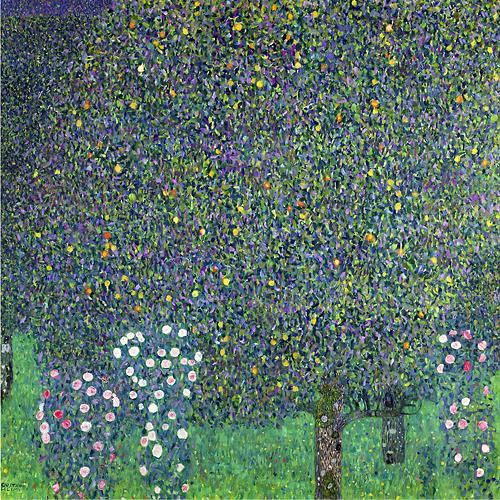
Gustav Klimt's Rose Bushes under Trees is the circa-1904/05 oil painting known in German as Rosen unter Bäumen and in French as Rosiers sous les arbres. It measures 110 × 110 centimetres. Formerly French national inventory RF 1980-195 at the Musée d'Orsay, the canvas was restituted to the heirs of Nora Stiasny on 23 March 2022 and is no longer part of the museum's collection.[1][3]
Three small rose bushes stand below three much larger apple-tree crowns. Slender trunks connect the rounded masses of foliage to a narrow meadow, but closely juxtaposed touches of green, blue, yellow, pink and mauve make those natural forms approach a continuous field. The painting preserves an orchard while repeatedly weakening ordinary depth.[1][6]
That visual identity eventually became decisive evidence. During the persecution of Vienna's Jewish population after the Anschluss, Nora Stiasny was compelled to sell a Klimt described simply as Pommier—Apple Tree—in August 1938. Austria restituted Apple Tree II to her heirs in 2001, but later research showed that this was the wrong canvas. The actual painting was the rose-and-apple-tree landscape then at Orsay.[1][2]
At a Glance
- ArtistGustav Klimt
- German titleRosen unter Bäumen
- Former French titleRosiers sous les arbres
- English titleRose Bushes under Trees or Roses beneath Trees
- DateCirca 1904/05 under the French Ministry baseline; the Klimt Database uses circa 1904
- MaterialsOil on canvas
- Dimensions110 × 110 centimetres
- SignatureNo exact signature transcription is supplied by the retained governing records
- Early exhibition titlesRosen in Vienna and Munich; Le rose in Venice
- First documented purchaserViktor Zuckerkandl, Galerie Miethke, 14 March 1911
- Former French inventoryRF 1980-195
- RestitutionReturned by the French Ministry of Culture to Nora Stiasny's heirs on 23 March 2022
- After restitutionReturned to the heirs; no individual holder, present location or accessible exhibition was identified in records checked on 10 August 2026[1][3]
One Painting, Many Titles
The names attached to this work changed with language, exhibition and ownership. Rosen unter Bäumen, Rosiers sous les arbres, Rose Bushes under Trees and Roses beneath Trees describe the visible conjunction of roses and trees. Early catalogues shortened the subject to Rosen or Le rose.[1][6]
In 1928 the Neue Galerie used Die Apfelbäume mit den Rosen—The Apple Trees with the Roses. During the Nazi persecution it appeared in records as Apfelbaum or Pommier, simply Apple Tree. These labels do not multiply the object. They show different observers giving priority to the low rose bushes or to the large fruit trees above them.[1]
The short apple-tree title later caused serious confusion. Klimt painted several independent orchard pictures, and a bare name without image, dimensions or chain could point to more than one. The correction depended on bringing title history together with inheritance records and the route through Philipp Häusler.
The English title is therefore more than a convenient description. It holds both plant groups together and helps prevent the background apple trees from displacing the roses that distinguish this canvas.
The Klimt Foundation identifies a composition sketch for this painting on page 55 of the sketchbook formerly owned by Sonja Knips. Klimt used the booklet between 1897 and 1905; the Foundation relates that span to a date before or around 1904/05 for the painting.[6] The sketch is evidence of compositional preparation, not an exactly dated transfer cartoon or a record of the orchard's precise location.
The 110-Centimetre Oil
The French research dossier records an oil painting on canvas measuring 110 × 110 centimetres.[1] The equal dimensions place the landscape within Klimt's established square practice, but size does not make it a pendant to another garden or orchard.
No exact signature transcription is supplied by the governing current records retained here. That silence is not proof that Klimt left the work unsigned. It means that a public account should not invent wording or placement that the cited authorities do not provide.
The medium is equally bounded. The surface may recall a mosaic because hundreds of small colour incidents build the larger forms, yet it is oil on canvas. No gold leaf, casein, glass, stone or metal belongs in the material description.
French researchers consider the surviving frame very probably the original one designed for Viktor Zuckerkandl's collection. Their assessment rests on historic photographs of the Zuckerkandls' Berlin-Grunewald residence, where the framed landscape can be seen.[1] “Very probably” preserves the evidentiary strength. The dossier does not license a named frame maker or a complete fabrication history.
Institutional photography documents the canvas before restitution. It supports close attention to composition, not a diagnosis of its present condition. No current technical report retained here establishes pigments, underdrawing, binding medium, restoration history or the sequence in which Klimt applied particular marks.
Three Crowns above Three Rose Bushes
The Klimt Database identifies three small rose bushes in the foreground and three apple-tree crowns behind them.[6] The crowns are rounded but not identical. Each gathers foliage into a self-contained mass, sometimes more spherical, sometimes more oval, and each sits on a comparatively slender trunk.
The contrast of scale is striking. The roses occupy little physical height, yet their paler blooms punctuate the lower field and make the immense crowns above seem even larger. The trees dominate area; the bushes retain the naming power.
The trunks matter because they stop the crowns from becoming entirely detached colour clouds. They indicate weight, growth and distance. At the same time, their thinness appears almost improbable beneath such broad foliage, making the upper masses feel suspended.
The meadow forms a narrow lower zone rather than a broad path into the scene. It gives the rose bushes ground, but it does not offer a clear route towards the trees. Vegetation accumulates before the viewer can settle how far apart the plants are.
This organisation differs from a tree portrait centred on one trunk. It also differs from an open orchard in which rows lead towards a horizon. Klimt provides enough structure to identify an orchard garden, then compresses that structure until foliage, bloom and meadow compete as areas on the canvas.
A Surface of Unequal Touches
The French Ministry describes the work through small, juxtaposed touches and relates it to Neo-Impressionist method without calling it strict chromatic divisionism.[1] That distinction can be seen in the irregularity of the marks.
Colours are not separated into a uniform scientific system. Short strokes and dabs vary in direction, size and density. Pale greens may sit against darker blues; pink and mauve interrupt a crown; yellow or light-green incidents flash within larger masses. The effect depends on differences rather than repetition alone.
At close range, the apple-tree crowns divide into many separate marks. At a greater distance, those marks cohere without losing their vibration. The eye can recognise three trees and still remain aware that their foliage is made from paint distributed across a flat support.
The rose bushes undergo a similar transformation at a smaller scale. Their blooms register as clustered pale forms, but individual petals are not consistently mapped. Recognition emerges from colour, grouping and position below the trees.
The French dossier also invokes Klimt's encounter with Byzantine mosaics at Ravenna in 1903.[1] This is an art-historical comparison, not a recipe. The painting's oil marks can form a mosaic-like total while remaining materially and optically different from tesserae.
Neither comparison should erase observation. The three crowns are not an abstract grid, and the roses are not generic ornamental signs. Modern technique intensifies the relation between the visible plants and the painted surface.
Near Abstraction without Losing the Orchard
The canvas approaches abstraction by dissolving conventional modelling and perspective. The French Ministry calls attention to the way flowers, foliage, trunks and meadow are treated without the usual gradations that would stabilise their volume.[1]
“Approaches” is important. The scene still contains apple trees and roses. Trunks link crown to ground, overlapping plants imply distance, and the lower meadow supplies orientation. The work does not abandon objects; it makes their boundaries less secure.
Large tree crowns read as separate silhouettes from a distance. Closer looking reveals internal passages that refuse a simple front-and-back order. A dark mark may suggest a recess within foliage, then operate as nothing more than a forceful patch beside a lighter one.
The effect can feel both expansive and enclosed. The foliage seems alive with movement, but so much of the square is occupied that visual escape is restricted. The viewer receives abundant nature without a conventional prospect through it.
No fixed symbolic code follows from this density. Roses need not stand universally for love, apple trees for temptation or the orchard for a private confession. Such associations may belong to broader cultural traditions, but the strongest interpretation begins with the painting's unequal scale, compressed ground and flickering surface.
A Landscape with Almost No Exit
The three crowns occupy so much of the square that open atmosphere becomes difficult to locate. There is no generous sky above them and no long view between their trunks. Even the meadow below functions more as a densely worked lower band than as an inviting foreground.
This enclosure changes the experience of scale. A normal orchard view might allow the eye to pass around a tree and measure it against distant land. Here each crown meets neighbouring foliage and the canvas edge before such measurement can settle. The trees feel immense partly because the composition provides so little beyond them.
The rose bushes introduce a different rhythm. Their pale clusters break the lower continuity and create small zones around which the eye can pause. Because the bushes are separated from the great crowns by thin trunks and intervals of meadow, they establish a layered relation without opening a continuous path.
The painting thus offers several partial depths rather than one commanding recession. A rose sits before a trunk; one edge of foliage overlaps another; light and dark touches imply pockets inside a crown. These local cues remain convincing even though the entire orchard is pressed towards the picture plane.
The absence of a visible route also makes looking less linear. The eye cannot begin at a path and follow it towards a distant destination. It circulates among three large upper masses, returns to the roses and compares colour incidents across forms that never resolve into one continuous vista.
This is why the work's approach to abstraction need not be explained as the disappearance of nature. Klimt keeps recognisable plants while dismantling the conventional visual journey through them. The orchard becomes more concentrated, not less specific.
An Attersee Landscape without an Exact Coordinate
French and Austrian sources place the work among the flowering landscapes Klimt made around the Attersee in 1904–05, when he stayed in the Litzlberg area.[1][6] The setting supplies a credible environment of orchards, meadows and rural gardens.
It does not secure an exact row of trees. No retained working photograph, map or property record fixes the painter's position, and the composition sketch does not locate a particular row of trees. The identification of the background plants as apple trees is stronger than any claim about cultivar, owner or precise garden boundary.
Klimt's selection also complicates topographical recovery. The narrow ground, minimal sky and self-contained crowns emphasise relationships within the square more than a route through a real property. Even a correct locality would not recreate the compositional decisions.
The site can therefore remain responsibly broad. Litzlberg and the Attersee explain the painting's working context; the canvas explains how observed vegetation became a concentrated pictorial field.
From Vienna to Munich and Venice
The work was shown at the Kunstschau Vienna in June 1908 as Rosen, catalogue number 11. It appeared at Munich's Glaspalast from June to October 1909 under the same short title, number 812. At the Venice Biennale from April to October 1910 it was listed in Italian as Le rose, number 7.[1]
The three titles strengthen identification because each foregrounds the roses. Their sequence also shows that the canvas circulated publicly before it entered Viktor Zuckerkandl's collection.
In 1911 Galerie Miethke exhibited the painting in Vienna. Viktor Zuckerkandl bought it there on 14 March.[1] The precise acquisition date turns a general collector association into a firm object-history anchor.
Miethke had already published or reproduced the work in 1908 and did so again in 1914.[1] Those images helped maintain its identity. They are documentary reproductions, not original Klimt prints or alternative painted states.
The French dossier describes the early exhibition history as evidence of the work's prominence. It should not be expanded by transferring reviews of other Klimt landscapes to this canvas. The secure value lies in the catalogue trail itself: roses in Vienna, Munich and Venice, then a dated purchase in 1911.
The trail grew less visible after 1928. The painting was offered without selling at both the Neue Galerie memorial exhibition and the Secession memorial display, and it was later shown at Galerie Wawra. It subsequently disappeared from public and specialist view for decades.[1]
The first Klimt catalogue raisonné, published by Galerie Welz in 1967, included the work but could not give its location. Its reappearance through Galerie Nathan near the end of the 1970s therefore joined a familiar reproduced composition to a physical canvas whose recent custody was poorly understood.[1]
This contrast is important. A work can remain present in books while its ownership evidence becomes thin. Reproduction protected visual identity, but it could not by itself reveal that Häusler's account of pre-1938 possession was unsupported.
Viktor and Paula Zuckerkandl
Viktor Zuckerkandl assembled a substantial Klimt collection. Rose Bushes under Trees was among at least nine Klimt canvases he owned at different times, bought between 1908 and 1914 or 1915.[1]
Viktor and his wife Paula later lived in Berlin-Grunewald. Interior photographs show the framed landscape in their residence, supporting both possession and the probable originality of its frame. The evidence belongs to the object; it does not require a general survey of the couple's house or patronage.
Viktor died in February 1927 and Paula in May. Their Klimt landscapes were distributed within the extended family. Later private archives clarified which branch received each work.[1]
The canvas was offered in two Vienna memorial exhibitions in 1928 without selling. The Neue Galerie called it Die Apfelbäume mit den Rosen. The Secession used the broader Landschaft.[1] These entries matter because the first preserves both elements of the image and helps connect the Zuckerkandl painting to the later Pommier record.
Research eventually concluded that this landscape passed to the family branch of Viktor's brother Otto. Nora Stiasny, Otto's daughter, inherited it. The conclusion rests on the allocation of the known Zuckerkandl landscapes and later transactions, not merely on title resemblance.[1]
Nora Stiasny and the August 1938 Sale
Eleonore, known as Nora, Stiasny was born in 1898. She lived with her family at the Purkersdorf sanatorium complex associated with the Zuckerkandls. After the Anschluss of March 1938, anti-Jewish persecution stripped the family of security, property and freedom.[1]
Nora needed funds to survive and meet financial demands imposed by the authorities. In August she was compelled to sell her Klimt, then described as Apfelbaum or Pommier.[1][2]
The surviving testimony gives different prices: 100, 200 or 395 Reichsmarks. Nora had valued the painting at 5,000 RM in July 1938. A 1927 estimate of 10,000 schillings was equivalent to about 5,900 RM, and a Nazi-appointed expert valued it at 2,500–3,000 RM in November 1939.[1] The variations do not obscure the central fact. The August payment was drastically below the work's contemporary value and occurred under persecution and urgent financial coercion.
Philipp Häusler, an earlier acquaintance of Nora's, organised the transaction, perhaps using his brother-in-law Adolf Frey as nominal purchaser. French research established that Häusler was an active Nazi Party member and used his position and personal access to exert pressure.[1]
The object's history should remain proportional. Those facts explain why the sale was spoliative; they do not turn every detail of Häusler's career into necessary artwork context. The central event is Nora's loss of a specific Klimt through a transaction that was neither free nor fairly priced.
Nora, her mother Amalie, her husband Paul and their son Otto were deported and murdered in 1942.[1][2] Their fate belongs to the provenance because persecution caused the transfer and prevented recovery. It must not be projected backwards into the painted roses and trees as if Klimt had encoded later events.
The Postwar Attempt to Recover the Painting
Nora's sister Hermine Müller-Hofmann and Hermine's husband Wilhelm tried to recover the Klimt after the war. In 1946 they brought proceedings against Häusler.[1]
Häusler denied that he had bought the painting and sent a threatening letter. The proceeding did not reach a successful recovery. The French dossier leaves the reasons unresolved, while noting Wilhelm's death in 1948, Häusler's residence in Germany and the painting's uncertain location as possible factors.[1]
These limits should remain open. There is no responsible basis for inventing a final judgment, private settlement or voluntary abandonment by the family.
Häusler retained the canvas until his death in 1966. It passed to Herta Blümel, his assistant, companion and universal legatee. Provenance researchers did not establish Blümel's identity as the immediate pre-market owner until 2016.[1]
Galerie Peter Nathan in Zurich obtained the painting from Blümel. That connection later proved crucial because it linked the canvas acquired by France to the man who had taken Nora's Pommier.
The French Acquisition in 1980
The French state bought Rosiers sous les arbres from Galerie Peter Nathan in 1980 for the future Musée d'Orsay. The price was 1.6 million Swiss francs, approximately four million French francs at the time.[1]
The acquisition underwent the required museum review. Researchers asked the gallery for its provenance, consulted the literature and contacted members of the Zuckerkandl family. The information then supplied asserted, without documentation, that Häusler had owned the painting by 1930. That date appeared to place his possession before the Nazi period.[1]
Published catalogues also incorrectly associated the canvas after Viktor with another Zuckerkandl relative. On the evidence accessible in 1980, no link to Nora Stiasny was recognised. The purchase was approved, and the painting entered the national collection as RF 1980-195.[1][2]
The provenance supplied through the gallery came from Herta Blümel, whose connection to Häusler was not yet recognised. She stated that he already had the canvas in 1930 but did not provide proof. The date nevertheless made a chain through a former Wiener Werkstätte figure appear plausible and apparently removed the work from the danger period.[1]
Researchers also consulted the 1978 catalogue raisonné, which placed the landscape after Viktor Zuckerkandl with his sister-in-law Bertha. Bertha had escaped to Paris after the Anschluss. Contact with members of that family branch raised no warning because the decisive inheritance allocation to Nora's branch had not yet been reconstructed.[1]
The 1980 investigation was therefore active but constrained by mistaken family assignment, an unverified date and archives not yet brought together. Its failure was not simply lack of effort. Several individually plausible pieces formed a reassuring history that later evidence overturned.
Later research changed the conclusion because archives opened and the family distribution became clearer. This does not justify describing the 1980 acquisition as a knowingly wrongful purchase. It demonstrates how apparently coherent provenance can depend on an unsupported early date and an incomplete family history.
At Orsay, the canvas became a prominent representative of Klimt and long remained the only painting by him in a French national museum.[1] That importance made restitution legally more complex, but it did not outweigh the evidence of Nora Stiasny's ownership and coerced loss.
Why Apple Tree II Was Returned in 2001
By the late 1990s, archives had established that Nora had been forced to sell a Klimt called Pommier. Gustav Ucicky had given a different Klimt, Apple Tree II, to the Austrian state in 1948. Records also showed that Ucicky had once been approached as a potential purchaser of Nora's painting.[1]
Those facts made Apple Tree II a plausible candidate. Nora's heirs submitted a legitimate claim, and Austria restituted that canvas in November 2001.[1][2]
Doubts persisted. The problem was not whether Nora had been persecuted or dispossessed; it was whether the generic apple-tree title had been attached to the correct physical painting. Researchers continued examining inheritance files, sale evidence and ownership links.
Apple Tree II remains a separate 1916 oil with its own later provenance. Its mistaken restitution should not be used to absorb the entire history of that painting here. What matters is the lesson for Rose Bushes under Trees: a title alone was not enough.
How the Correct Identity Was Established
Provenance researchers Monika Mayer of the Belvedere and Ruth Pleyer assembled new evidence through the 2000s and 2010s. In 2016 they identified Herta Blümel as Häusler's legatee and the owner from whom Galerie Nathan had obtained the Orsay canvas.[1]
Research into Viktor and Paula Zuckerkandl's estate also clarified the distribution of six identifiable Klimt landscapes. The rose-and-apple-tree painting could logically have passed to the branch of Viktor's brother Otto, to which Nora belonged.[1]
The two strands met in Häusler. Nora's coerced sale led to him; the Orsay canvas's pre-1980 chain also led back to him. The dossier notes that he does not appear to have owned another Klimt. The apple trees visible behind the roses also explain why historical documents could call this work Pommier.[1]
In July 2017 Austria's provenance authorities concluded that Apple Tree II was not Nora's lost canvas and identified Rose Bushes under Trees as the correct work with strong probability. Austrian officials informed their French counterparts in 2018. Nora's heirs submitted a formal request for the Orsay painting in September 2019.[1][2]
The Musée d'Orsay, French Ministry of Culture, Belvedere, Austrian researchers and the heirs' representatives then examined the evidence together. Their conclusion was not a casual visual resemblance. It rested on inheritance allocation, transaction history, the Blümel discovery and the unique Häusler connection.
From the 2021 Decision to the 2022 Restitution
France announced its decision to begin restitution on 15 March 2021.[2][5] An announcement could not itself transfer the painting because RF 1980-195 belonged to the inalienable French national collection, unlike works held provisionally in the MNR system.
Parliament therefore had to authorise removal from the public domain. The law of 21 February 2022 provided the required legal basis for this painting and other cultural objects connected to anti-Semitic persecution.[4]
The Ministry completed restitution on 23 March 2022, returning the canvas to Nora Stiasny's heirs.[3] The decision, legislation and physical/legal return are three distinct stages and should not be compressed into one date.
The former inventory remains useful for tracing records, but the painting ceased to belong to the French national collection. Calling it a current Musée d'Orsay holding or directing visitors there to see it would now be inaccurate.
No retained official source identifies a present individual owner, city or display. As checked on 10 August 2026, its status should be stated simply: restituted to Nora Stiasny's heirs and privately held, with current public access unverified.
The legal route also clarifies why a well-supported moral and historical decision still required time. The painting had been purchased voluntarily by the state in 1980 and incorporated into the permanent public collection. It was not an MNR object recovered after the war and held provisionally while an owner was sought.[1][2]
French public collections are protected by inalienability. Once the Ministry accepted the historical conclusion, it could announce an intention to return the work, but ordinary administrative action could not remove it from state ownership. Legislation was required to make the restitution legally effective.[2][4]
That sequence prevents two opposite errors. The interval from March 2021 to March 2022 was not evidence that France had withdrawn its commitment, and the 2021 announcement was not itself the completed return. Research, decision, legislation and restitution were connected but distinct acts.
Why Rose Bushes under Trees Matters
The painting's formal and historical identities are unusually intertwined. Its small roses and large apple-tree crowns create the scale contrast that gives the image its character. The same apple trees help explain why documents called it Pommier and why it was later confused with a different Klimt.
Correcting that confusion required more than recognising an image. Researchers rebuilt a family inheritance, questioned an unsupported 1930 ownership claim, identified Blümel, connected two chains through Häusler and separated the facts of persecution from the error of object identification.
The result also changes how current access is described. The painting was once a major Orsay holding; it is no longer French state property. Its former museum status remains part of its history, while its return to the heirs is the governing present fact.
Close looking and provenance research meet without reducing one to the other. The apple trees should not eclipse the rose bushes, and restitution history should not eclipse the painting. Both are necessary to understand why this particular square of foliage, trunks and flowers carries such a precise identity.
Frequently Asked Questions
References
- French Ministry of Culture, Annonce de la proposition de restitution du tableau de Gustav Klimt, Rosiers sous les arbres, research dossier, 2021; date, medium, dimensions, visual analysis, probable frame, exhibitions, Zuckerkandl and Stiasny history, coerced sale, Häusler/Blümel/Nathan chain, French acquisition, 2001 error and correct-object research. View source. Accessed 10 August 2026.
- French Ministry of Culture, “Annonce du lancement de la procédure de restitution du G. Klimt, Rosiers sous les arbres (Inv. RF 1980-195), conservé au musée d'Orsay,” 15 March 2021; formal restitution decision, persecution history and Apple Tree II correction. View source. Accessed 10 August 2026.
- French Ministry of Culture, “Restitution du tableau de Gustav Klimt, Rosiers sous les arbres, aux ayants droit de Nora Stiasny,” 23 March 2022; completed restitution and removal from the French national collection. View source. Accessed 10 August 2026.
- Légifrance / Vie publique, legislative dossier for Law no. 2022-218 of 21 February 2022 concerning restitution or return of cultural property to heirs of owners who suffered anti-Semitic persecution; legal authority for removal from the public domain. View source. Accessed 10 August 2026.
- Musée d'Orsay, “Return of a Work Looted by the Nazis”; institutional English title, former inventory and 2021 restitution procedure. View source. Accessed 10 August 2026.
- Gustav Klimt Database, “The Klimt Affair Surrounding the Faculty Paintings: 1904–1906”; current circa-1904 private identity, three rose bushes before three apple-tree crowns, and the page-55 composition sketch in Sonja Knips's former sketchbook. View source. Accessed 23 October 2026.
Discussion
Rose Bushes under Trees rewards close attention to source context, object identity and careful reproduction boundaries.