 by Tom Gurney
Tom Gurney BSc (Hons) is an art history expert with over 20 years experience
Published on August 21, 2026 / Updated on October 23, 2026
Email: tomgurney1@gmail.com / Phone: +44 7429 011000
About Danaë
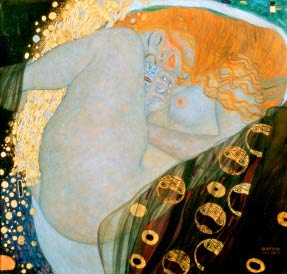
Danaë is folded into a near-square field. Her head rests against violet cloth, her eyes are closed and one hand disappears near her raised thighs. A stream of golden colour enters from above and moves across the compressed body. There is no visible god, palace or child—only flesh, textile and the divine descent that the myth calls Zeus.
Gustav Klimt painted Danaë in 1907/08 and first showed it at the 1908 Kunstschau Wien. The work is now recorded as privately owned. Unlike paintings held by public museums, it does not have a current collection page offering a recent technical examination, condition report or access information. The defensible medium is consequently conservative: oil on canvas, approximately 77 by 83 centimetres.[1][4]
The painting is famous for making conception intensely erotic. But erotic form does not settle the story's ethics. Danaë has been imprisoned by her father because an oracle says her son will kill him. Zeus uses divine transformation to reach her confinement. Klimt's closed eyes, parted lips and enveloping textiles can suggest ecstasy; they cannot tell us that unequal access was desired or consensual.[1][5]
That tension is central to the picture. A god becomes a visible current rather than a male body. A woman appears sheltered and penetrated, withdrawn and exposed. Klimt turns a long mythological narrative into a compact field in which shape, pressure and material illusion carry nearly everything.
At a Glance
- ArtistGustav Klimt
- TitleDanaë
- Date1907/08[1]
- MediumOil on canvas[4]
- Approximate dimensions76.83 × 82.87 centimetres, commonly rounded to 77 × 83 centimetres[4]
- Current statusPrivate collection[1]
- SubjectZeus reaches the confined Danaë in the form of a golden stream; she later bears Perseus[5]
- First exhibitionKunstschau Wien 1908, in Klimt's dedicated room[1]
- First buyerEduard Ast, for 8,000 crowns[1][6]
- Later domestic settingThe oval ladies' salon of Villa Ast, an interior designed by Josef Hoffmann[6]
- Associated drawingsThe Albertina's current digital Danaë group contains 23 sheets, including early poses later reconsidered for the painting[2][3]
- Material cautionGolden or gold-coloured passages are visible, but no current holder's technical record supports an object-specific gold-leaf or metal claim
Danaë Before Klimt
The story begins with an oracle. Acrisius, king of Argos, learns that a son born to his daughter Danaë will kill him. In the version reported by the mythographer Apollodorus, he confines her in a bronze chamber so that she cannot bear a child. Zeus nevertheless reaches her as a stream of gold pouring through the roof, and Perseus is born.[5]
The attempt to defeat prophecy produces the conditions through which it unfolds. Acrisius controls his daughter's movement and sexuality; Zeus overcomes that enclosure through divine metamorphosis. After discovering the child, Acrisius puts Danaë and Perseus into a chest and casts them into the sea. They survive, and the larger Perseus cycle begins.[5]
Ancient versions do not give one modern legal or psychological account of the encounter. Translations and retellings use terms ranging from intercourse and seduction to ravishment or rape. What remains structurally clear is the inequality: Danaë is confined by paternal authority, while a god obtains access in a form a mortal cannot match or refuse on equal terms.
Klimt removes almost every surrounding episode. Acrisius, the chamber architecture, oracle, infant, chest and sea disappear. Danaë's body and the descending stream alone make the story recognisable.
A Body Curled into the Canvas
The canvas is slightly wider than it is high, but the body does not stretch across it like a conventional reclining nude. Danaë bends sharply. Her knees rise, her thighs turn inwards and her head curls towards them. Shoulder, torso and legs form a compact circuit.
This pose is often called circular, oval, embryonic or womb-like. The first two words describe visible organisation. The latter terms are interpretations encouraged by a painting about conception. It is best to notice the construction before converting it into a biological symbol.
Klimt gives the figure very little unoccupied space. Her feet and lower legs press against an edge; the top of her hair nearly meets another. Cloth crosses behind and around her, while the golden current enters the same shallow zone. There is no stable floor or bed from which to calculate ordinary gravity.
Compression heightens bodily sensation. Bent limbs conceal some areas and bring others close. The viewer encounters the nude not as a continuous academic display but through overlap, foreshortening and pressure. Danaë seems gathered into herself even as the mythic force enters her enclosure.
Enclosure Without a Room
Apollodorus gives Danaë a bronze chamber. Klimt does not paint recognisable walls, a door or a roof. The visual equivalent of confinement is produced by the canvas edge and the mass of violet textile.[5]
Fabric curves around the head, shoulders and legs. It can appear protective because it cushions the body and creates an interior pocket. It can also appear restrictive because there is no open route out of the composition. Shelter and confinement become difficult to separate.
The textile does not behave like bedding arranged in deep space. Its colour and pattern remain close to the surface. Flesh, cloth and gold occupy adjacent zones with only limited recession. Klimt therefore makes enclosure a decorative and bodily condition rather than an architectural illustration.
A dark rectangular passage appears near the lower body, along with isolated ornamental marks. Such forms invite sexual or symbolic decoding, but their visible role should come first: they interrupt the curves, supply tonal weight and sharpen the difference between geometric sign and yielding flesh. No secure source makes the rectangle an automatic emblem.
A Profile Turned Inward
Danaë's face appears in profile rather than addressing the viewer. Hair and textile cushion the head, while the line of forehead, nose and lips remains remarkably clear within the crowded field. The face supplies a small zone of stillness inside the larger bodily spiral.
Profile removes the social exchange found in a portrait. Danaë does not meet an audience or register another person in the room. That withdrawal can make the scene seem private, dreamlike or self-contained even though the viewer has been brought very near.
The hand reinforces the ambiguity. It disappears near the thighs rather than offering a fully legible gesture. Erotic interpretations often treat its position as self-touch, and the Klimt Database records that reception.[1] Yet partial concealment prevents an exact anatomical account. Klimt makes the implication strong without turning it into an instructional display.
The distinction between inwardness and consent must remain visible here. A profile and closed eyes can reduce outward resistance within the image, but they cannot reveal the character's agreement to the event. They are pictorial devices through which a viewer experiences privacy, not testimony from a mythological woman.
The Golden Descent
Zeus is absent as a human or animal figure. He appears through the golden stream entering from above. Myth and visual form coincide: the god becomes the substance that moves across the picture.[1][5]
This choice avoids a two-body encounter. It also makes divine power pervasive. A male figure could be located, resisted or placed at a distance. The golden current has no face and little fixed boundary. It enters the fabric enclosure and flows alongside the body, converting access into light, colour and movement.
The Klimt Database interprets the stream as an objectified divine presence and discusses the precious effect of the surrounding brocade.[1] These descriptions support analysis of how gold operates pictorially. They do not establish the painting's exact technical recipe.
The available object record identifies oil on canvas.[4] In the absence of a current holder's material analysis, “golden rain”, “gold-coloured stream” and “metallic effect” are safer than “gold leaf”. Klimt could create the visual idea of gold through paint and surface treatment without every luminous passage containing metal.
Zeus Without a Body
Transformation is not merely an attribute added to an otherwise conventional encounter. It reorganises the balance of the painting. Zeus has direction and force but no human anatomy, gaze or facial expression. Danaë carries all the visible bodily vulnerability.
The substitution has contradictory effects. Removing the male nude can make the scene appear less physically violent, because no second body pins or grasps her. It can also make the god more invasive, because the descending substance enters the enclosure without occupying a bounded place.
Gold brings its own associations of value, radiance and divinity. In the myth it is a mode of access; in the composition it is also the brightest moving element. Klimt allows beauty to become the carrier of power. The passage attracts the eye at the same time that the story asks what that attraction accomplishes.
This is why Zeus should not be described as absent without qualification. He is visually disembodied, but his agency gives the composition its directional movement. Danaë is the only represented person; the god is present as event.
Flesh Against Violet Cloth
The painting's erotic intensity depends on colour as well as pose. Warm flesh is enclosed by deep purple or violet fabric, while the golden stream travels between and across them. The contrasts make the body seem heated and the surrounding cloth saturated.
Klimt does not use the textile merely as a background. It bends with the body and partly covers it, alternately hiding and revealing. The cloth gives the nude a private enclosure while making the act of looking feel more intimate.
Pattern changes the scale of the image. Large bodily curves coexist with small repeated marks, so attention moves between the whole folded figure and minute surface incidents. Naturalistic modelling describes weight and skin; ornament insists on the flatness of the canvas.
This is one reason Danaë should not be treated as a generic example of a “Golden Period”. The gold-coloured passage has a precise mythological job, and the violet fabric creates a specific enclosure. Other Klimt paintings use metallic splendour for portrait status, sacred association or architectural mosaic. Here the luminous current is Zeus.
Closed Eyes Do Not Explain Consent
Danaë's eyelids are shut. Her mouth opens slightly. Her face and hand position have encouraged descriptions of dream, orgasm, self-touch or ecstatic surrender. The Klimt Database records this erotic interpretive tradition, while private commentary from 1908 could recognise the stream in explicitly phallic terms.[1]
The sensual construction is visible. It would be evasive to pretend that Klimt painted a neutral mythological diagram. Yet expression cannot supply a reliable transcript of consent. Closed eyes might convey pleasure, sleep, withdrawal, vulnerability or an artistic convention for inward sensation.
The myth imposes a second limit. Danaë has already been confined to control her reproductive life, and Zeus's power lets him enter despite that confinement. A painted expression created by a male artist does not override those coercive conditions.
Two statements can therefore remain true together: Klimt eroticises the encounter, and the underlying story involves radically unequal power. Treating one as the answer to the other would simplify what makes the image both compelling and troubling.
Is the Pose Embryonic?
The folded body readily evokes an embryo. Knees, thighs, torso and head gather into an oval, and the subject culminates in conception. Such an association can enrich looking if it remains a response to form rather than a literal diagram.
Danaë is an adult woman, not a foetus. Her body creates a compact enclosure, but it does not reproduce a medically exact developmental stage. The shape can suggest self-containment, pregnancy, retreat, protection and pressure without having to stand for only one of them.
The circular reading also risks overlooking asymmetry. The head is pushed to one side; limbs cross at different angles; the golden stream enters rather than merely surrounding the figure. The composition is not a closed perfect circle. It is a body under directional force.
Klimt's success lies in making the pose carry myth before the viewer identifies every attribute. Compression establishes inwardness, and the stream breaks into it. Conception becomes a spatial event.
Do the Patterns Represent Cells?
Some writers have interpreted oval units in the brocade as blastocysts or embryonic cells. The Klimt Database reports the proposal within the painting's reproductive symbolism.[1]
The suggestion belongs to modern interpretation, not to a surviving statement by Klimt. Nor are the motifs literal scientific illustrations. Their scale, repetition and decorative setting distinguish them from diagrams of cellular development.
They can nevertheless activate biological thought. A viewer who already knows Danaë will bear Perseus may connect repeated ovals with division, fertility or early life. The ornament then appears to spread the narrative of conception beyond the body.
Other viewers may see textile pattern first. The two responses are not mutually exclusive, but evidentiary language matters: the painting contains oval motifs; scholarship has read them as cells. It does not contain a universally decoded “blastocyst symbol”.
A Drawing History That Begins Early
The Albertina's current digital catalogue brings 23 drawings into the Danaë group. That number describes an evolving scholarly association, not a list Klimt made and not a fixed total of every study he used.[2][3]
Alice Strobl dated many related poses to around 1903, several years before the 1907/08 canvas. Some were initially considered in connection with Medicine but were not used in the destroyed Faculty painting. Klimt later returned to bodily problems involving raised, crossed or tightly bent legs.[2]
This chronology does not date Danaë to 1903. An artist can preserve a pose, revisit a sheet or transform a dormant idea long after its first context has passed. The early studies show continuity in Klimt's thinking, while the final title and composition belong to the later painting.
The mixed origins also explain why not all 23 sheets should be called direct preparations. Some are close to the final leg relation; others belong to a wider family of reclining or suspended bodies. Catalogue grouping records degrees of relevance rather than identical purpose.
What a Group of Twenty-Three Drawings Means
Digital catalogue groups are scholarly tools. They bring together objects whose relation may be direct, probable, thematic or historical. The Albertina's total of 23 records can therefore change if drawings are reattributed, regrouped, newly digitised or understood differently.[3]
For Danaë, that flexibility is especially revealing. The painting's final pose did not emerge from a single line of ever-closer copies. Klimt worked through a reservoir of bodily ideas. A raised leg tested for one project could return years later; a clothed pose could clarify an arrangement ultimately painted nude; reversal could change direction without severing the relation.
The group should consequently be read as evidence of sustained invention rather than production arithmetic. It does not mean that Klimt made exactly 23 sheets at a sitting, selected one and enlarged it. Nor does it imply that every sheet was titled Danaë when drawn.
This graded history adds value to the painting. Its extraordinary compression appears less like a spontaneous erotic flourish and more like the late solution to a formal problem Klimt had revisited across contexts.
From Raised Legs to a Closed Oval
Across the associated drawings, clothed and unclothed figures test how legs can cross, rise and conceal the torso. One early pose already anticipates an important relation between the limbs, while others remain more open. The final canvas tightens these experiments into its compact oval.[2]
Direction changes matter. A drawn body can be reversed when transferred conceptually into a painting, and independent limbs can be compressed until they create a new enclosure. Such transformations prevent the studies from functioning as tracing cartoons.
The Albertina also notes an art-historical lineage of reclining female bodies, including Danaë traditions associated with Titian and Correggio and a Leda pose known through copies after Michelangelo.[2] These precedents show that Klimt worked within a recognised mythological repertoire.
They do not prove that the final body quotes one master directly. The folded position can carry memories of several admired forms while answering Klimt's own need for a near-square compression.
Mythology as Cultural Permission
European art had long used Danaë's story to authorise the display of a reclining nude. Myth supplied a prestigious name, a divine event and a history of celebrated precedents. Viewers could encounter explicit sensuality under the protection of classical culture.
Albertina scholarship proposes that this established tradition may help explain why the painting caused less public outrage than its erotic directness might suggest.[2] The argument is plausible, but it should not turn mythology into a universal exemption. Audiences varied, and absence of recorded protest is not proof of untroubled acceptance.
Klimt both uses and intensifies the convention. He gives the viewer very little narrative distance. Danaë is not one small figure in an elaborate antique setting. Her body occupies almost the entire field, and the god becomes a stream whose direction is sexually explicit.
The respectable mythological title and the compressed erotic image therefore support one another uneasily. Tradition makes the subject legible; Klimt removes much of the tradition's decorum.
Danaë in an Older Painted Tradition
The Danaë theme had supplied European painters with several durable choices: a reclining or enclosed woman, a descending shower of gold, and an attendant or surrounding objects that could turn divine transformation into a scene of wealth. Titian and Correggio are among the precedents discussed in Albertina scholarship, while the associated drawings also invite comparison with a Leda pose preserved in copies after Michelangelo.[2]
These names establish a field of artistic memory, not a checklist of quotations. Klimt does not reproduce one older composition wholesale. He removes the servant, spacious bed and fully extended reclining body that appear in parts of the tradition. His Danaë is neither comfortably horizontal nor surrounded by narrative props.
The Leda comparison is equally bounded. Both myths concern Zeus reaching a mortal woman through transformation, and both encouraged artists to explore folded female bodies. A related leg arrangement can travel across those stories without making Danaë secretly Leda.
Klimt's distinctive contribution is concentration. He retains the classical name and golden sign while pushing the body into a shallow near-square pressure chamber. Historical precedent legitimises the subject, but the final spatial solution belongs to this canvas.
First Seen at the 1908 Kunstschau
Danaë was completed for the Kunstschau Wien of 1908 and appeared as a brand-new work in the room devoted to Klimt. The Klimt Database records sixteen paintings in that display.[1]
The exhibition context matters because viewers encountered the canvas among a concentrated group of recent works rather than as an isolated private possession. Even so, Danaë announced itself through its near-square format and tightly gathered body.
Albertina research notes that no surviving contemporary critic publicly took offence at the work's eroticism.[2] Private response could be more explicit, recognising the sexual form of the golden stream.[1] These records show different modes of reception: public criticism shaped by exhibition language and private talk willing to state what the composition suggested.
Silence should not be made unanimous. Some reviews may be lost, some viewers may have been indifferent and others may have found the myth sufficient cultural cover. The evidence supports an absence of documented public scandal, not universal approval.
Eduard Ast's Purchase
The industrialist and building contractor Eduard Ast bought Danaë for 8,000 crowns in connection with its 1908 appearance. Ast and his wife had entered the modern Viennese design world that linked collectors, artists, architects and the Wiener Werkstätte.[1][6]
The price documents the painting as a valued contemporary object, but it does not tell us what Ast thought every symbol meant. Nor does private purchase make the nude a commissioned portrait or identify Danaë's model.
Ast's ownership is more illuminating when joined to the environment he created for the work. Josef Hoffmann designed Villa Ast, and the painting was later installed in an oval ladies' salon. The near-square canvas entered a carefully shaped domestic interior rather than an improvised storage space.[6]
That room gives Danaë a history of designed viewing. It does not fix a uniquely female interpretation because of the salon's name, and it does not make the painting part of the building's fabric. It remained a movable oil painting deliberately placed within an architectural scheme.
A Painting in Private Hands
Current institutional research records Danaë as privately owned.[1] That status limits what can responsibly be said about the object now. There is no public collection record confirming a permanent display, recent conservation campaign or detailed technical analysis.
Private ownership does not mean the painting is lost. It has a documented identity, images and exhibition history. Nor does it mean the public will never see it again. Loans and ownership conditions can change.
The same caution applies to provenance after Ast. Without a current holder statement sufficient to reconcile the whole chain, it is better to stop with secure history than to repeat names, locations or market rumours as fact.
Material language should reflect the same evidence boundary. Oil on canvas is documented.[4] Golden colour is visible. A precise metallic recipe, condition assessment or assertion of gold leaf would require technical evidence not supplied by the current public records used here.
No Secure Named Model
No documented sitter is required for the title. Danaë's identity comes from the golden descent and mythological context, not from a portrait record. The body's specificity may prompt viewers to search for a model, but no current institutional source used here supplies a secure name.
Preparatory drawings do show Klimt studying posed bodies. They demonstrate observation without converting the final figure into the portrait of one identifiable woman. A painted body can combine several sessions, revised limbs and a face developed for expressive rather than documentary purposes.
This matters because erotic interpretation often slides into biography. An intimate pose can tempt speculation about Klimt's private relations or the sitter's experience. Neither the canvas nor the associated catalogue group supports a personal confession.
Danaë is both a represented woman and a mythological construction. Respecting the model's anonymity keeps those levels distinct and avoids using an unknown person's body as evidence for a story about her life.
What Can Be Known from Reproductions
Most viewers encounter Danaë through published images. Reproductions can establish composition, title history and broad colour relations, especially when joined to catalogued dimensions and exhibition records. They are less reliable for surface texture, reflective behaviour and condition.
This limitation is acute in a painting whose effect depends on the difference among skin, textile and a gold-coloured stream. Screen brightness may make a passage look metallic or flatten distinctions that the original preserves. Colour balance can shift violet towards purple or alter the warmth of flesh.
The private-collection record therefore requires two kinds of confidence. The composition and oil-on-canvas identity are secure enough for sustained analysis.[1][4] Claims about precise metal content, present surface state or the experience of standing before the current object require more recent technical and display evidence.
Acknowledging that boundary does not diminish the work. It distinguishes what the image strongly supports from what only direct examination could establish.
Looking Without Solving
Start with the outline of the body. Trace head, back, knees and feet to see how little lateral space Danaë receives. Notice where the shape closes and where the gold-coloured stream interrupts it.
Then separate cloth from flesh. Violet fabric does not simply lie behind the figure; it presses, crosses and folds around her. Its enclosure makes the visible skin feel exposed within privacy rather than displayed in open space.
Follow the golden descent from the upper edge towards the hidden hand and thighs. The eye will probably recognise Zeus before finding any conventional attribute because movement itself carries the myth.
Finally, return to the face. Closed eyes are powerful because they refuse a public explanation. They intensify erotic inwardness without proving sleep, pleasure, consent or psychological escape. The painting remains strongest when those possibilities do not collapse into one.
What Danaë Changes
Earlier artists could make Danaë's chamber, attendants, shower of coins or visible Zeus part of the story. Klimt removes almost everything that would distribute attention away from the encounter. Myth becomes pressure within a square.
His most consequential invention is to deny Zeus a conventional body. Divine power becomes pictorial substance: bright, fluid, directional and difficult to resist. Danaë's body answers by curling into an enclosure that is never completely closed.
The painting is therefore not only a celebration of sensual conception. It is also an image of access under unequal power, made seductive through colour and form. Its beauty can reveal how myth eroticises coercion rather than cancel that problem.
No single biological or psychological code resolves the result. Embryo, womb, cells, ecstasy and retreat are interpretive possibilities attached to visible shapes. The secure achievement is formal: a body, textile and golden current make an ancient transformation feel immediate.
Frequently Asked Questions
References
Accessed August 2026.
- Gustav Klimt Database, “Gustav Klimt at His Zenith,” Danaë: 1907/08 date, private-collection status, composition and erotic interpretation, gold-coloured divine presence, 1908 Kunstschau display, private reception, Eduard Ast purchase and Villa context. View source.
- Albertina, Vienna, Alice Strobl, “Danaë” drawing-group essay: early study chronology, transformed poses, links to unused earlier figure studies, artistic precedents and 1908 reception. View source.
- Albertina, Vienna, “Danaë” group results, current set of 23 associated drawing records and dynamic catalogue grouping. View source.
- University of Michigan Library Digital Collections, “Danaë,” image and object record, oil-on-canvas medium and approximately 76.83 × 82.87-centimetre dimensions. View source.
- Perseus Digital Library, Tufts University, Apollodorus, Library, Book 2, Chapter 4: oracle to Acrisius, Danaë's confinement, Zeus as a stream of gold and the birth of Perseus. View source.
- Gustav Klimt Database, “Eduard Ast,” collector history, 8,000-crown purchase and Danaë in the designed oval ladies' salon at Villa Ast. View source.
Discussion
Danaë rewards close attention to source context, object identity and careful reproduction boundaries.