



 by Tom Gurney
Tom Gurney BSc (Hons) is an art history expert with over 20 years experience
Published on June 19, 2020 / Updated on November 1, 2026
Email: tomgurney1@gmail.com / Phone: +44 7429 011000
Nativity (Birth of Jesus) by Giotto: Introduction
This fresco of the Nativity is one of Giotto's most significant works, both among his paintings that sought to depict the life of the Virgin Mary, but also in its innovative style.
Mary reaches across the bed towards her swaddled son; at the other side of the scene, shepherds turn towards an angel descending above them. Between these encounters stand the timber shelter and a bare, folded landscape. Giotto's Nativity, also called the Birth of Jesus, gives the event a clear physical setting while bringing together human care and heavenly announcement. It remains in the Scrovegni Chapel in Padua, where the municipal catalogue records an approximate height of 203 centimetres and width of 200 centimetres. [1]
At a Glance
- SubjectMary reaches towards her swaddled son as shepherds turn towards an angel. [1]
- Setting and sizeScrovegni Chapel, Padua; approximately 203 cm high × 200 cm wide. [1]
- DateThe 1303–1305 chapel campaign, not a documented execution year for this compartment. [2]
This work across Giotto’s career
Santa Maria Novella Crucifix
Late 13th century; c.1288–89 or 1298–1301; disputed; track: c.1288–89 [3]Life of Saint Francis — Upper Church cycle, Assisi
Traditionally Giotto; late 13th–early 14th century; authorship and date disputed; track: c.1290–95 convention [4] [5] [6] [7] [8]Ognissanti Madonna
c.1300–05 (Uffizi); c.1310 also proposed; track: c.1300–05 [9]Scrovegni Chapel — painted decoration
c.1303–05 (chapel campaign); Giotto and workshop (painted decoration) [10] [11] [12]Nativity — Scrovegni Chapel, Padua (current article)
c.1303–05 (chapel campaign); Giotto and workshop [13] [10]Madonna and Child — Washington / Goldman Madonna
c.1310–1315 (National Gallery of Art) [14]Stefaneschi Triptych
c.1320; 1315–20 (Vatican Museums); Giotto and workshop [15]Bardi Chapel — painted decoration
After 1317, usually the 1320s; disputed; Giotto and workshop / Giottesque painters; individual hands disputed [16] [17]Baroncelli Polyptych
After 1328; completion uncertain; band continues to axis edge; Giotto and workshop [18]Giotto’s Campanile — Florence Cathedral bell tower
Giotto’s phase 1334–37; completed 1359 by successors [19] [20] [21]Contents
- Introduction
- Table of Contents
- Giotto's Interpretation of The Nativity
- What Techniques did the Artist use?
- How Long did the Giotto Fresco Cycle take to Complete?
- Did Giotto produce any other Nativity Paintings?
- The Artist's Background and Legacy
- Where can The Nativity (Birth of Jesus) be Found Today?
- Which other Artists have Featured the Nativity within their Paintings?
- How have the Interpretations of the Nativity varied across different Artistic Movements and Periods?
Introduction
Part of a series in Padua's Scrovegni Chapel , and his first mature work, the cycle is considered to be one of the greatest achievements in Western art. The frescoes fill the chapel, forming a narrative.
The series was commissioned around 1305 by his patron Enrico degli Scrovegni, to serve as a place of worship and a final resting place for the family, although it wasn't their parish church.
The official chapel account places the fresco cycle in 1303–1305, so 1305 is better understood as a major chronological anchor than as a secure date for the beginning of the commission. This range dates the campaign as a whole; it does not supply a documented year or month for the Nativity compartment itself. [2]
It may also have been an act of atonement for Enrico, who was a moneylender or usurer, with a father who featured in Dante's Seventh Circle of Hell. The chapel and monastery are now part of the city's museum.
The atonement explanation remains disputed: the City of Padua's account on the Ministry of Culture's Art Bonus website expressly rejects the familiar story that the chapel was built to expiate the father's usury. Private worship and family commemoration also belonged to a wider devotional setting, including the indulgence granted to visitors in 1304. The neighbouring Eremitani monastery is a separate building, rather than the chapel itself being a monastery. [22] Dante's usurer is identified through the blue sow on a white purse in Inferno XVII, 64–75; the poem does not name Reginaldo Scrovegni in that passage. The identification belongs to the heraldic and commentary tradition. [23]
Nativity was part of Giotto's most influential work, as he started to develop beyond stylised Byzantine formality.
He was beginning to produce more natural and realistic paintings, with folds of flowing robes, three-dimensional shapes, and figures that faced away from the viewer to create more space. He wanted his subjects to have movement and life, so that onlookers felt a connection and involvement with what they were looking at.
Giotto also altered the traditional group of animals in this Nativity, adding an ox and an ass, with the former perhaps representing the New Testament, while the ass might signify the Old Testament.
It could also be said to represent a contrast between those who stuck to the old beliefs, and those who embraced the changes that came with Christ and Christianity.
The ox and ass were already established Nativity figures long before Giotto. Their presence here continues a tradition rather than introducing two new animals. In the apocryphal Gospel of Pseudo-Matthew, chapter 14, they adore the infant after Mary leaves the birth cave and enters a stable. That account explicitly connects them with Isaiah 1:3, where the ox recognises its owner and the ass its master's manger. [24] [25] Christian interpretations could turn such passages into polemical contrasts between religious communities. Those readings belong to the history of Christian attitudes towards Judaism; they should not be adopted as judgments about Jewish belief, or treated as a secure key assigning one Testament to each animal in this fresco. The visible pair first draws attention to the child: the ox looks towards him, while the ass's head enters the same small gathering at the left.
The overall cycle of work that Giotto produced in the chapel ran into the many dozens of artworks. He called upon the assistance of 40 artists to help out with the completion of this project and would have had to work quickly because of the nature of fresco painting.
A workshop helped make a decoration of this scale possible, but a roster of forty artists is not established by the evidence discussed here. Michael Viktor Schwarz's account of the Padua workshop reviews sharply different scholarly estimates of Giotto's personal participation. Assigning individual faces, animals or whole scenes to particular assistants remains an attribution argument, rather than a surviving schedule of delegated tasks. [26]
The Nativity, Birth of Christ has become known as one of the most respected items from this series, with other notable artworks to be found here including the likes of Lamentation , The Last Judgement and The Arrest of Christ (Kiss of Judas) .
It was a huge undertaking but the confident artist knew that he could direct others for much of the work, leaving him time to concentrate on the initial designs as well as the more important parts of each composition.
Their achievements are still lauded today, with the chapel remaining a popular stop off for many Italian art trips organised for international travellers.
video
Table of Contents
- Giotto's Interpretation of The Nativity
- What Techniques did the Artist use?
- How Long did the Giotto Fresco Cycle take to Complete?
- Did Giotto produce any other Nativity Paintings?
- The Artist's Background and Legacy
- Where can The Nativity (Birth of Jesus) be Found Today?
- Which other Artists have Featured the Nativity within their Paintings?
- How have the Interpretations of the Nativity varied across different Artistic Movements and Periods?
- Which Paintings may have Inspired Giotto di Bondone's Nativity (Birth of Jesus)?
- Large Image of The Nativity (Birth of Jesus)
Giotto's Interpretation of The Nativity
Giotto's treatment of this event as a drama between mother and baby is another innovation, where emotion is conveyed, unlike in the more formal Byzantine paintings that Giotto was familiar with.
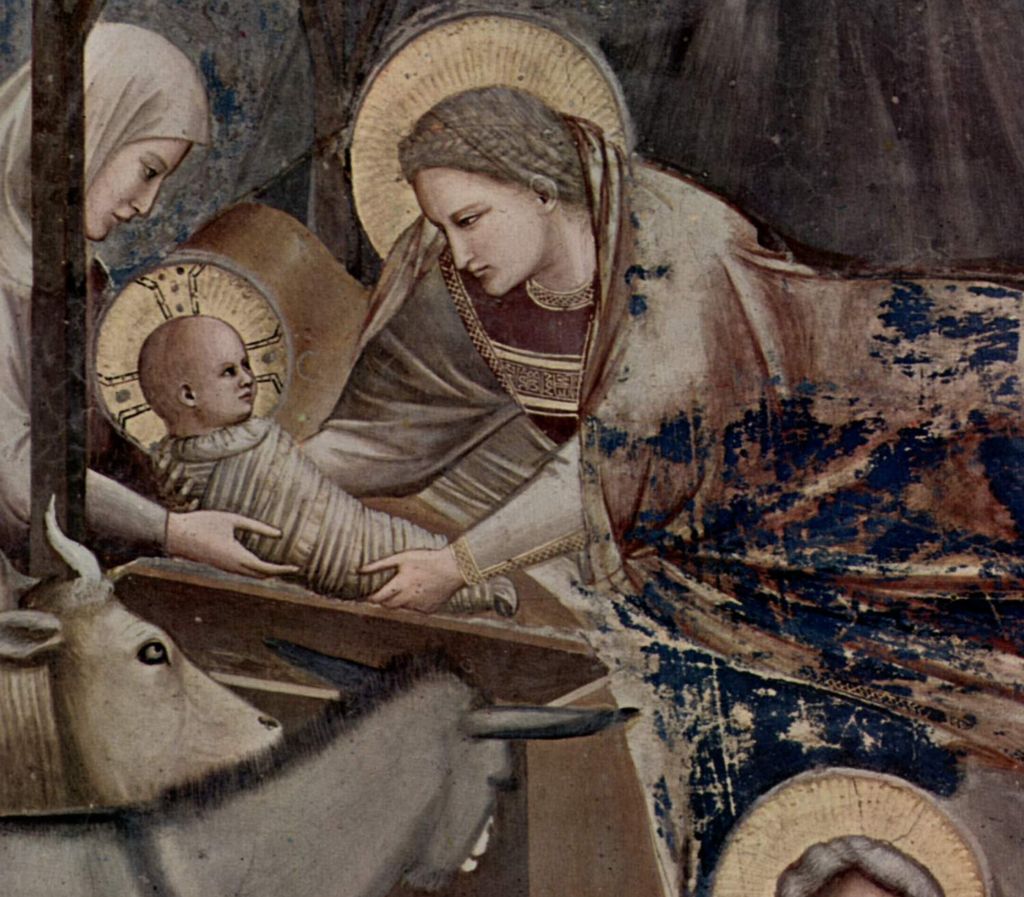
The particular force of the relationship comes from Mary's difficult, sustained turn. Her legs stretch along the bed towards the right, while her shoulders and face rotate left towards Jesus. The body therefore carries the gaze: we follow the diagonal across the blue mantle until it reaches the small, pale, swaddled form. Mary's hands and the helper's hands gather around him, making his support and handling the scene's closest action. The child looks back towards his mother, his face framed by the cross-marked halo. There is only one infant in this Padua composition; the surrounding figures are arranged around that single encounter.
Schwarz draws attention to precisely this torsion, arguing that Giotto made Mary's whole figure answer to her relationship with Christ. The pose sacrifices some of the ease and frontal dignity of a more upright reclining figure to intensify the exchange of looks. His comparison also makes an important historical qualification: a tender mother-and-child relationship was already possible in the Roman mosaics associated with Byzantine visual traditions. Giotto reworked an expressive inheritance; Byzantine art did not have to wait for him to discover affection. [27]
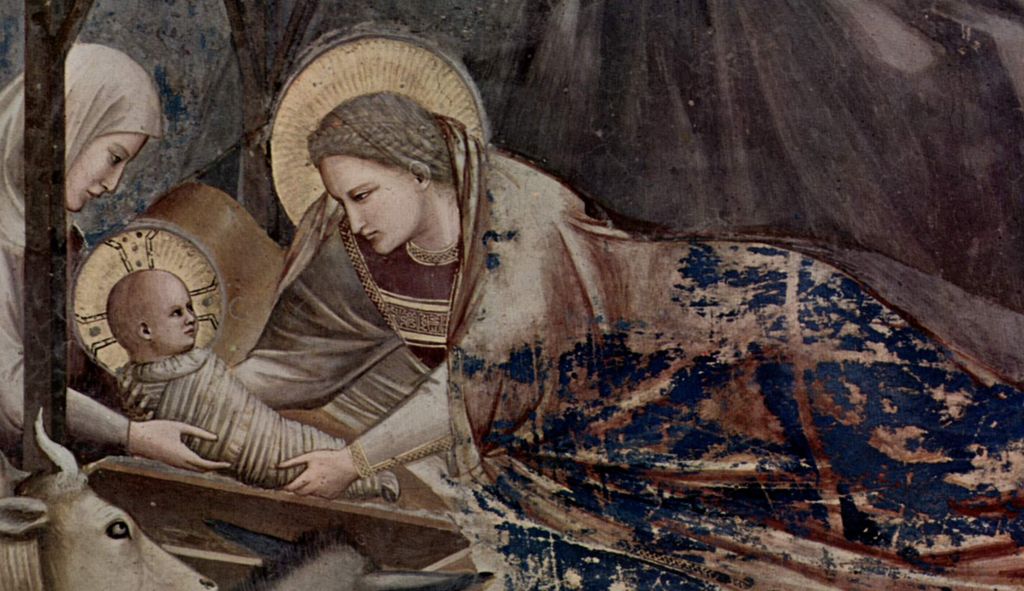
Mary, the swaddled Child and an attendant beneath the timber shelter. The Yorck Project2002. Image source. Public domain. Proportionally reduced reproduction; no colour or content enhancement.
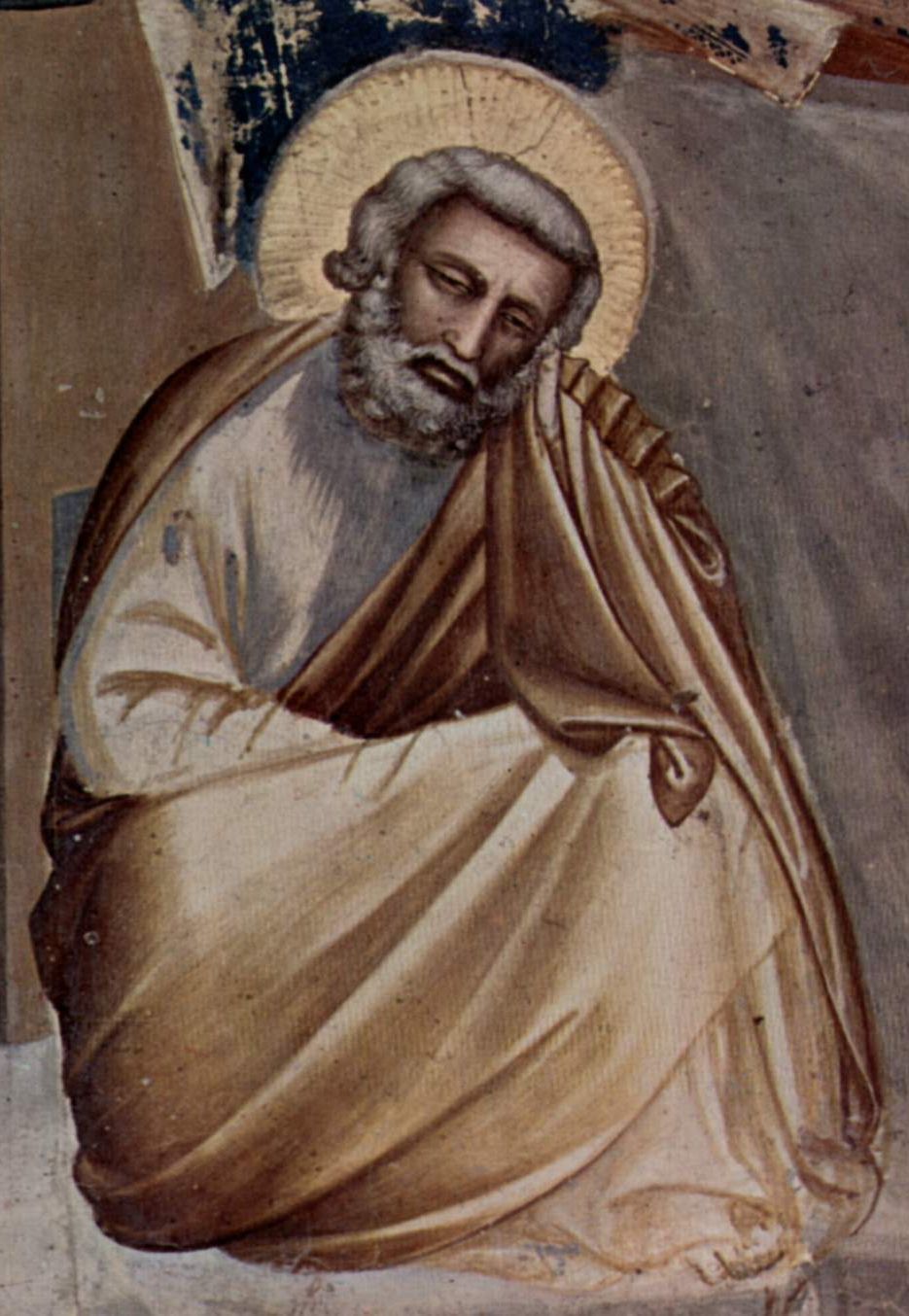
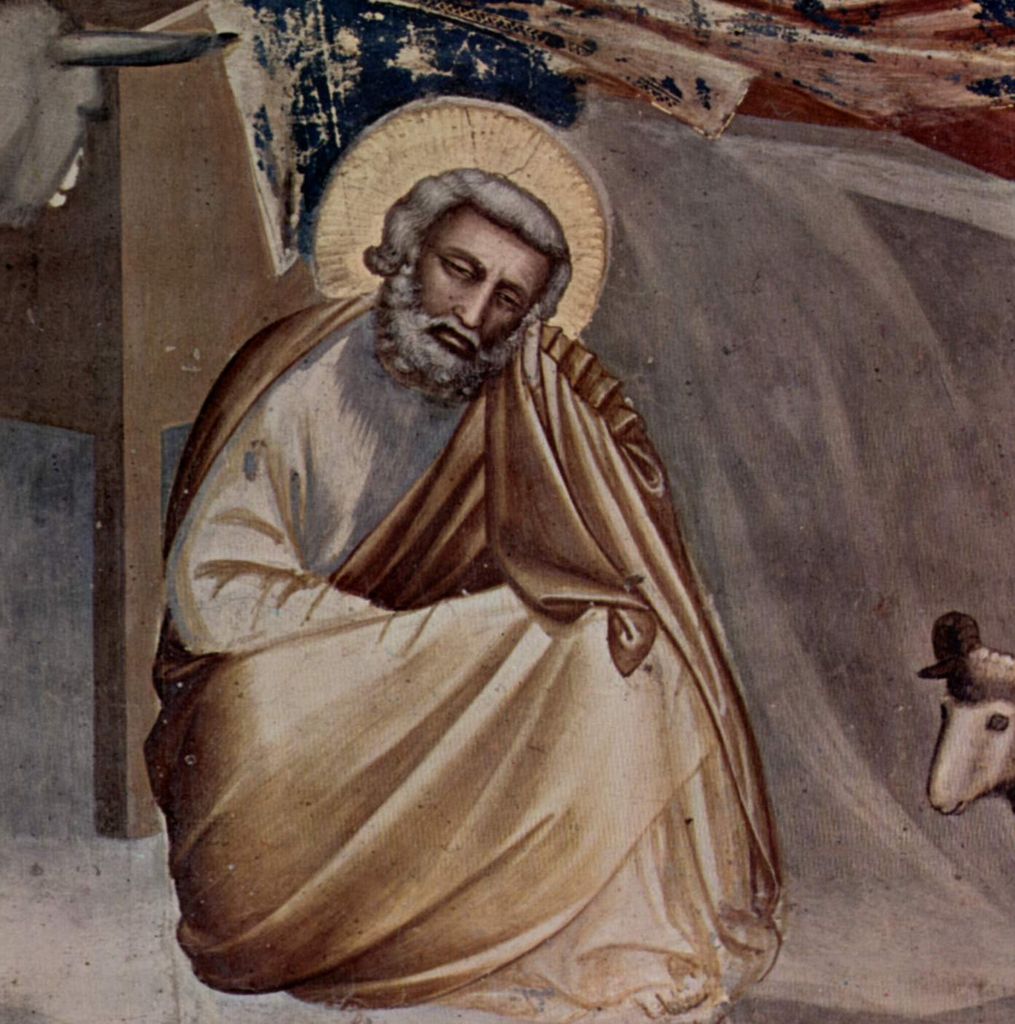
Joseph seated below Mary in an older Nativity photograph, with surface losses retained. The Yorck Project2002. Image source. Public domain. Proportionally reduced reproduction; no colour or content enhancement.
It's possible here to discern a sadness in Mary when she gazes at Jesus, as if aware that she will lose him one day. In Byzantine art, the birth of Christ traditionally took place in a cave, but Giotto places his Nativity in a shed, with livestock that eat, breathe and move like real farm animals that have wandered in for warmth and food.
A premonition of the Passion is a possible devotional response to Mary's concentration, rather than a private thought that can be read with certainty from her face. The animals' reasons for being present are similarly not visible evidence of wandering in for warmth. Shelter, rock and inherited sacred narrative are carefully combined. The shallow dark area behind Mary can suggest a recess or cave, so the wooden structure need not be understood as a complete replacement of the traditional grotto by an ordinary farm building. [28]
The shelter is unusually economical. Slender supports, diagonal braces and the underside of a pitched roof describe a space large enough to cover the bed. Its front beam separates Mary's horizontal world from the angels above; the right post marks the point where that protected interior gives way to the open ground of the shepherds. We can see under the roof, past the uprights and across the mattress. These overlapping forms make depth legible without requiring the whole scene to obey a single, mathematically constructed perspective.
The left border interrupts the gathering at its most intimate point. The helper's veiled head and arms appear from beyond the edge, while much of her body remains outside the painted field. Below her, the ox is largely a head; the ass's body is cut by the same boundary. Such cropping makes the scene seem to continue beyond what has been shown. Schwarz connects these interrupted forms with the shepherd whose back faces us: each encourages the sense that the people and animals inhabit a world extending beyond the picture's frame. [28]
The helper is usually understood in relation to the birth attendants of apocryphal tradition. Pseudo-Matthew 13 tells of two midwives brought by Joseph, with different responses to the miraculous birth. That provides a narrative context, but it does not give this particular veiled figure a securely readable name. Calling her a midwife is more defensible than confidently identifying her as Salome or transferring Salome's entire story into the gestures shown here. [24]
Joseph sits below the bed, his head inclined against his hand and his body gathered into an ochre cloak. His closed or lowered eyes give him the appearance of sleep or rest. The bent knees and enclosing folds make a compact, grounded shape, set apart from Mary's reaching movement. This separation gives the lower left its own rhythm: the animals stand, Joseph sits, and Mary stretches above them. We need not supply disappointment, doubt or any other unrecorded mental state to see how effectively his stillness balances the activity nearby.
On the right, the two shepherds are absorbed in another kind of encounter. The nearer man's back presents a broad, pale cloak; the second, partly interrupted by the frame, lifts his face towards the angel. Their feet remain planted among the flock while their attention rises. The angel bends sharply down over the rocky ridge, extending an arm towards them. Above the roof, the other angels turn, clasp their hands or bow. Their differing orientations spread the response across the upper zone, whereas the huddled sheep and goat form a dense, low group beside Joseph.
Luke 2:1–20 gives this arrangement its principal Gospel framework: Joseph and Mary travel to Bethlehem for registration; Mary gives birth, wraps the child and places him in a manger; an angel announces the birth to shepherds, who then visit. Giotto joins the birth and the announcement within one view. The shepherds are still receiving the message at the right while mother and child are already visible at the left. The painting thus makes distinct stages of Luke's account present together. [29]
The artist took a supervisory role in some of the artworks, designing all of the initial content and then overseeing the work of others to implement it. He would ensure that a consistent approach was carried out across the full cycle of paintings.
Its coherence depends on more than consistent figure types. The roof draws a firm horizontal line; Mary's bed supplies a second, sloping one; the angel and the shepherds establish an answering vertical exchange. Within that structure, the strongest connections are small distances between faces and hands. The mother and infant are placed close to the edge rather than at the geometric centre, yet the direction of her body gives them exceptional emphasis. Much of the landscape remains spare enough for these relationships to register immediately.
What Techniques did the Artist use?
Giotto was entirely comfortable in working with tempera or fresco techniques, and would choose between them depending on the requirements of each project.
His series of frescoes within the Padua chapel would require the use of the latter, where fast drying plaster would react against the artist's work to create each design. The method used meant that the artists would only have a short window in which to complete their painting, with Giotto overseeing the progress of each assistant.
Fresco work required the preparation of manageable areas of fresh plaster, known as giornate. A giornata is an area intended for a day's work, rather than an entire narrative picture necessarily completed in one sitting. Schwarz describes how the recording of plaster boundaries and overlaps during restoration changed discussions of the chapel's painting sequence. The evidence concerns the physical order of work; it cannot by itself tell us which assistant painted every passage. [30]
He would construct drawings initially to lay out each piece and then call upon his skilled helpers to implement each design themselves. Giotto kept a close eye on proceedings in order to ensure a consistent body of work was delivered by the end of the project.
He would be clear on the types of materials used, for example, so that colours were consistent from one iteration to the next.
The surviving surface also asks for care in looking. Broken areas of blue across Mary's mantle and in the background are readily visible in a close photograph, but a photograph alone cannot establish their causes, the identity of every pigment or the proportions of wet and dry painting used in this compartment. The municipal conservation history records the general campaign of July 2001–March 2002 and the continuing need for inspection and maintenance. Present appearance is the outcome of survival and conservation as well as Giotto's design. [31]
Even with those interruptions, the organisation of the drapery remains clear. Mary's mantle stretches across the bed as a broad, articulated mass. Joseph's cloak collects around his knees and falls into lighter and darker folds; the shepherd's pale garment makes the volume of a back facing away from us. Colour and modelling help distinguish people who occupy different positions, so the technique serves the direction of the story as well as the description of cloth.
Annotated Details from Nativity (Birth of Jesus)
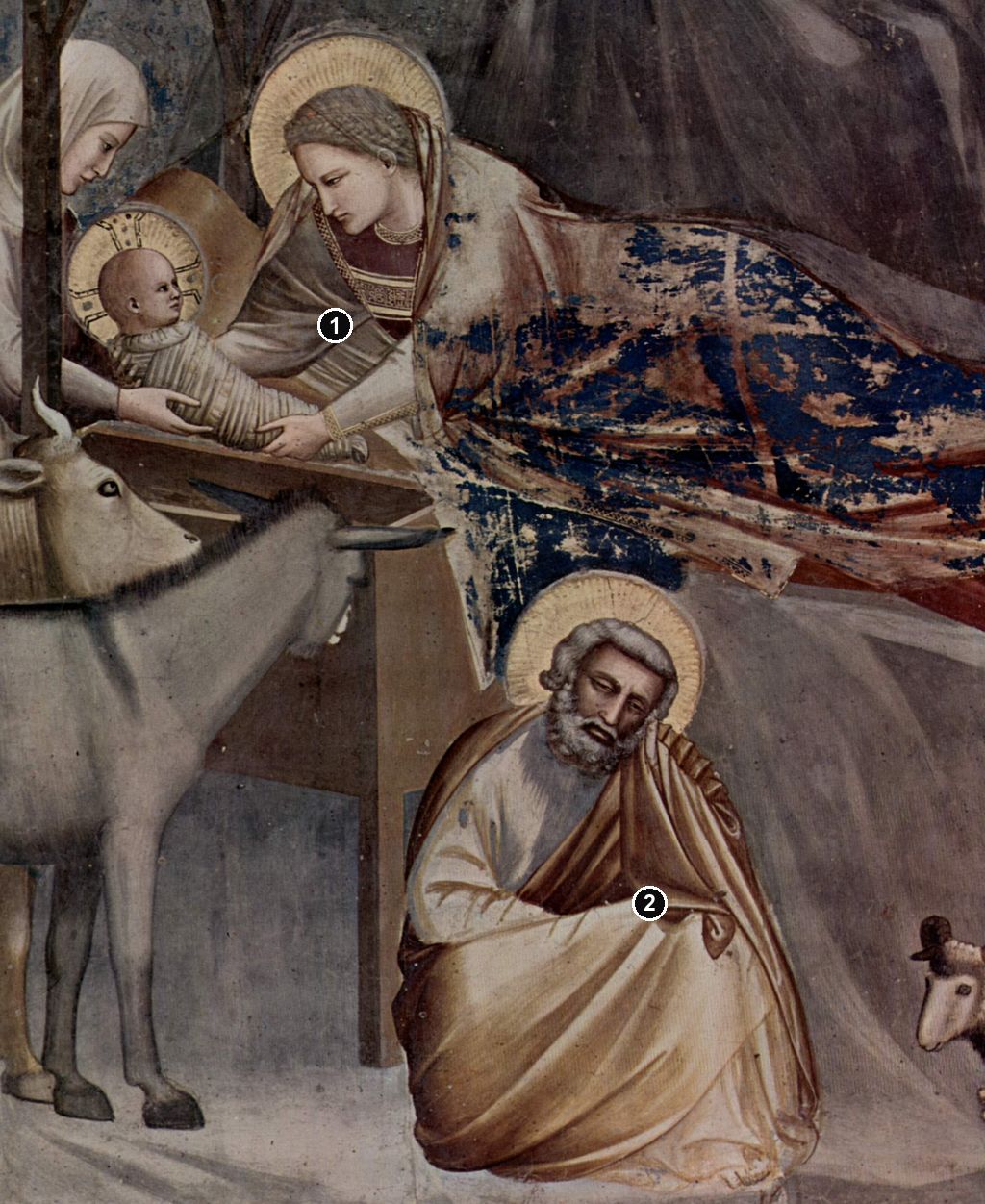
The numbered points identify visible features discussed in this article. Return from each detail to the numbered overview. Giotto, Nativity Padua, existing detail of Mary, Child, helper, animals and Joseph. The Yorck Project2002. Image source. Public domain. Numbers added to a separate resized overview; detail crops made from the unchanged native source. No upscaling, recolouring, retouching or reconstruction.
Details from NATIVITY (BIRTH OF JESUS)
Compare each detail with the complete source overview. The article and captions retain the stated source, identity and attribution qualifications.
Mary, Child and helper
The particular force of the relationship comes from Mary's difficult, sustained turn. Her legs stretch along the bed towards the right, while her shoulders and face rotate left towards Jesus. The body therefore carries the gaze: we follow the diagonal across the blue mantle until it reaches the small, pale, swaddled form. Mary's hands and the helper's hands gather around him, making his support and handling the scene's closest action. The child looks back towards his mother, his face framed by the cross-marked halo. There is only one infant in this Padua composition; the surrounding figures are arranged around that single encounter.
Joseph below the bed
Joseph sits below the bed, his head inclined against his hand and his body gathered into an ochre cloak. His closed or lowered eyes give him the appearance of sleep or rest. The bent knees and enclosing folds make a compact, grounded shape, set apart from Mary's reaching movement. This separation gives the lower left its own rhythm: the animals stand, Joseph sits, and Mary stretches above them. We need not supply disappointment, doubt or any other unrecorded mental state to see how effectively his stillness balances the activity nearby.
How Long did the Giotto Fresco Cycle take to Complete?
The artist worked on this series of frescoes between the years of 1304-1306. The project would have taken much longer were it not for the support of a large number of assistants, who took Giotto's lead and implemented his designs one at a time.
The chapel's current institutional chronology favours 1303–1305 over the older 1304–1306 range. Those dates should remain a campaign estimate, not a claim that all decorative elements were begun and finished on precisely known days. The 25 March 1305 dedication provides a particularly important historical anchor. [2] [22]
With plaster drying quickly, each design had only a short window in which it had to be painted, increasing the need for helpers. The topics covered were related to scenes from the life of Joachim, the Virgin and Christ, with Last Judgment then being added within the chapel too.
Giotto would travel around Italy frequently in order to complete various commissions, but was relatively new to Padua at the time of this large project. He would also complete work in Assisi, Rome, Florence and more, with his artistic reputation becoming particularly strong once his career had truly taken off.
His willingness to travel certainly enabled him to take on more work and increase the number of opportunities that came his way.
Did Giotto produce any other Nativity Paintings?
Giotto di Bondone would return to the theme of The Nativity in c.1311 - c.1320 for a project within the Basilica of Saint Francis of Assisi. Natività, therefore, takes inspiration from the artist's earlier work in the Padua chapel and makes some adjustments to produce this new iteration.
The Assisi comparison concerns the Nativity in the Lower Church's infancy cycle, rather than the Upper Church's stories of Saint Francis. Its authorship needs qualification. Schwarz discusses the lower-church paintings as a contested group, assigned at different times to Giotto, a closely related artist or an atelier; he himself argues for the painter Stefano. He illustrates the Nativity as figure 266 and refers to it as a work of about 1315. That is a named scholarly position, rather than proof that Giotto personally repeated his Padua painting in a securely documented later commission. [32]
The layout for his follow up piece is fairly similar, featuring the same angle of architecture in which the main figures are placed. There is also the landscape touches and supporting figures found in the earlier piece, though with postures and angles altered.
Through good fortune, the Assisi version remains in better condition today, with many of the original colours still visible and clear. The artist would re-visit other key themes in this manner throughout his career, including the Crucifixion , Madonna and Child and also The Adoration of the Magi .
In the Assisi image, the shelter opens over a larger gathering, with angels clustered around the central group and a separate bathing group in the foreground. Padua concentrates the mother's handling of the one child at the far left and leaves Joseph and the flock distinctly spaced below. These are different narrative distributions, even where the timber roof and rocky setting invite comparison. The assertion that Assisi survives in better condition would require comparable conservation evidence for the two paintings; greater apparent colourfulness in a reproduction cannot establish it. [32]
The Artist's Background and Legacy
Giotto di Bondone may or may not have been born a Florentine, but some reports claim that he was discovered by the artist Cimabue while working in the Tuscan countryside, and taken to Florence as an apprentice.
The discovery of a shepherd boy drawing sheep is a later literary tradition. Schwarz and Pia Theis examine Ghiberti's version and its relationship to subsequent accounts, showing how the anecdote supplies a story of natural talent recognised by an established master. It should not be treated as a witnessed event or an apprenticeship document. A connection with Cimabue remains an important traditional account of Giotto's formation, but its details cannot securely explain the choices made in the Nativity. [33]
In any case, whether the young, untrained painter was formally or informally schooled in the Byzantine style, he produced sublime art in that tradition. However, when he moved beyond that to experiment with a completely new way of portraying people and events, it changed the way in which painters viewed and interpreted subjects forever.
This revolutionary approach continued its influence into the period of the Renaissance, and to other great artists such as Raphael, Michelangelo and Masaccio, reaching down the centuries to today. Giotto's Nativity and the rest of his frescoes in the Scrovegni Chapel started art lovers on that journey.
For this fresco, the most persuasive account of Giotto's achievement begins with the arrangement in front of us. A reclining Virgin, attending angels, shepherds, animals and a rocky birthplace all had histories. He makes those elements work together through a sustained bodily turn, the interruption of figures at the edges and the two exchanges of attention across the scene. Recognising the inherited materials makes the invention more specific: it lies in their renewed relationships, rather than in creating every component from nothing.
Where can The Nativity (Birth of Jesus) be Found Today?
The artwork can be found in its original position in Padua's Scrovegni Chapel. The Nativity of Jesus sits in the middle tier of the south wall and is accompanied by The Adoration of the Magi, The Presentation of Jesus at the Temple , The Flight into Egypt and The Massacre of the Innocents .
The museum's placement is the right wall of the nave, central register, first compartment from the left. This corresponds to the south-wall sequence identified here. [1] In the chapel, the Nativity is encountered as one episode among others rather than as a detached easel picture. Its painted borders hold the action within a compartment while the neighbouring scenes continue Christ's infancy. The distinction matters to its emotional effect: an apparently self-contained moment of care also begins a sequence whose later suffering a Christian viewer already knows.
The chapel itself features on many Italian art tours for both domestic and international tourists and is relatively close to the city of Venice for those looking to discover some of the true cultural gems of this country.
UNESCO have promoted this location in recent years too, bringing it an even greater prominence but efforts have been continually made to protect Giotto's work from the constant stream of tourists who continue to flock to this historical, stunning location which offers much both in terms of painting and also architecture.
The precise UNESCO recognition is the 2021 inscription of Padua's fourteenth-century fresco cycles, a serial property comprising eight religious and secular building complexes. The Scrovegni Chapel is one component of that larger designation. [34] Looking at the Nativity in its original setting also restores its scale: this is a roughly two-metre wall painting within an encompassing decoration, whose small faces and gestures must remain readable across the chapel.
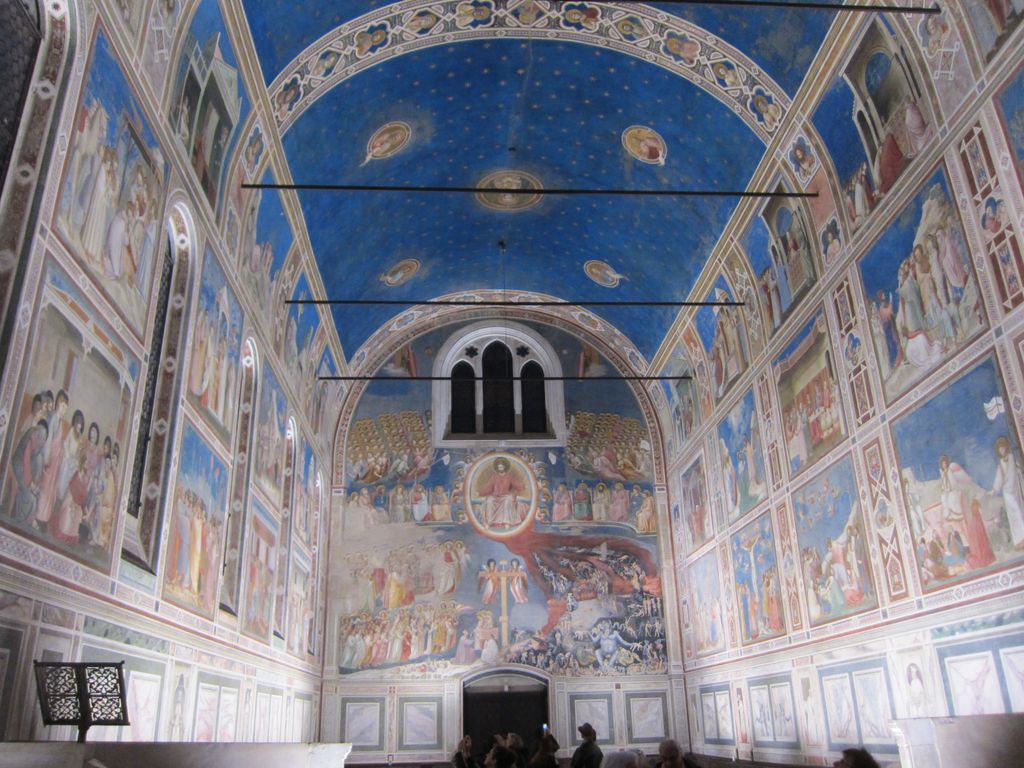
The Scrovegni Chapel looking towards the entrance wall in a 2017 photograph: the Last Judgement closes the interior, with narrative tiers at either side beneath the blue vault. Derbrauni. Image source. CC BY-SA 4.0. Proportionally reduced reproduction; original composition, colour and photographic lighting retained.
Which other Artists have Featured the Nativity within their Paintings?
This critical Christian theme derives directly from the biblical gospels of Luke and Matthew. It would become one of the most reproduced items from the Bible in western art. Some of the most famous names to have covered it at least once include the likes of Sandro Botticelli with Nativity of Jesus from circa 1473–1475.
Luke's shepherds and Matthew's Magi should nevertheless be distinguished. Matthew 2:1–12 describes the visitors from the East and their gifts, a separate narrative represented in the adjoining Adoration of the Magi. The Magi are absent from the Nativity discussed here. Keeping the two accounts distinct helps explain why a cycle can devote separate compartments to events that later Christmas imagery often combines. [35]
It has been seen most within Italian and North European art, with other examples including Nativity with St. Francis and St. Lawrence by Caravaggio, Adoration of the Christ Child by Gerard van Honthorst and also another interpretation by Petrus Christus .
Each generation of artist would take what had gone before and then add their own technical and compositional innovations on top, just as been the case leading into the Proto Renaissance in which Giotto would bring his own ideas, such as a deeper perspective and greater use of emotion.
A useful comparison asks how an artist directs attention to the infant: through a mother's turn, a circle of worshippers, the approach of gift bearers or the contrast of bodies and light. Padua offers an especially concentrated answer. The child occupies little space, but the hands surrounding him, Mary's elongated body and the animals' proximity give that small area extraordinary visual weight. Later treatments need not repeat Giotto's setting to engage with the same problem of making a birth carry a sacred meaning.
How have the Interpretations of the Nativity varied across different Artistic Movements and Periods?
Some of the earliest Nativity paintings that have been uncovered date back to the 9th century, with their style being rather different to that employed here by Giotto. He would bring much more depth to the painting, though the same figures would appear as before.
The subject's visual history begins much earlier than the ninth century. Vatican News identifies fourth-century Nativity imagery on sarcophagus fragments in the Vatican Museums' Pio Cristiano collection, including the infant, manger and animals. These early surviving examples are relief sculpture, rather than evidence for a particular lost painting. They establish the long history of the iconography that Giotto could transform. [36]
It was only later that painters started to work more freely in how they handled this topic, which reflects a wider movement towards free expression. Paul Gauguin, for example, offers a great contrast in how he presented the content without any of the divinity, but rather a fairly normal every day scene.
Gauguin's Te tamari no atua of 1896 also needs a more qualified description. The Neue Pinakothek's collection entry explicitly identifies an angel, a stable interior and halos around mother and child as elements that give the painting Christian meaning. Its altered setting and personal associations do not amount to an absence of divinity. [37]
The Baroque era would provide drama and exquisite detail within their own interpretations, but after that religious art would be much less common and so depictions of the Nativity were not embraced so much.
In today's contemporary world we see all manner of alternative approaches, though few have anything like the same level of precision and technical mastery as that displayed by the likes of Giotto.
Such differences are more illuminating than a simple progression from rigid medieval images to unrestricted modern freedom. Giotto's own composition combines formal constraints with considerable invention: the narrative compartment has fixed edges, the subject has an inherited cast, and the sacred figures retain their halos, yet the spatial and bodily decisions remain highly particular. The relative precision or finish of later paintings is a question of artistic means and aims, rather than an adequate measure of their engagement with the subject.
Which Paintings may have Inspired Giotto di Bondone's Nativity (Birth of Jesus)?
We do know that the artist is likely to have learnt his trade under Cimabue. His influence, and specifically the use of gold paint, continued into Giotto's career.
The apprenticeship tradition cannot, however, identify a single source painting for this fresco. Nor does the use of a gold appearance in halos establish a simple line of transmission from one teacher. A convincing comparison needs a particular motif or arrangement, together with an argument for how it could have reached Giotto. [33]
The teacher was famous for more of a two-dimensional approach, though, which his student moved away from and so it would be wrong to ignore the many innovations brought about by Giotto himself. We also know that Giotto travelled around Italy frequently, and he would have come across a great amount of art from previous centuries in doing so.
Some of these artworks may have come from anonymous artists, and might not even exist today, making it hard to point at elements of Giotto's methods and confidently attribute them to earlier painters.
Schwarz offers a more concrete set of comparisons: Byzantine Nativity schemes, the Roman mosaics of Pietro Cavallini and Jacopo Torriti, and early Christian reliefs showing a roof above the manger. He reads Giotto's shelter as a synthesis of visual traditions and devotional storytelling. In his reconstruction, texts of the Meditations on the Life of Christ help explain a makeshift structure associated with Joseph's carpentry. This is an interpretation of the painting's sources, not documentary proof that Giotto followed a particular manuscript or built his composition around an eyewitness account. [28]
The proposal is useful because it makes us look again at the building. The animals stand outside its covered area, while the bed takes up most of the protected space. The roof provides Mary with shelter and leaves the infant visible at the open edge. It can therefore be understood as a deliberately adapted setting, rather than merely the artist's attempt to copy a familiar stable. Joseph's sleeping posture may invite stories about labour and exhaustion, but the picture does not certify who built the roof or why he rests.
These comparisons also explain why Greek or Byzantine models do not imply a proved journey by Giotto to the eastern Mediterranean. Motifs could be encountered in Italian works and passed through artists, drawings and established visual conventions. In the Nativity, the significant question is how the inherited arrangement has been recast: a shelter fitted into rock, a mother turned towards her child, and shepherds caught by an announcement at the opposite edge. [28]
Indeed, a large amount of his own work still holds controversy over its attribution, though there can be no doubt as to the role he played in delivering the breaktaking display which can still be found in the Padua chapel today.
Large Image of The Nativity (Birth of Jesus)
The Nativity (Birth of Jesus) in Detail Giotto
At close range, the painting rewards a return to the space around the infant. The wooden edges and angles of the manger, the small hands at the swaddling clothes, the helper leaning in and Mary's steady gaze gather beneath the broad roof. Above, the angel's downward movement answers that human attention across the width of the fresco. The scene holds intimacy and proclamation together: one newborn receives care, while the news of his birth reaches the world beyond the shelter.
Watch: Explore Giotto’s Art
Choose an overview or a closer look at three major works. These films provide wider Giotto context alongside this article.
Artworks directory
This directory brings together 209 records for paintings, ensembles, individual scenes and components, architectural work, an associated disputed design, and reported or lost projects connected with Giotto. Ensembles and their parts appear separately, so 209 is a count of records rather than independent paintings or commissions. Attributions and dates remain qualified where disputed; inclusion does not establish Giotto’s own hand throughout.
| Name | Date | Medium, attribution and status |
|---|---|---|
| Expulsion of Joachim from the Temple — Scrovegni Chapel, Padua | c.1303–05 (chapel campaign) | Fresco / wall painting. Giotto and workshop. Scene within a cycle. Padova Musei. Chapel overview. |
| Joachim among the Shepherds — Scrovegni Chapel, Padua | c.1303–05 (chapel campaign) | Fresco / wall painting. Giotto and workshop. Scene within a cycle. Padova Musei. Chapel overview. |
| Annunciation to Saint Anne — Scrovegni Chapel, Padua | c.1303–05 (chapel campaign) | Fresco / wall painting. Giotto and workshop. Scene within a cycle. Padova Musei. Chapel overview. |
| Sacrifice of Joachim — Scrovegni Chapel, Padua | c.1303–05 (chapel campaign) | Fresco / wall painting. Giotto and workshop. Scene within a cycle. Padova Musei. Chapel overview. |
| Joachim’s Dream — Scrovegni Chapel, Padua | c.1303–05 (chapel campaign) | Fresco / wall painting. Giotto and workshop. Scene within a cycle. Padova Musei. Padova Musei. Chapel overview. |
| Meeting at the Golden Gate — Scrovegni Chapel, Padua | c.1303–05 (chapel campaign) | Fresco / wall painting. Giotto and workshop. Scene within a cycle. Padova Musei. Chapel overview. |
| Birth of the Virgin — Scrovegni Chapel, Padua | c.1303–05 (chapel campaign) | Fresco / wall painting. Giotto and workshop. Scene within a cycle. Padova Musei. Padova Musei. Chapel overview. |
| Presentation of the Virgin in the Temple — Scrovegni Chapel, Padua | c.1303–05 (chapel campaign) | Fresco / wall painting. Giotto and workshop. Scene within a cycle. Padova Musei. Chapel overview. |
| Delivery of the Rods — Scrovegni Chapel, Padua | c.1303–05 (chapel campaign) | Fresco / wall painting. Giotto and workshop. Scene within a cycle. Padova Musei. Chapel overview. |
| Prayer of Joseph and the Suitors — Scrovegni Chapel, Padua | c.1303–05 (chapel campaign) | Fresco / wall painting. Giotto and workshop. Scene within a cycle. Padova Musei. Chapel overview. |
| Marriage of the Virgin — Scrovegni Chapel, Padua | c.1303–05 (chapel campaign) | Fresco / wall painting. Giotto and workshop. Scene within a cycle. Padova Musei. Chapel overview. |
| Wedding Procession of Mary — Scrovegni Chapel, Padua | c.1303–05 (chapel campaign) | Fresco / wall painting. Giotto and workshop. Scene within a cycle. Padova Musei. Chapel overview. |
| Annunciation on the triumphal arch — complete ensemble (Scrovegni Chapel, Padua) | c.1303–05 (chapel campaign) | Wall painting with a central painted wooden panel. Giotto and workshop. Ensemble. Includes the Mission of Gabriel and the lower Annunciation pair; the original central wooden panel is in the Musei Civici agli Eremitani, with a conservation copy in the chapel. Padova Musei. Padova Musei. Scholarly study. Chapel overview. |
| Visitation — Scrovegni Chapel, Padua | c.1303–05 (chapel campaign) | Fresco / wall painting. Giotto and workshop. Scene within a cycle. Padova Musei. Chapel overview. |
| Nativity — Scrovegni Chapel, Padua | c.1303–05 (chapel campaign) | Fresco / wall painting. Giotto and workshop. Scene within a cycle. Padova Musei. Chapel overview. |
| Adoration of the Magi — Scrovegni Chapel, Padua | c.1303–05 (chapel campaign) | Fresco / wall painting. Giotto and workshop. Scene within a cycle. Padova Musei. Chapel overview. |
| Presentation of Christ at the Temple — Scrovegni Chapel, Padua | c.1303–05 (chapel campaign) | Fresco / wall painting. Giotto and workshop. Scene within a cycle. Padova Musei. Chapel overview. |
| Flight into Egypt — Scrovegni Chapel, Padua | c.1303–05 (chapel campaign) | Fresco / wall painting. Giotto and workshop. Scene within a cycle. Padova Musei. Chapel overview. |
| Massacre of the Innocents — Scrovegni Chapel, Padua | c.1303–05 (chapel campaign) | Fresco / wall painting. Giotto and workshop. Scene within a cycle. Padova Musei. Chapel overview. |
| Christ among the Doctors — Scrovegni Chapel, Padua | c.1303–05 (chapel campaign) | Fresco / wall painting. Giotto and workshop. Scene within a cycle. Padova Musei. Chapel overview. |
| Baptism of Christ — Scrovegni Chapel, Padua | c.1303–05 (chapel campaign) | Fresco / wall painting. Giotto and workshop. Scene within a cycle. Padova Musei. Chapel overview. |
| Marriage at Cana — Scrovegni Chapel, Padua | c.1303–05 (chapel campaign) | Fresco / wall painting. Giotto and workshop. Scene within a cycle. Padova Musei. Padova Musei. Chapel overview. |
| Raising of Lazarus — Scrovegni Chapel, Padua | c.1303–05 (chapel campaign) | Fresco / wall painting. Giotto and workshop. Scene within a cycle. Padova Musei. Chapel overview. |
| Entry into Jerusalem — Scrovegni Chapel, Padua | c.1303–05 (chapel campaign) | Fresco / wall painting. Giotto and workshop. Scene within a cycle. Padova Musei. Chapel overview. |
| Expulsion of the Money Changers — Scrovegni Chapel, Padua | c.1303–05 (chapel campaign) | Fresco / wall painting. Giotto and workshop. Scene within a cycle. Padova Musei. Padova Musei. Chapel overview. |
| Judas Receiving the Payment — Scrovegni Chapel, Padua | c.1303–05 (chapel campaign) | Fresco / wall painting. Giotto and workshop. Scene within a cycle. Padova Musei. Chapel overview. |
| Last Supper — Scrovegni Chapel, Padua | c.1303–05 (chapel campaign) | Fresco / wall painting. Giotto and workshop. Scene within a cycle. Padova Musei. Chapel overview. |
| Washing of the Feet — Scrovegni Chapel, Padua | c.1303–05 (chapel campaign) | Fresco / wall painting. Giotto and workshop. Scene within a cycle. Padova Musei. Chapel overview. |
| Arrest of Christ — Scrovegni Chapel, Padua | c.1303–05 (chapel campaign) | Fresco / wall painting. Giotto and workshop. Scene within a cycle. Padova Musei. Chapel overview. |
| Christ before Annas and Caiaphas — Scrovegni Chapel, Padua | c.1303–05 (chapel campaign) | Fresco / wall painting. Giotto and workshop. Scene within a cycle. Padova Musei. Chapel overview. |
| Mocking of Christ and Flagellation — Scrovegni Chapel, Padua | c.1303–05 (chapel campaign) | Fresco / wall painting. Giotto and workshop. Scene within a cycle. Padova Musei. Chapel overview. |
| Road to Calvary — Scrovegni Chapel, Padua | c.1303–05 (chapel campaign) | Fresco / wall painting. Giotto and workshop. Scene within a cycle. Padova Musei. Chapel overview. |
| Crucifixion — Scrovegni Chapel, Padua | c.1303–05 (chapel campaign) | Fresco / wall painting. Giotto and workshop. Scene within a cycle. Padova Musei. Chapel overview. |
| Lamentation — Scrovegni Chapel, Padua | c.1303–05 (chapel campaign) | Fresco / wall painting. Giotto and workshop. Scene within a cycle. Padova Musei. Chapel overview. |
| Resurrection / Noli me tangere — Scrovegni Chapel, Padua | c.1303–05 (chapel campaign) | Fresco / wall painting. Giotto and workshop. Scene within a cycle. Padova Musei. Chapel overview. |
| Ascension — Scrovegni Chapel, Padua | c.1303–05 (chapel campaign) | Fresco / wall painting. Giotto and workshop. Scene within a cycle. Padova Musei. Chapel overview. |
| Pentecost — Scrovegni Chapel, Padua | c.1303–05 (chapel campaign) | Fresco / wall painting. Giotto and workshop. Scene within a cycle. Padova Musei. Padova Musei. Chapel overview. |
| Coretto — right painted recess (Scrovegni Chapel, Padua) | c.1303–05 (chapel campaign) | Fresco / painted fictive architecture. Giotto and workshop. Ensemble component. Padova Musei. Padova Musei. Scholarly study. Chapel overview. |
| Coretto — left painted recess (Scrovegni Chapel, Padua) | c.1303–05 (chapel campaign) | Fresco / painted fictive architecture. Giotto and workshop. Ensemble component. Padova Musei. Padova Musei. Scholarly study. Chapel overview. |
| Envy — Scrovegni Chapel, Padua | c.1303–05 (chapel campaign) | Grisaille fresco / wall painting. Giotto and workshop. Ensemble component. Padova Musei. Chapel overview. Scholarly study. Padova Musei. |
| Despair — Scrovegni Chapel, Padua | c.1303–05 (chapel campaign) | Grisaille fresco / wall painting. Giotto and workshop. Ensemble component. Padova Musei. Chapel overview. Scholarly study. Padova Musei. |
| Prudence — Scrovegni Chapel, Padua | c.1303–05 (chapel campaign) | Grisaille fresco / wall painting. Giotto and workshop. Ensemble component. Padova Musei. Chapel overview. Scholarly study. Padova Musei. |
| Fortitude — Scrovegni Chapel, Padua | c.1303–05 (chapel campaign) | Grisaille fresco / wall painting. Giotto and workshop. Ensemble component. Padova Musei. Chapel overview. Scholarly study. Padova Musei. |
| Temperance — Scrovegni Chapel, Padua | c.1303–05 (chapel campaign) | Grisaille fresco / wall painting. Giotto and workshop. Ensemble component. Padova Musei. Chapel overview. Scholarly study. Padova Musei. |
| Justice — Scrovegni Chapel, Padua | c.1303–05 (chapel campaign) | Grisaille fresco / wall painting. Giotto and workshop. Ensemble component. Padova Musei. Chapel overview. Scholarly study. Padova Musei. |
| Faith — Scrovegni Chapel, Padua | c.1303–05 (chapel campaign) | Grisaille fresco / wall painting. Giotto and workshop. Ensemble component. Padova Musei. Chapel overview. Scholarly study. Padova Musei. |
| Charity — Scrovegni Chapel, Padua | c.1303–05 (chapel campaign) | Grisaille fresco / wall painting. Giotto and workshop. Ensemble component. Padova Musei. Chapel overview. Scholarly study. Padova Musei. |
| Hope — Scrovegni Chapel, Padua | c.1303–05 (chapel campaign) | Grisaille fresco / wall painting. Giotto and workshop. Ensemble component. Padova Musei. Chapel overview. Scholarly study. Padova Musei. |
| Folly — Scrovegni Chapel, Padua | c.1303–05 (chapel campaign) | Grisaille fresco / wall painting. Giotto and workshop. Ensemble component. Padova Musei. Chapel overview. Scholarly study. Padova Musei. |
| Inconstancy — Scrovegni Chapel, Padua | c.1303–05 (chapel campaign) | Grisaille fresco / wall painting. Giotto and workshop. Ensemble component. Padova Musei. Chapel overview. Scholarly study. Padova Musei. |
| Wrath — Scrovegni Chapel, Padua | c.1303–05 (chapel campaign) | Grisaille fresco / wall painting. Giotto and workshop. Ensemble component. Padova Musei. Chapel overview. Scholarly study. Padova Musei. |
| Injustice — Scrovegni Chapel, Padua | c.1303–05 (chapel campaign) | Grisaille fresco / wall painting. Giotto and workshop. Ensemble component. Padova Musei. Chapel overview. Scholarly study. Padova Musei. |
| Infidelity / Idolatry — Scrovegni Chapel, Padua | c.1303–05 (chapel campaign) | Grisaille fresco / wall painting. Giotto and workshop. Ensemble component. Padova Musei. Chapel overview. Scholarly study. Padova Musei. |
| Starry vault — complete ensemble (Scrovegni Chapel, Padua) | c.1303–05 (chapel campaign) | Vault painting. Giotto and workshop. Ensemble. Padova Musei. Padova Musei. Chapel overview. |
| Last Judgement — Scrovegni Chapel, Padua | c.1303–05 (chapel campaign) | Fresco / wall painting. Giotto and workshop. Scene within a cycle. Padova Musei. Padova Musei. Chapel overview. Padova Musei. |
| Prophet Malachi — vault medallion — Scrovegni Chapel, Padua | c.1303–05 (chapel campaign) | Fresco / wall painting. Giotto and workshop. Ensemble component. Padova Musei. Padova Musei. Chapel overview. Padova Musei. |
| Prophet Baruch — vault medallion — Scrovegni Chapel, Padua | c.1303–05 (chapel campaign) | Fresco / wall painting. Giotto and workshop. Ensemble component. Padova Musei. Padova Musei. Chapel overview. Padova Musei. |
| Prophet Isaiah — vault medallion — Scrovegni Chapel, Padua | c.1303–05 (chapel campaign) | Fresco / wall painting. Giotto and workshop. Ensemble component. Padova Musei. Padova Musei. Chapel overview. Padova Musei. |
| Prophet Daniel — vault medallion — Scrovegni Chapel, Padua | c.1303–05 (chapel campaign) | Fresco / wall painting. Giotto and workshop. Ensemble component. Padova Musei. Padova Musei. Chapel overview. Padova Musei. |
| Christ Pantocrator — vault medallion — Scrovegni Chapel, Padua | c.1303–05 (chapel campaign) | Fresco / wall painting. Giotto and workshop. Ensemble component. Padova Musei. Padova Musei. Chapel overview. Padova Musei. |
| Virgin and Child — vault medallion — Scrovegni Chapel, Padua | c.1303–05 (chapel campaign) | Fresco / wall painting. Giotto and workshop. Ensemble component. Padova Musei. Padova Musei. Chapel overview. Padova Musei. |
| Prophet Ezekiel — vault medallion — Scrovegni Chapel, Padua | c.1303–05 (chapel campaign) | Fresco / wall painting. Giotto and workshop. Ensemble component. Padova Musei. Padova Musei. Chapel overview. Padova Musei. |
| Prophet Micah — vault medallion — Scrovegni Chapel, Padua | c.1303–05 (chapel campaign) | Fresco / wall painting. Giotto and workshop. Ensemble component. Padova Musei. Padova Musei. Chapel overview. Padova Musei. |
| Saint John the Baptist — vault medallion — Scrovegni Chapel, Padua | c.1303–05 (chapel campaign) | Fresco / wall painting. Giotto and workshop. Ensemble component. Padova Musei. Padova Musei. Chapel overview. Padova Musei. |
| Scrovegni Chapel — painted decoration | c.1303–05 (chapel campaign) | Fresco / wall painting, with a painted wooden panel. Giotto and workshop (painted decoration). Ensemble. Includes separately listed scenes and components. The original central God the Father panel is in the Musei Civici agli Eremitani; a conservation copy is in the chapel. Chapel overview. Padova Musei. Padova Musei. Source. Source. Source. Padova Musei. Scholarly study. |
| Vices and Virtues — complete fourteen-figure programme | c.1303–05 (chapel campaign) | Grisaille fresco / wall painting. Giotto and workshop. Ensemble. Fourteen figures: seven virtues and seven opposed vices. Padova Musei. Chapel overview. Scholarly study. |
| Coretti — paired fictive chapels | c.1303–05 (chapel campaign) | Fresco / painted fictive architecture. Giotto and workshop. Ensemble. Two separate painted recesses, also listed individually. Padova Musei. Padova Musei. Scholarly study. |
| Mission of Gabriel — heavenly assembly | c.1303–05 (chapel campaign) | Wall painting with central painted wooden image. Giotto and workshop. Ensemble component. Central wooden God the Father panel preserved at the Musei Civici agli Eremitani; conservation copy in the chapel. Chapel overview. Padova Musei. Scholarly study. Padova Musei. |
| Annunciation — Gabriel and Mary in facing chambers | c.1303–05 (chapel campaign) | Fresco / wall painting. Giotto and workshop. Ensemble component. Chapel overview. Scholarly study. Padova Musei. |
| God the Father — central wooden panel of the Mission of Gabriel | c.1303–05 (chapel campaign) | Painting on wood. Associated with Giotto. Ensemble component. Original at the Musei Civici agli Eremitani, Padua; conservation copy in the Scrovegni Chapel. Padova Musei. Padova Musei. Scholarly study. Source. |
| Life of Saint Francis — Upper Church cycle, Assisi | Late 13th–early 14th century; dating disputed | Fresco / wall-painting cycle. Traditionally associated with Giotto; Giotto, Roman-school and other attributions disputed. Ensemble. Twenty-eight-scene nave cycle; scenes also listed individually. Basilica catalogue. Scholarly study. Basilica catalogue. Source. Source. |
| Homage of a Simple Man — Upper Church, Assisi | Late 13th–early 14th century; dating disputed | Wall painting. Traditionally associated with Giotto; authorship and dating disputed. Scene within a cycle. Source. Scholarly study. Source. Source. Source. |
| Gift of the Mantle — Upper Church, Assisi | Late 13th–early 14th century; dating disputed | Wall painting. Traditionally associated with Giotto; authorship and dating disputed. Scene within a cycle. Basilica catalogue. Scholarly study. Source. Source. Source. |
| Dream of the Palace Full of Arms — Upper Church, Assisi | Late 13th–early 14th century; dating disputed | Wall painting. Traditionally associated with Giotto; authorship and dating disputed. Scene within a cycle. Basilica catalogue. Source. Scholarly study. Source. Source. Source. |
| Prayer before the Crucifix at San Damiano — Upper Church, Assisi | Late 13th–early 14th century; dating disputed | Wall painting. Traditionally associated with Giotto; authorship and dating disputed. Scene within a cycle. Source. Source. Source. Scholarly study. Source. Source. |
| Renunciation of Worldly Goods — Upper Church, Assisi | Late 13th–early 14th century; dating disputed | Wall painting. Traditionally associated with Giotto; authorship and dating disputed. Scene within a cycle. Source. Scholarly study. Source. Source. |
| Dream of Innocent III — Upper Church, Assisi | Late 13th–early 14th century; dating disputed | Wall painting. Traditionally associated with Giotto; authorship and dating disputed. Scene within a cycle. Source. Source. Scholarly study. Source. Source. |
| Confirmation of the Rule — Upper Church, Assisi | Late 13th–early 14th century; dating disputed | Wall painting. Traditionally associated with Giotto; authorship and dating disputed. Scene within a cycle. Source. Scholarly study. Source. Source. |
| Vision of the Flaming Chariot — Upper Church, Assisi | Late 13th–early 14th century; dating disputed | Wall painting. Traditionally associated with Giotto; authorship and dating disputed. Scene within a cycle. Source. Source. Scholarly study. Source. Source. |
| Vision of the Thrones — Upper Church, Assisi | Late 13th–early 14th century; dating disputed | Wall painting. Traditionally associated with Giotto; authorship and dating disputed. Scene within a cycle. Basilica catalogue. Scholarly study. Source. Source. Source. |
| Expulsion of Devils from Arezzo — Upper Church, Assisi | Late 13th–early 14th century; dating disputed | Wall painting. Traditionally associated with Giotto; authorship and dating disputed. Scene within a cycle. Source. Source. Scholarly study. Source. Source. Source. |
| Trial by Fire before the Sultan — Upper Church, Assisi | Late 13th–early 14th century; dating disputed | Wall painting. Traditionally associated with Giotto; authorship and dating disputed. Scene within a cycle. Source. Source. Scholarly study. Source. Source. |
| Ecstasy of Saint Francis — Upper Church, Assisi | Late 13th–early 14th century; dating disputed | Wall painting. Traditionally associated with Giotto; authorship and dating disputed. Scene within a cycle. Source. Source. Source. Scholarly study. Source. Source. |
| Nativity at Greccio — Upper Church, Assisi | Late 13th–early 14th century; dating disputed | Wall painting. Traditionally associated with Giotto; authorship and dating disputed. Scene within a cycle. Basilica catalogue. Scholarly study. Source. Source. Source. |
| Miracle of the Spring — Upper Church, Assisi | Late 13th–early 14th century; dating disputed | Wall painting. Traditionally associated with Giotto; authorship and dating disputed. Scene within a cycle. Source. Scholarly study. Source. Source. Source. |
| Sermon to the Birds — Upper Church, Assisi | Late 13th–early 14th century; dating disputed | Wall painting. Traditionally associated with Giotto; authorship and dating disputed. Scene within a cycle. Basilica catalogue. Scholarly study. Source. Source. Source. |
| Death of the Knight of Celano — Upper Church, Assisi | Late 13th–early 14th century; dating disputed | Wall painting. Traditionally associated with Giotto; authorship and dating disputed. Scene within a cycle. Source. Source. Scholarly study. Source. Source. |
| Sermon before Pope Honorius III — Upper Church, Assisi | Late 13th–early 14th century; dating disputed | Wall painting. Traditionally associated with Giotto; authorship and dating disputed. Scene within a cycle. Source. Source. Scholarly study. Source. |
| Apparition at the Chapter of Arles — Upper Church, Assisi | Late 13th–early 14th century; dating disputed | Wall painting. Traditionally associated with Giotto; authorship and dating disputed. Scene within a cycle. Basilica catalogue. Scholarly study. Source. Source. Source. |
| Stigmatisation — Upper Church, Assisi | Late 13th–early 14th century; dating disputed | Wall painting. Traditionally associated with Giotto; authorship and dating disputed. Scene within a cycle. Source. Scholarly study. Source. Source. |
| Death and Ascension of Saint Francis — Upper Church, Assisi | Late 13th–early 14th century; dating disputed | Wall painting. Traditionally associated with Giotto; authorship and dating disputed. Scene within a cycle. Basilica catalogue. Scholarly study. Source. Source. Source. |
| Apparition to Brother Augustine and Bishop Guido — Upper Church, Assisi | Late 13th–early 14th century; dating disputed | Wall painting. Traditionally associated with Giotto; authorship and dating disputed. Scene within a cycle. Zeri catalogue. Scholarly study. Source. Source. Source. |
| Verification of the Stigmata — Upper Church, Assisi | Late 13th–early 14th century; dating disputed | Wall painting. Traditionally associated with Giotto; authorship and dating disputed. Scene within a cycle. Source. Source. Scholarly study. Source. Source. |
| Mourning of the Poor Clares — Upper Church, Assisi | Late 13th–early 14th century; dating disputed | Wall painting. Traditionally associated with Giotto; authorship and dating disputed. Scene within a cycle. Basilica catalogue. Source. Scholarly study. Source. Source. |
| Canonisation of Saint Francis — Upper Church, Assisi | Late 13th–early 14th century; dating disputed | Wall painting. Traditionally associated with Giotto; authorship and dating disputed. Scene within a cycle. Source. Source. Scholarly study. Source. Source. Source. |
| Apparition to Pope Gregory IX — Upper Church, Assisi | Late 13th–early 14th century; dating disputed | Wall painting. Traditionally associated with Giotto; authorship and dating disputed. Scene within a cycle. Zeri catalogue. Scholarly study. Source. Source. Source. |
| Healing of John of Lerida — Upper Church, Assisi | Late 13th–early 14th century; dating disputed | Wall painting. Traditionally associated with Giotto; authorship and dating disputed. Scene within a cycle. Source. Source. Scholarly study. Source. Source. |
| Resurrection of a Woman — Upper Church, Assisi | Late 13th–early 14th century; dating disputed | Wall painting. Traditionally associated with Giotto; authorship and dating disputed. Scene within a cycle. Source. Scholarly study. Source. Source. Source. |
| Liberation of the Prisoner Peter — Upper Church, Assisi | Late 13th–early 14th century; dating disputed | Wall painting. Traditionally associated with Giotto; authorship and dating disputed. Scene within a cycle. Source. Source. Scholarly study. Source. Source. Source. |
| Santa Maria Novella Crucifix | Late 13th century; c.1288–89 or 1298–1301; disputed | Tempera and gold on a shaped wooden cross. Giotto. Source. |
| Death of the Virgin / Dormition — Berlin | c.1310 | Tempera and gold on poplar; gabled dossal. Giotto. Source. Source. |
| Peruzzi Altarpiece | c.1311–1315 (North Carolina Museum of Art) | Tempera and gold on panel. Giotto and workshop. Ensemble. Source. |
| Bologna Polyptych | c.1330 | Tempera and gold on panel. Giotto and workshop. Ensemble. Source. |
| Death of Saint Francis, Bardi Chapel | After 1317, usually the 1320s; disputed | Wall painting with wet-plaster and dry-applied passages. Giotto. Scene within a cycle. Source. |
| Bardi Chapel — painted decoration | After 1317, usually the 1320s; disputed | Wall painting with wet-plaster and dry-applied passages. Giotto and workshop / Giottesque painters; individual hands disputed. Ensemble. Scholarly study. Source. |
| Badia Polyptych | c.1300; proposed dates include 1295–1300 and 1301–02 | Tempera and gold on panel; five cusped compartments. Giotto. Ensemble. Scholarly study. Source. Source. |
| Baroncelli Polyptych | After 1328; detached pinnacle c.1328–35 | Tempera and gold on panel; later altered framing. Giotto and workshop. Ensemble. Detached central pinnacle in San Diego. Santa Croce. |
| Adoration of the Magi / Epiphany — Metropolitan Museum panel | Possibly c.1320; c.1310–18 also proposed for the group | Tempera and gold on wood. Giotto. Part of the dispersed seven-scene board; original function disputed. Met catalogue. Source. |
| Franciscan Allegories | Early 14th century, often c.1315; disputed | Vault wall painting. Giotto and workshop / Giottesque painters; individual hands disputed. Ensemble. Basilica catalogue. |
| Navicella — lost / reworked original mosaic | Late 13th–early 14th century; date disputed | Mosaic. Original attributed to Giotto. Original lost / reworked; fragments and later remakes survive. Scholarly study. |
| Pentecost — London panel | Possibly c.1310–18 (Gordon) | Egg tempera on poplar. Giotto and workshop. Part of the dispersed seven-scene board; original function disputed. National Gallery. Source. |
| Saint Stephen — Horne panel | c.1330–1335 (Museo Horne) | Tempera and gold on panel. Giotto. Proposed association with the Washington and Chaalis panels remains hypothetical. Source. |
| Saint Francis Receiving the Stigmata — Louvre altarpiece | 1300–25 (Louvre) | Tempera and gold on poplar. Giotto. Louvre catalogue. |
| Stefaneschi Triptych | c.1320; 1315–20 (Vatican Museums) | Tempera and gold on panel; painted on both sides. Giotto and workshop. Ensemble. Vatican Museums. |
| Crucifixion, Berlin | c.1315–1320 | Tempera and gold on poplar. Giotto. Source. |
| Madonna and Child — Washington / Goldman Madonna | c.1310–1315 (National Gallery of Art) | Tempera and gold on poplar. Giotto. Washington panel, distinct from San Giorgio alla Costa; proposed Horne/Chaalis companions remain hypothetical. NGA catalogue. |
| Ognissanti Madonna | c.1300–05 (Uffizi); c.1310 also proposed | Tempera and gold on panel. Giotto. Uffizi. |
| Madonna of Borgo San Lorenzo | c.1290–95; dating and attribution debated | Tempera and gold on a fragment of a wooden panel. Giotto. Fragmentary. Source. |
| Madonna of San Giorgio alla Costa | c.1288–95 (Opera del Duomo); later dates also proposed | Tempera and gold on panel; cut edges. Giotto. Damaged in 1993 and treated in 1995. Source. |
| Magdalene Chapel — painted decoration | c.1307–08 (basilica); disputed | Wall painting with wet-plaster and dry-applied passages. Giotto and workshop / Giottesque painters; individual hands disputed. Ensemble. Basilica catalogue. |
| Ognissanti Crucifix | c.1315–1320 (Opificio) | Painting on a shaped wooden cross. Giotto and workshop. Workshop participation and alternative attributions debated. Source. |
| Padua Crucifix | c.1303–05 (Zeri catalogue) | Tempera and gold on a shaped wooden cross. Giotto. Zeri catalogue. |
| Peruzzi Chapel — painted decoration | c.1310–11 (Santa Croce); 1334–36 proposed by Schwarz | Wall painting with substantial dry-applied work and loss. Giotto and workshop / Giottesque painters; individual hands disputed. Ensemble. Santa Croce. |
| Rimini Crucifix | c.1300; late 13th century also proposed | Tempera and gold on a shaped wooden cross. Giotto. Source. |
| Giotto’s Campanile — Florence Cathedral bell tower | Begun 1334; completed 1359 under successors | Marble-clad masonry bell tower. Begun under Giotto; continued by Andrea Pisano and Francesco Talenti. Successive building and sculptural campaigns. Source. Scholarly study. Scholarly study. |
| Tower elevation on parchment, Siena — disputed relation to Giotto | 14th century; date and design context disputed | Brown ink and coloured washes over incised construction on three parchment skins. Attribution disputed; possibly a Giotto design transmitted through another hand. Associated design; autograph attribution unestablished. Alternative attributions include Lando di Pietro. Scholarly study. Source. Source. |
| Seven scenes of Christ — dispersed painted board | Possibly c.1310–18 (Gordon); component dates vary | Tempera and gold on a single wooden board, subsequently divided. Giotto and workshop; individual attributions vary. Reconstructed dispersed ensemble. Common board supported by matching wood grain; predella or dossal function disputed. Source. Source. |
| Presentation of Christ at the Temple — Boston panel | Possibly c.1310–18 (Gordon’s group dating) | Tempera and gold on wood. Giotto and workshop; individual attribution varies within the group. Ensemble component. Source. Source. |
| Last Supper — Munich panel | Possibly c.1310–18 (Gordon’s group dating) | Tempera and gold on wood. Giotto and workshop; individual attribution varies within the group. Ensemble component. Source. Source. Source. |
| Crucifixion — Munich panel | Possibly c.1310–18 (Gordon’s group dating) | Tempera and gold on wood. Giotto and workshop; individual attribution varies within the group. Ensemble component. Source. Source. Source. |
| Descent into Limbo — Munich panel | Possibly c.1310–18 (Gordon’s group dating) | Tempera and gold on wood. Giotto and workshop; individual attribution varies within the group. Ensemble component. Source. Source. Source. |
| Entombment — Villa I Tatti panel | Possibly c.1310–18 (Gordon’s group dating) | Tempera and gold on wood. Giotto and workshop; individual attribution varies within the group. Ensemble component. Source. Source. |
| God the Father with Angels — detached Baroncelli pinnacle | c.1328–1335 (San Diego Museum of Art) | Tempera and gold on wood. Giotto and workshop. Ensemble component. Detached in later remodelling; collection home in San Diego. Source. Source. |
| Saint John the Evangelist — Chaalis panel | c.1320 (INHA/RETIF) | Painting on wood. Giotto (INHA/RETIF attribution). Collection: Musée Jacquemart-André, Fontaine-Chaalis. Chantilly’s exhibition announcement, as of 1 November 2026, gives temporary display from 24 January 2026 with no end date. Association with the Washington/Horne altarpiece remains hypothetical. NGA catalogue. Source. Source. Source. Source. |
| Saint Lawrence — Chaalis panel | c.1320 (INHA/RETIF) | Painting on poplar. Giotto; possible execution by a collaborator (INHA/RETIF). Collection: Musée Jacquemart-André, Fontaine-Chaalis. Chantilly’s exhibition announcement, as of 1 November 2026, gives temporary display from 24 January 2026 with no end date. Association with the Washington/Horne altarpiece remains hypothetical. NGA catalogue. Source. Source. Source. Source. |
| Allegory of Poverty — Lower Church crossing vault, Assisi | Early 14th century, often c.1315; disputed | Vault wall painting. Giotto’s workshop / Giottesque painters; alternatives include Stefano. Ensemble component. Basilica catalogue. Source. Scholarly study. |
| Allegory of Chastity — Lower Church crossing vault, Assisi | Early 14th century, often c.1315; disputed | Vault wall painting. Giotto’s workshop / Giottesque painters; alternatives include Stefano. Ensemble component. Basilica catalogue. Source. Scholarly study. |
| Allegory of Obedience — Lower Church crossing vault, Assisi | Early 14th century, often c.1315; disputed | Vault wall painting. Giotto’s workshop / Giottesque painters; alternatives include Stefano. Ensemble component. Basilica catalogue. Source. Scholarly study. |
| Saint Francis in Glory — Lower Church crossing vault, Assisi | Early 14th century, often c.1315; disputed | Vault wall painting. Giotto’s workshop / Giottesque painters; alternatives include Stefano. Ensemble component. Basilica catalogue. Source. Scholarly study. |
| Renunciation of Worldly Goods — Bardi Chapel, Florence | After 1317, usually the 1320s; disputed | Wall painting: fresco with extensive dry-applied passages. Giotto and workshop; individual hands uncertain. Scene within a cycle. Source. Santa Croce. Scholarly study. Source. |
| Confirmation of the Rule — Bardi Chapel, Florence | After 1317, usually the 1320s; disputed | Wall painting: fresco with extensive dry-applied passages. Giotto and workshop; individual hands uncertain. Scene within a cycle. Source. Santa Croce. Scholarly study. Source. |
| Apparition at the Chapter of Arles — Bardi Chapel, Florence | After 1317, usually the 1320s; disputed | Wall painting: fresco with extensive dry-applied passages. Giotto and workshop; individual hands uncertain. Scene within a cycle. Source. Santa Croce. Scholarly study. Source. |
| Trial by Fire before the Sultan — Bardi Chapel, Florence | After 1317, usually the 1320s; disputed | Wall painting: fresco with extensive dry-applied passages. Giotto and workshop; individual hands uncertain. Scene within a cycle. Source. Santa Croce. Scholarly study. Source. |
| Apparitions to Brother Augustine and Bishop Guido — Bardi Chapel, Florence | After 1317, usually the 1320s; disputed | Wall painting: fresco with extensive dry-applied passages. Giotto and workshop; individual hands uncertain. Scene within a cycle. Source. Santa Croce. Scholarly study. Source. |
| Saint Francis Receiving the Stigmata — Bardi Chapel, Florence | After 1317, usually the 1320s; disputed | Wall painting: fresco with extensive dry-applied passages. Giotto and workshop; individual hands uncertain. Scene within a cycle. Source. Santa Croce. Scholarly study. Source. |
| Saint Louis of Toulouse — Bardi Chapel niche | After 1317; campaign date disputed | Wall painting. Giotto and workshop. Ensemble component. Source. Scholarly study. |
| Saint Clare — Bardi Chapel niche | After 1317; campaign date disputed | Wall painting. Giotto and workshop. Ensemble component. Source. Scholarly study. |
| Saint Elizabeth of Hungary — Bardi Chapel niche | After 1317; campaign date disputed | Wall painting. Giotto and workshop. Ensemble component. Source. Scholarly study. |
| Franciscan virtues — Bardi Chapel vault programme | After 1317; campaign date disputed | Vault wall painting. Giotto and workshop. Group of ensemble components. Santa Croce. Source. |
| Annunciation to Zacharias — Peruzzi Chapel, Florence | c.1310–11 (Santa Croce); 1334–36 proposed by Schwarz | Wall painting with substantial dry-applied work. Giotto and workshop. Scene within a cycle. Santa Croce. Scholarly study. Santa Croce. |
| Birth and Naming of John the Baptist — Peruzzi Chapel, Florence | c.1310–11 (Santa Croce); 1334–36 proposed by Schwarz | Wall painting with substantial dry-applied work. Giotto and workshop. Scene within a cycle. Santa Croce. Scholarly study. Santa Croce. |
| Feast of Herod — Peruzzi Chapel, Florence | c.1310–11 (Santa Croce); 1334–36 proposed by Schwarz | Wall painting with substantial dry-applied work. Giotto and workshop. Scene within a cycle. Santa Croce. Scholarly study. Santa Croce. |
| Vision of John on Patmos — Peruzzi Chapel, Florence | c.1310–11 (Santa Croce); 1334–36 proposed by Schwarz | Wall painting with substantial dry-applied work. Giotto and workshop. Scene within a cycle. Santa Croce. Scholarly study. Santa Croce. |
| Raising of Drusiana — Peruzzi Chapel, Florence | c.1310–11 (Santa Croce); 1334–36 proposed by Schwarz | Wall painting with substantial dry-applied work. Giotto and workshop. Scene within a cycle. Santa Croce. Scholarly study. Santa Croce. |
| Death and Ascension of John the Evangelist — Peruzzi Chapel, Florence | c.1310–11 (Santa Croce); 1334–36 proposed by Schwarz | Wall painting with substantial dry-applied work. Giotto and workshop. Scene within a cycle. Santa Croce. Scholarly study. Santa Croce. |
| Evangelist symbols — Peruzzi Chapel vault | c.1310–11 (Santa Croce); 1334–36 proposed by Schwarz | Wall painting. Giotto and workshop. Group of ensemble components. Santa Croce. |
| Eight prophets — Peruzzi Chapel entrance arch | c.1310–11 (Santa Croce); 1334–36 proposed by Schwarz | Wall painting. Giotto and workshop. Group of ensemble components. Santa Croce. |
| Mystic Lamb — Peruzzi Chapel fragment | c.1310–11 (Santa Croce); 1334–36 proposed by Schwarz | Wall painting. Giotto and workshop. Ensemble component; fragmentary. Santa Croce. |
| Meal in the Pharisee’s House — Magdalene Chapel, Assisi | c.1307–08 (basilica); disputed | Fresco / wall painting. Giotto and workshop; individual hands debated. Scene within a cycle. Basilica catalogue. Scholarly study. |
| Raising of Lazarus — Magdalene Chapel, Assisi | c.1307–08 (basilica); disputed | Fresco / wall painting. Giotto and workshop; individual hands debated. Scene within a cycle. Basilica catalogue. Scholarly study. |
| Noli me tangere — Magdalene Chapel, Assisi | c.1307–08 (basilica); disputed | Fresco / wall painting. Giotto and workshop; individual hands debated. Scene within a cycle. Basilica catalogue. Scholarly study. |
| Miracle of the Ruler of Marseille — Magdalene Chapel, Assisi | c.1307–08 (basilica); disputed | Fresco / wall painting. Giotto and workshop; individual hands debated. Scene within a cycle. Basilica catalogue. Scholarly study. |
| Angelic Elevation of Mary Magdalene — Magdalene Chapel, Assisi | c.1307–08 (basilica); disputed | Fresco / wall painting. Giotto and workshop; individual hands debated. Scene within a cycle. Basilica catalogue. Scholarly study. |
| Mary Magdalene Clothed by a Hermit — Magdalene Chapel, Assisi | c.1307–08 (basilica); disputed | Fresco / wall painting. Giotto and workshop; individual hands debated. Scene within a cycle. Basilica catalogue. Scholarly study. |
| Last Communion and Ascent of the Magdalene’s Soul — Magdalene Chapel, Assisi | c.1307–08 (basilica); disputed | Fresco / wall painting. Giotto and workshop; individual hands debated. Scene within a cycle. Basilica catalogue. Scholarly study. |
| Christ — Magdalene Chapel vault medallion | c.1307–08 (basilica); disputed | Vault wall painting. Giotto and workshop. Ensemble component. Basilica catalogue. Scholarly study. |
| Mary Magdalene — Magdalene Chapel vault medallion | c.1307–08 (basilica); disputed | Vault wall painting. Giotto and workshop. Ensemble component. Basilica catalogue. Scholarly study. |
| Martha — Magdalene Chapel vault medallion | c.1307–08 (basilica); disputed | Vault wall painting. Giotto and workshop. Ensemble component. Basilica catalogue. Scholarly study. |
| Lazarus — Magdalene Chapel vault medallion | c.1307–08 (basilica); disputed | Vault wall painting. Giotto and workshop. Ensemble component. Basilica catalogue. Scholarly study. |
| Teobaldo Pontano before Saint Rufinus — Magdalene Chapel donor image | c.1307–08 (chapel campaign) | Wall painting. Giotto and workshop; donor identified by Schwarz. Ensemble component. Scholarly study. |
| Teobaldo Pontano before Mary Magdalene — Magdalene Chapel donor image | c.1307–08 (chapel campaign) | Wall painting. Giotto and workshop; donor identified by Schwarz. Ensemble component. Scholarly study. |
| Penitential saints — Magdalene Chapel entrance programme | Early 14th century; associated with the c.1307–08 campaign | Wall painting. Giotto and workshop / associated chapel programme. Group of ensemble components. Scholarly study. |
| Life of Mary Magdalene — stained-glass window | Early 14th century; exact date uncertain | Stained glass. Associated chapel programme; designer and maker uncertain. Associated programme. Eleven-episode stained-glass window, distinct from the wall paintings. Basilica catalogue. Scholarly study. |
| Childhood of Christ and Franciscan miracles — Lower Church north transept | Early 14th century, often c.1315; disputed | Fresco / wall painting. Giotto and workshop; Stefano proposed by Schwarz; individual hands disputed. Ensemble. Basilica catalogue. Scholarly study. Source. |
| Flight into Egypt — Lower Church north transept, Assisi | Early 14th century; c.1308–11 (Zeri); disputed | Fresco / wall painting. Giotto’s workshop / Giottesque painters; Stefano proposed by Schwarz. Scene within a cycle. Basilica catalogue. Scholarly study. Source. Zeri catalogue. |
| Adoration of the Magi — Lower Church north transept, Assisi | Early 14th century; c.1308–11 (Zeri); disputed | Fresco / wall painting. Giotto’s workshop / Giottesque painters; Stefano proposed by Schwarz. Scene within a cycle. Basilica catalogue. Scholarly study. Source. Zeri catalogue. |
| Angel medallion from the Navicella — Vatican | Late 13th–early 14th-century original; later restoration | Mosaic. Associated with Giotto’s Navicella; medieval material and later restoration. Fragmentary and restored. Scholarly study. |
| Angel medallion from the Navicella — Boville Ernica | Late 13th–early 14th-century original; later restoration | Mosaic. Associated with Giotto’s Navicella; medieval material and later restoration. Fragmentary and restored. Scholarly study. |
| Dream of Innocent III — Louvre Stigmatisation predella | 1300–25 (Louvre’s dating of the altarpiece) | Tempera and gold on wood. Part of the signed Giotto altarpiece; individual hand uncertain. Ensemble component. Louvre catalogue. Louvre catalogue. |
| Approval of the Rule — Louvre Stigmatisation predella | 1300–25 (Louvre’s dating of the altarpiece) | Tempera and gold on wood. Part of the signed Giotto altarpiece; individual hand uncertain. Ensemble component. Louvre catalogue. Louvre catalogue. |
| Saint Francis Preaching to the Birds — Louvre Stigmatisation predella | 1300–25 (Louvre’s dating of the altarpiece) | Tempera and gold on wood. Part of the signed Giotto altarpiece; individual hand uncertain. Ensemble component. Louvre catalogue. Louvre catalogue. |
| Possible wall decoration at San Francesco, Rimini — lost | c.1300; exact date uncertain | Possibly fresco / wall painting. Possible association with Giotto. Possible lost commission. Programme and extent unknown. Source. Scholarly study. |
| Works at the Basilica of Saint Anthony, Padua — reported, lost | By c.1313 (reported activity); exact date unknown | Painting; wall or panel support uncertain. Giotto’s activity reported by Riccobaldo. Lost works reported in historical accounts. Scholarly study. Scholarly study. |
| Painted heaven / celestial decoration, Palazzo della Ragione — lost | Early 14th century (Giovanni da Nono’s account) | Painting; wooden-vault tempera or wall fresco disputed. Associated with Giotto in historical accounts. Lost. Wooden-vault interpretation proposed by Schwarz; present astrological murals follow the 1420 fire. Scholarly study. |
| Great chapel decoration, Castel Nuovo — disputed / largely lost | Documented 20 May 1331; Neapolitan service 1328–33 | Wall painting with metal decoration and mixed materials. Giotto-led documented commission. Largely lost; attribution of fragments disputed. Other masters participated; surviving window fragments leave the programme uncertain. Scholarly study. Source. |
| Private chapel decoration, Castel Nuovo — documented, lost | Documented 20 May 1331; execution dates unknown | Wall painting / chapel decoration; technique uncertain. Giotto. Documented commission; lost. Separate from the great chapel; programme unknown. Scholarly study. |
| Royal cona made in Giotto’s house, Naples — documented, lost | Recorded 20 May 1331 | Panel painting (cona); exact technique uncertain. Documented in Giotto’s house. Documented object; lost. Movable panel; subject, dimensions and composition unknown. Scholarly study. |
| Calvary and Lamentation / decoration — Santa Chiara, disputed fragments | Late 1320s–early 1330s; exact date uncertain | Wall painting and painted architectural furnishings. Associated with Giotto and collaborators; individual attributions disputed. Fragmentary programme. Extent of surviving decoration disputed. Source. Scholarly study. |
| Apocalypse paintings, Naples — reported, lost | Undated; associated in later accounts with Naples | Painting; support unknown. Attributed to Giotto in later accounts. Lost works reported in historical accounts. Programme uncertain. Source. Scholarly study. |
| Gloria mondana / Worldly Glory — disputed identification | Undated; proposed Milanese context disputed | Painting; support and format unknown. Association with Giotto and identity disputed. Lost; identity and location disputed. Scholarly study. Source. Scholarly study. |
| Marian cycle, Tosinghi-Spinelli Chapel — lost interior | Undated; reported by Ghiberti and Vasari | Wall painting. Attributed to Giotto by Ghiberti and Vasari. Lost cycle reported in historical accounts. Interior cycle distinct from the damaged entrance Assumption. Scholarly study. Scholarly study. |
| Assumption of the Virgin — Tosinghi-Spinelli entrance, badly preserved | Undated; associated with the Santa Croce decoration | Wall painting. Associated with Giotto in scholarship; attribution uncertain. Badly preserved trace reported in scholarship. Trace distinguished from the lost interior cycle by Schwarz and Theis. Scholarly study. Scholarly study. |
| Apostolic histories, Giugni Chapel — reported, lost | Undated; described by Vasari | Wall painting. Attributed to Giotto by Vasari. Lost cycle reported in historical accounts. Scholarly study. |
| Life of John the Baptist, Santa Maria del Carmine — reported, lost | Undated; attributed by Vasari | Wall painting. Attributed to Giotto by Vasari. Lost cycle reported in historical accounts. Scholarly study. |
| Marian wall decoration — Badia Fiorentina, disputed fragments | Undated; attribution disputed | Wall painting. Association with Giotto disputed. Fragmentary programme. Separate from the Badia Polyptych. Source. Scholarly study. |
| Allegory of the Commune Being Robbed — reported, lost | Undated; reported by Ghiberti | Wall painting / civic allegory. Attributed to Giotto by Ghiberti. Lost work reported in historical accounts. Composition uncertain. Scholarly study. Source. |
| Chapel decoration, Castello di Galliera, Bologna — reported, lost | Before 1334; chapel traces reported in 1560 | Wall painting. Associated with Giotto in historical accounts. Lost cycle reported in historical accounts. The chapel survived the fortress’s 1334 demolition; traces reported in 1560; date of final loss unknown. Scholarly study. Source. |
| Crucifixion — Lower Church north transept, Assisi | Early 14th century; c.1308–11 (Zeri); disputed | Fresco / wall painting. Giotto’s workshop (Zeri); alternative attributions disputed. Scene within a cycle. Zeri catalogue. |
| Young Man of Sessa Recovered from the Ruins — Lower Church north transept, Assisi | Early 14th century; c.1308–11 (Zeri); disputed | Fresco / wall painting. Giotto’s workshop (Zeri); alternative attributions disputed. Scene within a cycle. Separate scene from the Resurrection of the Young Man of Sessa. Zeri catalogue. Source. |
| Saint Francis Revives a Child Fallen from a Palace Window — Lower Church north transept, Assisi | Early 14th century; c.1308–11 (Zeri); disputed | Fresco / wall painting. Giotto’s workshop (Zeri); alternative attributions disputed. Scene within a cycle. Revival in Zeri’s title; the child’s identity and alternative harmless-fall interpretation remain disputed. Zeri catalogue. |
| Resurrection of the Young Man of Sessa — Lower Church north transept, Assisi | Early 14th century; c.1308–11 (Zeri); disputed | Fresco / wall painting. Giotto’s workshop (Zeri); alternative attributions disputed. Scene within a cycle. Separate scene from the Recovery of the Young Man of Sessa from the Ruins. Zeri catalogue. Source. |
| Saint Francis with Death — Lower Church north transept, Assisi | Early 14th century; c.1308–11 (Zeri); disputed | Fresco / wall painting. Giotto’s workshop (Zeri); alternative attributions disputed. Ensemble component. Zeri catalogue. |
| Visitation — Lower Church north transept, Assisi | Early 14th century; c.1308–11 (Zeri); disputed | Fresco / wall painting. Giotto’s workshop (Zeri); alternative attributions disputed. Scene within a cycle. Zeri catalogue. |
| Nativity — Lower Church north transept, Assisi | Early 14th century; c.1308–11 (Zeri); disputed | Fresco / wall painting. Giotto’s workshop (Zeri); alternative attributions disputed. Scene within a cycle. Zeri catalogue. |
| Presentation of Christ at the Temple — Lower Church north transept, Assisi | Early 14th century; c.1308–11 (Zeri); disputed | Fresco / wall painting. Giotto’s workshop (Zeri); alternative attributions disputed. Scene within a cycle. Zeri catalogue. |
| Massacre of the Innocents — Lower Church north transept, Assisi | Early 14th century; c.1308–11 (Zeri); disputed | Fresco / wall painting. Giotto’s workshop (Zeri); alternative attributions disputed. Scene within a cycle. Zeri catalogue. |
| Return of the Holy Family after the Temple Episode — Lower Church north transept, Assisi | Early 14th century; c.1308–11 (Zeri); disputed | Fresco / wall painting. Giotto’s workshop (Zeri); alternative attributions disputed. Scene within a cycle. Also titled Return to Bethlehem or Return to Nazareth; one physical painting. Zeri catalogue. |
| Annunciation — Lower Church north transept, Assisi | c.1310 (basilica); disputed | Fresco / wall painting. Collaborator of Giotto (basilica attribution). Scene within a cycle. Basilica catalogue. Scholarly study. |
| Christ among the Doctors — Lower Church north transept, Assisi | Early 14th century; disputed | Fresco / wall painting. Giottesque workshop; Stefano proposed by Schwarz. Scene within a cycle. Scholarly study. |
Discussion
Look again at the images and ideas explored in Nativity (Birth of Jesus) by Giotto. These editorial prompts invite your observations.
Reader Insights
How do the shelter and rocky slope guide attention towards Mary and the Child?
How does the shepherds’ encounter balance the intimate action at the bed?
Join the Conversation
Share a detail, comparison or question about Nativity (Birth of Jesus) by Giotto below.
References
- Padova Musei Civici, La natività di Gesù, Scrovegni Chapel collection record, sections “Dimensioni,” “Collocazione” and descriptive entry,. View source.
- Comune di Padova, La Cappella di Giotto, official Scrovegni Chapel overview, paragraph dating the cycle to 1303–1305,. View source. (in Italian).
- Opera per Santa Maria Novella, “The Crucifix by Giotto,” current church account, undated, accessed 31 October 2026, . Its early dating, colour symbolism and theological interpretation are identified here as the institution's account. View source.
- Basilica Papale di San Francesco in Assisi, “Chiesa Superiore,” institutional description, accessed 1 November 2026, . Building, decorative registers and explicitly competing Giotto/Roman-school attributions. View source. (in Italian).
- Michael Viktor Schwarz, with Michaela Zöschg, Giottus Pictor, vol. II, Giottos Werke (Vienna, Cologne and Weimar: Böhlau, 2008), pp. 331–344, especially pp. 333–334 on programme relationships, 335–337 on campaigns, 338–342 on comparisons and proposed borrowing, and 343–344 on work sequence and the proposed chronology; . Schwarz's reconstruction is presented as his argument. View source. (in German).
- Felice Autieri, OFMConv, “Il Presepe di Greccio nella Basilica superiore,” Basilica Papale di San Francesco in Assisi, accessed 1 November 2026, . Episode identity, institutional dating and discussion of represented liturgical furniture. View source. (in Italian).
- Miklós Boskovits, “Giotto di Bondone,” Dizionario Biografico degli Italiani, vol. 55 (2001), sections on the Upper Church biblical paintings, the twenty-eight Storie della leggenda di s. Francesco and the 1307–09 Assisi connection; . The account's attribution and chronology are distinguished from later alternatives. View source.
- Directorio Franciscano, “Vida de San Francisco de Asís: Textos de San Buenaventura e ilustraciones de Giotto,” complete twenty-eight-episode index with paired Legenda maior references, , accessed 1 November 2026; narrative details checked against the Salter edition cited in note 3. View source. (in Spanish).
- Daniela Parenti, “Virgin and Child enthroned, surrounded by angels and saints (Ognissanti Maestà),” Uffizi Galleries, current collection record, accessed 1 November 2026. View source.
- Comune di Padova, Cappella degli Scrovegni, “La Cappella di Giotto,” official overview, programme, dedication, vault and Giovanni Pisano sculpture. View source. (in Italian).
- Padova Musei Civici, Vita di Maria, collection inventory. View source. (in Italian).
- Padova Musei Civici, Dio Padre incarica l’arcangelo Gabriele di dare l’annuncio a Maria, collection record. View source. (in Italian).
- Padova Musei Civici, La natività di Gesù, Scrovegni Chapel collection record, sections “Dimensioni,” “Collocazione” and descriptive entry,. View source.
- National Gallery of Art, Washington, “Madonna and Child,” Giotto, c. 1310/1315, accession 1939.1.256, current artwork overview and object details, accessed 1 November 2026. View source.
- Vatican Museums, “Giotto di Bondone and assistants, Stefaneschi triptych,” Pinacoteca, Room II, current object description, consulted 1 November 2026; date 1315–1320, commission, two-sided arrangement and principal figures. View source.
- Michael Viktor Schwarz, with Michaela Zöschg, Giottus Pictor, vol. 2, Giottos Werke, Vienna, Cologne and Weimar: Böhlau, 2008, pp. 412–14, on the proposed chronology, and pp. 418–26: chapel status and liturgical memoria, pp. 418–19; Ridolfo, burial evidence and patronage, pp. 419–20; programme and memorial interpretation, pp. 420–26. View source. (in German).
- Opera di Santa Croce, , historical dossier, 11 September 2026, on programme, probable patron, post-1317 dating and the conservation history. View source.
- Opera di Santa Croce, “Incoronazione della Vergine tra angeli e santi (Polittico Baroncelli), Giotto,” current institutional catalogue, object information and introductory account, accessed 1 November 2026. View source. (in Italian).
- Opera di Santa Maria del Fiore, “Giotto's Bell Tower,” current institutional monument record, sections on structure, building chronology, sculpture and bells, consulted 1 November 2026. . The specialist museum records cited below control the early sculptors' names. View source.
- Michael Viktor Schwarz, with Michaela Zöschg, Giottus Pictor II: Giottos Werke (Vienna, Cologne and Weimar: Böhlau, 2008), “Der Campanile: Nachleben im Bau,” pp. 599–603 and 613–614: site sequence, design experience, structural breaks and sculptural attribution. View source. (in German).
- Michael Viktor Schwarz and Pia Theis, Giottus Pictor I: Giottos Leben (Vienna: Böhlau, 2004), pp. 58–62; appointment of 12 April 1334, pp. 267–269, transcribing Florence, Archivio di Stato, Provvisioni Registri 26, fols. 100v–101r. Foundation, 1335 witness and modern conversion of the death year: pp. 60–61. View source. (in German).
- Comune di Padova, Cappella degli Scrovegni, Ministry of Culture, Art Bonus, “Descrizione di carattere storico artistico relativa all’oggetto,” including the 1304 indulgence and 1305 consecration,. View source. (in Italian).
- Dante Alighieri, Inferno, canto XVII, lines 52–75, especially 64–75, Italian text, Società Dante Alighieri, ; see also its identification note, Reginaldo Scrovegni, . The note's account of expiation is distinct from the disputed patronage interpretation. View source 1. View source 2. (in Italian).
- The Gospel of Pseudo-Matthew, chapters 13–14, translated by Alexander Walker, in Ante-Nicene Fathers, vol. 8, 1886, New Advent edition, . This is an apocryphal infancy narrative, distinct from the canonical Gospel of Matthew. View source.
- Isaiah 1:3, Greek, Latin and English text, New Advent Bible,. View source. (in Hebrew/Greek/Latin/English).
- Michael Viktor Schwarz, with Michaela Zöschg, Giottus Pictor II: Giottos Werke (Vienna, Cologne and Weimar: Böhlau, 2008), pp. 126–130, “Die Paduaner Bottega,”. View source. (in German).
- Schwarz, Giottus Pictor II (2008), pp. 111–112, discussion of Mary's bodily turn in the Nativity, and pp. 84–85, Roman mosaic comparisons,. View source. (in German).
- Schwarz, Giottus Pictor II (2008), pp. 80–91, especially pp. 82–88 on cave, shelter and traditions, and pp. 90–91 on cropping and the back-facing shepherd; colour plate III identifies the Padua painting,. View source. (in German).
- Luke 2:1–20, Greek, Latin and English text, New Advent Bible, . Narrative paraphrased rather than quoted from the modern English translation. View source.
- Schwarz, Giottus Pictor II (2008), p. 91, discussion of recorded giornate and competing reconstructions of painting order,. View source. (in German).
- Padova Musei Civici, Il restauro dal 2000 ad oggi, paragraphs on the July 2001–March 2002 restoration and subsequent monitoring and maintenance,. View source. (in Italian).
- Schwarz, Giottus Pictor II (2008), pp. 355–356 and 362–363 on Lower Church attribution and chronology; p. 449 and fig. 266, “Assisi, Unterkirche, Nordquerhaus: Geburt Christi (Stefano),” with c.1315 in the accompanying discussion,. View source. (in German).
- Michael Viktor Schwarz and Pia Theis, Giottus Pictor I: Giottos Leben (Vienna: Böhlau, 2004), pp. 14–15, “Ghibertis Kindheitsgeschichte,” and pp. 35–38 on family and the uncertainties of early biography,. View source. (in German).
- UNESCO World Heritage Centre, Padua's fourteenth-century fresco cycles, World Heritage List no. 1623, inscription 2021, description of the serial property's eight religious and secular building complexes,. View source.
- Matthew 2:1–12, Greek, Latin and English text, New Advent Bible,. View source.
- Vatican News, The Nativity and Epiphany in early Christian art, 28 December 2017, description of fourth-century sarcophagi in the Vatican Museums' Pio Cristiano collection,. View source.
- Bayerische Staatsgemäldesammlungen, Neue Pinakothek, Paul Gauguin, Die Geburt – Te tamari no atua, 1896, inventory 8652, “Über das Werk,”. View source. (in German).
- Splash image, Nativity (Birth of Jesus) by Giotto
 Giotto.jpg)
 Giotto.jpg)


