



 by Tom Gurney
Tom Gurney BSc (Hons) is an art history expert with over 20 years experience
Published on June 19, 2020 / Updated on November 1, 2026
Email: tomgurney1@gmail.com / Phone: +44 7429 011000
Confirmation of the Rule: Introduction
Confirmation of the Rule was part of Giotto di Bondone’s work within the Upper Church of San Francesco in Assisi.
A kneeling man in a plain brown habit extends his hands towards a pope in red vestments. Behind each stands or kneels a compact company, while the elaborate room holds the two groups together. This is the seventh episode of the Upper Church's twenty-eight-scene Franciscan cycle: Innocent III recognises Francis's way of life and authorises his preaching. The subject belongs to the community's beginnings, well before Honorius III's confirmation of the later Rule in 1223. [1] The traditional association with Giotto remains central to the painting's reception, although the authorship and chronology of the Assisi cycle are disputed. [2]
At a Glance
- CycleSeventh episode of the Upper Church’s twenty-eight-scene life of Francis. [1] [2]
- SubjectInnocent III recognises Francis’s way of life and authorises his preaching. [1] [2]
- DistinctionThis early approval precedes Honorius III’s confirmation of the later Rule in 1223. [1] [2]
This work across Giotto’s career
Santa Maria Novella Crucifix
Late 13th century; c.1288–89 or 1298–1301; disputed; track: c.1288–89 [3]Life of Saint Francis — Upper Church cycle, Assisi
Traditionally Giotto; late 13th–early 14th century; authorship and date disputed; track: c.1290–95 convention [4] [5] [6] [7] [8]Confirmation of the Rule — Upper Church, Assisi (current article)
Traditionally Giotto; late 13th–early 14th century; authorship and date disputed; track: c.1290–95 convention [9] [5] [7] [8]Ognissanti Madonna
c.1300–05 (Uffizi); c.1310 also proposed; track: c.1300–05 [10]Scrovegni Chapel — painted decoration
c.1303–05 (chapel campaign); Giotto and workshop (painted decoration) [11] [12] [13]Madonna and Child — Washington / Goldman Madonna
c.1310–1315 (National Gallery of Art) [14]Stefaneschi Triptych
c.1320; 1315–20 (Vatican Museums); Giotto and workshop [15]Bardi Chapel — painted decoration
After 1317, usually the 1320s; disputed; Giotto and workshop / Giottesque painters; individual hands disputed [16] [17]Baroncelli Polyptych
After 1328; completion uncertain; band continues to axis edge; Giotto and workshop [18]Giotto’s Campanile — Florence Cathedral bell tower
Giotto’s phase 1334–37; completed 1359 by successors [19] [20] [21]Contents
The Legend of Saint Francis
The church was decorated with twenty eight scenes celebrating Saint Francis and the vast majority of those were completed by Giotto himself. At the time this was perhaps his most significant project, only later being surpassed by his frescoes for the Scrovegni Chapel in Padua.
The attribution of the vast majority to Giotto's own hand, however, is not an established scholarly consensus. The basilica's description acknowledges both attribution to Giotto and attribution to a Roman school. Different assessments of the painters involved also change the proposed sequence between Assisi and Padua. Michael Viktor Schwarz, for example, argues for an initial Assisi campaign around 1308, considering either Giotto's direction with limited personal execution or the involvement of a former Padua assistant. This is a specific scholarly reconstruction, rather than a generally agreed replacement date. [2] [22]
Within the painted narrative, the sequence is clearer. The preceding episode presents Innocent III's dream, in which Francis supports the endangered Lateran basilica. The approval scene then gives that visionary promise an institutional form. The poor man who sustains the Church in the dream receives the blessing of its earthly head. The building in the dream is the Lateran, not Saint Peter's; the present audience scene gives no reason to transfer the dream's threatened architecture into this richly appointed hall. [1]
The two pictures draw upon the same section of Bonaventure's Major Legend, III.10. Splitting that passage between adjacent episodes allows the cycle to show both the heavenly justification of Francis's mission and its recognition by the papacy. A visitor can follow the connection through the recurring protagonists without having to read a long text. The change of setting and action also makes each scene distinct: a precarious church and a sleeping pope give way to an ordered interior and a public blessing.
Description of the Fresco
Confirmation of the Rule features a large amount of detail, as Giotto takes advantage of the large area available for each of his works within this church. Indeed, this piece alone stands at 270 cm by 230 cm and it was important for each artwork to be sized correctly so that the overall series fitted together correctly.
The Web Gallery of Art records 270 by 230 centimetres for this particular episode. [23] Within the larger church interior, its figures and gestures must remain intelligible from below. The painted border encloses a room that seems to open behind the wall's surface. Its architecture establishes an audience chamber immediately, even before the viewer identifies the pope.
Within the painting we find two main groups of people who are faced directly opposite each other. To the left, this group is kneeling down, seemingly in prayer or pleading for something. They are dressed modestly and seemingly are subordinate to those on the right hand side. One figure also looks on whilst seated, perhaps suggesting a superior status.
The difference between the groups is expressed through their silhouettes as much as their clothing. On the left, rounded heads, tonsures and the folds of brown habits form an uneven, close-packed cluster. Several pairs of hands are pressed together. On the right, the pointed white mitres make a sharper upper contour, and the pope occupies a raised position above the steps. A richly dressed cleric seated in the foreground turns into the encounter, helping to frame it from the viewer's side.
Francis bridges these unequal companies. His kneeling body belongs to the brothers, yet he has moved far enough forward for his face, halo and extended arms to read separately. The pope leans towards him, lifting his right hand in blessing while the other hand reaches towards the small pale document between them. This exchange concentrates the episode into an easily followed chain: Francis's face, his hands, the document, the pope's hands and the pope's face. The sheet carries the subject of the audience into visible form, without requiring legible writing.
Across the background there is much to appreciate too. A patterned wall runs across the back, whilst above there are ornate arches and other architectural touches which provide a beautiful backdrop to the main content below. There is also a clever use of perspective, noticeably more advanced than most European artists were at this stage, and this remains one of Giotto’s biggest contributions to the evolution of art.
Here the spatial effect is more specific than a general claim of advanced perspective suggests. The side walls angle back; the upper cornices and supports mark a shallow enclosure; the stepped platform gives the pope a secure place within it. These devices make the room usable for the story. They should not be confused with the consistently calculated single-point perspective developed in fifteenth-century painting. Nor does every architectural element resolve into a straightforward reconstruction of a buildable hall. Schwarz draws particular attention to the enlarged architectural motifs and questions the spatial coherence of the arcading. [22]
The dense pattern behind the audience has a different function from the receding side walls. Its small, repeated interlocking forms create a continuous decorative surface against which heads and hands can be picked out. Above it, the arches repeat on a larger scale. Those two rhythms prevent the area over the figures from becoming empty, while the brown habits remain broad and comparatively quiet. Much of the painting's ceremonial richness comes from that contrast of surfaces. The saint's simplicity is made visible within the splendour of the room.
The surviving image also has conspicuous worn passages, particularly overhead. The damaged surface interrupts the painted ceiling, although the room's main outline remains readable. Looking closely therefore means attending both to the represented architecture and to the material condition through which it survives. The pale losses overhead should not be mistaken for deliberate openings into sky.
Context Explained
The seated figure is actually Pope Innocent III. and he blesses the founder of the new Franciscan order. The supporting figures are therefore fellow members of the order, who are there to support their leader, as well as other members of the Church who carry out proceedings whilst the Pope looks on.
Bonaventure supplies the reason for the audience. As the brothers increased in number, Francis wrote a simple form of life grounded in the Gospel and sought papal sanction. A Rule organised their common life around obligations they could undertake together. Earlier in the same chapter, Bonaventure describes Francis and Bernard consulting the Gospels: the passages concern giving possessions to the poor, taking nothing on a journey and taking up the cross to follow Christ. These demands help explain why the papal audience turns upon the practical possibility of sustaining such a life. The narrative describes an initial hesitation: some cardinals considered the proposed life too difficult for human beings to sustain. Cardinal John of Saint Paul defended the request by arguing that rejection of Gospel perfection as impossible would itself call the Gospel into question. [24] The gathered dignitaries in the painting give the blessing a public setting, although individual faces cannot all be assigned names from this passage.
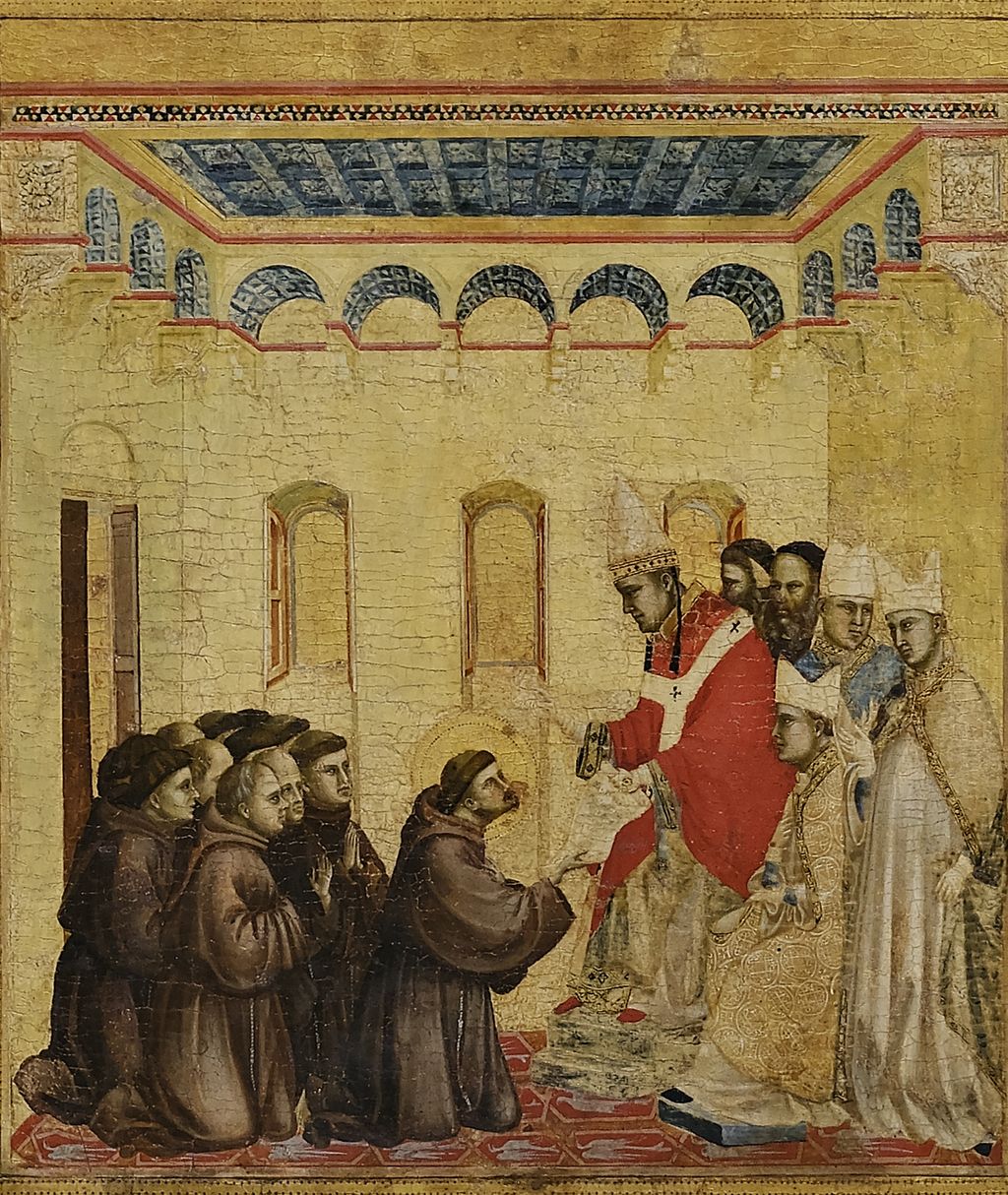
The separate Louvre predella scene of approval of Francis’s way of life. Shonagon / Wikimedia Commons / Public Domain Mark1.0. Image source. Public domain. Proportionally reduced reproduction; no colour or content enhancement.
Poverty is the central practical and theological issue. In III.10 Francis tells a parable of a rich king married to a poor woman. Their children bear the king's likeness and are fed at his table. Bonaventure interprets the story through Christ, poverty and the new religious family: the heavenly king will provide for those who follow him. Innocent's dream of the Lateran then confirms Francis's role as a supporter of the Church. The text concludes with the pope sanctioning the Rule, commanding the preaching of repentance and arranging tonsures for the lay brothers so that they could preach without hindrance. [24]
This gives the painted gestures a precise narrative purpose. Francis seeks authorisation for a shared life and an outward mission. His companions' proximity makes the result communal; the permission concerns more than the exceptional holiness of one individual. The exchange takes place across a visible distinction of rank, while the pope's inclination and answering gesture bring the two sides into contact. The scene makes an institutional decision legible through bodies.
The early Roman audience is conventionally dated to 1209, the year used in Benedict XVI's account of Francis's journey to Innocent III. [25] It must be distinguished from the confirmation of the Regula bullata by Honorius III on 29 November 1223. Bonaventure himself treats the later confirmation separately, in IV.11. The basilica preserves and describes the 1223 papal document, Solet annuere, in which the text of the Rule is incorporated into the letter of confirmation. [26] The document represented in this fresco identifies its subject; it does not turn Innocent's earlier audience into the later act of Honorius.
The founder and leader of the order is represented by Giotto in a number of ways. Firstly, he is positioned closer to the Pope, with a small gap between himself and the other members of the order. He is also given a halo in gold around his face, which was typical of the artist. His arms are outstretched, whereas the others are in a prayer posture. His figure is also slightly thicker in form, again separating him visually from the other members.
The breadth of his habit is especially useful pictorially: its long sleeve carries the eye towards the pope, and its folds give his kneeling body a substantial presence. The halo marks the saint for viewers looking back upon his life. It belongs to the devotional language of the representation, rather than recording something that the historical audience would have seen around his head. His upward glance and the pope's downward inclination sustain the encounter even when the small document is difficult to distinguish from a distance.
Three decades later, Giotto would create another version of the Confirmation of the Rule at the Bardi Chapel, Santa Croce, Florence, Within that version there are fewer figures and the overall layout is far more formulaic and organized. Giotto himself was regularly tasked with re-visiting topics, mainly due to his concentration on religious art throughout his career, as well as where some donors would appreciate his previous efforts and urge him to re-create items again.
The Bardi Chapel painting is a separate physical work, and the interval of three decades depends on which disputed dates are adopted for Assisi and Florence. [22] Repetition of the subject alone cannot establish a donor's request to recreate an earlier composition. The papal recognition of Francis's mission was a significant episode available to different Franciscan programmes, each with its own setting and arrangement.
A particularly revealing comparison is the small approval scene beneath the Louvre's Saint Francis Receiving the Stigmata. That is a painted panel from Pisa, with three narrative scenes below the main image, rather than a fragment of the Assisi wall cycle. Its approval scene also places kneeling Francis and his companions opposite the pope. The resemblance extends to the overhead arcading, yet the effect changes substantially with scale. [27]
In the Louvre scene, the figures fill more of the picture's height. The brothers gather behind Francis in a comparatively low cluster, the room's back wall has tall narrow openings, and the court recedes behind the pope. At Assisi, the patterned rear surface is more insistent, the architecture occupies more space above the heads, and the friars form a taller stack of bodies. Schwarz makes these proportional changes central to his comparison. He argues that the small panel supplied a model expanded and adapted at Assisi; the proposed direction of borrowing belongs to his larger chronology and should be understood as an argument. [27]
The comparison helps explain why repeating a design is an active compositional problem. Enlarging every part equally would preserve one set of relationships; increasing the room's prominence while keeping the people relatively smaller produces another. At Assisi, the blessing takes place within an imposing ceremonial enclosure. Its architecture gives the meeting a public weight, while the saint's extended hands keep a single human exchange at its centre.
Conclusion
Giotto di Bondone’s work within the Upper Church of San Francesco in Assisi came towards the end of the 13th century and led beautifully to his time in the Scrovegni Chapel which followed on shortly afterwards. Confirmation of the Rule was an important episode in the life of Saint Francis and was a natural choice for inclusion within the twenty eight panel series.
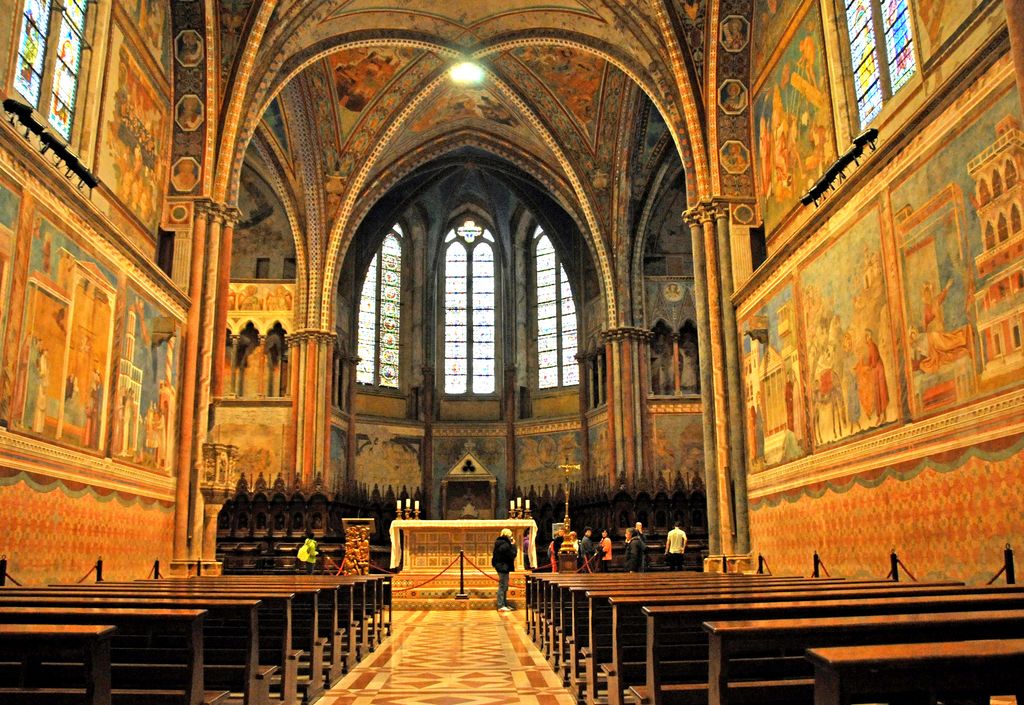
The nave of the Upper Church of San Francesco at Assisi, photographed in 2010. The Francis cycle occupies the lower narrative register; its authorship remains disputed. The photograph records the wider setting rather than an isolated scene. Dennis G. Jarvis. Image source. CC BY-SA 2.0. Proportionally reduced reproduction; original composition, colour and photographic lighting retained.
That late-thirteenth-century, pre-Padua sequence is the traditional chronology, rather than an uncontested account of the cycle's execution. [22] The narrative remains clear: Innocent III blesses Francis's mission before the assembled brothers and church dignitaries. A sheet of writing, a raised hand, a kneeling body and a richly articulated room make the recognition visible. The splendour surrounding the audience enlarges the event, while the plain brown figure reaching across its centre gives it focus.
Watch: Explore Giotto’s Art
Choose an overview or a closer look at three major works. These films provide wider Giotto context alongside this article.
Artworks directory
This directory brings together 209 records for paintings, ensembles, individual scenes and components, architectural work, an associated disputed design, and reported or lost projects connected with Giotto. Ensembles and their parts appear separately, so 209 is a count of records rather than independent paintings or commissions. Attributions and dates remain qualified where disputed; inclusion does not establish Giotto’s own hand throughout.
| Name | Date | Medium, attribution and status |
|---|---|---|
| Expulsion of Joachim from the Temple — Scrovegni Chapel, Padua | c.1303–05 (chapel campaign) | Fresco / wall painting. Giotto and workshop. Scene within a cycle. Padova Musei. Chapel overview. |
| Joachim among the Shepherds — Scrovegni Chapel, Padua | c.1303–05 (chapel campaign) | Fresco / wall painting. Giotto and workshop. Scene within a cycle. Padova Musei. Chapel overview. |
| Annunciation to Saint Anne — Scrovegni Chapel, Padua | c.1303–05 (chapel campaign) | Fresco / wall painting. Giotto and workshop. Scene within a cycle. Padova Musei. Chapel overview. |
| Sacrifice of Joachim — Scrovegni Chapel, Padua | c.1303–05 (chapel campaign) | Fresco / wall painting. Giotto and workshop. Scene within a cycle. Padova Musei. Chapel overview. |
| Joachim’s Dream — Scrovegni Chapel, Padua | c.1303–05 (chapel campaign) | Fresco / wall painting. Giotto and workshop. Scene within a cycle. Padova Musei. Padova Musei. Chapel overview. |
| Meeting at the Golden Gate — Scrovegni Chapel, Padua | c.1303–05 (chapel campaign) | Fresco / wall painting. Giotto and workshop. Scene within a cycle. Padova Musei. Chapel overview. |
| Birth of the Virgin — Scrovegni Chapel, Padua | c.1303–05 (chapel campaign) | Fresco / wall painting. Giotto and workshop. Scene within a cycle. Padova Musei. Padova Musei. Chapel overview. |
| Presentation of the Virgin in the Temple — Scrovegni Chapel, Padua | c.1303–05 (chapel campaign) | Fresco / wall painting. Giotto and workshop. Scene within a cycle. Padova Musei. Chapel overview. |
| Delivery of the Rods — Scrovegni Chapel, Padua | c.1303–05 (chapel campaign) | Fresco / wall painting. Giotto and workshop. Scene within a cycle. Padova Musei. Chapel overview. |
| Prayer of Joseph and the Suitors — Scrovegni Chapel, Padua | c.1303–05 (chapel campaign) | Fresco / wall painting. Giotto and workshop. Scene within a cycle. Padova Musei. Chapel overview. |
| Marriage of the Virgin — Scrovegni Chapel, Padua | c.1303–05 (chapel campaign) | Fresco / wall painting. Giotto and workshop. Scene within a cycle. Padova Musei. Chapel overview. |
| Wedding Procession of Mary — Scrovegni Chapel, Padua | c.1303–05 (chapel campaign) | Fresco / wall painting. Giotto and workshop. Scene within a cycle. Padova Musei. Chapel overview. |
| Annunciation on the triumphal arch — complete ensemble (Scrovegni Chapel, Padua) | c.1303–05 (chapel campaign) | Wall painting with a central painted wooden panel. Giotto and workshop. Ensemble. Includes the Mission of Gabriel and the lower Annunciation pair; the original central wooden panel is in the Musei Civici agli Eremitani, with a conservation copy in the chapel. Padova Musei. Padova Musei. Scholarly study. Chapel overview. |
| Visitation — Scrovegni Chapel, Padua | c.1303–05 (chapel campaign) | Fresco / wall painting. Giotto and workshop. Scene within a cycle. Padova Musei. Chapel overview. |
| Nativity — Scrovegni Chapel, Padua | c.1303–05 (chapel campaign) | Fresco / wall painting. Giotto and workshop. Scene within a cycle. Padova Musei. Chapel overview. |
| Adoration of the Magi — Scrovegni Chapel, Padua | c.1303–05 (chapel campaign) | Fresco / wall painting. Giotto and workshop. Scene within a cycle. Padova Musei. Chapel overview. |
| Presentation of Christ at the Temple — Scrovegni Chapel, Padua | c.1303–05 (chapel campaign) | Fresco / wall painting. Giotto and workshop. Scene within a cycle. Padova Musei. Chapel overview. |
| Flight into Egypt — Scrovegni Chapel, Padua | c.1303–05 (chapel campaign) | Fresco / wall painting. Giotto and workshop. Scene within a cycle. Padova Musei. Chapel overview. |
| Massacre of the Innocents — Scrovegni Chapel, Padua | c.1303–05 (chapel campaign) | Fresco / wall painting. Giotto and workshop. Scene within a cycle. Padova Musei. Chapel overview. |
| Christ among the Doctors — Scrovegni Chapel, Padua | c.1303–05 (chapel campaign) | Fresco / wall painting. Giotto and workshop. Scene within a cycle. Padova Musei. Chapel overview. |
| Baptism of Christ — Scrovegni Chapel, Padua | c.1303–05 (chapel campaign) | Fresco / wall painting. Giotto and workshop. Scene within a cycle. Padova Musei. Chapel overview. |
| Marriage at Cana — Scrovegni Chapel, Padua | c.1303–05 (chapel campaign) | Fresco / wall painting. Giotto and workshop. Scene within a cycle. Padova Musei. Padova Musei. Chapel overview. |
| Raising of Lazarus — Scrovegni Chapel, Padua | c.1303–05 (chapel campaign) | Fresco / wall painting. Giotto and workshop. Scene within a cycle. Padova Musei. Chapel overview. |
| Entry into Jerusalem — Scrovegni Chapel, Padua | c.1303–05 (chapel campaign) | Fresco / wall painting. Giotto and workshop. Scene within a cycle. Padova Musei. Chapel overview. |
| Expulsion of the Money Changers — Scrovegni Chapel, Padua | c.1303–05 (chapel campaign) | Fresco / wall painting. Giotto and workshop. Scene within a cycle. Padova Musei. Padova Musei. Chapel overview. |
| Judas Receiving the Payment — Scrovegni Chapel, Padua | c.1303–05 (chapel campaign) | Fresco / wall painting. Giotto and workshop. Scene within a cycle. Padova Musei. Chapel overview. |
| Last Supper — Scrovegni Chapel, Padua | c.1303–05 (chapel campaign) | Fresco / wall painting. Giotto and workshop. Scene within a cycle. Padova Musei. Chapel overview. |
| Washing of the Feet — Scrovegni Chapel, Padua | c.1303–05 (chapel campaign) | Fresco / wall painting. Giotto and workshop. Scene within a cycle. Padova Musei. Chapel overview. |
| Arrest of Christ — Scrovegni Chapel, Padua | c.1303–05 (chapel campaign) | Fresco / wall painting. Giotto and workshop. Scene within a cycle. Padova Musei. Chapel overview. |
| Christ before Annas and Caiaphas — Scrovegni Chapel, Padua | c.1303–05 (chapel campaign) | Fresco / wall painting. Giotto and workshop. Scene within a cycle. Padova Musei. Chapel overview. |
| Mocking of Christ and Flagellation — Scrovegni Chapel, Padua | c.1303–05 (chapel campaign) | Fresco / wall painting. Giotto and workshop. Scene within a cycle. Padova Musei. Chapel overview. |
| Road to Calvary — Scrovegni Chapel, Padua | c.1303–05 (chapel campaign) | Fresco / wall painting. Giotto and workshop. Scene within a cycle. Padova Musei. Chapel overview. |
| Crucifixion — Scrovegni Chapel, Padua | c.1303–05 (chapel campaign) | Fresco / wall painting. Giotto and workshop. Scene within a cycle. Padova Musei. Chapel overview. |
| Lamentation — Scrovegni Chapel, Padua | c.1303–05 (chapel campaign) | Fresco / wall painting. Giotto and workshop. Scene within a cycle. Padova Musei. Chapel overview. |
| Resurrection / Noli me tangere — Scrovegni Chapel, Padua | c.1303–05 (chapel campaign) | Fresco / wall painting. Giotto and workshop. Scene within a cycle. Padova Musei. Chapel overview. |
| Ascension — Scrovegni Chapel, Padua | c.1303–05 (chapel campaign) | Fresco / wall painting. Giotto and workshop. Scene within a cycle. Padova Musei. Chapel overview. |
| Pentecost — Scrovegni Chapel, Padua | c.1303–05 (chapel campaign) | Fresco / wall painting. Giotto and workshop. Scene within a cycle. Padova Musei. Padova Musei. Chapel overview. |
| Coretto — right painted recess (Scrovegni Chapel, Padua) | c.1303–05 (chapel campaign) | Fresco / painted fictive architecture. Giotto and workshop. Ensemble component. Padova Musei. Padova Musei. Scholarly study. Chapel overview. |
| Coretto — left painted recess (Scrovegni Chapel, Padua) | c.1303–05 (chapel campaign) | Fresco / painted fictive architecture. Giotto and workshop. Ensemble component. Padova Musei. Padova Musei. Scholarly study. Chapel overview. |
| Envy — Scrovegni Chapel, Padua | c.1303–05 (chapel campaign) | Grisaille fresco / wall painting. Giotto and workshop. Ensemble component. Padova Musei. Chapel overview. Scholarly study. Padova Musei. |
| Despair — Scrovegni Chapel, Padua | c.1303–05 (chapel campaign) | Grisaille fresco / wall painting. Giotto and workshop. Ensemble component. Padova Musei. Chapel overview. Scholarly study. Padova Musei. |
| Prudence — Scrovegni Chapel, Padua | c.1303–05 (chapel campaign) | Grisaille fresco / wall painting. Giotto and workshop. Ensemble component. Padova Musei. Chapel overview. Scholarly study. Padova Musei. |
| Fortitude — Scrovegni Chapel, Padua | c.1303–05 (chapel campaign) | Grisaille fresco / wall painting. Giotto and workshop. Ensemble component. Padova Musei. Chapel overview. Scholarly study. Padova Musei. |
| Temperance — Scrovegni Chapel, Padua | c.1303–05 (chapel campaign) | Grisaille fresco / wall painting. Giotto and workshop. Ensemble component. Padova Musei. Chapel overview. Scholarly study. Padova Musei. |
| Justice — Scrovegni Chapel, Padua | c.1303–05 (chapel campaign) | Grisaille fresco / wall painting. Giotto and workshop. Ensemble component. Padova Musei. Chapel overview. Scholarly study. Padova Musei. |
| Faith — Scrovegni Chapel, Padua | c.1303–05 (chapel campaign) | Grisaille fresco / wall painting. Giotto and workshop. Ensemble component. Padova Musei. Chapel overview. Scholarly study. Padova Musei. |
| Charity — Scrovegni Chapel, Padua | c.1303–05 (chapel campaign) | Grisaille fresco / wall painting. Giotto and workshop. Ensemble component. Padova Musei. Chapel overview. Scholarly study. Padova Musei. |
| Hope — Scrovegni Chapel, Padua | c.1303–05 (chapel campaign) | Grisaille fresco / wall painting. Giotto and workshop. Ensemble component. Padova Musei. Chapel overview. Scholarly study. Padova Musei. |
| Folly — Scrovegni Chapel, Padua | c.1303–05 (chapel campaign) | Grisaille fresco / wall painting. Giotto and workshop. Ensemble component. Padova Musei. Chapel overview. Scholarly study. Padova Musei. |
| Inconstancy — Scrovegni Chapel, Padua | c.1303–05 (chapel campaign) | Grisaille fresco / wall painting. Giotto and workshop. Ensemble component. Padova Musei. Chapel overview. Scholarly study. Padova Musei. |
| Wrath — Scrovegni Chapel, Padua | c.1303–05 (chapel campaign) | Grisaille fresco / wall painting. Giotto and workshop. Ensemble component. Padova Musei. Chapel overview. Scholarly study. Padova Musei. |
| Injustice — Scrovegni Chapel, Padua | c.1303–05 (chapel campaign) | Grisaille fresco / wall painting. Giotto and workshop. Ensemble component. Padova Musei. Chapel overview. Scholarly study. Padova Musei. |
| Infidelity / Idolatry — Scrovegni Chapel, Padua | c.1303–05 (chapel campaign) | Grisaille fresco / wall painting. Giotto and workshop. Ensemble component. Padova Musei. Chapel overview. Scholarly study. Padova Musei. |
| Starry vault — complete ensemble (Scrovegni Chapel, Padua) | c.1303–05 (chapel campaign) | Vault painting. Giotto and workshop. Ensemble. Padova Musei. Padova Musei. Chapel overview. |
| Last Judgement — Scrovegni Chapel, Padua | c.1303–05 (chapel campaign) | Fresco / wall painting. Giotto and workshop. Scene within a cycle. Padova Musei. Padova Musei. Chapel overview. Padova Musei. |
| Prophet Malachi — vault medallion — Scrovegni Chapel, Padua | c.1303–05 (chapel campaign) | Fresco / wall painting. Giotto and workshop. Ensemble component. Padova Musei. Padova Musei. Chapel overview. Padova Musei. |
| Prophet Baruch — vault medallion — Scrovegni Chapel, Padua | c.1303–05 (chapel campaign) | Fresco / wall painting. Giotto and workshop. Ensemble component. Padova Musei. Padova Musei. Chapel overview. Padova Musei. |
| Prophet Isaiah — vault medallion — Scrovegni Chapel, Padua | c.1303–05 (chapel campaign) | Fresco / wall painting. Giotto and workshop. Ensemble component. Padova Musei. Padova Musei. Chapel overview. Padova Musei. |
| Prophet Daniel — vault medallion — Scrovegni Chapel, Padua | c.1303–05 (chapel campaign) | Fresco / wall painting. Giotto and workshop. Ensemble component. Padova Musei. Padova Musei. Chapel overview. Padova Musei. |
| Christ Pantocrator — vault medallion — Scrovegni Chapel, Padua | c.1303–05 (chapel campaign) | Fresco / wall painting. Giotto and workshop. Ensemble component. Padova Musei. Padova Musei. Chapel overview. Padova Musei. |
| Virgin and Child — vault medallion — Scrovegni Chapel, Padua | c.1303–05 (chapel campaign) | Fresco / wall painting. Giotto and workshop. Ensemble component. Padova Musei. Padova Musei. Chapel overview. Padova Musei. |
| Prophet Ezekiel — vault medallion — Scrovegni Chapel, Padua | c.1303–05 (chapel campaign) | Fresco / wall painting. Giotto and workshop. Ensemble component. Padova Musei. Padova Musei. Chapel overview. Padova Musei. |
| Prophet Micah — vault medallion — Scrovegni Chapel, Padua | c.1303–05 (chapel campaign) | Fresco / wall painting. Giotto and workshop. Ensemble component. Padova Musei. Padova Musei. Chapel overview. Padova Musei. |
| Saint John the Baptist — vault medallion — Scrovegni Chapel, Padua | c.1303–05 (chapel campaign) | Fresco / wall painting. Giotto and workshop. Ensemble component. Padova Musei. Padova Musei. Chapel overview. Padova Musei. |
| Scrovegni Chapel — painted decoration | c.1303–05 (chapel campaign) | Fresco / wall painting, with a painted wooden panel. Giotto and workshop (painted decoration). Ensemble. Includes separately listed scenes and components. The original central God the Father panel is in the Musei Civici agli Eremitani; a conservation copy is in the chapel. Chapel overview. Padova Musei. Padova Musei. Source. Source. Source. Padova Musei. Scholarly study. |
| Vices and Virtues — complete fourteen-figure programme | c.1303–05 (chapel campaign) | Grisaille fresco / wall painting. Giotto and workshop. Ensemble. Fourteen figures: seven virtues and seven opposed vices. Padova Musei. Chapel overview. Scholarly study. |
| Coretti — paired fictive chapels | c.1303–05 (chapel campaign) | Fresco / painted fictive architecture. Giotto and workshop. Ensemble. Two separate painted recesses, also listed individually. Padova Musei. Padova Musei. Scholarly study. |
| Mission of Gabriel — heavenly assembly | c.1303–05 (chapel campaign) | Wall painting with central painted wooden image. Giotto and workshop. Ensemble component. Central wooden God the Father panel preserved at the Musei Civici agli Eremitani; conservation copy in the chapel. Chapel overview. Padova Musei. Scholarly study. Padova Musei. |
| Annunciation — Gabriel and Mary in facing chambers | c.1303–05 (chapel campaign) | Fresco / wall painting. Giotto and workshop. Ensemble component. Chapel overview. Scholarly study. Padova Musei. |
| God the Father — central wooden panel of the Mission of Gabriel | c.1303–05 (chapel campaign) | Painting on wood. Associated with Giotto. Ensemble component. Original at the Musei Civici agli Eremitani, Padua; conservation copy in the Scrovegni Chapel. Padova Musei. Padova Musei. Scholarly study. Source. |
| Life of Saint Francis — Upper Church cycle, Assisi | Late 13th–early 14th century; dating disputed | Fresco / wall-painting cycle. Traditionally associated with Giotto; Giotto, Roman-school and other attributions disputed. Ensemble. Twenty-eight-scene nave cycle; scenes also listed individually. Basilica catalogue. Scholarly study. Basilica catalogue. Source. Source. |
| Homage of a Simple Man — Upper Church, Assisi | Late 13th–early 14th century; dating disputed | Wall painting. Traditionally associated with Giotto; authorship and dating disputed. Scene within a cycle. Source. Scholarly study. Source. Source. Source. |
| Gift of the Mantle — Upper Church, Assisi | Late 13th–early 14th century; dating disputed | Wall painting. Traditionally associated with Giotto; authorship and dating disputed. Scene within a cycle. Basilica catalogue. Scholarly study. Source. Source. Source. |
| Dream of the Palace Full of Arms — Upper Church, Assisi | Late 13th–early 14th century; dating disputed | Wall painting. Traditionally associated with Giotto; authorship and dating disputed. Scene within a cycle. Basilica catalogue. Source. Scholarly study. Source. Source. Source. |
| Prayer before the Crucifix at San Damiano — Upper Church, Assisi | Late 13th–early 14th century; dating disputed | Wall painting. Traditionally associated with Giotto; authorship and dating disputed. Scene within a cycle. Source. Source. Source. Scholarly study. Source. Source. |
| Renunciation of Worldly Goods — Upper Church, Assisi | Late 13th–early 14th century; dating disputed | Wall painting. Traditionally associated with Giotto; authorship and dating disputed. Scene within a cycle. Source. Scholarly study. Source. Source. |
| Dream of Innocent III — Upper Church, Assisi | Late 13th–early 14th century; dating disputed | Wall painting. Traditionally associated with Giotto; authorship and dating disputed. Scene within a cycle. Source. Source. Scholarly study. Source. Source. |
| Confirmation of the Rule — Upper Church, Assisi | Late 13th–early 14th century; dating disputed | Wall painting. Traditionally associated with Giotto; authorship and dating disputed. Scene within a cycle. Source. Scholarly study. Source. Source. |
| Vision of the Flaming Chariot — Upper Church, Assisi | Late 13th–early 14th century; dating disputed | Wall painting. Traditionally associated with Giotto; authorship and dating disputed. Scene within a cycle. Source. Source. Scholarly study. Source. Source. |
| Vision of the Thrones — Upper Church, Assisi | Late 13th–early 14th century; dating disputed | Wall painting. Traditionally associated with Giotto; authorship and dating disputed. Scene within a cycle. Basilica catalogue. Scholarly study. Source. Source. Source. |
| Expulsion of Devils from Arezzo — Upper Church, Assisi | Late 13th–early 14th century; dating disputed | Wall painting. Traditionally associated with Giotto; authorship and dating disputed. Scene within a cycle. Source. Source. Scholarly study. Source. Source. Source. |
| Trial by Fire before the Sultan — Upper Church, Assisi | Late 13th–early 14th century; dating disputed | Wall painting. Traditionally associated with Giotto; authorship and dating disputed. Scene within a cycle. Source. Source. Scholarly study. Source. Source. |
| Ecstasy of Saint Francis — Upper Church, Assisi | Late 13th–early 14th century; dating disputed | Wall painting. Traditionally associated with Giotto; authorship and dating disputed. Scene within a cycle. Source. Source. Source. Scholarly study. Source. Source. |
| Nativity at Greccio — Upper Church, Assisi | Late 13th–early 14th century; dating disputed | Wall painting. Traditionally associated with Giotto; authorship and dating disputed. Scene within a cycle. Basilica catalogue. Scholarly study. Source. Source. Source. |
| Miracle of the Spring — Upper Church, Assisi | Late 13th–early 14th century; dating disputed | Wall painting. Traditionally associated with Giotto; authorship and dating disputed. Scene within a cycle. Source. Scholarly study. Source. Source. Source. |
| Sermon to the Birds — Upper Church, Assisi | Late 13th–early 14th century; dating disputed | Wall painting. Traditionally associated with Giotto; authorship and dating disputed. Scene within a cycle. Basilica catalogue. Scholarly study. Source. Source. Source. |
| Death of the Knight of Celano — Upper Church, Assisi | Late 13th–early 14th century; dating disputed | Wall painting. Traditionally associated with Giotto; authorship and dating disputed. Scene within a cycle. Source. Source. Scholarly study. Source. Source. |
| Sermon before Pope Honorius III — Upper Church, Assisi | Late 13th–early 14th century; dating disputed | Wall painting. Traditionally associated with Giotto; authorship and dating disputed. Scene within a cycle. Source. Source. Scholarly study. Source. |
| Apparition at the Chapter of Arles — Upper Church, Assisi | Late 13th–early 14th century; dating disputed | Wall painting. Traditionally associated with Giotto; authorship and dating disputed. Scene within a cycle. Basilica catalogue. Scholarly study. Source. Source. Source. |
| Stigmatisation — Upper Church, Assisi | Late 13th–early 14th century; dating disputed | Wall painting. Traditionally associated with Giotto; authorship and dating disputed. Scene within a cycle. Source. Scholarly study. Source. Source. |
| Death and Ascension of Saint Francis — Upper Church, Assisi | Late 13th–early 14th century; dating disputed | Wall painting. Traditionally associated with Giotto; authorship and dating disputed. Scene within a cycle. Basilica catalogue. Scholarly study. Source. Source. Source. |
| Apparition to Brother Augustine and Bishop Guido — Upper Church, Assisi | Late 13th–early 14th century; dating disputed | Wall painting. Traditionally associated with Giotto; authorship and dating disputed. Scene within a cycle. Zeri catalogue. Scholarly study. Source. Source. Source. |
| Verification of the Stigmata — Upper Church, Assisi | Late 13th–early 14th century; dating disputed | Wall painting. Traditionally associated with Giotto; authorship and dating disputed. Scene within a cycle. Source. Source. Scholarly study. Source. Source. |
| Mourning of the Poor Clares — Upper Church, Assisi | Late 13th–early 14th century; dating disputed | Wall painting. Traditionally associated with Giotto; authorship and dating disputed. Scene within a cycle. Basilica catalogue. Source. Scholarly study. Source. Source. |
| Canonisation of Saint Francis — Upper Church, Assisi | Late 13th–early 14th century; dating disputed | Wall painting. Traditionally associated with Giotto; authorship and dating disputed. Scene within a cycle. Source. Source. Scholarly study. Source. Source. Source. |
| Apparition to Pope Gregory IX — Upper Church, Assisi | Late 13th–early 14th century; dating disputed | Wall painting. Traditionally associated with Giotto; authorship and dating disputed. Scene within a cycle. Zeri catalogue. Scholarly study. Source. Source. Source. |
| Healing of John of Lerida — Upper Church, Assisi | Late 13th–early 14th century; dating disputed | Wall painting. Traditionally associated with Giotto; authorship and dating disputed. Scene within a cycle. Source. Source. Scholarly study. Source. Source. |
| Resurrection of a Woman — Upper Church, Assisi | Late 13th–early 14th century; dating disputed | Wall painting. Traditionally associated with Giotto; authorship and dating disputed. Scene within a cycle. Source. Scholarly study. Source. Source. Source. |
| Liberation of the Prisoner Peter — Upper Church, Assisi | Late 13th–early 14th century; dating disputed | Wall painting. Traditionally associated with Giotto; authorship and dating disputed. Scene within a cycle. Source. Source. Scholarly study. Source. Source. Source. |
| Santa Maria Novella Crucifix | Late 13th century; c.1288–89 or 1298–1301; disputed | Tempera and gold on a shaped wooden cross. Giotto. Source. |
| Death of the Virgin / Dormition — Berlin | c.1310 | Tempera and gold on poplar; gabled dossal. Giotto. Source. Source. |
| Peruzzi Altarpiece | c.1311–1315 (North Carolina Museum of Art) | Tempera and gold on panel. Giotto and workshop. Ensemble. Source. |
| Bologna Polyptych | c.1330 | Tempera and gold on panel. Giotto and workshop. Ensemble. Source. |
| Death of Saint Francis, Bardi Chapel | After 1317, usually the 1320s; disputed | Wall painting with wet-plaster and dry-applied passages. Giotto. Scene within a cycle. Source. |
| Bardi Chapel — painted decoration | After 1317, usually the 1320s; disputed | Wall painting with wet-plaster and dry-applied passages. Giotto and workshop / Giottesque painters; individual hands disputed. Ensemble. Scholarly study. Source. |
| Badia Polyptych | c.1300; proposed dates include 1295–1300 and 1301–02 | Tempera and gold on panel; five cusped compartments. Giotto. Ensemble. Scholarly study. Source. Source. |
| Baroncelli Polyptych | After 1328; detached pinnacle c.1328–35 | Tempera and gold on panel; later altered framing. Giotto and workshop. Ensemble. Detached central pinnacle in San Diego. Santa Croce. |
| Adoration of the Magi / Epiphany — Metropolitan Museum panel | Possibly c.1320; c.1310–18 also proposed for the group | Tempera and gold on wood. Giotto. Part of the dispersed seven-scene board; original function disputed. Met catalogue. Source. |
| Franciscan Allegories | Early 14th century, often c.1315; disputed | Vault wall painting. Giotto and workshop / Giottesque painters; individual hands disputed. Ensemble. Basilica catalogue. |
| Navicella — lost / reworked original mosaic | Late 13th–early 14th century; date disputed | Mosaic. Original attributed to Giotto. Original lost / reworked; fragments and later remakes survive. Scholarly study. |
| Pentecost — London panel | Possibly c.1310–18 (Gordon) | Egg tempera on poplar. Giotto and workshop. Part of the dispersed seven-scene board; original function disputed. National Gallery. Source. |
| Saint Stephen — Horne panel | c.1330–1335 (Museo Horne) | Tempera and gold on panel. Giotto. Proposed association with the Washington and Chaalis panels remains hypothetical. Source. |
| Saint Francis Receiving the Stigmata — Louvre altarpiece | 1300–25 (Louvre) | Tempera and gold on poplar. Giotto. Louvre catalogue. |
| Stefaneschi Triptych | c.1320; 1315–20 (Vatican Museums) | Tempera and gold on panel; painted on both sides. Giotto and workshop. Ensemble. Vatican Museums. |
| Crucifixion, Berlin | c.1315–1320 | Tempera and gold on poplar. Giotto. Source. |
| Madonna and Child — Washington / Goldman Madonna | c.1310–1315 (National Gallery of Art) | Tempera and gold on poplar. Giotto. Washington panel, distinct from San Giorgio alla Costa; proposed Horne/Chaalis companions remain hypothetical. NGA catalogue. |
| Ognissanti Madonna | c.1300–05 (Uffizi); c.1310 also proposed | Tempera and gold on panel. Giotto. Uffizi. |
| Madonna of Borgo San Lorenzo | c.1290–95; dating and attribution debated | Tempera and gold on a fragment of a wooden panel. Giotto. Fragmentary. Source. |
| Madonna of San Giorgio alla Costa | c.1288–95 (Opera del Duomo); later dates also proposed | Tempera and gold on panel; cut edges. Giotto. Damaged in 1993 and treated in 1995. Source. |
| Magdalene Chapel — painted decoration | c.1307–08 (basilica); disputed | Wall painting with wet-plaster and dry-applied passages. Giotto and workshop / Giottesque painters; individual hands disputed. Ensemble. Basilica catalogue. |
| Ognissanti Crucifix | c.1315–1320 (Opificio) | Painting on a shaped wooden cross. Giotto and workshop. Workshop participation and alternative attributions debated. Source. |
| Padua Crucifix | c.1303–05 (Zeri catalogue) | Tempera and gold on a shaped wooden cross. Giotto. Zeri catalogue. |
| Peruzzi Chapel — painted decoration | c.1310–11 (Santa Croce); 1334–36 proposed by Schwarz | Wall painting with substantial dry-applied work and loss. Giotto and workshop / Giottesque painters; individual hands disputed. Ensemble. Santa Croce. |
| Rimini Crucifix | c.1300; late 13th century also proposed | Tempera and gold on a shaped wooden cross. Giotto. Source. |
| Giotto’s Campanile — Florence Cathedral bell tower | Begun 1334; completed 1359 under successors | Marble-clad masonry bell tower. Begun under Giotto; continued by Andrea Pisano and Francesco Talenti. Successive building and sculptural campaigns. Source. Scholarly study. Scholarly study. |
| Tower elevation on parchment, Siena — disputed relation to Giotto | 14th century; date and design context disputed | Brown ink and coloured washes over incised construction on three parchment skins. Attribution disputed; possibly a Giotto design transmitted through another hand. Associated design; autograph attribution unestablished. Alternative attributions include Lando di Pietro. Scholarly study. Source. Source. |
| Seven scenes of Christ — dispersed painted board | Possibly c.1310–18 (Gordon); component dates vary | Tempera and gold on a single wooden board, subsequently divided. Giotto and workshop; individual attributions vary. Reconstructed dispersed ensemble. Common board supported by matching wood grain; predella or dossal function disputed. Source. Source. |
| Presentation of Christ at the Temple — Boston panel | Possibly c.1310–18 (Gordon’s group dating) | Tempera and gold on wood. Giotto and workshop; individual attribution varies within the group. Ensemble component. Source. Source. |
| Last Supper — Munich panel | Possibly c.1310–18 (Gordon’s group dating) | Tempera and gold on wood. Giotto and workshop; individual attribution varies within the group. Ensemble component. Source. Source. Source. |
| Crucifixion — Munich panel | Possibly c.1310–18 (Gordon’s group dating) | Tempera and gold on wood. Giotto and workshop; individual attribution varies within the group. Ensemble component. Source. Source. Source. |
| Descent into Limbo — Munich panel | Possibly c.1310–18 (Gordon’s group dating) | Tempera and gold on wood. Giotto and workshop; individual attribution varies within the group. Ensemble component. Source. Source. Source. |
| Entombment — Villa I Tatti panel | Possibly c.1310–18 (Gordon’s group dating) | Tempera and gold on wood. Giotto and workshop; individual attribution varies within the group. Ensemble component. Source. Source. |
| God the Father with Angels — detached Baroncelli pinnacle | c.1328–1335 (San Diego Museum of Art) | Tempera and gold on wood. Giotto and workshop. Ensemble component. Detached in later remodelling; collection home in San Diego. Source. Source. |
| Saint John the Evangelist — Chaalis panel | c.1320 (INHA/RETIF) | Painting on wood. Giotto (INHA/RETIF attribution). Collection: Musée Jacquemart-André, Fontaine-Chaalis. Chantilly’s exhibition announcement, as of 1 November 2026, gives temporary display from 24 January 2026 with no end date. Association with the Washington/Horne altarpiece remains hypothetical. NGA catalogue. Source. Source. Source. Source. |
| Saint Lawrence — Chaalis panel | c.1320 (INHA/RETIF) | Painting on poplar. Giotto; possible execution by a collaborator (INHA/RETIF). Collection: Musée Jacquemart-André, Fontaine-Chaalis. Chantilly’s exhibition announcement, as of 1 November 2026, gives temporary display from 24 January 2026 with no end date. Association with the Washington/Horne altarpiece remains hypothetical. NGA catalogue. Source. Source. Source. Source. |
| Allegory of Poverty — Lower Church crossing vault, Assisi | Early 14th century, often c.1315; disputed | Vault wall painting. Giotto’s workshop / Giottesque painters; alternatives include Stefano. Ensemble component. Basilica catalogue. Source. Scholarly study. |
| Allegory of Chastity — Lower Church crossing vault, Assisi | Early 14th century, often c.1315; disputed | Vault wall painting. Giotto’s workshop / Giottesque painters; alternatives include Stefano. Ensemble component. Basilica catalogue. Source. Scholarly study. |
| Allegory of Obedience — Lower Church crossing vault, Assisi | Early 14th century, often c.1315; disputed | Vault wall painting. Giotto’s workshop / Giottesque painters; alternatives include Stefano. Ensemble component. Basilica catalogue. Source. Scholarly study. |
| Saint Francis in Glory — Lower Church crossing vault, Assisi | Early 14th century, often c.1315; disputed | Vault wall painting. Giotto’s workshop / Giottesque painters; alternatives include Stefano. Ensemble component. Basilica catalogue. Source. Scholarly study. |
| Renunciation of Worldly Goods — Bardi Chapel, Florence | After 1317, usually the 1320s; disputed | Wall painting: fresco with extensive dry-applied passages. Giotto and workshop; individual hands uncertain. Scene within a cycle. Source. Santa Croce. Scholarly study. Source. |
| Confirmation of the Rule — Bardi Chapel, Florence | After 1317, usually the 1320s; disputed | Wall painting: fresco with extensive dry-applied passages. Giotto and workshop; individual hands uncertain. Scene within a cycle. Source. Santa Croce. Scholarly study. Source. |
| Apparition at the Chapter of Arles — Bardi Chapel, Florence | After 1317, usually the 1320s; disputed | Wall painting: fresco with extensive dry-applied passages. Giotto and workshop; individual hands uncertain. Scene within a cycle. Source. Santa Croce. Scholarly study. Source. |
| Trial by Fire before the Sultan — Bardi Chapel, Florence | After 1317, usually the 1320s; disputed | Wall painting: fresco with extensive dry-applied passages. Giotto and workshop; individual hands uncertain. Scene within a cycle. Source. Santa Croce. Scholarly study. Source. |
| Apparitions to Brother Augustine and Bishop Guido — Bardi Chapel, Florence | After 1317, usually the 1320s; disputed | Wall painting: fresco with extensive dry-applied passages. Giotto and workshop; individual hands uncertain. Scene within a cycle. Source. Santa Croce. Scholarly study. Source. |
| Saint Francis Receiving the Stigmata — Bardi Chapel, Florence | After 1317, usually the 1320s; disputed | Wall painting: fresco with extensive dry-applied passages. Giotto and workshop; individual hands uncertain. Scene within a cycle. Source. Santa Croce. Scholarly study. Source. |
| Saint Louis of Toulouse — Bardi Chapel niche | After 1317; campaign date disputed | Wall painting. Giotto and workshop. Ensemble component. Source. Scholarly study. |
| Saint Clare — Bardi Chapel niche | After 1317; campaign date disputed | Wall painting. Giotto and workshop. Ensemble component. Source. Scholarly study. |
| Saint Elizabeth of Hungary — Bardi Chapel niche | After 1317; campaign date disputed | Wall painting. Giotto and workshop. Ensemble component. Source. Scholarly study. |
| Franciscan virtues — Bardi Chapel vault programme | After 1317; campaign date disputed | Vault wall painting. Giotto and workshop. Group of ensemble components. Santa Croce. Source. |
| Annunciation to Zacharias — Peruzzi Chapel, Florence | c.1310–11 (Santa Croce); 1334–36 proposed by Schwarz | Wall painting with substantial dry-applied work. Giotto and workshop. Scene within a cycle. Santa Croce. Scholarly study. Santa Croce. |
| Birth and Naming of John the Baptist — Peruzzi Chapel, Florence | c.1310–11 (Santa Croce); 1334–36 proposed by Schwarz | Wall painting with substantial dry-applied work. Giotto and workshop. Scene within a cycle. Santa Croce. Scholarly study. Santa Croce. |
| Feast of Herod — Peruzzi Chapel, Florence | c.1310–11 (Santa Croce); 1334–36 proposed by Schwarz | Wall painting with substantial dry-applied work. Giotto and workshop. Scene within a cycle. Santa Croce. Scholarly study. Santa Croce. |
| Vision of John on Patmos — Peruzzi Chapel, Florence | c.1310–11 (Santa Croce); 1334–36 proposed by Schwarz | Wall painting with substantial dry-applied work. Giotto and workshop. Scene within a cycle. Santa Croce. Scholarly study. Santa Croce. |
| Raising of Drusiana — Peruzzi Chapel, Florence | c.1310–11 (Santa Croce); 1334–36 proposed by Schwarz | Wall painting with substantial dry-applied work. Giotto and workshop. Scene within a cycle. Santa Croce. Scholarly study. Santa Croce. |
| Death and Ascension of John the Evangelist — Peruzzi Chapel, Florence | c.1310–11 (Santa Croce); 1334–36 proposed by Schwarz | Wall painting with substantial dry-applied work. Giotto and workshop. Scene within a cycle. Santa Croce. Scholarly study. Santa Croce. |
| Evangelist symbols — Peruzzi Chapel vault | c.1310–11 (Santa Croce); 1334–36 proposed by Schwarz | Wall painting. Giotto and workshop. Group of ensemble components. Santa Croce. |
| Eight prophets — Peruzzi Chapel entrance arch | c.1310–11 (Santa Croce); 1334–36 proposed by Schwarz | Wall painting. Giotto and workshop. Group of ensemble components. Santa Croce. |
| Mystic Lamb — Peruzzi Chapel fragment | c.1310–11 (Santa Croce); 1334–36 proposed by Schwarz | Wall painting. Giotto and workshop. Ensemble component; fragmentary. Santa Croce. |
| Meal in the Pharisee’s House — Magdalene Chapel, Assisi | c.1307–08 (basilica); disputed | Fresco / wall painting. Giotto and workshop; individual hands debated. Scene within a cycle. Basilica catalogue. Scholarly study. |
| Raising of Lazarus — Magdalene Chapel, Assisi | c.1307–08 (basilica); disputed | Fresco / wall painting. Giotto and workshop; individual hands debated. Scene within a cycle. Basilica catalogue. Scholarly study. |
| Noli me tangere — Magdalene Chapel, Assisi | c.1307–08 (basilica); disputed | Fresco / wall painting. Giotto and workshop; individual hands debated. Scene within a cycle. Basilica catalogue. Scholarly study. |
| Miracle of the Ruler of Marseille — Magdalene Chapel, Assisi | c.1307–08 (basilica); disputed | Fresco / wall painting. Giotto and workshop; individual hands debated. Scene within a cycle. Basilica catalogue. Scholarly study. |
| Angelic Elevation of Mary Magdalene — Magdalene Chapel, Assisi | c.1307–08 (basilica); disputed | Fresco / wall painting. Giotto and workshop; individual hands debated. Scene within a cycle. Basilica catalogue. Scholarly study. |
| Mary Magdalene Clothed by a Hermit — Magdalene Chapel, Assisi | c.1307–08 (basilica); disputed | Fresco / wall painting. Giotto and workshop; individual hands debated. Scene within a cycle. Basilica catalogue. Scholarly study. |
| Last Communion and Ascent of the Magdalene’s Soul — Magdalene Chapel, Assisi | c.1307–08 (basilica); disputed | Fresco / wall painting. Giotto and workshop; individual hands debated. Scene within a cycle. Basilica catalogue. Scholarly study. |
| Christ — Magdalene Chapel vault medallion | c.1307–08 (basilica); disputed | Vault wall painting. Giotto and workshop. Ensemble component. Basilica catalogue. Scholarly study. |
| Mary Magdalene — Magdalene Chapel vault medallion | c.1307–08 (basilica); disputed | Vault wall painting. Giotto and workshop. Ensemble component. Basilica catalogue. Scholarly study. |
| Martha — Magdalene Chapel vault medallion | c.1307–08 (basilica); disputed | Vault wall painting. Giotto and workshop. Ensemble component. Basilica catalogue. Scholarly study. |
| Lazarus — Magdalene Chapel vault medallion | c.1307–08 (basilica); disputed | Vault wall painting. Giotto and workshop. Ensemble component. Basilica catalogue. Scholarly study. |
| Teobaldo Pontano before Saint Rufinus — Magdalene Chapel donor image | c.1307–08 (chapel campaign) | Wall painting. Giotto and workshop; donor identified by Schwarz. Ensemble component. Scholarly study. |
| Teobaldo Pontano before Mary Magdalene — Magdalene Chapel donor image | c.1307–08 (chapel campaign) | Wall painting. Giotto and workshop; donor identified by Schwarz. Ensemble component. Scholarly study. |
| Penitential saints — Magdalene Chapel entrance programme | Early 14th century; associated with the c.1307–08 campaign | Wall painting. Giotto and workshop / associated chapel programme. Group of ensemble components. Scholarly study. |
| Life of Mary Magdalene — stained-glass window | Early 14th century; exact date uncertain | Stained glass. Associated chapel programme; designer and maker uncertain. Associated programme. Eleven-episode stained-glass window, distinct from the wall paintings. Basilica catalogue. Scholarly study. |
| Childhood of Christ and Franciscan miracles — Lower Church north transept | Early 14th century, often c.1315; disputed | Fresco / wall painting. Giotto and workshop; Stefano proposed by Schwarz; individual hands disputed. Ensemble. Basilica catalogue. Scholarly study. Source. |
| Flight into Egypt — Lower Church north transept, Assisi | Early 14th century; c.1308–11 (Zeri); disputed | Fresco / wall painting. Giotto’s workshop / Giottesque painters; Stefano proposed by Schwarz. Scene within a cycle. Basilica catalogue. Scholarly study. Source. Zeri catalogue. |
| Adoration of the Magi — Lower Church north transept, Assisi | Early 14th century; c.1308–11 (Zeri); disputed | Fresco / wall painting. Giotto’s workshop / Giottesque painters; Stefano proposed by Schwarz. Scene within a cycle. Basilica catalogue. Scholarly study. Source. Zeri catalogue. |
| Angel medallion from the Navicella — Vatican | Late 13th–early 14th-century original; later restoration | Mosaic. Associated with Giotto’s Navicella; medieval material and later restoration. Fragmentary and restored. Scholarly study. |
| Angel medallion from the Navicella — Boville Ernica | Late 13th–early 14th-century original; later restoration | Mosaic. Associated with Giotto’s Navicella; medieval material and later restoration. Fragmentary and restored. Scholarly study. |
| Dream of Innocent III — Louvre Stigmatisation predella | 1300–25 (Louvre’s dating of the altarpiece) | Tempera and gold on wood. Part of the signed Giotto altarpiece; individual hand uncertain. Ensemble component. Louvre catalogue. Louvre catalogue. |
| Approval of the Rule — Louvre Stigmatisation predella | 1300–25 (Louvre’s dating of the altarpiece) | Tempera and gold on wood. Part of the signed Giotto altarpiece; individual hand uncertain. Ensemble component. Louvre catalogue. Louvre catalogue. |
| Saint Francis Preaching to the Birds — Louvre Stigmatisation predella | 1300–25 (Louvre’s dating of the altarpiece) | Tempera and gold on wood. Part of the signed Giotto altarpiece; individual hand uncertain. Ensemble component. Louvre catalogue. Louvre catalogue. |
| Possible wall decoration at San Francesco, Rimini — lost | c.1300; exact date uncertain | Possibly fresco / wall painting. Possible association with Giotto. Possible lost commission. Programme and extent unknown. Source. Scholarly study. |
| Works at the Basilica of Saint Anthony, Padua — reported, lost | By c.1313 (reported activity); exact date unknown | Painting; wall or panel support uncertain. Giotto’s activity reported by Riccobaldo. Lost works reported in historical accounts. Scholarly study. Scholarly study. |
| Painted heaven / celestial decoration, Palazzo della Ragione — lost | Early 14th century (Giovanni da Nono’s account) | Painting; wooden-vault tempera or wall fresco disputed. Associated with Giotto in historical accounts. Lost. Wooden-vault interpretation proposed by Schwarz; present astrological murals follow the 1420 fire. Scholarly study. |
| Great chapel decoration, Castel Nuovo — disputed / largely lost | Documented 20 May 1331; Neapolitan service 1328–33 | Wall painting with metal decoration and mixed materials. Giotto-led documented commission. Largely lost; attribution of fragments disputed. Other masters participated; surviving window fragments leave the programme uncertain. Scholarly study. Source. |
| Private chapel decoration, Castel Nuovo — documented, lost | Documented 20 May 1331; execution dates unknown | Wall painting / chapel decoration; technique uncertain. Giotto. Documented commission; lost. Separate from the great chapel; programme unknown. Scholarly study. |
| Royal cona made in Giotto’s house, Naples — documented, lost | Recorded 20 May 1331 | Panel painting (cona); exact technique uncertain. Documented in Giotto’s house. Documented object; lost. Movable panel; subject, dimensions and composition unknown. Scholarly study. |
| Calvary and Lamentation / decoration — Santa Chiara, disputed fragments | Late 1320s–early 1330s; exact date uncertain | Wall painting and painted architectural furnishings. Associated with Giotto and collaborators; individual attributions disputed. Fragmentary programme. Extent of surviving decoration disputed. Source. Scholarly study. |
| Apocalypse paintings, Naples — reported, lost | Undated; associated in later accounts with Naples | Painting; support unknown. Attributed to Giotto in later accounts. Lost works reported in historical accounts. Programme uncertain. Source. Scholarly study. |
| Gloria mondana / Worldly Glory — disputed identification | Undated; proposed Milanese context disputed | Painting; support and format unknown. Association with Giotto and identity disputed. Lost; identity and location disputed. Scholarly study. Source. Scholarly study. |
| Marian cycle, Tosinghi-Spinelli Chapel — lost interior | Undated; reported by Ghiberti and Vasari | Wall painting. Attributed to Giotto by Ghiberti and Vasari. Lost cycle reported in historical accounts. Interior cycle distinct from the damaged entrance Assumption. Scholarly study. Scholarly study. |
| Assumption of the Virgin — Tosinghi-Spinelli entrance, badly preserved | Undated; associated with the Santa Croce decoration | Wall painting. Associated with Giotto in scholarship; attribution uncertain. Badly preserved trace reported in scholarship. Trace distinguished from the lost interior cycle by Schwarz and Theis. Scholarly study. Scholarly study. |
| Apostolic histories, Giugni Chapel — reported, lost | Undated; described by Vasari | Wall painting. Attributed to Giotto by Vasari. Lost cycle reported in historical accounts. Scholarly study. |
| Life of John the Baptist, Santa Maria del Carmine — reported, lost | Undated; attributed by Vasari | Wall painting. Attributed to Giotto by Vasari. Lost cycle reported in historical accounts. Scholarly study. |
| Marian wall decoration — Badia Fiorentina, disputed fragments | Undated; attribution disputed | Wall painting. Association with Giotto disputed. Fragmentary programme. Separate from the Badia Polyptych. Source. Scholarly study. |
| Allegory of the Commune Being Robbed — reported, lost | Undated; reported by Ghiberti | Wall painting / civic allegory. Attributed to Giotto by Ghiberti. Lost work reported in historical accounts. Composition uncertain. Scholarly study. Source. |
| Chapel decoration, Castello di Galliera, Bologna — reported, lost | Before 1334; chapel traces reported in 1560 | Wall painting. Associated with Giotto in historical accounts. Lost cycle reported in historical accounts. The chapel survived the fortress’s 1334 demolition; traces reported in 1560; date of final loss unknown. Scholarly study. Source. |
| Crucifixion — Lower Church north transept, Assisi | Early 14th century; c.1308–11 (Zeri); disputed | Fresco / wall painting. Giotto’s workshop (Zeri); alternative attributions disputed. Scene within a cycle. Zeri catalogue. |
| Young Man of Sessa Recovered from the Ruins — Lower Church north transept, Assisi | Early 14th century; c.1308–11 (Zeri); disputed | Fresco / wall painting. Giotto’s workshop (Zeri); alternative attributions disputed. Scene within a cycle. Separate scene from the Resurrection of the Young Man of Sessa. Zeri catalogue. Source. |
| Saint Francis Revives a Child Fallen from a Palace Window — Lower Church north transept, Assisi | Early 14th century; c.1308–11 (Zeri); disputed | Fresco / wall painting. Giotto’s workshop (Zeri); alternative attributions disputed. Scene within a cycle. Revival in Zeri’s title; the child’s identity and alternative harmless-fall interpretation remain disputed. Zeri catalogue. |
| Resurrection of the Young Man of Sessa — Lower Church north transept, Assisi | Early 14th century; c.1308–11 (Zeri); disputed | Fresco / wall painting. Giotto’s workshop (Zeri); alternative attributions disputed. Scene within a cycle. Separate scene from the Recovery of the Young Man of Sessa from the Ruins. Zeri catalogue. Source. |
| Saint Francis with Death — Lower Church north transept, Assisi | Early 14th century; c.1308–11 (Zeri); disputed | Fresco / wall painting. Giotto’s workshop (Zeri); alternative attributions disputed. Ensemble component. Zeri catalogue. |
| Visitation — Lower Church north transept, Assisi | Early 14th century; c.1308–11 (Zeri); disputed | Fresco / wall painting. Giotto’s workshop (Zeri); alternative attributions disputed. Scene within a cycle. Zeri catalogue. |
| Nativity — Lower Church north transept, Assisi | Early 14th century; c.1308–11 (Zeri); disputed | Fresco / wall painting. Giotto’s workshop (Zeri); alternative attributions disputed. Scene within a cycle. Zeri catalogue. |
| Presentation of Christ at the Temple — Lower Church north transept, Assisi | Early 14th century; c.1308–11 (Zeri); disputed | Fresco / wall painting. Giotto’s workshop (Zeri); alternative attributions disputed. Scene within a cycle. Zeri catalogue. |
| Massacre of the Innocents — Lower Church north transept, Assisi | Early 14th century; c.1308–11 (Zeri); disputed | Fresco / wall painting. Giotto’s workshop (Zeri); alternative attributions disputed. Scene within a cycle. Zeri catalogue. |
| Return of the Holy Family after the Temple Episode — Lower Church north transept, Assisi | Early 14th century; c.1308–11 (Zeri); disputed | Fresco / wall painting. Giotto’s workshop (Zeri); alternative attributions disputed. Scene within a cycle. Also titled Return to Bethlehem or Return to Nazareth; one physical painting. Zeri catalogue. |
| Annunciation — Lower Church north transept, Assisi | c.1310 (basilica); disputed | Fresco / wall painting. Collaborator of Giotto (basilica attribution). Scene within a cycle. Basilica catalogue. Scholarly study. |
| Christ among the Doctors — Lower Church north transept, Assisi | Early 14th century; disputed | Fresco / wall painting. Giottesque workshop; Stefano proposed by Schwarz. Scene within a cycle. Scholarly study. |
Discussion
Look again at the images and ideas explored in Confirmation of the Rule. These editorial prompts invite your observations.
Reader Insights
How does the room connect the kneeling friars and the pope’s company?
Why does distinguishing Innocent’s approval from the later Rule matter to this scene?
Join the Conversation
Share a detail, comparison or question about Confirmation of the Rule below.
References
- Directorio Franciscano, Vida de San Francisco de Asís: Textos de San Buenaventura e ilustraciones de Giotto, episodes 6–7, both paired with Legenda maior III.10, . The accompanying narrative distinguishes the Lateran dream from Innocent III's approval. View source.
- Custodia Generale del Sacro Convento di San Francesco, “Chiesa Superiore,” institutional account of the Upper Church and the competing Giotto/Roman-school attributions,. View source. (in Italian).
- Opera per Santa Maria Novella, “The Crucifix by Giotto,” current church account, undated, accessed 31 October 2026, . Its early dating, colour symbolism and theological interpretation are identified here as the institution's account. View source.
- Basilica Papale di San Francesco in Assisi, “Chiesa Superiore,” institutional description, accessed 1 November 2026, . Building, decorative registers and explicitly competing Giotto/Roman-school attributions. View source. (in Italian).
- Michael Viktor Schwarz, with Michaela Zöschg, Giottus Pictor, vol. II, Giottos Werke (Vienna, Cologne and Weimar: Böhlau, 2008), pp. 331–344, especially pp. 333–334 on programme relationships, 335–337 on campaigns, 338–342 on comparisons and proposed borrowing, and 343–344 on work sequence and the proposed chronology; . Schwarz's reconstruction is presented as his argument. View source. (in German).
- Felice Autieri, OFMConv, “Il Presepe di Greccio nella Basilica superiore,” Basilica Papale di San Francesco in Assisi, accessed 1 November 2026, . Episode identity, institutional dating and discussion of represented liturgical furniture. View source. (in Italian).
- Miklós Boskovits, “Giotto di Bondone,” Dizionario Biografico degli Italiani, vol. 55 (2001), sections on the Upper Church biblical paintings, the twenty-eight Storie della leggenda di s. Francesco and the 1307–09 Assisi connection; . The account's attribution and chronology are distinguished from later alternatives. View source.
- Directorio Franciscano, “Vida de San Francisco de Asís: Textos de San Buenaventura e ilustraciones de Giotto,” complete twenty-eight-episode index with paired Legenda maior references, , accessed 1 November 2026; narrative details checked against the Salter edition cited in note 3. View source. (in Spanish).
- Directorio Franciscano, Vida de San Francisco de Asís: Textos de San Buenaventura e ilustraciones de Giotto, episodes 6–7, both paired with Legenda maior III.10, The accompanying narrative distinguishes the Lateran dream from Innocent III's approval. View source.
- Daniela Parenti, “Virgin and Child enthroned, surrounded by angels and saints (Ognissanti Maestà),” Uffizi Galleries, current collection record, accessed 1 November 2026. View source.
- Comune di Padova, Cappella degli Scrovegni, “La Cappella di Giotto,” official overview, programme, dedication, vault and Giovanni Pisano sculpture. View source. (in Italian).
- Padova Musei Civici, Vita di Maria, collection inventory. View source. (in Italian).
- Padova Musei Civici, Dio Padre incarica l’arcangelo Gabriele di dare l’annuncio a Maria, collection record. View source. (in Italian).
- National Gallery of Art, Washington, “Madonna and Child,” Giotto, c. 1310/1315, accession 1939.1.256, current artwork overview and object details, accessed 1 November 2026. View source.
- Vatican Museums, “Giotto di Bondone and assistants, Stefaneschi triptych,” Pinacoteca, Room II, current object description, consulted 1 November 2026; date 1315–1320, commission, two-sided arrangement and principal figures. View source.
- Michael Viktor Schwarz, with Michaela Zöschg, Giottus Pictor, vol. 2, Giottos Werke, Vienna, Cologne and Weimar: Böhlau, 2008, pp. 412–14, on the proposed chronology, and pp. 418–26: chapel status and liturgical memoria, pp. 418–19; Ridolfo, burial evidence and patronage, pp. 419–20; programme and memorial interpretation, pp. 420–26. View source. (in German).
- Opera di Santa Croce, , historical dossier, 11 September 2026, on programme, probable patron, post-1317 dating and the conservation history. View source.
- Opera di Santa Croce, “Incoronazione della Vergine tra angeli e santi (Polittico Baroncelli), Giotto,” current institutional catalogue, object information and introductory account, accessed 1 November 2026. View source. (in Italian).
- Opera di Santa Maria del Fiore, “Giotto's Bell Tower,” current institutional monument record, sections on structure, building chronology, sculpture and bells, consulted 1 November 2026. . The specialist museum records cited below control the early sculptors' names. View source.
- Michael Viktor Schwarz, with Michaela Zöschg, Giottus Pictor II: Giottos Werke (Vienna, Cologne and Weimar: Böhlau, 2008), “Der Campanile: Nachleben im Bau,” pp. 599–603 and 613–614: site sequence, design experience, structural breaks and sculptural attribution. View source. (in German).
- Michael Viktor Schwarz and Pia Theis, Giottus Pictor I: Giottos Leben (Vienna: Böhlau, 2004), pp. 58–62; appointment of 12 April 1334, pp. 267–269, transcribing Florence, Archivio di Stato, Provvisioni Registri 26, fols. 100v–101r. Foundation, 1335 witness and modern conversion of the death year: pp. 60–61. View source. (in German).
- Michael Viktor Schwarz, with Michaela Zöschg, Giottus Pictor II: Giottos Werke (Vienna, Cologne and Weimar: Böhlau, 2008), pp. 339–344, especially p. 344 for the proposed campaign around 1308 and alternatives for transmitting the Padua style; pp. 397–398 for the approval scene's architecture; pp. 424–425 for the Bardi dating argument and alternatives,. View source. (in German).
- Emil Krén and Daniel Marx, Web Gallery of Art, “Legend of St Francis: 7. Confirmation of the Rule,” object entry giving fresco, 270 × 230 cm, Upper Church, San Francesco, Assisi, . Its categorical authorship and dating are subject to the qualifications discussed above. View source.
- Saint Bonaventure, The Life of Saint Francis, translated by E. Gurney Salter (London: J. M. Dent, 1904), Legenda maior III.3, III.8–10, pp. 24–25 and 28–32, especially III.9–10, pp. 29–32 (physical scan pages 44–47); IV.11, pp. 43–44 (scan pages 58–59), . A hagiographical account used here as the narrative source. View source.
- Benedict XVI, “Saint Francis of Assisi,” General Audience, 27 January 2010, paragraph beginning “While listening to a passage from the Gospel of Matthew,”. View source.
- Custodia Generale del Sacro Convento di San Francesco, “L'originale della Regola dell'Ordine dei Frati Minori,” institutional description of Solet annuere, 29 November 1223, ; Bonaventure, The Life of Saint Francis (1904), IV.11, pp. 43–44,. View source 1. View source 2. (in English/Italian).
- Schwarz, Giottus Pictor II (2008), pp. 396–398, especially p. 397 and figs. 228–229, comparing the Louvre panel's approval scene with Assisi and arguing for adaptation from panel to wall painting,. View source. (in German).
- Splash image, Confirmation of the Rule
 Giotto.jpg)
 Giotto.jpg)


