


 by Tom Gurney
Tom Gurney BSc (Hons) is an art history expert with over 20 years experience
Published on June 19, 2020 / Updated on November 1, 2026
Email: tomgurney1@gmail.com / Phone: +44 7429 011000
Giotto: a biography: Introduction
Giotto di Bondone spent his life making images for people who expected painting to do important work. Friars required sacred histories for their churches; a wealthy Paduan wanted a chapel beside his palace; a cardinal commissioned pictures for Saint Peter’s; a king employed him in a royal residence. Florence eventually offered him responsibility for its cathedral and other communal building projects. His career connected workshops, religious houses, banking families and courts across Italy. By the time he died in 1337, his name already belonged to literature as well as to painting. [1]
The man behind that reputation is intermittently visible. A house, a rented loom, a daughter’s dowry and a son’s ecclesiastical appointment survive more clearly in documents than many of his commissions. These records give substance to a life too often reduced to the miraculous discovery of a shepherd boy. They reveal an urban craftsman’s son who became a property owner, a father who arranged careers and marriages, and a master capable of directing ambitious collaborative enterprises. They also leave enduring questions. His birth cannot be dated exactly, his training has no surviving contract, and parts of the painted career attributed to him remain contested.
The timeline of Giotto’s life, works and commissions gathers the surviving dates for a chronological overview. The paintings make the attraction of that career easier to understand. Giotto’s figures occupy space with weight and purpose. Their hands reach, support, accuse and withdraw; groups form around something that matters to them. His achievement emerged through the practical demands of individual commissions. Following those demands brings us closer to his life than treating him simply as the person who stood at the beginning of the Renaissance.
At a Glance
- FamilyGiotto’s father Bondone was a blacksmith associated with Florence. [2]
- Civic careerFlorence resolved to appoint Giotto to cathedral and communal building responsibilities on 12 April 1334. [3]
- Early testimonyA 1312 testament provides for lighting Giotto’s cross in Santa Maria Novella. [4]
Giotto in context
Byzantine traditions
Historical frame c.330–1453; artistic traditions continue beyond political boundaries [5] [6]International Gothic
Late 14th–mid 15th centuries; later artistic context [13]Simone Martini
c.1284–1344 (approximate lifespan) [17]Santa Maria Novella Crucifix
Late 13th century; c.1288–89 or 1298–1301; disputed; track: c.1288–89 [20]Life of Saint Francis — Upper Church cycle, Assisi
Traditionally Giotto; late 13th–early 14th century; authorship and date disputed; track: c.1290–95 convention [21] [22] [23] [24] [25]Scrovegni Chapel — painted decoration
c.1303–05 (chapel campaign); Giotto and workshop (painted decoration) [26] [27] [28]Ognissanti Madonna
c.1300–05 (Uffizi); c.1310 also proposed; track: c.1300–05 [29]Madonna and Child — Washington / Goldman Madonna
c.1310–1315 (National Gallery of Art) [30]Stefaneschi Triptych
c.1320; 1315–20 (Vatican Museums); Giotto and workshop [31]Bardi Chapel — painted decoration
After 1317, usually the 1320s; disputed; Giotto and workshop / Giottesque painters; individual hands disputed [32] [33]Baroncelli Polyptych
After 1328; completion uncertain; band continues to axis edge; Giotto and workshop [34]Giotto’s Campanile — Florence Cathedral bell tower
Giotto’s phase 1334–37; completed 1359 by successors [35] [36] [37]Contents
- A Florentine family and an uncertain beginning
- Learning to paint, and learning to tell his life
- Establishing a name in Florence
- Assisi and the limits of an itinerary
- Rimini and the reach of Franciscan connections
- Padua: painting for Enrico Scrovegni
- Fame during his lifetime
- Rome, a cardinal and Saint Peter’s
- Pictures for Florentine churches
- Houses, land and a rented loom
A Florentine family and an uncertain beginning
The familiar birth date of 1267 is a calculation from a later statement, rather than a date preserved in a birth record. Antonio Pucci, writing decades after Giotto’s death, said that the painter died aged seventy. Subtracting seventy from 1337 gives the conventional year. Pucci was considerably closer to Giotto’s lifetime than Giorgio Vasari, whose sixteenth-century biography supplied 1276, but the apparent precision remains misleading. As Michael Viktor Schwarz and Pia Theis observe, seventy could also carry the conventional resonance of a full human lifespan. Miklós Boskovits accepts Pucci as the best available guide while still treating the result as approximate. A birth around 1267 remains a useful convention, provided its uncertainty stays visible. [38]
Vespignano, in the Mugello countryside north of Florence, is equally prominent in the received story. Lorenzo Ghiberti named it in his fifteenth-century account, and Giotto’s later family certainly had substantial connections there. Rural property documents do not, however, establish where he was born. Nor does the survival of a building associated with his name turn it into a certified birth house. Schwarz and Theis argue that the family background was Florentine, whether or not a temporary stay in the country accounted for his actual birthplace.
The strongest evidence for his origins concerns his father. Bondone was a blacksmith associated with Florence and the parish of Santa Maria Novella. Giotto’s brother Martino followed the same occupation. Documents concerning Martino’s marriage in 1295 and his subsequent activity in the blacksmiths’ guild show a family participating in the legal, economic and corporate life of the city. Bondone’s trade supplied a more substantial social setting than the destitute peasant household of the later discovery legend. [2]
That setting deserves attention without becoming an invented childhood. Blacksmiths made tools, fittings, weapons and many other objects, but we do not know Bondone’s particular specialism. We cannot reconstruct lessons given to his son at the forge. Schwarz and Theis suggest that an upbringing among skilled urban artisans could have encouraged technical confidence and access to education. These are plausible ways of thinking about the environment; they are not records of Giotto learning geometry beside an anvil.
The parish also mattered. Santa Maria Novella was a Dominican centre whose church, preaching, confraternities and lay associations connected religious practice with everyday urban life. Giotto’s daughter Bice would later belong to its Dominican lay community. In 1312 a parishioner, Ricuccio di Puccio, made testamentary provision for lighting a cross by Giotto in the church. Such connections place the painter within a living network of neighbours and patrons. His career began somewhere inside that world, even though the sequence of its earliest steps has disappeared.
Four stages of Giotto’s career
These overlapping phases group related works and documentary anchors. Several major campaigns retain disputed dates and attributions.
Building weight and presence
San Giorgio alla Costa, the Santa Maria Novella cross and the Badia altarpiece explore bodily weight, sacred presence and the framed panel. Their approximate dates overlap and remain debated. The later childhood-discovery story offers a different kind of testimony. [10] [39] [40] [15]


Painting for connected spaces
Padua’s c.1303–05 painting campaign anchors the development of an integrated narrative environment. The Upper Church cycle at Assisi has disputed authorship and chronology; the Magdalene Chapel belongs to a distinct campaign. [41] [42] [43] [44]

 Giotto.jpg)

Different formats, shared resources
The dispersed Christ panels, Washington Madonna and Stefaneschi altarpiece show related designs across portable objects and collaborative production. Bardi brings Franciscan narratives into a Florentine chapel. Peruzzi has competing early and late datings. [45] [46] [47] [48] [49]

.jpg)
A master across institutions
Naples records salaried royal service from December 1328 and a large painting enterprise in 1331. Florence’s 1334 appointment belongs alongside overlapping late painting activity. Giotto died in 1337; his successors completed the Campanile in 1359. [50] [51] [52] [11] [12] [53]


Learning to paint, and learning to tell his life
Giotto’s association with Cimabue is an important artistic tradition. The precise circumstances of their relationship are much less secure than its place in popular biography suggests. No apprenticeship agreement survives. Later writers present Cimabue as his teacher; comparisons between paintings attributed to the young Giotto and Cimabue’s work provide a separate line of evidence. Stylistic relationships can support an account of artistic formation without confirming every detail of a literary meeting. [54]
Ghiberti’s version, written in the mid-fifteenth century, is wonderfully economical. Cimabue encounters a country boy drawing a sheep from life on a stone. Astonished by his ability, he obtains the father’s permission to take him away as a pupil. The story gives Giotto the qualities that Ghiberti values: a natural gift, direct observation and the power to renew painting. It also gives the older master a generous role in recognising the person who will surpass him. Its structure explains an artistic transformation more neatly than a surviving apprenticeship record ever could.
Vasari expanded the story in his Lives, first published in 1550 and revised in 1568. His ten-year-old shepherd, drawing wherever opportunity allowed, became one of the most memorable children in European art history. The interval between Giotto’s lifetime and Vasari’s writing matters. A detail as vivid as the boy’s age can feel like evidence while actually belonging to the later construction of the story. We can enjoy the account as a Renaissance image of artistic vocation without claiming to have witnessed Giotto’s discovery.
The painted fly belongs to another stage in that construction. Around the 1460s, Filarete described Giotto painting flies so convincingly that Cimabue tried to brush them away. Here the pupil’s illusion defeats the experienced eye of his teacher. The anecdote recalls older stories about painters deceiving one another and suits a fifteenth-century discussion of painting’s powers. It tells us how Giotto’s skill was imagined long after his death, rather than supplying a documented incident from his training. [55]
The perfect circle is later still in its familiar developed form. Vasari tells how a papal messenger asked Giotto for a sample of his work. Giotto steadied his arm and drew a circle with a brush, leaving the messenger uncertain whether he had been mocked. The pope and knowledgeable observers recognised what the apparently simple performance demonstrated. A proverb concerning Giotto’s “O” existed before Vasari’s account, but the story’s papal circumstances do not provide a dependable date for an actual journey or commission. [56]
Taken together, the sheep, fly and circle form an appealing sequence: observation, illusion and manual mastery. Their explanatory elegance is also a reason to handle them carefully. They give narrative shape to a reputation whose beginnings were already obscure. Giotto’s actual education must have involved the sustained learning required to prepare supports, handle pigments, organise figures and work with other craftsmen. The romance of spontaneous genius conceals that labour. The paintings require us to recover its importance even when the names of his instructors and the terms of his training are lost.
Establishing a name in Florence
The great painted cross in Santa Maria Novella provides firmer ground than the discovery anecdotes. Ricuccio’s testament of 1312 identifies a cross by Giotto in the Dominican church and provides for its illumination. This establishes an early recognition of the work and its maker. It does not establish that Ricuccio commissioned it, nor does it settle its exact date. The church’s early dating and later scholarly proposals differ; Schwarz, for example, argues for 1298–1301. What matters for the biography is that a major public image by Giotto was already part of Florentine religious life before 1312. [4]
Giotto’s painted Crucifix in Santa Maria Novella, known from the 1312 lamp provision.
Its scale and subject demanded a painter able to make the dead body legible from a distance. The weight of Christ’s torso, the hanging head and the pull of the arms organise the image around bodily vulnerability. The cross also remained an object within worship: it was suspended, approached, lit and seen across the divisions of a Dominican church. A modern reproduction can isolate it as a masterpiece while obscuring the practical and devotional conditions for which it was made.
Those conditions help explain the range of skills a successful master needed. A large wooden cross required a substantial support, a coordinated painted surface and a relationship with the building in which it would hang. It involved more than the invention of a compelling face. Surviving evidence of adjustments to the support, discussed by Schwarz from conservation research, reminds us that such works developed through material decisions as well as through composition. Their apparent simplicity was achieved.
A sermon preached by Giordano da Rivalto at Santa Maria Novella in 1305 offers a glimpse of the religious expectations surrounding such images. Giordano valued old paintings associated with Greece because they were understood to transmit the authority of sacred witnesses, including images traditionally credited to saints. His account gives an illuminating counterpoint to later writers who celebrated Giotto for overcoming a “Greek” manner. Innovation and the authority of inherited images could be valued within the same culture. The sermon does not tell us what Giotto personally heard or believed, but it places the cross within a world that prized continuity as well as renewal. [4]
The broader early career is harder to arrange. Panels associated with San Giorgio alla Costa, the Badia and other Florentine churches have been assigned different dates and different positions within Giotto’s development. The existing pictures are only a portion of what he made, and their chronology has often been inferred by comparing them with works whose own dates are disputed.
 in Detail Giotto.jpg)
Whole surviving San Giorgio panel despite filename in Detail
What can be said is that Florence offered multiple kinds of patronage. Dominican, Franciscan, Benedictine and Humiliati settings brought different institutional needs. A painter who could satisfy them did not have to abandon sacred conventions in order to make them more immediate. Gold grounds, hieratic arrangements and traditional subjects remained useful. Giotto’s distinctive treatment of bodies and relationships worked within those forms, giving them a persuasive physical presence. His early success rested on the ability to renew familiar images for communities that already knew what they were looking at.
Assisi and the limits of an itinerary
The frescoes at Assisi occupy a commanding place in most accounts of Giotto’s youth. The twenty-eight scenes of Saint Francis’s life in the Upper Church of San Francesco have often been presented as the decisive early achievement that prepared him for Padua. Their connection with his artistic world is fundamental. Their attribution, chronology and division of labour nevertheless remain subjects of serious disagreement. Even the basilica’s institutional description acknowledges competing positions, associating the cycle with Giotto for some scholars and with Roman painters for others. [57]
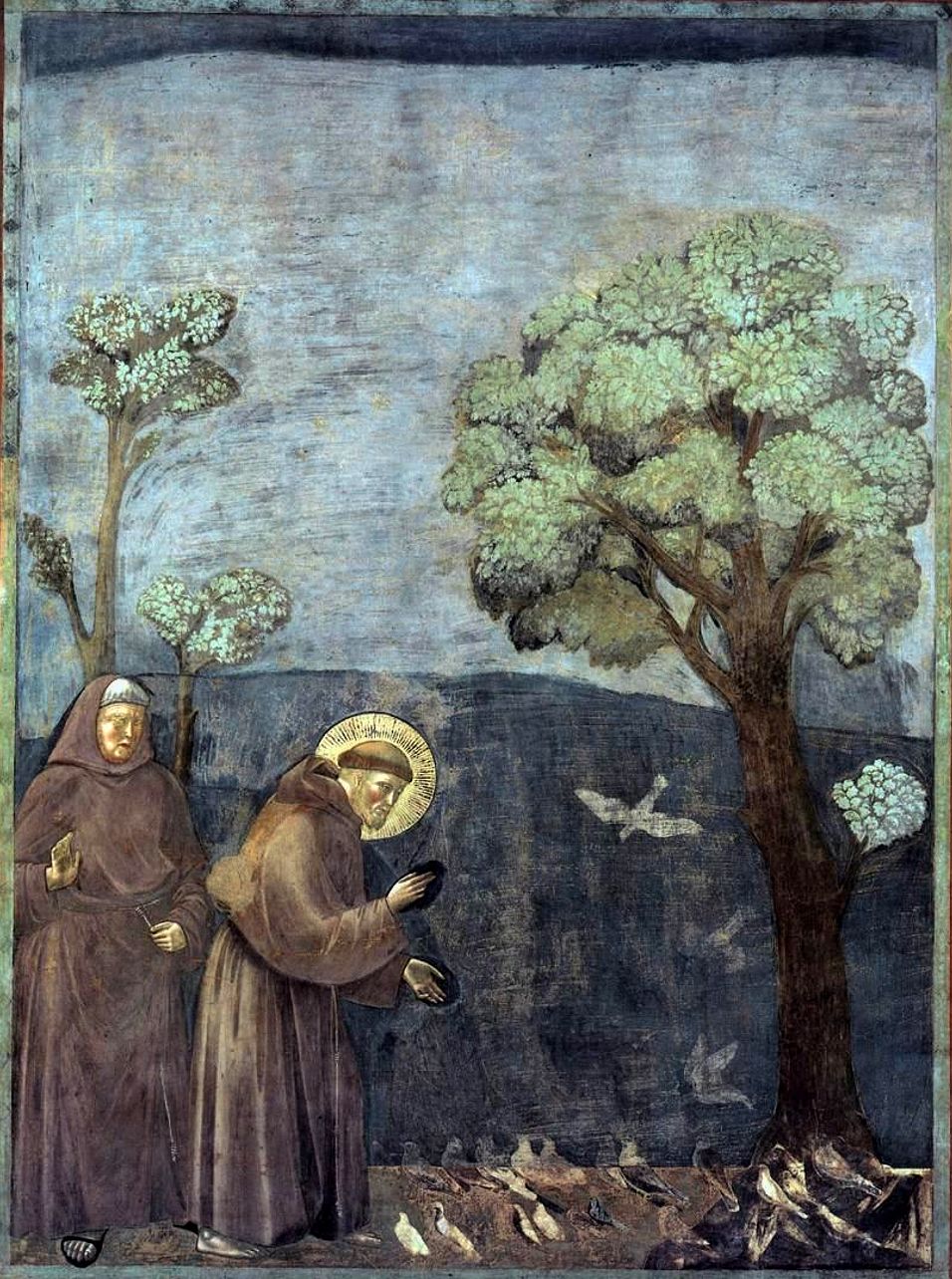
The bird sermon in Assisi’s Upper Church; the cycle’s attribution and chronology remain disputed. Image source. Public domain. Proportionally reduced reproduction; no colour or content enhancement.
The disagreement reaches beyond deciding which assistant painted a particular head. Scholars differ over the identity of the powerful painter conventionally called the Isaac Master, the relation between the Upper Church’s biblical and Franciscan scenes, and the number and sequence of working campaigns. Boskovits develops a case for the young Giotto’s central role. Schwarz questions a unified early chronology and allows for more limited direction by Giotto or the transmission of his practice by another painter. These positions cannot simply be combined into one certain itinerary. [58]
Two early written references are especially valuable because they establish a connection while leaving room for those questions. Riccobaldo of Ferrara, writing in the early fourteenth century, named works by Giotto in Franciscan churches at Assisi, Rimini and Padua, as well as the Arena Chapel and Padua’s communal palace. His testimony shows that Giotto had an extensive reputation by the early 1310s. It does not itemise the surviving Assisi scenes or identify the individual hand responsible for every surface.
A document of 1309 involving Palmerino and a debt associated with Giotto supplies another connection with Assisi. Its financial character matters. It is evidence of a professional relationship and of activity connected with the place, rather than the surviving contract for the complete Franciscan cycle. Converting it into such a contract would give the biography an attractive certainty at the cost of changing what the evidence says. [59]
The paintings themselves explain why so much depends on the question. Episodes such as Francis’s renunciation before the bishop make spiritual commitment visible as a public encounter involving family, property and authority. Architectural settings contain groups whose gestures carry the action. The stories are grounded in Franciscan hagiography, particularly Bonaventure’s life of the saint; they are images of an order’s remembered founder, not eyewitness reports of Giotto’s own experience.
Assisi also required collaboration on an exceptional scale. The basilica contained programmes produced by different masters and teams, in different locations and campaigns. Its Lower Church paintings belong to separate programmes and campaigns. Whatever position one takes on individual attributions, Giotto’s connection with Assisi places his career in a world of large institutional enterprises. It offers a more credible framework for his growth than a solitary young painter moving from one entirely personal masterpiece to the next.
Rimini and the reach of Franciscan connections
Riccobaldo’s mention of Rimini helps bring a partly lost phase into view. A painted crucifix survives in the church once called San Francesco, later transformed into the Tempio Malatestiano. Rimini’s municipal account places it near the end of the thirteenth century and associates Giotto’s presence around 1300 with the development of the local school. The existence of a fresco cycle has also been proposed, although the institutional account carefully treats it as a possibility. [60]
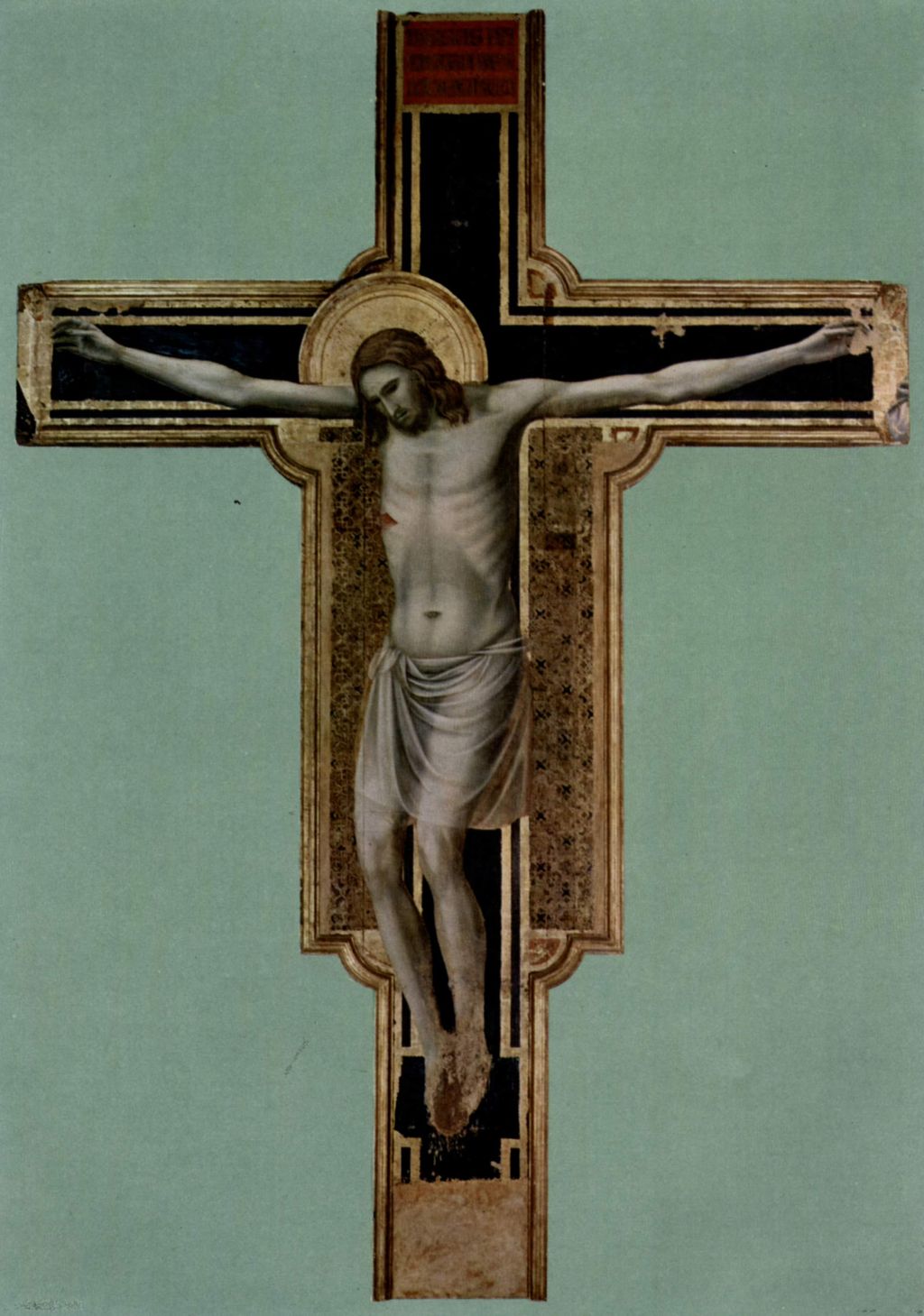
The surviving Crucifix in Rimini’s Tempio Malatestiano, formerly San Francesco. Image source. Public domain. Proportionally reduced reproduction; no colour or content enhancement.
The survival of the cross and the disappearance of other decoration produce an imbalance. A major visit can now be represented by a single object, encouraging us to imagine a short, self-contained episode. The original circumstances may have involved a wider enterprise. Its scenes, assistants and timetable remain undocumented.
Rimini also changes the scale of the biography. Giotto’s reputation extended beyond Florence before the Florentine documents begin to speak regularly about him. Franciscan institutions provided connections between cities, and a successful commission in one setting could make his work known in another. Riccobaldo’s list is valuable precisely because it preserves this geographical reach without requiring us to reconstruct the exact order of all his journeys.
Painters working in Rimini responded to Giotto’s example through their own habits, patrons and opportunities. A visiting master’s authority could stimulate a local culture without supplying every invention within it. Giotto’s growing name travelled through images and through other painters as well as through his own movements. That distinction becomes increasingly important as his career expands: the geographical spread of a style is never a complete map of its inventor’s physical presence.
Padua: painting for Enrico Scrovegni
The Scrovegni Chapel in Padua gives Giotto’s career a great surviving centre. Enrico Scrovegni commissioned it beside his residence in the area of the ancient Roman arena. Dedicated to Santa Maria della Carità, it is generally associated with the years 1303–05, with the 1305 consecration providing an essential chronological anchor. Its modest exterior encloses a remarkably sustained painted environment: a starry vault above, histories of the Virgin and Christ around the walls, opposing virtues and vices below, and the Last Judgement facing the altar from the entrance wall. [61]
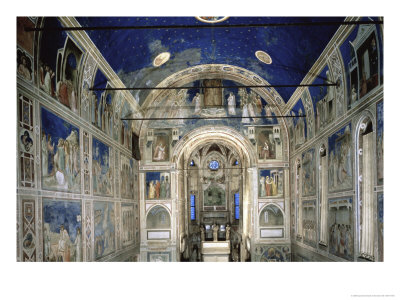
The Scrovegni Chapel’s narrative walls and vault, looking towards the sanctuary.
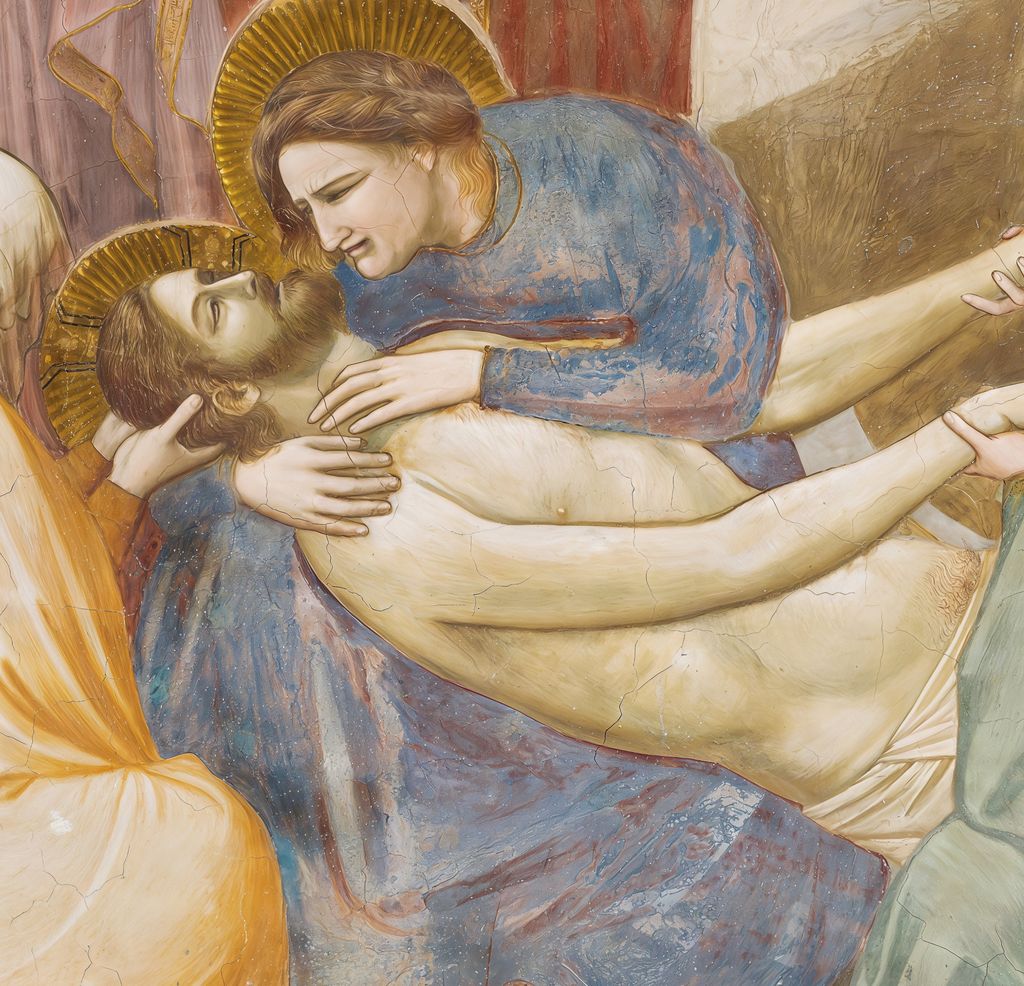
Mary leans close to Christ and supports his head in the Padua Lamentation.
This was a different task from producing a single monumental cross. Giotto had to organise narrative across an entire interior and make the relationships between separate pictures intelligible. The painted borders, fictive architecture and changes in register are part of that achievement. A scene could carry its own immediate drama while also participating in a larger history of salvation. The visitor’s body, turning and moving inside the chapel, belongs to the way the work unfolds.
The Lamentation shows how concentrated that drama could become. The rocky slope descends towards Christ’s head, where the Virgin bends close to his face. Two seated figures turn their broad backs towards us, enclosing the foreground while allowing us to look between them. John’s arms extend behind him; other mourners bend, clasp hands or support the body. Above, the angels twist and fall through the blue. Grief is distributed through bodies occupying different positions, rather than assigned to a single conventional expression.
Nothing in this arrangement requires us to invent Giotto’s personal experience of bereavement. The evidence lies in what he made visible. The weight of the dead Christ, the pressure of supporting hands and the contrast between stillness below and agitation above produce an encounter that remains direct. Giotto’s command of such relationships helps explain why he could attract patrons who needed more than ornamental splendour. The images make sacred history available to sustained looking and reflection.
Enrico’s reasons for commissioning them have generated a second kind of story. His family’s wealth and association with moneylending, together with Dante’s treatment of his father Rainaldo in Inferno XVII, have encouraged an account of the chapel as an act of penitence for usury. Anxiety about salvation belongs within its religious world. Making that concern the single documented explanation for the entire commission goes further than the evidence allows. [62]
Laura Jacobus’s review of Anne Derbes and Mark Sandona’s The Usurer’s Heart makes the problem particularly clear. She challenges the proposed conversion of Enrico in 1300, the assumption that a change in family lending necessarily reveals his individual crisis of conscience, and the identification of Altegrado de’ Cattanei as the guiding confessor behind the programme. She also questions readings that make the donor’s dress or every appearance of Judas serve one overriding usury theme. Her objections do not remove money, charity or salvation from the chapel. They prevent those themes from becoming a complete biography of its patron’s inner life. [63]
The donor portrait itself offers a more complicated encounter. Enrico kneels with a model of the chapel, presenting his foundation within the Last Judgement. The gesture expresses devotion and a claim to privileged religious remembrance. It also displays the material achievement of a patron able to build and decorate such a place. Household worship, family identity, civic standing and hopes for salvation could coexist. Giotto worked within that conjunction of interests, while the surviving paintings leave the exact distribution of decisions between patron, painter and advisers uncertain.
Padua’s place in his life extended beyond Enrico’s chapel. Riccobaldo also named work in the Franciscan church and the communal palace. The lost or transformed condition of those enterprises makes the Arena cycle unusually dominant in our view. The other commissions place it within a wider Paduan career. His reputation there involved several settings and kinds of audience, which helps explain why a writer could invoke his works as the evidence of his distinction while the painter was still alive.
Fame during his lifetime
Giotto’s appearance in Dante’s Purgatorio is one of the strongest signs that his name had become publicly meaningful. In canto XI, the illuminator Oderisi speaks about the instability of worldly reputation. Cimabue once seemed to hold the field in painting; now Giotto has the acclaim. The comparison is intelligible only if a reader can recognise the change in fame to which it refers. [64]
The setting is crucial. Oderisi is learning humility among the proud, and his account proceeds from painters to poets. The passage concerns reputation’s transience as much as Giotto’s success. It is neither a contract proving his apprenticeship under Cimabue nor a technical description of his painting. Dante makes the painter’s name part of a larger moral argument, and that literary use became extraordinarily important to the way later generations understood him.
It also helped bind two Florentine careers together in retrospect. Dante’s exile and Giotto’s eventual civic honours supplied a powerful contrast: one great citizen driven away, another welcomed home. Later stories made the poet an intimate companion or adviser of the painter. The surviving evidence does not justify treating every such meeting as fact. The celebrated relationship is partly a history of how Florence imagined its cultural ancestry.
Riccobaldo’s list of places provides an illuminating companion to Dante’s compressed comparison. One writer points to works distributed across Italy; another uses Giotto as an immediately recognisable example of current fame. Together they establish that his reputation was already substantial in the early fourteenth century. They leave the detailed sequence of his travels unresolved, but they make it difficult to picture his achievement as a discovery made only by the Renaissance.
Recognition had practical consequences. A widely known master could attract powerful patrons and could himself become an asset to the community that claimed him. In Giotto’s case, literary renown and professional success developed alongside one another. The name increasingly carried an expectation of quality before a viewer encountered a particular picture. That was a valuable resource for the painter, although it would eventually make his biography vulnerable to stories explaining how a single exceptional person had transformed an entire art.
Rome, a cardinal and Saint Peter’s
Rome was another major setting in Giotto’s working life. A Florentine document of 1313 concerning the winding up of a household there confirms a connection more substantial than a casually imagined visit. Cardinal Jacopo Caetani degli Stefaneschi became an especially important patron. His commissions for Old Saint Peter’s placed Giotto within one of Christianity’s most prestigious artistic environments. [65]
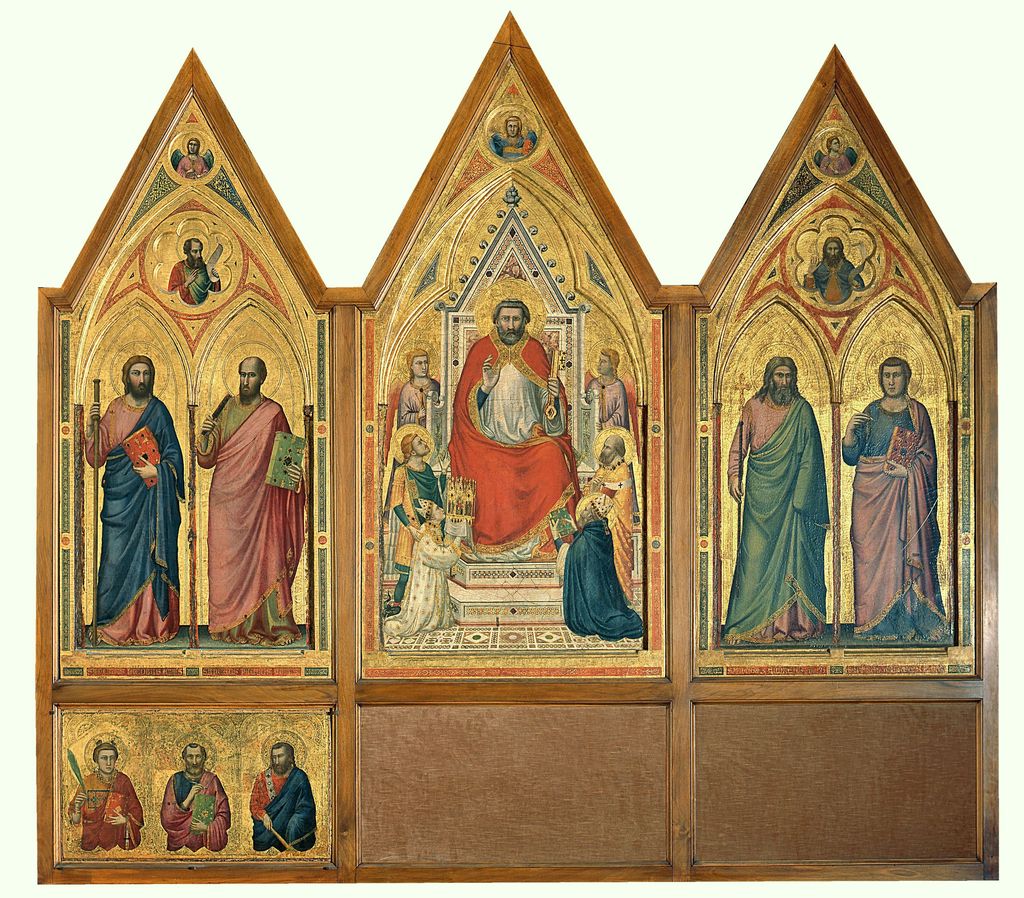
The Peter and donor face of the Stefaneschi Triptych. Self-scanned reproduction, Commons uploader Eugene a. Image source. Public domain. Proportionally reduced reproduction; no colour or content enhancement.

The restored Boville Ernica angel medallion associated with the Navicella.
The Navicella, an enormous mosaic of the apostles in a boat and Christ rescuing Peter, became a famous example of his narrative power. Its original form is now difficult to recover. Rebuilding and successive interventions transformed the work; the mosaic visible in the present portico is a later remaking of Giotto’s composition. Early copies, descriptions and fragments supply evidence of different kinds. They do not all preserve the same state of the composition. [66]
That history also complicates its date. The often repeated year 1298 comes through indirect transmission, and scholars have proposed different chronologies and political interpretations. Schwarz favours an early place within the career and questions arguments that make it primarily a statement against the papacy’s residence at Avignon. The Stefaneschi connection and Giotto’s contribution to Old Saint Peter’s remain secure even where their chronology is unresolved.
The subject itself suited the basilica’s association with Peter. The episode from Matthew 14 combines fear, danger and rescue; Peter’s relation to Christ could carry both devotional and institutional meanings. The mosaic’s fame later depended in part on the different reactions of the figures in the endangered boat. Those responses belong to a work conceived for a monumental architectural setting, rather than to the small, intimate scale of a panel handled in a private room.
The surviving Stefaneschi Triptych shows another aspect of the relationship. The Vatican Museums catalogue it as Giotto and assistants and date it around 1320, giving 1315–20 in the accompanying account. Painted on both sides, it addressed different viewers within the church. Christ, Peter, the apostles and the martyrdoms of Peter and Paul give the altarpiece a thoroughly Roman emphasis. Stefaneschi appears as donor, including a representation in which he holds a model of the triptych itself. [67]
This is an especially useful corrective to the notion that Giotto’s mature art always sought the same appearance. A prestigious, double-sided altarpiece for Saint Peter’s had requirements different from Enrico’s wall paintings. Gold, ceremonial arrangement, hierarchical scale and narrative detail could serve the commission together. The explicit involvement of assistants also demonstrates that the master’s authority did not depend on personally applying every brushstroke. His name could identify an enterprise whose coherence came from design, supervision and skilled collaboration.
Rome’s influence on his art cannot be reduced to a single journey through an imagined museum of ancient sculpture. Roman painting, mosaics, church decoration and the patronage surrounding them formed an active culture. Giotto’s work participated in that culture. The loss of much of what he made there limits our account, but it also warns against defining him entirely through the surviving Florentine and Paduan works.
Pictures for Florentine churches
Giotto’s continuing Florentine commissions show how success elsewhere could be absorbed into the religious life of his home city. The Ognissanti Madonna, now in the Uffizi, is among the clearest surviving demonstrations of his ability to renew an established image. The Virgin sits within an elaborate throne, holding the blessing Child; angels and saints gather around her against gold. The figures have volume, and the surrounding group is arranged so that bodies and haloes partly conceal one another. Presence is created through relationships within a traditional devotional structure. [68]

The Ognissanti Madonna, now in the Uffizi; its original position in the church is uncertain.
The current Uffizi record dates the panel approximately 1300–05, earlier than the frequently encountered date around 1310. Its exact original position in the Humiliati church of Ognissanti is unknown. A possible altar or screen setting remains a proposal. These uncertainties matter because the picture cannot securely be assigned to one brief Florentine return simply to make a biography flow more smoothly.
Ognissanti received other works associated with Giotto, including a monumental cross and the Dormition of the Virgin, now in Berlin. [69] The group points to an enduring institutional relationship. Such relationships are a recurring feature of the career. A community’s investment in a successful painter could continue through different objects, locations and functions.
The panels also make visible a side of Giotto’s work obscured by the fame of his frescoes. Wood, gesso, tempera and gold demanded their own procedures, and an altarpiece’s shape structured the encounter with its figures. Large public images and smaller narrative panels belonged to overlapping practices. Attribution and reconstruction become difficult when an ensemble has been cut apart or when its original setting has disappeared.
Changes in scale, function, assistants and patronal expectation can produce differences that do not fit a simple movement from youthful stiffness to mature freedom. Giotto’s professional achievement lay partly in his ability to work across those conditions. The career that emerges is varied: monumental and intimate, narratively expansive and ceremonially concentrated, adapted to particular communities while carrying an increasingly recognisable authority.
Houses, land and a rented loom
From the early fourteenth century, Giotto becomes much easier to see as a legal and economic actor. By 1301 he owned a house in the parish of Santa Maria Novella. Later notices concern tenants and property in the same area. These are small pieces of information, but they establish a rooted urban existence alongside his extensive activity elsewhere. Travel and local investment were compatible parts of the same career. [70]
In December 1311 a notarial document identifies him as an emancipated son of Bondone. Medieval legal emancipation concerned a son’s capacity to act independently of paternal authority; it was not the automatic modern arrival of adulthood at a fixed birthday. The phrase establishes Giotto’s legal status at that moment. It does not tell us exactly when emancipation occurred, or permit a reconstruction of every earlier transaction as an argument between father and son.
The following year he rented a French-type loom to a weaver. This concrete, unexpected object draws the painter into the textile economy of Florence. It shows that his resources could be employed beyond his own craft. The transaction has sometimes been made into a sensational story about spectacular profits, but the surviving terms do not justify casually repeating a modern percentage as the measure of his business character. The loom is interesting enough without that embellishment. [71]
Land transactions give the Mugello an increasingly substantial place in the family’s history. Giotto is documented there in 1315; from 1318 the records become denser. He and his representatives bought, sold, leased and disputed property around Vespignano and nearby settlements. The documents reveal a family building and managing a rural position while retaining Florentine affiliations. They do not prove that each purchase was financed by payment for a particular surviving painting.
These activities also correct the assumption that artistic distinction required detachment from ordinary business. Giotto appointed representatives, used notaries and participated in credit arrangements. His sons and son-in-law could act for him while he was away. Such arrangements supplied continuity across a career whose commissions required long absences.
The scale of that prosperity remains difficult to measure. Schwarz and Theis compare the family’s dowries and later estate arrangements with the circumstances of other respectable artisans and find comfortable prosperity more readily than extraordinary riches. Famous patrons, valuable land and ready access to money were different forms of advantage; their proportions cannot be recovered from the surviving documents. Giotto’s position was successful and increasingly influential, but his financial life remained embedded in the obligations of a large household.
The distance between that household and the shepherd legend is revealing. Later biography made his beginnings almost impossibly humble. The actual records reveal a more complicated achievement: a craftsman’s son extending his family’s security through painting, property and connections, while managing the ordinary legal responsibilities that success brought with it.
Ciuta and the children
Giotto’s wife, Ciuta di Lapi Pele, emerges clearly in documents of 1326 and 1331 and in the arrangements made after his death. The records identify a Florentine woman whose family belonged to the parish of San Pancrazio. They do not preserve a dependable marriage date. Her appearance in transactions concerning a daughter’s dowry and the family’s land shows her place within the household’s legal affairs, although it leaves most of her daily life inaccessible. [72]
Seven children are documented: Bice, Bondone, Caterina, Chiara, Francesco, Lucia and Nicola. The papal document of 1324 calls Bondone “Donatus”, also rendered as Donato. The familiar assertion that Giotto had eight children belongs to a different biographical tradition. The seven documented names do not establish the total number ever born, and the uncertain duplication of a name supplies no firm evidence of a second marriage.
Bice offers one of the most distinctive surviving lives within the family. A Dominican lay sister associated with Santa Maria Novella, she received land through an arrangement involving her father and brother Francesco in 1328. Her testament after Giotto’s death and the later execution of her wishes connect family property with charity. Money was distributed to named poor people in the Vespignano area for her father’s spiritual benefit. The act brings Florence, the Mugello and religious remembrance together in a way that no generic description of Giotto’s “devout family” could convey.
Bondone’s career reveals the practical value of his father’s wider connections. On 7 July 1324 Pope John XXII provided for him to obtain a suitable ecclesiastical benefice. The document addressed a Florentine cleric and envisaged an income of up to fifty gold florins annually. Among those charged with helping implement the provision was a member of the Stefaneschi network. It establishes an important relationship before that date; it does not date all Giotto’s work for the family or prove a journey to Avignon. [73]
Bondone became prior at San Martino in Vespignano. Francesco subsequently held the same position, while also acting repeatedly in the family’s business. Their careers helped connect ecclesiastical opportunity with the area where the family had accumulated property. Later records identify both names with painting as well. Schwarz and Theis discuss ways in which clerical and workshop careers may have intersected, but the sequence cannot be reconstructed into a certain succession plan for Giotto’s studio.
Caterina married the painter Ricco di Lapo, who also acted as Giotto’s representative. His several roles show how professional trust and kinship could overlap. Chiara’s marriage arrangements in 1326, in which Ciuta participated, are among the last documents placing Giotto personally in the Mugello before his Neapolitan employment. Lucia’s marriage arrangements were conducted through Francesco. Nicola appears in business documents and had died by 1330, leaving debts that continued to concern the family. The surviving records are uneven because they preserve transactions and disputes, rather than balanced portraits of each child. [74]
The family consequently belongs near the centre of the biography. Its members managed resources and represented an absent father; his standing could assist their careers, and their work could sustain his affairs. They were participants in a shared social position. Giotto’s travels did not detach him from this structure. The ability to leave home for demanding commissions depended partly on the people who remained able to act there.
Santa Croce and the problem of dating a mature career
The Bardi and Peruzzi chapels in Santa Croce connect Giotto with two powerful Florentine families and with the expanding Franciscan church. They are also a warning against organising the middle and later career by treating stylistic dates as documentary appointments. Both ensembles have undergone damage and restoration, and the proposed chronologies differ markedly. [75]
Renunciation and Apparition at Arles in the Bardi north-wall crop; the photograph does not document the 2026 treatment state.
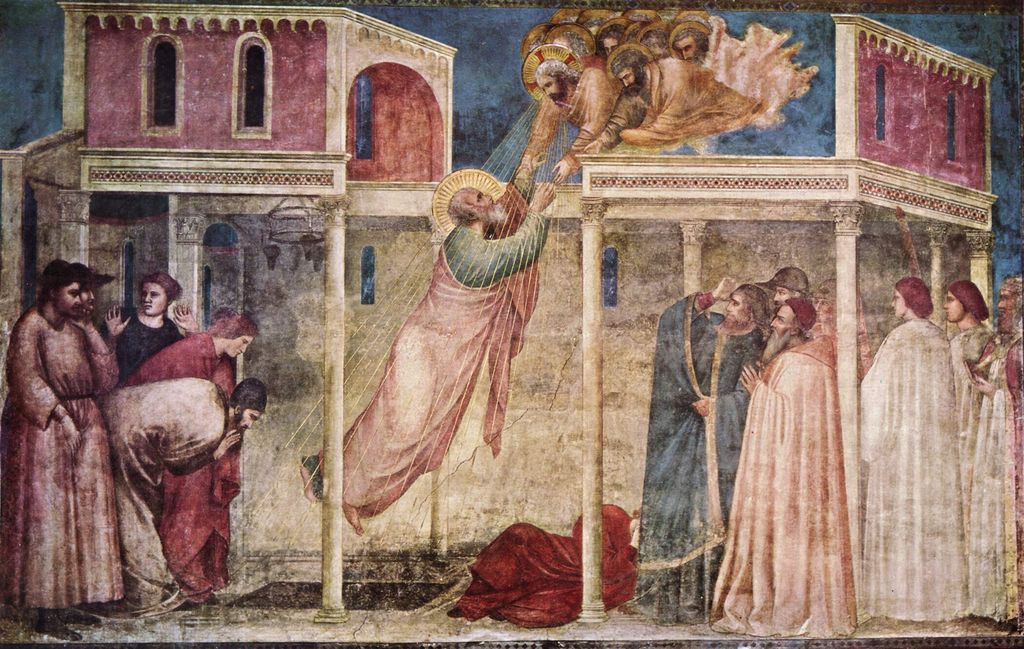
The Ascension of John the Evangelist in the Peruzzi Chapel, an earlier ordinary-light reproduction. Image source. Public domain. Proportionally reduced reproduction; no colour or content enhancement.
In the Bardi Chapel, six principal scenes recount the life of Saint Francis, accompanied by the Stigmatisation above the entrance, saints on the rear wall and Franciscan virtues on the vault. The programme is much more concentrated than the twenty-eight-scene Upper Church cycle at Assisi. It selects episodes through which the order’s founder can be encountered within a family chapel. Ridolfo de’ Bardi is the probable patron, rather than a name secured by a surviving painting contract.
The current Santa Croce account establishes that the paintings were made after 1317, since Saint Louis of Toulouse, canonised in that year, appears on the rear wall. It leaves the precise date under discussion. Proposals include the later 1310s and the 1320s. Schwarz and Theis connect the commission with the opening of the church’s eastern part around 1320, while acknowledging the differences among scholarly dates. Their suggested relationship between Giotto’s land purchases and a possible payment for the chapel remains conjectural.
The paintings’ modern condition is part of our access to Giotto’s career. They were covered with limewash before 1730 and uncovered in 1851, when Gaetano Bianchi restored and extensively completed them. In 1957–59, Ugo Procacci and Leonetto Tintori removed the nineteenth-century overpainting. A further conservation campaign, begun in 2022 and completed in September 2026, sought to preserve the surviving work and improve its legibility while retaining evidence of its complicated history. The cycle visible today has passed through all those interventions. The recent study also made differences among the participating painters clearer and confirmed extensive work on dry plaster above a fresco base. Its evidence brings the workshop back into a commission long associated primarily with the master’s name. [76]
The Peruzzi Chapel presents histories of John the Baptist and John the Evangelist on opposing walls. Its damaged surfaces reflect both technique and later treatment: much of the painting was carried out on dry plaster, and whitewashing and successive restorations compounded its vulnerability. Santa Croce currently proposes a date around 1310–11. Schwarz argues instead for 1334–36, making the cycle an enterprise of Giotto’s final years. His case depends on comparisons, including relationships with Andrea Pisano’s Baptistery door, rather than a newly discovered contract. [77]
That is too large a discrepancy to hide behind the word “mature”. Adopting one date changes the account of what Giotto had done before Naples and what remained possible after his return. The honest narrative can keep the chapel’s place in the career open while explaining the character of its contribution. Its spacious settings and substantial figures explore relationships between architecture, movement and spectatorship. The Evangelist’s sequence moves from his vision on Patmos through the raising of Drusiana to his own ascent: Christian stories of death overcome and a future beyond the grave. Schwarz relates that selection to the family’s burial and commemorative interests. This is an interpretation of the programme, rather than a recovered instruction from its patrons, but it helps explain why the selection of three episodes from an extensive saint’s life mattered. The pictures offered a way of contemplating the fate of the family’s own dead.
The contrast with Bardi also resists a simple division between a master and inferior assistants. Different purposes, working methods and patronal expectations could change a painter’s solutions. Schwarz’s account of a varied late style is valuable on that point even where his chronology remains disputed.
Santa Croce preserves an important panel commission as well. The Baroncelli polyptych bears the inscription Opus magistri Iocti, identifying it as the work of Master Giotto. The current institutional account assigns it to Giotto and workshop after the chapel’s foundation in 1328. Its ranks of saints and music-making angels surround the Coronation of the Virgin. This formal, crowded heavenly assembly belongs comfortably within the range of a painter whose reputation had become so broad. The signature asserts a master’s authority over a collaborative object; it does not require us to identify every figure as his unaided execution. [78]
The master and the people who worked with him
A career spread across such enterprises required a workshop. Giotto’s name is prominent in the Florentine painters’ matriculation list begun in 1320, within the guild of doctors and apothecaries. The connection with that guild reflected, among other things, painters’ involvement with materials supplied by apothecaries. The history of a register copied from an earlier list does not establish a precise personal enrolment in 1312, a date sometimes repeated too confidently. [79]
The Baroncelli Polyptych, a signed altarpiece attributed to Giotto and workshop.
Guild membership placed painters within the corporate structures of Florence. It provided a framework for work and disputes and connected artistic practice with the city’s economy. Giotto’s prominence in the 1320 list is suggestive of his standing, although its order establishes no particular office. Reputation and formal responsibility were related but different things.
Taddeo Gaddi supplies the clearest later testimony to sustained workshop continuity. Around 1400, Cennino Cennini explained his own training through Agnolo Gaddi, Agnolo’s father Taddeo, and Taddeo’s long association with Giotto. He credited Taddeo with twenty-four years as Giotto’s pupil and described a method of painting flesh handed down through that line. This is valuable testimony from a practising painter with a declared professional genealogy. It remains later testimony, shaped by Cennini’s purpose in establishing the authority of his instruction. [80]
His celebrated account of Giotto changing painting from Greek to Latin and bringing it into the modern belongs to that same inheritance. It is Cennini’s formulation about Giotto, not Giotto’s own announcement of a programme. Its language reflects medieval and Renaissance cultural comparisons and their preference for a particular account of artistic renewal.
Large projects could involve several levels of participation. A master might establish designs and procedures, assistants execute substantial areas, and local craftsmen supply materials or help with the organisation of a site. The exact relationship varied. We do not possess a dependable headcount for the Arena Chapel, and the presence of Giotto’s name does not make every surviving surface an individual autograph. Conversely, collaboration need not strip a commission of his responsibility.
Family connections complicate the picture further. Ricco di Lapo was both painter and son-in-law; Bondone and Francesco appear in later painter records as well as in ecclesiastical and financial affairs. Those connections support a view of artistic practice embedded in a household and a professional community. They do not authorise assigning a particular passage of fresco to an otherwise poorly documented son. The distinction protects something valuable: a real collaborative history, which is more interesting than a collection of invented names attached to individual brushstrokes.
At King Robert’s court in Naples
Giotto’s Neapolitan employment marks an important change in the form of his career. He had already worked for exceptionally influential patrons, but royal service placed him within a court establishment. The surviving documentary texts are unusually informative about status, payments, materials and organisation, even though most of the paintings have disappeared. [81]
On 8 December 1328, King Robert of Anjou ordered a monthly salary for Giotto, effective from the beginning of that month. The exact sum has not survived in the transmitted text. The date is worth stating carefully because published summaries differ: the critical edition’s documentary text reads December, not September. It supplies a firm point for his service without proving the exact day on which he first arrived in Naples.
On 20 January 1330, Robert admitted him as a royal familiar, granting the honours and privileges attached to that status after the required oath. This was a significant act of recognition and protection. It made Giotto a member of the king’s household in a formal court sense, with substantial privileges. The document records familiar status, without granting knighthood.
A treasury account of 20 May 1331 gives a more tangible impression of the work. It concerns decoration in the great and private chapels of Castel Nuovo, as well as an altarpiece executed in Giotto’s house. He is identified as the leading master of the painted enterprise. Other masters, painters and labourers are paid within the same account. The project emerges as an organised site supported by the royal administration, with responsibilities extending beyond the production of an isolated picture. [82]
The materials make that site unusually vivid. The account names lime and gypsum, glue, fine gold, linen, silver, gilded tin, colour materials and other supplies. It also records wine for the workers and payment to someone keeping written accounts. Elsewhere, changes to windows and provision for draining water show how the painted work depended on the building’s condition. Painting, construction, record-keeping and ordinary bodily needs occupied the same enterprise.
These details offer a better image of Giotto at work than an anecdote about exchanging jokes with a king. They show a senior practitioner whose authority was recognised within a complicated court project. They also help explain why surviving decorative fragments cannot stand for everything that was achieved. The loss of the principal paintings deprives us of what may have been one of the most extensive and consequential undertakings of his later career.
Payments and benefits continued. In 1332 the king ordered a gift of gold and granted Giotto an annual pension for life. Accounts extend the Neapolitan enterprise into the early 1330s, although they do not supply a complete diary of his presence. His family’s representatives continued to act in Tuscany. Court employment and the management of the Florentine household were sustained across distance.
Later descriptions and literary stories cannot fully reconstruct the lost programme. Nor can a general resemblance in a southern Italian painting prove that Giotto personally painted it during the visit. The documentary richness of Naples makes its visual losses especially striking. Here we know more about the master’s place within an institution than about the appearance of his major work. Any biography organised only around famous surviving pictures would underestimate this phase.
Florence calls him home
On 12 April 1334, Florence resolved to appoint Giotto to a leading role in its building works. The provision names the cathedral of Santa Reparata, the city’s walls and fortifications, and other communal undertakings. Its language praises an experienced and famous man whose presence and instruction could benefit the city. The appointment was both a practical allocation of responsibility and an expression of civic esteem. [3]
The cathedral bell tower whose construction Giotto began in 1334; later builders shaped the completed elevation.
The city wished to encourage him to reside there permanently. That concern makes sense after a career whose prestige had carried him to Rome, Padua and Naples. Florence was claiming the value of its successful son and seeking to secure the advantage of his knowledge. The language does not require us to assume that officials regarded painting and building as interchangeable. It shows confidence in the wider competence and authority of a master whose experience extended across demanding sites.
The cathedral project long preceded this appointment and continued far beyond his death. Giotto did not design or complete the whole building, and Brunelleschi’s dome belongs to a much later history. The bell tower provides the most conspicuous architectural connection with his name. According to Giovanni Villani, its foundation was laid on 18 July 1334. The work continued under Andrea Pisano and Francesco Talenti after Giotto’s death. [83]
The existing tower consequently records several successive decisions. Its continued association with Giotto honours the beginning of the enterprise and his responsibility for it; it does not make every storey, opening or sculptural element his personal work. The attribution of particular reliefs and the reconstruction of his intended upper termination remain separate questions. A tall parchment elevation preserved in Siena has been related to the project, but it is not a securely accepted autograph drawing by Giotto.
The distinction between a design and its transmission also matters for his graphic practice more broadly. A painter capable of organising the Arena Chapel plainly used forms of planning. That does not provide a surviving sheet in his hand. Later claims about drawings, copies of lost designs and architecture painted inside pictures belong to different categories of evidence. A securely identified portfolio of drawings in his hand remains unavailable.
Giotto was again conducting property business in Florence by October 1334, when a document places him in the parish of San Michele Visdomini and brings Ricco di Lapo into view as a witness. Subsequent family records suggest a later residence in the cathedral parish. A record made in the cathedral workshop on 12 December 1335 names Giotto as a witness. These modest notices help anchor the celebrated appointment in a continuing urban life. The famous master still appeared before notaries, relied on familiar colleagues and took part in transactions whose importance was local and immediate. [84]
Milan, death and a household left behind
Giotto’s final years included another journey. Villani reports that Florence sent him to serve the lord of Milan and that he returned before his death. The patron was Azzone Visconti, lord of Milan; the city’s duchy lay in the future. The exact extent and programme of Giotto’s Milanese work remain difficult to establish. The testimony supports the journey and its civic connection more securely than it supports an elaborate reconstruction of his last paintings. [85]
It is a fitting final glimpse of a career that had repeatedly crossed political and institutional boundaries. Even after the Florentine appointment, his skill could be valuable away from home. Villani’s account presents the journey as something undertaken through the commune, rather than as an independent abandonment of his new responsibilities. A painter’s prestige could serve relationships between rulers and cities as well as the decoration of their buildings.
Giotto died on 8 January 1337 in modern dating. Villani gives the year as 1336 because the Florentine calendar began its new year on 25 March. The apparent contradiction disappears once the calendar is understood. Villani also records an honourable burial by the commune in Santa Reparata, the older cathedral whose site became incorporated into the later building.
That burial can be understood in more than one way. It honoured a distinguished citizen, and it also placed a master associated with the cathedral works within the church entrusted to him. Schwarz and Theis explore both meanings. The exact balance of civic fame and professional commemoration cannot be recovered as if the officials had left a complete statement of intention. Villani’s near-contemporary account nevertheless establishes that the honour was publicly remembered.
The later cathedral monument to Giotto belongs to his commemorative history. Its commemorative likeness was made long after the original burial. Nor does the modern discovery of skeletal remains in the Santa Reparata area establish, beyond reasonable doubt, an identified body of the painter. The burial tradition is firmer than the anatomical identification sometimes built upon it.
For Ciuta and the children, his death also created immediate practical work. Documents of 1337 and 1338 concern property transfers, estate arrangements and disagreements among the heirs. Bice died after making her own testament, adding another estate to be settled. Ciuta remained active in these affairs and was still mentioned in 1344. That last surviving reference does not establish her death in that year. [86]
The household’s persistence gives the life story a different ending from the death of an isolated genius. Giotto left relationships, obligations and assets as well as images and fame. The legal record follows those consequences with a detail it rarely grants his working days. His family continued to negotiate the material results of the career long after the painter himself had ceased to appear before a notary.
The life that later generations made
Giotto’s death did not begin his fame; it changed the ways in which that fame could be used. Boccaccio’s Decameron gives him one of his most enduring literary appearances. In the fifth tale of the sixth day, the painter and the lawyer Forese da Rabatta return from the Mugello, are caught in rain and borrow shabby garments. Their exchange turns on the difference between an undignified appearance and intellectual or artistic distinction. Giotto answers the lawyer’s mockery with an equally quick judgment of his own. [87]
The tale has points of contact with documented circumstances. Both men had Mugello connections, and Giotto’s professional eminence was real. Boccaccio shaped those circumstances into a novella, giving his figures dialogue whose force depends on the story’s arrangement. Boccaccio’s importance lies partly in giving the painter a memorable social character: unimpressive in outward appearance, accomplished in art and capable of holding his own with an educated man.
The same caution applies to images presented as portraits of Giotto. Later likenesses and proposed identifications among the figures in frescoes can show how his face was imagined or remembered. They do not supply an undisputed contemporary self-portrait. Ghiberti’s report of a likeness in a painting by Taddeo Gaddi is valuable historical testimony, but it leaves us interpreting another writer’s identification of another painter’s work. [54]
Other writers extended that character through jokes and encounters with patrons. The witty Giotto became almost as recognisable as the maker of paintings. At the same time, Boccaccio’s account of him as a restorer of painting helped shape a grander historical role. By the time Ghiberti and Vasari wrote, an increasingly coherent story could connect natural talent, discovery by Cimabue, command of illusion and the revival of an art supposedly fallen into decline.
The poem against poverty transmitted under Giotto’s name offers a different and more difficult kind of personal evidence. Early manuscripts attribute it to the Florentine painter, and Schwarz and Theis argue strongly for its authenticity. Other scholars have questioned the attribution. Its criticism of involuntary poverty and of hypocritical claims to virtue could complicate a romantic portrait of Giotto as the unqualified spokesman for Franciscan poverty. Its disputed authorship leaves that possible glimpse of Giotto’s outlook tantalisingly uncertain. [88]
Similarly, memorable modern sayings placed beneath his portrait need a traceable source before they become his words. The surviving record offers enough voices speaking about Giotto without requiring invented declarations by him. Dante, Cennini, Boccaccio, Ghiberti and Vasari each made something different of his name. Their testimony belongs within the biography, provided their dates, purposes and distance from the events remain visible.
Across those accounts, the historical painter can still be recognised in outline. He grew out of a Florentine artisan family, worked through institutions and collaborators, invested in the security of his household and acquired a reputation that powerful patrons wished to enlist. His surviving paintings explain why that reputation had such force. Their people meet one another with the pressure of bodies, the direction of a look and the consequences of a gesture. The documentary life is fragmentary, but the attention to human relationships that made his work compelling remains available wherever the paintings survive.
Watch: Explore Giotto’s Art
Choose an overview or a closer look at three major works. These films provide wider Giotto context alongside this article.
Artworks directory
This directory brings together 209 records for paintings, ensembles, individual scenes and components, architectural work, an associated disputed design, and reported or lost projects connected with Giotto. Ensembles and their parts appear separately, so 209 is a count of records rather than independent paintings or commissions. Attributions and dates remain qualified where disputed; inclusion does not establish Giotto’s own hand throughout.
| Name | Date | Medium, attribution and status |
|---|---|---|
| Expulsion of Joachim from the Temple — Scrovegni Chapel, Padua | c.1303–05 (chapel campaign) | Fresco / wall painting. Giotto and workshop. Scene within a cycle. Padova Musei. Chapel overview. |
| Joachim among the Shepherds — Scrovegni Chapel, Padua | c.1303–05 (chapel campaign) | Fresco / wall painting. Giotto and workshop. Scene within a cycle. Padova Musei. Chapel overview. |
| Annunciation to Saint Anne — Scrovegni Chapel, Padua | c.1303–05 (chapel campaign) | Fresco / wall painting. Giotto and workshop. Scene within a cycle. Padova Musei. Chapel overview. |
| Sacrifice of Joachim — Scrovegni Chapel, Padua | c.1303–05 (chapel campaign) | Fresco / wall painting. Giotto and workshop. Scene within a cycle. Padova Musei. Chapel overview. |
| Joachim’s Dream — Scrovegni Chapel, Padua | c.1303–05 (chapel campaign) | Fresco / wall painting. Giotto and workshop. Scene within a cycle. Padova Musei. Padova Musei. Chapel overview. |
| Meeting at the Golden Gate — Scrovegni Chapel, Padua | c.1303–05 (chapel campaign) | Fresco / wall painting. Giotto and workshop. Scene within a cycle. Padova Musei. Chapel overview. |
| Birth of the Virgin — Scrovegni Chapel, Padua | c.1303–05 (chapel campaign) | Fresco / wall painting. Giotto and workshop. Scene within a cycle. Padova Musei. Padova Musei. Chapel overview. |
| Presentation of the Virgin in the Temple — Scrovegni Chapel, Padua | c.1303–05 (chapel campaign) | Fresco / wall painting. Giotto and workshop. Scene within a cycle. Padova Musei. Chapel overview. |
| Delivery of the Rods — Scrovegni Chapel, Padua | c.1303–05 (chapel campaign) | Fresco / wall painting. Giotto and workshop. Scene within a cycle. Padova Musei. Chapel overview. |
| Prayer of Joseph and the Suitors — Scrovegni Chapel, Padua | c.1303–05 (chapel campaign) | Fresco / wall painting. Giotto and workshop. Scene within a cycle. Padova Musei. Chapel overview. |
| Marriage of the Virgin — Scrovegni Chapel, Padua | c.1303–05 (chapel campaign) | Fresco / wall painting. Giotto and workshop. Scene within a cycle. Padova Musei. Chapel overview. |
| Wedding Procession of Mary — Scrovegni Chapel, Padua | c.1303–05 (chapel campaign) | Fresco / wall painting. Giotto and workshop. Scene within a cycle. Padova Musei. Chapel overview. |
| Annunciation on the triumphal arch — complete ensemble (Scrovegni Chapel, Padua) | c.1303–05 (chapel campaign) | Wall painting with a central painted wooden panel. Giotto and workshop. Ensemble. Includes the Mission of Gabriel and the lower Annunciation pair; the original central wooden panel is in the Musei Civici agli Eremitani, with a conservation copy in the chapel. Padova Musei. Padova Musei. Scholarly study. Chapel overview. |
| Visitation — Scrovegni Chapel, Padua | c.1303–05 (chapel campaign) | Fresco / wall painting. Giotto and workshop. Scene within a cycle. Padova Musei. Chapel overview. |
| Nativity — Scrovegni Chapel, Padua | c.1303–05 (chapel campaign) | Fresco / wall painting. Giotto and workshop. Scene within a cycle. Padova Musei. Chapel overview. |
| Adoration of the Magi — Scrovegni Chapel, Padua | c.1303–05 (chapel campaign) | Fresco / wall painting. Giotto and workshop. Scene within a cycle. Padova Musei. Chapel overview. |
| Presentation of Christ at the Temple — Scrovegni Chapel, Padua | c.1303–05 (chapel campaign) | Fresco / wall painting. Giotto and workshop. Scene within a cycle. Padova Musei. Chapel overview. |
| Flight into Egypt — Scrovegni Chapel, Padua | c.1303–05 (chapel campaign) | Fresco / wall painting. Giotto and workshop. Scene within a cycle. Padova Musei. Chapel overview. |
| Massacre of the Innocents — Scrovegni Chapel, Padua | c.1303–05 (chapel campaign) | Fresco / wall painting. Giotto and workshop. Scene within a cycle. Padova Musei. Chapel overview. |
| Christ among the Doctors — Scrovegni Chapel, Padua | c.1303–05 (chapel campaign) | Fresco / wall painting. Giotto and workshop. Scene within a cycle. Padova Musei. Chapel overview. |
| Baptism of Christ — Scrovegni Chapel, Padua | c.1303–05 (chapel campaign) | Fresco / wall painting. Giotto and workshop. Scene within a cycle. Padova Musei. Chapel overview. |
| Marriage at Cana — Scrovegni Chapel, Padua | c.1303–05 (chapel campaign) | Fresco / wall painting. Giotto and workshop. Scene within a cycle. Padova Musei. Padova Musei. Chapel overview. |
| Raising of Lazarus — Scrovegni Chapel, Padua | c.1303–05 (chapel campaign) | Fresco / wall painting. Giotto and workshop. Scene within a cycle. Padova Musei. Chapel overview. |
| Entry into Jerusalem — Scrovegni Chapel, Padua | c.1303–05 (chapel campaign) | Fresco / wall painting. Giotto and workshop. Scene within a cycle. Padova Musei. Chapel overview. |
| Expulsion of the Money Changers — Scrovegni Chapel, Padua | c.1303–05 (chapel campaign) | Fresco / wall painting. Giotto and workshop. Scene within a cycle. Padova Musei. Padova Musei. Chapel overview. |
| Judas Receiving the Payment — Scrovegni Chapel, Padua | c.1303–05 (chapel campaign) | Fresco / wall painting. Giotto and workshop. Scene within a cycle. Padova Musei. Chapel overview. |
| Last Supper — Scrovegni Chapel, Padua | c.1303–05 (chapel campaign) | Fresco / wall painting. Giotto and workshop. Scene within a cycle. Padova Musei. Chapel overview. |
| Washing of the Feet — Scrovegni Chapel, Padua | c.1303–05 (chapel campaign) | Fresco / wall painting. Giotto and workshop. Scene within a cycle. Padova Musei. Chapel overview. |
| Arrest of Christ — Scrovegni Chapel, Padua | c.1303–05 (chapel campaign) | Fresco / wall painting. Giotto and workshop. Scene within a cycle. Padova Musei. Chapel overview. |
| Christ before Annas and Caiaphas — Scrovegni Chapel, Padua | c.1303–05 (chapel campaign) | Fresco / wall painting. Giotto and workshop. Scene within a cycle. Padova Musei. Chapel overview. |
| Mocking of Christ and Flagellation — Scrovegni Chapel, Padua | c.1303–05 (chapel campaign) | Fresco / wall painting. Giotto and workshop. Scene within a cycle. Padova Musei. Chapel overview. |
| Road to Calvary — Scrovegni Chapel, Padua | c.1303–05 (chapel campaign) | Fresco / wall painting. Giotto and workshop. Scene within a cycle. Padova Musei. Chapel overview. |
| Crucifixion — Scrovegni Chapel, Padua | c.1303–05 (chapel campaign) | Fresco / wall painting. Giotto and workshop. Scene within a cycle. Padova Musei. Chapel overview. |
| Lamentation — Scrovegni Chapel, Padua | c.1303–05 (chapel campaign) | Fresco / wall painting. Giotto and workshop. Scene within a cycle. Padova Musei. Chapel overview. |
| Resurrection / Noli me tangere — Scrovegni Chapel, Padua | c.1303–05 (chapel campaign) | Fresco / wall painting. Giotto and workshop. Scene within a cycle. Padova Musei. Chapel overview. |
| Ascension — Scrovegni Chapel, Padua | c.1303–05 (chapel campaign) | Fresco / wall painting. Giotto and workshop. Scene within a cycle. Padova Musei. Chapel overview. |
| Pentecost — Scrovegni Chapel, Padua | c.1303–05 (chapel campaign) | Fresco / wall painting. Giotto and workshop. Scene within a cycle. Padova Musei. Padova Musei. Chapel overview. |
| Coretto — right painted recess (Scrovegni Chapel, Padua) | c.1303–05 (chapel campaign) | Fresco / painted fictive architecture. Giotto and workshop. Ensemble component. Padova Musei. Padova Musei. Scholarly study. Chapel overview. |
| Coretto — left painted recess (Scrovegni Chapel, Padua) | c.1303–05 (chapel campaign) | Fresco / painted fictive architecture. Giotto and workshop. Ensemble component. Padova Musei. Padova Musei. Scholarly study. Chapel overview. |
| Envy — Scrovegni Chapel, Padua | c.1303–05 (chapel campaign) | Grisaille fresco / wall painting. Giotto and workshop. Ensemble component. Padova Musei. Chapel overview. Scholarly study. Padova Musei. |
| Despair — Scrovegni Chapel, Padua | c.1303–05 (chapel campaign) | Grisaille fresco / wall painting. Giotto and workshop. Ensemble component. Padova Musei. Chapel overview. Scholarly study. Padova Musei. |
| Prudence — Scrovegni Chapel, Padua | c.1303–05 (chapel campaign) | Grisaille fresco / wall painting. Giotto and workshop. Ensemble component. Padova Musei. Chapel overview. Scholarly study. Padova Musei. |
| Fortitude — Scrovegni Chapel, Padua | c.1303–05 (chapel campaign) | Grisaille fresco / wall painting. Giotto and workshop. Ensemble component. Padova Musei. Chapel overview. Scholarly study. Padova Musei. |
| Temperance — Scrovegni Chapel, Padua | c.1303–05 (chapel campaign) | Grisaille fresco / wall painting. Giotto and workshop. Ensemble component. Padova Musei. Chapel overview. Scholarly study. Padova Musei. |
| Justice — Scrovegni Chapel, Padua | c.1303–05 (chapel campaign) | Grisaille fresco / wall painting. Giotto and workshop. Ensemble component. Padova Musei. Chapel overview. Scholarly study. Padova Musei. |
| Faith — Scrovegni Chapel, Padua | c.1303–05 (chapel campaign) | Grisaille fresco / wall painting. Giotto and workshop. Ensemble component. Padova Musei. Chapel overview. Scholarly study. Padova Musei. |
| Charity — Scrovegni Chapel, Padua | c.1303–05 (chapel campaign) | Grisaille fresco / wall painting. Giotto and workshop. Ensemble component. Padova Musei. Chapel overview. Scholarly study. Padova Musei. |
| Hope — Scrovegni Chapel, Padua | c.1303–05 (chapel campaign) | Grisaille fresco / wall painting. Giotto and workshop. Ensemble component. Padova Musei. Chapel overview. Scholarly study. Padova Musei. |
| Folly — Scrovegni Chapel, Padua | c.1303–05 (chapel campaign) | Grisaille fresco / wall painting. Giotto and workshop. Ensemble component. Padova Musei. Chapel overview. Scholarly study. Padova Musei. |
| Inconstancy — Scrovegni Chapel, Padua | c.1303–05 (chapel campaign) | Grisaille fresco / wall painting. Giotto and workshop. Ensemble component. Padova Musei. Chapel overview. Scholarly study. Padova Musei. |
| Wrath — Scrovegni Chapel, Padua | c.1303–05 (chapel campaign) | Grisaille fresco / wall painting. Giotto and workshop. Ensemble component. Padova Musei. Chapel overview. Scholarly study. Padova Musei. |
| Injustice — Scrovegni Chapel, Padua | c.1303–05 (chapel campaign) | Grisaille fresco / wall painting. Giotto and workshop. Ensemble component. Padova Musei. Chapel overview. Scholarly study. Padova Musei. |
| Infidelity / Idolatry — Scrovegni Chapel, Padua | c.1303–05 (chapel campaign) | Grisaille fresco / wall painting. Giotto and workshop. Ensemble component. Padova Musei. Chapel overview. Scholarly study. Padova Musei. |
| Starry vault — complete ensemble (Scrovegni Chapel, Padua) | c.1303–05 (chapel campaign) | Vault painting. Giotto and workshop. Ensemble. Padova Musei. Padova Musei. Chapel overview. |
| Last Judgement — Scrovegni Chapel, Padua | c.1303–05 (chapel campaign) | Fresco / wall painting. Giotto and workshop. Scene within a cycle. Padova Musei. Padova Musei. Chapel overview. Padova Musei. |
| Prophet Malachi — vault medallion — Scrovegni Chapel, Padua | c.1303–05 (chapel campaign) | Fresco / wall painting. Giotto and workshop. Ensemble component. Padova Musei. Padova Musei. Chapel overview. Padova Musei. |
| Prophet Baruch — vault medallion — Scrovegni Chapel, Padua | c.1303–05 (chapel campaign) | Fresco / wall painting. Giotto and workshop. Ensemble component. Padova Musei. Padova Musei. Chapel overview. Padova Musei. |
| Prophet Isaiah — vault medallion — Scrovegni Chapel, Padua | c.1303–05 (chapel campaign) | Fresco / wall painting. Giotto and workshop. Ensemble component. Padova Musei. Padova Musei. Chapel overview. Padova Musei. |
| Prophet Daniel — vault medallion — Scrovegni Chapel, Padua | c.1303–05 (chapel campaign) | Fresco / wall painting. Giotto and workshop. Ensemble component. Padova Musei. Padova Musei. Chapel overview. Padova Musei. |
| Christ Pantocrator — vault medallion — Scrovegni Chapel, Padua | c.1303–05 (chapel campaign) | Fresco / wall painting. Giotto and workshop. Ensemble component. Padova Musei. Padova Musei. Chapel overview. Padova Musei. |
| Virgin and Child — vault medallion — Scrovegni Chapel, Padua | c.1303–05 (chapel campaign) | Fresco / wall painting. Giotto and workshop. Ensemble component. Padova Musei. Padova Musei. Chapel overview. Padova Musei. |
| Prophet Ezekiel — vault medallion — Scrovegni Chapel, Padua | c.1303–05 (chapel campaign) | Fresco / wall painting. Giotto and workshop. Ensemble component. Padova Musei. Padova Musei. Chapel overview. Padova Musei. |
| Prophet Micah — vault medallion — Scrovegni Chapel, Padua | c.1303–05 (chapel campaign) | Fresco / wall painting. Giotto and workshop. Ensemble component. Padova Musei. Padova Musei. Chapel overview. Padova Musei. |
| Saint John the Baptist — vault medallion — Scrovegni Chapel, Padua | c.1303–05 (chapel campaign) | Fresco / wall painting. Giotto and workshop. Ensemble component. Padova Musei. Padova Musei. Chapel overview. Padova Musei. |
| Scrovegni Chapel — painted decoration | c.1303–05 (chapel campaign) | Fresco / wall painting, with a painted wooden panel. Giotto and workshop (painted decoration). Ensemble. Includes separately listed scenes and components. The original central God the Father panel is in the Musei Civici agli Eremitani; a conservation copy is in the chapel. Chapel overview. Padova Musei. Padova Musei. Source. Source. Source. Padova Musei. Scholarly study. |
| Vices and Virtues — complete fourteen-figure programme | c.1303–05 (chapel campaign) | Grisaille fresco / wall painting. Giotto and workshop. Ensemble. Fourteen figures: seven virtues and seven opposed vices. Padova Musei. Chapel overview. Scholarly study. |
| Coretti — paired fictive chapels | c.1303–05 (chapel campaign) | Fresco / painted fictive architecture. Giotto and workshop. Ensemble. Two separate painted recesses, also listed individually. Padova Musei. Padova Musei. Scholarly study. |
| Mission of Gabriel — heavenly assembly | c.1303–05 (chapel campaign) | Wall painting with central painted wooden image. Giotto and workshop. Ensemble component. Central wooden God the Father panel preserved at the Musei Civici agli Eremitani; conservation copy in the chapel. Chapel overview. Padova Musei. Scholarly study. Padova Musei. |
| Annunciation — Gabriel and Mary in facing chambers | c.1303–05 (chapel campaign) | Fresco / wall painting. Giotto and workshop. Ensemble component. Chapel overview. Scholarly study. Padova Musei. |
| God the Father — central wooden panel of the Mission of Gabriel | c.1303–05 (chapel campaign) | Painting on wood. Associated with Giotto. Ensemble component. Original at the Musei Civici agli Eremitani, Padua; conservation copy in the Scrovegni Chapel. Padova Musei. Padova Musei. Scholarly study. Source. |
| Life of Saint Francis — Upper Church cycle, Assisi | Late 13th–early 14th century; dating disputed | Fresco / wall-painting cycle. Traditionally associated with Giotto; Giotto, Roman-school and other attributions disputed. Ensemble. Twenty-eight-scene nave cycle; scenes also listed individually. Basilica catalogue. Scholarly study. Basilica catalogue. Source. Source. |
| Homage of a Simple Man — Upper Church, Assisi | Late 13th–early 14th century; dating disputed | Wall painting. Traditionally associated with Giotto; authorship and dating disputed. Scene within a cycle. Source. Scholarly study. Source. Source. Source. |
| Gift of the Mantle — Upper Church, Assisi | Late 13th–early 14th century; dating disputed | Wall painting. Traditionally associated with Giotto; authorship and dating disputed. Scene within a cycle. Basilica catalogue. Scholarly study. Source. Source. Source. |
| Dream of the Palace Full of Arms — Upper Church, Assisi | Late 13th–early 14th century; dating disputed | Wall painting. Traditionally associated with Giotto; authorship and dating disputed. Scene within a cycle. Basilica catalogue. Source. Scholarly study. Source. Source. Source. |
| Prayer before the Crucifix at San Damiano — Upper Church, Assisi | Late 13th–early 14th century; dating disputed | Wall painting. Traditionally associated with Giotto; authorship and dating disputed. Scene within a cycle. Source. Source. Source. Scholarly study. Source. Source. |
| Renunciation of Worldly Goods — Upper Church, Assisi | Late 13th–early 14th century; dating disputed | Wall painting. Traditionally associated with Giotto; authorship and dating disputed. Scene within a cycle. Source. Scholarly study. Source. Source. |
| Dream of Innocent III — Upper Church, Assisi | Late 13th–early 14th century; dating disputed | Wall painting. Traditionally associated with Giotto; authorship and dating disputed. Scene within a cycle. Source. Source. Scholarly study. Source. Source. |
| Confirmation of the Rule — Upper Church, Assisi | Late 13th–early 14th century; dating disputed | Wall painting. Traditionally associated with Giotto; authorship and dating disputed. Scene within a cycle. Source. Scholarly study. Source. Source. |
| Vision of the Flaming Chariot — Upper Church, Assisi | Late 13th–early 14th century; dating disputed | Wall painting. Traditionally associated with Giotto; authorship and dating disputed. Scene within a cycle. Source. Source. Scholarly study. Source. Source. |
| Vision of the Thrones — Upper Church, Assisi | Late 13th–early 14th century; dating disputed | Wall painting. Traditionally associated with Giotto; authorship and dating disputed. Scene within a cycle. Basilica catalogue. Scholarly study. Source. Source. Source. |
| Expulsion of Devils from Arezzo — Upper Church, Assisi | Late 13th–early 14th century; dating disputed | Wall painting. Traditionally associated with Giotto; authorship and dating disputed. Scene within a cycle. Source. Source. Scholarly study. Source. Source. Source. |
| Trial by Fire before the Sultan — Upper Church, Assisi | Late 13th–early 14th century; dating disputed | Wall painting. Traditionally associated with Giotto; authorship and dating disputed. Scene within a cycle. Source. Source. Scholarly study. Source. Source. |
| Ecstasy of Saint Francis — Upper Church, Assisi | Late 13th–early 14th century; dating disputed | Wall painting. Traditionally associated with Giotto; authorship and dating disputed. Scene within a cycle. Source. Source. Source. Scholarly study. Source. Source. |
| Nativity at Greccio — Upper Church, Assisi | Late 13th–early 14th century; dating disputed | Wall painting. Traditionally associated with Giotto; authorship and dating disputed. Scene within a cycle. Basilica catalogue. Scholarly study. Source. Source. Source. |
| Miracle of the Spring — Upper Church, Assisi | Late 13th–early 14th century; dating disputed | Wall painting. Traditionally associated with Giotto; authorship and dating disputed. Scene within a cycle. Source. Scholarly study. Source. Source. Source. |
| Sermon to the Birds — Upper Church, Assisi | Late 13th–early 14th century; dating disputed | Wall painting. Traditionally associated with Giotto; authorship and dating disputed. Scene within a cycle. Basilica catalogue. Scholarly study. Source. Source. Source. |
| Death of the Knight of Celano — Upper Church, Assisi | Late 13th–early 14th century; dating disputed | Wall painting. Traditionally associated with Giotto; authorship and dating disputed. Scene within a cycle. Source. Source. Scholarly study. Source. Source. |
| Sermon before Pope Honorius III — Upper Church, Assisi | Late 13th–early 14th century; dating disputed | Wall painting. Traditionally associated with Giotto; authorship and dating disputed. Scene within a cycle. Source. Source. Scholarly study. Source. |
| Apparition at the Chapter of Arles — Upper Church, Assisi | Late 13th–early 14th century; dating disputed | Wall painting. Traditionally associated with Giotto; authorship and dating disputed. Scene within a cycle. Basilica catalogue. Scholarly study. Source. Source. Source. |
| Stigmatisation — Upper Church, Assisi | Late 13th–early 14th century; dating disputed | Wall painting. Traditionally associated with Giotto; authorship and dating disputed. Scene within a cycle. Source. Scholarly study. Source. Source. |
| Death and Ascension of Saint Francis — Upper Church, Assisi | Late 13th–early 14th century; dating disputed | Wall painting. Traditionally associated with Giotto; authorship and dating disputed. Scene within a cycle. Basilica catalogue. Scholarly study. Source. Source. Source. |
| Apparition to Brother Augustine and Bishop Guido — Upper Church, Assisi | Late 13th–early 14th century; dating disputed | Wall painting. Traditionally associated with Giotto; authorship and dating disputed. Scene within a cycle. Zeri catalogue. Scholarly study. Source. Source. Source. |
| Verification of the Stigmata — Upper Church, Assisi | Late 13th–early 14th century; dating disputed | Wall painting. Traditionally associated with Giotto; authorship and dating disputed. Scene within a cycle. Source. Source. Scholarly study. Source. Source. |
| Mourning of the Poor Clares — Upper Church, Assisi | Late 13th–early 14th century; dating disputed | Wall painting. Traditionally associated with Giotto; authorship and dating disputed. Scene within a cycle. Basilica catalogue. Source. Scholarly study. Source. Source. |
| Canonisation of Saint Francis — Upper Church, Assisi | Late 13th–early 14th century; dating disputed | Wall painting. Traditionally associated with Giotto; authorship and dating disputed. Scene within a cycle. Source. Source. Scholarly study. Source. Source. Source. |
| Apparition to Pope Gregory IX — Upper Church, Assisi | Late 13th–early 14th century; dating disputed | Wall painting. Traditionally associated with Giotto; authorship and dating disputed. Scene within a cycle. Zeri catalogue. Scholarly study. Source. Source. Source. |
| Healing of John of Lerida — Upper Church, Assisi | Late 13th–early 14th century; dating disputed | Wall painting. Traditionally associated with Giotto; authorship and dating disputed. Scene within a cycle. Source. Source. Scholarly study. Source. Source. |
| Resurrection of a Woman — Upper Church, Assisi | Late 13th–early 14th century; dating disputed | Wall painting. Traditionally associated with Giotto; authorship and dating disputed. Scene within a cycle. Source. Scholarly study. Source. Source. Source. |
| Liberation of the Prisoner Peter — Upper Church, Assisi | Late 13th–early 14th century; dating disputed | Wall painting. Traditionally associated with Giotto; authorship and dating disputed. Scene within a cycle. Source. Source. Scholarly study. Source. Source. Source. |
| Santa Maria Novella Crucifix | Late 13th century; c.1288–89 or 1298–1301; disputed | Tempera and gold on a shaped wooden cross. Giotto. Source. |
| Death of the Virgin / Dormition — Berlin | c.1310 | Tempera and gold on poplar; gabled dossal. Giotto. Source. Source. |
| Peruzzi Altarpiece | c.1311–1315 (North Carolina Museum of Art) | Tempera and gold on panel. Giotto and workshop. Ensemble. Source. |
| Bologna Polyptych | c.1330 | Tempera and gold on panel. Giotto and workshop. Ensemble. Source. |
| Death of Saint Francis, Bardi Chapel | After 1317, usually the 1320s; disputed | Wall painting with wet-plaster and dry-applied passages. Giotto. Scene within a cycle. Source. |
| Bardi Chapel — painted decoration | After 1317, usually the 1320s; disputed | Wall painting with wet-plaster and dry-applied passages. Giotto and workshop / Giottesque painters; individual hands disputed. Ensemble. Scholarly study. Source. |
| Badia Polyptych | c.1300; proposed dates include 1295–1300 and 1301–02 | Tempera and gold on panel; five cusped compartments. Giotto. Ensemble. Scholarly study. Source. Source. |
| Baroncelli Polyptych | After 1328; detached pinnacle c.1328–35 | Tempera and gold on panel; later altered framing. Giotto and workshop. Ensemble. Detached central pinnacle in San Diego. Santa Croce. |
| Adoration of the Magi / Epiphany — Metropolitan Museum panel | Possibly c.1320; c.1310–18 also proposed for the group | Tempera and gold on wood. Giotto. Part of the dispersed seven-scene board; original function disputed. Met catalogue. Source. |
| Franciscan Allegories | Early 14th century, often c.1315; disputed | Vault wall painting. Giotto and workshop / Giottesque painters; individual hands disputed. Ensemble. Basilica catalogue. |
| Navicella — lost / reworked original mosaic | Late 13th–early 14th century; date disputed | Mosaic. Original attributed to Giotto. Original lost / reworked; fragments and later remakes survive. Scholarly study. |
| Pentecost — London panel | Possibly c.1310–18 (Gordon) | Egg tempera on poplar. Giotto and workshop. Part of the dispersed seven-scene board; original function disputed. National Gallery. Source. |
| Saint Stephen — Horne panel | c.1330–1335 (Museo Horne) | Tempera and gold on panel. Giotto. Proposed association with the Washington and Chaalis panels remains hypothetical. Source. |
| Saint Francis Receiving the Stigmata — Louvre altarpiece | 1300–25 (Louvre) | Tempera and gold on poplar. Giotto. Louvre catalogue. |
| Stefaneschi Triptych | c.1320; 1315–20 (Vatican Museums) | Tempera and gold on panel; painted on both sides. Giotto and workshop. Ensemble. Vatican Museums. |
| Crucifixion, Berlin | c.1315–1320 | Tempera and gold on poplar. Giotto. Source. |
| Madonna and Child — Washington / Goldman Madonna | c.1310–1315 (National Gallery of Art) | Tempera and gold on poplar. Giotto. Washington panel, distinct from San Giorgio alla Costa; proposed Horne/Chaalis companions remain hypothetical. NGA catalogue. |
| Ognissanti Madonna | c.1300–05 (Uffizi); c.1310 also proposed | Tempera and gold on panel. Giotto. Uffizi. |
| Madonna of Borgo San Lorenzo | c.1290–95; dating and attribution debated | Tempera and gold on a fragment of a wooden panel. Giotto. Fragmentary. Source. |
| Madonna of San Giorgio alla Costa | c.1288–95 (Opera del Duomo); later dates also proposed | Tempera and gold on panel; cut edges. Giotto. Damaged in 1993 and treated in 1995. Source. |
| Magdalene Chapel — painted decoration | c.1307–08 (basilica); disputed | Wall painting with wet-plaster and dry-applied passages. Giotto and workshop / Giottesque painters; individual hands disputed. Ensemble. Basilica catalogue. |
| Ognissanti Crucifix | c.1315–1320 (Opificio) | Painting on a shaped wooden cross. Giotto and workshop. Workshop participation and alternative attributions debated. Source. |
| Padua Crucifix | c.1303–05 (Zeri catalogue) | Tempera and gold on a shaped wooden cross. Giotto. Zeri catalogue. |
| Peruzzi Chapel — painted decoration | c.1310–11 (Santa Croce); 1334–36 proposed by Schwarz | Wall painting with substantial dry-applied work and loss. Giotto and workshop / Giottesque painters; individual hands disputed. Ensemble. Santa Croce. |
| Rimini Crucifix | c.1300; late 13th century also proposed | Tempera and gold on a shaped wooden cross. Giotto. Source. |
| Giotto’s Campanile — Florence Cathedral bell tower | Begun 1334; completed 1359 under successors | Marble-clad masonry bell tower. Begun under Giotto; continued by Andrea Pisano and Francesco Talenti. Successive building and sculptural campaigns. Source. Scholarly study. Scholarly study. |
| Tower elevation on parchment, Siena — disputed relation to Giotto | 14th century; date and design context disputed | Brown ink and coloured washes over incised construction on three parchment skins. Attribution disputed; possibly a Giotto design transmitted through another hand. Associated design; autograph attribution unestablished. Alternative attributions include Lando di Pietro. Scholarly study. Source. Source. |
| Seven scenes of Christ — dispersed painted board | Possibly c.1310–18 (Gordon); component dates vary | Tempera and gold on a single wooden board, subsequently divided. Giotto and workshop; individual attributions vary. Reconstructed dispersed ensemble. Common board supported by matching wood grain; predella or dossal function disputed. Source. Source. |
| Presentation of Christ at the Temple — Boston panel | Possibly c.1310–18 (Gordon’s group dating) | Tempera and gold on wood. Giotto and workshop; individual attribution varies within the group. Ensemble component. Source. Source. |
| Last Supper — Munich panel | Possibly c.1310–18 (Gordon’s group dating) | Tempera and gold on wood. Giotto and workshop; individual attribution varies within the group. Ensemble component. Source. Source. Source. |
| Crucifixion — Munich panel | Possibly c.1310–18 (Gordon’s group dating) | Tempera and gold on wood. Giotto and workshop; individual attribution varies within the group. Ensemble component. Source. Source. Source. |
| Descent into Limbo — Munich panel | Possibly c.1310–18 (Gordon’s group dating) | Tempera and gold on wood. Giotto and workshop; individual attribution varies within the group. Ensemble component. Source. Source. Source. |
| Entombment — Villa I Tatti panel | Possibly c.1310–18 (Gordon’s group dating) | Tempera and gold on wood. Giotto and workshop; individual attribution varies within the group. Ensemble component. Source. Source. |
| God the Father with Angels — detached Baroncelli pinnacle | c.1328–1335 (San Diego Museum of Art) | Tempera and gold on wood. Giotto and workshop. Ensemble component. Detached in later remodelling; collection home in San Diego. Source. Source. |
| Saint John the Evangelist — Chaalis panel | c.1320 (INHA/RETIF) | Painting on wood. Giotto (INHA/RETIF attribution). Collection: Musée Jacquemart-André, Fontaine-Chaalis. Chantilly’s exhibition announcement, as of 1 November 2026, gives temporary display from 24 January 2026 with no end date. Association with the Washington/Horne altarpiece remains hypothetical. NGA catalogue. Source. Source. Source. Source. |
| Saint Lawrence — Chaalis panel | c.1320 (INHA/RETIF) | Painting on poplar. Giotto; possible execution by a collaborator (INHA/RETIF). Collection: Musée Jacquemart-André, Fontaine-Chaalis. Chantilly’s exhibition announcement, as of 1 November 2026, gives temporary display from 24 January 2026 with no end date. Association with the Washington/Horne altarpiece remains hypothetical. NGA catalogue. Source. Source. Source. Source. |
| Allegory of Poverty — Lower Church crossing vault, Assisi | Early 14th century, often c.1315; disputed | Vault wall painting. Giotto’s workshop / Giottesque painters; alternatives include Stefano. Ensemble component. Basilica catalogue. Source. Scholarly study. |
| Allegory of Chastity — Lower Church crossing vault, Assisi | Early 14th century, often c.1315; disputed | Vault wall painting. Giotto’s workshop / Giottesque painters; alternatives include Stefano. Ensemble component. Basilica catalogue. Source. Scholarly study. |
| Allegory of Obedience — Lower Church crossing vault, Assisi | Early 14th century, often c.1315; disputed | Vault wall painting. Giotto’s workshop / Giottesque painters; alternatives include Stefano. Ensemble component. Basilica catalogue. Source. Scholarly study. |
| Saint Francis in Glory — Lower Church crossing vault, Assisi | Early 14th century, often c.1315; disputed | Vault wall painting. Giotto’s workshop / Giottesque painters; alternatives include Stefano. Ensemble component. Basilica catalogue. Source. Scholarly study. |
| Renunciation of Worldly Goods — Bardi Chapel, Florence | After 1317, usually the 1320s; disputed | Wall painting: fresco with extensive dry-applied passages. Giotto and workshop; individual hands uncertain. Scene within a cycle. Source. Santa Croce. Scholarly study. Source. |
| Confirmation of the Rule — Bardi Chapel, Florence | After 1317, usually the 1320s; disputed | Wall painting: fresco with extensive dry-applied passages. Giotto and workshop; individual hands uncertain. Scene within a cycle. Source. Santa Croce. Scholarly study. Source. |
| Apparition at the Chapter of Arles — Bardi Chapel, Florence | After 1317, usually the 1320s; disputed | Wall painting: fresco with extensive dry-applied passages. Giotto and workshop; individual hands uncertain. Scene within a cycle. Source. Santa Croce. Scholarly study. Source. |
| Trial by Fire before the Sultan — Bardi Chapel, Florence | After 1317, usually the 1320s; disputed | Wall painting: fresco with extensive dry-applied passages. Giotto and workshop; individual hands uncertain. Scene within a cycle. Source. Santa Croce. Scholarly study. Source. |
| Apparitions to Brother Augustine and Bishop Guido — Bardi Chapel, Florence | After 1317, usually the 1320s; disputed | Wall painting: fresco with extensive dry-applied passages. Giotto and workshop; individual hands uncertain. Scene within a cycle. Source. Santa Croce. Scholarly study. Source. |
| Saint Francis Receiving the Stigmata — Bardi Chapel, Florence | After 1317, usually the 1320s; disputed | Wall painting: fresco with extensive dry-applied passages. Giotto and workshop; individual hands uncertain. Scene within a cycle. Source. Santa Croce. Scholarly study. Source. |
| Saint Louis of Toulouse — Bardi Chapel niche | After 1317; campaign date disputed | Wall painting. Giotto and workshop. Ensemble component. Source. Scholarly study. |
| Saint Clare — Bardi Chapel niche | After 1317; campaign date disputed | Wall painting. Giotto and workshop. Ensemble component. Source. Scholarly study. |
| Saint Elizabeth of Hungary — Bardi Chapel niche | After 1317; campaign date disputed | Wall painting. Giotto and workshop. Ensemble component. Source. Scholarly study. |
| Franciscan virtues — Bardi Chapel vault programme | After 1317; campaign date disputed | Vault wall painting. Giotto and workshop. Group of ensemble components. Santa Croce. Source. |
| Annunciation to Zacharias — Peruzzi Chapel, Florence | c.1310–11 (Santa Croce); 1334–36 proposed by Schwarz | Wall painting with substantial dry-applied work. Giotto and workshop. Scene within a cycle. Santa Croce. Scholarly study. Santa Croce. |
| Birth and Naming of John the Baptist — Peruzzi Chapel, Florence | c.1310–11 (Santa Croce); 1334–36 proposed by Schwarz | Wall painting with substantial dry-applied work. Giotto and workshop. Scene within a cycle. Santa Croce. Scholarly study. Santa Croce. |
| Feast of Herod — Peruzzi Chapel, Florence | c.1310–11 (Santa Croce); 1334–36 proposed by Schwarz | Wall painting with substantial dry-applied work. Giotto and workshop. Scene within a cycle. Santa Croce. Scholarly study. Santa Croce. |
| Vision of John on Patmos — Peruzzi Chapel, Florence | c.1310–11 (Santa Croce); 1334–36 proposed by Schwarz | Wall painting with substantial dry-applied work. Giotto and workshop. Scene within a cycle. Santa Croce. Scholarly study. Santa Croce. |
| Raising of Drusiana — Peruzzi Chapel, Florence | c.1310–11 (Santa Croce); 1334–36 proposed by Schwarz | Wall painting with substantial dry-applied work. Giotto and workshop. Scene within a cycle. Santa Croce. Scholarly study. Santa Croce. |
| Death and Ascension of John the Evangelist — Peruzzi Chapel, Florence | c.1310–11 (Santa Croce); 1334–36 proposed by Schwarz | Wall painting with substantial dry-applied work. Giotto and workshop. Scene within a cycle. Santa Croce. Scholarly study. Santa Croce. |
| Evangelist symbols — Peruzzi Chapel vault | c.1310–11 (Santa Croce); 1334–36 proposed by Schwarz | Wall painting. Giotto and workshop. Group of ensemble components. Santa Croce. |
| Eight prophets — Peruzzi Chapel entrance arch | c.1310–11 (Santa Croce); 1334–36 proposed by Schwarz | Wall painting. Giotto and workshop. Group of ensemble components. Santa Croce. |
| Mystic Lamb — Peruzzi Chapel fragment | c.1310–11 (Santa Croce); 1334–36 proposed by Schwarz | Wall painting. Giotto and workshop. Ensemble component; fragmentary. Santa Croce. |
| Meal in the Pharisee’s House — Magdalene Chapel, Assisi | c.1307–08 (basilica); disputed | Fresco / wall painting. Giotto and workshop; individual hands debated. Scene within a cycle. Basilica catalogue. Scholarly study. |
| Raising of Lazarus — Magdalene Chapel, Assisi | c.1307–08 (basilica); disputed | Fresco / wall painting. Giotto and workshop; individual hands debated. Scene within a cycle. Basilica catalogue. Scholarly study. |
| Noli me tangere — Magdalene Chapel, Assisi | c.1307–08 (basilica); disputed | Fresco / wall painting. Giotto and workshop; individual hands debated. Scene within a cycle. Basilica catalogue. Scholarly study. |
| Miracle of the Ruler of Marseille — Magdalene Chapel, Assisi | c.1307–08 (basilica); disputed | Fresco / wall painting. Giotto and workshop; individual hands debated. Scene within a cycle. Basilica catalogue. Scholarly study. |
| Angelic Elevation of Mary Magdalene — Magdalene Chapel, Assisi | c.1307–08 (basilica); disputed | Fresco / wall painting. Giotto and workshop; individual hands debated. Scene within a cycle. Basilica catalogue. Scholarly study. |
| Mary Magdalene Clothed by a Hermit — Magdalene Chapel, Assisi | c.1307–08 (basilica); disputed | Fresco / wall painting. Giotto and workshop; individual hands debated. Scene within a cycle. Basilica catalogue. Scholarly study. |
| Last Communion and Ascent of the Magdalene’s Soul — Magdalene Chapel, Assisi | c.1307–08 (basilica); disputed | Fresco / wall painting. Giotto and workshop; individual hands debated. Scene within a cycle. Basilica catalogue. Scholarly study. |
| Christ — Magdalene Chapel vault medallion | c.1307–08 (basilica); disputed | Vault wall painting. Giotto and workshop. Ensemble component. Basilica catalogue. Scholarly study. |
| Mary Magdalene — Magdalene Chapel vault medallion | c.1307–08 (basilica); disputed | Vault wall painting. Giotto and workshop. Ensemble component. Basilica catalogue. Scholarly study. |
| Martha — Magdalene Chapel vault medallion | c.1307–08 (basilica); disputed | Vault wall painting. Giotto and workshop. Ensemble component. Basilica catalogue. Scholarly study. |
| Lazarus — Magdalene Chapel vault medallion | c.1307–08 (basilica); disputed | Vault wall painting. Giotto and workshop. Ensemble component. Basilica catalogue. Scholarly study. |
| Teobaldo Pontano before Saint Rufinus — Magdalene Chapel donor image | c.1307–08 (chapel campaign) | Wall painting. Giotto and workshop; donor identified by Schwarz. Ensemble component. Scholarly study. |
| Teobaldo Pontano before Mary Magdalene — Magdalene Chapel donor image | c.1307–08 (chapel campaign) | Wall painting. Giotto and workshop; donor identified by Schwarz. Ensemble component. Scholarly study. |
| Penitential saints — Magdalene Chapel entrance programme | Early 14th century; associated with the c.1307–08 campaign | Wall painting. Giotto and workshop / associated chapel programme. Group of ensemble components. Scholarly study. |
| Life of Mary Magdalene — stained-glass window | Early 14th century; exact date uncertain | Stained glass. Associated chapel programme; designer and maker uncertain. Associated programme. Eleven-episode stained-glass window, distinct from the wall paintings. Basilica catalogue. Scholarly study. |
| Childhood of Christ and Franciscan miracles — Lower Church north transept | Early 14th century, often c.1315; disputed | Fresco / wall painting. Giotto and workshop; Stefano proposed by Schwarz; individual hands disputed. Ensemble. Basilica catalogue. Scholarly study. Source. |
| Flight into Egypt — Lower Church north transept, Assisi | Early 14th century; c.1308–11 (Zeri); disputed | Fresco / wall painting. Giotto’s workshop / Giottesque painters; Stefano proposed by Schwarz. Scene within a cycle. Basilica catalogue. Scholarly study. Source. Zeri catalogue. |
| Adoration of the Magi — Lower Church north transept, Assisi | Early 14th century; c.1308–11 (Zeri); disputed | Fresco / wall painting. Giotto’s workshop / Giottesque painters; Stefano proposed by Schwarz. Scene within a cycle. Basilica catalogue. Scholarly study. Source. Zeri catalogue. |
| Angel medallion from the Navicella — Vatican | Late 13th–early 14th-century original; later restoration | Mosaic. Associated with Giotto’s Navicella; medieval material and later restoration. Fragmentary and restored. Scholarly study. |
| Angel medallion from the Navicella — Boville Ernica | Late 13th–early 14th-century original; later restoration | Mosaic. Associated with Giotto’s Navicella; medieval material and later restoration. Fragmentary and restored. Scholarly study. |
| Dream of Innocent III — Louvre Stigmatisation predella | 1300–25 (Louvre’s dating of the altarpiece) | Tempera and gold on wood. Part of the signed Giotto altarpiece; individual hand uncertain. Ensemble component. Louvre catalogue. Louvre catalogue. |
| Approval of the Rule — Louvre Stigmatisation predella | 1300–25 (Louvre’s dating of the altarpiece) | Tempera and gold on wood. Part of the signed Giotto altarpiece; individual hand uncertain. Ensemble component. Louvre catalogue. Louvre catalogue. |
| Saint Francis Preaching to the Birds — Louvre Stigmatisation predella | 1300–25 (Louvre’s dating of the altarpiece) | Tempera and gold on wood. Part of the signed Giotto altarpiece; individual hand uncertain. Ensemble component. Louvre catalogue. Louvre catalogue. |
| Possible wall decoration at San Francesco, Rimini — lost | c.1300; exact date uncertain | Possibly fresco / wall painting. Possible association with Giotto. Possible lost commission. Programme and extent unknown. Source. Scholarly study. |
| Works at the Basilica of Saint Anthony, Padua — reported, lost | By c.1313 (reported activity); exact date unknown | Painting; wall or panel support uncertain. Giotto’s activity reported by Riccobaldo. Lost works reported in historical accounts. Scholarly study. Scholarly study. |
| Painted heaven / celestial decoration, Palazzo della Ragione — lost | Early 14th century (Giovanni da Nono’s account) | Painting; wooden-vault tempera or wall fresco disputed. Associated with Giotto in historical accounts. Lost. Wooden-vault interpretation proposed by Schwarz; present astrological murals follow the 1420 fire. Scholarly study. |
| Great chapel decoration, Castel Nuovo — disputed / largely lost | Documented 20 May 1331; Neapolitan service 1328–33 | Wall painting with metal decoration and mixed materials. Giotto-led documented commission. Largely lost; attribution of fragments disputed. Other masters participated; surviving window fragments leave the programme uncertain. Scholarly study. Source. |
| Private chapel decoration, Castel Nuovo — documented, lost | Documented 20 May 1331; execution dates unknown | Wall painting / chapel decoration; technique uncertain. Giotto. Documented commission; lost. Separate from the great chapel; programme unknown. Scholarly study. |
| Royal cona made in Giotto’s house, Naples — documented, lost | Recorded 20 May 1331 | Panel painting (cona); exact technique uncertain. Documented in Giotto’s house. Documented object; lost. Movable panel; subject, dimensions and composition unknown. Scholarly study. |
| Calvary and Lamentation / decoration — Santa Chiara, disputed fragments | Late 1320s–early 1330s; exact date uncertain | Wall painting and painted architectural furnishings. Associated with Giotto and collaborators; individual attributions disputed. Fragmentary programme. Extent of surviving decoration disputed. Source. Scholarly study. |
| Apocalypse paintings, Naples — reported, lost | Undated; associated in later accounts with Naples | Painting; support unknown. Attributed to Giotto in later accounts. Lost works reported in historical accounts. Programme uncertain. Source. Scholarly study. |
| Gloria mondana / Worldly Glory — disputed identification | Undated; proposed Milanese context disputed | Painting; support and format unknown. Association with Giotto and identity disputed. Lost; identity and location disputed. Scholarly study. Source. Scholarly study. |
| Marian cycle, Tosinghi-Spinelli Chapel — lost interior | Undated; reported by Ghiberti and Vasari | Wall painting. Attributed to Giotto by Ghiberti and Vasari. Lost cycle reported in historical accounts. Interior cycle distinct from the damaged entrance Assumption. Scholarly study. Scholarly study. |
| Assumption of the Virgin — Tosinghi-Spinelli entrance, badly preserved | Undated; associated with the Santa Croce decoration | Wall painting. Associated with Giotto in scholarship; attribution uncertain. Badly preserved trace reported in scholarship. Trace distinguished from the lost interior cycle by Schwarz and Theis. Scholarly study. Scholarly study. |
| Apostolic histories, Giugni Chapel — reported, lost | Undated; described by Vasari | Wall painting. Attributed to Giotto by Vasari. Lost cycle reported in historical accounts. Scholarly study. |
| Life of John the Baptist, Santa Maria del Carmine — reported, lost | Undated; attributed by Vasari | Wall painting. Attributed to Giotto by Vasari. Lost cycle reported in historical accounts. Scholarly study. |
| Marian wall decoration — Badia Fiorentina, disputed fragments | Undated; attribution disputed | Wall painting. Association with Giotto disputed. Fragmentary programme. Separate from the Badia Polyptych. Source. Scholarly study. |
| Allegory of the Commune Being Robbed — reported, lost | Undated; reported by Ghiberti | Wall painting / civic allegory. Attributed to Giotto by Ghiberti. Lost work reported in historical accounts. Composition uncertain. Scholarly study. Source. |
| Chapel decoration, Castello di Galliera, Bologna — reported, lost | Before 1334; chapel traces reported in 1560 | Wall painting. Associated with Giotto in historical accounts. Lost cycle reported in historical accounts. The chapel survived the fortress’s 1334 demolition; traces reported in 1560; date of final loss unknown. Scholarly study. Source. |
| Crucifixion — Lower Church north transept, Assisi | Early 14th century; c.1308–11 (Zeri); disputed | Fresco / wall painting. Giotto’s workshop (Zeri); alternative attributions disputed. Scene within a cycle. Zeri catalogue. |
| Young Man of Sessa Recovered from the Ruins — Lower Church north transept, Assisi | Early 14th century; c.1308–11 (Zeri); disputed | Fresco / wall painting. Giotto’s workshop (Zeri); alternative attributions disputed. Scene within a cycle. Separate scene from the Resurrection of the Young Man of Sessa. Zeri catalogue. Source. |
| Saint Francis Revives a Child Fallen from a Palace Window — Lower Church north transept, Assisi | Early 14th century; c.1308–11 (Zeri); disputed | Fresco / wall painting. Giotto’s workshop (Zeri); alternative attributions disputed. Scene within a cycle. Revival in Zeri’s title; the child’s identity and alternative harmless-fall interpretation remain disputed. Zeri catalogue. |
| Resurrection of the Young Man of Sessa — Lower Church north transept, Assisi | Early 14th century; c.1308–11 (Zeri); disputed | Fresco / wall painting. Giotto’s workshop (Zeri); alternative attributions disputed. Scene within a cycle. Separate scene from the Recovery of the Young Man of Sessa from the Ruins. Zeri catalogue. Source. |
| Saint Francis with Death — Lower Church north transept, Assisi | Early 14th century; c.1308–11 (Zeri); disputed | Fresco / wall painting. Giotto’s workshop (Zeri); alternative attributions disputed. Ensemble component. Zeri catalogue. |
| Visitation — Lower Church north transept, Assisi | Early 14th century; c.1308–11 (Zeri); disputed | Fresco / wall painting. Giotto’s workshop (Zeri); alternative attributions disputed. Scene within a cycle. Zeri catalogue. |
| Nativity — Lower Church north transept, Assisi | Early 14th century; c.1308–11 (Zeri); disputed | Fresco / wall painting. Giotto’s workshop (Zeri); alternative attributions disputed. Scene within a cycle. Zeri catalogue. |
| Presentation of Christ at the Temple — Lower Church north transept, Assisi | Early 14th century; c.1308–11 (Zeri); disputed | Fresco / wall painting. Giotto’s workshop (Zeri); alternative attributions disputed. Scene within a cycle. Zeri catalogue. |
| Massacre of the Innocents — Lower Church north transept, Assisi | Early 14th century; c.1308–11 (Zeri); disputed | Fresco / wall painting. Giotto’s workshop (Zeri); alternative attributions disputed. Scene within a cycle. Zeri catalogue. |
| Return of the Holy Family after the Temple Episode — Lower Church north transept, Assisi | Early 14th century; c.1308–11 (Zeri); disputed | Fresco / wall painting. Giotto’s workshop (Zeri); alternative attributions disputed. Scene within a cycle. Also titled Return to Bethlehem or Return to Nazareth; one physical painting. Zeri catalogue. |
| Annunciation — Lower Church north transept, Assisi | c.1310 (basilica); disputed | Fresco / wall painting. Collaborator of Giotto (basilica attribution). Scene within a cycle. Basilica catalogue. Scholarly study. |
| Christ among the Doctors — Lower Church north transept, Assisi | Early 14th century; disputed | Fresco / wall painting. Giottesque workshop; Stefano proposed by Schwarz. Scene within a cycle. Scholarly study. |
Discussion
Look again at the images and ideas explored in Giotto: a biography. These editorial prompts invite your observations.
Reader Insights
Which surviving family or business record most changes your picture of Giotto?
How do the later stories about his childhood shape expectations of his paintings?
Join the Conversation
Share a detail, comparison or question about Giotto: a biography below.
References
- Michael Viktor Schwarz and Pia Theis, Giottus Pictor, Band I: Giottos Leben (Vienna: Böhlau, 2004), selected biographical discussion, pp. 35–63, and documentary apparatus. Open-access edition. View source. (in German).
- Schwarz and Theis, Giottus Pictor I (2004), pp. 35–39, 54; documents I a 1–6, 19 and 23. Open-access edition. View source. (in German).
- Florentine appointment provision, 12 April 1334, document I e 2 in Schwarz and Theis, Giottus Pictor I (2004), pp. 267–69; contextual discussion pp. 58–59. Full text and commentary. View source. (in German).
- Schwarz and Theis, Giottus Pictor I (2004), p. 39 and document I d 1; Michael Viktor Schwarz, with Michaela Zöschg, Giottus Pictor, Band II: Giottos Werke (Vienna, Cologne and Weimar: Böhlau, 2008), pp. 280–98, especially 280–87, on documentary attribution, dating, Giordano’s 1305 sermon and the support. Volume I; Volume II. View source 1. View source 2. (in German).
- Metropolitan Museum of Art, Byzantium (ca. 330–1453), collection essay. View source.
- Metropolitan Museum of Art, Italian Painting of the Later Middle Ages, collection essay. View source.
- National Gallery, Gothic, glossary. View source.
- Padova Musei Civici, Vano prospettico, right coretto collection record. View source.
- National Gallery, Cimabue, artist biography. View source.
- Opera di Santa Maria del Fiore, “Giotto, Madonna of San Giorgio alla Costa, ” object record, sections “Information” and description; c.1288–1295 and c.1295. View source.
- Schwarz and Theis, Giottus Pictor I (2004), document I e 2, pp. 267–269, Florentine decision of 12 April 1334, transcribing ASF, Provvisioni Registri26, 100 v–101 r; editorial commentary on the invitation and scope of the office. View source. (in German).
- Giovanni Villani, Nuova Cronica, XI.12, written before 1348, reproduced in Schwarz and Theis, Giottus Pictor I (2004), testimony II a 1, p. 285; see also pp. 60–62 for discussion. View source. (in German).
- National Gallery, International Gothic, glossary. View source.
- Michael Viktor Schwarz and Pia Theis, Giottus Pictor I, Giottos Leben (2004), pp.35–39, especially37–38. View source. (in German).
- Michael Viktor Schwarz and Pia Theis, Giottus Pictor I: Giottos Leben (Vienna: Böhlau, 2004), pp. 14–15, 31, 35–38, 45–47, 54; Lorenzo Ghiberti, Commentarii, book II, critical text and commentary reproduced as II a 4, pp. 291–294; Giorgio Vasari, Lives, 1550 and 1568 selections, pp. 305, 310, 314; late Dante commentaries II e 5–6, pp. 364–366. . These selected witnesses distinguish the later training stories from surviving documentary evidence. View source. (in German).
- National Gallery, Duccio, artist biography. View source.
- National Gallery, Simone Martini, artist biography. View source.
- National Gallery, Pietro Lorenzetti, artist biography. View source.
- Schwarz, Giottus Pictor II (2008), pp. 355–359, 363–366 and 383–389, on the Lower Church transept and vault programmes, compositional comparisons, attribution to Stefano and the proposed sequence; . See also the institutional account cited in note 2 for the different Giotto/workshop attribution and c. 1315 label. View source. (in German).
- Opera per Santa Maria Novella, “The Crucifix by Giotto,” current church account, undated, accessed 31 October 2026, . Its early dating, colour symbolism and theological interpretation are identified here as the institution's account. View source.
- Basilica Papale di San Francesco in Assisi, “Chiesa Superiore,” institutional description, accessed 1 November 2026, . Building, decorative registers and explicitly competing Giotto/Roman-school attributions. View source. (in Italian).
- Michael Viktor Schwarz, with Michaela Zöschg, Giottus Pictor, vol. II, Giottos Werke (Vienna, Cologne and Weimar: Böhlau, 2008), pp. 331–344, especially pp. 333–334 on programme relationships, 335–337 on campaigns, 338–342 on comparisons and proposed borrowing, and 343–344 on work sequence and the proposed chronology; . Schwarz's reconstruction is presented as his argument. View source. (in German).
- Felice Autieri, OFMConv, “Il Presepe di Greccio nella Basilica superiore,” Basilica Papale di San Francesco in Assisi, accessed 1 November 2026, . Episode identity, institutional dating and discussion of represented liturgical furniture. View source. (in Italian).
- Miklós Boskovits, “Giotto di Bondone,” Dizionario Biografico degli Italiani, vol. 55 (2001), sections on the Upper Church biblical paintings, the twenty-eight Storie della leggenda di s. Francesco and the 1307–09 Assisi connection; . The account's attribution and chronology are distinguished from later alternatives. View source.
- Directorio Franciscano, “Vida de San Francisco de Asís: Textos de San Buenaventura e ilustraciones de Giotto,” complete twenty-eight-episode index with paired Legenda maior references, , accessed 1 November 2026; narrative details checked against the Salter edition cited in note 3. View source. (in Spanish).
- Comune di Padova, Cappella degli Scrovegni, “La Cappella di Giotto,” official overview, programme, dedication, vault and Giovanni Pisano sculpture. View source. (in Italian).
- Padova Musei Civici, Vita di Maria, collection inventory. View source. (in Italian).
- Padova Musei Civici, Dio Padre incarica l’arcangelo Gabriele di dare l’annuncio a Maria, collection record. View source. (in Italian).
- Daniela Parenti, “Virgin and Child enthroned, surrounded by angels and saints (Ognissanti Maestà),” Uffizi Galleries, current collection record, accessed 1 November 2026. View source.
- National Gallery of Art, Washington, “Madonna and Child,” Giotto, c. 1310/1315, accession 1939.1.256, current artwork overview and object details, accessed 1 November 2026. View source.
- Vatican Museums, “Giotto di Bondone and assistants, Stefaneschi triptych,” Pinacoteca, Room II, current object description, consulted 1 November 2026; date 1315–1320, commission, two-sided arrangement and principal figures. View source.
- Michael Viktor Schwarz, with Michaela Zöschg, Giottus Pictor, vol. 2, Giottos Werke, Vienna, Cologne and Weimar: Böhlau, 2008, pp. 412–14, on the proposed chronology, and pp. 418–26: chapel status and liturgical memoria, pp. 418–19; Ridolfo, burial evidence and patronage, pp. 419–20; programme and memorial interpretation, pp. 420–26. View source. (in German).
- Opera di Santa Croce, , historical dossier, 11 September 2026, on programme, probable patron, post-1317 dating and the conservation history. View source.
- Opera di Santa Croce, “Incoronazione della Vergine tra angeli e santi (Polittico Baroncelli), Giotto,” current institutional catalogue, object information and introductory account, accessed 1 November 2026. View source. (in Italian).
- Opera di Santa Maria del Fiore, “Giotto's Bell Tower,” current institutional monument record, sections on structure, building chronology, sculpture and bells, consulted 1 November 2026. . The specialist museum records cited below control the early sculptors' names. View source.
- Michael Viktor Schwarz, with Michaela Zöschg, Giottus Pictor II: Giottos Werke (Vienna, Cologne and Weimar: Böhlau, 2008), “Der Campanile: Nachleben im Bau,” pp. 599–603 and 613–614: site sequence, design experience, structural breaks and sculptural attribution. View source. (in German).
- Michael Viktor Schwarz and Pia Theis, Giottus Pictor I: Giottos Leben (Vienna: Böhlau, 2004), pp. 58–62; appointment of 12 April 1334, pp. 267–269, transcribing Florence, Archivio di Stato, Provvisioni Registri 26, fols. 100v–101r. Foundation, 1335 witness and modern conversion of the death year: pp. 60–61. View source. (in German).
- Schwarz and Theis, Giottus Pictor I (2004), pp. 35–38; Miklós Boskovits, “Giotto di Bondone,” Dizionario Biografico degli Italiani, vol. 55 (2001), opening discussion of birth and Pucci’s testimony. Treccani. View source. (in Italian).
- Santa Maria Novella, The Crucifix by Giotto, church account. View source.
- Gallerie degli Uffizi, Badia Polyptych, collection presentation on Google Arts and Culture. View source. (in English/Italian).
- Basilica Papale di San Francesco in Assisi, Chiesa superiore, institutional account. View source. (in Italian).
- Cappella degli Scrovegni, La Cappella di Giotto, official overview. View source. (in Italian).
- Basilica Papale di San Francesco in Assisi, , institutional chapel account, sections “Il ciclo pittorico,” “Arte e luce” and “L'ultimo restauro”; location, patron's episcopate, proposed 1307–08 dating and 2020 restoration. View source. (in Italian).
- Schwarz, Giottus Pictor II (2008), pp. 384–386, ; proposed 1308 attribution, relation to Padua and a team drawn partly from the Assisi working environment. View source. (in German).
- National Gallery of Art, Washington, Madonna and Child, 1939.1.256, c.1310/1315, current object metadata and description. View source.
- National Gallery, London, Giotto and Workshop, Pentecost, NG5360, collection record. View source.
- Opera di Santa Croce, Peruzzi Chapel, institutional account. View source.
- Opera di Santa Croce, The painted cycle: from concealment to restoration, historical dossier,11September2026. View source.
- Vatican Museums, “Giotto di Bondone and assistants, Stefaneschi triptych, ” inventory 40120, label and description. View source.
- Opera di Santa Croce, “Incoronazione della Vergine tra angeli e santi (Polittico Baroncelli), ” metadata, signature and remodelling sections. View source. (in Italian).
- Schwarz and Theis, Giottus Pictor I (2004), Neapolitan documents I b 1–3, pp. 222–225: salary order 8 December 1328, familiar 20 January 1330, account 20 May 1331; the reproduced Latin dating clauses govern the dates. View source. (in German).
- Schwarz and Theis, Giottus Pictor I (2004), pp. 55–57, account of Neapolitan service and later payments. View source. (in German).
- Opera di Santa Maria del Fiore, “Giotto's Bell Tower, ” construction history, 1334–1359. View source.
- Boskovits, “Giotto di Bondone” (2001), discussion of training and the Cimabue tradition; Lorenzo Ghiberti, I Commentarii, book II, as transcribed and discussed in Schwarz and Theis, Giottus Pictor I (2004), pp. 291–92, source II a 4. Treccani; critical source edition. View source 1. View source 2. (in Italian, German).
- Filarete, Trattato di architettura, book XXIII, c. 1460–64; text and commentary in Schwarz and Theis, Giottus Pictor I (2004), p. 341, source II c 8. Critical source edition. View source. (in German).
- Giorgio Vasari, Lives, Giotto, editions of 1550 and 1568, transcribed in Schwarz and Theis, Giottus Pictor I (2004), pp. 305 and 314; discussion of the earlier proverb, p. 393. Critical source edition. View source. (in German).
- Basilica Papale di San Francesco in Assisi, “Chiesa superiore,” institutional description, section on the Franciscan cycle and competing attributions. Basilica of Saint Francis. View source. (in Italian).
- Boskovits, “Giotto di Bondone” (2001), discussion of the Isaac Master and Upper Church; Schwarz, Giottus Pictor II (2008), pp. 331–44. Treccani; Volume II. View source 1. View source 2. (in Italian, German).
- Schwarz and Theis, Giottus Pictor I (2004), pp. 40–41; document I a 9 and Riccobaldo testimony II b 1. Critical edition. View source. (in German).
- Comune di Rimini, “Crocifisso di Giotto,” institutional account of the surviving cross and proposed lost frescoes. Rimini Turismo. View source. (in Italian).
- Comune di Padova, “La Cappella di Giotto,” institutional overview of the Scrovegni Chapel, its dedication, dating and programme. Official chapel website. View source. (in Italian).
- Dante Alighieri, Inferno, XVII, especially lines 64–75, on the Scrovegni arms among the usurers; Laura Jacobus, review of Anne Derbes and Mark Sandona, The Usurer’s Heart: Giotto, Enrico Scrovegni, and the Arena Chapel in Padua (Penn State University Press, 2008), The Medieval Review 09.07.18 (2009), on the limits of a penitential interpretation. Jacobus review. View source.
- Jacobus, The Medieval Review 09.07.18 (2009), discussion of Enrico’s supposed conversion, family lending, Altegrado, the donor portrait and the interpretation of Judas. Derbes and Sandona’s arguments are discussed here through this reviewed critique. Full review. View source.
- Dante Alighieri, Purgatorio, XI, lines 79–108, especially 94–96; Schwarz and Theis, Giottus Pictor I (2004), pp. 45–47, on speaker, context and later reception. Critical discussion. View source. (in German).
- Schwarz and Theis, Giottus Pictor I (2004), pp. 40–41, document I a 12; pp. 50–51 on the Stefaneschi connection. Critical edition. View source. (in German).
- Schwarz, Giottus Pictor II (2008), pp. 255–69 and 276–80, selected discussion of the Navicella, its documentary transmission, copies, location and interpretation; Matthew 14:22–33 for the biblical episode. Volume II. View source. (in German).
- Vatican Museums, “Giotto di Bondone and assistants, Stefaneschi triptych,” Pinacoteca, inv. 40120, current object account and attribution. Vatican Museums. View source.
- Daniela Parenti, “Madonna col Bambino in trono, angeli e santi (Maestà di Ognissanti),” Gallerie degli Uffizi, current object record, inv. 1890 no. 8344. Uffizi. View source. (in Italian).
- Stephan Weppelmann, “Mariä Entschlafung,” in 200 Meisterwerke der europäischen Malerei: Gemäldegalerie Berlin (2019), reproduced in the Staatliche Museen zu Berlin object record, inv. 1884, with discussion of the Ognissanti setting; Ghiberti’s Ognissanti list in Schwarz and Theis, Giottus Pictor I (2004), pp. 291–92. Berlin collection record; Ghiberti text. View source 1. View source 2. (in German).
- Schwarz and Theis, Giottus Pictor I (2004), pp. 40–43, 48–54 and 63; house notices I a 7–8 and I c 2–3. Critical edition. View source. (in German).
- Schwarz and Theis, Giottus Pictor I (2004), pp. 41–42; emancipation identification I a 10 and loom rental I a 11. Critical edition. View source. (in German).
- Schwarz and Theis, Giottus Pictor I (2004), pp. 49–54, 62–63; Ciuta’s appearances in I a 47, 97 and 115–18. Critical edition. View source. (in German).
- Pope John XXII, provision for Bondone called Donato, 7 July 1324, document I e 1 in Schwarz and Theis, Giottus Pictor I (2004), pp. 265–67; biographical discussion pp. 50–51. Document and commentary. View source. (in German).
- Schwarz and Theis, Giottus Pictor I (2004), pp. 50–54, individual discussions of the seven documented children and their legal, ecclesiastical and painter records. Critical edition. View source. (in German).
- Schwarz and Theis, Giottus Pictor I (2004), pp. 47–49; Opera di Santa Croce, “The painted cycle: from concealment to restoration,” press dossier, 11 September 2026. Santa Croce dossier. View source.
- Opera di Santa Croce, “The painted cycle: from concealment to restoration,” 11 September 2026; “Restoration of Giotto’s frescoes completed,” 11 September 2026. Historical dossier; completion announcement. View source 1. View source 2.
- Opera di Santa Croce, “Peruzzi Chapel,” current institutional account, proposing c. 1310–11 and describing technique and conservation; Schwarz, Giottus Pictor II (2008), pp. 538–67, especially the late-dating argument and conditional conclusions. Santa Croce; Volume II. View source 1. View source 2. (in German).
- Opera di Santa Croce, “Giotto, Polittico Baroncelli,” current object account, signature, workshop attribution, dating after 1328 and later remodelling. Santa Croce. View source. (in Italian).
- Schwarz and Theis, Giottus Pictor I (2004), pp. 43–44, with source I c 4, on guild incorporation and the copied and 1320 registers. Critical edition. View source. (in German).
- Cennino Cennini, Il Libro dell’Arte, chapters I and LXVII, transcribed and discussed in Schwarz and Theis, Giottus Pictor I (2004), pp. 336–37, source II c 5. Critical source edition. View source. (in German).
- Schwarz and Theis, Giottus Pictor I (2004), pp. 55–57; Naples documents I b 1–2, pp. 222–23: salary order, 8 December 1328; familiar status, 20 January 1330. These are transmitted documentary texts, not newly examined original Neapolitan records. Documents and commentary. View source. (in German).
- Royal treasury account, 20 May 1331, document I b 3 in Schwarz and Theis, Giottus Pictor I (2004), pp. 223–25; the Latin closing dates it to 1331. Further benefits discussed pp. 56–57, documents I b 4–5. Documentary edition. View source. (in German).
- Giovanni Villani, Cronica, testimony II a 1 in Schwarz and Theis, Giottus Pictor I (2004), discussed pp. 60–61; Opera di Santa Maria del Fiore, “Giotto’s Bell Tower,” on Giotto, Andrea Pisano and Francesco Talenti. Critical edition; Opera del Duomo. View source 1. View source 2. (in German).
- Schwarz and Theis, Giottus Pictor I (2004), pp. 58–60, with I a 105–6 and 112; Schwarz, Giottus Pictor II (2008), pp. 599–614 and 616–20, selected discussion of the tower, Siena elevation and attribution questions. Volume I; Volume II. View source 1. View source 2. (in German).
- Villani, Cronica, testimony II a 1, and Schwarz and Theis, Giottus Pictor I (2004), pp. 60–62, on Milan, death, calendar conversion and burial. Critical edition. View source. (in German).
- Schwarz and Theis, Giottus Pictor I (2004), pp. 62–63, with estate and family records I a 115–26. Critical edition. View source. (in German).
- Giovanni Boccaccio, Decameron, VI.5; Italian text and commentary in Schwarz and Theis, Giottus Pictor I (2004), pp. 348–51, source II d 3. Critical source edition. View source. (in German).
- Chancon Giotti pintori de Florentia, text and attribution discussion in Schwarz and Theis, Giottus Pictor I (2004), pp. 63–66 and 270–72, source I f 1; their defence of authenticity is distinguished here from general scholarly agreement. Text and commentary. View source. (in German).
- Splash image, Lamentation, Scrovegni Chapel, Padua.
 Giotto.jpg)


