 by Tom Gurney
Tom Gurney BSc (Hons) is an art history expert with over 20 years experience
Published on June 19, 2020 / Updated on October 27, 2026
Email: tomgurney1@gmail.com / Phone: +44 7429 011000
Twilight in the Wilderness: Introduction
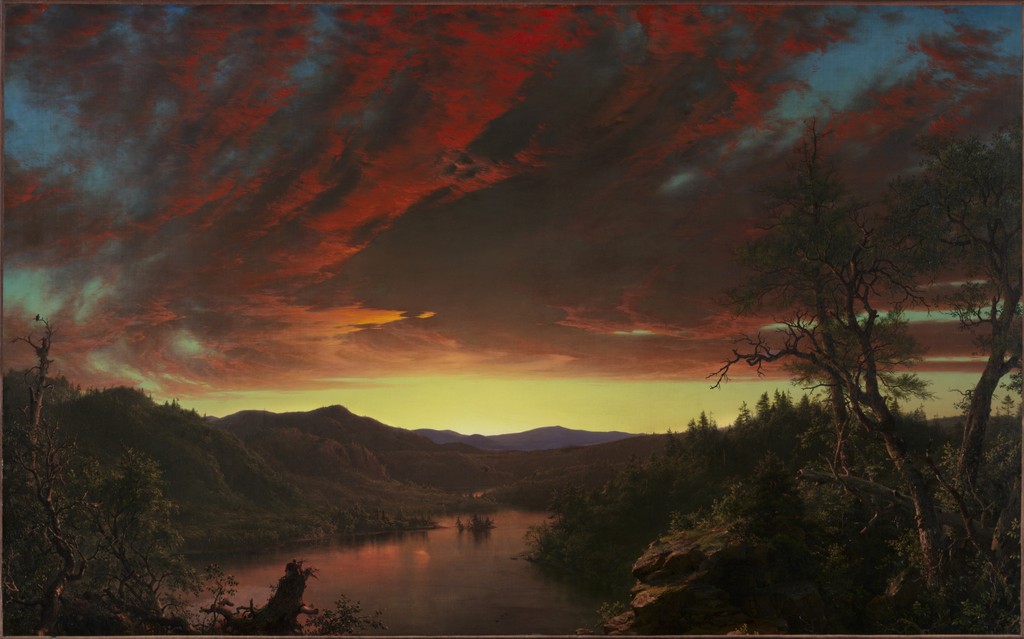
Frederic Edwin Church’s Twilight in the Wilderness sets a blazing sky above a dark, wooded valley. Broad red clouds sweep across the canvas, while the last light near the horizon separates distant mountains from the land in shadow. Painted in 1860, it belongs to the Cleveland Museum of Art. Its extraordinary sunset commands attention, but the still water, broken branches and small passages of reflected light reward a slower look. [1]
Church developed the picture from years of attention to northeastern scenery, especially Maine. The Metropolitan Museum’s American Paradise catalogue discusses it as a likely composite rather than the record of one identifiable prospect. That distinction helps explain how an apparently immediate evening view could emerge from accumulated studies and decisions made in the studio. The picture offers both the conviction of observed nature and the concentration of a carefully arranged composition. [2]
At a Glance
- ArtistFrederic Edwin Church (1826–1900)
- TitleTwilight in the Wilderness
- Date1860
- MediumOil on canvas
- Dimensions101.6 × 162.6 cm, unframed
- CollectionCleveland Museum of Art
- CreditMr. and Mrs. William H. Marlatt Fund
- Accession1965.233
This work across Church’s career
Tamaca Palms
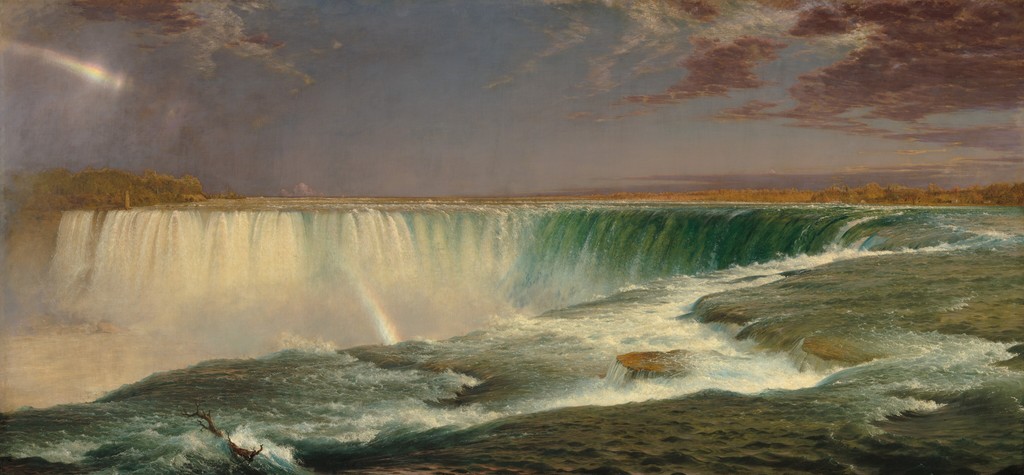
1854Niagara
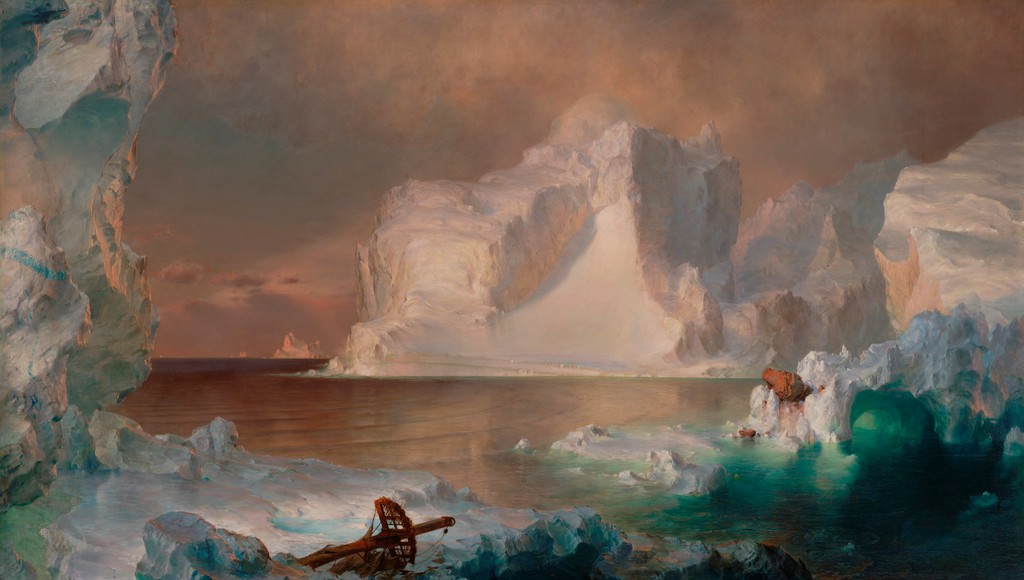
1857The Icebergs
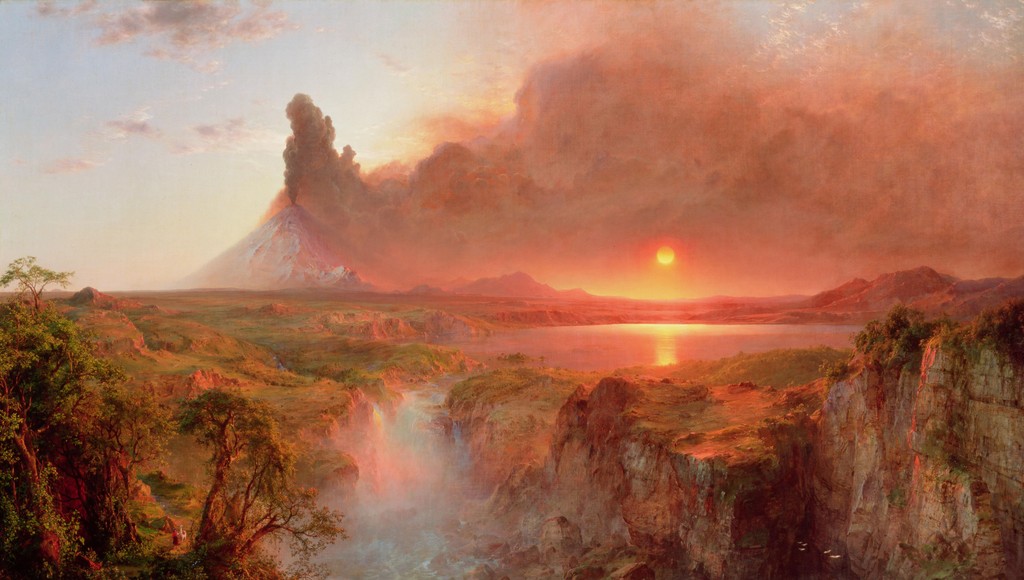
1861; foreground mast added between mid-1862 and early 1863Cotopaxi
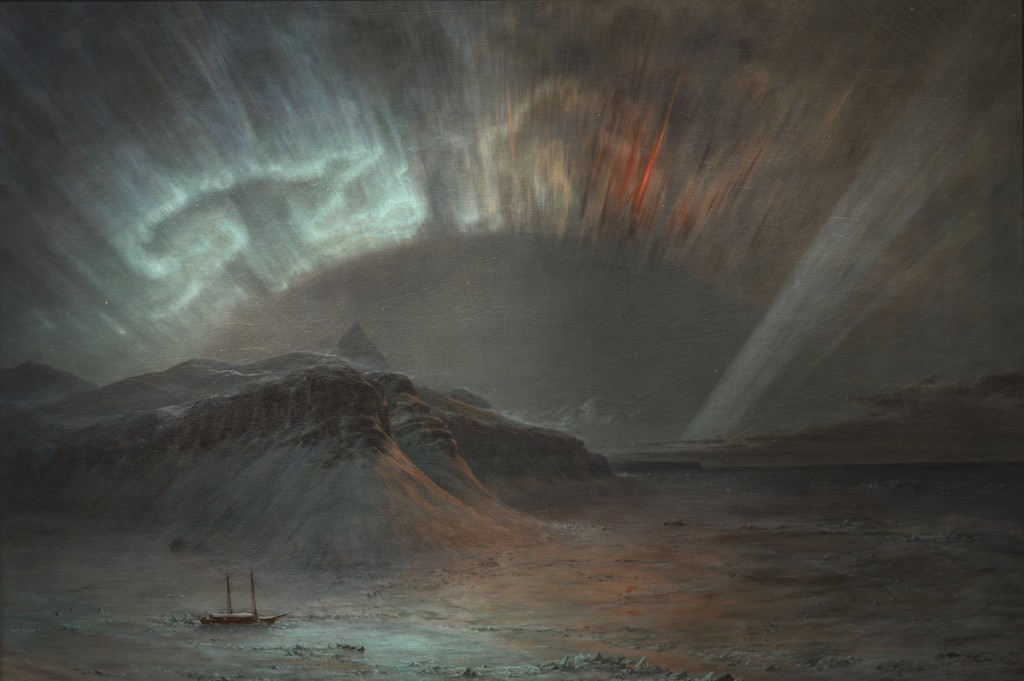
1862Aurora Borealis
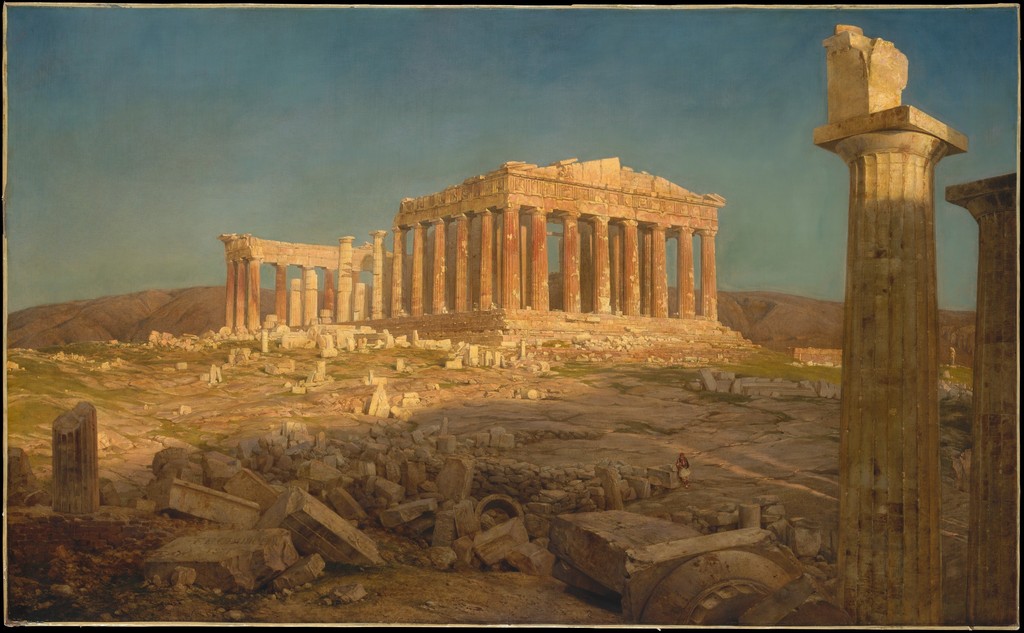
1865The Parthenon
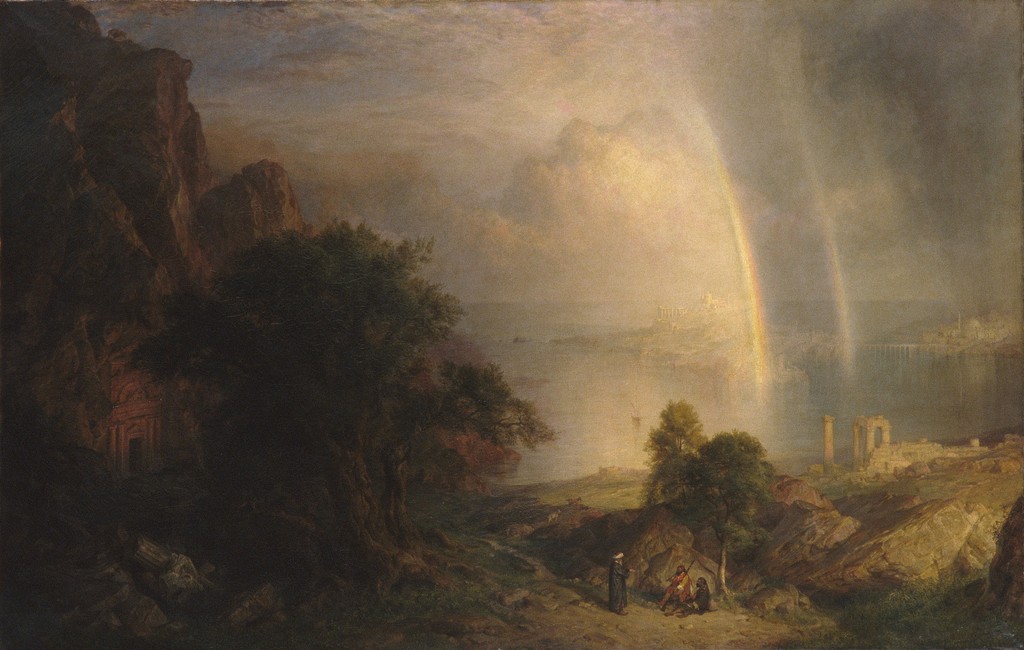
1871The Aegean Sea
About 1877Contents
- A moving sky above quiet water
- Maine as a place of repeated observation
- An evening remembered by a travelling companion
- Twilight, A Sketch and the larger idea
- Branches, rocks and the near foreground
- Paint and the construction of brilliance
- The 1860 exhibition and its audience
- What does wilderness mean here?
- Sunset and the approach of the Civil War
- Annotated details
A moving sky above quiet water
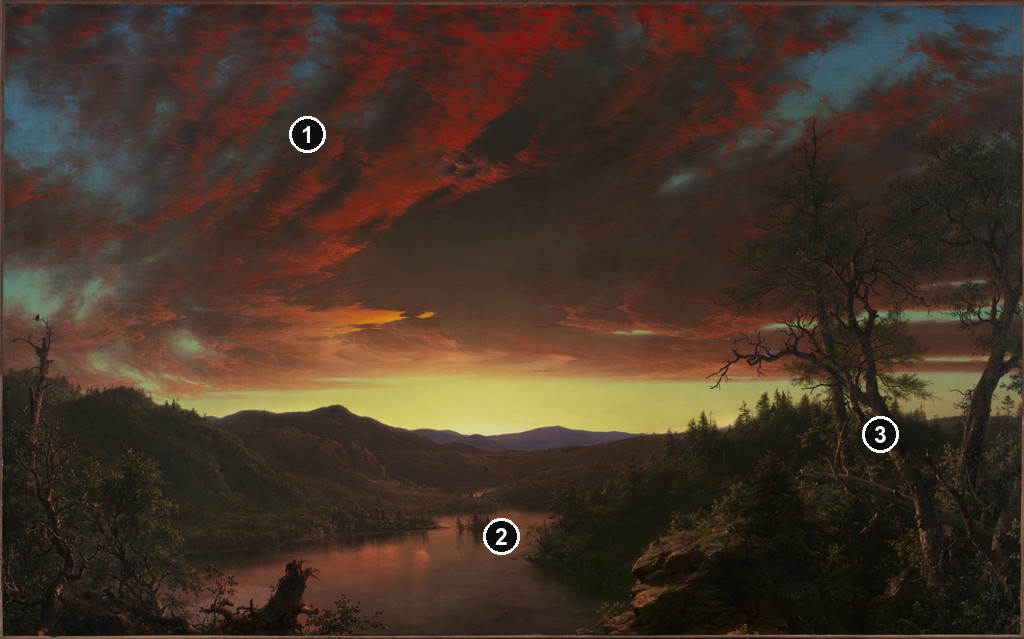
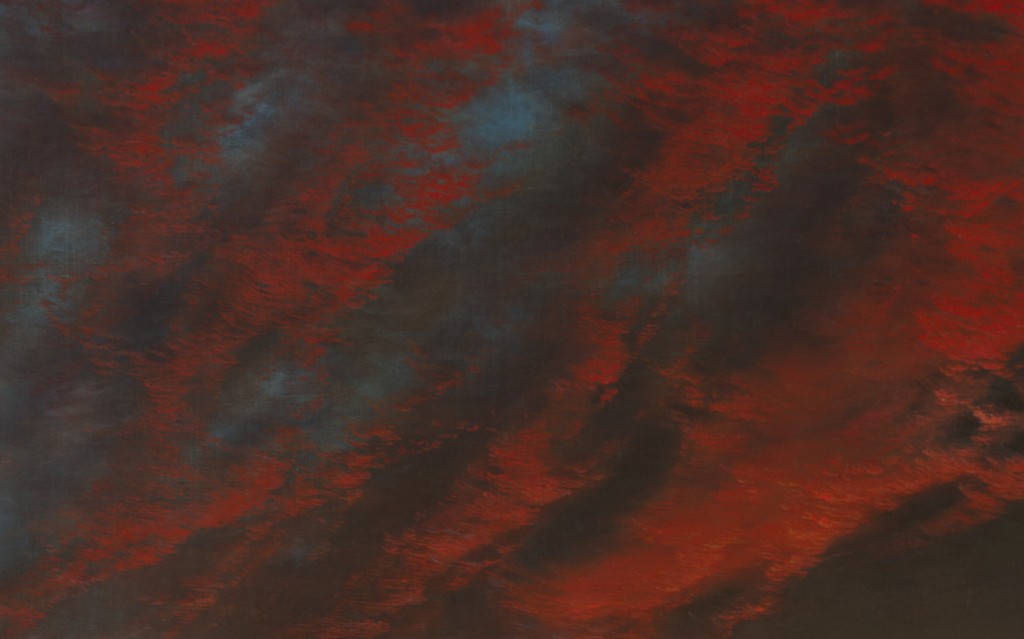
The most immediate contrast is between the sky’s sweeping forms and the water’s still surface. Clouds extend diagonally from the left towards the upper right, their illuminated edges broken into many small divisions. Red dominates, but patches of blue remain between the bands. A broad dark mass near the centre interrupts the colour. The sky feels expansive because its different parts do not resolve into one flat, continuous glow.
Near the horizon, the light changes character. Yellow and pale green form a relatively clear belt behind the mountains, whose purple outlines remain easy to follow. This quieter strip gives the eye a place to rest beneath the crowded clouds. It also establishes depth: the distant ridge seems far removed from the intricate foreground branches, even though both are dark against lighter areas.
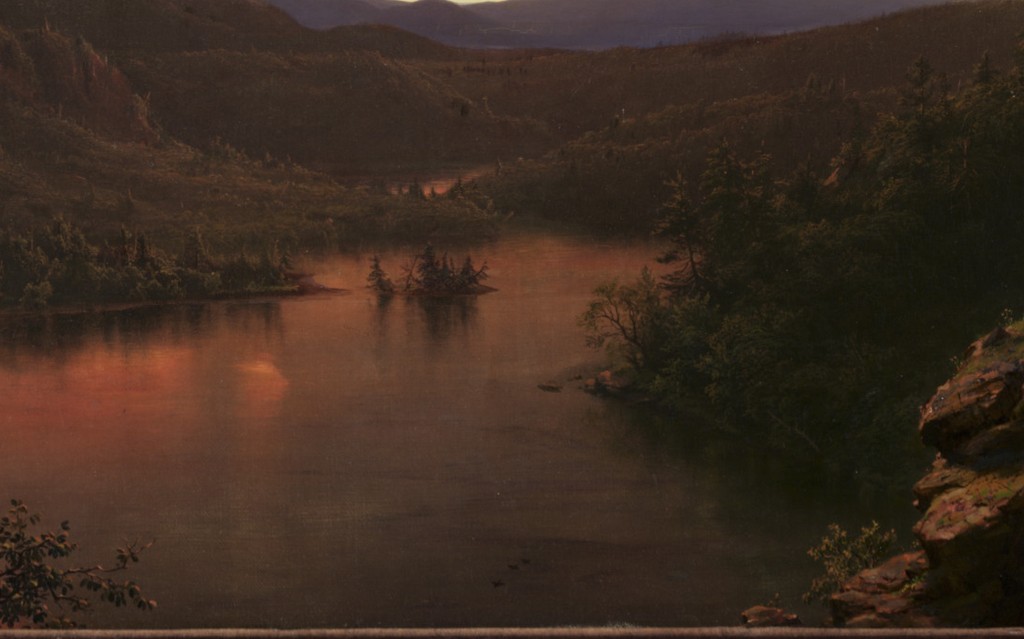
The water carries a softened version of the warm sky. Its reflections are less sharply divided, and the surface narrows as it recedes between wooded banks. Looking from the clouds down into the valley changes the pace of attention. Above, long diagonals suggest extension and movement; below, the water leads gradually towards the distant country. The picture can seem dramatic and quiet at the same time.
Annotated Details from Twilight in the Wilderness
The numbered points draw attention to visible features discussed in this article. Look from each detail back to the full composition. Frederic Edwin Church, Twilight in the Wilderness, 1860. Oil on canvas, 101.6 × 162.6 cm. Mr. and Mrs. William H. Marlatt Fund, 1965.233. Source image. CC0 / Cleveland Museum of Art Open Access. Numbered overview resized; detail crops added from the source master. No recolouring.
Details from TWILIGHT IN THE WILDERNESS
These crops come directly from the verified source images. They preserve the original colours or printed tones; the numbered overview is a separate aid to looking.
Red cloud bands
Red clouds spread across blue intervals in the sky. Their varied direction gives the evening atmosphere a sense of movement.
Receding water
Quiet water extends between dark landforms. Its reflected colour connects the lower landscape with the illuminated sky.
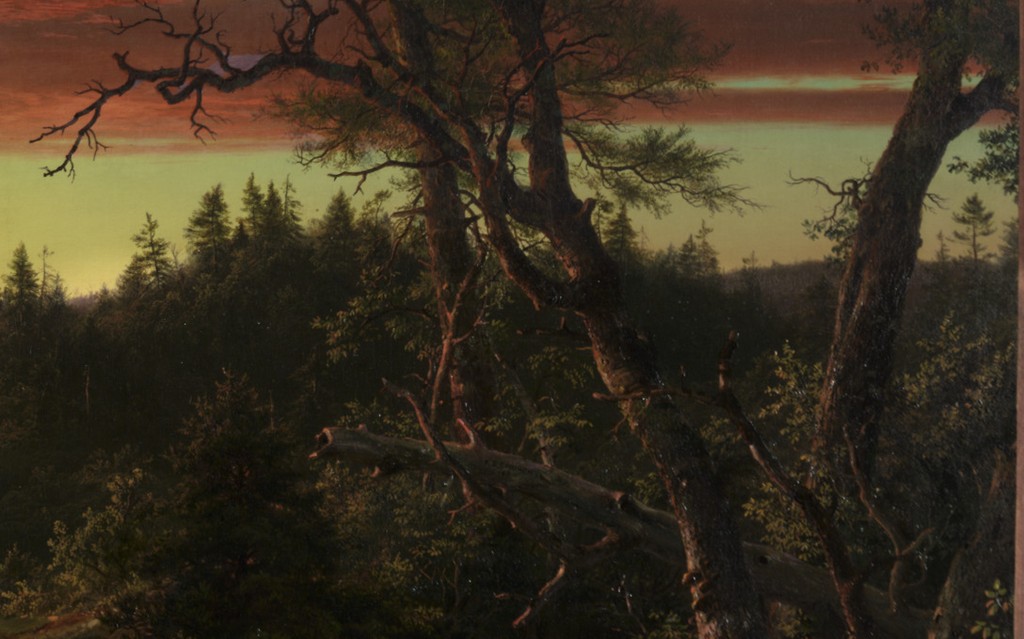
Foreground branches
Dark branches frame the right side of the view. They make the brighter sky and distant mountain forms appear more remote.
Maine as a place of repeated observation
The Olana exhibition Maine Sublime, curated by John Wilmerding, placed Church’s Maine pictures within a substantial part of his career. Its account describes a six-week visit to Mount Desert Island in 1850 and a journey inland towards Katahdin in 1852. He continued returning to coastal and inland scenery, gathering studies of water, rocks, trees, mountains and sky. The large 1860 painting belongs within that sustained interest, rather than to a single encounter with an impressive sunset. [3]
The American Paradise catalogue describes trips in the Maine woods as occasions for both work and recreation, including journeys with friends. That combination matters to the painting’s character. Church encountered scenery through movement and repeated attention, not solely from the fixed viewpoint offered by a finished canvas. The experience of a region could supply details and relationships that he later brought together in another setting. [2]
The Cleveland Museum associates the painting with scenery near Katahdin that Church had sketched roughly two years earlier. Its account leaves room for the distinction between the region that informed the work and the precise arrangement we see. A mountain, waterway and trees can each retain the force of observation without proving that the entire view existed together in front of the painter. [1]
An evening remembered by a travelling companion
Theodore Winthrop’s Life in the Open Air, published in 1863, offers a companion’s account of a Maine journey made with Church in 1856. The painter appears under the name Iglesias. In chapter XIII, Winthrop describes climbing Katahdin in fog, descending after a disappointing view, and later seeing the mountain become clear. The changing conditions remind us that a traveller could spend hours reaching a prospect only to find it concealed. [2] [4]
The evening brings another opportunity. From the river, Winthrop watches a violet glow deepen towards blue above darkening forest. Rosy clouds appear near the mountain, while a crimson maple and its reflection repeat warm colour closer to the observers. His description moves between distant light and a small nearby detail, attending to relationships that could change quickly as the sun declined. [4]
Winthrop describes Iglesias rapidly drawing the scene in pencil and then adding signs that the artist could later interpret. This account gives a practical glimpse of observation becoming a portable record. The drawing preserved forms, while notation could help retain information that pencil alone did not capture. It also distinguishes the writer’s memory from the painter’s additional means of recording the encounter. [4]
The episode is not identified as the exact evening represented in Twilight in the Wilderness. Its relevance is the process it makes visible: waiting, moving through a landscape, discovering a transient effect, and taking something of it back for later use. The finished canvas’s apparent stillness belongs to a different kind of experience from the traveller’s changing route through woodland, fog and evening light.
Twilight, A Sketch and the larger idea
A small painting of 1858, Twilight, A Sketch, remains at Olana. Karen Zukowski’s Historic Furnishings Report identifies it as an oil on canvas and records its display at the National Academy of Design in 1859. The report makes a useful distinction: the small work presents an idea developed more fully in Twilight in the Wilderness, rather than serving simply as a preparatory template. Its shared elements include receding water, mountain forms, silhouetted trees and fiery clouds illuminated from below. [5]
Thinking of the sketch as an earlier pictorial idea changes how we imagine the relationship between the two works. A small composition can test an effect, a balance of forms or a relationship between colours. Enlarging and developing that idea involves more than transferring outlines. It changes the amount of detail a viewer can explore, the spacing between objects and the force with which the sky occupies the field of vision.
Franklin Kelly places the beginning of the major canvas by mid-January 1860. He emphasises Church’s ability to combine precise handling with a broad expressive effect, and relates the cloud passages to the artist’s understanding of Turner. These observations help us read the finished work as a deliberate achievement in paint, even though the scene appears to capture a fleeting condition of light. [6]
Branches, rocks and the near foreground
The foreground gives the sunset a setting that is much less smooth than its distant horizon. At the left, a thin, partly bare tree rises above the wooded slope. Lower down, irregular branches cross in front of the water, and a broken trunk projects from the bank. Their jagged outlines interrupt the reflection. They make our position feel close to the edge of the valley, with objects almost within reach.
At the right, a much larger tree leans into the picture. Some branches carry foliage; others extend as dark, leafless lines across the coloured sky. Its uneven growth prevents it from becoming a simple decorative frame. The viewer can follow separate limbs and return to the whole tree, then compare its size with the distant trees that form a fine fringe along the ridge.
Rocks below it catch small warm highlights while most of their surfaces remain dark. These limited accents give them volume without competing with the sunset. The light is strongest overhead and near the horizon, yet its weaker traces make the foreground legible. Looking into the shadows reveals that the lower half of the canvas contains its own variety of colour and texture.
The trees and broken wood also keep the scenery from appearing uniformly fresh or idealised. Living foliage and dead branches occupy the same view. Without assigning each form a hidden meaning, we can recognise that Church’s woodland includes different states of growth and decay. The richness of the foreground comes partly from those irregularities, which contrast with the broad continuity of the distant mountain range.
Paint and the construction of brilliance
The American Paradise entry discusses a letter Church wrote to the artists’ supplier Thomas B. Lawson on 11 January 1860 about newly received colours, including madder lake and stone yellow. Its notes also report technical findings from the Museum of Fine Arts, Boston, identifying several red, yellow, green and blue pigments on the canvas. The catalogue brings material evidence into the account of the spectacular effect; the original laboratory reports are a separate source. [2]
The variety of materials does not provide a simple chemical label for every cloud or tree. What we can follow directly is the way adjacent colours change one another’s appearance. Red bands become more emphatic beside blue gaps. The pale horizon appears exceptionally bright against purple mountains. In the water, softer warm tones seem to recede beneath the dark banks. Church distributes these relationships across the composition rather than reserving all colour for its principal attraction.
Kelly’s comparison with Turner is especially helpful at the level of handling. The sunset relies on broad effects that must remain convincing when seen together, while the foreground contains finely specified branches and surfaces. A viewer can move between those different scales of attention. The achievement lies in making them belong to the same evening, so that precise details support the atmosphere instead of breaking it apart. [6]
Watch: Frederic Edwin Church
Choose a film to explore the artist’s work, its interpretation and its wider setting.
Frederic Edwin Church's "The Icebergs" on the Move at the DMA
Follow the Dallas Museum of Art as it moves Church’s large painting The Icebergs.
Watch on YouTubeThe 1860 exhibition and its audience
Deborah Chotner Rindge’s chronology records the painting as made for the Baltimore collector William T. Walters. It was exhibited at Goupil’s Gallery in New York from 8 June to 25 July 1860. Rather than appearing as one item in an annual group exhibition, it received a presentation focused on a single painting. This gave the sunset an occasion of its own and allowed spectators to attend closely to its effects. [7]
The Cleveland Museum describes advance publicity and favourable press as part of the exhibition’s attraction. Church had already demonstrated the appeal of such concentrated presentations with major landscapes. The arrangement joined the work’s visual ambition to a way of seeing: visitors came to encounter one picture whose details and broad effect could hold their attention. [1]
The reception was not entirely uniform. American Paradise reproduces an admiring description from The Albion, alongside a dismissive response from the Cosmopolitan Art Journal. Those differing judgments remind us that the very intensity that made the painting memorable could also prompt resistance. A spectacular sunset did not dictate an identical response from every critic. [2]
The published responses also suggest how slowly a spectator might explore the scene. The eye can begin with the sky, travel down to the mountains and water, and finally notice the broken wood near the edge. Following that sequence changes the painting from a vivid colour effect into a landscape with distinct distances and surfaces. Its exhibition history helps explain why such a work could sustain prolonged looking.
What does wilderness mean here?
No conspicuous settlement or human figure occupies the painted valley. That absence contributes to its stillness, but it describes what Church chose to show. It does not supply a complete history of the region from which he gathered material. A modern photograph by TJ aka Teej, taken near Katahdin Stream Campground in Baxter State Park, offers a useful comparison: the mountain rises beyond green woodland, while a picnic shelter stands in the foreground. It is a different view and time, with human use readily visible. [8]
The National Park Service’s history of Katahdin Woods and Waters identifies the wider area as the present and traditional homeland of the Penobscot Nation, and describes continuing relationships between Wabanaki peoples and its land and waterways. It also notes the sacred importance of Katahdin to the Maliseet, Mi’kmaq, Passamaquoddy and Penobscot Nations. The painted absence of people should therefore be distinguished from the region’s long cultural history. [9]
This context makes the title a subject for thought. Wilderness invites the viewer to imagine a place distant from ordinary settlement, where natural forms and light command the scene. At the same time, the region has histories of travel, stewardship and work that the painting does not visibly narrate. Recognising the difference allows us to appreciate the pictorial experience while remaining attentive to the world beyond its frame.
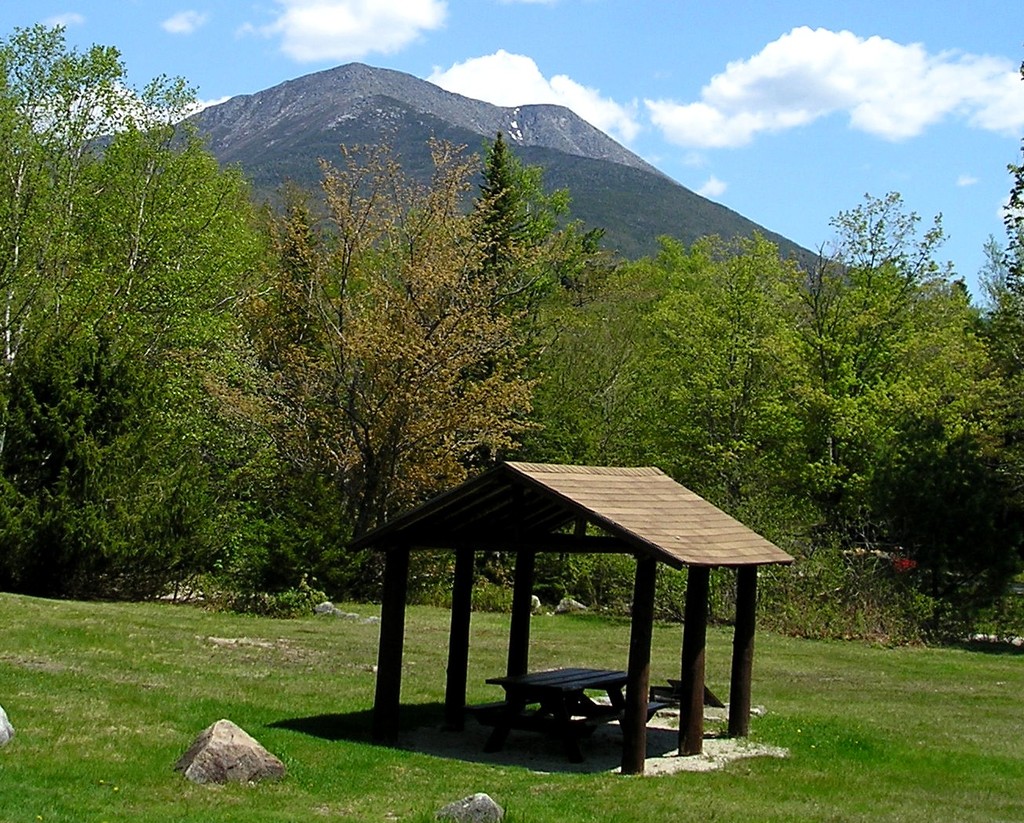
Katahdin from Katahdin Stream Campground, Baxter State Park. Photograph by TJ aka Teej, uploaded19April2006; capture date unspecified. TJ aka Teej, via Wikimedia Commons. Image source. Author-released public domain worldwide; unrestricted-use fallback grant. Resized; full source proportions retained.
Sunset and the approach of the Civil War
The painting appeared in 1860, before the outbreak of the American Civil War. Kelly interprets its national landscape in relation to uncertainty about the country’s future. Mark Cole’s Cleveland Museum essay similarly discusses the fiery sky as a possible image of impending conflict, while also considering an environmental reading. These arguments give the work a historical setting and propose ways its subject can carry meaning. [6] [10]
The scene’s transition from light into darkness makes such interpretations understandable. The brilliant sky lasts above terrain already in shadow; dead branches appear beside living growth. Those visual contrasts can evoke change and vulnerability. They do not by themselves establish a specific prediction or a complete political programme. The force of the picture lies partly in the way its visible relationships sustain several kinds of response.
Mark Cole’s environmental interpretation also directs attention to what is valued in the scene: wooded slopes, open water and a landscape without conspicuous construction. The idea of a threatened natural environment gives these elements a different emphasis from a reading centred on war. Both interpretations remain proposals about the picture’s significance, rather than instructions to decode every cloud or tree as a fixed symbol. [10]
Ownership and renewed study
The museum’s provenance traces the painting from Walters through auction and collecting histories, including John Taylor Johnston and later members of the de Forest family. Some intermediate steps are marked as probable or uncertain in the record. The secure endpoint is its acquisition by Cleveland in 1965, under the Mr. and Mrs. William H. Marlatt Fund. The detailed record preserves those uncertainties rather than turning the painting’s travels into an artificially seamless account. [1]
At Cleveland in 2014–15, Maine Sublime displayed Twilight in the Wilderness alongside a group of sketches from Olana. Pencil, gouache and oil studies brought the finished painting into conversation with smaller records of Maine’s scenery. Such an exhibition changes the questions we ask: we can compare the concentrated result with the variety of observations, formats and experiments surrounding it. [11]
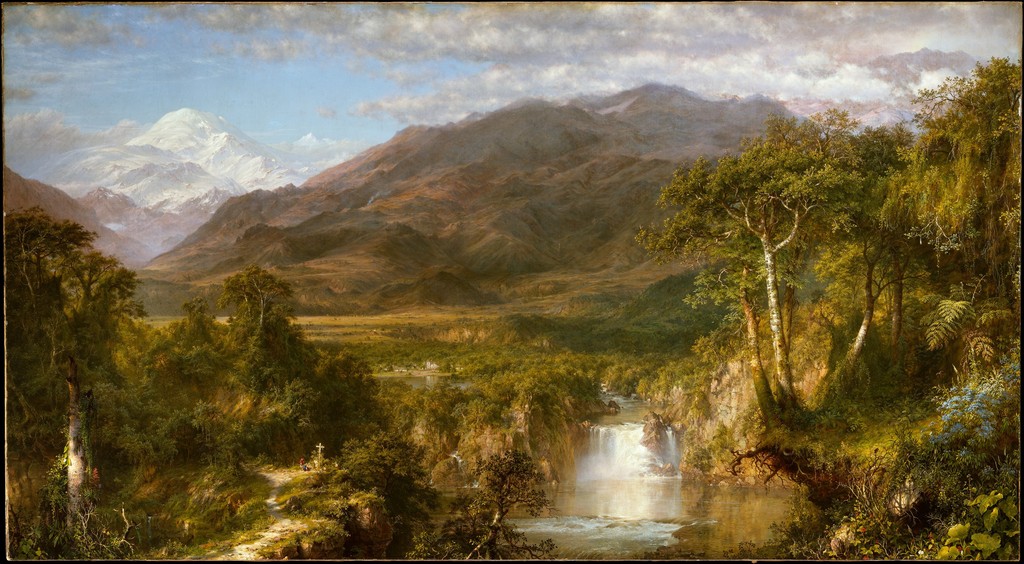
Comparison with Heart of the Andes offers another way to understand its scale of ambition. In one picture, a varied tropical world encourages the eye to roam among many subjects; here, a more restricted combination of woodland, water and mountains gains extraordinary range through light. Aurora Borealis later made a different atmospheric display central to a northern landscape. Looking between these works reveals how Church could make the sky determine the character of an entire scene.
Artworks directory
A documented selection of Church’s works discussed across these articles, together with identified prints after his designs. This is not a catalogue raisonné. Repeated titles and aliases are reconciled; studies remain distinct from finished paintings. Some dates remain unconfirmed. Other makers are named where a print adapts Church’s work.
| Name | Date | Medium |
|---|---|---|
| Above the Clouds at Sunrise | 1849 | Oil on canvas |
| The Aegean Sea | About 1877 | Oil on canvas |
| The Andes of Ecuador | 1855 | Oil on canvas |
| Aurora Borealis | 1865 | Oil on canvas |
| Autumn in North America | Circa 1856 | Oil on board |
| Coast Scene | 1852 | Oil on canvas |
| Cotopaxi | 1862 | Oil on canvas |
| A Country Home | 1854 | Oil on canvas |
| El Khasné, Petra | 1874 | Oil on canvas |
| El Rio de Luz | 1877 | Oil on canvas |
| The Heart of the Andes | 1859 | Oil on canvas |
| The Icebergs | 1861; foreground mast added between mid-1862 and early 1863 | Oil on canvas |
| Jerusalem from the Mount of Olives | 1870 | Oil on canvas |
| Mount Ktaadn | 1853 | Oil on canvas |
| Our Banner in the Sky | 1861 | Oil paint over lithograph on paper, laid down on cardboard |
| The Parthenon | 1871 | Oil on canvas |
| Rainy Season in the Tropics | 1866 | Oil on canvas |
| Storm in the Mountains | 1847 | Oil on canvas |
| Syria by the Sea | 1873 | Oil on canvas |
| Tamaca Palms | 1854 | Oil on canvas |
| Tropical Scenery | 1873 | Oil on canvas |
| Twilight in the Tropics | 1874; signed and dated, according to Bonhams’ catalogue | Oil on canvas |
| Twilight in the Wilderness | 1860 | Oil on canvas |
| View of Cotopaxi | 1857 | Oil on canvas |
| Niagara | 1857 | Oil on canvas |
| Magdalena River, New Granada, Equador | 1853 | Graphite heightened with white on wove paper |
| Tamaca Palm, Colombia or Ecuador | May–October 1853 | Graphite on gray laid paper |
| Mixed Sketches with a Champan, Río Magdalena, Colombia | May 1853 | Graphite on gray laid paper |
| Study for Rainy Season in the Tropics | 1865–1866 | Graphite on ruled notepad paper |
| Al-Khazneh, Petra (study) | February–March 1868 | Oil and graphite on tan paperboard |
| The Great Fall, Niagara (Charles Risdon, after Church) | 1874 impression | Hand-coloured chromolithograph on paperboard |
| The Heart of the Andes (William Forrest, after Church) | 1862 | Engraving in black on wove paper |
| Our Heaven Born Banner (William Bauly, adapting Church’s motif) | circa 1861 | Colour lithograph |
| A Tropical Moonlight (wood engraving after Church) | 1879 publication | Wood engraving in American Painters |
| Off Iceberg, Newfoundland | June 1859 | Oil and graphite on paperboard |
| Parthenon at Night, Athens | April 1869 | Oil and graphite on tan paperboard |
| Jerusalem from the Mount of Olives (study) | 1 April 1868 | Oil and graphite study |
| Horseshoe Falls (study) | December 1856–January 1857 | Oil on paper mounted to canvas |
| Niagara Falls, from the American Side | 1867 | Oil on canvas |
| Study for The Heart of the Andes | 1858 | Oil study |
| Mount Chimborazo through Rising Mist and Clouds | 1857 | Oil study |
| Cotopaxi Erupting, Viewed from Quito, Ecuador | June 1857 | Oil and graphite on tan paperboard |
| Cotopaxi (painted for Cyrus Field) | 1855 | Painting |
| Chimborazo | 1864 | Painting |
| Twilight, A Sketch | 1858 | Oil on canvas |
| View of Baalbek | 1868 | Oil and pencil on board |
| Three Bedouins | Date unconfirmed | Oil study |
| Coast Scene, Mount Desert (later canvas) | 1863 | Painting |
| The Wreck | Date unconfirmed | Painting |
| Grand Manan Island, Bay of Fundy | Date unconfirmed | Painting |
| Summer in South America | circa 1853 | Painting |
| Evening in Vermont | Date unconfirmed | Painting |
| Home by the Lake | Date unconfirmed | Painting |
| Storm in the Blue Mountains, Jamaica | August 1865 | Painting |
| The Natural Bridge, Virginia | 1852 | Painting |
| The Vale of St. Thomas, Jamaica | 1867 | Painting |
| Tequendama Falls, near Bogota, New Granada | Date unconfirmed | Painting |
| Sunrise in Syria | Before the 1876 exhibition | Painting |
| Cuernavaca (oil study; descriptive title) | 1898 | Oil study |
| Olana window design (descriptive title) | Date unconfirmed | Watercolour and graphite |
| Olana dining-room stencil sketch (descriptive title) | Date unconfirmed | Oil and graphite |
| Olana house (with Calvert Vaux) | 1870–1872; later additions | Architecture |
| Olana designed landscape | From 1860; developed over decades | Designed landscape |
Frequently Asked Questions
It belongs to the Cleveland Museum of Art, Mr. and Mrs. William H. Marlatt Fund, accession 1965.233. [1]
Twilight, A Sketch of 1858, at Olana, presents an idea Church developed in the larger painting. It was exhibited at the National Academy of Design in 1859. [5]
Discussion
Look again at the images and ideas explored in Twilight in the Wilderness. These editorial prompts invite your own observations.
- What changes when you look into the dark foreground after concentrating on the sky?
- How does the reflection differ from the light it carries?
- What does the title lead you to assume about the land and its history?
Reader Insights
How does the moving sky contrast with the quiet water?
Which dark foreground forms make the evening colour appear most intense?
What does the smaller twilight study help you notice in the larger picture?
Join the Conversation
Share a detail, comparison or question about Twilight in the Wilderness below.
References
- Cleveland Museum of Art, Twilight in the Wilderness, 1860, 1965.233, including printable provenance record. Object identity, measurements, commission, ownership and exhibition context.
- Metropolitan Museum of Art, American Paradise: The World of the Hudson River School, 1987, Twilight in the Wilderness entry signed J.K.H., pp. 251–254 and notes. Composition, travel, criticism and paint evidence; historical letters and laboratory findings discussed through the catalogue.
- The Olana Partnership, Maine Sublime exhibition account. Maine visits, studies and John Wilmerding’s curatorial framing.
- Theodore Winthrop, Life in the Open Air, and Other Papers, chapter XIII, “Up Katahdin”, 1863, via Wikisource transcription. First-person literary account of the journey; sketching and evening light.
- Karen Zukowski, Historic Furnishings Report for Olana State Historic Site, part 2, The Olana Partnership and New York State Office of Parks, Recreation and Historic Preservation, April 2001, pp. 218–219. Twilight, A Sketch, 1858, OL.1981.8.A-.B.
- Franklin Kelly, “Church and the National Landscape,” in Frederic Edwin Church, National Gallery of Art, 1989, pp. 58–59 and notes 130–131. Studio development, Turner comparison and interpretation.
- Deborah Chotner Rindge, “Chronology,” in Frederic Edwin Church, National Gallery of Art, 1989, p. 164, 1860 entry. Walters and the 8 June–25 July exhibition.
- TJ aka Teej, photograph of Katahdin from Katahdin Stream Campground, Baxter State Park, via Wikimedia Commons. Original upload 19 April 2006; capture date unspecified. Modern regional comparison, not the painting’s exact viewpoint.
- National Park Service, “History & Culture,” Katahdin Woods and Waters National Monument, updated 30 July 2024. Regional Penobscot and Wabanaki cultural context.
- Mark Cole, Cleveland Museum of Art, “Twilight in the Wilderness: A closer look at an American masterpiece”. Museum essay on sources, viewpoint and possible wartime/environmental interpretations.
- Cleveland Museum of Art, Maine Sublime: Frederic Church’s Twilight in the Wilderness, 2014–15 exhibition. Studies from Olana and the completed canvas.
- Splash image source.
Frederic Edwin Church, Twilight in the Wilderness, 1860. Oil on canvas, 101.6 × 162.6 cm. Mr. and Mrs. William H. Marlatt Fund, 1965.233. Image source. CC0 / Cleveland Museum of Art Open Access. Resized; full source proportions retained.